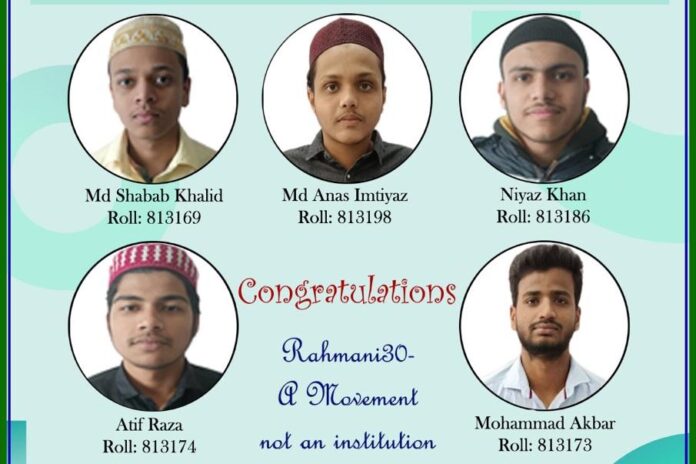
Successful candidates of Rahmani30 CMA (Cost and Management Accountant) Foundation exams
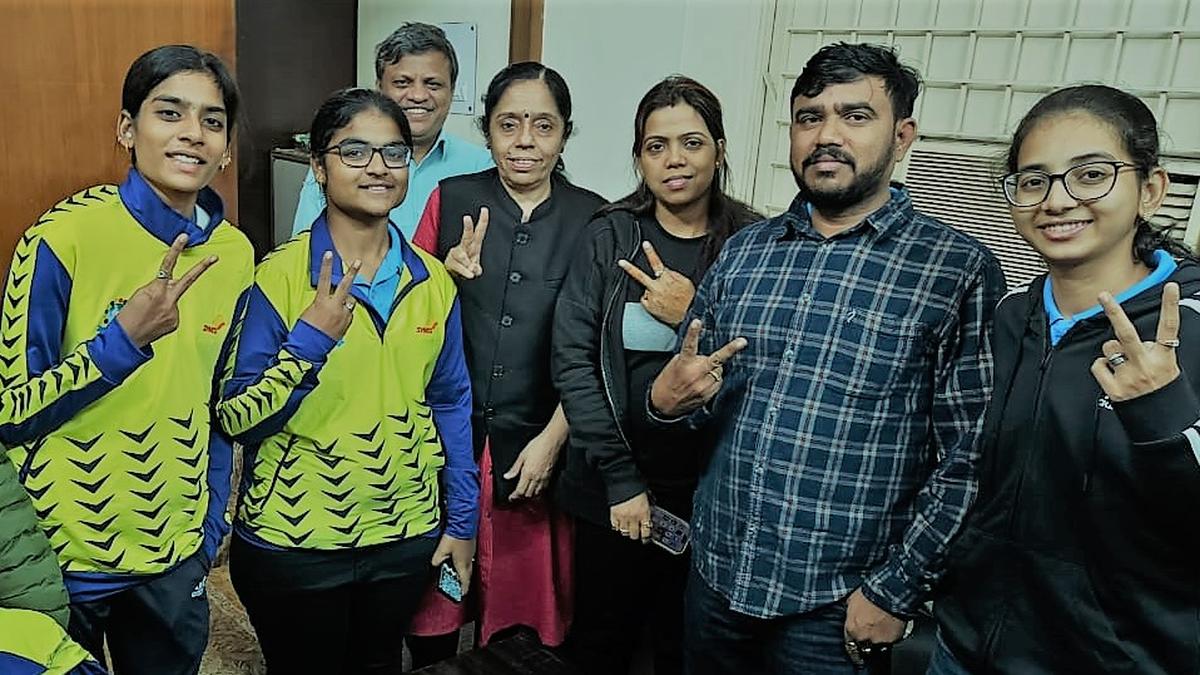
Rahmani30 has reaffirmed its commitment to academic excellence by achieving an impressive 100% success rate in the Session-1 2024 CMA (Cost and Management Accountant) Foundation exams. All five students who appeared for the exam successfully qualified, continuing Rahmani30’s legacy of excellence. This milestone marks the second consecutive year of perfect results, following the 2023-24 session where all 11 students passed. These achievements underline Rahmani30’s dedication to nurturing young talent and equipping students to achieve their full potential. Session-2 of the CMA Foundation exams is scheduled for December 2024, and expectations remain high.
About the CMA Stream
The CMA qualification is a globally recognized credential that emphasizes cost management, financial planning, and strategic decision-making. The CMA Foundation program introduces students to essential concepts in economics, accounting, and business laws, preparing them for dynamic careers in finance and management. With increasing awareness, more students are pursuing this qualification, drawn by the career stability and professional growth it offers.
Success Across Diverse Streams
Rahmani30’s distinctive approach lies in fostering student success across various fields, tailoring education to individual aptitudes and interests. While the institution is renowned for its achievements in engineering (JEE-Advanced) and medical (NEET) streams, its students have also excelled in commerce-related fields such as Chartered Accountancy (CA), CMA, and even specialized areas like statistical sciences.
A standout achievement this year was the success of Rahmani30 student Tabish Raza, who qualified for the prestigious Bachelor of Statistical Data Science (Hons) program at the Indian Statistical Institute (ISI) in Delhi. Notably, Raza is the only Muslim student to secure admission in this highly competitive program at the Delhi branch.
A Mission to Empower the Community
Rahmani30’s mission extends beyond academic success, aiming to empower the Muslim community by creating pathways to diverse professional careers. It emphasizes the significance of the commerce stream, often overlooked within the community, as a viable and rewarding career option. By nurturing highly skilled, ethical professionals like chartered accountants and company secretaries, Rahmani30 seeks to foster transformative change in the professional landscape. These efforts are helping students realize the potential of commerce as a field that ensures job satisfaction, stability, and personal growth.
Ameer-e-Shariat and Patron of Rahmani30, Hazrat Maulana Ahmad Wali Faisal Rahmani Sb., expressed heartfelt congratulations to the students, faculty, and supporters on this remarkable success. Reflecting on the vision of his late father, Hazrat Maulana Mohammad Wali Rahmani Sb. (RA), he reiterated the belief that commerce is as significant as traditional career streams like medicine and engineering. This vision continues to inspire Rahmani30’s mission of fostering academic excellence and community empowerment.
Rahmani30’s 100% success in the CMA Foundation exams is a testament to its unwavering dedication to nurturing excellence across diverse fields. By inspiring students to achieve their potential and expanding career opportunities within the Muslim community, Rahmani30 is not just shaping individual futures but also driving collective progress.
source: http://www.muslimmirror.com / Muslim Mirror / Home> Education> Indian Muslim> Positive Story / by Muslim Mirror Staff / December 17th, 2024
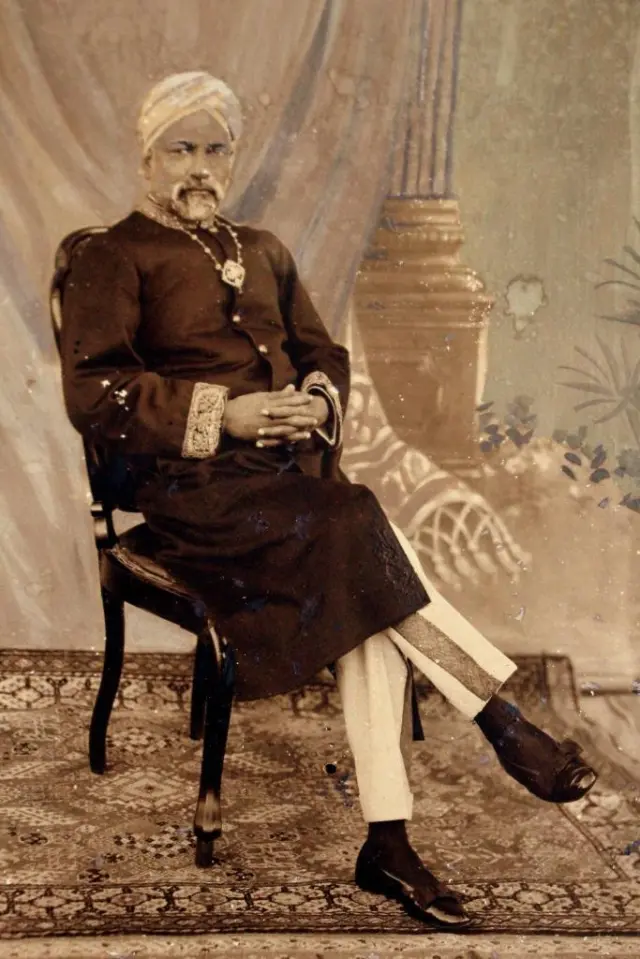
Mir Humza Hussain, portrait.Image courtesy: Nagineh Hussain Rizvi
“My grandfather, Mushir –ul-Mulk Mir Humza Hussain was appointed Chairman of the Reception Committee when Gandhiji visited Bengaluru in 1927” says Mir Sajjad Hussain with quiet pride. “However, when Gandhiji alighted on the station platform, he found my grandfather missing. He enquired about his absence. He was told that my grandfather was advised bed rest due to a serious heart condition. He insisted on visiting him and made his way to Binfield, our family home. He sat by the sick bed for a while and before his departure, my grandmother, Sajida Begum donated her gold bangles to Gandhiji’s Harijan Fund. Then my father, late Alhaj Justice Mir Iqbal Hussain escorted him to the door.” This unscheduled visit took the family by surprise, but it wasn’t completely unexpected. The two men had met during Gandhiji’s previous visits to the city when Mir Humza Hussain had been entrusted with supervising law and order for the national leader’s visit.
The Roll of Honour in the 1930 Mysore Gazetteer (Vol II, Chapter XII, Page 3151) records Mir Humza Hussain’s birth as 15th March 1869. He lost his father at an early age, but went on to be educated at the Maharaja’s College (1889) in Mysuru and completed his BA from Central College, Bengaluru. The family recalls him staying on Jumma Masjid Road off Avenue Road at this time and studying through the night by streetlight. He then got married and completed studying law in Madras. Recognising the young man’s potential, his father-in-law, a Risaldar in the Mysore Government, presented him to Diwan Sir Seshadri Iyer, whereupon he joined service as a Judicial Probationer in 1893.
The family says that their origins can be traced back to the Persian province of Khorasan from where they migrated to central India and then to the courts of the Deccan Sultanate. They eventually spread across the Mysuru region and one branch then settled Periyapatna. Mir Mir Humza Hussain’s ancestors chose Mysuru, where they have firm roots even today.
During the course of his distinguished career, he occupied the positions of Assistant Superintendent of Police (1898), Senior Assistant Commissioner (1909), District and Sessions Judge (1911) and Inspector General of Police (1920). By 1923, he was appointed First Member in the Mysore Legislative Council and was conferred the title `Mushir-ul-Mulk’ by the Maharaja of Mysore at the Dasara Durbar in the same year. He then stepped in as Officiating Diwan of Mysore for Diwan Sir Albion Banerji from February-March 1925, before his retirement. Portraits of Mir Humza Hussain show him as a bearded, impeccably dressed gentleman wearing the royal Mysorean`Ghanda Berunda’ a mark of distinction received directly from the Maharaja.
Before moving to Binfield, the family stayed at their home`Umda Bagh’, opposite the MN Krishnarao Park in Basavanagudi, next to Dr. Armugam Circle. Other Diwans of Mysore and prominent statesmen too had been allotted plots here to build residences nearby. Not many know that the road from Sajjan Rao Circle to South End Circle was once named after him for services rendered to the state. Part of it was changed to Vasavi Dharamshala Road in 1977. A name board can still be found (in Kannada) on the last house at South End Circle, but the family hopes that at least the section from the junction of Vani Vilas Road to South End Circle will revert to its previous name in his memory.
Residents of Rustomjee Reidency on Richmond Road have no idea that their apartment building is where the large colonial bungalow called Binfield that Gandhiji visited was once located. Most of Bengaluru’s history is now buried in our memories and the foundations of new constructions. Photographs of Binfield past show an Araucaria columnaris tree towering above its roof. It continues to thrive in the compound today and is the only living link to the building’s past.
source: http://www.aturquoisecloud.wordpress.com / Home> Placing Bengaluru> Bangalore: A Rememberd City / by Aliyeh Rizvi / June 11th, 2015
He took various steps to ensure harmony among the Hindus and the Muslims
Khan Bahadur Khan, the ruler of Rohilkhand, who fought against the British to liberate the motherland, was born in 1781. Declining a very high official post offered by the East India Company, Khan Bahadur Khan revolted against the British at the age of 70.
He declared Independence at Bareilly, the capital of Rohilkhand on 31 May 1857. He created history by addressing the people of Rohilkhand as ‘people of India’ and gave a clarion call to them: ‘the auspicious day of our freedom has dawned. The English may resort to deceit. They would try their hardest to incite Hindus against Mussalmans and vice-versa. Mussalmans, if you revere the Holy Quran, and Hindus, if you venerate the cow-mother, forget your petty differences and join hands in this holy war. Fight under one flag and with the free flow of your blood wash away the blemishes of the domination of the English over Hindustan’.
Under the leadership of Khan Bahadur Khan, Shobharam had become the Prime Minister, who was known for his honesty, and Bakht Khan had become the Commander-in-Chief.
When the Green Flag, the symbol of independence was hoisted in Rohilkhand, the British rulers were shocked. Khan Bahadur Khan took various steps to ensure harmony among the Hindus and the Muslims. He banned cow slaughter during the Hindu festivals. As a result of his several efforts, the British could not split the Hindus and the Muslims in order to fulfil their selfish interests. This is even admitted by the British themselves in their reports. Finally, the British commanders laid siege to Bareilly with huge troops.
Khan Bahadur Khan fought against the enemy till the last minute, in an adverse situation. He retreated into the forests of Nepal with his nominal troops on 5 May 1858. But Jung Bahadur, the ruler of Nepal who was pro-British, handed over Khan Bahadur Khan to the British. They tried Rohilkhand leader Bahadur Khan and 243 others who had participated in the fight against the East India Company and executed them. All of them were hanged to a big banyan tree at the old office building of the British Commissioner in Bareilly on 24 March 1860.
Saluting the motherland, Khan Bahadur Khan, along with his compatriots merged into the soil of India.
source: http://www.siasat.com / The Siasat Daily / Home> Featured News / by Syed Naseer Ahamed / November 27th, 2022
In my previous article, I featured an Ethiopian coffee export company who ran her business based on trust. This is factored in two ways; dealing with her farmers and clientele. In this day and age, we can learn a thing or two by understanding the wisdom behind why some people do the things they do, treading a harder path and not resort to shortcuts. They are in it for the long term, not focused on the short term gains. I have nothing but high regard for individuals like Medina.
Continuing a similar conversation, I have been focusing on what exactly is happening at the farm level by getting in touch with the producer directly. In this article, I talk to the owner of a coffee estate farm based in India. Sumaira gives us an insight about how her family’s coffee estate started in the late 18th century, processing techniques employed on her farm, the specialty coffee movement in India, and much more.
source: Rasulpur Coffee Estates
Can you tell me a bit about yourself and Rasulpur Coffee Estates?
I am Sumaira, the owner of Rasulpur Coffee Estates & Roasters . We are located in the Rasulpur village, Coorg district, in the hot spots of the Western Ghats, India. My entrepreneurship journey has had its shares of ups and downs. I took up a career as an interior designer and worked as a business head for a furniture empire in India. Later on, I moved to the UAE and explored the real estate industry and the coffee sector. I envisioned starting up something of my own, being from a family of coffee planters and having the self-confidence and determination to start my own business. Something clicked the moment I realized how the coffee industry is growing day-by-day.
To add, I am a fifth generation coffee planter who introduced specialty coffee at our estate. We introduced better equipments and techniques, and new processing and fermentation methods which I’ll get into a little later. A laboratory is set up for roasting and cupping to create different roast profiles and new blends at our estate. We believe in helping and encouraging our coffee community, especially the neighboring small and marginal coffee growers to analyze their coffees, and improve their harvesting and processing methods to fetch a better price for their coffee.
The journey of Rasulpur Coffee Estates started in the late 18th century when our ancestors migrated to the Western Ghats of India i.e. Coorg at the time of the British rule, as their main occupation was trading in coffee and spices. They travelled to different parts of Coorg, as they developed a liking towards coffee estates and the greenery, purchased plenty of estates, learnt the methods of coffee cultivation, and started exporting coffee to foreign countries. England was one of the major countries to which coffee was exported to from our estates in that period with the help of the Coffee Board.
We named the estate and brand ‘Rasulpur Coffee’ after the village, Rasulpur, which is on the banks of the Kaveri river in Kodagu district is named after Mr. Rasul Khan, our first generation planter. He cleared the land, started cultivation, built dams for irrigation, made the place livable and initiated agricultural works. Looking at his abilities and progress, the government named this village after him.
In time, our second, third and fourth generation planters purchased more coffee plantations and improved the methods of cultivation, processing, and introduced pulping and irrigation. An R&D team was also set up and a variety of experiments are conducted to this day. The goal here is to enhance the quality of the crops, and advance the processing and post harvesting methods. Our coffee is featured in auctions, supplied for projects, sold locally and exported to wholesalers, cafes, and restaurants. We also ferment micro lots as per requirements from our roasters and young entrepreneurs who are venturing into the coffee industry.
What kind of processing is done on the farm?
Processing on our farm is done in three different ways along with few specialty processing methods, all of which change the sweetness, body and acidity of brewed coffee. These are natural/sun dried, washed, and honey processed.
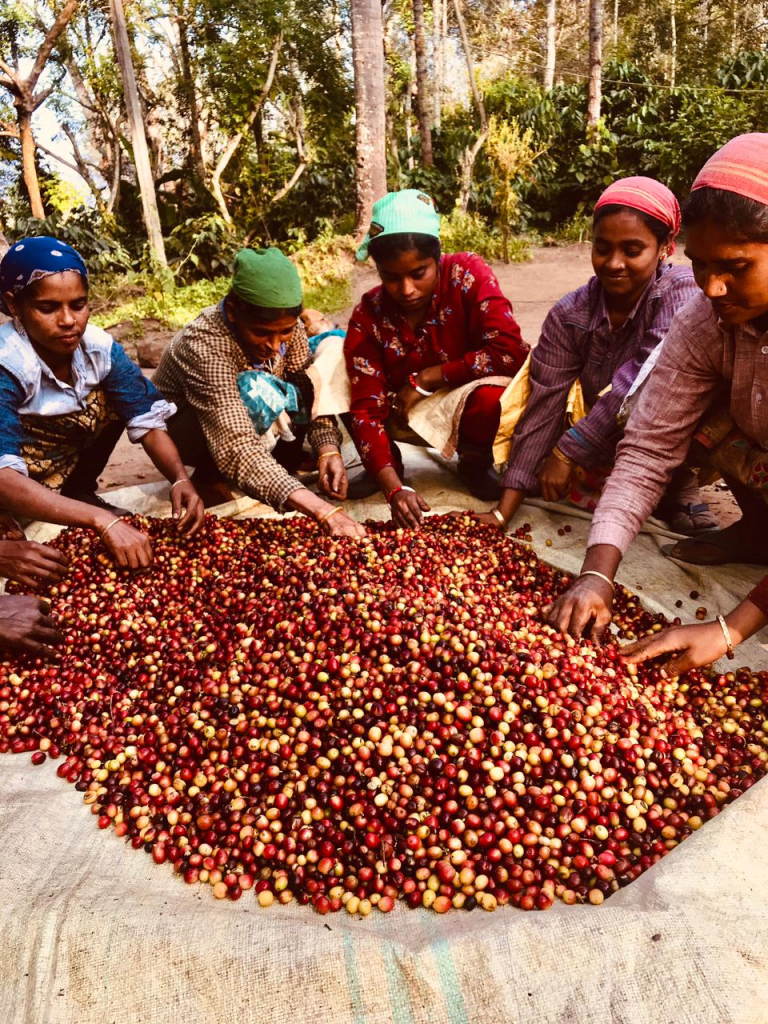
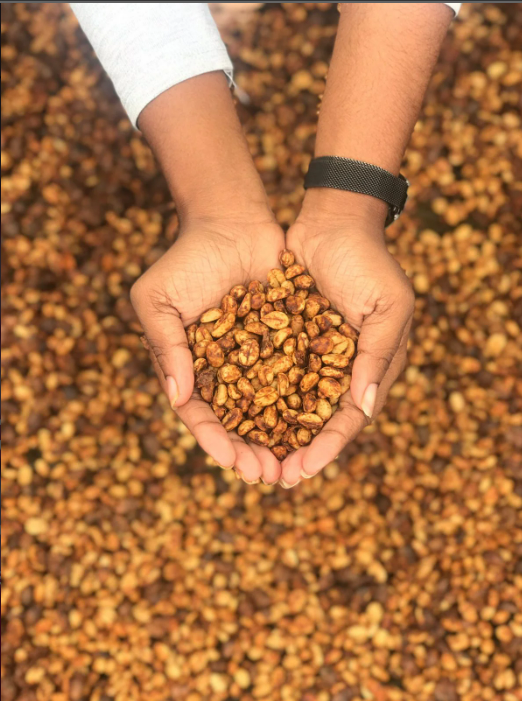
Natural/sun dried process. A natural processed coffee, also referred to as dry processed, is a traditional yet common way to process coffee today. Originating in Ethiopia, it involves drying out freshly picked coffee cherries with the seed still inside. To do this, we place the cherries on drying beds in the sun. These beds are either patios or raised drying tables. The cherries have to be rotated and turned to prevent mold, and takes about seven to eight days to ferment. During this time, the sugars and mucilage (the sticky substance that coats the seed) will latch onto the seeds, develop flavours and make them sweeter. Once the coffee is dry, a machine separates the pulp from the seed. Natural coffees are heavy bodied, and have deep, complex tasting notes. This development comes from the way the cherry ferments differently. Natural processed coffees can be difficult to replicate because of the inconsistencies in fermentation. However when done right, these coffees can also be some of the sweetest you’ll taste. It is juicy, syrupy and well worth the extra effort.
Washed process. Unlike natural, washed processed coffees are called the opposite, i.e. wet processed. In this scenario, machines called pulpers remove the seeds from the cherries before drying them. However, it is not just any cherry that gets the seed removal treatment. These cherries must have the perfect amount of ripeness to make sure they are sweet enough. To accomplish this, they go through a sorter and are segregated according to density. Once these pulpers remove the skin and pulp from the seeds, they are placed in tanks full of water. The water separates the rest of the mucilage and fruit caked onto the seed. Finally, the seeds are dried on the beds in the sun. Washed processed coffees have cleaner, and more crisp tasting notes when compared to natural processed coffees. The body of a brewed washed coffee is lighter. There is typically more brightness as well, because of a cleaner acidity that balances out the sweetness of the coffee. They are just as fruity as natural coffees, but the flavor notes are easier to differentiate.
Honey processed. This method is a combination of both natural and washed. It is a rare and demanding method, and not as commonly practiced as the previous two. However, it produces a unique cup of coffee, with flavours similar to both of the previously described processing methods. During honey processing, a pulper removes the seed from the cherry before it undergoes a drying process. However, it does not go into washing tank to remove the mucilage. That mucilage, which is what the ‘honey’ refers to stays on the seed and is now dried in the sun. The amount of mucilage left behind determines the sweetness, and there are even machines to control the amount on the seed. Like natural process, the seeds are dried on beds. The flavor components of honey coffees are varied and complex. Like washed coffees, they have lighter body and are very syrupy and sweet. Acidity is present but more mellow when compared to washed coffees.
Specialty processing. This is an emerging field and we use unique methods like anaerobic, aerobic, natural fermented, and fruit fermented to name a few. We ferment our coffee in a temperature controlled environment, with or without oxygen, followed by controlled drying to bring out unique and funky flavors out of the coffee.
source: Rasulpur Coffee Estates
What is the current state of the specialty coffee industry in India?
The coffee culture in India has evolved over the past decades. The nostalgia-inducing coffee houses were popular meeting grounds until the 1980’s. In the 90’s, cafe culture took over the country and coffee became the trendy drink to try.
Cafes are becoming the primary hangouts for youngsters and coffee found an emerging and appreciative audience. In the past two decades, we have seen a surge of cafes all over the country. They have materialized as a central hub for meeting, whether casual or business, and also doubling up as co-working spaces.
The 2020 pandemic impacted the industry In multiple ways and its effects were manifold. Logistics of coffee exports are pretty bad even today. Traditional coffee plantation owners who supply heavily within India and export to Europe are left with excess stock of coffee that could no longer be shipped to international markets.
Coming to the Indian coffee space, in recent years, the spotlight is on specialty coffee. This movement is picking up speed with many brands and roasters setting up shop. Analysis gives us a deeper understanding on how speciality coffee has emerged as the current buzzword in coffee circles. Current generation and millennials have emerged as the major chunk of consumers of specialty coffee within India.
Increased awareness and interest about coffee augmented by growing exposure to worldwide trends due to rising international travel and social media saw many of them exploring specialty coffee and manual brewing techniques. Lockdowns put a halt to the possibility of exploring cafes and thus many coffee consumers in the country turned to home brewing.
Many retail specialty coffee brands saw skyrocketing sales in 2020 as consumers invested in manual brewing equipment ranging from French Press, Moka Pots, Chemex and Aeropress. The new generation of coffee consumers respect the people behind the product, want to better understand the ‘farm to cup’ journey and are willing to invest in educating themselves on all nuances of coffee.
A few years back, this was largely unheard of. Farmers were just one aspect of the coffee supply chain, but hardly ever found the spotlight on them. Now plantation owners are keen on sharing their stories and experiences, information on their crops and the work they put in to make that perfect cup of coffee.
One can safely say that specialty coffee will not just be a passing trend, but en route to becoming one of the mainstays of the Indian coffee space in the coming decade.
I think there is a lack of communication between the consumers and farmers. I know some of the consumers, including me, have started to pay attention to where exactly the coffee is coming and from which farm. What do you think can be done to fill this gap?
The missing ingredient is awareness. People need to be educated about Indian coffee. The new-generation farmers need to collaborate with the Coffee Board of India and conduct events to promote coffees originating from India within the country and internationally.
Joint efforts need to be made by all coffee enthusiasts to encourage the consumption of coffee by making people understand the benefits of drinking coffee. The government has to support and help promote farmers to come forward and establish their own brands.
Being honest and transparent ensures the consumers and clients knows about the past, present and the way you are going to build a future. Bringing credibility to the table builds trust factor for the brand with the consumers.
I know some of the issues the farmers are facing currently are the increasing production costs, what steps are you employing to change that? Have you increased the price of your coffee to reflect that?
Whether we like it or not, coffee is getting more expensive. It’s important to look at some of the reasons why this is happening, before you potentially do one of the following:
Buy less sustainable and ethical coffee because it’s cheaper or
Lay blame on the wrong people for higher prices.
There are many factors influencing the cost of coffee from climate change, disruptions to global shipping, consumer demand, and packaging cost. While the need to use more environmentally-friendly packaging for coffee cups and bags is real, so too is the cost for shops switching to compostable or recyclable materials. We have also witnessed fluctuating shortages of packaging stock forcing some companies to find more costly short term solutions to packaging which comes at a higher cost.
Lastly, coming to the cost of quality, producing coffee of higher quality simply costs more. Coffee must be cared, harvesting and processing is hard work. It requires time and physical effort if you want to achieve the highest quality standards. You can’t have it both ways.
source: Rasulpur Coffee Estates
What are your thoughts on transparency? Has it benefitted you in any way?
Yes, by ten-fold. Transparency has improved our overall trust factor in this industry. It solves many problems and even stops disasters before they happen. It expands relationships, increases productivity, strengthens innovation, and improved our revenue.
What is the future of specialty coffee?
By far, the most interesting and exciting coffee segment of the moment is specialty coffee. It is rapidly expanding in India and across the globe as consumers continue to seek out the best cup of coffee to enjoy.
When it comes to coffee quality, specialty coffee is the ‘cream of the crop’ and is likened to fine wines due to its distinctive characteristics and delicious flavour that can only be achieved under certain growing conditions.
In today’s market, specialty coffee has become an intricate science and a global phenomenon that is seeing rapid growth across all sectors. More estates are coming into this specialty game, that will give ‘Indian specialty coffee a lot of mileage.’
What do you do in terms of R&D on Rasulpur Estate
We are currently doing research on developing a hybrid plant which is resistant to white stem borer and leaf rust. These are the two biggest pests and diseases faced by all Arabica growers throughout the world. International Coffee Organization (ICO) is working with different countries to find a solution for this.
This R&D program has been ongoing for the past four years on a 40 year old, 30 ft tall, Arabica plant labelled by us as Rasulpur Arabica. So far, the results look promising and it is resistant to these diseases. We have propagated progenies of this plant by clonal cutting, seed and tissue culture, and cross-bred this plant with other varieties of Arabica.
source: Rasulpur Coffee Estates
About Rasulpur Coffee Estate
Rasulpur Coffee Estates & Roasters is based out of Rasulpur village in Coorg district in the hot spots of the Western Ghats, India. The Estate is run by Syeda Sumaira, a fifth generation coffee planter and entrepreneur.
Fun fact: Coffee farms are the best place to get first hand knowledge about the beverage, how it is grown, harvested and processed.
Rasulpur Coffee Estates organizes coffee tours, get in touch with them to find out more.
source: http://www.fltrmagazine.com / FLTR / Home> Insight> People / by Naveed Syed / August 11th, 2022
Muezzin (mosque official) Yunus Baig as a witness stated in the above mentioned case that in those days his monthly pay was just two-and-a-half rupees and that of the Peshimam (leader of the congregation) used to be four rupees. Gradually that amount was increased to five and eight rupees respectively. The monthly expenditure of the mosque did not exceed thirty-five rupees. For Prophet’s birthday and Shab-e-Qadar during, Ramzan the expenditure would be thirty rupees. The total annual expenditure would be Rs. 490.
Much later it went up to Rs. 730. Every Thursday there used to be feeding of about four to five people for which one rupee used to be spent. Travellers visiting the mosque were always treated as guests. During the first ten days of Muharram, food used to be supplied for ten to twelve persons. In the month of Ramzan, the staff of the mosque and some five or six well-known people of the locality would be presented with shawls.
Another witness whose statement was recorded was Mohammed Jaffer, Superintendent of Police. He was the President of the Muslim Rifah-ul-Muslimeen. This organisation was founded in the year 1907. Abdul Fateh was paying a monthly subscription of ten rupees to that organisation till 1913. His two brothers Tajuddin and Badruddin were contributing two rupees and half-a-rupee respectively. Tajuddin had also given initially a one-time duration of a hundred rupees. That organisation is still existing and it is looking after an orphanage for girls known as Phulwari and another for boys called Apna Ghar.
The second Muthavalli of the mosque Abdul Fateh was a man of great reputation. He was a famous builder of his time. He had constructed some of the important government buildings. He was also considered to be a dedicated agriculturist and in appreciation of his services to farming at Taripura Village near Mahadevapura in Srirangapatna Taluk, he was awarded a medallion by Maharaja Chamarajendra Wadiyar Bahadur at Mysore Agriculture and Industrial Exhibition held in 1888.
After the demise of Abdul Fateh, his brother Tajuddin became the Muthavalli of the mosque but on account of his indifferent health he died in 1916. He was succeeded by his youngest brother Badruddin who enjoyed the title of Muthavalli for the longest period in the history of the mosque. When he died in 1942, Gulam Ahmed, son of Abdul Wahab, shouldered the responsibility but he too passed away soon.
One common feature in the case of all the above Muthavallies was that none among them thought of exploiting the mosque properties suitably. All that they did was just to receive the rents and spend them.
It was only Abdul Sattar Khan Durrani, son of Abdul Fateh (who succeeded Ahmed Khan), who rendered truly memorable service as a Muthavalli of the mosque. During his tenure, he got demolished all the old dilapidated shops and houses with country-tiled roofs opposite the present day Shree Nagaraj Talkies in Benki Nawab Street and rebuilt at his own expense thirteen new shops and behind them seven tenements for people with low income. In the same street almost in front of the mosque, the front portion of an existing house was converted into five shops and four houses were added in the rear portion. With the increased revenue accruing from these properties, he could increase the emoluments of the well-deserved staff of the mosque.
As time passed on, there was a constant increase among the members of the congregation. Therefore Abdul Sattar shifted the houz (open water tank for ablution) from the front yard to the southern side. Then an additional roof was added to the open space, thus providing greater accommodation to the faithful.
Another notable act performed by him was to get Omer Khan Mosque and its properties registered with the Mysore State Board of Wakfs as per Gazette Notification No. M.W.B. 19 (2) 1965. And the greatest of his acts was to perform Haj first on his own behalf and then on behalf of his father and mother respectively.
The devout and dutiful Haji Abdul Sattar passed away on Nov. 30, 1983. A new Muthavalli had to be appointed to fill the vacancy. Syed Abdul Rehman, ex-MLC, was the Chairman of Mysore District Wakf Committee at that time and he was invited to give proper guidance to the family. He formed an Advisory Committee consisting of the senior members of the family to run the Trust and the Committee appointed Tajuddin II, grandson of Tajuddin I. But unfortunately the new incumbent could not continue because of his personal problems. However, his younger brother Amir Amanulla was appointed in his place and he served the mosque for a period of 23 years.
Since a need arose to expand the mosque to accommodate the ever-growing congregation, Amir Amanulla utilised the spacious backyard for the extension of the prayer hall. Under his personal supervision, the new structure came up in record time for which he deserves kudos. He also converted the road facing rooms in the front side of the mosque into shops which supplemented the revenue to a large extent.
Amir Amanulla was the second Muthavalli after Abdul Sattar who rendered sincere service worthy of emulation. However, he had to relinquish his office in 2008 since he had to shift to Bangalore. The next Muthavalli appointed by the committee was Fida Mohammed, the great-grandson of Abdul Wahab, who after a period of four years, realised that he was not doing justice to his Muthavalliship and resigned on June 15, 2012.
The Committee decided that yours truly should be the next Muthavalli. In spite of my age, having one foot in the grave, I accepted the offer without any reluctance since I have always believed in Tennyson’s Ulysses that before the eternal silence something more could be done by me though made weak by time and fate but strong in will to strive, to seek, to find and not to yield. And so within three months, by the grace of Allah, I have succeeded in prevailing upon the tenants, who were giving an apology of a rent, to increase it four-fold. For the last thirty years, no Muthavalli had ever seriously tried to get the rents revised.
The houz or the water tank was completely exposed to the sun but now a new shelter is put up to provide sufficient shade for those performing ablution.
The task of increasing the rental value of the mosque properties was made easier by the unstinting support and co-operation extended to me by the young members of the Committee who seem to have been galvanised into collective action and who appear to have realised:
How dull it is to pause, to make an end,
To rust unburnished, not to shine in use !
As though to breathe were life.
I fondly hope that they will continue to evince greater interest in realising the dream of their patriarch to render maximum acts of charity through the Trust created by him.
______________
March 13th, 2013
Recollections of Ancestors and their Progeny.
He came, he saw and he fell in love. Yes — he fell in love! Nothing surprising in that at all; he was an exuberant young man. But the object of his love was not a ravishing damsel; it was something which he had least expected. It was a city — the city of a benevolent Maharaja, the city of a salubrious climate and the city of most hospitable people. Where else would he find a place like that ! For him, Mysore was just as Kashmir was to the then Moghul ruler of India. On his first visit to Kashmir, Jehangir is reported to have said in Persian:
“Agar Firdaus bar rooye zamee asth Hamee astho, hamee astho, hamee asth” (If there be a paradise on Earth, then, it is this; it is this; it is this !)
Mysore in those good old days was a place of verdant gardens and lakes every where, with the beautiful eye-catching Chamundi Hill in the background. What if there were no canals and gondola-like shikaras with the oarsman and houseboats. It was almost like his own Kandahar but with a tranquil atmosphere and with no fear of any marauding gangs of armed looters or invading armies or East India Company, targeting his homeland. Here was a man who felt even in his veins the fear of lurking devastation and chaos which seemed to be the lot of his country. So Mysore was the ideal place for a peace-loving person to settle in and so he decided to make it his home.
And that was Mohammed Omer Khan Durrani, a Pathan from Afghanistan, who had migrated from Kandahar, his native place, and after wandering throughout India, finally reached the picturesque Mysore where he was welcomed with open arms by the local residents on account of his straight-forward simplicity and unquestionable integrity and for the beautiful merchandise he was dealing in, in the form of Benarasi textiles.
It was in the early half of the nineteenth century that this young man had arrived as a travelling salesman. He was fortunate enough to have been patronised by the royal family of Mysore when Sri Chamaraja Wadiyar X was the Maharaja of Mysore.
Though appearing initially to be an uncouth spunky Pathan, he won the hearts and trust of his customers so much by his piety and honesty that they introduced him to their other affluent friends and relatives. Soon, along with his textile business he started accepting contracts as a reliable builder. As his business activities expanded, he felt the need to get his brothers from Kandahar to support him and to share his growing prosperity. The two brothers who joined him were Mohammed Usman and Mohammed Zaman (sharing the same surnames Khan and Durrani, hereafter deliberately omitted).
Mohammed Omer was a man with the Midas touch. Whatever he attempted, he was crowned with success. He didn’t pursue wealth but wealth seemed to follow him. He made a name for himself and he was on a roll and he couldn’t see anything going wrong. He thrived so very well that he started buying one property after another including lands in Srirangapatna Taluk and residential houses in Mysore city.
He had married thrice. By the first two wives he had three sons and five daughters and by his third wife he had his youngest son. All his daughters were sent to Kandahar for their marriages. The sons also brought their wives from their ancestors’ land. His youngest son married a girl from Mysore.
After giving their respective shares in his property to his sons, Omer decided to go on pilgrimage to Mecca and at the same time he wanted to construct a mosque at Benki Nawab street in Mandi Mohalla. As the news about his intention to build a mosque spread in the locality, a local Nawab voluntarily offered a plot of land in the same street. The Nawab’s only wish was that after the demise of his daughter and himself, both of them should be buried in a corner of that site. Omer thankfully accepted the offer along with the aforementioned stipulation. And even to this day the two graves are there in the southern corner of the mosque where after every Eid prayer, the entire congregation offers special prayers for their salvation and higher rewards in the hereafter.
Before his departure to Mecca along with his brother Usman, Omer handed over all his goods and chattels along with hard cash to his youngest brother Zaman for safe-keeping and for the family requirements, and authorised him to proceed with the construction of the mosque for which he promised to send from Mumbai four beautifully carved rosewood columns and three matching arches with floral designs for enhancing the interior beauty of the prayer hall. And after reaching Mumbai, he sent those columns and arches as per his promise.
After performing the Haj, when Haji Omer along with Haji Usman returned to Mysore, he was shocked to see that no mosque had been built on the donated site but there was a palatial house on the adjoining site and that house belonged to Mohammed Zaman who had passed away during the absence of the two brothers.
When they entered the newly-built house they saw to their chagrin that the rosewood pillars and arches had been used in the construction of the drawing room. It was a clear case of betrayal of the trust reposed by the elder brother in the younger one. It was an indictable offence. Omer’s second son Abdul Fatheh, who had accompanied his father, commented that what his uncle had done was grossly inappropriate and highly condemnable. Haji Omer admonished his son gently for having criticised a departed person but at the same time he predicted that one day in the future, God willing, it would become Abdul Fatheh’s property and so it turned out to be a prophecy.
Abdul Raheem, son of Zaman, got into financial straits owing to his dolce vita and squandering nature and had to sell his house which was bought by Abdul Fatheh whose descendants are residing even to this day in that nearly one-hundred-and-fifty-year-old relic.
Haji Omer in the presence of his brother Haji Usman and nephew Abdul Raheem, son of Zaman, acknowledged in writing that he had received back all the remaining cash and other articles which he had given in trust to his brother, Zaman. It was further stated that no one from among his sons should claim anything more from Abdul Raheem. He did not want them to enter into any kind of litigation in the future in this regard.
Haji Omer was a far-sighted patriarch. Without any formal education, this Pathan was a practical, down-to-earth man. He had great intelligence and knowledge of human nature, therefore he tried to pre-empt his progeny from becoming litigious. Even when he made his will he advised his sons to refrain from going to courts of law for any real or imaginary misappropriation or embezzlement in the management of mosque’s funds or properties; they would be answerable only to God.
And finally Haji Omer got busy with the construction of mosque and completed the same in the year 1883. For the future expenses of the mosque, he donated several houses and wetlands but those lands came under the purview of The Karnataka Land Reforms Act, 1961 since they were tenanted lands. However, the rental income from the shops and residential properties was sufficient to meet the mosque expenses and other charities at that time.
Haji Omer, the God-fearing man, died in the year 1890 leaving behind four sons who were to act as Muthavallies (managers) of the mosque, one after another, as per their seniority. Abdul Wahab, the eldest son, took the management of the mosque after the demise of his father and he too died in the year 1901. Then his brother, Abdul Fateh became the Muthavalli and he passed away in 1913. Then the third son, Mohammed Tajuddin took charge of the mosque. During his tenure he filed a case on Dec. 10, 1915 against Abdul Sattar, the teenaged son and other heirs of Abdul Fateh before the Subordinate Judge of Mysore in O.S 350/1915-16 accusing Abdul Fateh of having embezzled the mosque funds by not keeping proper accounts and pleading for the recovery of Rs. 3,857 from the assets of the deceased Muthavalli. The learned Judge, however, directed that a decree be drawn up in favour of the plaintiff for the recovery Rs. 184 only.
Aggrieved by the above order, the plaintiff approached the Chief Court of Mysore at Bangalore against the said order in R.A. No. 31 of 1917-18 and that appeal was dismissed with costs.
This particular litigation which took place on account of personal malice and malfeasance, will be of least interest to either the readers or the descendants of Haji Omer. But on accounts of the proceedings of the above case sufficient light is thrown upon the prevailing socio-economic status of the people of Mysore in the early years of the twentieth century.
by: Professor MIK Durrani
source: http://www.facebook.com / Professor MIK Durrani (written in segments from March 08th to March 13th, 2013
Khazima practised 12 hours daily for months to prepare for the championship.
Deputy CM Udhayanidhi Stalin awarding Rs1 crore cash to M Khazima (Photo | Express)
Chennai :
Three TN women dominated the Women’s Carrom World Championship. M Khazima (18), the youngest world champion, who competed in doubles and team events, received Rs 1 crore from the state government. Mithra (17) and Nagajothi (26), who won the doubles and team events, received Rs 50 lakh each from Deputy Chief Minister Udhayanidhi Stalin in a felicitation conducted by Sports Development Authority of Tamil Nadu (SDAT).
Khazima practised 12 hours daily for months to prepare for the championship. Mehaboob Basha (her father), an autorickshaw driver, runs the Cherian Nagar Carrom Coaching Club with 45 members. “This is a huge recognition,” Khazima said.
“My brother, Abdul Rahman (26), a Junior National Champion, quit playing due to our financial condition. We live in a rented house, and my father’s club is also in a rented space.” She added that the government has promised to improve the club and revealed that she plans to buy a house with the money.
Mithra’s father also drives an autorickshaw. She learned carrom when she was in Class 5. She said her father bought her a carrom board since none of the people playing carrom in her compound included her. She expressed her dream of buying a house and supporting other players.
Nagajothi was part of the winning team in the Asian Cup. She works as an Income Tax Inspector, selected through the sports quota.
source: http://www.newindianexpress.com / The New Indian Express / Home> Tamil Nadu / by Subhashini Vijayakumar / December 19th, 2024
Indian carrom team returns triumphant from World Cup in San Francisco, with Rashmi Kumari praising champions Srinivas and Khazima.
Some members of the World Cup-winning Indian carrom team on return in Delhi on Wednesday (November 21, 2024). From left, K Nagajothi, M Khazima, V Mithra, VD Narayan, Bharti Narayan, Rashmi Kumari, K Srinivas, and Aakanksha Kadam. | Photo Credit: Kamesh Srinivasan
It was a happy homecoming for the champion Indian carrom team from the World Cup in San Francisco, USA, on Wednesday (November 20, 2024).
Even though it was K. Srinivas and M. Khazima who won the individual men’s and women’s titles in a thrilling fashion, it was the World Champion Rashmi Kumari who was singing their praise, appreciating their high-quality game, in a chat with The Hindu.
The evergreen women’s champion Rashmi, who has won the national title 12 times, apart from three World titles, expressed admiration for Srinivas finishing brilliantly with a white slam, to emerge champion after trailing 16-20.
“It was a great finish,” said Rashmi.
On his part, Srinivas said that Mohd. Arif had executed nine slams through the World Cup with his brilliant play, and that he derived great satisfaction in winning in such great style with a slam, not giving the opponent any chance.
The 17-year-old Khazima, a first year student of Justice Basheer Ahmed Sayeed College in Chennai, had won a thriller 25-23, 22-25, 25-24 agaiinst Rashmi in the final for the women’s crown.
“I have great respect for Rashmi. I practised 12 hours a day to prepare for this World Cup. My father Mehboob Basha and former World Champion Maria Irudayam have guided me”, said Khazima, who won the doubles title with V. Mithra.
For one so young, Khazima was quite unselfish and was thinking more about improving the structure of the Chennai Nagar Carrom Coaching centre as and when she gets to meet the Tamil Nadu Chief Minister.
The small structure that gets flooded during the rains, has already produced many national champions, including Khazima’s brother.
It was a triple crown for both Srinivas and Khazima, as they not only won the singles but also the doubles and the team championships. Srinivas won the doubles title with Mohd. Arif.
The secretary of the All India Carrom Federation (AICF), Bharti Narayan, was delighted with the high quality performance of the Indian players, in sweeping every possible medal except one.
“Preeti Jakhotia of the USA played a superb game right through and beat two of our players, V Mithra in the third place match and K Nagajothi in the quarterfinals”, said Bharti.
The secretary general of the International carrom federation, VD Narayan said that the standard of the game was going up globally, and that the USA had done a great job of hosting the World Cup, acquiring 80 boards from India, and changing the frame to blue for a more impressive screen presence.
“We are planning to have the Asian championship every year, like the way Europeans conduct their championship. We have many plans to develop the game”, said Narayan.
“Khazima played a very aggressive game, pulling off many impressive shots. The loss in the final gives me the motivation to train better in the next four years,”, said Rashmi.
source: http://www.thehindu.com / The Hindu / Home> Sport / by Kamesh Srinivasan / November 21st, 2024
When he (Khan Bahadur) finished his narration I could understand why with regard to other things he used to be so reticent. He was so fond of talking about his exceptional experience that he appeared to be greatly exhilarated.
The next day my brother-in-law took me down to explore a part of the Coffee Estate. Going down was of course very easy but coming up was a bit strenuous. We returned to the bungalow and sat in the chairs of the verandah. Some one drew my attention by pointing his finger towards the lower part of my white pyjama and what I noticed was that on both the parts there were large stains of blood and as I rolled up the lower portions I found leeches, which having sucked my blood, had become quite large and were sticking to my body.
Hussain Khan told me that all the bad blood of my body had been sucked. I wondered whether I had any bad blood at all. However that reminded me of William Wordsworth’s leech gatherer who used to collect leeches to be sold to an apothecary so that they could be used for sucking bad blood from his ailing patients. Anyhow that decrepit old man had found a means of livelihood since he had resolved to lead an independent life without being a parasite on society.
That afternoon we went on sight-seeing to Madikeri where we visited Raja Seat and old fort regarding which there was nothing much to write home about. In the evening we returned to Abial. The Khan who had also gone to Madikeri on some office work came back to the estate with two cars full of guests picked from the town. I was told that it was Khan’s habit to entertain his friends quite regularly. In this way we had an opportunity to meet the local people.
The Khan was a host par excellence. Every time we sat at the dining table we had exceptional food. The English lexicon describes dinner as the chief meal of the day but at Abial we used to have three dinners daily, one in the morning, the other one in the afternoon and, of course, the third one at night and every time we used to have epicurean food, such a one that the very look of it would make every connoisseur’s mouth salivate.
Throughout the day tea would be served after almost every hour. I just wondered why these coffee planters preferred tea to coffee and that too so frequently. Dr. Samuel Johnson, the first lexicographer of the English language, according to his biographer Boswell, used to drink about twenty cups of tea per day while working on his dictionary but here almost one was consuming hot tea by bucket-loads, perhaps on account of chilly weather.
Khan Bahadur, renowned for his hospitality, exulted in giving parties. Under one excuse or the other he would arrange banquets. I myself was witness to such a grand party about two years later. My cousin Capt. Amir Ahmed stationed at Ambala Cantt. had come on a holiday to Mysore. He was hoping to get a transfer to Bangalore about which he made a casual reference to Hussain Khan and the latter promised to help him.
After a week, my cousin and I were invited to Abial and there we found a banquet being arranged. Hussain Khan had perhaps dropped a hint to Khan Bahadur and he had invited General K.M. Cariappa and the then Commissioner of Kodagu Mr. Bedi with some other VIPs numbering about a hundred invitees. There was as usual a great deal of bonhomie but a little restrained perhaps on account of the General’s presence. There were no speeches whatsoever but the guests were divided in groups and mixed freely with everyone and had a great time.
The party came to an end but the main purpose for which the Khan Bahadur had taken so much trouble, was not realised. My cousin didn’t get a transfer. Perhaps, the formidable General was not spoken to regarding that matter. But for Hussain Khan it was a question of his honour. Immediately, of course, he could not get my cousin transferred but he did succeed in due course, thanks to his brother’s enormous clout.
As time passed on, Hussain Khan was prevailed upon by my sister in 1952 to go with her on pilgrimage to Mecca along with Khan Bahadur’s wife who was accompanied by her uncle as an escort. I think that he did appear to have a semblance of change for the better after Haj and seemed to have shunned the primrose path. As far as his squandering habit was concerned, it was burning a deeper hole in pocket and ultimately he could not tone down his kamikaza tendencies and finally lost all his patrimony.
It is generally noticeable that a younger sister, after her own marriage, thinks that it is her duty and prerogative to find a suitable match for her own elder brother so that he may also experience conjugal bliss and so it happened in the case of my sister too.
After becoming Mrs. Hussain Khan, the loving sister started in right earnest looking for the eligible girl for me. Finally, her woman’s intuition guided her to spot one fifteen-year-old from among a host of nubile girls. She was Razia, the second daughter of her husband’s cousin Yusuf Ali Khan who was also a coffee planter with his Balayatrie Estate at Boikere near Suntikoppa. His first daughter was already betrothed to Rahmatullah Khan, the eldest son of Khan Bahadur.
Rahmatullah Khan had just then been admitted to Junior Intermediate class while I had joined that college as a lecturer in English. When once my engagement took place, Rahmath did not attend my class since, by getting married to the elder sister, he considered himself to be my senior in relationship and it would be infra dig for him to be the student of a junior brother-in-law. However, his marriage took place three days after mine and in that respect also he became my junior. But I must say to his credit that he turned out to be an affectionate and considerate relative and remained so throughout his life.
My young wife, Razia, was too young, just fifteen and was studying in the eighth standard when she was made to discontinue her studies in view of the impending marriage. However, she was a sort of linguist as she could read five scripts — Urdu, Arabic, Hindi, Kannada and English — whereas I could read only Urdu, Arabic and English. Thus to her credit I must say that she was a Jill of so many lingoes but mistress of none.
The nuns at Good Shepherd Convent in Mysore where she joined later thought that their pupil was an accomplished girl to take up the duties of a housewife. I was afraid of only one thing about her — her smattering of so many languages. John Milton, the author of Paradise Lost and Paradise Regained, though being a great scholar in Latin and Greek, was himself not in favour of teaching his daughters any language other than their mother tongue. Perhaps he thought that while knowing just one language they turn out to be such chatter boxes what would happen if they knew some more lingoes.
Most women are accused by the male chauvinist of being very talkative. But my wife came from a family where most of the women knew only to whisper and that too barely audible, fearing perhaps that their language was too unmusical or too intruding.
On one occasion my father-in-law took me to a Kodava wedding since his invitation card bore the words “with family and friends.” He also prevailed upon a foreign tourist whom he had met in the North Coorg Club to accompany us so that the Englishman could have an idea about a Kodava marriage.
As we entered the wedding hall we found the bride seated on the dais and several guests on the chairs in front of the dais. Then the invitees started moving towards the bride, some of them offered cash gifts to the bride, some sprinkled rice grain over her head and some made her sip a little quantity of milk from the feeder. Yusuf Ali Khan told the Englishman jokingly that he should also perform that ritual since it was expected of all the well-wishers.
That Englishman-stranger, who had minutely observed the proceedings, went straight to the bride, sprinkled the rice grains on her head and then put some milk in her mouth and finally placed two rupees before her as a gift.
[To be continued]
_______________________
October 03rd, 2013
RECOLLECTIONS : THE KHANS OF KODAGU-3
Dr. Zakir Hussain’s (extreme right) visit to Abial Estate. Others seen are (from left) Yusuf Ali Khan with his son, Khan Bahadur, a guest and M.I.K. Durrani.
_____________________
October 03rd, 2013
RECOLLECTIONS : THE KHANS OF KODAGU-3
[Continued from Sept. 17]
During my stay in Kodagu at that time there was a sensational news afloat that one woman in a coffee estate was living since her birth without consuming any food. The owner of that estate was very well-known to my father-in-law so he decided to pay a visit to that place and I was asked to accompany him.
When we reached the estate the owner came out to receive us and then he introduced Dhanalakshmi that unique person. She was a buxom maiden perhaps in her late twenties but looking every inch as fit as a fiddle and much healthier than people consuming food with a high calorific value. I wished if the secret behind that woman’s food-less existence could be known it would solve the food problems of the human race. However that was not to be. Subsequently owing to still greater publicity the cat was out of the bag that it was just a hoax played upon the gullible persons since it was the month of April.
One particular family trait of the Khans was their unquenchable desire to extend their hospitality to all the VIPs whom they happened to meet. Yousuf Ali Khan had a plenitude of this characteristic. If we came across such noteworthy persons at Mysore he would take them to his estate and from there to other places just for sight-seeing. One particular guest who was taken to Balayatrie in 1956 was Dr. Zakir Hussain, the ex-Vice-Chancellor of Aligarh Muslim University. It was M.A Qadir, lecturer in Urdu at St. Philomena’s College, who had introduced his friend and guest, Dr. Zakir Hussain, to Yusuf Ali Khan along with Col. Bashir Hussain Zaidi, the designated Vice-Chancellor of Aligarh Muslim University who had accompanied Dr. Hussain.
At that time I was spending my summer vacation in the estate and there I had the honour of meeting the celebrities. Dr. Hussain went round the beautiful garden in front of the bungalow and checked very minutely the plants which appealed to him most. Then he saw the rose garden at the back of the bungalow. He had a doctorate in Economics from Germany but his knowledge of various subjects was simply amazing. He could talk on any subject in an interesting and enlightening manner.
While having lunch he started extolling the virtue of eating bananas. There were on the table the famous Nanjangud bananas and as he tasted one he advised us that after eating one we should go for a second helping since one banana would be feeling very lonely inside the belly and it needed company of another to provide maximum energy. Listening to him with rapt attention we could find him to be a brilliant conversationalist. Col. Zaidi was however comparatively very quiet.
Next morning after a clean shave and a bath, Col. Zaidi sat before the mirror of the dressing table and started the ritual of getting ready for the day by attending meticulously to his facial. I was just astounded. Never before had I seen the male of the species using different beautifying aids. Time may be the greatest healer but he is certainly no beauty specialist and Col. Zaidi, in my view, could not revive the long last youthful looks, still he seemed to be happy that his face had successfully withstood the ravages of time. If Zakir Hussain had a doctorate in Economics, Col. Zaidi seemed to be a past master in cosmetics.
Khan Bahadur Abdul Rehman Khan had arranged a grand party in honour of the visiting luminaries and all of us went to Abial Estate for lunch. Once again most of the conversation was monopolised by the visitors. Then started a photo session where all the cameras were taken out and all the young men started clicking so that they could record the visit of such renowned scholars for the posterity to feel proud about. We stayed there up to the evening.
Dr. Hussain had heard a great deal about Kerala, God’s own country and now after having come so close he expressed his desire to visit Cannanore. Yusuf Ali Khan readily agreed and next morning we started on our journey.
Quite often the guest would ask his host to stop the car. Then he would get down looking for some rare ferns which grew on the sides of the road. The most surprising thing was his knowledge about the botanical names of those plants. Throughout the route we used to notice small hamlets where there would be at least one tea shop showing the enterprising Malayalis. It was a pleasant drive throughout the journey. We found verdant scenic beauty welcoming us.
After reaching Cannanore we got accommodation in a posh hotel but the food was highly disappointing because almost all dishes were cooked with coconut oil. The food might not have been up to the mark but the company of Dr. Hussain by itself was very exhilarating, educative and thoroughly rewarding. However, after one day we found the weather to be too sultry and humid therefore the journey was cut short and we returned to Mysore.
At a distance of about 20 km from Balayatrie Estate, Yusuf Ali Khan had wet lands in Rasulpura, a small village on the Kushalnagar-Siddapur Road near Guddehossur and that perhaps was the only village in Kodagu named after an individual. Late Rasool Khan was the father of Yusuf Ali Khan. He had built a very fine farm house at a high altitude from where he could have a panoramic view of the paddy fields. Right behind the house there was the Cauvery with a sandy bank.
During summer there used to be five streams flowing downwards but during the rainy season Cauvery would be making merry in all its glory. The water of the river some times used to touch the kitchen door at the back. Many of the guests preferred that spot to the bungalow and the garden at Balayatrie. Children, in particular, always had a very good time crossing the five streams and going over to the other side. Even to this day under the personal management of Afroz Mohammed Khan, the youngest son of Yusuf Ali Khan, the traditional hospitality of the Khans is extended to all the visitors to that place.
Yusuf Ali Khan, being a progressive farmer, used to experiment with the planting of exotic fruit trees in his Balayatrie Estate but that was just for the consumption of his own family and friends. But at Rasulpura he had selected a particular spot for the cultivation of a particular variety of bananas which were called cavendish bananas. The exotic bananas were giant cavendish. By eating just half of it one would feel so full. Following the advice of Dr. Zakir Hussain, eating two bananas would be out of the question!
The cultivation of those delicious bananas of extraordinary size became the cynosure of all eyes in the neighbourhood. Farmers started visiting the farm from far off places. Even S. Nijalingappa, the then Chief Minister who himself was a keen agriculturist, paid a visit to the grove in the year 1962. He was much impressed by the size of the bunches just harvested and congratulated Yusuf Ali Khan on his dedication to agriculture.
A great horticulturist that he was, he used to participate in almost every competition and won hundreds of medals, cups and trophies which used to be displayed on the mantelpiece in his bungalow at Balayatrie. His son F. M. Khan was with his father at Balayatrie when his father had a massive heart attack and succumbed to it on the last day of the fasting month. His body was brought to Mysore on 22.12.1968. The next day was the Eid day. So at the Eidgah grounds after the Eid prayers the assembly of 30,000 people took part in the funeral prayers for the departed person. May his soul rest in peace. Amen.
October 30th, 2013
RECOLLECTIONS…: THE KHAN OF KHANS
So you are going to stage Hamlet without the Prince of Denmark?” asked my wife as I returned home at 5.30 pm. After my late afternoon prayers she was still holding the copy of Star of Mysore in her hands obviously she had finished reading the last part of my article on her relatives entitled ‘The Khans of Kodagu.’ She seemed to be vexed on not finding her brother F.M. Khan’s name in that small galaxy of the Khans who had made a name for themselves. And certainly F.M. Khan was the most famous of them all. Whereas the reputation of the other Khans was confined only to Kodagu or at the most to Mysore and Bengaluru. F.M. Khan, in spite of his short political career, was well-known through out the length and breadth of India as belonging to Sanjay Brigade and hence a very influential person. I could, of course, understand why she was sulking and becoming hypersensitive to her familial sentiments. I think that her feelings towards him were almost maternal.
Though the difference of age between them was just two years she used to attend to him from his infancy. She loved him very much. Perhaps forty thousand sisters could not (with all their quantity of love) make up her sum. My readers may perhaps accuse me of resorting to hyperbole but in my defence all I can say is that it is just a matter of poetic-licence. If Hamlet says forty thousand brothers why can’t I substitute it with forty thousand sisters. William Wordsworth says with regard to daffodils that he saw ten thousand at a glance, and nobody accuses him of exaggerating the number. However just to mollify her I said how I could forget Faiz who, as a mischievous element, always tried to pull a fast one on me. Those Khans, his predecessors, mentioned in the earlier article were long since dead and gone, and even their perturbed spirits would not visit their once beloved abode. Further, I needed no ghost come from the grave to tell me that nothing was rotten in the estate of Balayatrie in spite of there absence.
However there was something disturbing me very much. “To write or not to write” was not the question. To write about him was perhaps preordained and I had to bow to the inevitable. But the conundrum was “What was right to write about and what was not?” Because as the saying goes “No one is a hero to his valet.” In Urdu language we have a better equivalent which says “Ghar Ki Murghi daal barabar” (meaning a chicken reared at home is as good as the humble daal) or “Ghar ka pir maskara” (meaning a saintly person in his own house is like a clown). So I decided to be circumspect regarding the usage of words and narration of events so as to avoid inadvertent puffery or criticism of any kind. Further I didn’t wish to lose touch with the power and allure of the written word and at the same time I didn’t want to indulge in unnecessary verbiage.
Born in 1938 to Yusuf Ali Khan, Coffee planter of Balayatrie Estate at Boikeri, near Suntikoppa in North Madikeri, Faiz was the eldest son, born after two successive daughters. The full name given to him was Faiz Mohammed (Faiz meaning gift — gift from Mohammed, the Prophet). All the elders called him Faiz and the youngsters addressed him as Saab Bhai and that moniker became very popular. Already there was one Saab (Hussain Khan) in the family and here was another with the suffix bhai (meaning brothers).
It was in the year 1951, after my marriage with his sister, Razia, that I came in contact with Faiz and at that time he was just an adolescent — almost a spoilt child, full of puckish pranks which used to be camouflaged by “boys-will-be-boys-you-know.” I myself had been brought up in an altogether different environment where children’s disciplined behaviour used to convince the visitors that the rod had not been spared.
When Dr. Zakir Hussain, after relinquishing his pot as Vice-Chancellor of Aligarh Muslim University had visited Balayatrie, I was very particular that I should have some photographs with him. But every time I posed for the picture Faiz would crack a joke in such a manner that I could hardly restrain myself and the whole picture would be spoilt. So, later on I stopped trusting him with my camera. There were others who knew how to comport themselves with decency. Perhaps it was for the first time in my life that I had seen so young a boy being so uninhibited.
As Faiz grew up his mischievous nature also tried to innovate and experiment with unimaginable situations. Once during the summer vacation I was staying at Balayatrie bungalow along with my wife and three young children. Faiz was supposed to be in charge of hospitality. He had nothing to worry about since there was a very experienced cook in charge of the kitchen. The bungalow had two very large master-bedrrooms and another four smaller rooms in addition to servants-quarters in the rear. Between the two master-bedrooms there was a spacious dining room with a fireplace (of course without any fire at that time) and a beautiful mantel piece over it. I was there sleeping with my family in one of the large rooms and Faiz was in the opposite bedroom. The generators used to be switched off at 9 pm and we had to manage with the kerosene bed-lamp during nights. At about two ‘o clock the kerosene oil in the lamp was exhausted and there was total darkness. I got up from the bed to fetch the matches and kerosene from the
mantel piece where it used to be kept. It was pitch dark and I couldn’t see anything and banged my sine against a chair but continued to move towards the door of the dining room which I opened very carefully since the children were fast asleep. As I opened the door and stopped towards the fireplace, suddenly before I could even open my eyes fully, two arms from nowhere took me in their hold and hugged me with a vice-like grip. I knew that the only ghost in that lovely place could be no one but the one and only upstart that was there. With a sense of indignation I muttered, “stop it, I say, you can’t scare me in that puerile way.” He just giggled sheepishly. He had plotted the entire course of action to frighten me. He was responsible, I knew, for reducing the quantity of kerosene in the lamp. But his plan fell flat and I had not screamed like some others on whom Faiz had many a time played that kind of risky prank. Then the devil’s incarnation had realised that I had the last laugh.
In the year 1957 I had brought from Bangalore the latest model of Lambretta scooter and that happened to be the only one scooter in Mysore of those days. Formerly I used to ride a Raleigh bicycle whenever I went out. But now having the one and only scooter in the city I took it to my father-in-law’s house, situated in Arch gate road and had it parked in the compound of the bungalow. Faiz and his young brothers along with their friends stood admiringly around the two wheeler. Then Faiz started trying to locate the different cables, like the gear cable, brake cable and clutch cable which were concealed under the shield of the handle-bar. Leaving the admirers there I went inside the house where at that time my family was staying.
After a few minutes, I heard the sound of clapping. A group of boys was standing on the footpath and they were vociferously applauding Faiz who had taken my scooter out and was riding at breakneck speed on that traffic-free road from the Arch gate to the Five-light circle and then returning at the same speed. And the wonder of wonders was that he was not seated but was standing on the chassis-platform of the scooter with his arms outstretched above and I, with my heart in my mouth, was just watching the riskiest feat. Thank Heavens, nothing untoward happened. It was a close shave but Faiz was immensely happy as he was a hero’s welcome by the whole caboodle.
Another time Faiz came to my house by Dodge Kingsway which his father had just then bought. He asked me to accompany him to Bengaluru where he intended to attend the Maharaja’s Gold Cup race. I was always game for such outings. Along with him there was his Kodava friend in the back seat. We were passing through Srirangapatna when Faiz asked me to watch the speedometer which showed that the maximum speed would be 12 miles per hour. There was a fine stretch of concrete road for about ten miles from Srirangapatna towards Mandya. At the commencement of that stretch Faiz suddenly pressed the accelerator and the brand new car vroomed and the needle touched the figure of 100. I started shouting at him to slow down. In a matter of no time we had covered that stretch. I told him that I didn’t want to take any risk since I was a man with a family, having my own commitments and further my insurance was also just for a pittance. If anything were to happen to Faiz it wouldn’t matter much since he was still a bachelor and
he had four more brothers and seven sisters. So I warned him if he tried to scare me again I would return home by bus. With his usual disarming smile he formally apologized to me and promised that he would not further offend my sensibilities.
Then there was to be a motor cycle race in Mysore sponsored by F.K. Irani of Ideal Jawa. Even some foreign ace racers were expected to take part in that competition. Faiz bought a very powerful motor-bike for the nonce, and he gave it to his trusted mechanic to tune it up. That mechanic himself was to be one of the competitors. On the eve of the competition both of them had a trial run in which Faiz had beaten him hollow almost by a street.
On the D-day all the members of the family went to the special racing track to witness the race. We located a vantage point and settled down there anxiously waiting for the start. My wife Razia was seated along with us but with folded hands and half closed eyes as though in communion with Allah on behalf of her dear brother. Then it happened. The signal was given. Faiz’s bike vroomed past us like some flying object, far ahead of all the other competitors. It seemed as though he was going to win hands down but within a few minutes, to everyone’s shock his bike stopped as the engine had seized up. And the winner of the event turned out to be Faiz’s trusted ever smiling mechanic. That was indeed a bitter lesson that our very own speed merchant had learnt, along with the realisation that one may smile and smile and be a villain.
by: Professor MIK Durrani
_____________
source: http://www.facebook.com / Professor MIK Durrani (written in segments from September 17th to October 30th, 2013
Being raised by a single mother, Yaseen had to face societal insults apart from neglect and poverty. At the age of seven, Yaseen started working to support his family.
Adv. Muhammed Yaseen.(Photo| Special arrangement)
Dream is a heavy word, for those who believe in it. But the heaviness makes it all the more sweet when the impossible happens.
For 29-year-old Muhammed Yaseen, who scored the second rank in the Kerala Judicial Service Examination, this moment is of sweetness and satisfaction, that has come after a plethora of bitter events in his life. From being called the ‘newspaper boy of Vilayur,’ Yaseen has now earned the title of a Magistrate.
Hailing from Vilayur, a small village in the Palakkad district of Kerala, Yaseen and his family was abandoned by his father at the age of three. Yaseen, along with his younger brother was singlehandedly raised by his mother, an ASHA worker.
Being raised by a single mother, Yaseen had to face societal insults apart from neglect and poverty. At the age of seven, Yaseen started working to support his family. Since then, Yaseen has never known the comfort and luxury of rest. From being a newspaper delivery boy, to a milk supplier, painter, construction worker, and food delivery boy, the menial jobs Yaseen has done to survive are many.
“As a child raised by a single mom, we often had to endure insulting comments from society, claiming we weren’t raised well. Insults have always been my investment. During school, I was teased for being below average and was constantly pushed out of class for underperformance. On top of that, the societal insults surrounding my personal circumstances added to the challenges,” Yaseen recounted.
After gaining a Bachelor’s degree in Public Administration and a diploma in Electronics, Yaseen joined Ernakulam Government Law College in 2019, to pursue his passion for law.
But challenges never left his back. Having no means to complete his law degree, Yaseen took up the food delivery job to find money to support his studies. He attended college during the day and worked as a food delivery agent for Zomato at night in Kochi.
Despite this, Yaseen shined in his studies.
Shamna Sherin, Yaseen’s classmate at the law college remembers him as a bright student who effortlessly overcame the limitations imposed by his circumstances.
“In the first year, he seemed like an average student. But from the second semester onwards, he began proving his capabilities. From then until the last semester, he consistently ranked among the top five in the university, surpassing students from privileged backgrounds,” Shamna wrote in a social media post.
“Having studied in a government school in Malayalam medium, he initially struggled with English, but he overcame this challenge as well. Yaseen excelled in moot court competitions, presenting exceptionally well and earning recognition and appreciation,” she added.
After completing his LLB, Yaseen enrolled as a lawyer in March 2023. Due to his extraordinary performances in litigation, Yaseen received the Outstanding Lawyer Award in the very first year of practice.
“I studied using second-hand books, wore used clothes from others, and cooked our meals with rice donated by the Masjid. I am deeply grateful to everyone who supported me during this journey, including my senior, Adv. Shahul Hameed PT, who gave me a space in his office even before my enrollment,” Yaseen said.
“My life experiences made me bold and resilient, equipping me to face any challenge with a strong mind. Challenges have always been a part of my life, but I chose to see them as investments that add up over the years. I firmly believed that these investments would eventually return to me with interest,” he added.
Walking the dream of many, in just the second year of his practice as a lawyer, Yaseen has successfully earned the title of a Magistrate. However, complacency is not his thing.
“I don’t believe I’ve reached my final destination. Life is organic; it should evolve. But one thing I know for sure—today is more beautiful than yesterday,” Yaseen said.
Vowing to work for the oppressed communities, Yaseen emphasised that his passion for law has a purpose.
“By embracing the power of positivity and holding a position of authority where I can serve justice, I will always be a representative of the oppressed classes to which I belong,” Yaseen stressed.
“Who could serve them better than someone who has lived through those very circumstances?” he asked.
source: http://www.newindianexpress.com / The New Indian Express / Home> Kerala / by Fayisa C A / December 12th, 2024
Farooqia PU College marked the success of Chandrayaan-3 at a celebration during its 42nd Annual Day. The event featured Kamran Ahmed, a scientist and engineer from the Indian Space Research Organisation (ISRO), Bengaluru and a resident of Mysuru.
Kamran Ahmed played a key role in the Chandrayaan-3 mission. He presented glimpses of the mission and on space exploration, encouraging students to aspire to become accomplished scientists, drawing inspiration from role models like Dr. A.P.J. Abdul Kalam.
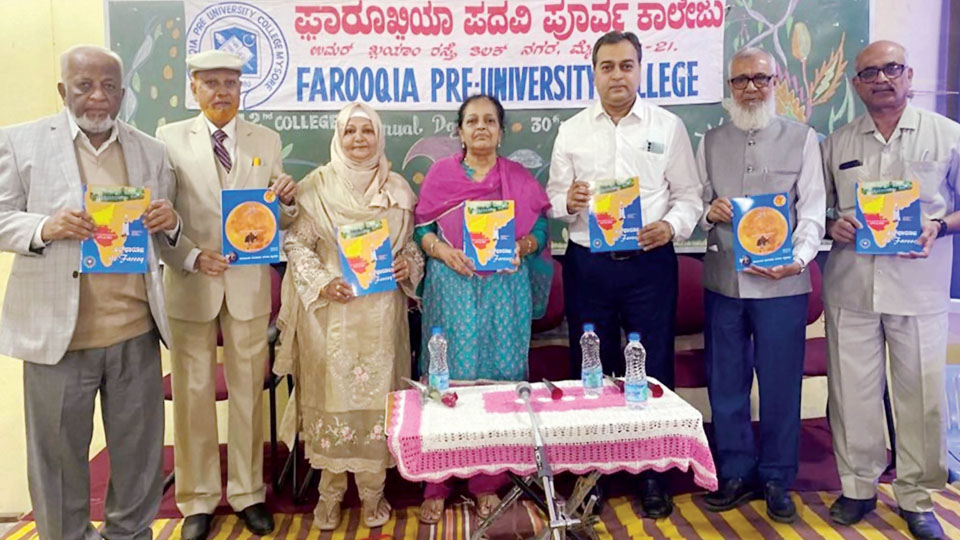
Prof. M. Sayeed Ahmed and Dr. Syed Abdul Khuddus presented a memento to Kamran Ahmed and Prof. Riyaz Ahmed unveiled the 35th volume of the college magazine, “Al-Farooq,” featuring the Chandrayaan-3 rocket launch and Vikram’s historic soft landing.
The issue also dedicated a section to late Mujeeb-Ur-Rehman Khan, a key figure in the establishment of Farooqia College in 1980, and paid tributes to freedom fighter Khazi Abdul Ghafoor Khan, known as “Coorg Gandhi.”
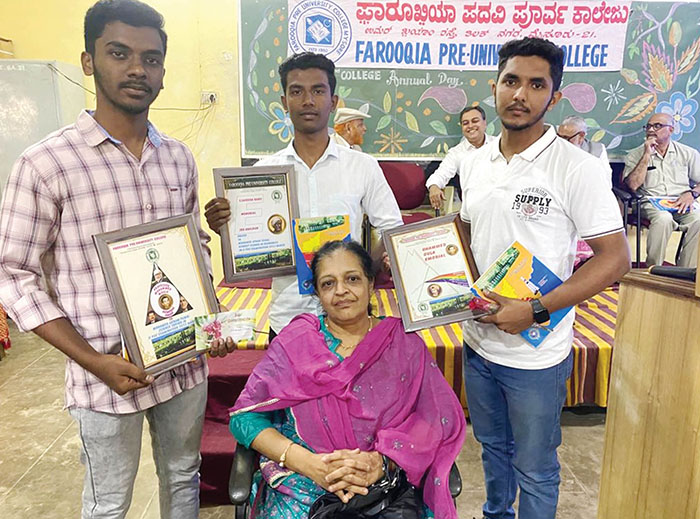
Dr. Anisa Ather, Retired Associate Professor of Microbiology, presented cash prizes in memory of her parents late Prof. Mohammed Moula and late Y. Sayeeda Banu to outstanding students — Mohammed Ikram (highest scorer in Science), Mohammed Afnan (Economics) and Zaid (Physics) — in II PU March 2023 exam.
Additionally, the magazine honoured the first method actor of world cinema, Dilip Kumar, with articles and rare photographs, and featured articles on Prof. B Shaikh Ali and Kannada Professor Kareemuddin of MDTDB College.
Special invitees were Dr. Thouqeer Ahmed and Dr. Shaista Ahmedi, an alumna of the college and successful doctors. Dr. Ahmedi announced cash prizes for the highest scorers.
Prof. M Sayeed Ahmed, Hon. Secretary of the College, emphasised the importance of serving parents and society, highlighting the obligation of Huqooq-ul-Ibaad for every Muslim.
Dr. Syed Abdul Khuddus presided over the function, which included Qirath by Mohammed Taufeeq and Naath by M.K. Zakir.
The event, compered by Zahara Jabeen Tabassum, featured a brief report on the college’s 2023 activities by R.H. Basha, Principal. BiBi Ameena proposed a vote of thanks, following cultural programmes, literary competitions and sports events.
source: http://www.starofmysore.com / Star of Mysore / Home> News / January 04th, 2024