Total Assistance by ZCI-Patna Reached Rs. 51 Lakhs Since August 2023
Patna:
The Zakat Centre India (ZCI) – Patna Chapter announced the disbursement of ₹8.85 lakhs to 18 deserving beneficiaries during its 13th phase of financial assistance. With this round, the Chapter has extended a total of ₹51 lakhs from August 2023 to November 2025 through multiple phases of outreach.
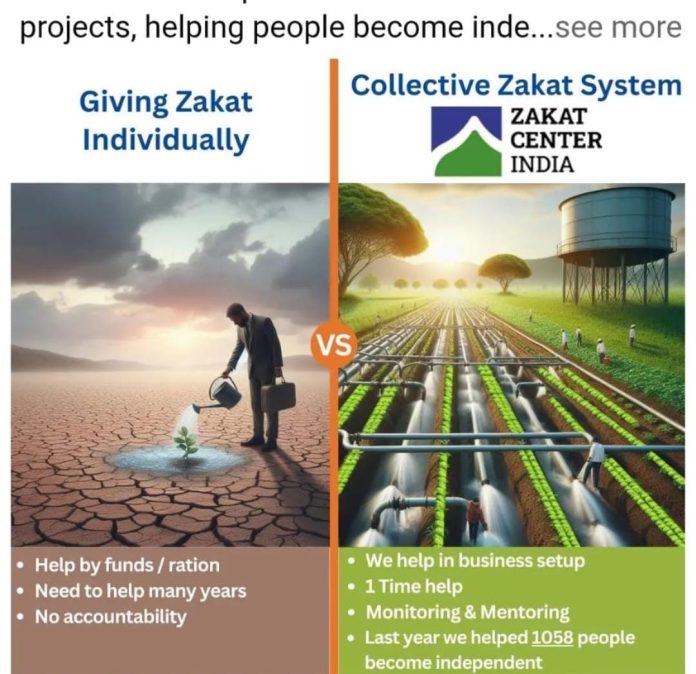
Established in 2023, ZCI–Patna aims to organise zakat collection and ensure transparent and systematic distribution, focusing on sustainable welfare, education, and income generation. Unlike individual zakat practices, ZCI follows a pooled, structured model designed to create long-term social impact.
A review and sanction meeting was convened on 18 November 2025 at Anisabad, Patna, where 25 applications for financial aid were evaluated. Members expressed satisfaction with the Chapter’s progress and resolved to deepen engagement in both zakat collection and beneficiary outreach.
During the meeting, a new Unit Management Committee (UMC) was constituted to strengthen operations. The committee includes Manzoor Ali (IAS Rtd.), Quamruddin Warsi (Chief Manager, SBI, Rtd.), Abdul Wahab Ansari (ADM Rtd.), Mobin Ali Ansari (ADM Rtd.), and Syed Nashoor Ajmal.
Category-wise Disbursement
Income Generating Activities: Support for 9 individuals to start or expand livelihood ventures – ₹4,55,000
Livelihood Support (Mu’awasat): Assistance to 3 families with urgent social needs – ₹72,000
Educational Scholarships: Aid for 6 students pursuing higher education – ₹3,58,000
Beneficiaries namely Sonu Aryan (₹90,000), Nadiya Khatoon (₹72,000), Md. Aslam (₹40,000), Nikhat Parween (₹1,00,000), Mozaffar Alam (₹40,000), Saniya Faraz (₹40,000), Faiz Alam (₹50,000), Nuruddin (₹24,000), Lal Babu (₹50,000), Nasima (₹24,000), Shahid (₹50,000), Farzin Khatoon (₹36,000), Sohail (₹45,000), Hena Parween (₹40,000), Mumtaz Alam (₹30,000), Jawaid (₹50,000), Mushtaque (₹50,000), and Riaz Arif (₹40,000) have received the financial aid.
The meeting was attended by key office bearers and senior members, including Syed S. Quadri (President), M. Naushad Ansari (Secretary), Quamruddin Warsi (Treasurer), Manzoor Ali (IAS Rtd.), Abdul Wahab Ansari (ADM Rtd.), Muhammad Anwar (Director, Al-Hira Schools), Ghulam Shahid, Abdul Mubeen Ansari (ADM Rtd.), Shakib ur Rahman, Nashoor Ajmal, Ruby Nishat, and Shahzad Rasheed, among others.
Commitment to Transparent and Sustainable Impact
The ZCI–Patna reaffirmed its dedication to need-based allocation, ethical governance, and supporting individuals in becoming self-reliant. The Chapter emphasised that its long-term vision is to transform beneficiaries into future zakat contributors, thereby strengthening the community through a continuous cycle of support and empowerment.
source: http://www.radiancenews.com / Radiance News / Home> Latest News> Social Service / by M Naushad Ansari / November 20th, 2025
Prof. Afzal Anees being honoured with Eminent Senior Surgical Teacher Award
Aligarh:
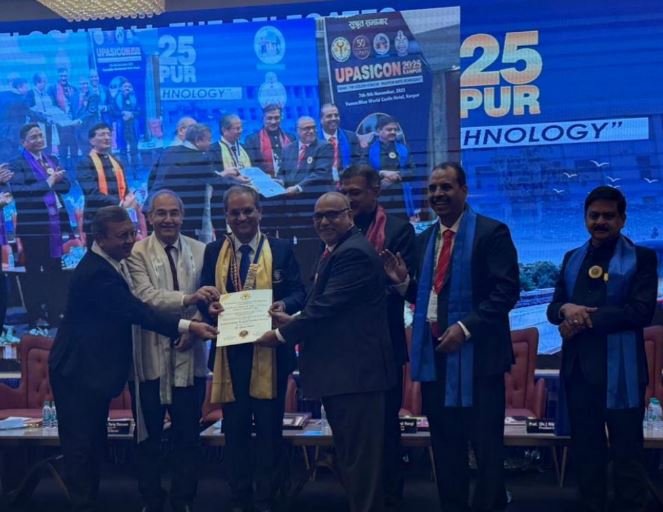
Prof. Afzal Anees, Department of Surgery, Jawaharlal Nehru Medical College, Aligarh Muslim University, has been honoured with the “Eminent Senior Surgical Teacher Award” at the Uttar Pradesh Chapter of ASICON, held on November 7. The award recognises his outstanding contribution to surgical education, mentorship and academic excellence.
A distinguished surgeon and respected academician, Prof. Anees has been a guiding force in the Department of Surgery for several decades, shaping the careers of numerous surgical residents and medical students. His leadership, clinical expertise and unwavering commitment to patient care have earned him wide respect across the medical fraternity.
Earlier in May 2025, Prof. Anees was elected as a Fellow of the Royal College of Physicians and Surgeons (FRCS), Glasgow, which is an honour reserved for surgeons who have demonstrated exemplary professional achievement and contributed significantly to the advancement of surgical practice.
source: http://www.radiancenews.com / Radiance News / Home> Pride of the Nation> Awards / by Radiance News Bureau / November 18th, 2025
Prof. Nizamuddin Khan, former faculty member of the Department of Geography, Aligarh Muslim University
Aligarh:
Prof. Nizamuddin Khan, retired faculty member of the Department of Geography, Aligarh Muslim University, has been conferred upon the ESDA Environmental Excellence Award 2025 by the Environment and Social Development Association (ESDA), Delhi. The award was presented during the 6th World Environment Summit, recently held in Bangkok, Thailand.
The honour recognises his significant contributions to geography and environmental studies over a distinguished academic career spanning 35 years. A former Chairperson of the Department of Geography at AMU, Prof. Khan has worked extensively on socio-economic and environmental issues at the grassroots level across diverse geographical regions.
He has completed nine major research projects funded by premier national agencies, and published 127 research papers in reputed international and national journals, along with 18 books.
source: http://www.radiancenews.com / Radiance News / Home> Pride of the Nation> Awards> Latest News / by Radiance News Bureau / November 22nd, 2025
Sabir Ahamed, Programme Director at Pratichi Institute, Pratichi (India) Trust, and Founder Director of the Sabar Institute
Sabir Ahamed is the Programme Director at Pratichi Institute, and Founder Director of the Sabar Institute. His research spans the socio-economic status of Muslims in India, child protection, and education. He is proficient in analysing official datasets (NSS, Census, DISE, AISHS) using tools like Stata and R. Sabir has led largescale research and evaluation projects for the Government of West Bengal, including assessments of Kanyashree Prakalpa, Sabooj Sathi, Duare Sarkar, Lakshmir Bhandar, and the PM Poshan School Nutrition Garden Survey. He is currently leading the Human Development Report 2025 for West Bengal and directed the Second Human Development Report for Tripura. His experience includes work with international organisations like Railway Children UK on projects supported by the European Union and UNICEF. He served as the West Bengal State Lead for a UNICEF-commissioned study on secondary education transitions and was awarded the Just Transition Writing and Research Fellowship at IIT Kanpur (2022–2023). He actively promotes the RTI Act (2005) in West Bengal and is a core member of the Know Your Neighbour campaign. He contributes op-eds to national dailies and has co-edited publications on development issues. Excerpts from his interview with Mohd. Naushad Khan:
Q: How was the idea Know Your Neighbour conceptualised, when and how did it start, and what was the basic objective of this campaign?
We started the initiative because we noticed a deep division between different communities in our city. The immediate context was the publication of a report titled ‘Living Reality of Muslims in West Bengal’ in 2013. The findings shed lights on the deplorable condition of Muslims in West Bengal, yet a large section of people was unaware the status of Muslims. Many academics and Journalists were surprised to see those facts, especially they were educationally and economically backward. Secondly, historically different communities are living in the city for generations, Partition has created some chasm between Hindus and Muslims. The worst outcome is the spatial segregation – this led to the concept call ‘living together separately’. This gave birth of a plethora of myth and misconception about the Muslims.
We found that even well-meaning and educated people in Kolkata knew very little about the city’s Muslim community, even though it makes up 20% of the population.
We learned that most people didn’t visit Muslim-majority neighbourhoods because they didn’t have friends there or, in some cases, they believed the areas were unsafe.
To break the misinformation about Muslims and its neighbourhood, Know Your Neighbour (KYN) started neighbourhood walk in 2026. Till then, thousands of young people had participated in the walks and discussion.
The main goal is to build familiarity between communities that live close to each other but knew little about the other. The campaign aims to break down stereotypes and overcome the ignorance and distrust that can grow from different religious identities. This ignorance and distrust are the biggest barriers to communal harmony.
Q: Since its inception, how do you see the journey of KYN, and what were the challenges faced so far?
The journey of KYN involves actively bringing people from different backgrounds together. The main way it does this is by organising walks or visits to:
Areas with large Muslim populations, like Metiabruz and Rajabazar, Kidderpore, etc.
Places with shared, syncretic histories, like the Daptaripada area near College Street, where book-binding communities have co-existed.
Sites that remind people of the legacy of past communal violence, such as Selimpada.
Areas facing common problems that affect everyone, like pollution in the Rajapur canal, where both Hindus and Muslims use the water.
The campaign also organises events like Dosti ki Iftar (Friendship Iftar) and joint Durga Puja celebrations, allowing people to learn about and join in each other’s religious festivals.
The main challenge the campaign faces is ignorance, stereotypes, and fear that keep communities separated from each other.
Q: What has been the impact of KYN in Bengal, and how have people responded to this campaign?
Over the years, neighbourhood walks conducted by KYN have made a lasting impression on young minds, promoting peace, social cohesion, and pluralism. Around 1,500 students have joined us in exploring overlooked neighbourhoods across Kolkata through these immersive walks.
The initiative aims to instil core constitutional values – secularism, pluralism, and fraternity – through lived experiences and encounters with historical memory embedded in the urban fabric. These walks offer students a unique opportunity to engage with diverse communities, reflect on shared histories, and foster a deeper understanding of inclusive citizenship.
In collaboration with Maulana Azad College, our language course in Arabic, Persian, and Bengali enabled about 90 students to learn the basic reading of these languages. These programmes strengthen cultural roots and encourage appreciation for linguistic plurality.
We run a WhatsApp support network of over 850 students from marginalised areas, offering career counselling, peer mentoring, job opportunities, and regular workshops to help them navigate academic and professional spaces. We have trained more than 250 students on career counselling.
In partnership with Swayam and Azad Foundation, we’ve held group counselling sessions for children affected by communal tension, providing psychological support and nurturing safe spaces for recovery.
We conducted a hands-on RTI (Right to Information) workshop for students and professionals, teaching them how to use RTI to uncover critical datasets and hold government institutions accountable. Many participants have since used RTI to pursue issues of social relevance.
We host regular book reading and discussion sessions with acclaimed writers and scholars. Sabar Institute’s data for better lives initiative regularly post data on discrimination, lack of opportunity among the disadvantaged communities.
People, including college students, have started visiting Muslim-majority areas, even without our facilitation. The response from students has been particularly rewarding. These students, who had often been told by their parents not to go into minority areas, visited them and reported that they do not feel unsafe.
Q: Why do you think such campaigns are necessary in Bengal and elsewhere in the country?
Campaigns like KYN are necessary to repair growing divisions in our society. They are needed to address the loss of camaraderie between communities. The goal is to stop ignorance and indifference from turning into alienation.
Even among the educated city-dwellers, there is often a lack of friendship and familiarity with people from other communities. Campaigns are necessary to remove the distrust and ignorance that come from religious differences, calling this the biggest barrier to communal harmony. In a time of divisive politics and attacks on secular values, new ways of building unity are needed. Campaigns like KYN are important because they build social solidarity and brotherly or sisterly bonds directly between citizens.
Q: Finally, how can such a campaign add to the concept of a value-based society?
These campaigns are a key part of building a value-based society, as they focus on human connection.
The campaign helps build fraternity, which is a core value in the Indian Constitution. This means it focuses on building strong relationships and bonds of trust among citizens.
Instead of just using rational intellectual arguments for equality, these campaigns use shared cultures, local histories, and neighbourhood connections. This has a broad emotional appeal and helps trigger empathy in people.
By creating deeper emotional solidarity, the campaign helps people connect based on the shared value of equality. Ultimately, by creating new friendships and shared celebrations, these campaigns help to repair and restore the social fabric and build a more inclusive and united society.
source: http://www.radiancenews.com / Radiance News / Home> Face to Face> Focus / by Mohd Naushad Khan / November 20th, 2025
The Council of Science and Technology, Uttar Pradesh honoured Dr. Riaz Ahmad, Lecturer at Department of Zoology, Aligarh Muslim University (AMU), with ‘Young Scientist Award’ yesterday. The award has been given to Dr. Ahmad in recognition of his contributions in the area of Biochemical and Molecular Genetics. Besides cash prize of Rs. 25,000/, award carries a certificate, memento and a shawl.
The award was presented to Dr. Riaz Ahmad by Mr. Abdul Mannan, the State Minister for Science and Technology at the Vigyan Samaroh at Sir C.V. Raman Auditorium in Lucknow.
Dr. Ahmad is also a recipient of prestigious Dr. D. S. Kothari Post Doctoral Fellowship from UGC, Young Scientist Project of DST and Scientist of the Year Award-2009 given by the National Environmental Science Academy.
He has a number of research papers to his name published in various scientific journals of national and international repute.
source: http://www.twocircles.net / TwoCircles.net / Home> Indian Muslim / by TCN News / March 30th, 2010
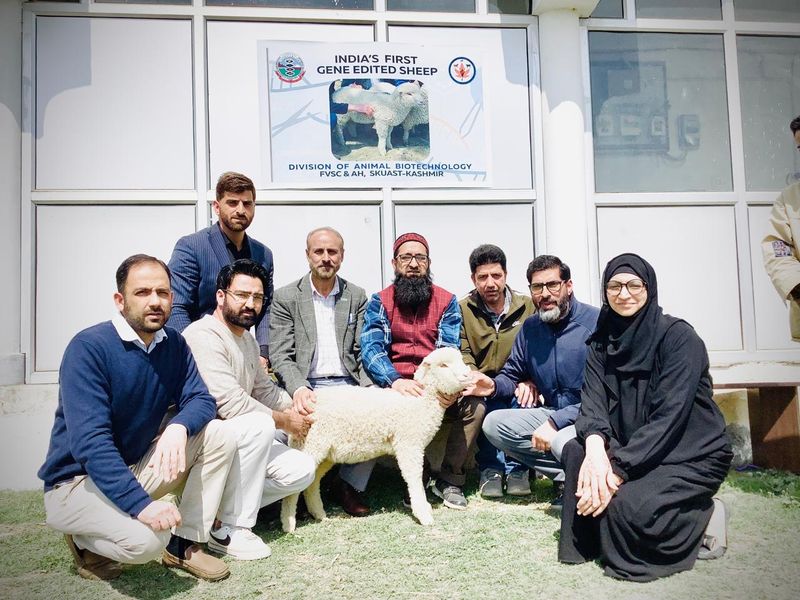
A team from SKUAST-Kashmir with country’s first gene-edited sheep.
In a landmark achievement in the field of animal biotechnology, Sher-e-Kashmir University of Agricultural Sciences and Technology (SKUAST), Kashmir, has successfully produced India’s first gene-edited sheep. University officials are calling it a “historic milestone” in genetic research and livestock development.
“This is a major breakthrough at the national level. It is the first of its kind in India, and everyone at the university is thrilled,” said Dr Riyaz Ahmad Shah, Professor of Animal Biotechnology, who led the expert team behind the project.
Dr Shah revealed that a female gene-edited lamb was born four months ago. The team specifically targeted the myostatin gene, which regulates muscle growth, making changes at the embryonic level. “The gene editing was carried out using CRISPR-Cas9 technology,” Shah explained. This revolutionary tool has broad applications in medicine, agriculture, and biotechnology. Importantly, he noted, “The edited sheep contains no foreign DNA,” distinguishing it from transgenic organisms and easing its path under India’s evolving biotech regulatory framework.
“All international biosafety protocols were strictly followed throughout the process,” he added.
The university views this achievement as a major step in placing India on the global map of advanced genome editing technologies. It also positions SKUAST-Kashmir at the forefront of reproductive biotechnology research.
Experts say the lamb’s muscle growth is expected to be enhanced due to the gene editing, although a few years of observation will be required to fully understand the differences between the edited lamb and a normal one.
Notably, Dr Shah and his team were also behind the creation of “Noori,” India’s first cloned Pashmina goat, in 2012. Noori lived for 11 years before passing away in 2023.
Vice Chancellor of SKUAST-Kashmir, Prof Nazir Ahmad Ganai, recently briefed Lieutenant Governor Manoj Sinha about the development. “This is not just the birth of a lamb, but the birth of a new era in livestock genetics in India,” Prof Ganai remarked.
University officials said the Lieutenant Governor praised the team’s efforts and their contribution to advancing scientific research in the region.
Looking ahead, the university plans to produce more gene-edited sheep. “We’re exploring possibilities in other areas like twin births and disease resistance,” said Shah. “For now, we are closely monitoring the lamb for safety and other parameters. Everything is normal so far.”
The team is also in the process of selecting a name for the pioneering lamb. “We’ll announce it soon,” Shah said.
source: http://www.tribuneindia.com / The Tribune / Home> Jammu & Kashmir / by Adil Akhzer / May 27th, 2025
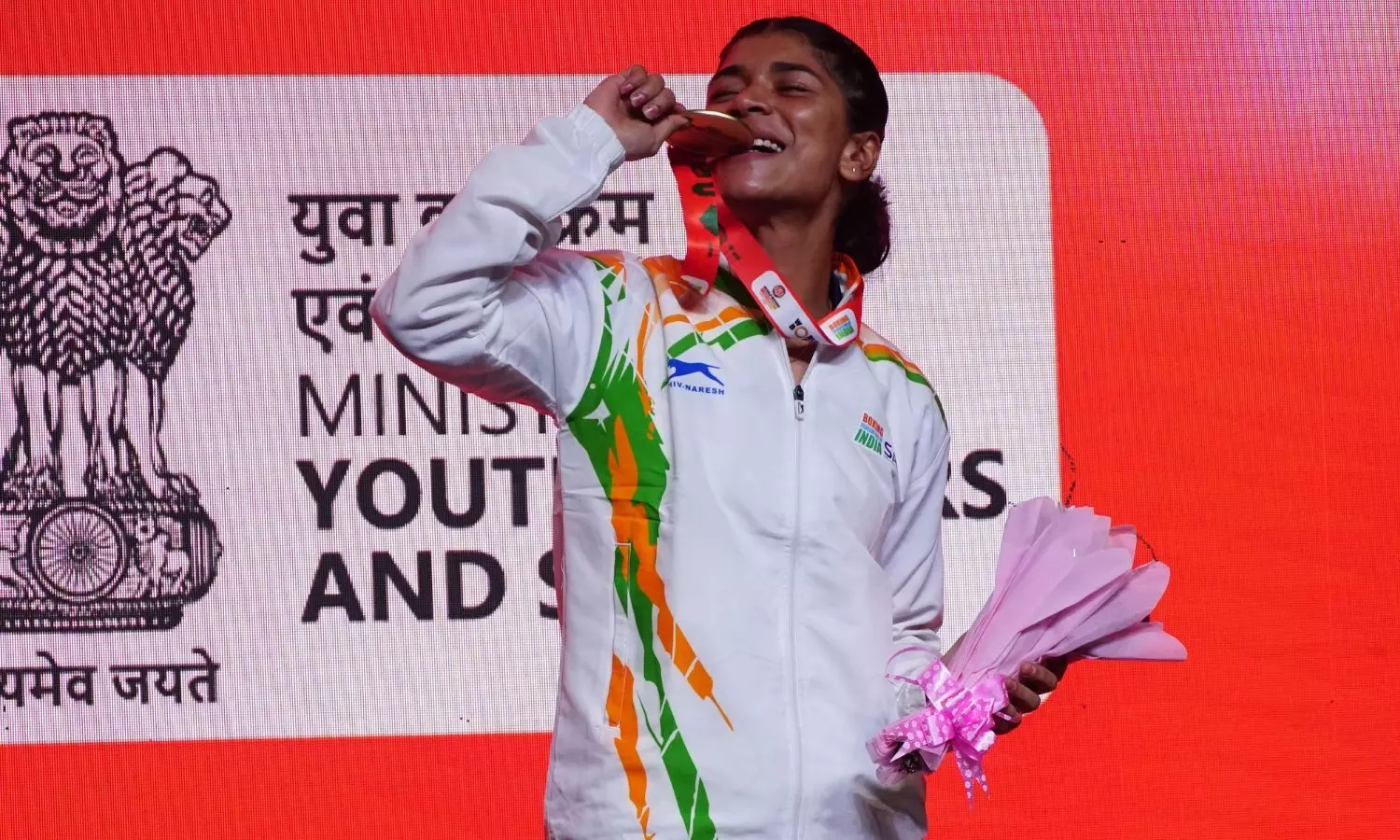
Nikhat clinched the women’s 51 kg gold medal at the 2025 World Boxing Cup Finals in Greater Noida.
Nikhat Zareen clinched the 51 Kg gold medal at the World Boxing Cup Finals 2025. (Photo Credits: The Bridge)
Greater Noida:
Star Indian boxer Nikhat Zareen has once again captured headlines after winning the gold medal at the 2025 World Boxing Cup Finals on Thursday.
The two-time World Champion delivered a commanding 5–0 victory over Guo Yi-xuan of Chinese Taipei in the women’s 51 kg final, returning to the top of the podium after 32 months.
Her last gold also came on home soil in 2023, when she clinched her second world title at the New Delhi World Championships.
“I always believe in manifestation, so I manifested that this time also, in India, I would repeat that. It’s always a pleasure to play in front of a home crowd, and today I did it,” Nikhat Zareen told the media after her win.
Bouncing back from two consecutive setbacks
Nikhat endured a difficult run in her last two major tournaments, the Paris Olympics and the World Boxing Championships, returning empty-handed from both.
At the Paris Games, competing as the reigning World Champion, she exited in the Round of 16 against eventual champion Wu Yu of China.
Later, at the 2025 World Championships in Liverpool, her first international event of the year, she fell in the quarterfinals to Turkiye’s Buse Naz Cakıroğlu.
Now, she has turned back the clock, returning to winning ways in front of her home crowd and putting behind her the disappointment of missing out on key medals.
“This medal is a big boost for my confidence. After a long time, I reached the final and won the gold. I’m very happy that I can once again compete as a gold medal contender,” Nikhat said, relieved to end her medal drought.
Nikhat also mentioned that she had very little time after the World Championships to prepare for this event. Within days, she shifted to Patiala to join the training camp.
“I spent a few days with my family, but then moved to Patiala for training since the Finals were in India and I didn’t want to disappoint fans. In Patiala, I sparred with boxers across weight categories, from 48 kg to 54 kg and even 57 kg, which helped me a lot,” she added.
Nikhat’s Road to the title
The World Cup Finals, expected to be a top-tier competition with the world’s best eight players in each weight category, did not fully live up to expectations as several major nations skipped the event.
In the women’s 51 kg category, only five boxers participated, which meant Nikhat received a bye in the quarterfinals and secured a medal without stepping into the ring.
Her campaign began in the semifinals against Uzbekistan’s Gulsevar Ganieva, where she won by unanimous decision to enter the final.
However, it wasn’t her most convincing bout, marked by frequent clinches and several clumsy falls near the ropes.
“The first bout was not as good as everyone expected, but I’m happy that I at least won and reached the final after so long,” Nikhat said after the semifinal.
In the final against Guo Yi-xuan, Nikhat looked much more composed, displaying sharper footwork and cleaner punches to seal the title at home.
“Today, I played against a boxer who moves a lot and is a counter-puncher. So I also opted for counter boxing instead of going all-out, which could have disadvantaged me,” Nikhat explained.
Future Plans
Nikhat shared that she often has to travel for training because there is no proper boxing academy near her home, something she now hopes to build herself for upcoming talent from Telangana.
“I mostly have to travel to Pune or IIS for training and don’t have a fixed location. So if the Telangana government allocates land, I will build my own academy where I can train and support rising boxers from the region,” she said.
This win may not carry immense competitive weight due to the limited field, but it has undoubtedly reignited her confidence after a challenging year.
With a packed 2026 season ahead, including major events like the Commonwealth Games and Asian Games, Nikhat will aim to use this momentum to elevate her performance further.
Her parting words, “This is just the start, and a lot more has to be done,” reflect the grit and hunger she will need as she prepares to face stronger opponents on the global stage.
source: http://www.thebridge.in / The Bridge / Home> Boxing / by Deepanshu Jain / November 21st, 2025
Jamia Millia Islamia Assistant Professor at Department of Chemistry, Dr. Ufana Riaz has been awarded “Sir CV Raman Young Scientist Award 2021” along with cash money of Rs 25,000 in recognition of her outstanding contribution in the field of Materials Chemistry by the St. Peters Institute of Higher Education and Research, Avadi Chennai. The award and citation were presented to her at the 12th convocation of the Institute.
Dr. Ufana Riaz has published more than 140 research papers in the field of conducting polymers, co-authored 3 books and 25 book chapters. Her research work has been published in renowned and highly reputed international journals.
Dr Riaz holds membership of the prestigious National Academy of Science (NASI) Allahabad, International Union of Pure and Applied Chemistry (IUPAC) and Royal Society of Chemistry (RSC).
Dr. Ufana Riaz has been the recipient of the International Research Excellence Award in Green Chemistry by Center for Professional Advancement and Continuing Education (CPACE), Senior Scientist Award by Environment & Social Development Association (ESDA), Green Technology Innovation Award by National Environmental Science Academy (NESA), National Education Excellence Award in Materials Chemistry by International Multidisciplinary Research Foundation (IMRF), and Outstanding Performance Award by Novel Research foundation.
source: http://www.siasat.com / The Siasat Daily / Home> News> India / by Mohammed Hussain Ahmed / February 05th, 2022
The Council of Science and Technology, Uttar Pradesh honored Dr. Tamanna Jahangir, from Jamia Hamdard, currently working as Assistant Professor at Jazan University, Kingdom of Saudi Arabia with ‘Young Scientist Award’ on Jan. 29th 2011.
The award has been given to Dr. Tamanna Jahangir in recognition of her contributions in the area of Cancer Chemoprevention Toxicology. Besides cash prize of Rs. 25,000/ award carries a certificate, memento and a shawl.
The award was received by her Father Mr. Mohd. Jahangir presented by Mr. Abdul Mannan, the State Cabinet Minister for Science and Technology at the Vigyan Samaroh at Sir C.V. Raman Auditorium in Lucknow.
Dr. Tamanna Jahangir is also a recipient of prestigious DST fast track Young Scientist Award and Young Scientist Award at TOXCON 2010 given by the Slovak Toxicological Society (SETOX), Slovakia.
She has a number of research papers to her name published in various scientific journals of national and international repute.
source: http://www.twocircles.net / TwoCircles.net / Home> Indian Muslim / by TCN Staff Reporter, TwoCircles.net / February 01st, 2011
Joygram Village (North 24 Parganas District), WEST BENGAL :
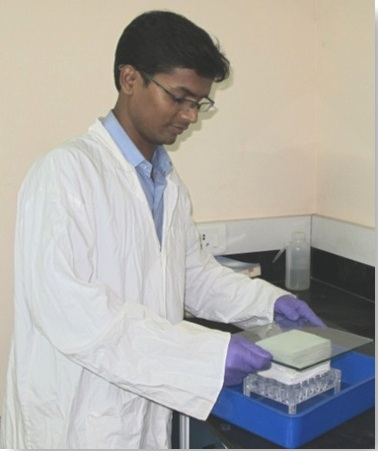
Kutubuddin Ali Molla in research lab
Kolkata:
A young researcher from West Bengal beat poverty to bag the Young Scientist Award 2013-14 of India. The Young Botanist Kutubuddin Ali Molla, who hails from a very poor family in North 24 Parganas district received the honour for his research on “Development of Transgenic Rice Plants for Sheath Blight Resistance”.
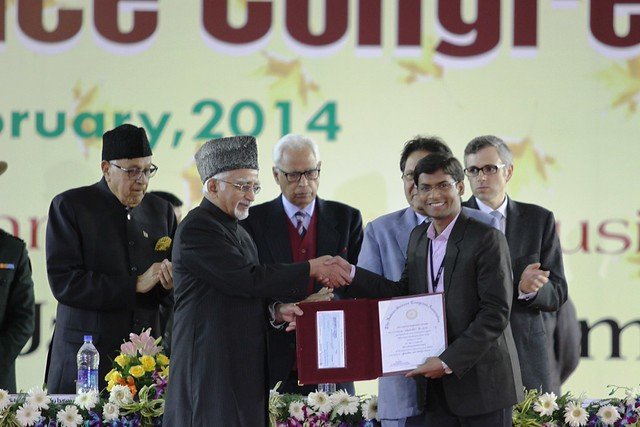
The young scientist was felicitated on February 7, 2014 at Jammu University by Vice President of India Hamid Ansari with a cheque of Rs 25000 and an Award Certificate in the field of Agriculture and Forestry Sciences.
Chief Minister of Jammu & Kashmir Omar Abdullah and Governor of Jammu Kashmir N N Vhora, Former CM of J&K Dr. Farooq Abdullah were also present in this award ceremony.
Kutubuddin is currently posted as a scientist trainee at National Academy of Agricultural Research Management in Hyderabad.
Originally from a remote village of Joygram in North 24 Parganas, Kutubuddin Ali Molla, his father Illias Molla is a farmer and Grandfather Nasim Molla was a Maulana and social worker.
With only three Bighaa of agricultural land in a joint family, Illias Molla was not able to fulfill all the needs of the family; his eldest brother Yusuf Molla, however, financially supported his bright nephew in times of economic-crunch.
Kutubuddin Ali Molla taking award from VP Hamid Ansari at Jammu University.
As a young boy, he Kutubuddin also helped his father in the agricultural fields and learnt several things about paddy cultivation that developed his interest for becoming an agricultural scientist. Stricken by poverty, his father told him, he will not stop him from studying, but he is not in a condition to financially support him and hence he would need to manage the expenses from somewhere.
After completing his senior secondary from Joygram JN High School, Kutub took admission at City College in Kolkata in B.Sc (Honours) in Botany. As the college was about 60 KM from his village, he shifted to a hostel near the college on a nominal fees of Rs 50.
Kutub is very grateful to his Professor in college Dr Argha Hait, who helped in several ways. After graduating with first class, he took admission for post-graduation in Calcutta University, which he completed with first class and ranked third.
All these while, he gave private tuitions to support the expenses of his study and staying in Kolkata. Meanwhile, he also cleared the Junior Research Fellowship (JRF) of the Council of Scientific and Industrial Research (CSIR), GATE, ICAR (NET) and ARS tests.
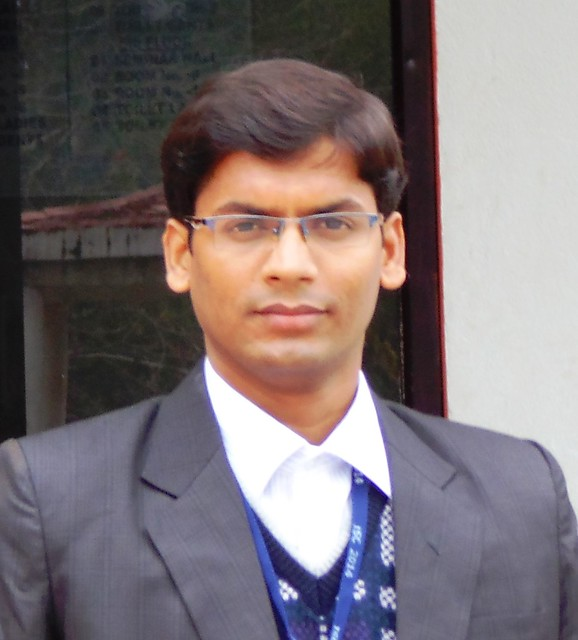
Kutubuddin Ali Molla
He took admission in Phd under the Dr Karabi Dutta in 2009 in Plant Molecular Biology and Plant Biotechnology. He did his PhD research (PhD award still awaited) on transgenic rice and published a research article in a Research Journal of the British Society on `Molecular Plant Pathology’ in 2013 that attracted the attention of the agricultural scientists in the country.
He then participated in All India Young Scientist Award Competition and was selected for the Best Young Scientist Award of India in the field of agriculture for 2013-14.
Speaking to TCN over phone from Hyderabad, Kutubuddin thanked the Almighty Allah for the honour and hoped that his research in agricultural yields good result in paddy cultivation.
source: http://www.twocircles.net / TwoCircles.net / Home> Indian Muslim / by Zaidul Haque, TwoCircles.net / March 19th, 2014