The Jamiat Ulema-e, a Muslim organization, on Thursday distributed Rs 50 lakh among nearly 350 . The funds were distributed at function organized by the organization at Kaveri Kalakshetra in Madikeri.
“Humanism is above religion and each one should cultivate humanity,” said Maulana Mufthi Ifthkar, president, Karnataka Jamiat Ulema-e.
Hajarath Maulana Mufthi Shamsuddin, secretary of the organization, said, “We have come forward to help the people in need and no religion will come in the way of this godly act.”
Download The Times of India for Latest
source: http://www.milbankmonitor.com / MilBankMonitor.com / Home> World News / by Milbank News Writer / February 06th, 2019
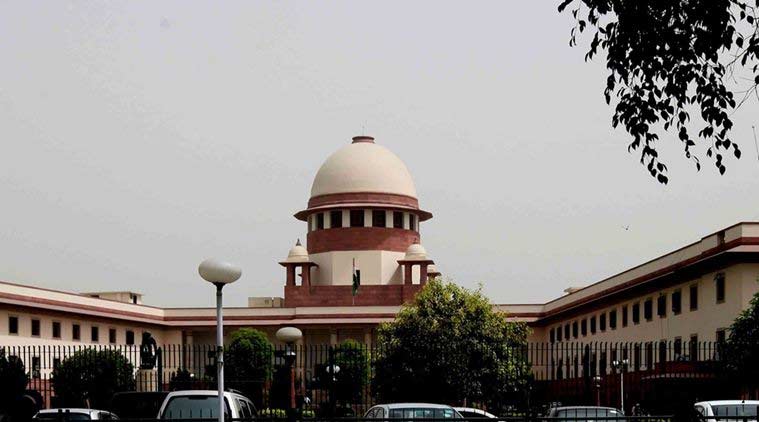
Justice Nazeer said that considering the “Constitutional importance” and “significance” of the issue, the Ram Janmabhoomi land dispute case should be referred to a larger bench.
The majority verdict by other members of the bench, comprising Chief Justice Dipak Misra and Justice Ashok Bhushan, said that this observation was made in the context of land acquisition.
The observation in the 1994 Ismail Faruqui case that a mosque is not an essential part of Islam and namaz by Muslims can be offered anywhere, “even in open” was arrived at “without undertaking a comprehensive examination,” Supreme Court judge Justice S Abdul Nazeer said Thursday.
The majority verdict by other members of the bench, comprising Chief Justice Dipak Misra and Justice Ashok Bhushan, said that this observation was made in the context of land acquisition.
Disagreeing with this in his 42-page dissenting judgment, Justice Nazeer said that considering the “Constitutional importance” and “significance” of the issue, the Ram Janmabhoomi land dispute case should be referred to a larger bench.
Justice Nazeer referred to the Srirur Mutt case which had observed that “what constitutes the essential part of a religion is primarily to be ascertained with reference to the doctrines of that religion itself”. Ismail Faruqui needs to be brought in line with the “authoritative pronouncements in Shirur Mutt,” he said.
Justice Nazeer posed four key questions.
First, whether in the light of Shirur Mutt, “an essential practice can be decided without a detailed examination of the beliefs, tenets and practice of the faith in question” ; second, whether the test for determining the essential practice is both essentiality and integrality; third, does Article 25 (Freedom of conscience, practice and propagation of religion), “only protect belief and practices of particular significance of a faith or all practices regarded by the faith as essential” ; fourth, do Articles 15 (prohibition of discrimination on grounds of religion, race, caste, sex or place of birth), 25 and 26 (freedom to manage religious affairs) read with Article 14 (right to equality) “allow the comparative significance of faiths to be undertaken”.
Justice Nazeer also referred to a string of rulings on similar issues that have been referred to a larger bench: a three-judge bench of the SC has referred the matter relating to polygamy including Nikah Halala, Nikha Mutah, and Nikah Misya to a Constitution Bench; a two-judge Bench had has referred the matter in relation to the policy decision permitting Ram Leela and Puja once in a year in public parks to a Constitution Bench; and, most recently, a three-judge bench considering the question relating to banning the practice of Female Genital Mutilation (FGM) has referred the matter to a larger bench.
The issue of referring the observation of 1994 verdict had cropped up when the three-judge bench headed by the CJI was hearing the batch of appeals filed against the Allahabad High Court’s 2010 verdict by which the disputed land on the Ram Janmabhoomi-Babri Masjid area was divided into three parts.
Justice Nazeer said that this 2010 verdict has been “expressly and inherently” affected by the questionable observations made in Ismail Faruqui case.
The issue of referring the observation of 1994 verdict had cropped up when the three-judge bench headed by the CJI was hearing the batch of appeals filed against the Allahabad High Court’s 2010 verdict by which the disputed land on the Ram Janmabhoomi-Babri Masjid area was divided into three parts.
A three-judge bench of the high court, in a 2:1 majority ruling of 2010, had ordered that the 2.77 acres be partitioned equally among three parties — the Sunni Waqf Board, the Nirmohi Akhara and Ram Lalla, the deity.
source: http://www.indianexpress.com / The Indian Express / Home> India / by Kaunain Sheriff M / New Delhi / September 28th, 2018
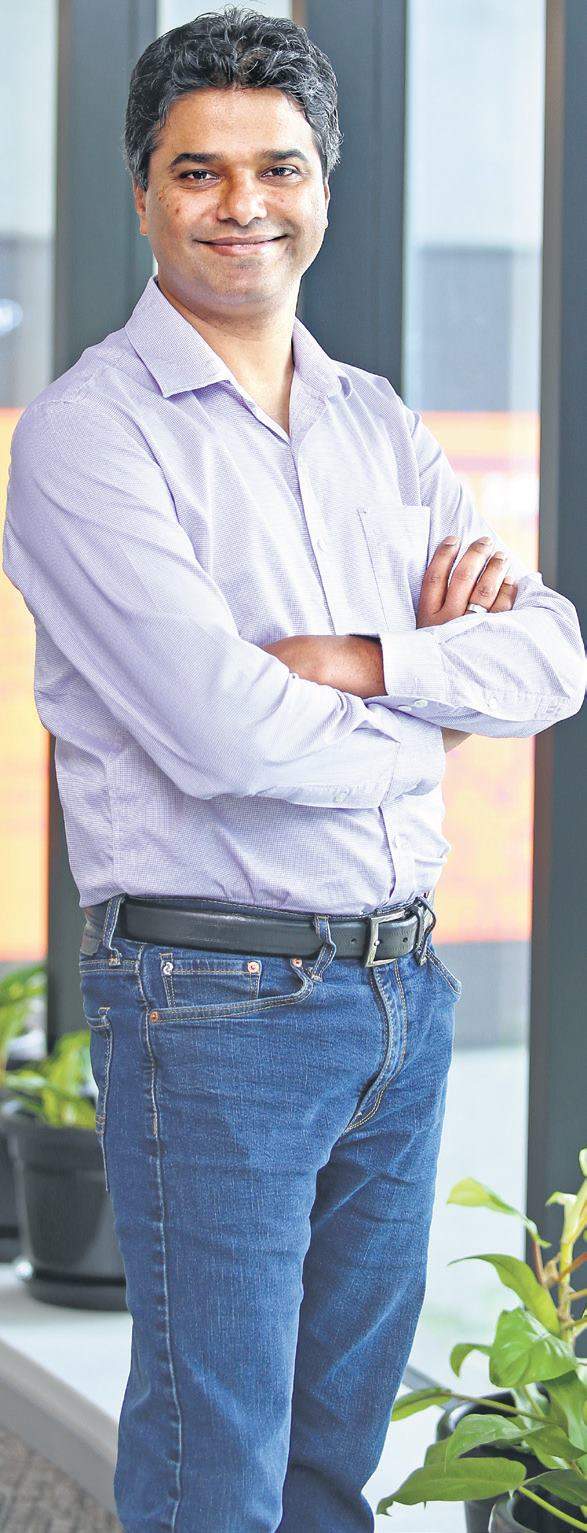
As senior vice-president of SAP, V R Ferose’s job has taken him to as many as 40 countries.
Bengaluru :
As senior vice-president of SAP, V R Ferose’s job has taken him to as many as 40 countries. With back-to-back meetings and tight schedules, Ferose rarely has had any time to explore the places. But the corporate honcho has found a unique way of understanding cultures: Visiting bookstores. In fact, he even planned an entire vacation to visit the world’s largest independent bookstore – Powell’s Bookstore in Portland, USA.
VR Ferose
As a child, Ferose read magazines such as Reader’s Digest and comics, but his reading habit didn’t really take off until college. “My wife Deepali was a voracious reader, and gifted me Eric Segal’s The Class. That is when I got hooked to reading,” he says.
Today, he has more than 3,000 books in his collection, but Ferose reveals that he doesn’t have a particular way of organising these books. “Currently I am cataloguing my 100 rarest books.
I have always wanted to organise my books properly, but never found the time. Also, I find there is fun in randomness and the hunt for finding a book is a part of the experience,” he says.People may call him crazy for his quirky hobby, but his wife has always been supportive. To an extent. He explains: “I have no more place in my home or office. Sometimes, my wife gets frustrated when books pile up in our wardrobes.”
So in order to strike a balance, Ferose does what most booklovers would find hard to do: “I have started giving away books – every time I buy a book, I give away one!” says the senior corporate professional.
On a visit to the Nobel museum in Stockholm, he found that every chair in the cafeteria was signed by a Nobel Laureate. This then sparked off another idea: to collect books signed by Nobel Laureates.
Over a decade, Ferose managed to expand his collection of such books to 67. This collection includes Geetanjali signed by Tagore, My Experiments with Truth signed by Gandhi, Effects And Self Fertilization In The Vegetable Kingdom signed by Darwin, Where Do We Go From Here signed by Martin Luther King and Profiles In Courage signed by John F Kennedy.
His favourite, however, is Man’s Search for Meaning by Victor Franklyn. “It was hard to get a signed book by him, since he rarely signed books. Getting this copy from a book dealer was a high point,” he explains.
His favourite bookstores are all over the world, from Mystery Pier Books in LA (where every book is a true first edition) to El Ateneo in Buenos Aires (considered to be the most beautiful bookstore in the world) to Bookworm in Bengaluru. Collecting books, however, isn’t just a hobby for Ferose. “It’s also about focus and constant learning. A hobby allows me to stand out in the crowd and it’s something I lean on in good times and bad. As they say, books are uniquely portable magic,” he says.
source: http://www.newindianexpress.com / The New Indian Express / Home> Cities> Bengaluru / by Simran Ahuja / Express News Service / January 08th, 2019
It was a proud moment for the Karnataka High Court as two of its judges were elevated to the Supreme Court.
Bengaluru :
It was a proud moment for the Karnataka High Court as two of its judges were elevated to the Supreme Court. In a rare instance, one of the judges has been elevated even before becoming the chief justice of a high court.
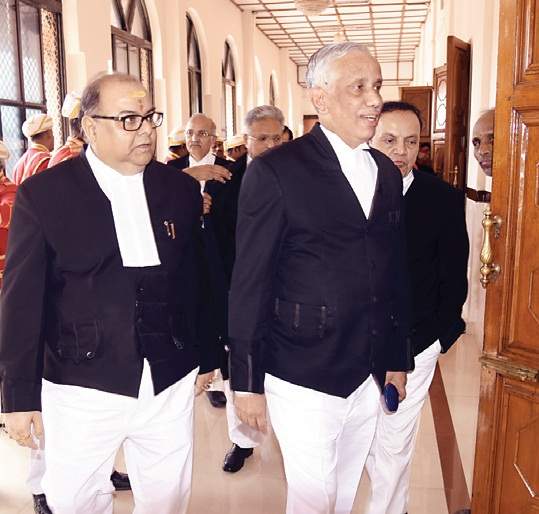
Chief Justice Subhro Kamal Mukherjee, Justice S Abdul Nazeer (right) after a farewell programme at the High Court on Thursday | Vinod Kumar T
The elevated judges are Justice S Abdul Nazeer from the Karnataka High Court and Justice Mohan M Shantanagoudar, who was recently transferred from Karnataka High Court as chief justice of Kerala High Court. They will be sworn in as judges of the Supreme Court on Friday. Both the Judges will have a six-year tenure in the apex court.
Justice Nazeer is perhaps the third judge elevated directly to apex court before becoming the chief justice of a high court.
Earlier, Justice S Rajendra Babu, former Chief Justice of India and Justice N Venkatachala, former Lokayukta were elevated directly as judges of the Supreme Court from the Karnataka High Court.
“I have become emotional.. the reason is my elevation to the apex court and also heading towards Delhi, leaving all the legal fraternity of the state. The real power of courts lie in the trust and confidence reposed by the people and the power vested with them to decide or punish the guilty. Continuing efforts are needed by the bar and bench to keep the faith of people in judiciary,” Justice Nazeer said, while thanking his mother for “raising him to this level despite poverty.”
A warm farewell was given to Justice Nazeer by both the Bar and bench on Thursday. His elevation was described as a proud moment for the Karnataka High Court by those who were on the dais as well as those who were in attendance.
source: http://www.newindianexpress.com / The New Indian Express / Home> Cities> Bengaluru / by Express News Service / February 17th, 2017
This is expected to boost the writing of people belonging to Nawayat community from Bhatkal, who use the Persian script to write their unique language ‘Nawaiti’ — a rare language and script.
Karwar :
A 1,000-year-old language is complete only now after a team of software engineers from Mumbai developed three of its characters to crack its Unicode script.
This is expected to boost the writing of people belonging to Nawayat community from Bhatkal, who use the Persian script to write their unique language ‘Nawaiti’ — a rare language and script.
Nawayat is an Indian-Muslim community, which lives in Bhatkal of the Uttara Kannada district.
Mohammed Mohsin Shabandri, a community member, pointed out that due to three missing characters in Unicode fonts, people were not able to write as they pronounced.
“About three years ago, we decided to develop these three characters and called a meeting of Nawaiti-speaking people. After eliciting their opinion and conducting proper research, we finalised three new characters,” he said.
“Nawaiti is an endangered language. Three months ago, we approached a software development firm in Mumbai. After studying the language, they developed phonetic characters and its software, which is called ‘Nawayat language solution’,” he said.
source: http://www.newindianexpress.com / The New Indian Express / Home> States> Karnataka / by Arunkumar Huralimath / Express News Service / January 16th, 2019
Samatala Village, Tarikere Taluk, Chikkamagalur District – KARNATAKA :
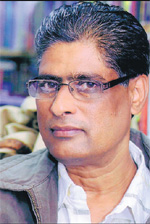
Tarikere, the Dean of the Languages Discipline at the Hampi Kannada University won the award for his work Kattiyanchina Daari.
The others who have been chosen for the awards are former union minister Veerendrakumar (Malayalam), Aurobindo Uzir (Bodo), Arun Sakhardande (Konkani), Gopi Narayan Pradhan (Nepali), Vanita (Punjabi), Mangat Badal (Rajasthani), Mithila Prasad Tripathi (Sanskrit), Laxman Dubey (Sindhi), Sheen Kaaf Nizam (Urdu), Bani Basu (Bengali), Esther David (English), Dhirendra Mehta (Gujarati), M Borkanya (Manipuri), Manoj (Dogri), Uday Prakash (Hindi), Nanji Nadan (Tamil), Keshada Mahanta (Assamese), Basher Bashir (Kashmiri), Ashok R Kelkar (Marathi) and Pathani Pattnaik (Oriya).
Tarikere told Deccan Herald: “I had authored this book in 2006 itself. The joy is manifold as the award comes at a time when Kannada University is celebrating the 19th ‘Nudihabba’. I dedicate the award to the university”.
source: http://www.deccanherald.com / Deccan Herald / Home> State / by New Delhi – Hospet / DHNS / December 20th, 2010
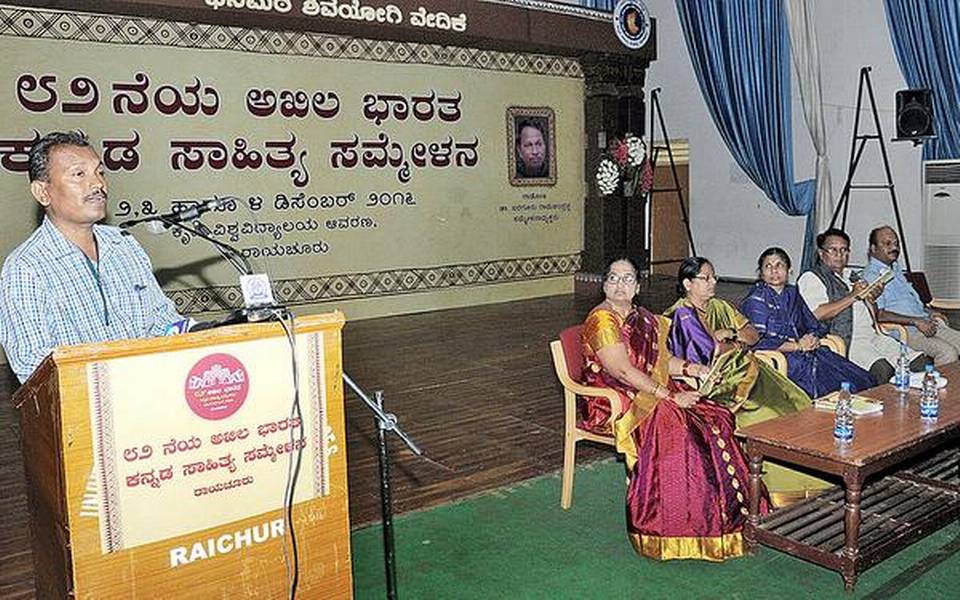
Dastagirsab Dinni, writer, speaking at parallel venue at the 82nd Akhila Bharata Kannada Sahitya Sammelan in Raichur on Sunday.
Terming triple talaq, restrictions on going to masjids, bigamy and other Islamic practices as shackles, Dastagirsab Dinni, a progressive writer, stressed the need for raising voices against Islamic fundamentalistic forces, for women’s liberation.
He was speaking on Muslim sensitivities in literature at a session on multiple dimensions of literature at the 82nd Akhila Bharata Kannada Sahitya Sammelan in Raichur on Sunday. The writer went on to point out prevalent anti-women practices which were indeed not preached by Prophet Mohammed.
“Prophet Mohammed did not oppose women offering prayers at masjids, but our fundamentalists are doing it. Muslim women are increasingly opposing the practice of triple talaq and bigamy practices. Some are even fighting against these anti-women practices in courts. Literature should voice their woes,” he said.
Pointing at the standard approach of fundamentalists towards progressive Muslim writers, Mr. Dinni went on to give a long list of Muslim writers who in one way or the other had to face the wrath of fundamentalism for their radical writing.
“Salman Rushdie, Taslima Nasreen, Sara Abubakar, Safeera, Bhanu Mushtaq and others Muslim writers were under attack from Islamic fundamentalists as they questioned the anti-women and other ill-practices of Islam.
“The attacks indeed gave rise to more resistance rather than curbing the existing opposition,” he said.
He added that Mumtaz Begum, Bolvar Mohammed Kunhi, Fakir Mohammad Katpadi, Ramzan Darga, Jameer Ulha Sharif, Rahamat Tarikere, Abdul Rashid and other Muslim writers have continued to question reactionary practices and resist the attack on freedom of expression.
He called upon young Muslim writers to continue the tradition of questioning fundamentalistic practices in Islam so that the process of emancipation of women could get quickened.
source: http://www.thehindu.com / The Hindu / Home> News> States> Karnataka / by Kumar Buradikatti / Raichur – December 05th, 2016
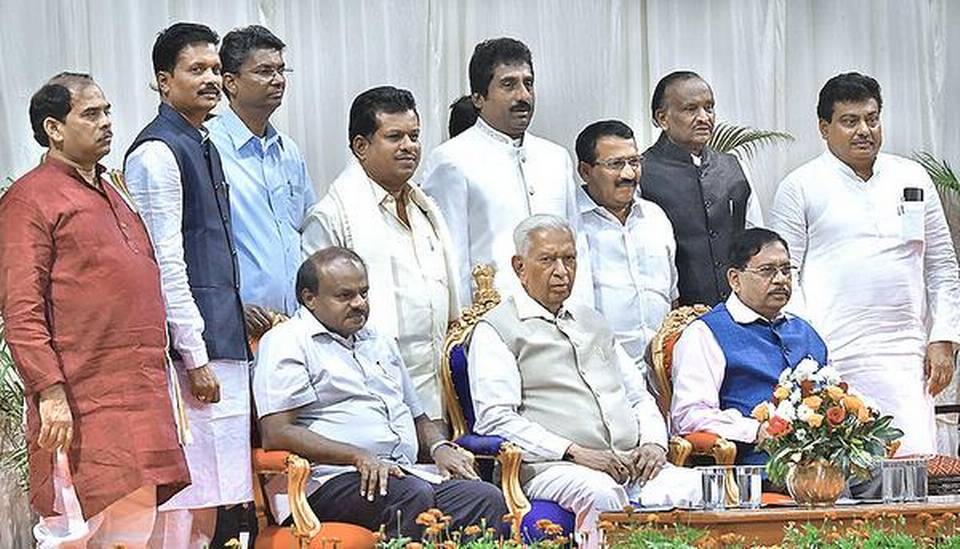
Governor Vajubhai Vala, Chief Minister H.D. Kumaraswamy, and his deputy G. Parameshwara posing for a photographs after the swearing in of eight new Cabinet Ministers at the Raj Bhavan in Bengaluru on Saturday.
R. Shankar, Ramesh Jarkiholi dropped from the Ministry
The long-awaited expansion of Karnataka Cabinet materialised on Saturday, with eight Congress legislators — seven of them hailing from the north Karnataka — being sworn in by Governor Vajubhai R. Vala.
While this fills the Congress quota in the coalition government’s Cabinet, Janata Dal (Secular) has chosen to keep its options open on its quota of two Ministers.
Ahead of the 2019 general elections, the decision of the Congress to give prominence to north Karnataka has assumed significance as the JD(S) is largely focussing on its electoral base in the southern districts of the State. This is also aimed at addressing the constant complaints of neglect of the people of north Karnataka.
While M.T.B. Nagaraj (Hoskote, Bengaluru Rural) is the lone MLA to become Minister from the southern part of the State this time, the other newly sworn-in ministers are M.B. Patil from Babaleshwar in Vijayapura district; R.B. Timmapur, MLC; Satish Jarkiholi from Yemkanmardi in Belagavi district; C.S. Shivalli from Kundgol in Dharwad district; P.T. Parameshwar Naik from Huvinahadagali in Ballari district; E. Tukaram from Sandur in Ballari district; and Raheem Khan from Bidar North.
All eight were administered the oath of office and secrecy at the Raj Bhavan in the presence of Chief Minister H.D. Kumaraswamy, Deputy Chief Minister G. Parameshwara and several Congress and JD(S) leaders. All eight are of Cabinet rank.
Forest Minister R. Shankar and Municipal Administration Minister Ramesh Jarkiholi have been dropped from the Ministry.
Protest
There were rumblings of discontent from some legislators not inducted into the Cabinet even as the oath-taking ceremony was on. Supporters of the Congress MLA, Ramalinga Reddy, protested near the Raj Bhavan to demand his induction into the Cabinet.
With the Ministry’s size fixed at 34, the Congress has filled its full quota (22) and the total strength of the Council of Ministers has increased to 32. Only two seats are vacant and both belong to the JD(S) quota.
Of the eight inducted, four have become Ministers for the first time. Mr. Satish Jarkiholi, Mr. Patil, Mr. Thimmapur, and Mr. Naik had served in the previous Siddaramaiah government.
Caste equation
The Congress struck a balance by providing fair representation to all major castes/communities. There are two Ministers from Kuruba community (Mr. Shivalli and Mr. Nagaraj), two from the Scheduled Castes (Mr. Naik and Mr. Thimmapur), two from the Scheduled Tribes (Mr. Tukaram and Mr. Satish Jarkiholi), one from Lingayat (Mr. Patil), and one Muslim (Mr. Khan).
To contain dissidence, the Congress has given postings to 31 legislators, including eight Ministers, nine parliamentary secretaries, and 19 heads to boards and corporations. The Congress has recommended to the government names of 19 MLAs to appoint as heads of various government boards and corporations.
The party has appointed three MLCs and six MLAs as Parliament Secretaries. Sharanappa Darshanapur, MLA for Shahpur in Yadgir, has been appointed as Deputy Chairman of the Planning Board.
Senior leader and former Minister H.K. Patil has been appointed as Chairman of the campaign committee of KPCC. He has replaced Minister for Water Resources and Medical Education D.K. Shivakumar.
Jewargi MLA Ajay Singh has been appointed as the special representative of the government in Delhi, while V. Muniyappa, MLA, is the Political Secretary to the Chief Minister.
source: http://www.thehindu.com / The Hindu / Home> News> States> Karnataka / by Special Correspondent / Bengaluru – December 23rd, 2018
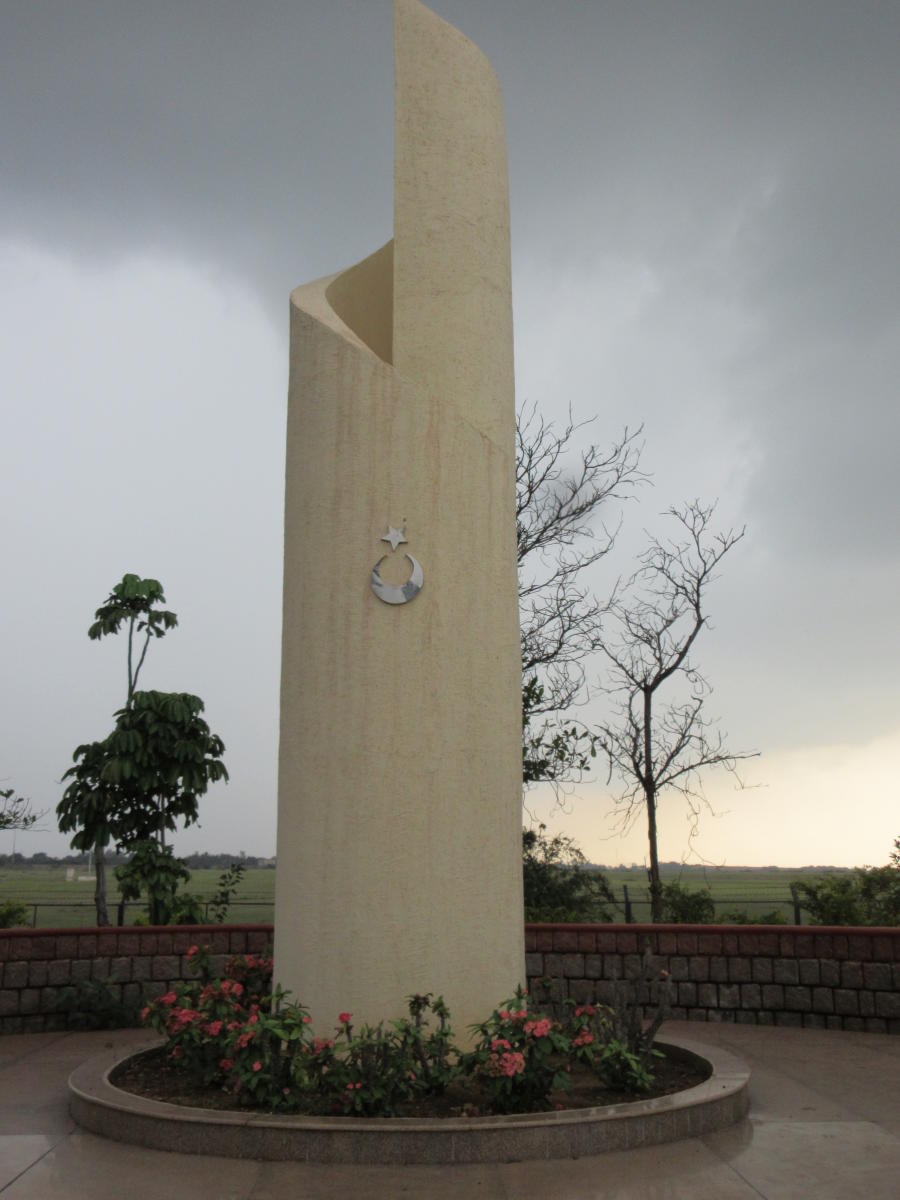
Before I set out on a journey to Turkey, I decided to visit the Turkish Martyrs Graveyard Memorial in Ballari, built in memory of Turkish Prisoners of War (PoW) of the First World War.
Turkish Memorial
The memorial is actually a spiral column built over a rectangular platform. Indian and Turkish flags flutter on both sides. The cylindrical spiral structure in white is surrounded by fountains, multi-coloured floral plants with Ashoka trees and rose plants on the border. The memorial is located close to the airport.
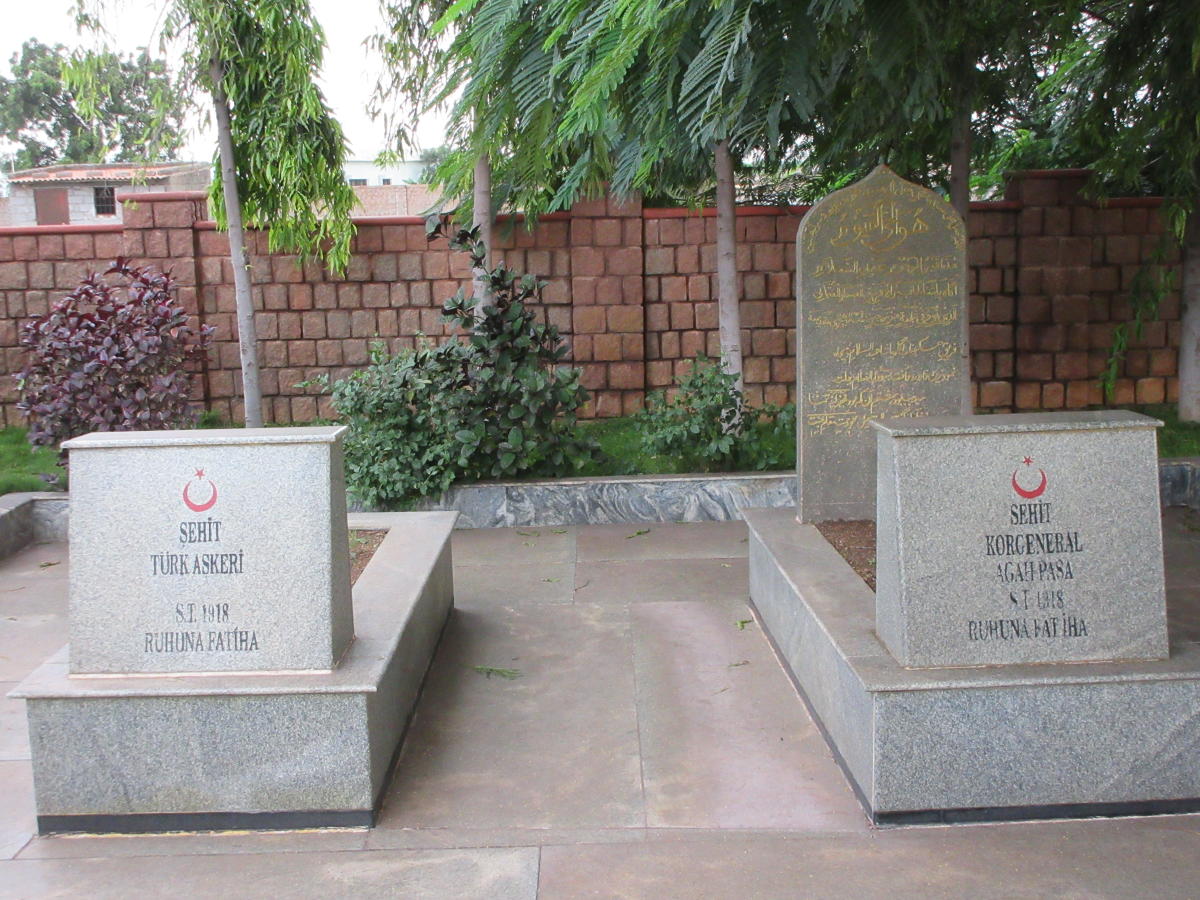
There are two marble-dressed graves on its left side. A memorial plaque on one of them refers to General Agha Pasha Abdussalam, the prince from the Ottoman ruling family of Turkey, buried there. The second one refers to Turk Askeri.
The epitaph on the memorial (it also has a Turkish translation) reads: “Here lie the Turkish martyrs brought to India in the year 1918 as prisoners of war during World War I from the Suez Canal front where they had fought. God bless them all.”
Turkey is a nation straddling eastern Europe and western Asia. Suez Canal is a sea-level waterway in Egypt connecting the Mediterranean Sea to the Red Sea through the Isthmus of Suez. And Ballari is in South India. These contradictions increased my curiosity to unearth the links.
A tale of tragedy and futility of war silently unfolded when I began digging deep into history. I realised that the memorial traces its roots to the brutal first world war.
Tale of tragedy
After about a century since the war ended, the memorial in Ballari stands tall silently reminding the greed of rich belligerents trying to get richer by inflicting large-scale violence, brutality and futility.
Austria and Hungary declared war on Serbia on July 28, 1914, over the assassination of a leader, triggering the first world war. A web of entangling alliances and the manoeuvrings of diplomats and generals dragged ambivalent nations into an unnecessary war.
The war pitted the Central Powers—led by Germany, Austria-Hungary and Turkey—against the Allies—led by France, Great Britain, Russia, Italy, Japan and the United States. The Allies won the war which claimed maximum lives in the history.
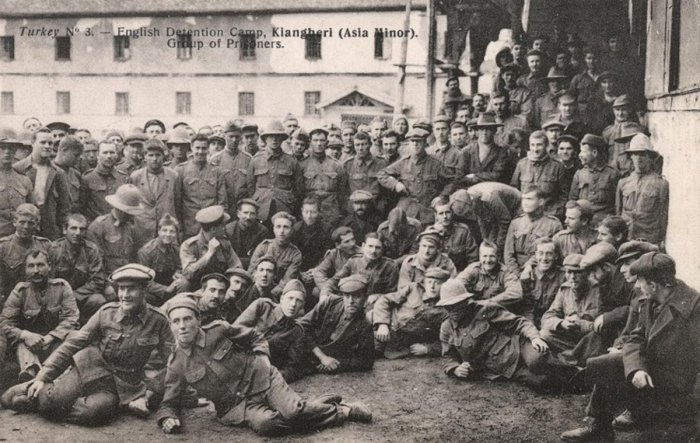
The Allies captured soldiers of rival forces, while soldiers of the Allies were taken captive by the Central Powers. About 1.5 lakh soldiers from Turkey were taken captive by the British forces. Turkey had detained 34,000 British soldiers.
The two sides had a common problem, lack of prisons to keep captive soldiers. And they were unwilling to keep rival soldiers in their motherland.
About 8,000 soldiers from Turkey, Germany and Austria, in British captivity, were placed in British colonies, in Egypt, India, Burma (now Myanmar).
Sumerpur in Rajasthan; Ahmednagar, Belagavi and Ballari in Bombay province; Kata Pahar in Bengal and Burma were chosen for the detention of prisoners.
Soldiers from Austria and Germany were interned at Ahmednagar, Christian citizens and women at Belagavi, and Turkey soldiers at Sumerpur, Ballari and Burma.
The British establishment shipped the prisoners from the port city of Basra in Iraq to Karachi and later sent them to Kolkata by train. One team was sent to Burma, while the second one to Sumerpur, Ahmednagar, Belagavi and Ballari.
The entire exercise was ironical and a large number of soldiers died on the way to Karachi from Basra. Hundreds of them were injured while being shipped. All these met with gory and gruesome deaths due to hunger, starvation and a lack of treatment.
Conflicting theories
Historians consider their journey as a procession of deaths. Many of them, who had survived starvation before reaching India, lost their battles against changing weather conditions and food.
Hundreds of them fell prey to infectious diseases as prisoners from different nations were housed collectively. In the Egyptian camps, a contagious eye spread relatively quickly blinding prisoners.
As many as 137 soldiers were kept at Allipuram Jail in Ballari. There are conflicting theories on how they died. One theory says a trigger-happy British officer massacred them en masse. The second theory quotes plague as the cause for the deaths.
Locals claim that there used to be hundreds of graves of Turkish soldiers in the area until the 1980s. A major part of the remains was erased during the expansion of the Bellari Aerodrome.
Commemorating sacrifice
The Turkish Embassy in Delhi negotiated with the Indian government for a memorial to commemorate the sacrifice made by the soldiers for the nation ten thousand miles away from their motherland. As a result, the Turkish Martyrs Graveyard came up in 1980.
Since then, the Indian and the Turkish flags are hoisted twice a year – on August 15 and January 26.
Details of Turkey soldiers in Ballari come from the lone report of Red Cross Society. A high-level committee at the Geneva convention in 1971 decided to send the Society teams for reports on charges of brutalities meted out to soldiers at camps.
A team visited Ballari, Egypt and Myanmar as part of the decision. The team members visited Ballari on March 17, 1971, and submitted a report regarding the medical facility, food, physical and mental health of the prisoners. The most common complaint from the prisoners was that they hardly heard anything from their family members.
Due to isolation, the futility of war and uncertain future, most of them became mentally ill. They had converted a hall meant for prayer to play games. They also used the hall as a coffee house, played Dice Chess Dominoes, consumed Turkish coffee without milk and demanded books in the Turkish language for reading.
In the end, the report expresses confidence that the Turkey soldiers would surely say that the British establishment took proper care of them in India once they reached their hometowns. However, it is not known even today if they returned to their hometown.
The ordeal of soldiers from England and India in Turkey prisons was no different. There are memorials all over the world commemorating sacrifices made by foreign soldiers. Most of these soldiers laid down their lives for the British imperialism.
These memorials never reveal why wars were fought; why soldiers were killed; why they were shipped and interned in different continents; what happened to their families after their deaths. These memorials also mirror inhuman acts of war.
(Translated by Jagadish Angadi)
source: http://www.deccanherald.com / Deccan Herald / Home> Spectrum> Spectrum Top Stories / by Rahamat Tarikere / December 19th, 2019