The 13th Kodagu district Kannada literary meet will be organised at government PU College premises in Napoklu on December 22 and 23, said Kannada Sahitya Parishat district president B S Lokesh Sagar.
He told reporters here on Thursday that Madikeri tahsildar Kusuma will hoist the National flag at 8 am on December 22. Napoklu gram panchayat president K M Ismail will hoist the Kannada flag.
Exhibition stalls will be inaugurated by CMC president Kaveramma Somanna at 11 am.
The formal inaugural programme will be held at Jagadatmanada G Maharaj Sabhangana at 11.30 am. Zilla panchayat vice president Lokeshwari Gopal will inaugurate the programme.
The main stage, ‘Mahabaleshwara Bhat Pradhana Vedike’ will be inaugurated by zilla panchayat president B A Harish. Kannada Sahitya Parishat state president Dr Manu Baligar will inaugurate the literary convention.
Bharadwaj K Anand Theertha will preside over the literary convention. MLA K G Bopaiah, MLC Sunil Subramani and MLC Veena Acchaiah will take part. Cultural programmes will be inaugurated by social worker Sanket Poovaiah.
ZP member Latif will inaugurate Janapadotsava at 9.30 am on December 23.
An open forum will be held at 2.30 pm. The valedictory programme will be held at 4 pm, said B S Lokesh Sagar and added that various literary events will be held on both the days.
Kannada Sahitya Parishat district honourary secretary K S Ramesh, taluk president Kudekal Santhosh and office bearer Kodi Chandrashekhar were present in the press meet.
source: http://www.deccanherald.com / Deccan Herald / Home> State> Districts / by Adithya KA / DH News Service / Madikeri – December 20th, 2018
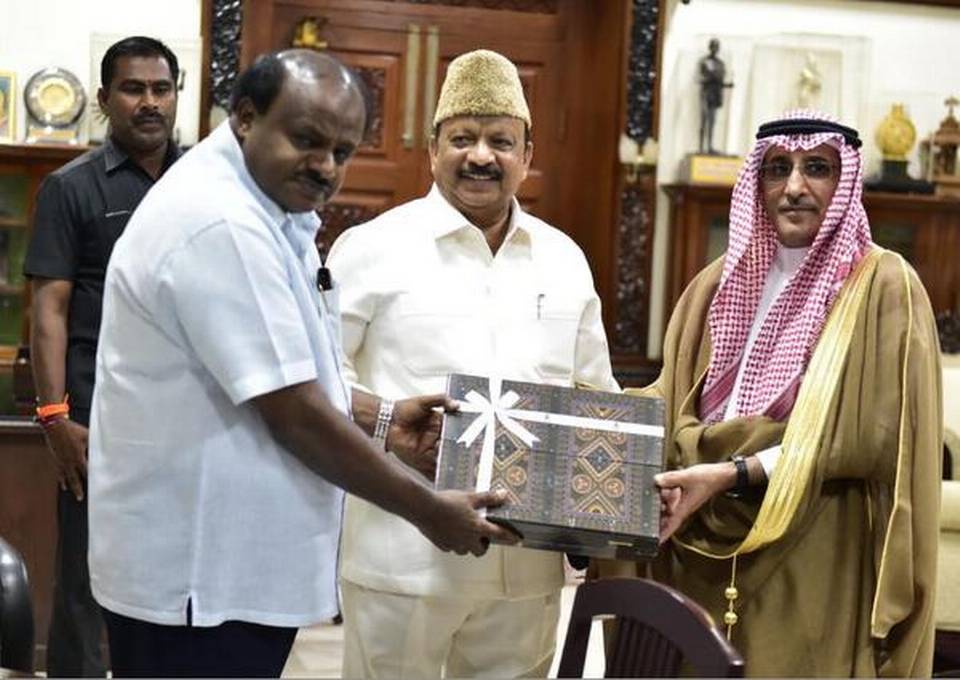
Saudi Arabia Ambassador to India Saud Mohammed Al-sati shared this information when he called on Chief Minister H.D. Kumaraswamy, along with Karnataka State Haj Committee Chairman and former Minister Roshan Baig, on Tuesday. | Photo Credit: the hindu
About a 100 years ago, a woman philanthropist from Bengaluru had set up a school for girls in Mecca, Saudi Arabia.
On Tuesday, many people in Bengaluru were in for a pleasant surprise when Saudi Arabia Ambassador to India Saud Mohammed Al-sati shared this information during a meeting with Chief Minister H.D. Kumaraswamy. The ambassador informed that they had all the records pertaining to the woman, named Saulath Unnisa, and expressed a desire to honour her family members if they could be located.
Karnataka State Haj Committee Chairman and former Minister Roshan Baig told The Hindu that they would try to trace the family. “These days, we take a five-and-a-half hours flight to Jeddah for Haj or Umra. But back then, pilgrims would have to take a ship from Bombay and sail for a fortnight to reach Mecca. It is a great contribution by the lady at that time,” he said.
Saudi consulate in city
Meanwhile, one of the long-standing demands of pilgrims and the large Kannadiga diaspora in Saudi Arabia for a consulate in Bengaluru could be fructifying shortly.
According to Mr. Baig, around 50,000 pilgrims travel from Karnataka annually for Haj and Umra. This is apart from a large number of people employed in Saudi Arabia.
The ambassador is learnt to have told Mr. Kumaraswamy that work on establishing the consulate is in progress, and it is waiting for approval from the Ministry of External Affairs. The ambassador said that the number of people seeking a visa to Saudi Arabia had doubled, and that it was the reason for opening a consulate. Currently, residents of Karnataka have to travel to Mumbai for the paperwork.
Mr. Kumaraswamy welcomed the move to open a consulate in Bengaluru, and also invited Saudi Arabian businessmen to invest in Bengaluru.
source: http://www.thehindu.com / The Hindu / Home> News> Cities> Bengaluru / by Special Correspondent / December 04th, 2018
Wipro Limited Chairman Azim Premji receives the highest French civilian distinction, Chevalier de la Legion d’Honneur (Knight of the Legion of Honour), from Ambassador of France to India Alexandre Ziegler, in Bengaluru on Thursday.
Azim Premji, philanthropist and Chairman of Wipro Limited, on Wednesday received the highest French civilian distinction, Chevalier de la Legion d’Honneur (Knight of the Legion of Honour) from Ambassador of France to India Alexandre Ziegler.
Speaking on the occasion at the Wipro campus, Ziegler said the award was bestowed on Azim Premji for his outstanding contribution to developing the information technology industry in India.
“Also, for his economic outreach in France, and his laudable contribution to society as a philanthropist through the Azim Premji Foundation and Azim Premji University,” he said.
TheLegion d’Honneur , instituted in 1802 by Napoleon Bonaparte, is the highest civilian award given by the French Republic for outstanding service to France, regardless of the nationality of the recipients.
The President of the French Republic is the Grand Master of the Order of the Legion of Honour.
In his acceptance speech, Premji said he is extremely honoured by the award bestowed on me. “The vibrancy of the French democracy and its diversity is an inspiration to all across the world,” he said.
Wipro’s association with France spans over 15 years and the company enjoys a close relationship with several French organizations. Nearly 65% of Wipro’s employees in France are locals.
France is a key market for Wipro and the company is committed to continues investments there. Large French digital companies already have a strong footprint in India, employing over 1.3 lakh people at their R&D centres and facilities.
source: http://www.deccanherald.com / Deccan Herald / Home> Business> Business News / by N.V. Vijayakumar / DH News Service, Bengaluru / November 28th, 2018
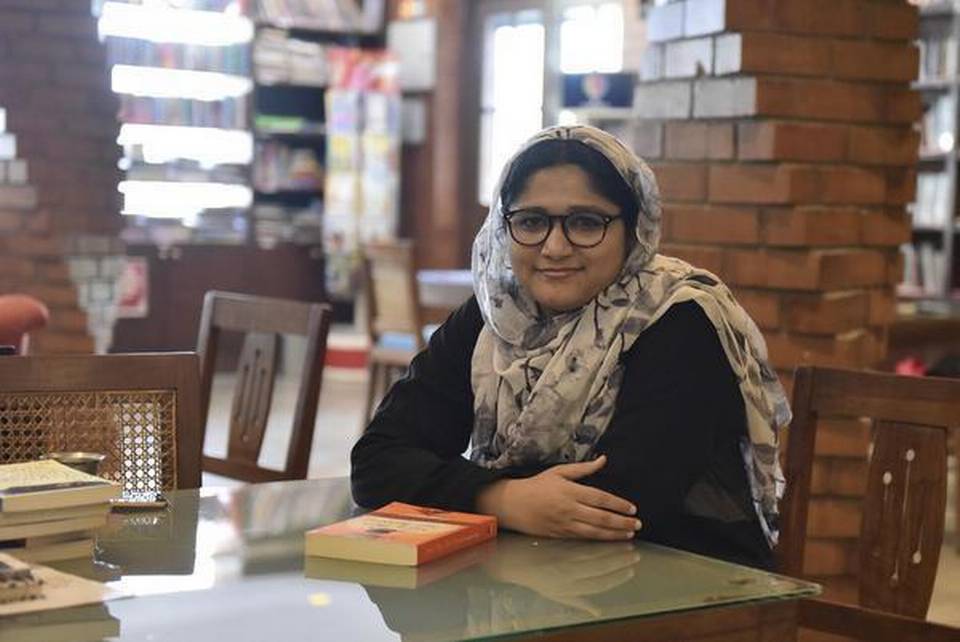
Relatable ‘I wanted to write stories about people like you and me.’ | Photo Credit: Poornima Marh
‘My characters’ Muslimness is secondary to the story’
Andaleeb Wajid is a household name in Bengaluru, with a large oeuvre —18 novels and counting — that spans genres like Young Adult, romance, sci-fi and horror. Recently, a couple of her books have been optioned by film production houses. Wajid started off with slice-of-life stories about young Muslims but has broadened her scope with each book. Over the years, she has honed her craft well but is still writing from the heart. Excerpts from an email interview:
You are one of the most prolific published authors in the country today. What drives your pace and output?
I write constantly and consistently. After I wrote my first novel Kite Strings, I took a break, waiting for it to get published. When that happened three years later, I realised I’d been an idiot not to have been writing in that time. So I got down to writing continuously, making up for lost time!
Does contemporising your stories with its mainly Muslim milieu come easy or do you work at setting up and sustaining a specific atmosphere?
The Muslim milieu part was not deliberate at first, I was just writing stories from the lens through which I perceived the characters. But things changed along the way. If you read my earlier books like My Brother’s Wedding and the more recent ones like The Crunch Factor or Asmara’s Summer, there’s a decided shift in the way my heroines behave and think. There is lesser assimilation of what society expects and more assertiveness in the characters. This was a deliberate choice. I wanted to write stories everyone could relate to, and not just a ‘this is what happens behind closed doors in Muslim houses’ story which exoticises and otherises Muslims.
You are a publisher’s dream because you play a major part in promoting your work on social media and off it. Is this part of the job for you?
Well, I like to be involved in all the aspects of publishing because, at the end of the day, I want more peopleto read my books. I’m happy that there are new mediums available today to promote books.
It’s a combined effort — publishers have social media teams who come up with some excellent book-related creatives, and I try to push them as much as I can, on the different platforms I’m comfortable with.
The Muslimhood of your characters is kept light… is this deliberate?
Yes. My characters’ Muslimness is secondary to the story and sometimes, even incidental. Some of my recent books (It Waits, Night at the Warehouse) don’t have Muslim characters at all because I think the story comes first, everything else is secondary.
Continuing with Muslimhood, there is no mention of the problems Muslims face today in any of your books. The conflicts are all internal, not external. Would that be a conscious decision to steer clear of controversy?
To be honest, I haven’t given this much thought. I wanted to write stories about people like you and me. I’ve lived quite the cocooned and privileged life and have not faced the amount of discrimination others have faced. Maybe that has shaped my consciousness into writing narratives that are ‘normal’ rather than filled with conflict. Then, I don’t like controversies because at the end of the day, I don’t want anything to come in the way of my writing.
“I am flabbergasted when I meet with questions like, why didn’t you write this book in Urdu? How come you wear a burkha? There seems to be a big disconnect between my work and my personal appearance.” This is what you had told me years ago, in an interview for your first book, Kite Strings. Have things changed for you since then? Or have you changed?
Both. Things have changed because I think people have stopped seeing my burkha when they see me, which is what I’d wanted all along — people to focus on my work and not my appearance. I too have changed in the sense that I’m more tuned in to the world around me, especially in the current political climate. If I don’t feel comfortable wearing a burkha somewhere, I don’t. The choice is mine and it always has been, actually. I just didn’t know that with as deep a conviction as I know it now.
Tell us about the MAMI Word to Screen sessions you attended last year and this year.
MAMI Word to Screen is a great opportunity for content creators from films and web series to learn about authors and their books. Two of my books were shortlisted last year and I had to pitch them on stage, for producers and content creators. I went in with no idea of anything and came back having learned quite a bit. This year, my books were only longlisted, which meant I didn’t have to do the stage bit but could still meet producers and others who showed interest. Seema Mohapatra’s StoryLoft Productions has already optioned Asmara’s Summer and The Crunch Factor to adapt for web and feature film, and there’s been a lot of interest from platforms and production houses like Netflix, Amazon, Sony Pictures, etc. Apart from these, a few production houses like Hotstar, Jio have picked up some of my work for reading and evaluation; but of course, these things take time.
What’s up next?
As of now, there’s House of Screams, which was published by Penguin Random House last month. I have a romance novel, A Sweet Deal, which will be published by Fingerprint next year. I’ve pitched a couple of ideas to my publishers and I’m waiting for the go-ahead before I can start working on them.
The interviewer is a manuscript editor and novelist based in Bengaluru.
source: http://www.thehindu.com / The Hindu / Home> Books> In Conversation / by Sheila Kumar / November 10th, 2018
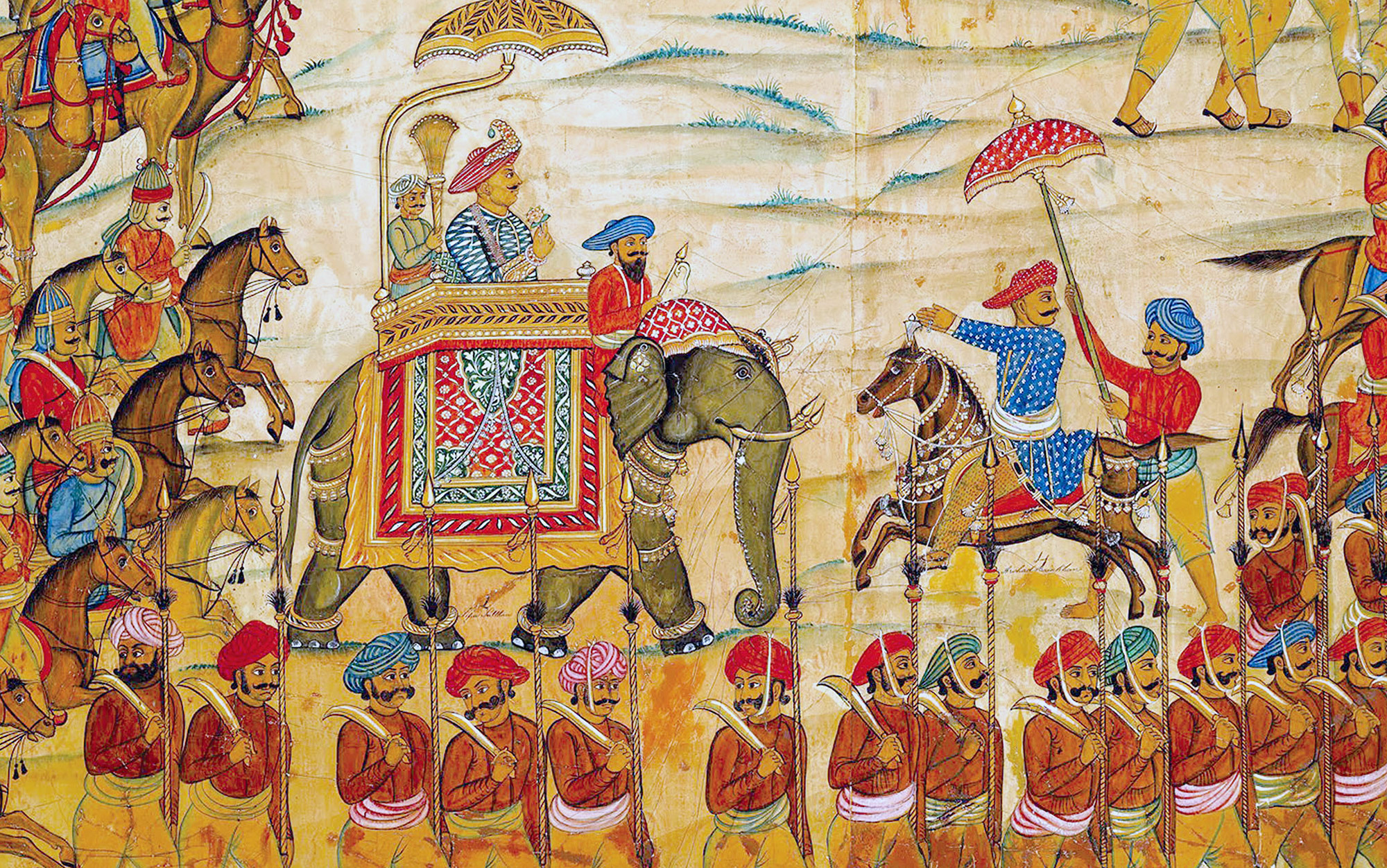
Tipu Sultan, son of Haider Ali, on an elephant in a detail from ‘The Battle of Pollilur’, 1780, a mural at Daria Daulat Palace, Seringapatam. Photo by Bridgeman Iages
If the sultan of Mysore had had a bit more luck, George Washington might be known as the Haider Ali of North America
If the sultan of Mysore had had a bit more luck, George Washington might be known as the Haider Ali of North America. As the ruler of Mysore, a kingdom in what is now southwestern India, Haider fought a series of wars with Great Britain in the latter half of the 18th century, at the onset of the Age of Revolution. While Haider was fighting his last battles against the British, Washington was leading the forces of the nascent United States from the harsh winter at Valley Forge to the final victory at Yorktown.
The circumstances of Haider’s childhood did not seem to mark the young man out for greatness. Born around 1720, Haider soon lost his father, a mercenary officer who died on campaign. Haider followed his father’s path, becoming an officer for the Wodeyar dynasty that ruled Mysore. After many years of service, he grew indispensable to the ruling family, sidelining it entirely by the 1760s. It was a dangerous time to come to power in South Asia. The British East India Company was expanding its power throughout the Subcontinent, at the expense of rulers from Bengal in the east to Haider’s neighbours in the south. Allied with France, however, Haider held off the British advance for another two decades, dying in 1782, just a year before the US triumphed in its own rebellion against Britain.
Haider and Washington never communicated directly with one another, but they fought against a common enemy, and shared a common ally. Like the Mysoreans, the American rebels were members of a global coalition funded by the French government, which saw both uprisings as a chance to humble Britain. In the Seven Years’ War (1756-1763), Britain had ended nearly a century of conflict with its imperial rival in North America by seizing France’s vast territories in Canada and the Mississippi River Valley. Some French observers tried to minimise the extent of the defeat. Voltaire dismissed loss of North America as ‘a few acres of snow’. Yet French policymakers were well aware that Britain had greatly increased its power. Too weak to confront it again on its own, the French government wove a network of alliances, playing on resentments against Britain’s growing control of global trade and rapidly expanding empire. Beginning in the mid-1770s, it sent money and military advisors to both Mysore and the US, aiming to avenge its defeat by stoking colonial rebellions against Britain.
The alliance with France proved critical to the survival of the fledgling US. The memory of French aid, and particularly of the dashing Marquis de Lafayette’s assistance to Washington, has for more than two centuries served as a symbolic origins story of close Franco-American relations. During the Revolutionary War, however, Americans saw themselves not just as allies of France, but as part of a coalition that included Mysore.
Even after the US made peace with Britain in 1783, the American fascination with Haider and his son and successor, Tipu Sultan (1750-1799) lived on. Mysore’s rulers became familiar references in American newspapers, poems and everyday conversation. Yet, within a generation, Americans lost their sense of solidarity with the Indian Subcontinent. Mysore remained under British control, written out of the story of the American Revolution. The US turned its attention to the interior of North America, and to becoming an imperial power in its own right.
Even before the Revolutionary War, American interest in South Asia was lively. In fact, Americans’ rebellion against Britain in part grew out of the connections between America and the Subcontinent. Before the 1770s, Americans were cheerleaders, rather than critics, of British imperialism. The Philadelphia-born poet Nathaniel Evans (1742-1767) commemorated the victory of the East India Company at the Battle of Plassey in 1757, in which Robert Clive had seized control of Bengal:
The world to British valour yields
How has bold Clive, with martial toil
O’er India born his conqu’ring lance?
Sharing in Britain’s glory in this way seemed natural to Americans, who were proud to be part of the British Empire. The East India Company’s growing influence in Bengal enabled it to export large quantities of South Asian goods, particularly textiles, to American ports such as Boston and Charleston. Colonial elites displayed them in their homes with pride, signs that they were part of a global British empire growing rich from the spoils of the Subcontinent.
While Americans were free to purchase these imperial commodities, they were not free to join British merchants in South Asia. Britain’s colonies served to provide the motherland with raw materials. They were not supposed to have direct economic relations with each other, but rather to send their exports to the great trading centre of London. New England merchants in particular resented being pushed to the side of the mercantile system. Following military victories by the East India Company in South Asia, the company’s economic power within the British Empire, including North America, grew even greater, and so too did New England merchants’ resentment.
In 1773, the British government issued the Tea Act, a bill in effect subsidising the East India Company so it could sell tea to North America more cheaply than any other company. The Tea Act was meant to save the Company’s struggling finances, which were sinking under the cost of its expensive wars. By allowing the Company to sell its tea without paying the heavy taxes normally due on tea exports to the colonies, British officials thought they could help the Company while also keeping Americans happy. Because of the taxes levied on it, tea was expensive in the colonies, and tea-loving New Englanders often resorted to buying theirs on the black market. If the Company no longer had to pay these taxes, it could pass the savings on to thirsty American consumers.
Seeing themselves as victims of Britain’s imperial oppression, Americans sympathised with the empire’s other victims: South Asians
The colonists, however, did not respond as the British expected. By granting the East India Company an exemption from the tax, Parliament had confirmed that the tax on tea, passed without Americans’ consent, was there to stay for all other merchants. And the smugglers that the British government hoped to cut out of the tea business were influential members of New England society. On 16 December 1773, economic self-interest combined with principled opposition to taxation inspired a group of protestors to attack a Company shipment of tea, dumping its contents into the ocean.
The Boston Tea Party marked Americans’ growing opposition to British rule, and the beginning of a new perspective on South Asia. The British government retaliated by stripping Massachusetts of its right to self-government. Outraged colonists met in 1774 to form the First Continental Congress. The following year, armed conflict between colonial militias and British soldiers broke out at Lexington and Concord, and the American Revolution was underway. Americans started to see themselves as victims of Britain’s imperial oppression. They were soon sympathising with the empire’s other victims, particularly South Asians.
The American revolt against Britain quickly took on international dimensions. In 1776, the Continental Congress declared independence, transforming the former British colonies into the United States of America. American agents were soon busy seeking international recognition and goodwill from countries including Morocco, the Netherlands and, most importantly, France, Britain’s imperial rival. Within a year, the French government began sending aid to the fledgling US. A year later, in 1778, France and the US officially became allies.
The Continental Congress recognised that it was not France’s only partner against Britain, and looked for ways to cooperate with Mysore, France’s South Asian ally. In 1777, on the advice of Thomas Conway, an Irish-born French military advisor, the American patriots contemplated sending troops to join the French military expedition to the Subcontinent. The provisional American government lacked the resources for such a scheme, so instead it encouraged American privateers to attack the East India Company’s shipping to weaken Britain’s economic grasp on South Asia.
Different state governments also made friendly gestures toward Mysore. In 1781, the Pennsylvania legislature commissioned a warship named theHyder-Ally, an eccentrically spelled tribute to the Sultan of Mysore. This ship sailed the North Atlantic only, far from the Indian Ocean. Its existence, however, demonstrated the affinity American elites felt for Mysore’s cause. Philip Freneau, an ally of Thomas Jefferson and one of the country’s leading poets, wrote a poem in honour of the Hyder-Ally and its namesake, the sultan of Mysore:
From an Eastern prince she takes her name,
Who, smit with freedom’s sacred flame
Usurping Britons brought to shame,
His country’s wrongs avenging.
Clearly, nothing prevented these 18th-century Americans from seeing faraway Asian peoples as exemplars of liberty.
Despite Freneau’s optimistic vision, freedom’s sacred flame did not save South Asia. By the early 1780s, it was becoming clear that Britain would lose the war. Many Americans happily imagined a post-war world in which the East India Company would no longer be a significant force. Britain, however, managed to hold on to its territory in the Subcontinent, resisting the combined forces of Mysore and France.
France’s military support for Mysore and the US helped drive it into crippling debt and push French society toward its own, more radical revolution. Meanwhile, Britain’s finances survived the conflict intact, allowing it to continue an aggressive policy in the Subcontinent after 1783. The cash-strapped French, however, could maintain only a token military presence in the region. The situation left Mysore’s new ruler, Tipu Sultan, to his own devices. He resisted mounting pressure from the British for nearly two decades, succumbing only in 1799. He died beneath the walls of his citadel as he fought a last-ditch battle against the East India Company.
The American government adjusted to the new realities of South Asian politics. New England merchants eagerly sought to trade directly with the Subcontinent. In the first years after the end of the Revolutionary War, they relied on the French colony of Pondicherry on the southeastern coast of the Subcontinent as a port. They soon realised however that they could not enter the region’s most lucrative markets without the permission of the British East India Company. They lobbied for the establishment of American consulates to foster goodwill for American interests. Responding to their pressure, the US government created its first consulate in South Asia in 1792, in Calcutta. Two years later, in Madras, they added another. American consuls in the region were responsible only for relations with the Company. They had no contacts with independent South Asian states such as Mysore, which the American government, like the French, left to fend for itself.
Only recently an enemy of the British empire, America had won independence and become Britain’s junior partner in empire
On a state level, American interest in Mysore disappeared. But many Americans remained fascinated by Haider Ali and Tipu Sultan. When Tipu sent a team of ambassadors to Paris in 1788, in an unsuccessful attempt to restore the Franco-Mysorean alliance, Jefferson, then the American minister to France, reported on the event with keen interest. Like Jefferson, a wide range of Americans were eager to learn more about Mysore. American newspapers of the 1780s and ’90s reported on the country’s desperate struggle with Britain. American textbooks, including Jedidiah Morse’s influential The American Universal Geography (1793), included sections on Mysore. Haider and Tipu seem to have approached the status of household names. In Williams vs Cabarrus (1793), a lawsuit brought before a circuit court in North Carolina, the two parties disputed a wager made on a horse race. One of the horses was named ‘Hyder Ali’ in tribute to Mysore’s former ruler.
Even in the wake of Tipu’s final defeat, in 1799, his struggle for an independent Mysore continued to echo in the imagination of Americans. In his sermon on 4 July 1800, John Russell, a Baptist minister in Providence, warned his audience about the dangers of British imperialism. While many Americans, such as Alexander Hamilton, advocated for closer ties to Britain, Russell insisted that Britain could not be trusted. The ultimate example of British injustice, he argued, was its conquest of Mysore. Deeply moved by what he saw as Tipu’s heroic resistance, Russell told his congregation of Tipu’s death at the hands of British soldiers: ‘here the full heart must have vent… [Tipu Sultan] defended his power with a spirit which showed he deserved it. His death was worthy of a king.’
For Russell, Tipu’s end ought to warn America about the mortal dangers of empire. By the early 19th century, however, America had embarked on its own imperial project. American missionaries fanned out across North America, travelled to the Levant, and poured into South Asia, writing glowing reports back home on the work that the British were doing to ‘civilise’ the world, including the Subcontinent. Only recently an enemy of the British empire, America had won independence and become Britain’s junior partner in empire.
American diplomats, merchants and missionaries in South Asia accepted Britain’s empire in South Asia, working alongside it to profit from local trade or proselytise to potential converts. Over the following decades, foreign policy officials, commercial interests and religious groups pushed for the US to acquire a colonial empire of its own. Just like the British empire Americans had once rebelled against, the US became an imperial power, with colonies stretching from Puerto Rico and Guantánamo in the Caribbean to the Philippines in the Pacific.
Today, with military bases in more than 70 countries across the globe, the US remains an empire. Yet, the generation of Americans who fought for independence from Britain and laid the foundations of America’s identity saw the US as an anti-imperial cause and nation. The founding generation and the children of the founders were fascinated with Mysore and its leaders because they thought Haider Ali and Tipu Sultan embodied American values of resistance to empire and aspiration to freedom. If later generations of Americans had continued to see Haider and Tipu as heroes, had continued to identify with underdogs and anti-imperial causes, then the US, and indeed the world, might look quite different today.
source: http://www.aeon.com / Aeon / Home> Essays / by Blake Smith / Edited by Sam Haselby / December 07th, 2016
___________
Blake Smith is a postdoctoral fellow at the European University Institute in Florence, Italy. His research, focusing on the French East India Company, has appeared in scholarly journals such as French Cultural Studies and the Journal of the Economic and Social History of the Orient, as well as popular media such as The Wire and The Appendix.
Impressed by the culinary skills of a Mangalurucook, Karnataka minister gifts a cash of 25,000 as a tip and a pilgrimage to holy Makkah to perform Umrah.
According to reports, the Minister for Food and Civil Supplies BZ Zameer Ahmed Khan on Thursday (October 18) was in the coastal district for an official review meeting.
He went to ‘Fish Market,’ a seafood restaurant in Lower Bendoor for lunch along with the President of Wakf Committee UK Monu, Former MLA Mohiuddin Bawa and UT Iftikhar Ali, brother of minister UT Khader.
Haneef Mohammed, the 48-year-old chef and co-owner of the restaurants served the minister the local delicacies such as stuffed Pomfret and Green Tawa Pomfretalong with rice preparations.
Such was the flavour and aroma of the sumptuous meal that the minister made the cook sit next to him, fed him a mouthful from his own plate.
“As I entered, the minister greeted me warmly. He made me sit next to him, fed me a mouthful of food and told me that he had never eaten such an appetising course of fish,” said the father of six, reported TNM.
Post lunch, he promptly handed over a hefty tip of Rs 25,000 to Haneef with a promised that he would pay for his Umrah(Islamic pilgrimage) as well.
Haneef, who has been a chef for the last 18 years, serving fish as his speciality said he never come across by such benevolent offer.
He distributed Rs 25,000 out of the tip to all the employees at his restaurant.
The legislator, who holds the post of Minority Welfare alongside the portfolio of Hajj and Wakf, famed for his generosity.
source: http://www.siasat.com / The Siasat Daily / Home> Bangalore> Featured News> News> Top Stories / by Safoora / October 23rd, 2018
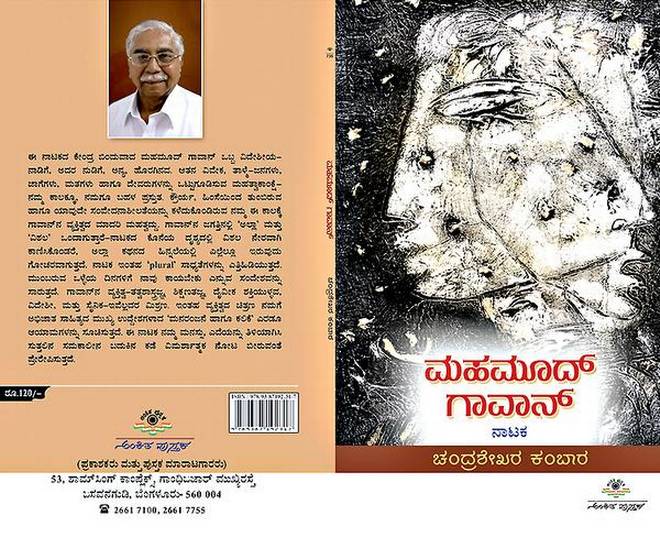
Chandrashekhar Kambar’s new historical play, Mahmoud Gawan, based on the life of the merchant who arrived in Bidar and later became the Prime Minister of the Bahmani Sultanate, will be released on Sunday
The word “global” is something that we come across not infrequently in literary discussions in recent times. It seems to be used in a very complimentary manner too. When we study it more closely, we see its multiple uses, ranging from the highly complimentary to the particularly disturbing connotations (especially, in the political and economic aspects of the so-called “globalization” phenomenon). Depending on the context, the philosophy implied in this use is vastly interesting.
In this context, dipping into pardonable autobiography, I must confess that my early acquaintance with the kind of writings I found in Chandrasekhar Kambar (this was back in 1964) was very new to my navya taste-buds of those days. This was around the time he wrote HelatiniKela . But, by the time Jokumaraswami arrived, I had begun to sense the fascinating spread of his literary intentions. The play seemed to insist on a message of passion (closely related to sexuality, the body, as well as the body politic!). The legitimacy of this passion was far more powerful than any petty legal correctness, or any mundane understanding of what constitutes the “moral” in our society. I was of course reminded of Lawrence. Kambar was utilizing passion as a powerful motive-free force, and constantly pushing at obstructions in its way. I became an avid follower of Kambar’s growth as a writer. His use of “sexuality” as a central and powerful theme and his struggle out of its grasp.
The latter part of his career witnesses an attempt to cover areas of creativity which could not be accommodated inside the constrictions of this strong force (note, however, a sliver of this sexuality is noticeable even in his latest play,Mahmoud Gawan ). I would assert that it is this constant and consistent presence which turns all of Kambar’s writing into his legitimate oeuvre.
Here was a writer, who, on the one hand was close to the North Karnataka folk and at the same time could engage the political and the modern predicament of our lives. You see this everywhere beginning from Helatini Kela , Rishyashringa , or Jokumaraswamy to the recent works like Shikharasoorya , Shivana Dangura orMahmoudGawan . I would like to go back to what I began with, the idea of the “global” in relation to Kambar’s works. In what sense is Kambar global? It is true that at least in one of the recent novels globalisation and neo-colonialism figure predominantly (in Shivana Dangura ).
Could we try to identify an effort, more indirect, and subtler perhaps, to highlight an earlier moment in history, a moment that marked the international and inter-cultural ferment that characterised North Karnataka in his play, Mahmoud Gawan ? Interestingly, the choice of language in Gawan is not the kind of North Karnataka folk that Kambar worked with in say Helatini Kela or Jokumaraswami. I would describe the language of Gawan as Kambar’s idea of “neutral” Kannada, a conscious avoidance of the folk dialect. Again, look at the choice of the central figure in this play, Gawan. Hee is a foreigner, a non-Kannada person. He enters the world of Bahamani politics in the North Karnataka of fourteenth and fifteenth centuries. All these, I would venture to suggest, point towards a movement, a possibility, beyond the strictly local and Kannada contexts. In other words, Kambar is found testing his talent in handling something beyond what could be identified as exclusively Kannada, Karnataka. The significance of this kind of language use is for Kambar like playing a field without his arch-player—the folk tongue! Does he succeed in working this language, playing in this new field? Perhaps in a manner that is different from say Jokumaraswamy , where he is using sexual passion in order to design and project the drama experience, he is trying to move into other spaces in which his choice of an “other” Kannada could function adequately. This kind of language lends itself more easily to translation across other linguistic contexts. The absence of localism in itself is a strong pointer towards achieving such a global presence.
Could we simply say perhaps that Kambar moved from passion to politics—apparently, it seems so. This also begs the question, why? It is my opinion that an author like Kambar, a writer of immense literary imagination, constantly feels the need to move out of his familiar area of creativity and attempts to work in other new areas. As a result, politics becomes the main driving force in a play like Gawan . Overall, he succeeds in creating a layered experience of such historical and political play-fields. In Gawan , you see an extension of the literary Kambar, of Kambar’s entire literary oeuvre. And to say that is to acknowledge a serious happening in contemporary Kannada literature.
Finally, I invite my reader to look at Mahmoud Gawan, the protagonist. Here is a foreigner, theoretically foreign to the land and its language. His wisdom and his calming presence, his overarching ambition to unite people, places, religions, and gods—these are things crucially and painfully relevant to us and our times, times of cruelty and abhorrent insensitivity. In times where you see the cream of the population failing to respond to the degradation of all that is human, all that is noble and valuable in human experience.
In Gawan’s cosmos, Allah and Vitthala still fuse brilliantly—one as the implied presence and the latter as the explicit presence in the final scene. The play moves towards a certain sense of legitimization of this conclusion, the hope of better times to come. In a way, the encompassing presence of Gawan—the philosopher, educator, the saint, foreigner, and a soldier—should take us back to the classical idea of the function of literature, what literature should do—“to educate and entertain.” A closer look at the play would also perhaps clear our hearts and minds, making us look around at our own times with a sharply critical eye.
(Mahmoud Gawan by Chandrashekhar Kambar will be released on October 28 at 10. 30 a.m., Indian Institute of World Culture, B.P. Wadia Road, Bangalore).
(The author is a critic and musician of repute)
source: http://www.thehindu.com / The Hindu / Home> Features> Friday Review / by Dr. Rajeev Taranth / October 26th, 2018
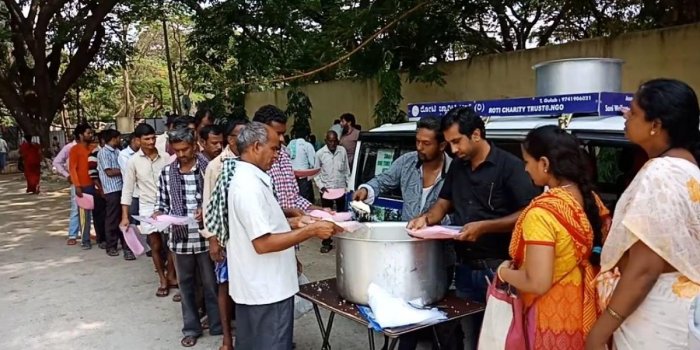
Syed Gulab, an automobile spray painter by profession, is a saviour for many who live on the pavement outside NIMHANS and nearby hospitals.
He has been serving free lunches to over 300 people for the last two years.
People come from across the country to admit their family members at these hospitals.
But with very little savings they tend to skip meals for days to afford the treatment at the hospital. The hospitals only provide food for the patients and not their family. Unable to afford accommodation the relatives also sleep on the pavements or sheds outside the hospital. Pained by this scene while visiting a relative at a hospital in 2015, Gulab started serving the meals.
“The sight would pain me and I wanted to do something about it,” said Gulab who has set up the Roti Charity Trust for carrying out the initiative.
Gulab started it with the support of some of his friends. “We started by serving lunch on Sundays as the nearby hotels would remain closed at noon. I was inspired by Azhar Maqsusi from Hyderabad who has been feeding destitute people every afternoon for the last six years in the Old City,” he added.
When Maqsusi met Gulab on his visit to Bengaluru he was impressed by the initiative and said he will also support Gulab. He then started sending 30 bags of rice weighing 25 kg each to Gulab every month.
“It was due to his encouragement and support that we were able to make it a daily service,” Gulab added.
Gulab has now rented a small house near Jayanagar to store his materials. The lunch is cooked by 1 pm and a van takes the food to the hospital to be served by 2 pm.
They started serving breakfast — idli and chutney — a few months ago.
Gulab said they have never sought for donations but many people have come forward with donations.
Sharath Kumar from Kolkata has admitted his child at the Indira Gandhi Institute of Child Health for a kidney disease for the last two months. “Gulab is a blessing in disguise. It is because of him that people like me are able to get our meals,” Kumar said.
source: http://www.deccanherald.com / Deccan Herald / Home> City / by Aparna Karthik, DH News Service, Bengaluru / October 20th, 2018
Nusaiba, the sole working woman from her family, runs her own boutique on Commercial Street. A fan of Sabyasachi and Manish Malhotra, she was once recognised as a homemaker alone, but today aims to turn her designs into a brand one day. Her journey till this point, she claims, has been a result of maintaining a fine balance between her household expectations and her passion for her dreams. “My kids were young and I had to attend classes to learn more about designing. It was tough but I had my mind set on opening a boutique, so I managed it,” she recalls.
One of Nusaiba’s designs
Now, she says, her kids are proud of her. “Their school bus passes by my store. They feel happy to tell their friends that this is their mother’s store. On the opening day, my daughter struck off my occupation as ‘housewife’ and wrote ‘fashion designer’ in her school diary.”She also goes on to give credit to her family members, saying, “My husband, a businessman, is a great support. All my family members are supportive,” she adds.
Popularly known as Dadu, the passionate fashion designer has named the boutique on Promenade Road after this nickname. “My customers ask me about the name of the boutique. They say it is intriguing,” Dadu says with a smile.Speacialising in Indo Western wear, Dadu provides customised services. “I discuss client requirements and design the attire accordingly. I show them my colour charts and once it’s all finalised, we work on designs. I give my suggestions and draw them out for my customers,” she explains.
It takes Dadu two weeks to complete an order. “It takes time because we source fabrics from Kolkata and Mumbai. We source white fabrics, dye them to the client’s preferred colour, and then polish them,” she says. Behind this successful woman, is a team of 15 who aid her.
“Only after the trial is done and the fitting is right, we deliver the order,” she says, adding that she always maintains client relationships even after orders are delivered.On an average, she gets at least four to five orders a day. “We have many regular customers. I have customers from the UK and the US as well, who have liked the designs I share on social media, and have gotten in touch with me. I have been getting a good response,” she says.
Dadu is a diploma holder in fashion designing, with a one-year diploma course in Calicut and another 1.5 year diploma course in Bengaluru. With the sky as the limit for her dreams, she is planning to expand her venture to Kochi, Hyderabad and Chennai in two years.
source: http://www.newindianexpress.com / The New Indian Express / Home> Cities> Bengaluru / by Akhila Damodaran, Express News Service / October 23rd, 2018
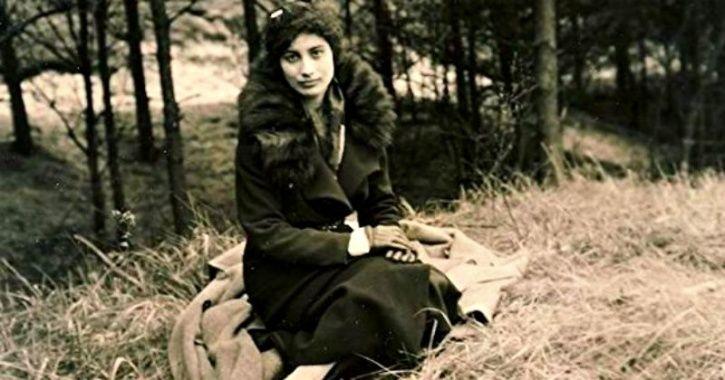
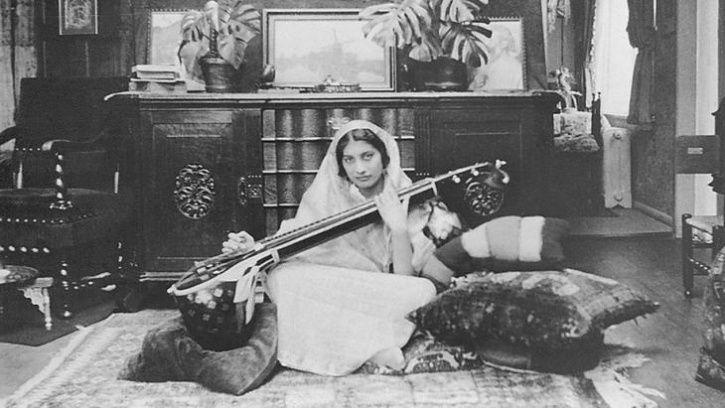
British Indian World War II spy Noor Inayat Khan may be the next face of British currency. A campaign for the same is gaining momentum wherein people are demanding the spy to be featured on a redesigned 50-pound currency note.
The Bank of England had recently announced plans for a new polymer version of the large denomination note to go into print from 2020 and indicated that it would invite public nominations for potential characters to appear on the new note.
An online petition in favour of the campaign has already garnered over 1,200 signatures by Wednesday, calling for Khan, a descendant of Tipu Sultan and daughter of Indian Sufi saint Hazrat Inayat Khan, to be considered as the first ethnic minority British woman to be honoured on the currency.
“I am absolutely delighted that the story of Noor Inayat Khan has inspired so many people and that she has become an icon. Noor was an extraordinary war heroine,” said Shrabani Basu, the author of Khan’s biography ‘Spy Princess’ and founder-chair of the Noor Inayat Khan Memorial Trust.
The trust was set up in 2010 to campaign for a memorial in honour of the war-time spy, who had been recruited by Britain’s Special Operations Executive (SOE) and infiltrated beyond enemy lines before being captured and killed by the Nazis in 1944, aged only 30.
Khan’s memorial bust now has a permanent home at Gordon Square in central London, with the trust also lobbying for a commemorative blue plaque to mark the house nearby where she spent time with her family.
“I am very happy to support the campaign for Noor Inayat Khan on the 50-pound note. It is a way of keeping her memory alive and taking this story to the next generation. It will certainly make a big statement internationally because Noor was someone who believed in breaking down barriers,” Basu said.
The campaign has found the backing of prominent political leaders, historians and academics in the UK, with many taking to social media to voice their support.
“The new 50-pound note could have anyone on it. I’m backing Noor Inayat Khan. She volunteered for SOE, served bravely as an agent in occupied Europe, was eventually captured and murdered. A Muslim, a woman, a hero of WWII. This would celebrate her courage and all SOE,” said Conservative Party MP Tom Tugendhat, who is currently leading the UK Parliament’s Global Britain and India Inquiry.
“Just returned from both East Africa and the Western Front and am more than ever aware of the shared service and sacrifice of men and women of many backgrounds. I would love to see Noor Inayat Khan on the new 50-pound note,” said Melvyn Roffe, Principal at George Watson’s College in Edinburgh.
Noor Inayat Khan, born in Moscow to an Indian father and American mother, was raised in Paris and Britain. As a Sufi, she believed in non-violence and also supported the Indian independence struggle.
But she felt compelled to join the British war effort against fascism and went on to become the first female radio operator to be infiltrated into Nazi-occupied France before she was captured, tortured and killed at the Dachau concentration camp in Nazi Germany.
“In this age, when we see a rise in anti-semitism, anti-Muslim hatred and intolerance, it is important that we continue to build bridges and show positive contributions from Britain’s ethnic and religious minorities, not least one of World War II’s almost forgotten heroes, a British Muslim woman,” said social activist Zehra Zaidi in the online petition she started to campaign for Khan as the face of the new banknote.
The 50-pound currency will be the final redesigned note to go into circulation after notes in the denomination of 5 and 10 have already been reissued in polymer. The new 20-pound polymer note will go into circulation from 2020 when the 50-pound is set to go into print to be circulated later.
“The bank will announce a character selection process for the new 50-pound note in due course, which will seek nominations from the public for potential characters to appear on the new note,” the Bank of England said.
With Inputs From PTI
source: http://www.indiatimes.com / India Times / Home> News> India / October 18th, 2018