Category Archives: Karnataka (under research project)

Self-Driving Car Wins Plainfield Teen 2nd Place At Science Event

Bengaluru, KARNATAKA  / Illinois,  U.S.A ;

Amaan Khan placed at the National Junior Sciences and Humanities Symposium in Maryland.

AmaanKhan02MPOs20may2018

PLAINFIELD, IL :

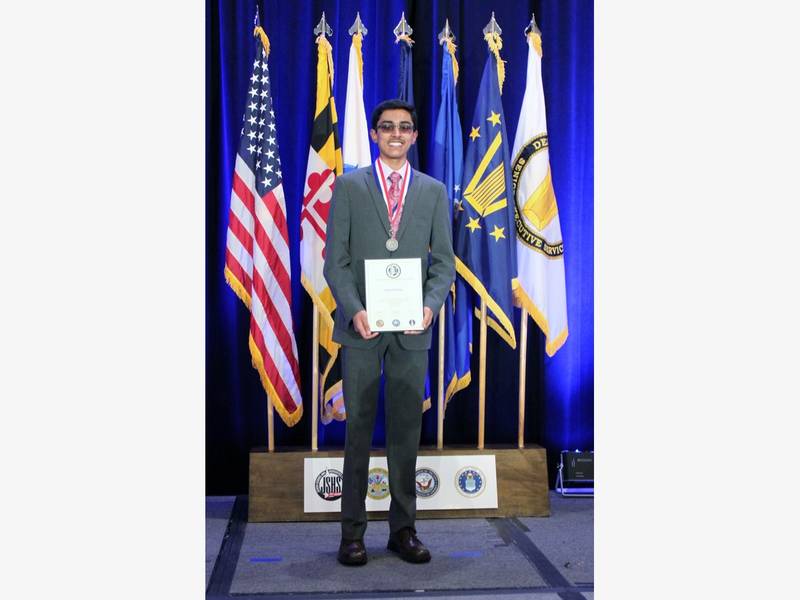
Plainfield South High School sophomore Amaan Khan won second place in the National Junior Sciences and Humanities Symposium (JSHS) held in Maryland May 2 to May 5, 2018, for creating a self-driving model car.

He advanced to the national competition after winning first place at the regional JSHS competition in March.

Khan’s model car can drive within designated lanes, stop and go at traffic lights, and avoid obstacles.

His second-place finish earned him an $8,000 scholarship in addition to the $2,000 scholarship for winning the regional event. The regional competition is open to ninth through twelfth grade students.

Most of the 97 national competitors were high school juniors and seniors. “Second in national is still really great,” Khan said.

Students compete in several categories including computer science and math, bioengineering, behavioral science, medicine, health, physics, engineering and environmental science.

Khan wants to enter the Intel International Science and Engineering Fair next year, he said.

Photo/article via District 202

source: http://www.patch.com / Plainfield Patch / Home> Kids & Family /  by Shannon Antinori , Patch National Staff / May 17th, 2018

Plainfield South High School sophomore creates, programs self-driving car

Bengaluru, KARNATAKA  / Illinois,  U.S.A

Amaan Khan, 15, to travel to national competition

Photo provided
Photo provided

Plainfield :

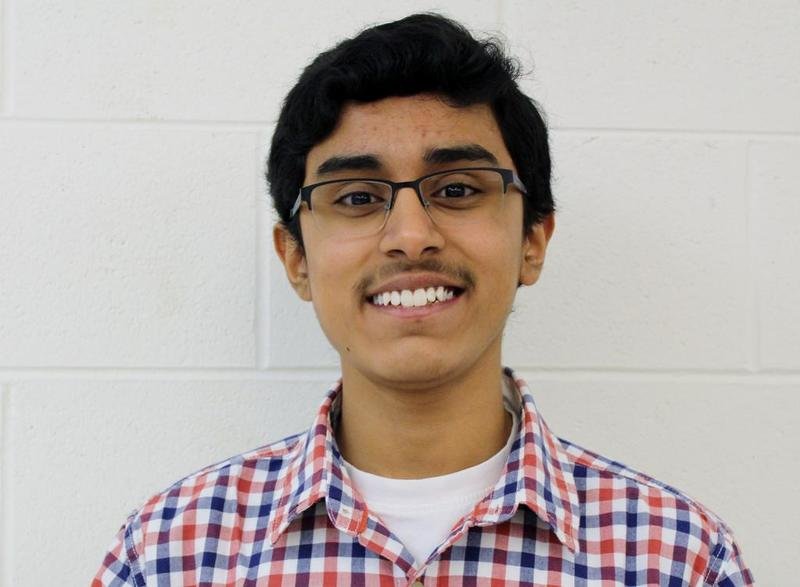
A Plainfield South High School sophomore is traveling to a national science competition, after he created and programmed a self-driving car.

Amaan Khan, 15, will compete this week in the National Junior Science and Humanities Symposium in Maryland, after winning the Illinois Junior Science and Humanities Symposium (JSHS) in March, according to a news release from Plainfield District 202.

Khan created and programmed a self-driving car that can drive within designated lanes, stop and go at lights and avoid obstacles.

He won a $2,000 college scholarship and free trip to the national competition. He is one of two students from Illinois heading to Maryland to compete Tuesday through Saturday with 93 students from across the nation.

Competitors must submit a research paper and present their projects before a panel of judges and an audience of their peers.

Khan became interested in robotics and artificial intelligence last year, after he built a voice-controlled toy car. He took online college courses and watched college lecture courses and YouTube videos to teach himself computer programming.

“As I was learning I kept building the project,” Khan said. “I’d learn one thing, implement it, learn another thing and implement that.”

Patrick and Samantha Scanlan, PSHS science teachers, have supported Khan along the journey.

Samantha Scanlan helped Khan register for the contest. Patrick Scanlan helped Khan polish his oral presentation.

“[Khan] knows what he wants and seeks out the resources to do it,” Patrick Scanlan said. “And if there’s something he needs to learn, he’s able to figure out what he needs to be successful.”

The JSHS is designed to challenge and engage students in science, technology, engineering or math.

To see Khan’s car in action, visit youtube.com/watch?v=3dEgJ7sz6XA.

source: http://www.theherald-news.com / The Herald-News / Home> Local News  / by The Herald-News / April 30th, 2018

Three lions and Tipu’s Tiger

KARNATAKA / London, UNITED KINGDOM  :

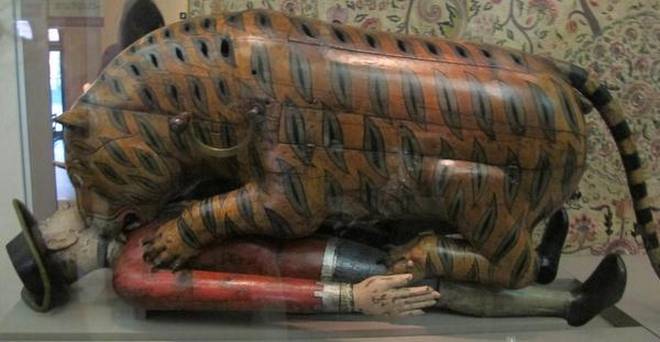
Could the Tiger’s position — now behind a glass case, its crank handle inaccessible to the public — be an apology for the disrespect permitted in East India House?

The artefact sitting in V&A was iconic, identifiable and far away from home

The day I saw Tipu’s Tiger behind its glass case at the Victoria and Albert Museum in London was a day of significance. That morning, after months of being cooped up in Oxford, some friends and I took the train to Marylebone and found the absence of dreaming spires refreshing to say the least. At noon, a friend from India was waiting for me on the other side of the busy Camden High Street. As we hugged amidst the crush of gliding Londoners, her muffled exclamation might have been: ‘It’s so crazy we’re meeting here of all places, so far from home.’

That phrase would be borrowed by me on two separate occasions during the day. In the evening, I stood before Julian Barnes at the Royal Institution and told him how I had read ‘A Short History of Hairdressing’ over and over again to teach myself the ‘architecture’ of a short story. I felt a potent urge then to parrot my friend. It was ‘crazy’ to see and hear Barnes in the flesh, so far from my bedroom in Kolkata, the only other place he had seemed real and, dare I say, attainable through his prose and through the material object, that is, his books in my hands, the only feasible rendezvous with the man.

I had never thought then it would happen: to have someone I studied so minutely sit before me and confess he didn’t think as highly of his short prose as I did.

Iconic meeting

The second occasion I was inclined to echo her words that day was when I stood in the South Asia section of the V&A before Tipu’s Tiger, which had always been relegated to the Did You Know section of our history books. It was not exactly like meeting an old friend or a revered author, but it bore all the characteristics of such a meeting. Like Barnes and my Kolkata friend, it was instantly iconic, identifiable from a distance, and a ready reminder of my distance from India. In fact, standing before the wooden automaton, slightly disconcerted, I addressed it and thought: ‘You are so far away from home.’

The possible inspiration for the mechanical figure seems fitting to some. Hector Munro Jr, whose father defeated Tipu’s father Hyder Ali in the Second Anglo-Mysore War in 1781, was mauled by a royal Bengal tiger at Saugor Island in 1792 and died from the injuries. This must have seemed like divine intervention to Tipu, a wrong set right. The carved and painted, almost life-size, wooden musical automaton was created for the Sultan, whose personal emblem was a tiger and whose hatred of the British was well-known.

The last laugh

With the fall, however, of Seringapatam and the execution of Tipu in the Fourth Mysore War of 1799, the Tiger travelled from the music room of Tipu’s summer palace to the Company’s East India House at Leadenhall Street in London, where the public was given access to view and play with it.

Its wooden body with a keyboard embedded in the flank was thrown open to the English masses who came in and played ‘God Save the King’ and ‘Rule, Brittania!’ upon it. If Tipu thought he had been mocking the Englishmen with the Tiger, they were now having the last laugh.

I deal with issues of empire and post-colonial anxiety almost on a daily basis, especially in a place like Oxford, especially on a course called World Literatures in English. Of course, when I first saw it, I silently demanded a restoration of the tiger to its previous owner, to its previous nation. My anger at seeing the Tiger in an English museum, so far away from home, was justifiable. The Tiger was not borrowed. Nor was it touring, as it had to New York’s MoMA in the 50s. Instead, it was a ‘permanent’ acquisition at the V&A.

Of collaborations

For every Indian schoolchild, the Tiger, just an artefact but nonetheless awe-inspiring, was not an affordable train or flight away, like Fatehpur Sikri or Sher Shah’s tomb.

For me, the Tiger’s distance from my home was a reiteration of the national and racial distinctions not only of the Anglo-Mysore variety, but also of the Jadavpur-Oxford type that I faced every day. Besides dodging questions like ‘If you’re from India, how’s your English so good?’ for the past few months, I had had to clarify to a white friend who subsisted on the chic-ideal of Zadie Smith that India has Bengalis too, and no, I did not have relatives in Brick Lane, not that I knew of anyway.

Seeing Tipu’s Tiger that day catalysed a recollection of an afternoon in 2016 in the Victoria Memorial Hall with Thomas Daniell and his nephew William. Their tranquil scenes of India, while in stark contrast to the ferocity of the Tiger, do something interesting.

The English hands of the Daniells reproduce the Indian hands of the architects behind the buildings and locations they sketch. Their canvas becomes a surface of Anglo-Indian collaboration, similar to how it is conjectured that the mechanics of the Tiger have an Indo-French history.

This recollection, and the subsequent contemplation on collaboration, made me think of several works of restoration that the V&A carried out upon the Tiger, especially after the bombing of London in World War II. Could this act of restoration be seen as an act of reparation? Could the Tiger’s position — now behind a glass case, its crank handle inaccessible to the public — be an apology for the disrespect permitted in East India House?

The Tiger, so far from home, is an icon that reminds me of a past based on plunder and pillage by the nation it sits in. Yet, its 18th century splendour has weathered war and wear so well. Do present acts of safekeeping obliterate the violent history of its, for want of a better word, theft?

I am persuaded to wonder if the Tiger is now a collaboration between Tipu’s Mysore craftsmen and its modern conservationists in England and if I should be thankful for the restoration. Are the acquisition and conservation of an Indian object in a British museum and the works of British painters displayed in a Calcutta museum an instance of transnational collaboration and exchange? But in the case of Tipu’s Tiger, this then also begs the question: how long is too long before we forget that what is ‘acquired’ is what was once ‘removed’ from its home?

The writer, a Felix Scholar, is studying World Literatures in English at Oxford

source: http://www.thehindu.com / The Hindu / Home> Society> History & Culture / by Rohit Chakraborty / May 05th, 2018
Karnataka elections 2018: Here is a list of winning Muslim candidates

KARNATAKA :

KarMuslimsMPOs17may2018

Bengaluru :

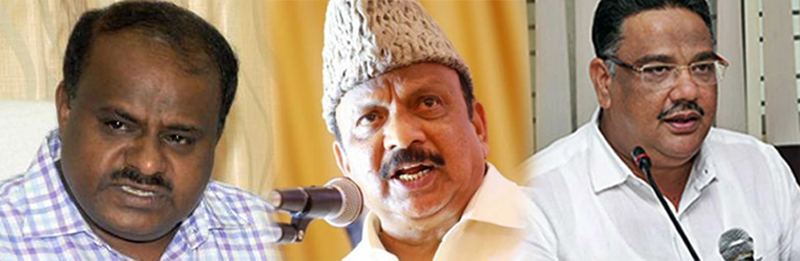
This election saw the lowest Muslim representation in Karnataka Assembly unlike the 2013 Assembly polls where number had gone up to eleven.

Only seven of the Muslim candidates won their seats and incidentally all are from Congress party. Also, five of them had won the 2013 Assembly polls on the party ticket.

Congress, the ruling party in Karnataka fielded 17 Muslim candidates, JD(S) do have Muslim candidates while the saffron party (BJP) does not have a single Muslim candidate.

Among the winners is Kaneez Fatima, the sole Muslim woman won the Gulbarga Uttar constituency by defeating Chandrakant Patil of Bhartiya Janata Party by 5,940 votes. Her husband late Qamar Ul Islam had won the seat in 2013.

Veteran politician Roshan Baig won his stronghold Shivajinagar constituency by defeating BJP leader Katta Subramanya Naidu with a margin over 15,000 votes.

UT Abdul Khader, minister for food, civil supplies and consumer affairs in the Siddaramaiah cabinet, won Mangalore constituency by 19,739 seats, defeating Santosh Kumar Rai Boliyaru of BJP by 19,737 votes. Khader won 80,813 votes while BJP’s Santosh trailed behind with 61,074.

B.Z. Zameer Ahmed Khan, former JD(S) legislator, who defected to Congress in March this year won the Chamrajpet constituency in Bangalore city by beating M Lakshminarayana of BJP with margin of 33,137 votes.

After Aziz Sait’s death, his son Tanveer Sait proved a winning horse for the party. Tanveer won the Narasimharaja constituency defeating BJP’s Sandesh Swamy by 18,127 votes. Sait is the Primary and Secondary Education Minister in the Siddaramaiah cabinet.

Mohammed Nalapad Haris or NA Haris won from Shantinagar seat with margin of 18,205 votes by defeating K Vasudevamurthy.

Rahim Khan has emerged victorious in Bidar assembly constituency with 73270 votes. The 52-year-old incumbent MLA defeated BJP’s Suryakanth Nagmarpalli who got 63025 votes.

Besides these seven winners, nine other Mulsim candidates finished at No. 2 in this poll.

Courtesy: Carvan Daily

Of the 222 assembly constituencies which went to polls on May 12, the Congress party has won in 78 seats, while the JD-S has won 37 seats. The BJP emerged as the single-largest party with 104 seats.

Interestingly, the Congress polled more votes this time (38 per cent) than in the 2013 assembly election, when got 36.76 per cent votes.

source: http://www.siasat.com / The Siasat Daily / Home> Bangalore> Breaking News> News> Politics> Real Estate> Top Stories / May 16th, 2018

SSLC exam: Girls top in Yadgir district

Yadgir, KARNATAKA :

NameeraMPOs11may2018

Topper scores 619 marks

Girls have taken the top two slots in the Secondary School Leaving Certificate (SSLC) examination results in Yadgir district.

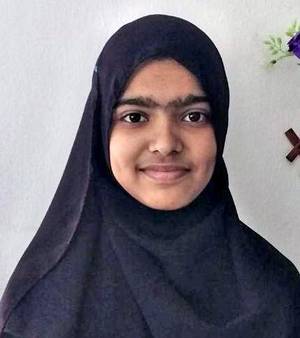
Namira Umama, daughter of Sarfuddin, an employee of the Education Department in Yadgir, has emerged the topper. She has secured 619 marks with 98.72%. Ms. Namira is a student of Saba High School.

Second topper

The second topper is Dhanyashree Nagarajgowda, who has secured 614 marks with 98.24%. She is studying in Srinivasreddy Memorial Kannada and English Medium School, Gurmitkal.

The third topper is Naresh Kumar Sabanna, who has scored 608 marks with 97.38 %. He is a student of Pujya Shantaveeraswami Smriti High School in Gurmitkal.

Ms. Nameera said that she wants to become a doctor and serve poor people in rural areas. She said her mother Ameena Roohi, a teacher in Urdu Medium School, was her biggest support.

source: http://www.thehindu.com / The Hindu / Home> News> States> Karnataka / by Staff Reporter / Yadgir – May 09th, 2018

Bengaluru girls to represent India at Jr NBA World C’ships in Orlando

Bengaluru, KARNATAKA :

Bengaluru’s girls basketball team, who will represent India at the Jr. NBA World Championship in Orlando, Florida in August

Bengaluru :

Several weeks of preparation and hard-fought wins over some of the country’s best teams has finally paid off for a bunch of talented young women basketball players from Bengaluru, who will now represent India at the Jr. NBA World Championship to be held near Orlando, Florida, in August.

After a gruelling three-day league phase, the city girls overcame favourites Kerala 47-41 in the semifinals and then sealed a 41-38 comeback win over Chennai in the Reliance Foundation Jr. NBA National Finals at the NBA Academy in Greater Noida on Wednesday. Among the boys, Delhi defeated Kolkata 81-71.

Both Bengaluru and Delhi teams, along with international teams from Africa and West Asia, Europe, Mexico, Canada, Asia Pacific, China and South America will take part in the first-of-a-kind global youth tournament for U-14 cagers which will be held at the ESPN Wide World of Sports Complex near Orlando from August 7-12.

The National Finals featured the country’s top eight boys and girls’ teams from Bengaluru, Chennai, Hyderabad, Delhi, Kolkata, Kerala, Mumbai and Punjab, based on their performance during the Reliance Foundation Jr. NBA Programme held in January. The programme consisted of several individual skills contests and 5v5 competitions and following the city finals in March, each city picked its 10-member All-Star teams (boys & girls) for the National Final.

“The competition was tough, we were facing some of the best in the country. But the girls were confident. We had a good preparatory camp in the run-up to the tournament,” coach Prasanna Venkatesh told TOI on Wednesday. “In the league phase, we finished second behind Chennai and therefore faced Kerala in the semifinals. Kerala, with their tall players, were tough but we still beat them in the end by six points.”

In the final, however, facing old nemesis Chennai was not going to be easy. “There were some nerves because we had lost to them earlier in the league phase and at the 2017 Sub-Junior Nationals,” Sunishka Kartik, one of the team’s top performers, said.

Trailing 2-17 after the first quarter, the Bengaluru girls never lost hope and pushed hard to surge ahead at the break and then defend the lead for the win. “Seven of us have played together before for Karnataka so we rallied together as a team, fought hard and defended well. It was a victory to cherish forever,” said the Baldwin Girls’ High School student.

Asked if they had received any cash award for their achievement, Sunishka quipped, “It doesn’t matter. There is no award bigger than representing India.”

Winning squad: Sunishka Kartik, Diya J Kothari (Baldwin Girls’ HS), Smriti Vemula, Vedaa Anand (Greenwood High), Hamsa R, Meghana M (Carmel Convent), Shreya Ashok (Bishop Cotton), Shreya Bose (NPS HSR Layout), Moumita Mishra (Vibgyor High), Nuha Asif Masood (JSS PS). Coaches: Prasanna Venkatesh, Palani M, Jyothi Rao S.

source: http://www.timesofindia.indiatimes.com / The Times of India / Home> Sports News> Others / by Maxin Mathew / TNN / May 03rd, 2018

UPSC exam: Not an easy journey

ALL INDIA  / KARNATAKA / MAHARASHTRA :

For those who made it into the UPSC exam results, the journey has not been easy.

New Delhi :

For those who made it, the journey has not been easy. “When I told my family members and friends that I wanted to take the exam, I was discouraged at first,” said Mohammad Nadeemuddin from Karnataka, who secured 656th rank this year but hopes to get into the Indian Police Service as he is an OBC.

“I was told that at the interview level there would be bias at play but I was elated when I found the interview board to be cordial,” the 25-year-old said.

For Nooh Siddiqui of Maharashtra, who has got 326th rank and hopes to get into the Indian Revenue Service, the target is clear. “I want to be able to serve my community in the best way possible and address the concerns they have,” he told The New Sunday Express.

A total of 990 candidates — 750 men and 240 women — were recommended by the UPSC for appointment to various central government services.

Of these candidates, 476 are from the general category, 275 from OBC, 165 from scheduled caste and 74 from scheduled tribes category.

source: http://www.newindianexpress.com / The New Indian Express / Home> Nation / by Sumi Sukanya Dutta / Express News Service / April 29th, 2018

Over 100 Missiles of Tipu Sultan found in a shivamogga well

Mysuru, KARNATAKA :

Surprise find came when well was being desilted

It is one of the most sensational archaeological discoveries in Karnataka. Over a 100 war rockets from the 18th Century were found recently during the desilting of an open well in Shivamogga. The rockets used by the Mysore kingdom, during the Anglo-Mysore Wars, especially in the last two of them during the reign of Tipu Sultan, are considered the most-advanced of their age. Only five known specimens of the rockets were known to be in existence till now; three in the Government Museum in Bengaluru and two in the Royal Armoury, Woolwich, UK.

The rockets discovered were being studied outside of public glare for a few months now. When Bangalore Mirror asked Shejeshwara Nayak – the assistant director and curator of the Government Museum, Shivappa Nayaka Palace in Shivamogga (where some of these rockets are now being kept for display) – he said: “When they were discovered a couple of months ago, these were thought to be some kind of shells. Dr HM Siddhanagoudar [historian] has identified them as rockets.”
“Rockets have been used in battles for 700 years. But it was only in Mysore, under Hyder Ali, that iron casings were first used. Before that, rockets had wooden or paper casings. The iron casings drastically improved their efficiency and range. Mysore rockets were the most advanced ones during the second half of the 18th Century,” said Nayak.

Hyder Ali’s father Fath Muhammad worked for the Nawab of Carnatic before moving on to work for the Mysore Kingdom. Under the Nawab, he handled a rocket corps. Back then, these rockets were used for signalling during battles, not as weapons. Hyder became the first to use rockets with iron casing, and that’s how they became deadly battlefield weapons.

After the fall of Tipu Sultan in 1799, hundreds of rockets of various kinds fell into the hands of the British. The Congreve rockets developed by the British in 1804 (and later used against the armies of Napoleon) were based on the Mysore rockets.

TipuSultan02MPOs19apr2018

THE INITIAL FINDING

The rockets discovered in Shivamogga are likely to be put up for public display in March-April this year. However, how the discovery was made is not being revealed by authorities. The rockets are said to have been found in a well in Nagara of Hosanagara taluk, 60 km from Shivamogga, in a farm belonging to one Nagaraja Rao.

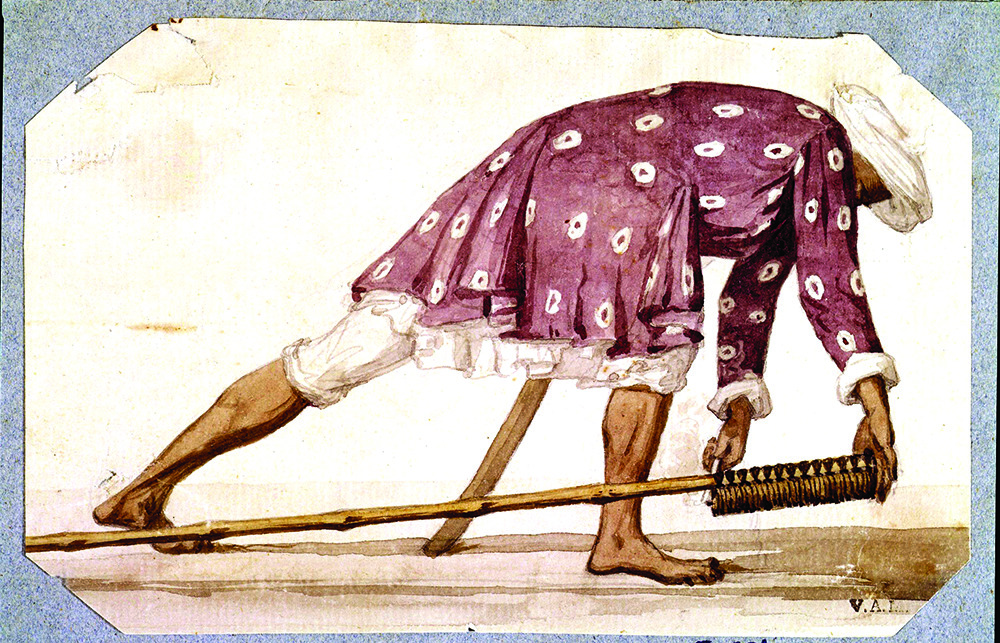
The rockets were basically metal cylinders that were filled with gunpowder and then strapped to a bamboo pole, sometimes up to 30 feet long. Mysore rockets had the highest range of around 1 km. During Tipu’s time, more changes were made to these rockets. From a few hundreds, the ‘cushoons’ – or regiments handling rockets – reached a high of 5,000 men during his time. During the battles of the III and the IV Anglo-Mysore Wars, the rocket cushoons had a terrifying impact on the British forces, as recounted in several accounts of the period.

The area where these rockets were found was part of the Keladi Kingdom, one of the bigger principalities in Karnataka and was annexed to the Mysore Kingdom in 1763 by Hyder Ali. His successor, Tipu Sultan built a mint and an armoury at Nagara. Thus, these rockets are from between 1763 and 1799.

Nidhin George Olikara, a historian with specialisation in Tipu’s era, said: “These rockets were found sometime ago but were identified as rockets recently. Nagara in Shivamogga district earlier was home to an armoury and mint during Tipu Sultan’s rule. The work of researchers is now over and scientists should step in to find out what kind of iron has been used to make rockets.”

2006AP2869

THE REMAINS

The newly discovered rockets are actually the iron casings. Those are the only part of the rocket that could have survived being buried for 200 years. The other parts, such as the bamboo pole and straps, are long gone. Like the records of that age which mention Mysore rockets of various sizes, the Shivamogga rockets are also found in various sizes. Most of the rockets are 7-8 inch long. A few of them are longer. The circumferences are 1, 2 or 3 inches.

source: http://www.bangaloremirror.indiatimes.com / Bangalore Mirror / Home> Bangalore> Cover Story / by Bangalore Mirror Bureau / by S. Shyam Prasad & Gururaj B R / January 20th, 2018

This Indian calligrapher is on a mission to revive Arabic calligraphy

Bengaluru, KARNATAKA :

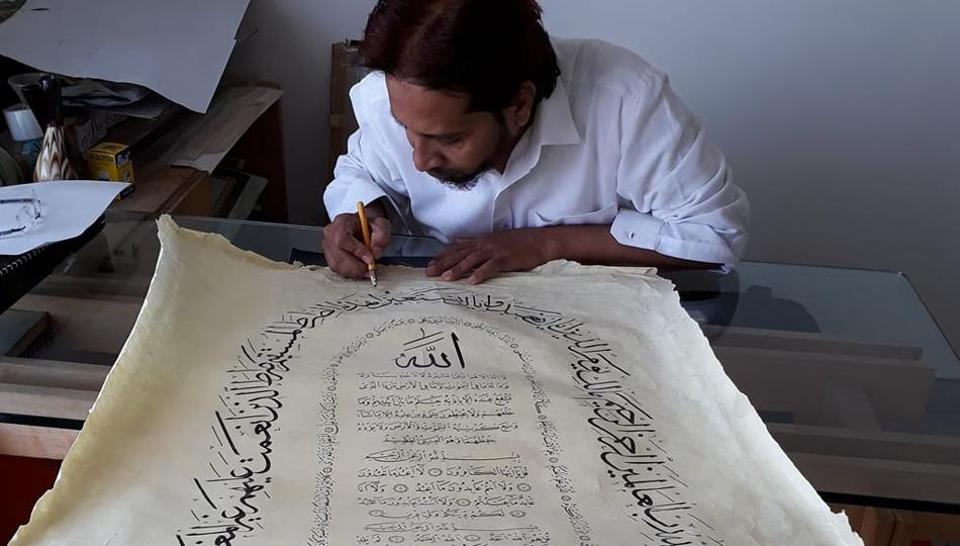
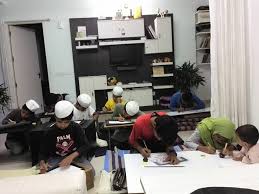
Bengaluru-based calligrapher Muqtar Ahmed is on a mission to revive the art of Arabic calligraphy in India. At the Indo-Islamic Art and Culture (IIIAC) in Bengaluru, he has trained 500 youngsters so far.

Muqtar Ahmed believes that there is no script as beautiful as Arabic in the world. (Facebook)

Arabic calligraphy is worship for Muqtar Ahmed, an Indian calligrapher who has made a mark for himself at a global level. Hailing from a remote village in Telangana, and currently based in Bengaluru, Muqtar is on a mission to revive this dying art in India.

As beautiful as pearls, his works attract attention even if one is not familiar with Arabic. According to him, the aesthetics and refinement are the specialities of Islamic art. “Writing the Quranic verses and Hadith (sayings of the Prophet Mohammad) is worship. These works are sawab-e-jaria (continuous reward),” says the calligrapher, who believes that there is no script as beautiful in the world.

Muqtar believes his efforts have started yielding results as his disciples are carving a niche for themselves at a global level. The only Indian to obtain an “Ijazah” (Master’s diploma) from the Istanbul-based Research Centre for Islamic History, Art and Culture (IRCICA) of the Organisation of the Islamic Cooperation (OIC), Muqtar is grooming young talent at the Institute of Indo-Islamic Art and Culture (IIIAC) in Bengaluru.

Institute of Indo-Islamic Art & Culture about 11 months ago
Institute of Indo-Islamic Art & Culture
about 11 months ago

He has so far trained 500 youngsters, including students and professionals coming from varied backgrounds at the institute. A Japanese girl is among the three foreigners who learnt Arabic calligraphy under him. Muqtar, whose calligraphic works adorn mosques and even private jets abroad, is happy that the institute is getting global recognition for the high standards set by it in Arabic calligraphy.

Three of his students bagged top prizes at a national-level calligraphy competition organised in New Delhi last year by Yayasan Restu, a Malaysian organisation. Ameerul Islam and Abdul Sattar of Hyderabad won the top honours and were selected for an 18-month training programme in Malaysia.

About 400 people from calligraphy institutes across the country participated in the competition. “For the first time, people in India saw what real Arabic calligraphy is,” said Muqtar, who has participated in many exhibitions in different parts of the world.

Institute of Indo-Islamic Art & Culture about a year ago
Institute of Indo-Islamic Art & Culture
about a year ago

According to him, the art in India has been in continuous decline after the end of Mughal rule. He pointed out that the calligraphy work in India was never recognised globally, as it was nowhere near the international standard.

Ameerul Islam and Abdul Sattar are now teaching calligraphy at the institute’s Hyderabad branch, which was opened recently. The talented youth, who have participated in competitions in various countries, are training more than 20 students.

Muqtar, who plans to open another branch of the institute in Lucknow, believes that with more youngsters evincing interest in Arabic calligraphy, the art has bright future in the country. The “ijazah” obtained by Muqtar in 2013 may have fetched him a good job in the Arab world, where Islamic art is greatly valued. But he stayed back to revive the art in India, where it once enjoyed royal patronage.

One of his works was purchased by the then governor of Madina in 2011 when he participated in the international exhibition in the holy city in Saudi Arabia.

Interested in calligraphy from his school days, Muqtar migrated from his village in Medak district to Hyderabad to learn the art. He them moved to Bengaluru where he started working for a Urdu daily. Rendered jobless after the newspaper replaced calligraphy with computers in the early 1990s, Muqtar started writing wedding cards to make a living. “It was not my goal. I wanted to go deep into the art,” recalled the artist, who improved his art under renowned international calligraphers Mamoun Luthfi Sakkal and Mohammed Zakariya of the US, and refined it further under the guidance of Turkey’s Hassan Chalabi and Dawood Biktash.

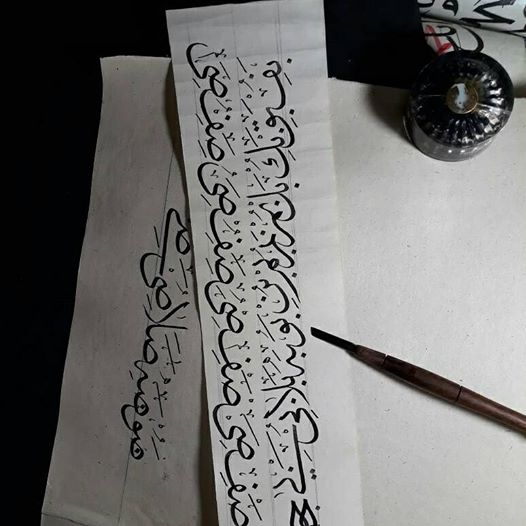
Muqtar, who uses special, handmade pens for his writings, said he achieved precision with perseverance. “Even a small piece of calligraphy takes several hours. You have to write a letter hundreds of times to achieve accuracy,” he said.

source: http://www.hindustantimes.com / Hindustan Times / Home> Lifestyle> Art and Culture / by Indo Asian News Service / April 08th, 2018

This new store offers a mix of Chikankari and Gotta-Patti crafts

Lucknow, UTTAR PRADESH / Bengaluru, KARNATAKA :

Sajda Boutique
Sajda Boutique

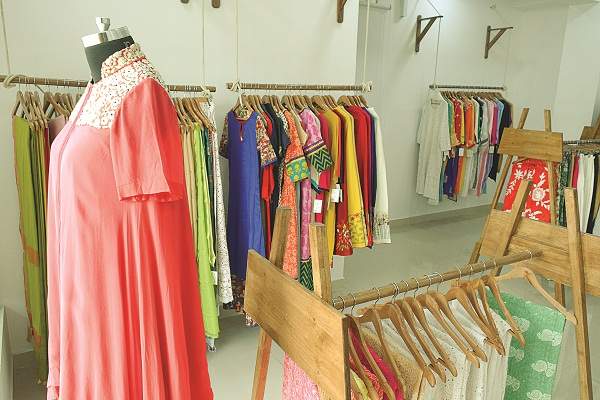
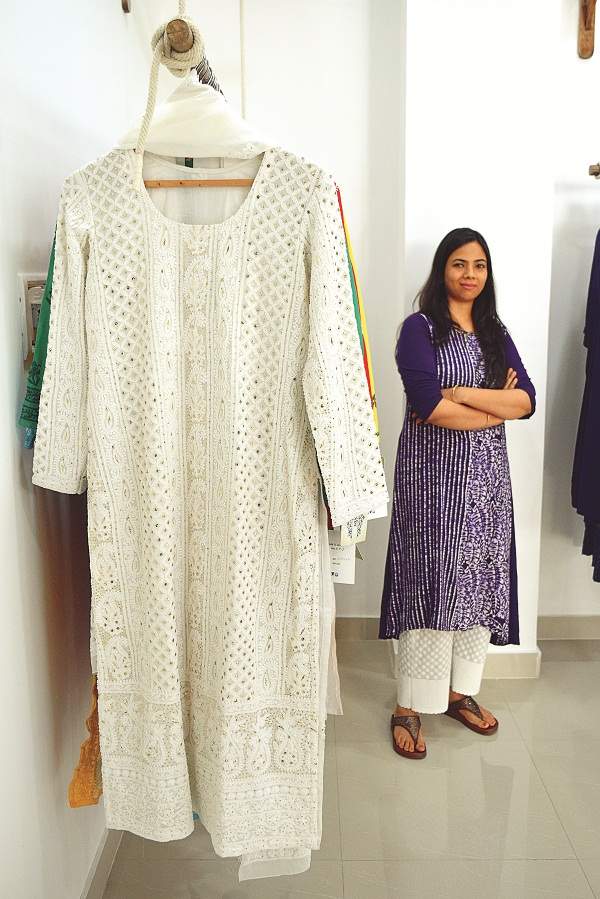
When Lucknow-based Sadaf Haseen designed her line of handbags under the brand Sajda in 2012 for the Bangalore Fashion Week, little did she know that this experiment would turn into a larger boutique Sajda, The Fashion House predominantly showcasing Chikankari craft. “I worked on the line of handbags till 2015. In 2016, I shifted to Bengaluru and decided that it was time to take the brand to the next level,” says Sadaf.

SajdaBoutique02MPOs08apr2018

Under the brand, Sadaf curates exquisite traditional clothing and accessories from across India, and not just Lucknow. “We also stock ready-to-wear garments and fabrics with Gotta-Patti work (gold or silver ribbon and lace with intricate detailing) from Rajasthan, Bengal cotton saris and stoles from Kolkata and Benarasi saris,” explains Sadaf who threw open the doors of her boutique in February this year. “I personally handpick everything and there is nothing in our store that I wouldn’t want to wear myself,” says Sadaf, an alumni of NIFT, Kolkata.
Apart from traditional salwar sets and dresses, they also offer Banarasi, Chikankari and Phulkari dupattas.
Next, Sadaf plans to launch a line of her handbags called Azilea in June.
Rs 300 upwards. At Sector 1, HSR Layout. Details: 48522359

source: http://www.indulgexpress.com / Indulge – The New Indian Express / Home> Lifestyle / by Ayesha Tabassum / June 02nd, 2017