Director Saad Khan is a known name in the world of theatre and movies. And why not? He knew that he wanted to get into filmmaking and had a clear idea about how to go about it.
As his film ‘Humble Politiciann Nograj’ is all set to release in January, Saad is all excited. In a candid chat with Tini Sara Anien, he talks about the film and more.
How did your interest in direction come about?
I belong to the age when video cassettes were popular. I used to watch at least two movies every weekend. This is when the passion for films came in. At school, I was already into theatre. I remember doing a professional play and being yelled at by my director because I was mouthing everyone’s lines. The director told me that acting is not what I should be doing and that I should probably assist him. My passion grew. I did a summer workshop with Bangalore Little Theatre and finally directed my own play.
What kept your interest alive?
My first play ‘Idle Hand’ was a big moment for me as a director. I didn’t know about the method acting or anything then. The play was about a lazy man and how one particular night, when he sleeps, his hands take over his body. I was associated with many plays after that. I always wanted to be a filmmaker. I knew that I had to make a transition and at that time I felt theatre was the right way ahead.
Is theatre a stepping stone to filmmaking?
From what I have observed in the recent past, there is no particular design for artistes. I’ve heard so many filmmakers and actors’ stories that I know that there is no set formula for it. Eventually, I realised that I didn’t want to stick to any genre. I brought the Hollywood movie ‘Scream’ on stage. I’ve also done musicals.
What was the turning point in your career?
It was when my short film ‘Another Kind of Black’ went to the Cannes Film Festival. I felt I was too cool but I soon realised I was just lucky as the concept was pretty good. That was the moment when I knew that this is what I wanted to do. I wanted to sell stories.
How is your chemistry with actor Danish Sait who plays the ‘Humble Politiciann Nograj’?
Danish used to do prank calls on air as Nograj. Slowly he and I made YouTube videos with ‘Nograj’. Once we did a live video of it from Times Square. After this, I said ‘I think we are now ready to make a film on Nograj’. We already had the title of the film since we always referred to the character as a humble politician. Danish, Maaz (Khan) and I met and wrote the story. I took a bit more time to do the screenplay. We were lucky to get Pushkar Films, Lost and Found Films and Paramvah Studios as producers.
What’s next?
We are just focussing on the movie release at the moment. There are speculations about a sequel.
source: http://www.deccanherald.com / Deccan Herald / Home> Supplements> MetroLife / by Tina Sara Anien / DH News Service / December 26th, 2017
Gundappa Viswanath’s masterful stroke of 137 on debut against Bill Lawry’s Australia persuaded Irfan Sait to choose cricket over football.
Irfan Sait, Director of Karnataka Institute of Cricket (KIOC) Photo Courtesy: Irfan Sait Instagram Account
This is not the tale of a cricketer who rose through struggles to make it big for India. This is about a man who took an unthinkable path in his life, coaching, unearthing the best talents. This is about Irfan Sait, a coach who has been thanked endlessly by several cricketers.
Who is Irfan Sait? Without Irfan, cricket would not have a Mayank Agarwal piling on centuries in Ranji Trophy and sitting atop of the leading run-scorers list; or Manish Pandey, first Indian to score an IPL century; or Robin Uthappa, second Indian to win an IPL Orange Cap (after Sachin Tendulkar), and more.
It was Irfan who had once cajoled the father of Nooshin Al Khadeer to switch her daughter from hockey to cricket. It was Irfan who persuaded Swami-ji to permit Karu Jain to play cricket. It was Irfan who assured a 12-year old Veda Krishnamurthy’s parents to send her from Kadur to Bengaluru. It was Irfan who ensured Vanitha VR shifted her focus from academics to cricket.
***
But years before that, Irfan was awestruck by Gundappa Viswanath, whose masterful 137 on debut against Bill Lawry’s Australia that rung the bells of cricket in his mind. Even then, the transition from a football-playing boy to Director of Karnataka Institute of Cricket (KIOC) has not been an easy one.
With a unique distinction of completing the Levels I, II and III coaching courses from India, Australia and England, Irfan throws light on his passion for cricket, on discovering talents like Manish and Mayank, and women’s cricket in an exclusive interview with CricketCountry:
CricketCountry (CC): What drove your interest towards cricket despite you being a football addict?
Irfan Sait (IS): It was Gundappa Viswanath. His century on his debut created an impact on me. I was 8 years of age when my teacher announced about his century. Actually it made no sense [to me] as I knew nothing about cricket. But I was aware it was a huge event, which was my first inspiration. From thereon, like most of us in India, I treated cricket as important as water.
CC: When in college and playing cricket at Chennai, you were not selected for the Tamil Nadu Colts team. Could you narrate that incident?
IS: I was playing for a club in Chennai. I had done very well in the league stage. When I went for the selection, they said I was not a domicile of Madras. I did not take it personally. Since they did not want me, I backed off.
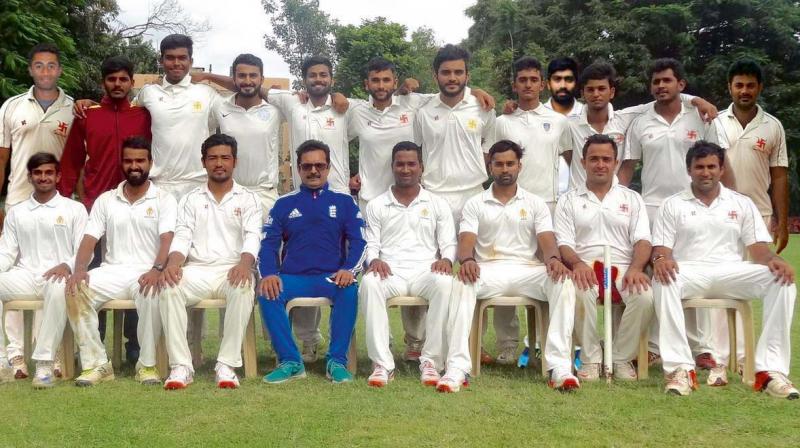
Swastic Union Cricket Club (1), winners of the KSCA Group I–I / Image Deccan Chronicle
CC: Tell us more about Swastic Union Cricket Club (SUCC), where you were first a captain and are now the coach. What has been the journey like?
IS: I must thank Mr YB Patel, former Karnataka captain, my godfather in Karnataka cricket and was the secretary of SUCC. He was the one who pushed me. He encouraged me a lot and provided me all the support I was seeking.
There were times when the club played without a proper XI. Only 7-8 players were present. I took charge and signed up some young boys, captaining them. Then, we were at the sixth division. Today we have reached the first division. I am happy we are doing extremely well.
CC: You also formed the Banni-Mantap Cricket Club in Mysuru…
IS: I started with a set of my childhood friends along with whom I used to play cricket. Although it was not an official club, we participated in various competitions and did very well. Some played at university level and some played zonal cricket in Mysore. Those were the most difficult days when nobody had the provisions to buy anything. We bought one kit that was used by everyone. We also did not have a proper pitch in place. But the cricket was great.
CC: With little experience of running local cricket clubs and teams, what led to the launch of KIOC?
IS: Had there been no difficulties, we would not have enjoyed this journey. We went through those times, which is why it looks so flowery today. I started off with the blessings of my mother and a few cricketers. Some, like the coaches and ground-staff, are still with me. The people who had restricted me from offering the ground for the academy then, support me today.
There have been times where I had no money to pay the coaches. I had to borrow, sometimes on interests, in order to pay the coaches. Since cricket was my pleasure and passion, I had to drain off my retail outlet which was a fashion garment store called Fashion Street.
There was trouble from both ends. My focus and attention was on cricket, so my business was drowning. Many a time were the funds of the business used for the academy. That was when I had to make a choice and I went with my passion — cricket. Although it was a risky proposition, cricket is something I love and enjoy.
CC: Manish Pandey has been mentored by you for 20 years. How did you spot him?
IS: There was a time when I had announced discounted price for children from the army. The word spread across like wildfire. Manish Pandey’s father, an army man, brought his 8-year-old kid along to the academy. From the very first year we knew Manish was very special. The thing I really pride over is that in the very first function that we had, we chose Manish as the most promising cricketer. He used to enjoy his batting and I remember he never used to get out at all in the Under-8 and Under-10 matches. He is god-gifted and also had the knack of taking singles.
One day, I was umpiring the U-8 match where Manish was batting. He took a run off every delivery and won the game with ease. During a seniors match when the rest of batsmen were struggling, Manish went on to score an unbeaten 155 to make our Jawans Cricket Club win. These are fond memories that I have shared with Manish.
Irfan Sait with Karnataka’s leading run-scorer in ongoing Ranji season – Mayank Agarwal Photo Courtesy: Irfan Sait
CC: How did Mayank Agarwal’s journey begin in KIOC?
IS: In KIOC, Mayank came in as a 15-year old. He used to devote several hours to net practice. There was a time when he ran into an electric pole during a training session and sustained a deep cut under his eye. An important league match was to take place a week after. I suggested him to take rest but he was determined to continue playing. His right eye had stitches but he went on to score a hundred. This boy was different. He was hungry to get runs.
The Nivarana Cup is an inter-academy tournament in Bengaluru. In that, he scored a double-hundred in a T20 game. Like always, I sent out a press note and mentioned about the double-hundred. That was something they could not believe. A senior journalist told me, ‘it could have been a 30-yard ground.’ I wrote back to him saying, ‘This was the semi-final; 12 teams had played, which meant 144 players participated in the tournament. Nobody has scored a hundred on the same ground and this boy scored a double-century. Please give some credit.’ This was noticed by everyone.
Unfortunately for him, during the U-19 days, Mayank worked hard but could not score as heavily as anticipated. There were times he came back depressed on not getting runs. Luckily, I had an international coach with me during that phase. Ross Edwards helped him with the training. Even Mohammad Azharuddin had asked to tell the boys to enjoy their batting. When I conveyed that piece of advice to Mayank, it turned around his fortunes. He was then selected for the India A team that travelled to Australia. That was when he got 161 on his debut.
CC: Mayank has piled on runs for Karnataka in the ongoing Ranji season. Do you see him in the Indian squad soon?
IS: I felt Mayank should have been part of the limited-overs series against Sri Lanka. This was the right moment. Considering his red-hot form, he is doing what no one else has ever done. Unfortunately the selectors showed a blind eye. I was told that the selectors emphasised on his India A performance. His performance has not been so good in India A games. Now when he is doing so well, Mayank should have been there.
Of course, all others are also doing well. I think this would have been the right time for him to get a break. I pray hard that he gets it very soon. As a cricket coach and as someone who follows cricket intensely, it is not the just the number of runs but the way he is going about. His performance has been magnificent and nobody has done such thing in the past. I do not see anyone even coming close to this.
CC: In an interview with CricketCountry, Mamatha Maben had mentioned there were times you have shelled out money from your own pocket to organise women’s matches. Could you take us through that phase?
IS: There were times when women cricketers needed mutual and logistics support. I happily extended help from my end. For a long time women’s cricket has been treated very shabbily, but I knew these cricketers had the capacity in them to represent the country and get glory. They did very well. In 2005, they reached the final of the World Cup. And when I sit back and think about these moments, I feel I had done the right thing.
There was a time when women’s cricket had not merged with BCCI. Mamatha and Pramila Bhatt, who was the captain then, wanted to practice in the men’s stadium. There was a coterie opposing them. That was a very tough time. Somehow, I got the support of C Nagaraj, who knew this behaviour was against the state and the country.
CC: Veda Krishnamurthy and Vanitha VR have mentioned how you have pushed their families to allow them participate in cricket. They have credited you during their interviews with CricketCountry. How do you feel on them achieving greater heights today?
IS: Well, that is a feeling that I cannot describe in words. This is the happiness, satisfaction and pleasure that I get which no money can buy. At the same time, anytime they face any problem or a setback, we as coaches die a thousand deaths. We have developed so much of attachment that we are living a life through them. To sit back and think there are five international women cricketers from KIOC is a wonderful feeling. They in turn value the kind of support they received from KIOC.
Irfan Sait assured Veda’s parents to send her to Bengaluru from Kadur Photo Courtesy: Irfan Sait’s Twitter Account
CC: Veda is playing in WBBL for the first time. Is there a special message you would like to convey to her?
IS: I want to tell her that we are living our life through her and enjoying her game more through her successes. She has already given us so much pleasure and happiness. Now I wish her the very best and I am sure she will come back with flying colours. She has been in touch and I know she is the one who carries women’s cricket on her shoulders. She is bringing a lot of glory not only to women’s cricket but to Karnataka and India.
CC: Tell us more about Sindhu Ashok and her journey from India Women to USA Women.
IS: She started off her cricketing career as a 10-year-old with us. She got very few chances initially. I had to work really hard to keep her interest in the game. She was also a very bright student. So she would indulge into education as well.
I realised that Sidhu was very strong-minded. She was mentally strong and had a good cricketing mind. Her education background also helped. She was playing for juniors and was leading Karnataka. That was when we built a good rapport. She knew what I was expecting from her.
Since then I backed her constantly not only for the junior tournament but the rest of her playing days in India. She set a record to her name getting six victims behind the stumps during the tournament. Thanks to her ’keeping and the support she extended from behind the stumps, the bowlers got more and more confident.
Then I realised that she could be instrumental in building the career of so many bowlers. There was this match during the U-19 days. Mumbai were dismissed for a paltry 55. Sindhu once again had 6 victims and fast bowlers Pooja Shah and Anuradha took 4 wickets each, courtesy Sindhu.
She was equally good at studies, which handed her a job in USA. Eventually she got married. She struggled for her visa initially, but her cricketing abilities handed her a Green Card. For me it was a very proud moment. At the age of 10 I realised she had the potential in her and she proved me right. Now that she will be leading USA in the World Cup qualifiers, it means a lot.
CC: BCCI have come up with an A team to boost the confidence of the budding women cricketers. Do you feel there should be more of such competitions in the future?
IS: Where women cricketers are concerned, the shelf life is small. Most of them do not consider it as a full-time profession. They quit the sport either to get married or to pursue academics. It is definitely good to have India A team system. It actually helps to keep women’s cricket alive.
If we can have fun tournaments (like Australia and England have Milo Cup and Quick Cricket respectively), there will more girls participating. One should also introduce inter-school competitions. Nevertheless, India are catching up on women’s cricket. Thanks to World Cup, there is so much enthusiasm. We have never seen so many girls register in our academy.
In terms of IPL, why not? Provided there is proper system in place. IPL has its downside as well. Everyone wants to be play only for the slam-bang game. We need to have these A tours and junior competitions to help women’s cricket get recognised more. There should be more awareness of the girls doing the right job by opting to play cricket.
CC: How does a day at KIOC begin? What are the special sessions that you provide to the youngsters?
IS: The day begins much before sunrise. I arrive at the academy before 6. There have been times when Manish has laughed at me and said, ‘Sir, main aapse pehele aaya. (Sir, I came before you).’ There are others as well who come in the dark and do some running. The first session begins at 6.30. We have a motivational chat for 2-3 minutes. Then we have a group session that ends at 8.30. We have breakfast before starting on one-on-one coaching from 9.30. It goes on till lunch.
We now have a full day program where we have boys from all over the country. They undergo fitness programmes from 9.30 to 10.30. From 10.40 to noon they have fielding sessions and from 12.30 to 3 they have net sessions.
After tea, we have a massive group session from 4 to 6. It is attended by almost 500-600 kids every evening. After sunset, every Monday to Thursday, we have one-on-one coaching from 6.30 to 9.
On Friday and Saturday nights we have gatherings of young boys who undergo weekend sessions. On Saturdays and Sundays we have 6 sessions in a day. Every session has about 250-300 kids turning up from morning to night. This is how our week runs. We work 365 days. We have not taken a break in 21 years.
CC: How do you spot upcoming talents?
IS: Our USP lies in giving the boys plenty of match practices. We now enrol boys and girls from the age of 5. Earlier, we started enrolling kids from the age of 7. Now we realise that young kids want to be part of this sport.
For the kids ranging from age group of 5 to 8, we focus on fun and enjoyment. We ask them to understand the process. The only sign we look for is whether the kids enjoy themselves. We just want them to be happy and have some fun and go back.
From age 8, we start conducting U-10 tournaments within our academy. Since we have many kids, we organise our own tournaments. These kids start performing and playing from that age. Mayank Agarwal, Manish Pandey and all were spotted at a very young age. Ganesh Satish from Vidarbha as well was very talented at the age of 8. Robin Uthappa was special right since the age of 10. When we see kids enjoying, we encourage them. When they perform well, we give them more opportunities. Our entire staff and admin talk to the kids with a smile and encourage them. We make them believe that we are doing something different.
CC: Is coaching more challenging than playing cricket?
IS: The most challenging aspect is to retain the interest of the kids, especially when they are not doing well. To make them believe they can is the biggest challenge. Sometimes it hurts when our trainee works hard but does not do well. When you have a great bonding with the trainee and they come back teary-eyed, it is a horrendous feeling. The challenge is to ensure they are happy and enjoying the process.
Shruti Hariharan, a singer, loves music, food, cricket and writes about the game. She can be followed on Twitter at @Shruti_2890
source: http://www.cricketcountry.com / CricketCountry.com / Home> Features> Interview / by Shruti Hariharan / December 21st, 2017
As a young boy, Javeed Mehkri would watch his father spend hours with his favourite car — a 1950 model of Morris Oxford, better known in India as the Hindustan 14. Javeed not only learnt about the car and its mechanics but thoroughly enjoyed the drive in it to and from school.
The passion for the Morris Oxford is living on through four generations with Javeed now transferring the ownership of the car to his 22-year-old son Junaid Mehkri. Junaid shares as much passion for the classic beauty as his father.
The car has an interesting history to it and Javeed gets nostalgic when he settles down to talk about it. Javeed says, “My grandfather, AK Mehkri, purchased it. He was working as the superintendent of engineering in the Shimsha hydro-electric station in the erstwhile princely state of Mysore. The car was initially registered and used in Mysore for three years, after which my great grandfather moved to Bengaluru. The car has been with us since,” explains Javeed.
Almost every member of the Mehkri family has driven the car. Those who revelled at its wheel include MG Mehkri, private secretary to the Yuvaraja of Mysore; Dr MS Mehkri, founder of the Bangalore Medical College; and ME Mehkri, a freedom fighter and a well-known philanthropist. “In fact, the landmark, Mehkri Circle, is named after ME Mehkri,” adds Javeed.
Decades after, the car has been restored with some of its parts being replaced and brought to perfect working condition. “The car was taken care of by Rasheed Mehkri, my late uncle. Rasheed passed away in 2013 and wasn’t there to see the car in running condition,” says Javeed.
However, he admits that the biggest challenge, is to maintain the car. “Spare parts for the American-made vintage and classic cars are available online but you will never find perfect spares for British classic vehicles in India. I got some of the parts replicated here but again you have to personally supervise it to make sure you are not taken for a ride. It is an expensive and time-consuming process to maintain these cars,” he says.
Javeed says among those who were drawn to his car was former prime minister of Nepal, Tulsi Giri. “There’s a church just opposite our house and he used to visit the church whenever he was in the City. Once, he saw the car parked outside my house and he asked me why I didn’t do anything to get it back on the roads. When he returned six months later, he again asked me the same question. I got the same advice from my cousin Sajjad. All this hastened the restoration process,” adds Javeed.
Among Javeed’s prized possession is also a 1960 model Lambretta Scooter — his father’s first purchase. “My father rode it and I used to go to college on it. Now, my youngest son Uzair gets dropped by the scooter once in a while,” he says. Like other youngsters of their age — Junaid and Uzair — love swanky cars but they value their two prized possessions more.
The Morris Oxford has been a regular at Karnataka Vintage and Classic Car Club rally for the last two years. And Javeed loves basking in all the adulation the car draws. “It was during one of the rallies that a lady in a car stopped beside us. She asked me: ‘How old is she?’ I said 65. She smiled and said: ‘She’s my age’. Total strangers admire and compliment me on the car,” he narrates.
(Javeed can be reached on Javeedmehkri@hotmail.com)
source: http://www.deccanherald.com / Deccan Herald / Home> Supplements> MetroLife / by Nina C. George / DHNS – Bengaluru , November 10th, 2015
People usually hurry to reach Mina creating tremendous risk for themselves and others. It’s during this ritual that chaos is triggered.
I went for Haj pilgrimage with my wife in December-January 2006. During the journey, we noticed that the Gulf region was unstable owing to the trial of the deposed Iraqi dictator Saddam Hussein in Baghdad and emotions were running high among the Arabs. The political fever in the region also spread among Haj pilgrims. Emotions and arguments add to the atmospherics of Haj. One can imagine the energy and excitement of a pilgrimage in which millions of people from diverse linguistic, ethnic and racial backgrounds are united by religion.
Our delegation was special as we were being accompanied by former Chief Justice of India A.M. Ahmadi and other dignitaries from different parts of India. But from the beginning of the journey, I saw that arrangements on the ground were not quite right. The Saudi officials gave out instructions only in Arabic, though most of the pilgrims were unfamiliar with the language.
Countries that send the largest number of pilgrims are from South and Southeast Asia like Indonesia, Pakistan, Bangladesh, Afghanistan and India. People from this region speak many languages. Special attention is needed for the elderly, many of whom undertake foreign travel for the first time and, therefore, are quite disoriented and find it difficult to adjust to sudden orders yelled out in Arabic by policemen.
Also, the Saudi rules aim at segregation of men and women which creates a lot of problems for first-time travellers from our region. Often families which are separated by the Saudi police have to endure hardship, which is multiplied because neither the pilgrims nor the police can understand each other.
The process of Haj starts from Mina where one has to begin early after a prayer, followed by the circumambulation of the holy mosque Kaaba. The pilgrimage ends at Mina following the ritual of ‘Stoning the Shaitan.’ This last ritual at Mina needs to be completed before sunset and people usually hurry to reach Mina creating tremendous risk for themselves and others. It’s during this ritual that chaos is triggered.
On January 12, as we were returning to Mina for the last ritual of Haj, we saw the big stampede from a distance as waves of people collided. Dust and fear enveloped us. Our group stopped midway out of fear and went back to Mecca.
Next morning, we started early at 3 a.m. for the dash to Mina. On the way, we saw huge piles of shoes, clothes, and water bottles left behind by the stampede victims being loaded onto the trucks by the police. Officials informed us that around 350 people had died in the stampede and hundreds more were injured. The possessions of the pilgrims left behind made me suspicious of the official account.
The road to Mina which is where the stampedes often happen is very risky as it’s the only one for the journey to Mina and for returning to Mecca. I am told that the Saudi government has created an alternative route for the pilgrims returning to Mecca but that route is longer and many pilgrims continue to return by the old, shorter and narrow route which puts them at risk.
Year after year, stampedes have taken place on the same route near Mina, yet the Saudi authorities have failed to do anything to reduce the risk.
The occasion of Haj brings more than three million pilgrims to Mecca. A number of factors can trigger a crisis and a stampede on the ground where the crowd is united by religion and divided by political sentiments of the Arab countries. Sabotage is often suspected when such tragedies take place.
The Saudi government should also be open to learning from other countries where a large number of pilgrims congregate, for example in India’s Kumbh Melas and in the Vatican where authorities take care of the linguistic differences while managing people. There is no harm in learning from others.
Prof. Pasha teaches West Asian politics in JNU.
(As told to Kallol Bhattacherjee)
source: http://www.thehindu.com / The Hindu / Home> National / by Prof. A.K. Pasha / September 26th, 2015
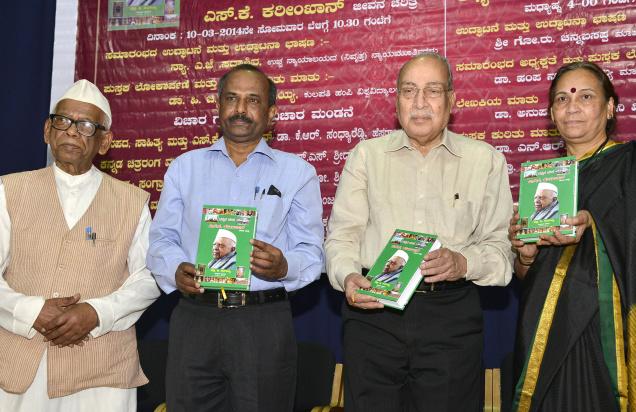
(From left) D. Boralingaiah, Vice-Chancellor, Kannada University, Hampi; A.J. Sadashiva, former judge, Karnataka High Court; and K.R. Sandhya Reddy, writer, releasing a book on Karim Khan in Bangalore on Monday. / Photo: K. Murali Kumar
‘Kannadada Santa Karim Khan Jeevana Charitre’ is written by the late D. Lingaiah
A biography on the late Kannada folk poet and scholar Karim Khan will provide an account of the entire 20th century, H.C. Boralingaiah, Vice-Chancellor, Kannada University, Hampi, has said.
He was speaking at the release of Karim Khan’s biography Kannadada SantaKarim Khan Jeevana Charitre at Kannada Sahitya Parishat on Monday.
Mr. Boralingaiah said the story of Karim Khan, a Gandhian, was also the story of the creative success of the Gandhian path before Independence.
“In an era of unbridled growth and development post-Independence, we have forgotten Gandhi and this book can be an excuse to introspect on the path we have taken,” he said.
Mr. Boralingaiah also recounted his interaction with Karim Khan when the two worked together at the Janapada Academy in the late 80s. “Despite the criticism he came under over his appointment to head the Academy at a ripe old age of 83, Karim Khan worked tirelessly for three years and did foundational work in the field of folk arts, along H. L. Nage Gowda, another scholar in the field,” Mr. Boralingaiah said.
A.J. Sadashiva, retired judge, Karnataka High Court, who inaugurated the function, said that in his limited interaction with him, Karim Khan came across as a polymath and a great humanitarian.
“He was a man who believed there was not much of a difference between man and God and if one strove hard, man could reach that holy state. His life was a journey in the direction,” he said.
The biography is written by the late D. Lingaiah. It is published by Godhooli publications.
source: http://www.thehindu.com / The Hindu / Home> News> National> Karnataka / by Staff Reporter / Bangalore – March 11th, 2014