Chennai, TAMIL NADU :
New Delhi :
The Madras High Court has invoked a famous Hadith of Prophet Muhammad on prompt and fair payment upon completion of work, while directing the Madurai Municipal Corporation to settle the long-pending professional fees claimed by its former lawyer. The judgment has come as a pleasant surprise in the present atmosphere of hostility towards Islam and Muslims.
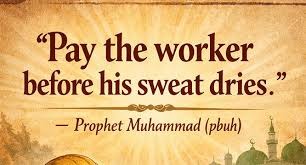
While deciding the case on December 19, Justice G.R. Swaminathan at the High Court’s Madurai Bench referred to the prophetic saying – “Pay the worker before his sweat dries” – and observed that this principle was only a facet of fairness and was eminently applicable in labour jurisprudence. The court’s observations have upheld the truth and timelessness of Islamic principles of justice and fairness.
By citing Prophet Muhammad’s saying to stress the moral duty of employers to pay workers without delay, the Judge came to the aid of a lawyer struggling to recover his unpaid legal fees from the Municipal Corporation. The court observed that the principle of fairness should equally apply to labour and service jurisprudence.
Justice Swaminathan directed the Municipal Corporation to settle the lawyer’s fees and censured the practice of engaging advocates who charge a hefty sum for a single appearance in court, citing an instance when a senior counsel was paid Rs. 4 lakh per appearance. “The university, which is pleading that its financial situation is such that it is unable to pay the dues of its retired staff, has no difficulty in paying exorbitant fees to its counsel,” he said.
Additional Advocate Generals appeared even for small matters where their presence was not really required and where even a “novice of the government counsel could handle,” the court observed. “All this for a few pennies. Marking appearance is a matter of money. It is time an audit is undertaken regarding the payment of fees to the law officers,” the Judge noted.
Coming to the rescue of the Municipal Corporation’s former standing counsel P. Thirumalai who sought a direction to the civic body to pay Rs. 13.05 lakh due for him as fee for representing it in numerous cases, Justice Swaminathan said: “Pay the worker before his sweat dries is an instruction attributed to the Holy Prophet (PBUH).”
“This principle is only a facet of fairness and is eminently applicable in labour jurisprudence. It can also be invoked in the case at hand,” the judgement stated, while making it clear that timely payment is not just a legal requirement but also a matter of basic justice.
The Prophet’s famous saying has been narrated as a Hadith from Abdullah bin Umar, saying: The Messenger of Allah (PBUH) said, “Give the worker his wages before his sweat dries.” (Sunan Ibn Majah). The command to give wages before the sweat dries is a metaphor. It is a form of excellence to pay someone before they finish the job and it becomes an injustice if one does not pay them after they complete the job.
The writ petition was filed by the standing counsel for Madurai City Municipal Corporation for over 14 years from 1992 to 2006. He had represented the Corporation in the Madurai district courts. His grievance was that the Corporation had not settled his fee bills. Hence, he filed a writ in 2006 seeking the payment.
According to the petitioner, the Corporation had to pay him Rs. 14.07 lakh, but it paid only Rs. 1.02 lakh and a balance of Rs. 13.05 lakh remained to be paid. The petitioner had appeared in 818 cases, the Judge noted, and recorded submissions that the lawyer was in penurious circumstances and unable to even afford the cost of obtaining certified copies.
The court directed the Legal Services Authority attached to the Madurai district court to verify the list of cases, obtain certified copies and provide them to the petitioner within two months.
Upon submission of the verified fee bills, the Municipal corporation was directed to settle the bills within a further two months without interest.
While upholding the Islamic principles of justice, the judgment has also sent a strong message to government bodies and public institutions on the need to treat legal professionals fairly, ensure prompt payment for services rendered, and review excessive spending on senior counsels, especially when ordinary matters can be handled by junior or regular government advocates.
Ironically, a Muslim Traffic Sub-Inspector, Afaq Khan, in Uttara Pradesh’s Kannauj was recently sent to the Police Lines as a punishment after being removed from active duty, following an event in which he referred to Prophet Muhmmad while addressing the students at a college on the issue of girls’ safety. Khan cited the Prophet’s saying: “A home in which a daughter is born is blessed with mercy.”
After a video of the programme went viral on social media platforms, members of Hindu right-wing organisations – Vishwa Hindu Parishad and Bajrang Dal – objected to it and filed a complaint, alleging that Khan was imparting religious teachings while in uniform. Subsequently, the Kannauj Superintendent of Police placed Khan on line duty.
In a state where the police personnel have been seen showering flowers during the Kanwar Yatra, and where the Sambhal Circle Officer Anuj Chaudhary was seen participating in a religious programme carrying a mace, Khan was removed from active duty as a punishment. On the other hand, the Madras High Court has invoked the Prophet’s saying in the case involving payment of wages.
source: http://www.indiatomorrow.net / India Tomorrow / Home> Economy> India Tomorrow Correspondent / December 23rd, 2025