NEW DELHI :
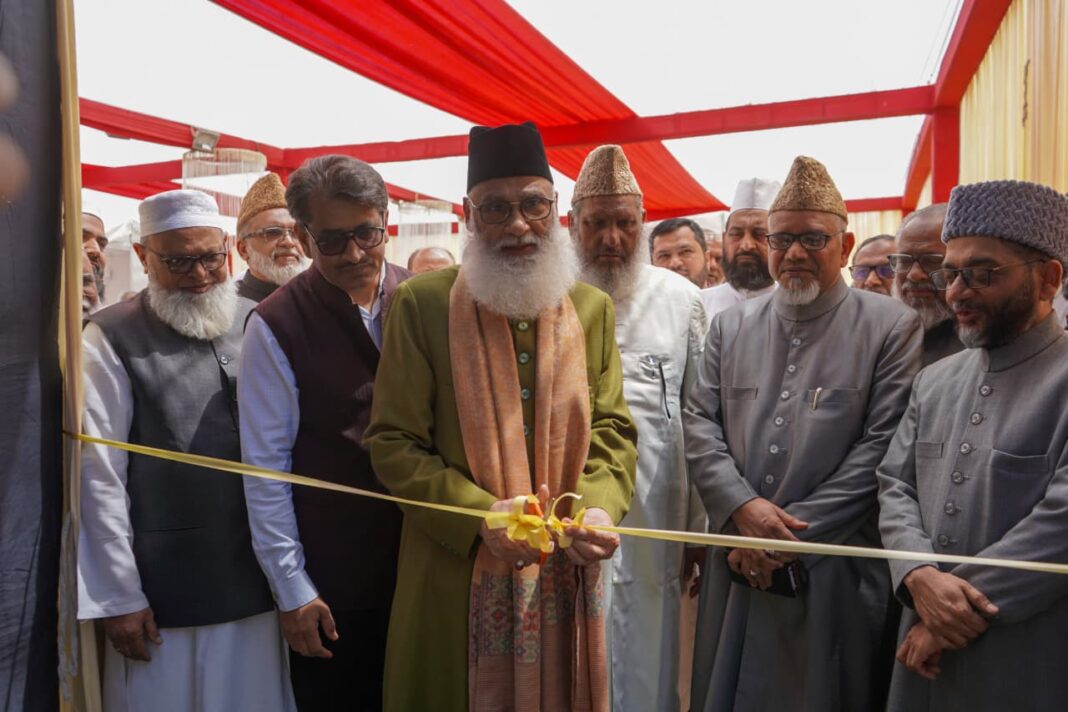
Syed Sarwar Chishty (wearing a scarf) inaugurates an exhibition on the contributions of Indian Muslims to India’s history, society, and civilization by cutting the ribbon at the headquarters of Jamaat-e-Islami Hind in New Delhi on April 14, 2026.
New Delhi :
At a time when efforts are being made at governmental level to erase the contributions of Indian Muslims and Islam to the glorious history of India, the Indian History Forum organised a unique exhibition titled “The Woven Land: A Visual Narrative of Muslim History in India” at the headquarters of the Jamaat-e-Islami Hind, exploring the historical contributions of Muslims to India’s civilizational journey.
The exhibition was formally inaugurated on Tuesday in presence of several prominent personalities, including Syed Sadatullah Husaini, President of Jamaat-e-Islami Hind; Maulana Syed Sarwar Chishty, Secretary of the Anjuman Committee of Ajmer Sharif Dargah; Maulana Asghar Ali Imam Mehdi, President of the Markazi Jamiat Ahle Hadees Hind, Senior Supreme Court advocate M R Shamshad, apart from other community leaders and intellectuals.
The exhibition will remain open to the public until 19 April 2026, from 10 am to 9 pm daily. Since its inauguration, it has witnessed significant participation, with visitors from different walks of life attending the event.
The exhibition presents an expansive visual narrative tracing the arrival of Islam in India and highlighting its multifaceted contributions across various fields. Through a series of well-curated displays and models, it brings to light the role of Muslims in education, trade, social equality, women’s empowerment, and the translation of classical texts. It also showcases contributions in architecture, culture, medicine, language development, as well as advancements in science and astronomy.
Dr. Shadab Moosa, Convener of Indian History Forum, explained the conceptual framework of the exhibition, stating that prevailing narratives often claim that Muslims came to India, demolished temples, and forced conversions. The exhibition, he said, attempts to visually reconstruct how Muslims arrived, built settlements, constructed mosques, and developed architectural forms while integrating into local environments.
The first section of the exhibition presents scenes of early Muslim arrival in Kerala, including depictions of boats reaching the shore. It highlights that Muslims initially came as merchants, engaging in trade and establishing settlements. A strong focus is placed on their interaction with local communities, particularly marginalized groups, showing how justice-oriented business practices influenced these engagements. The exhibition traces a continuous coastal cultural pattern from Gujarat to Malabar, Chennai, Vizag, and Kolkata, demonstrating linguistic and cultural integration across regions such as Malayalam, Tamil, Bengali, and even parts of Assam.
Dr. Moosa emphasized that the exhibition highlights Islam’s ability to integrate within a plural society and accommodate diverse practices. One display shows the inclusion of Dalits in market spaces where their access was historically restricted, indicating social changes associated with Muslim presence.
Another section focuses on mosque construction, displaying models that illustrate the fusion of Indian architectural styles with Islamic ethics and theology. A prominent exhibit includes the model of the Cheraman Mosque in Kerala. Coastal trade routes are also mapped, showing the movement of goods, services, and people.
The exhibition further explores the spread of Islam through Sufi saints, mapping their routes across India. Colour-coded pins mark sea routes, historical sites, libraries, observatories, trading hubs, and Sufi centres. A notable highlight is a Sanskrit document describing mosque architecture, referred to as “Rehmana Prasada” or “Rehman Ki Ibadat Gah,” reflecting the blending of Indic and Islamic traditions. References are also made to structures such as the Qutub complex, Barwada Mosque, and Goga Mosque.
The education section depicts the close relationship between mosques and learning centres. It highlights linguistic synthesis between Arabic and regional languages like Malayalam. Models of institutions such as Madrasa Feroz Shahi during the reign of Sultan Feroz Shah and Madrasa Mehmood Gawand of the Bahmani dynasty are displayed, along with institutions established during the time of Usman Ali Khan.
Scientific contributions are also featured prominently. A painting shows Raja Jai Singh drawing inspiration from Ulugh Baig’s astronomical work to establish Jantar Mantar. Exhibits include instruments such as the astrolabe, celestial globe, and telescope, emphasizing the contributions of Muslim scholars to astronomy.
The exhibition also traces the development of educational institutions, noting that present-day Delhi University originated as Madrasa Ghaziuddin, where students from diverse backgrounds studied. Libraries, including the Raza Library, are highlighted for their role in translation movements that advanced scientific knowledge.
Medical advancements are presented through displays showing the synthesis of Greek, Indian, and Arabic medical traditions. The role of Tipu Sultan is also emphasized, particularly his efforts in promoting translation movements and knowledge exchange.
Industrial and economic contributions form another major segment. The exhibition discusses innovations in steam engine technology adapted to Indian terrain, developments in shipbuilding that made India a global leader in the 19th century, and the establishment of infrastructure such as roads, highways, and caravan-serais.
Urban development is explored through examples of cities such as Shahjahanabad(now called Delhi), Hyderabad, Lucknow, Aurangabad, and Ajmer, which flourished due to advancements in water systems, security arrangements, and architectural planning. Agricultural reforms during the Delhi Sultanate, including land measurement and irrigation systems, are also highlighted.
The exhibition concludes by presenting the evolution of standardized currency systems that enabled international trade, along with administrative and moral frameworks of the Mughal period, where both Muslims and non-Muslims contributed to governance. It illustrates how these systems supported India’s economic prosperity, often described historically as making the country a “golden bird.”
Overall, the exhibition offers a detailed visual narrative of Muslim contributions to India’s cultural, scientific, and economic history.
source: http://www.indiatomorrow.net / India Tomorrow / Home> Education / by India Tomorrow / April 14th, 2026