NEW DELHI :
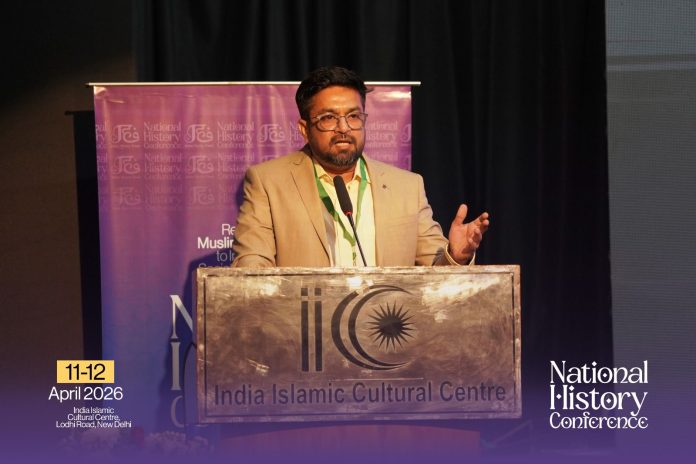
PIC
The Indian History Forum hosted a two-day event in Delhi on April 11 and 12, highlighting the contributions of Muslims to Indian history. Several scholars, intellectuals, academicians and Parliamentarians took part and delivered insightful speeches at the event. For the benefit of its readers, India Tomorrow is serialising the full texts of selected speeches by some of the event’s most prominent speakers.
Here is the full text of the speech delivered by Dr Shadab Moosa, convener of the Indian History Forum:
“From Bengal to Gujarat, and from Kerala to Delhi, across universities, among professors, and with students pursuing PhDs and postdoctoral research, our interactions revealed a clear pattern. When we engaged with them and examined the challenges in the study of history, it became evident that there are three major problems.
The first problem, which you and I are well aware of, is that a very superficial, misinformed, and propagandist narrative of history is reaching our screens, mobile phones, and social media day and night. But if you look beyond this level, even if you have a little interest in history, whether you are a teacher, someone who teaches or designs a syllabus, someone related to NCERT, or among those who read serious media, you will see that alongside this, changes in NCERT and in school, college, and university history syllabi are altering the entire pattern of study and research. We understand that this is a very important and critical issue that needs to be identified, corrected, and given a proper objective narrative.
This is our primary duty. Beyond that, if you are an ordinary person, you must have visited a history museum with your family, taken your children to museums, or visited archaeological monuments. You will see that from museums to archives, from archaeological sites to the guides who show you around, history is a major issue everywhere. When we went t the Victoria Museum in Kolkata, it was a very magnificent museum.
If you go to that museum, you can feel that you have entered the colonial era. When you go to the first floor and observe the exhibits, you will see that the heroes of the First War of Independence of 1857 have been depicted there. However, you will find every person represented except the Muslims.
You will find every leader’s photo except those who led the 1857, those who played the most important and leading role in that movement. When we observed this phenomenon in many places, we motivated some of our research scholars to conduct a study of Indian museums to examine the extent of marginalisation and fake narratives present in them.
It is not a big deal to spread misinformation on WhatsApp today, but when it reaches Aasar-e-Qadeema(archaeology) and when those historical remains are manipulated, then there are serious problems. We have visited 50 universities in India where history is taught, and a syllabus is followed.
What is the challenge in these universities? When we talk about Muslim history, plural history, or objective history, the major challenge we identified is that within these universities, history is divided into three major domains: ancient, medieval, and modern history.
The most contested zone is medieval history. There are no contemporaries of medieval history, and there is a lack of new students interested in it. As a result, when someone attempts to discuss medieval history after 50 years, we face a crisis where there are very few students, PhD scholars, or post-doctorate researchers in this field.
The Indian History Forum will try to fill this gap. When discussing medieval history, we must understand that it is not just history. To understand it, you need knowledge of the Persian language, geography, and climate. History is not just about individuals or buildings; it is about language, geography, and culture.
When this culture becomes a geographical entity that we call Indian culture, and when we aim to present an objective and plural narrative, we must strive for a centrist approach. We do not want to lean left or right, but instead bring history to an objective and balanced position.
The second major challenge we identified is that historians have done immense work. People have dedicated their entire lives to writing books and conducting remarkable research. Professors have worked for 30 to 40 years and are the guiding lights of our nation. Their books are luminaries that continue to illuminate the field of history.
However, the biggest challenge is bringing this intellectual and academic work, often filled with jargon, into the public domain. Making it accessible as popular history and embedding it into public consciousness is what the Indian History Forum seeks to achieve.
Today, through fake narratives spread every minute and every second via algorithms, people’s minds and, consequently, societal behaviour are being manipulated. This manipulation is changing social psychology, which in turn is reshaping the political identity of the nation. This is a serious concern.
We often wonder how long we can keep responding to fake narratives. If you answer today, a new question arises tomorrow; if you answer tomorrow, another appears the next day. This becomes a never-ending cycle.
But there is a simple solution: if you want to make a line appear smaller, draw a bigger line next to it. That bigger line is the recognition that in the thousand-year span of medieval history, Indian Muslims have made immense contributions, in universities, science and development, civic infrastructure, city-building, food and cuisine, women’s leadership, and economic development.
Their role was so significant that India once had the highest GDP in the world. The Indian History Forum aims to bridge the gap between the common masses and historical texts and promote an objective understanding of history.
The third and final challenge is interpretation. Writing history is one thing, but interpreting it correctly is equally important. Without an objective lens, history cannot be understood properly. Whether one leans right or left, problems arise.
We recognise two major ideological challenges in revisiting history. The first is the colonial framework. Much of today’s biased and propagandist history traces back 150 years to British historians like James Mill, Henry Elliot, and John Davison, who wrote highly biased and communal accounts. These narratives continue to influence modern interpretations, whether in academic writing, media, or social platforms.
The second challenge is communal narratives. We must understand that this country has a thousand-year history marked by love, education, development, and harmony. It is a legacy where cultures evolved, people learned to live together, and India emerged as a global leader in philosophy, culture, food, clothing, and education.
The Indian History Forum will work across all these areas. Inshallah, through our conferences, prominent professors and historians will engage with you. Our programmes will focus on four major areas.
First, we will examine economic contributions, how economic systems, currency, mechanisms, land reforms, agricultural revolutions, and trade routes were developed, and how India’s goods and influence reached global markets. A strong regulatory economic system based on justice, equality, and moral integrity enabled India to become a prosperous nation.
Next, we will discuss the contributions of women and highlight the extraordinary roles they played. Following that, we will explore urban planning, administration, and infrastructure.
For example, building large cities in medieval India required advanced systems, water management, security, technology, and architectural innovation. These were not simple tasks but complex achievements.
We will also examine key industries. For instance, while the British introduced railways, the development of steam engine technology suitable for India’s diverse terrain required local adaptation. Unlike Europe’s plains, India’s geography demanded advanced engineering solutions.
This thousand-year history remains one of the most significant aspects of our past. We aim to establish an objective and centrist narrative. With such a perspective, we welcome you and hope that you will find this programme intellectually enriching and engaging.”
As reported in India Tomorrow
source: http://www.radiancenews.com / Radiance News / Home> Features / by Radiance News Bureau – As reported in India Tomorrow / April 13th, 2026