NEW DELHI :
New Delhi:
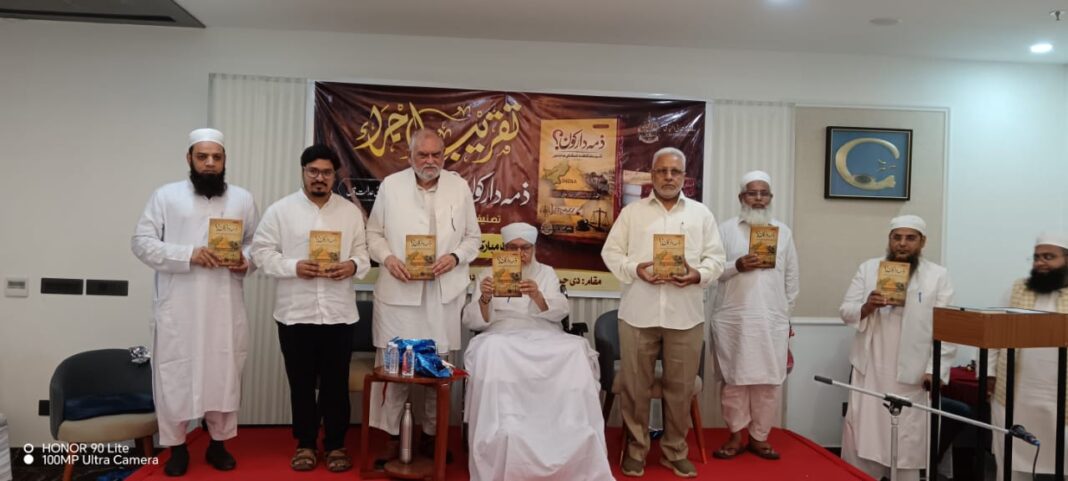
A book titled “Zimmedar Kaun? Taqseem-e-Hind Ka Muqaddama Insaaf Ki Adalat Mein” (Who is Responsible? The Case of the Partition of India in the Court of Justice) was released by well-known Islamic scholar Hazrat Maulana Khalil-ur-Rahman Sajjad Nomani, at the Jasola Hotel here on Friday.
Authored by researcher Muhammad Sujood-ul-Aziz Al-Qasmi, the publication offers an unbiased, objective examination of the 1947 Partition of India. Utilizing primary documentary evidence, historical facts, and key correspondence, the author frames Partition as a courtroom trial to deliver a fair analysis of the respective roles played by the British Raj, the All-India Muslim League, and the Indian National Congress.
Key speakers—including veteran journalist Dr. Zafarul-Islam Khan and senior journalist Masoom Moradabadi—lauded the author’s painstaking research and the book’s scholarly depth. Attended by prominent local religious figures, distinguished women, and numerous students, the gathering widely praised the volume as a landmark contribution to historical and socio-political literature.
Eminent senior Urdu journalist, columnist, and editor of “Jadeed Khabar”, Mr. Masoom Moradabadi, brought a sharp journalistic and analytical lens to the podium. Opening his address, he reflected on the purpose behind literary works, noting that while Urdu media frequently publishes book reviews, truly purposeful and substantive contributions remain rare. The supreme merit of Al-Qasmi’s work lies in its rigorous research methodology. Eschewing oral hearsay and unverified folklore, the author navigated authentic Urdu, English, and historical archival sources with academic discipline, producing an investigative masterpiece that warrants the highest commendation.
Transitioning to the broader context of Partition historiography, Moradabadi challenged the conventional narrative that places Muslims exclusively in the dock. He drew attention to significant analytical works published across the border, such as Syed Hasan Riaz’s monumental 1,400-page volume ‘Pakistan Naguzeer Tha’ and Chaudhry Khaliquzzaman’s ‘Shahrah-e-Pakistan’, alongside notable Indian contributions like Kamleshwar’s ‘Kitne Pakistan’. Addressing the core question of why this retrospective debate matters nearly eighty years post-independence, he underscored that the Partition remains one of history’s worst human catastrophes, claiming nearly a million innocent lives.
While political theorists often argue that a unified nation would have spared Indian Muslims their current socio-political vulnerability, historical realities demand deeper contemplation. Pakistan, founded upon religious nationalism as a “Mamlekat-e-Khudadad,” fractured along linguistic lines in 1971 with the emergence of Bangladesh. Highlighting the irony inherent in majoritarian political demands, Moradabadi shared his frequent counsel to proponents of a mono-cultural state: “If you wish to reshape India, as a “Hindu Rashtra” look first at the complex realities and fragmentation haunting Pakistan’s history!”—a challenge that invariably leaves proponents silent.
Detailing the grim socio-economic realities of migrant communities (Muhajirs) in urban centers like Islamabad and Karachi, he emphasized that the sacrifices underpinning Pakistan’s creation were heavily compromised by feudal hegemony and elite governance. The systemic marginalization faced by minority and migrant populations across borders serves as a poignant reminder of the failures of majoritarian statecraft. In India, the continuous weaponization of Partition to demand questioning of community loyalty constitutes a malicious scheme by fringe extremist elements. Moradabadi concluded with an earnest recommendation: to bridge cultural divides and counter misinformation effectively, this stellar research work must be translated into Hindi and edited by linguistic experts to reach a broader national readership where the book trade thrives.
Eminent Islamic scholar and founder-editor of The Milli Gazette, Dr. Zafarul-Islam Khan delivered a keynote address characterized by intellectual rigor and fearless candor. Opening his remarks, Dr. Khan congratulated the author for steering clear of emotional rhetoric and adopting a balanced, scholarly methodology that refreshes historical debate.
Focusing on community communication failures, Dr. Khan observed that Indian Muslims have historically failed to articulate their grievances and historical narrative effectively to the global and national mainstream. Whatever documentation existed remained confined to Urdu—a language that itself became a victim of Partition’s linguistic reorganization. Had unity been preserved, Urdu would likely have stood alongside Hindi as a national co-official language. While English persists as an administrative bridge for non-Hindi speaking southern and eastern states, Northern India’s “Cow Belt” has overwhelmingly adopted Hindi as its vernacular baseline. Despite these shifts, Dr. Khan stressed the urgent moral imperative to protect and propagate Urdu, noting that after Arabic, the richest theological and literary heritage of Islamic scholarship resides within Urdu texts, surpassing even Persian in certain analytical compilations.
Reflecting on constitutional history, Dr. Khan recounted the tragic marginalization of Urdu during Constituent Assembly voting, where a initial majority favouring Urdu was overturned due to political compromises. He recalled that Begum Ezaz Rasul’s casting vote in the Constituent Assembly made Hindi the national language but she failed to extract the concession to make Urdu the second official language. He recalled Sardar Patel’s historic assurances regarding minority integration and political reservations and protections that minority leadership voluntarily relinquished in good faith within a secular framework, only to face systemic erosion decades later. Contrasting this trajectory with international models, he cited the Jewish community’s systematic efforts to memorialize historical persecution through literature, cinema, and rigorous legal protections across Western Europe. While external political actions continue to reshape global sympathies, minority communities in pluralistic societies must master modern bridge languages—specifically English —to project their contributions and historical truths accurately.
Challenging simplistic attributions of blame for the Partition, Dr. Khan offered a nuanced structural analysis. The tragedy cannot be reduced to a single culprit; colonial conspiracies played a decisive role. British imperial strategy abhorred the prospect of leaving behind a monolithic superpower comprising India, Pakistan, and Bangladesh—an economic titan commanding a huge chunk of global GDP. Colonial historiography, spearheaded by chroniclers like Elliot and Dawson post-1857, systematically injected communal poison into historical texts. In reality, the Mughal rulers and Muslim dynastic governance integrated disparate principalities into a cohesive economic and administrative grid stretching from Kabul to south India. Concluding his address, Dr. Khan endorsed the book as a monumental, objective contribution that paves the way for intellectual clarity. He suggested that the book should be translated at least into Hindi.
In his visionary presidential address, renowned Islamic scholar Hazrat Maulana Khalil-ur-Rahman Sajjad Nomani elevated the discourse from political critique to civilizational psychology and spiritual resilience. Analyzing the dynamics of societal rise and fall, Maulana Nomani emphasized that navigating severe socio-political adversity requires a balanced, composed psychological state. Despair, panic, and emotional reactivity cloud intellectual clarity and paralyze collective progress. Just as individuals experience biological cycles of health and illness, nations traverse historical epochs of ascendancy and decline governed by universal divine laws.
Addressing the contemporary hopelessness gripping the Muslim community, the Maulana asserted that the current cycle of decline is neither permanent nor absolute. Prophetic traditions explicitly outline periods of trial for the Ummah, but they equally promise a grand renaissance—a ‘Nishat-e-Saaniya’—wherein past prestige and moral leadership will be restored through divine providence. Achieving this revival, however, demands systematic intellectual, moral, and emotional training. During times of intense crisis, leadership must extinguish fear, kindle hope, and foster critical self-accountability.
Maulana Nomani cautioned against internal inferiority complexes fuelled by historical ignorance and unverified propaganda. The persistent self-doubt among the younger generation—questioning whether elders erred in pursuing Partition—stems from a superficial reading of history. A rigorous historical inquiry must examine the complex web of British divide-and-rule tactics, broken political pacts, and compelling existential pressures that forced communities into corners. He praised young scholar Muhammad Sujood-ul-Aziz Al-Qasmi for stepping forward with methodological rigor to counter emotionally charged, rhetorical narratives with archival documentation.
Presenting an extensive and deeply reflective introduction to his work, author Maulana Muhammad Sujood-ul-Aziz Al-Qasmi addressed the audience with an impassioned discourse on the imperatives of historical truth and collective memory. Nearly eighty years have passed since the partition of the country, yet the socio-political climate shows no signs of healing or progressive evolution. Muslims—who shed the most blood and offered unprecedented sacrifices for the liberation of their beloved motherland—find themselves regrettably thrust into the dock of public scrutiny today. An insidious indictment is consistently levied against them, branding them as the primary culprits and sole architects of the Partition of India. The rhetoric has reached such a distressing juncture that the community’s collective fate is brazenly framed around coercive premises: ‘Since a separate nation was carved out in the name of Islam, those who remained here must accept life as second-class citizens’, and ‘If Pakistan could be founded in the name of Islam, why shouldn’t a Hindu Rashtra be established in the name of Hindus?’
Reflecting on the psychological burden this narrative places on the community, the author noted that without access to true historical facts, even conscientious citizens are often left uncomfortable when confronted with such probing queries from fellow countrymen. For years, he harboured a profound internal conflict, mindful of the immense sacrifices rendered by Muslims during the freedom struggle—especially the tragic saga of the First War of Independence in 1857. During that dark period, freedom fighters were crushed in oil mills across the landscape from Chandni Chowk in Delhi to Lahore, and the bodies of martyrs hung from trees as grim reminders of colonial brutality. Even after enduring such devastation, following a principled and collective consensus, a vast majority of Muslims chose to remain in their homeland. Yet, when a portion of undivided India was partitioned in the name of religion, public discourse persistently questioned the moral validity of demanding equal citizenship and rights in the residual nation.
Though fundamentally flawed and unreasonable, this relentless propaganda deeply unsettled empathetic and thoughtful minds for decades. The author expressed profound gratitude to his mentor, Hazrat Maulana Khalil-ur-Rahman Sajjad Nomani, whose comprehensive lecture on the subject nearly a decade ago provided a vital paradigm shift in thought and critical analysis. Extensive reading followed, gradually dissolving the lingering, undeserved sense of collective guilt. In today’s climate—where hate-mongering elements are hyperactive and Muslim communities face constant taunts—an average citizen committed to national welfare easily falls prey to mental distress and a defensive posture. This environment pressures even the well-educated to entertain regressive notions. Consequently, uncovering hidden archival truths preserved in British libraries and independent historical records became an absolute necessity.
Unpacking the methodological challenges of historical inquiry, Al-Qasmi observed that writing history requires rigorous engagement with the works of preceding scholars. The primary challenge lies in navigating the conflicting ideological biases of historical actors and commentators to extract objective truth. Maintaining strict neutrality on a monumental tragedy like the Partition of India is exceptionally difficult, yet vital for scholarly integrity. History is not merely a chronicle of past events; it serves a higher purpose. Rather than recounting the entire chronology of independence, this study isolates a singular, crucial inquiry: Were Muslims truly the culprits of Partition, or were external and multi-party forces responsible?
Examining the multi-layered political landscape, the author noted that existing literature tends to mirror partisan narratives—British justifications, Congress frameworks, or Muslim League stances. Comprehensive works offering an inclusive Muslim perspective remain scarce, often prioritizing leadership actions while overlooking the tireless efforts of organizations like Jamiat Ulema-e-Hind to preserve a united country through workable constitutional formulas. The book endeavours to synthesize a holistic perspective, moving beyond mutual recrimination. With British archival documents now declassified, facts stand in crystal-clear clarity: the Muslims of India were not self-fragmented; rather, they were systematically partitioned under a calculated imperial strategy. Ultimately, the division weakened all parties, fracturing the largest global Muslim community since the Ottoman era. Finding answers to these foundational questions forms the bedrock of this timely research study.
source: http://www.indiatomorrow.net / India Tomorrow / Home / by Zillur Rahman Haider / October 23rd, 2026