UTTAR PRADESH :
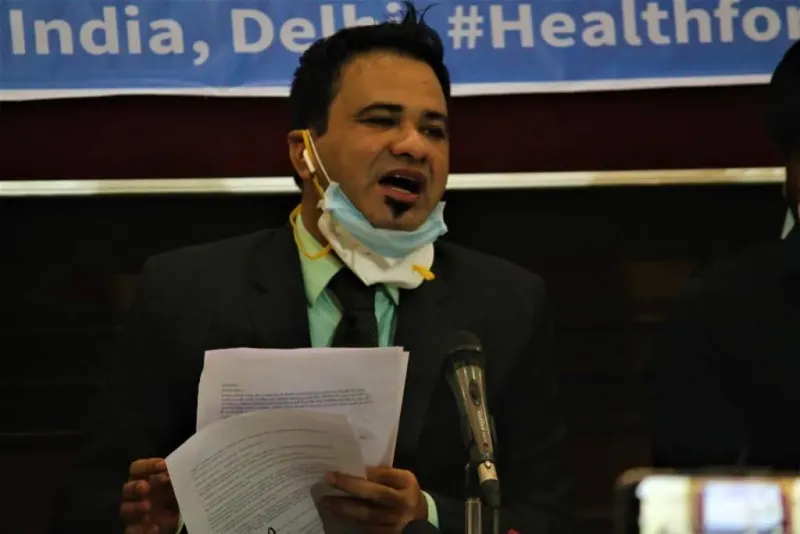
In this excerpt from The History-Sheeter, Dr Kafeel Khan recalls joining the Shaheen Bagh protest against the CAA on 31 December 2019 and traces how his flood-relief work in Assam exposed him to the anxiety of the NRC’s exclusion of nearly 19 lakh people, set against the government’s contradictory messaging on a nationwide NRC and a decade of growing hostility toward those questioning the state.
History-sheeter is a term used by Indian police to refer to an individual with a criminal record, due to which they maintain a detailed file, or history-sheet, on them, even without conviction. In 2018, after being falsely accused in connection with the deaths of children at Gorakhpur’s B.R.D. Medical College, he was released from prison. He later recounted his experience in The Gorakhpur Hospital Tragedy: A Doctor’s Memoir of a Deadly Medical Crisis (2021). His troubles, however, were far from over. Within months, Khan was arrested again over a speech he delivered at Aligarh Muslim University. The Uttar Pradesh government invoked the National Security Act to detain him, and he spent nine months in custody before his release. By then, his continued fight for justice had brought him into prolonged conflict with the state.
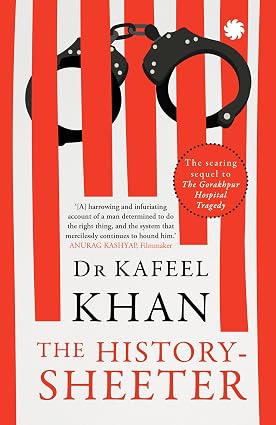
source: amazon.in
In The History-Sheeter, published by Juggernaut, Dr. Kafeel Khan recounts his third arrest and the ordeal that followed, including his imprisonment during the Covid-19 pandemic. He also reflects on how his experiences found a fictional counterpart in Shah Rukh Khan’s film Jawan. Unflinching in its account of the personal costs of dissent, the book examines how those who challenge authority can be criminalised and subjected to the power of the state.
The following excerpt is from the first chapter, “Insiders Turned Outsiders.”
Insiders Turned Outsiders
31 December 2019.
Delhi was in the grip of one of its coldest winters in decades. Under a blue tarpaulin at Shaheen Bagh, women sat wrapped in shawls, children asleep in their laps, and men stood at the edges of the gathering. They had occupied that stretch of road for days. They said they would not leave. They had come out of their homes to protest against the Citizenship Amendment Act (CAA) that became law on 12 December 2019.
I stood among them that night – neither as a doctor nor as an organizer, but as a citizen.
I had already learnt what it meant to be marked by the State. I knew what silence could buy. Safety, perhaps. Distance. Rehabilitation.
But by then, silence no longer felt neutral.
In August 2019, when I began conducting free health camps across Assam with a team of doctors from the Medical Service Centre, we witnessed much devastation. As happens nearly every year, floods had destroyed fields and homes, leaving in their wake all types of infectious diseases like cholera, malaria, skin diseases, hepatitis, eye diseases, ear discharge and many such ailments. In addition, I saw how people live on riverine islands in this state without the most basic facilities. They don’t have access to a safe water supply, no electricity, and boats are the only means of transport. We found that primary health centres (PHCs) were shut, schools were destroyed and communities were severely affected in many places.
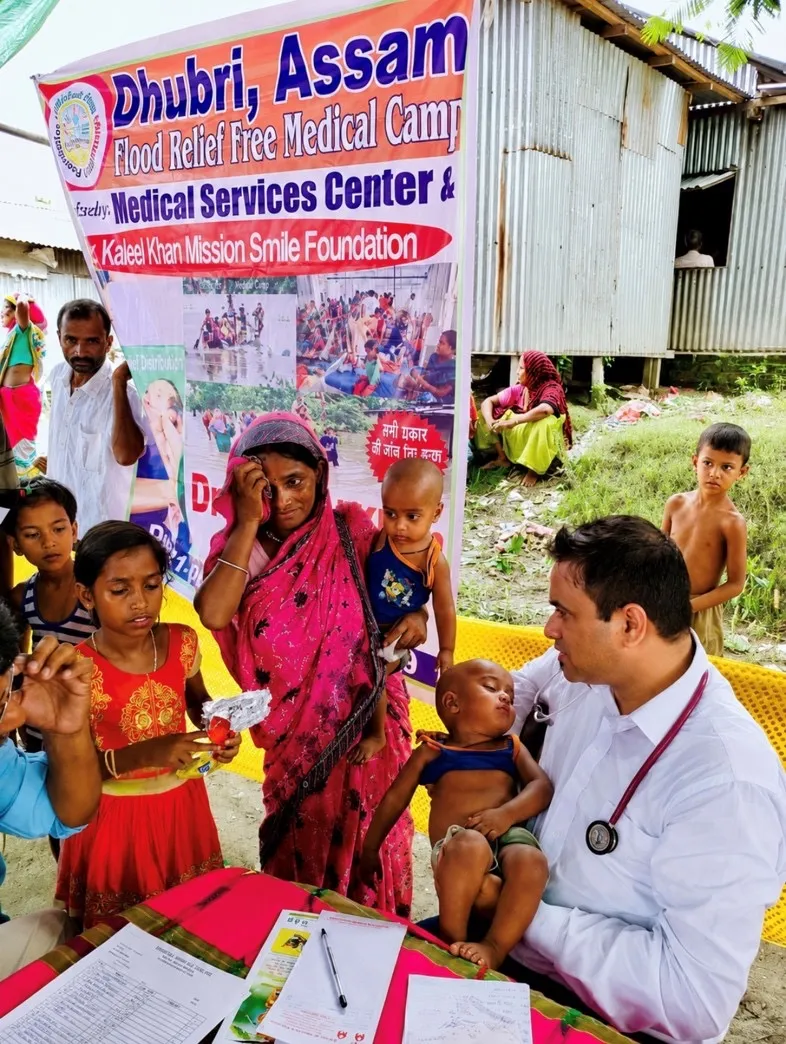
Dhubri, Assam, August 2019: In a free health camp during a flood relief effort, an exhausted mother watched as I examined her son.
The Assam experience took me across various thresholds. We would walk miles with the local people from one camp to another. We were able to see up close how they lived, how they struggled and what they celebrated. It was during this time that I began to understand the confounding question of citizenship for the people of Assam.
What I did not realize then was that this was going to pull me into the subsequent big struggle with the powers that be. When the updated National Register of Citizens (NRC) list was released on 31 August 2019, nearly 19 lakh people were excluded from citizenship rolls out of a population of 3.3 crore. The history behind this moment was long.
For decades, migration from what was once East Pakistan, and later Bangladesh, had shaped Assam’s politics. The Assam Movement of the late 1970s and early 1980s, led by the All Assam Students’ Union, culminated in the Assam Accord of 1985. Under that agreement:
Anyone entering Assam after 24 December 1971 would be considered an illegal migrant. Those who entered between 1966 and 1971 would be disenfranchised for 10 years before regaining citizenship. Those who entered before 1966 would be recognized as citizens.
This administrative categorization might appear orderly on paper.
On the ground, it was anything but. To prove citizenship, residents had to establish linkage to ancestors present before 1971 through specified documents – electoral rolls, land records, the 1951 NRC, educational certificates.
Driving licences were invalid.
Aadhaar cards were invalid.
PAN cards were invalid.
‘Hum itna kaagaz kahan se laayega? (Where do we get so many papers from?)
Floods had swallowed land and homes. Names were misspelled across generations. Ages were incorrectly recorded. Entire families depended on fragile, fading sheets of paper to assert belonging.
In village after village, people spoke in hushed voices of detention camps.
‘O bada camp bana hai. Camp mein band rebna padega. (Big camps have been built. We will be kept there.)’
As a doctor, I had come to treat. Instead, I encountered something harder to diagnose: the anxiety of erasure.
In September 2018, during a rally in Rajasthan, the home minister referred to illegal immigrants as ghuspaithiyee and deemak- infiltrators and termites- promising that they would be removed one by one.
While his party spokesperson justified his ‘termite’ analogy on television, the poll promise to rid the country of illegal immigrants was amplified in speech after speech, several times in the lead- up to the May 2019 general elections. One significant promise of his, which became an oft- repeated phrase, was: ‘Aap chronology samajh lijiyee. Peble CAB aayega…fr NPR…fr NRC aayega…Aur sirf Bengal ke liye nahi…saare desh ke liye aayega aayega (You, please understand the chronology. First, we will bring CAB and after that, we will bring NPR, and then NRC and not only for Bengal but for the entire country). This, repeated again and again across social media, underscored how the Citizenship Amendment Bill (later Act) (CAB) would be followed by the National Population Register (NPR) and then the NRC across the country to identify ‘outsiders’.
This style of speaking in a code had become commonplace by 2019 and drew little protest. Perhaps many people reasoned, ‘We are not illegal immigrants, so why should we care?’ Such campaign speeches were part of the BJP’s successful re- election in 2019 – a victory that gave the party an even bigger majority than they had secured in 2014.
Yet, on 22 December 2019, at Ramlila Maidan in Delhi, the prime minister stated:
‘No discussion on a nationwide NRC has taken place anywhere.’
Both statements were public. Both were recorded and circulated widely.
In Parliament on 10 and 11 December 2019, while introducing and defending the CAB, the home minister insisted that the law was about granting citizenship to persecuted minorities from Pakistan, Bangladesh and Afghanistan – not about taking it away. For many citizens, especially those already struggling with documentation under the NRC in Assam, the assurances did not calm fears. Words matter. When those in power use them repeatedly, they shape the climate of belonging.
In the decade that preceded December 2019, something had shifted in the air of the republic.
Mob violence had entered headlines with disturbing regularity. Hate crimes were debated, then normalized. Election campaigns increasingly invoked Mughal invaders and the descendants of Aurangzeb. ‘Go to Pakistan!’ had become a reflexive insult hurled at anyone questioning state policy. The word ‘anti- national’ was no longer an accusation; it was a weapon.
The signs had been visible for years.
Dr Kafeel Khan is a paediatrician and author from Gorakhpur, Uttar Pradesh. He completed his MBBS and MD in Paediatrics at Kasturba Medical College, Manipal, and worked at the Sikkim Manipal Institute of Medical Sciences in Gangtok before joining Baba Raghav Das Medical College in Gorakhpur. Following the medical crisis at BRD Medical College in August 2017, Khan was suspended from service and later imprisoned. He subsequently established the Dr Kafeel Khan Mission Smile Foundation and launched initiatives including the Health for All campaign, which advocates for a legal right to healthcare, and Doctors on Road, which aims to bring medical services to underserved communities. Khan’s first book, The Gorakhpur Hospital Tragedy: A Doctor’s Memoir of a Deadly Medical Crisis, was published in 2021 and subsequently translated into several Indian languages. The History-Sheeter is his second book.
This is an excerpt from The History-Sheeter by Dr Kafeel Khan, reproduced by arrangement with Juggernaut
source: http://www.maktoobmedia.com / Maktoob Media / Home> Bookshelf / by Dr Kafeel Khan / October 19th, 2026