Hamed Aziz Safwi of Kolkata seeks to change the lives of many in Uluberia, an industrial town in Howrah, West Bengal and beyond through his coaching institute where he provides all support to those willing to sit in the competitive examinations for admission in professional courses, but can’t afford the expensive fee.
Two years ago, Safwi established the Haider Aziz Safwi Career Development Centre, on the death anniversary of his father Haider Aziz Safwi, bureaucrat turned political who served as MLA for nearly 7.5 years.
“In 2011, my father contested the Assembly Election and started his strong bond with the community. As an MLA, he interacted with people daily, and I used to accompany him since I was 11 years old.
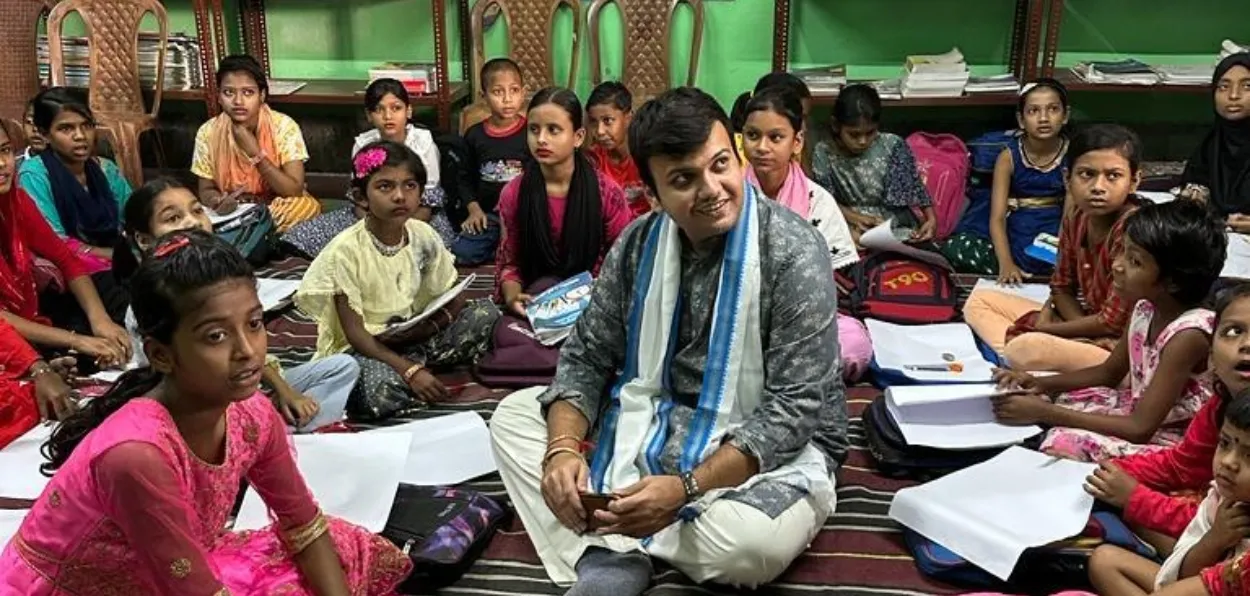
Hamed Aziz Safwi with students
“When re-elected in 2016, he became a revered figure, with a park and statue now bearing his name.” He passed away in 2018 and is remembered fondly by people.
Safwi, an economics graduate from St. Xavier University, Kolkata says that he is happy that today, the center (in his father’s name) can serve 600 students, while the e-Shiksha Centre caters to 80, and another section 40 students.
The center is located within the premises of the Taj Mahal Library in Uluberia—a location dear to his father. The Library is a subsidiary of the Taj Mahal Gram Vikas Kendra.
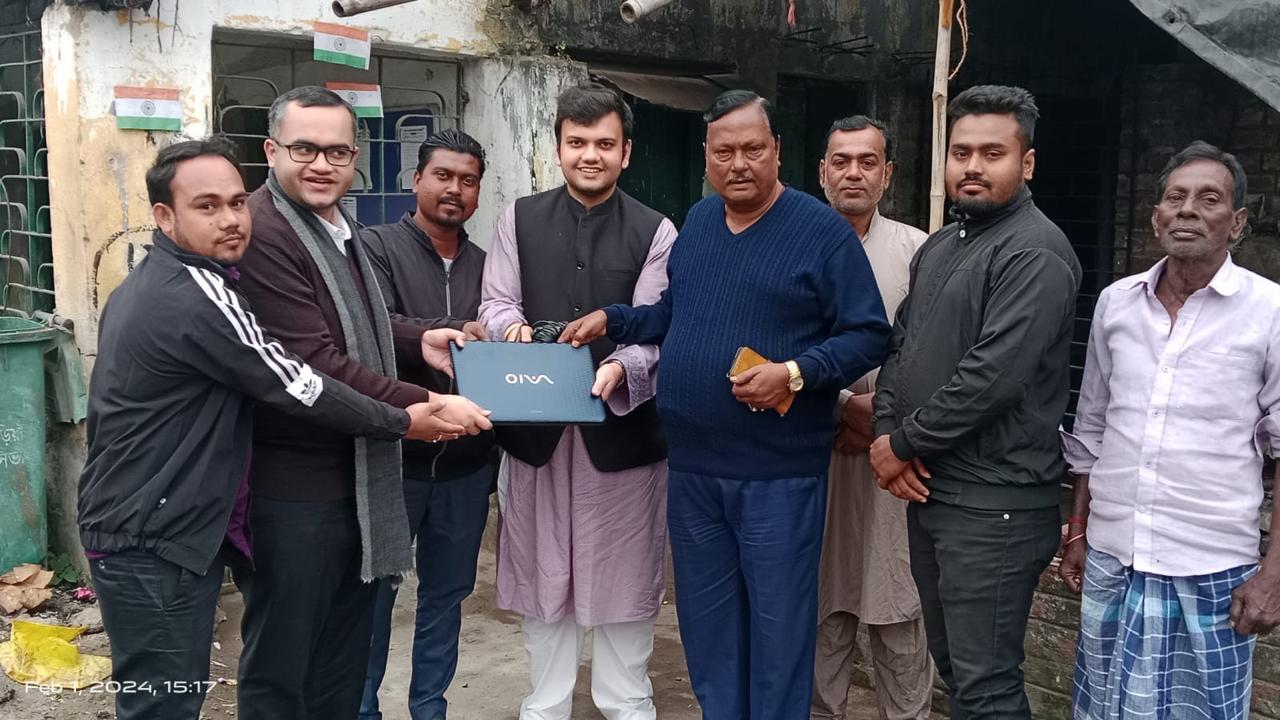
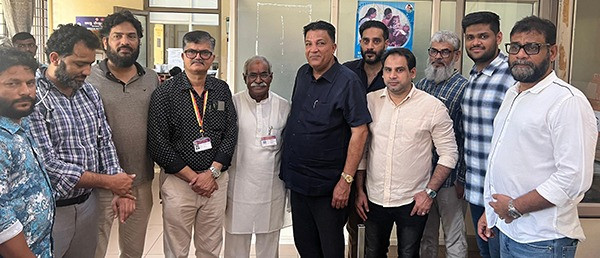
Hamed Aziz Safwi gifting laptops to students
The library, initially founded with the help of friends and locals, provides expensive books and resources free of cost to students preparing for exams like IIT-JEE, NEET, CAT, etc. This initiative is useful for locals for whom such resources can be prohibitively expensive.
Uluberia has a sizeable Muslim population and a majority of them can ill afford expensive coaching for prestigious examinations for professional colleges and hence the youth don’t even dare to dream big.
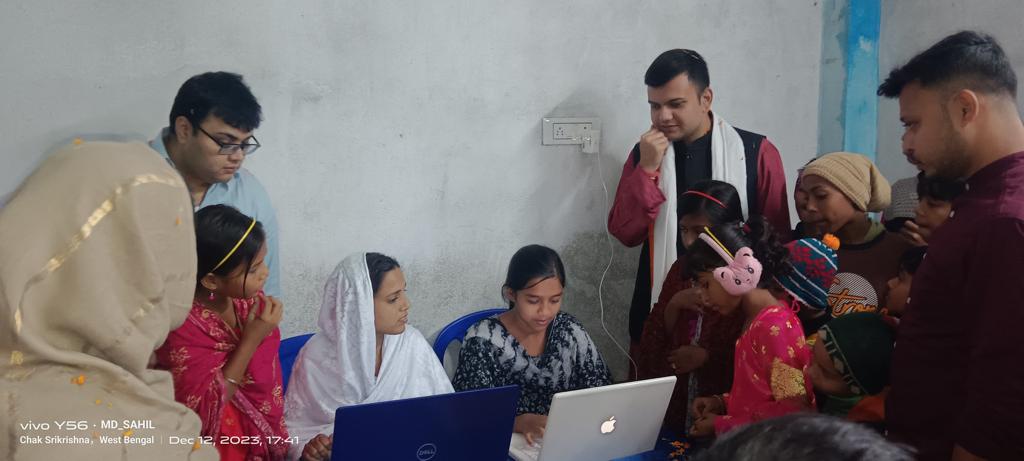
Hamed Safwi set up his e-Shiksha Centre (digital learning center) to give students access to laptops, the internet, and virtual coaching, enabling them to pursue their education.
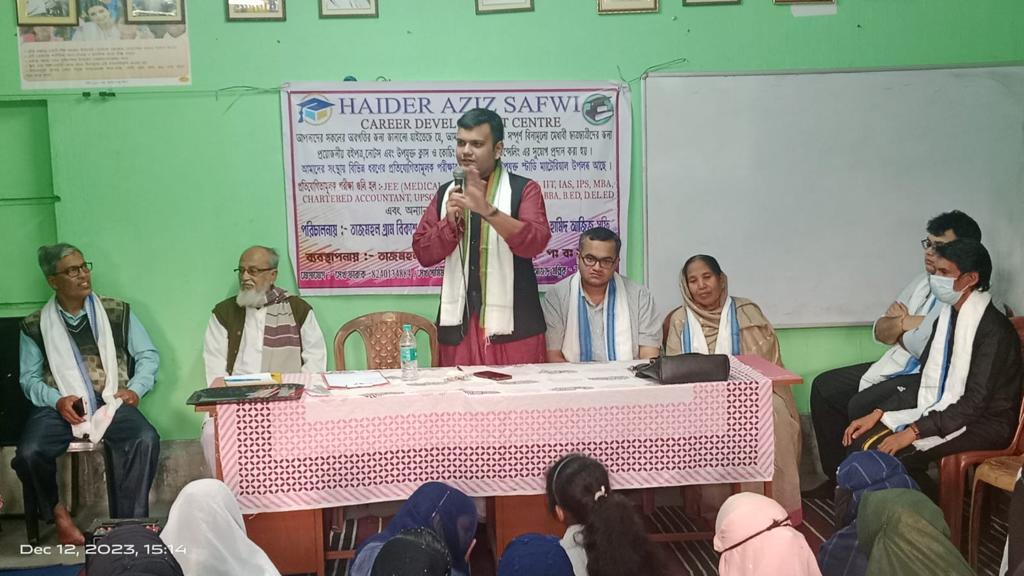
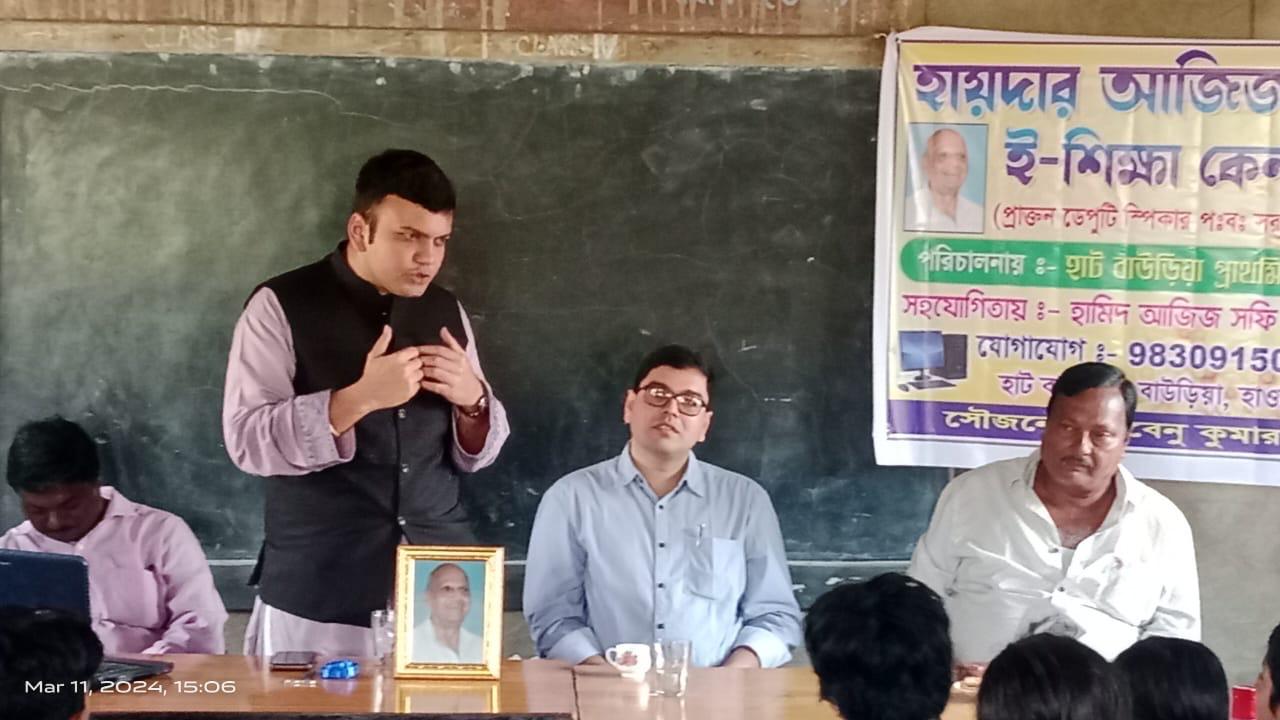
Hamed Aziz Safwi speaking at a function
Safwi said, “Access to books was the first step and to truly enhance the learning opportunities for the youth of Uluberia I introduced the e-Shiksha Centre, or digital learning center for better access to the digital world.”
Last year, he opened two digital literacy centers to bridge the digital divide in the community. These centers offer online classes and assistance, especially form-filling, particularly for those who struggle with technology. He felt the need for such a platform during and after the COVID-19 pandemic.
One center runs in collaboration with local club members and another in with the Hart Memorial Primary School.
Safwi said, “Locals are encouraged to come and learn, using the space to fill out forms or attend classes in their spare time. The community has been instrumental in these efforts, donating books, old laptops, and even stools to help fund and sustain these initiatives. The initiative is being run on Zero Cash policy here, we focus on providing resources rather than cash and are mostly funded by me.”
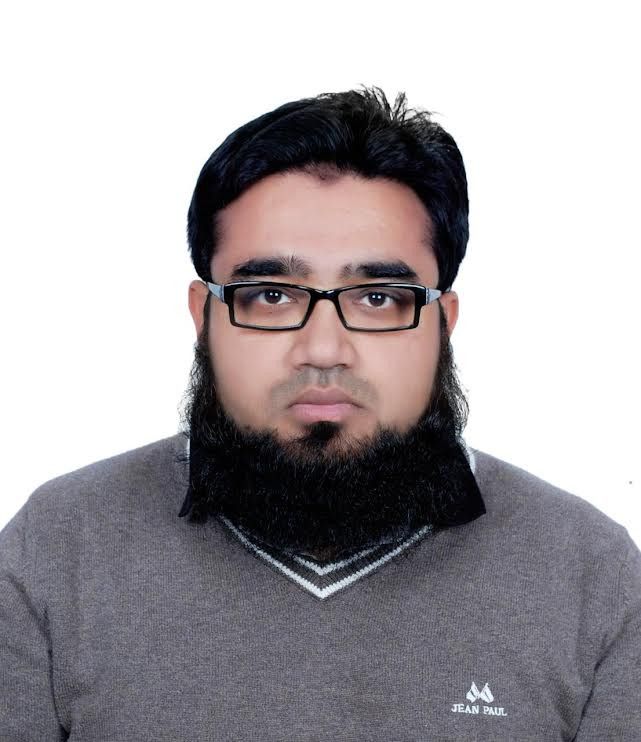
Hamed Aziz Safwi
“The e-Shiksha Centre provides essential resources to students who face financial hardships. It offers services to a maximum of 30 students per day, many of whom come from distant areas. For these students, the center serves as a crucial lifeline, offering take-home resources and digital access they otherwise couldn’t afford. Additionally, the center remains open from 10 am till 4 pm,” said local coordinator S K Faruk.
With support from Prof. Souvik Mukherjee of St. Xavier’s University, Hamed Safwi is determined to expand his reach to as many students as possible. “Together, we are working on plans to serve the educational needs of the community, ensuring that every student has the opportunity to access quality resources and support for their academic growth,” he said.
Nargis Parvin from Raghudebbati Mufty Para, Howrah, who works as a field facilitator at Nari o Shishu Kalyan Kendra on the Right to Food project the story is different.
She says, “Whenever I have free time, I visit the Haider Aziz Safwi Career Development Centre to read detective books by Satyajit Ray. These stories help shape my perspective on life.”
source: http://www.awazthevoice.in / Awaz, The Voice / Home> Story / by Hena Ahmed, Kolkata / September 11th, 2024
To mark Kannada Rajyothsava, Team B-Human conducted a charitable distribution drive on Thursday at Wenlock Hospital, Mangaluru, offering fruits and essential items to dialysis patients and children receiving treatment.
Dr. Shiva Prakash, District Medical Officer at Wenlock, inaugurated the event and praised Team B-Human’s efforts in raising awareness on health issues and supporting patients in need. “Wenlock Hospital has a well-equipped dialysis centre, and we provide a full range of treatment options in the children’s ward. Our mission is to offer free medical and surgical services to the underprivileged, both in urban and rural areas, along with specialized care,” he said.
Shareef Whitestone, a trustee of Team B-Human, highlighted the group’s commitment to community service, noting that they have sponsored free dialysis for many needy patients at Yenepoya and Kanachur hospitals over the past two years. “Our goal is to assist the economically disadvantaged across all communities. In the future, we also intend to offer financial aid to students from low-income families,” added Asif Deals, the founder of Team B-Human.
The distribution included lunch, blankets, and towels for adult patients, and special kits for young patients containing toys, fruits, biscuits, chocolates, diapers, slippers, and other essentials.
Several hospital staff and officials attended the event, including RMO Dr. Sudhakar T., physicians Dr. Sadananda Poojary and Dr. Abdul Basith, Nursing In-charge Sumanagala, Office Superintendent Tilak U., SDO Avil Clarence Raj, Health Committee Member Shashidhar K. Bajal, and ARS Member Prabhakar Amin.
Representing Team B-Human were members Imthiyaz Z. M., Abbas Uchil, Imran Hasan, Nazeer Ullal, Iqbal Bantwal, Ahnaf Deals, Basheer, Azeez, Faiz, and Health In-charge Haneef Thodar.
source: http://www.english.varthabharati.in / Vartha Bharati / Home> India / by Vartha Bharati / November 07th, 2024
Hangishart Village (Kupwara, Kashmir), JAMMU & KASHMIR:
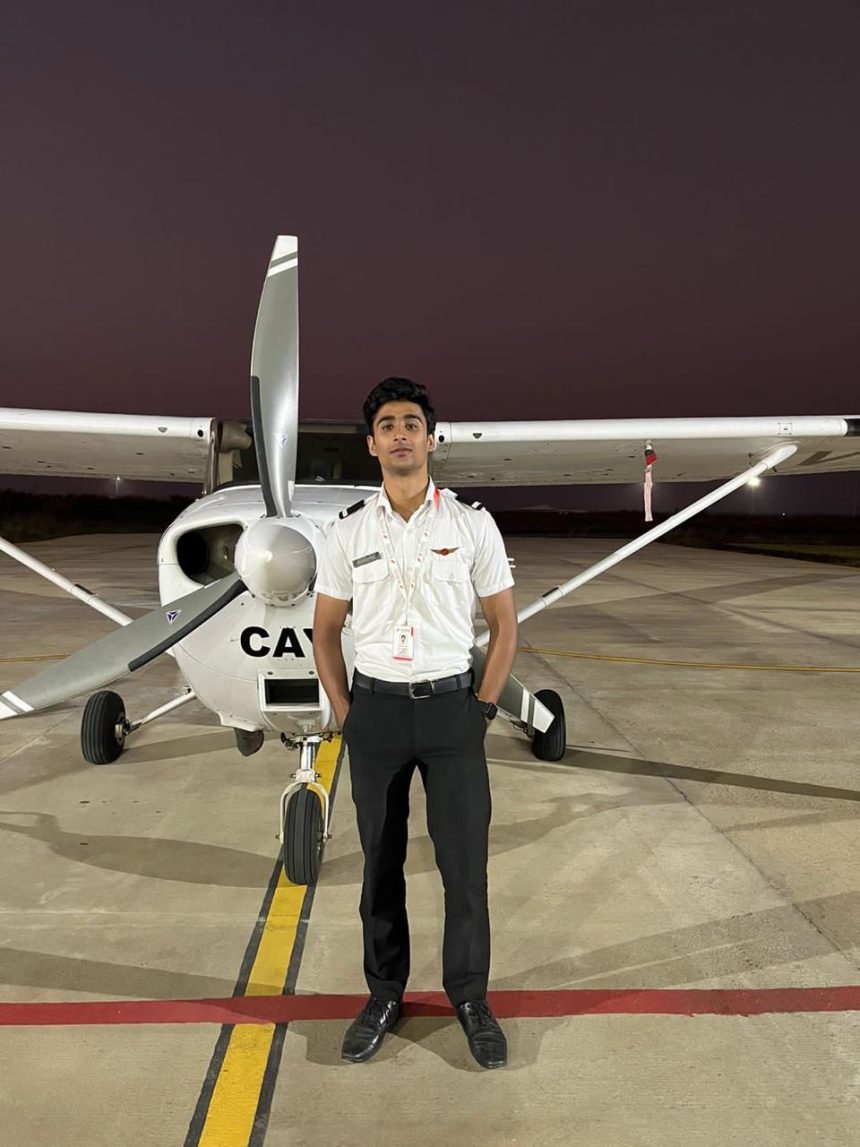
Owais Manzoor, a 21-year-old from Hangishart village in North Kashmir’s Kupwara district, has made history by becoming the first commercial pilot from the area. He has recently joined Air India.
Mehak Bandey sent him a few question to know about him and his opinion on issue through email. Owais shared his journey and his challenges in the following online conversation:
Was it your childhood dream to become a pilot? Please tell us about your journey to becoming a pilot and the challenges you faced.
Yes, it was my childhood dream. I used to get very fascinated by looking at the cockpit and always thought about how the plane flies. So, about my journey, I did my schooling in Kashmir, and soon after 12th, I joined aviation, cleared my DGCA exams, and completed my 200 hours of flying from Redbird Flight Training Academy in Karnataka. Then I applied for the Air India vacancy and cleared it.
How supportive were your parents in achieving your goal?
My parents have been my backbone; they supported me immensely throughout my aviation journey.
From a remote village in Kashmir to Air India—how was that journey?
It was a journey full of patience, as that’s what aviation teaches us and tests us.
Since you wanted to fly, did you ever consider joining the Indian Air Force?
While I have immense respect for the army personnel who serve our country, my sole goal has always been to fly for a commercial airline.
Flying commercial planes means taking full responsibility for all passengers. How do you cope with that?
It comes with experience and the confidence that builds over time. No one is perfect, but anything can be mastered. I feel confident in my ability to make decisions that ensure the safety and well-being of both the aircraft and the passengers.
What message would you like to give to the younger generations of Kashmir?
My message is to stay patient, set a goal, and work on it. We can achieve anything if we set our minds to it and not let other things overpower us.
source: http://www.awazthevoice.in / Awaz, The Voice / Home> Story / by Mehak Bandey, New Delhi / September 21st, 2024
Prof Farhan Ahmad Khan, Department of Pharmacology, JN Medical College, Aligarh Muslim University has been granted a certificate of registration by the UK Intellectual Property Office for a novel design of an innovative device that enables early diagnosis of rare genetic disorders in children.
He said that the design paves the way for understanding and solving some of the difficult challenges in medical science today. The device, when ready to use, will help in the management of rare pediatric genetic disorders.
Prof. Syed Ziaur Rahman, Chairman, Department of Pharmacology, congratulated Prof. Khan on the registration of the design of his device, adding that it is a proud moment for the department and the university.
source: http://www.amu.ac.in / Aligarh Muslim University / Home> AMU News / by Public Relations Office (headline edited) / October 25th, 2024
Tariq Ahmad Patloo, 51, says he is grateful to the PM for appreciating his efforts, yet, he remains unmoved by the fame because successive governments have done nothing for the Hanjis- the dwellers of waters in the Dal and other lakes of Kashmir Valley.
The floating ambulance by Tariq Ahmad Patloo on Dal Lake in Srinagar (Image: ANI)
Houseboat owner Tariq Ahmad Patloo, who converted his boat into a floating ambulance to ferry COVID-19 patients on the Dal Lake in Jammu and Kashmir, found mention in Prime Minister Narendra Modi’s monthly radio address ‘Mann Ki Baat’ on June 27.
Fifty-one-year -old Patloo, who lives with his mother, wife and daughter, along with thousands of others in the houseboats stationed in the world-famous Lake of Srinagar, had designed the free floating ambulance service after he recovered from COVID-19 during the first wave of the pandemic in August last year.
Tariq Ahmad Patloo
Patloo, who owns the house boat named ‘Sea Palace’, apart from the ambulance, is grateful to the Prime Minister for appreciating his efforts. But, he is unmoved by the fame because of the grudge that successive governments have not done anything for the Hanjis- the ethnic community who are dwellers of waters in the Dal and other lakes of Kashmir Valley.”I can’t thank the Prime Minister enough for mentioning me in his address. But I would have been happier if the Centre, or the state, may have done something for the progress of our community.” Patloo told MoneyControl.
Hanjis living in about 900 houseboats, Patloo said, have been living in misery for years. “No one care for us. They talked about rehabilitation, nothing happened. They said they will relocate us, nothing happened. We do not have even a dispensary here. No one has been ever given a government job. We have had enough promises,” he said.
Patloo is not the only member from his family to catch Prime Minister Modi’s attention. In 2018, the PM praised his eight-year-old daughter Jannat’s efforts for cleaning Dal Lake.
“We don’t need money. We need to live a respectful life, like any other community,” he said.
During his ‘Mann Ki Baat’ programme the PM appreciated Patloo’s novel idea of a boat ambulance.
“Here a boat ambulance service was started at Dal Lake. This service was started by Tariq Ahmad Patloo ji of Srinagar, who is a houseboat 0wner. He himself has also fought the battle with COVID-19 and this inspired him to start the ambulance service,” the Prime Minister said in the 78th edition of the address.
Patloo said he thought of setting up the ambulance out of his personal experience. He had faced difficulties to reach the hospital from Dal waters when he contracted the disease. He was in home isolation for the first few days but had to be hospitalised at downtown Srinagar’s Shri Maharaja Hari Singh (SMHS) hospital after his health deteriorated.
“I had a difficult time in reaching the shore of the Dal Lake. I cannot even tell you how my family managed to take me to the hospital,” said Patloo.
The ambulance comes equipped with PPE kits, stretchers, wheelchair and other healthcare amenities. It also provides oxygen cylinders to the needy besides generating awareness regarding COVID-19 appropriate behavior.
Jammu and Kashmir reported 415 new COVID-19 cases and eight deaths in the last 24 hours. As many as 46,148 fresh COVID-19 cases and 979 deaths were recorded across the country in the last 24 hours, the Union Health Ministry said.
source: http://www.moneycontrol.com / Money Control / Home> News> India> Trending Topics / by Gulam Jeelani / June 28th, 2021
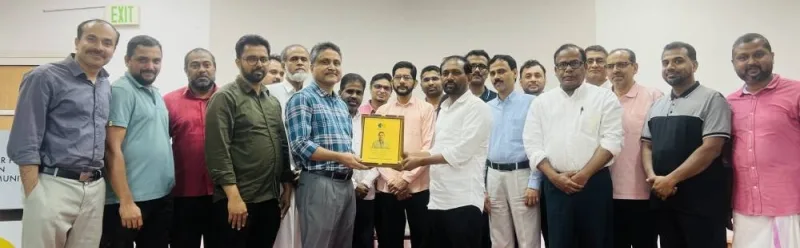
Dr Abdul Rahiman Elikkottil, associate consultant at Hamad Medical Corporation and an active member of the Center for Indian Community (CIC) was given a farewell by the CIC Medical Affairs Wing as he concluded 26 years of expatriate life and returned to his homeland.
At the event chaired by CIC vice-president Habeeb Rahman Keezhisseri, president T K Qasim, Haris, Abdul Jaleel M M, Dr Hussain, Dr Noushad, Dr Naseem, Mansoor and Mohammed Ali spoke.
Noufal Paleri delivered the welcome address and Dr Abdul Rahiman gave a reply speech.
Habeeb Rahman presented a memento on behalf of CIC.
source: http://www.gulf-times.com / Gulf Times / Home> Community> Culture / September 22nd, 2024
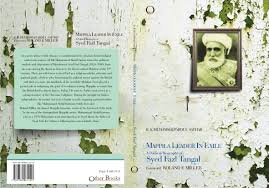
In the biography of Syed Fazl, Dr. K K Muhammad Abdul Sathar traces the political outlook and disposition of Mamburam Syed Fazal Tangal (1824-1900) from his roots among Ba alwis in Yemen to the Malabar of the 19th century.
There are references to Syed Fazal as a religious scholar, reformer, and spiritual guide, all these roles buttressing his political stance against the British and the feudal aristocracy.
In the preface to her memoir, the author B. M. Zuhara writes, “I grew up at a time when Muslim girls did not even have the freedom to dream.” The Dreams of a Mappila Girl is set at the time when independent India was embracing its new identity as a free nation. It offers a rare portrait of women in Muslim households in North Kerala through the lens of a woman writer. Zuhara showcases how women, bound as they were by the rules of society, still managed to hold key positions in their family and had an important voice in the discussions concerning their lives, contrary to popular perception.
The following piece is an excerpt from Fehmida Zakeer’s translation of the book, soon to be out from Yoda Press.
****
During the holidays, the hall upstairs turned into a playground for the children, who were allowed to play outdoors only in the evenings. Lined by long windows without grills, and furnished only with Uppa’s charukasera and writing table, the hall was an expansive place for us to jump and run and skip and play. Below the glass windows was a cement slab broad enough to be used as a seat, running the length of the hall. If you sat on it and looked out of the window, you could see paddy fields and coconut groves and people out on the road in front of the house.
One evening, I was playing with Achu, the elder brother nearest me in age. Though his name was Assoo, I called him Achu. We were racing cars, or rather matchboxes converted by our imaginations into pretend cars. Since both Achu and I were recovering from a fever, we did not have permission to go out and play with the others, and so we were playing in the hall upstairs. Suddenly I heard the sound of Umma’s medhiyadi on the staircase leading from the women’s section of the house.
In those days, people used wooden footwear indoors. Climbing stairs in a medhiyadi, gripping the peg in the middle with the big toe and the second toe, was a feat in itself. Valippa’s medhiyadi, which he wore when he went out, had leather straps. Uppa preferred to wear shoes when he stepped out of the house. Once a year, Chandu Aashari, the family carpenter, made medhiyadi for the whole family. Achu once broke the small medhiyadi made for me by Chandu Aashari, and how I wept!
Umma did not normally come upstairs in the evenings. I looked enquiringly at Achu when we heard the sound of her footsteps.
‘Umma is going to Kozhikode tomorrow morning. She knows that you will cry and insist on going with her. That’s why she didn’t tell you.’
Even though I knew Achu was trying to provoke me, my eyes started filling with tears. I was five years old at that time, and in class one at school. I missed school frequently because I used to accompany my mother wherever she went. This continued in class two. At the end of each year, Uppa would visit the school and meet the teacher, and I would be promoted to the next class. This was the usual practice.
I closed my brimming eyes and stood there thinking.
Achu spoke again. ‘Umma must have come upstairs to pack her clothes for the trip. You’d better go quickly.’
‘Don’t take my matchboxes. I’ll be right back,’ I called out as I ran to Umma’s room.
‘I told you about Umma’s trip, so now the matchboxes are mine,’ I heard Achu shouting after me, but I decided to ignore his words for now.
When I entered the room I saw the doors of the meshalmarah opened wide. The scent of kaithapoo filled the room. How it lingers, the fragrance of screwpine! The meshalmarah doubled as a table and a cupboard, and was actually a long table with drawers on both sides with space to store things below. Umma called the meshalmarah her clothes cupboard. Umma stored her clothes on one side and the children’s on the other side. In those times, children usually had only one or two sets of clothes, made from lengths of cotton. Trousers and shirts for the boys and chelakuppayam, or frocks, for me.
‘You are packing to go to Kozhikode without me?’ I whimpered.
Umma turned to look at me. ‘The crybaby has arrived!’ she said.
At that, I wailed even more loudly.
I had three nicknames as a child. Karachapetti, Tarkakozhi and Ummakutty. Karachapetti because I cried a lot; I did not know the meaning of Tarkakozhi but when someone called me that, I would put on a sullen look; I actually liked my third nickname of Ummakutty, ‘mother’s darling’. When someone called me by that name, a shy smile would tug at my lips. I liked to sing the lullaby Umma often sang to me. ‘Umma’s little girl Soorakutty, darling little daughter of mine.’
But at that moment, I was not thinking about the nicknames or Umma’s special song for me.
‘If you go without taking me with you, by God, by the Prophet, I will not go to school till you come back.’
‘Moideen will tie your hands and legs and take you to school,’ Umma said as she placed her clothes in a cloth bag fitted with wooden handles.
Moideen was the caretaker of our house, and all the children were scared of him. But even though he put on a stern face when any of us misbehaved, he really liked us. Whenever I cried and created a fuss, he would arrive and take me to the pond at the back of our house. He would get into the pond and pluck a lotus for me or teach me how to make toys with lotus leaves.
‘If I complain about a stomach ache, Ummama will not send me to school,’ I said, pouting.
‘This is too much. Don’t you want to learn to read and write? If you follow me around all the time, how will you learn your lessons?’
‘I don’t want to,’ I said resolutely.
‘Don’t imagine I’ll take you this time, Soora. If you hide inside the car, I will drag you out.’
Usually when it became clear that Umma would not take me with her on a trip, I would hide between the seats in the car without even having changed into an appropriate outfit. It did not occur to me that my grandfather, seated in the charukasera on the verandah, the driver, and the servants busy in their tasks would all notice my presence. I thought I was fooling Umma by hiding in the car. When Umma came out of the house and went up to the car, Valippa would jokingly call out, ‘Mariya, be careful, there is a cockroach in the car.’
Umma would understand immediately. She would get into the car and pinch my ear and say, ‘Don’t get smart with me. Get out of the car.’
I would hug the seat and wail loudly.
Valippa would say then, ‘Take her with you. She’s a baby after all.’
‘Baby indeed, she’s over five years old. You are all spoiling her.’
And I would get to accompany Umma to Kozhikode once again. Umma’s younger sister lived in Kozhikode and, to us children, her house was a source of wonder. Umma had to see the doctor in Kozhikode every three months and she would drop in at her sister’s house when she made the trip.
Now Umma ignored my wails and placed the bag filled with her clothes on the table. Then she went downstairs. Sobbing loudly, I followed her.
‘Why is the baby crying?’ Ummama called out from below the stairs.
‘If she complains of a stomach ache tomorrow morning, don’t allow her to take the day off from school, Elama.’
When Umma was fifteen years old, her thirty-year-old mother, nine months pregnant, died. Later, Valippa married again. Our present Ummama was his second wife. I understood all this only later. Even though my mother and her siblings called their stepmother Elama, Ummama treated them as if they were her own children.
Ummama intervened on my behalf now. ‘Take her with you, Mariyu. If you leave her here, she will raise the roof with her crying.’
By then we had climbed down the stairs.
Umma ignored me and asked Ummama, ‘Is Uppa sitting on the verandah?’
‘He was asking for you. He just sent Assan to look for you.’ Assan, the handyman, was Moidyaka’s son.
Every evening Umma and Ummama went to the verandah to keep Valippa company. This was the only time they were allowed on the verandah.
‘Aren’t you coming?’ Umma asked as she made her way outside.
‘You go on. I’ll come soon,’ Ummama said, walking towards the eastern side of the house where the bathrooms were located.
As Umma made her way to the front of the house, I followed close behind, sniffling and crying.
‘Soora, don’t irritate me. If you don’t stop I’ll lock you up in the kunhiara. I’m warning you.’
Kunhiara. As soon as I heard that word, my wails dwindled to a whimper. Kunhiara was the small room where the sparingly used big and heavy copper and brass utensils were stored. The room was dark even during the daytime and was a haven for cockroaches, moths and rats. I was not really scared of the cockroaches, the moths, the rats. What terrified me was the tomcat installed in our house to catch the rats. Its glowing eyes struck terror in my heart. To me, spending time there was like being in hell, and once locked inside I would remain there until the servants came to rescue me. I was still sobbing when we reached the verandah.
‘Chu, why are you laughing?’ asked Valippa.
My grandfather called me Chu.
‘Your darling Chu cries all the time,’ Umma said crossly.
‘Don’t say that, Mariya. Look at her smiling now. She looks so beautiful.’
On hearing this, in spite of the tears streaming from my eyes, I attempted a smile.
‘That’s my brave girl. Come here.’ Valippa beckoned to me. ‘If you massage my legs, I’ll give you a mukkal.’
Forgetting about the trip to Kozhikode, I walked towards the charukasera where my grandfather sat with his legs hoisted over its elongated armrests. I massaged his legs one by one with my small hands.
‘I want the coin with the hole.’
In those times, one pice coins came with a hole and without. I preferred the ones with the hole. I dropped all the coins I got from Valippa into a powder tin which had its top cut open with a knife.
By then, Ummama had reached the verandah. Ummama would sit on the bench and Umma would stand by the door as they talked about the events of the day with my grandfather. I listened to them talking as I pressed Valippa’s feet, directing smug looks at my mother and feeling like the valiant Unniarcha.* Absorbed in conversation, Umma too seemed to have forgotten the whole episode.
***
* Unniarcha is a mythological warrior woman celebrated for her fearlessness, immortalised in the vadakkan paatu, the ballads of the region.
Translator’s Bio
Fehmida Zakeer is an Independent writer with bylines in several publications including, The Bangalore Review, The Hindu, Al Jazeera, Reader’s Digest, National Geographic, Whetstone Magazine, NPR. Her fiction has appeared in publications such as The Indian Quarterly, Out of Print Magazine, Quarterly Literary Review Singapore, Asian Cha, among others. A story of hers was placed first in the Himal South-Asian short story competition 2013, and another was chosen by the National Library Board of Singapore for the 2013 edition of their annual READ Singapore anthology.
___________________________________________
B. M. Zuhara
BM Zuhara has written novels and short stories and is the first Muslim woman writer from Kerala. She won the Kerala Sahitya Akademi Award for her contribution to Malayalam literature in 2008 and has received awards such as Lalithambika Antharjanam Memorial Special Award, Unnimoy Memorial Award and the K. Balakrishnan Smaraka Award. Her novels, Iruttu (Darkness), Nilavu (Moonlight) and Mozhi (Divorce), have been translated into Arabic while the English translation of Nilavu was published by the Oxford University Press in an anthology titled, Five Novellas. She translated Tayeb Salih’s Wedding of Zein and Naguib Mahfouz’s Palace Walk into Malayalam.
______________________
source: http://www.bangalorereview.com / The Bangalore Reviews / Home> Non-Fiction / by B M Zuhera / July 2022
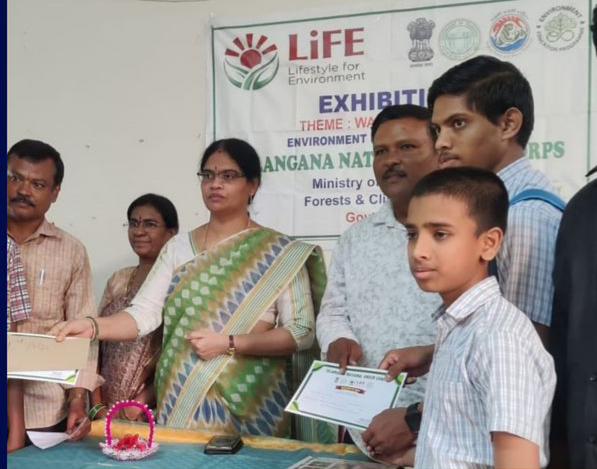
Ansar School is beaming with pride as our talented students, Alkama Shamim (Grade 10) and Mohammad Farhan (Grade 9), achieved an impressive milestone by securing the 3rd prize at the Telangana National Green Corps’ district-level ‘Waste to Wealth’ exhibition.
This prestigious event witnessed fierce competition among 105 students from various schools across the district, showcasing innovative ideas on turning waste into valuable resources. Alkama and Mohammad’s creative project stood out, earning them well-deserved recognition.
The awards were presented by the esteemed District Education Officer, Mrs. Vasanthi, adding to the honour of this achievement.
The school authorities extended our heartfelt congratulations to Alkama Shamim, Mohammad Farhan, and the entire Ansar School community for this remarkable accomplishment: “Your hard work and dedication have made us all proud, added Abdul Hanna (Chairman, Ansar Educational Trust).”
source: http://www.radiancenews.com / Radiance News / Home> Latest News> Markers of Excellence / by Radiance News Bureau / November 05th, 2024
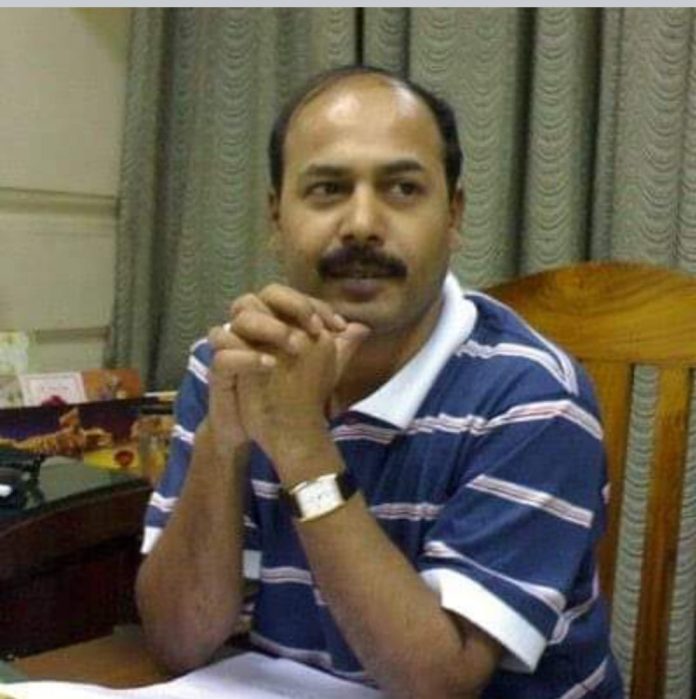
Dr. Abdus Sattar, former Cabinet Minister in the Left Front government and an associate professor, has been appointed Chief Advisor to West Bengal Chief Minister Mamata Banerjee and the Department of Minority Affairs & Madrasah Education. Previously a leader of CPI(M), Dr. Sattar has a longstanding record in public service.
According to a notification from the governor’s office, Dr. Sattar will serve as Chief Advisor to the Chief Minister and Department of Minority Affairs & Madrasah Education, holding the rank of a Cabinet Minister. In this role, he will assist the Chief Minister and the department on initiatives and welfare activities benefiting the state’s minority communities. He will receive emoluments, allowances, and perks equivalent to those of a state Cabinet Minister.
Dr. Sattar is expected to assume his new role after obtaining lien from his current institution. A respected figure in West Bengal’s political landscape, he was elected from the Amdanga constituency in 2006 assembly elections and served as Minister of State for Minority Development, Welfare, and Madrasah Education under the Left Front administration.
source: http://www.radiancenews.com / Radiance News / Home> Latest News> Report / by Radiance News Bureau / November 07th, 2024