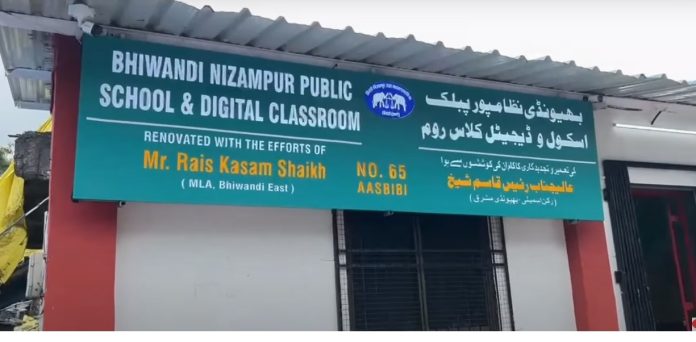
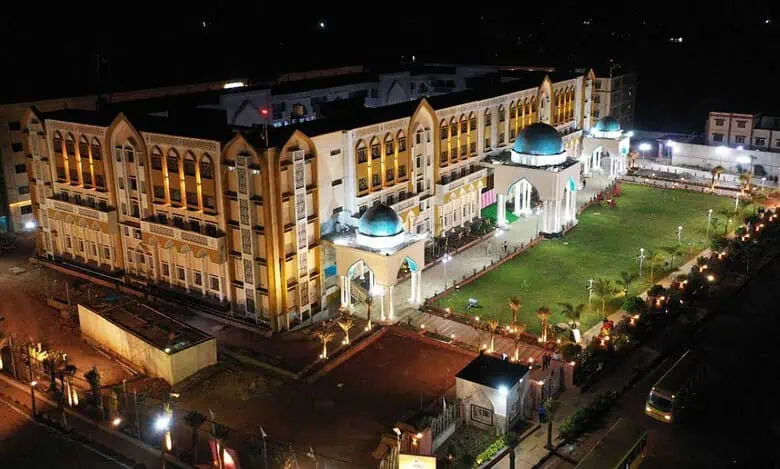
The city of power looms marked an educational milestone with the inauguration of its first municipal digital classroom at the historic Municipal Urdu School. This achievement is a result of the concerted efforts of the MLA Raees Sheikh.
The newly introduced digital classroom aims to modernize municipal schools and level the playing field for students compared to private institutions. This initiative started at one of the oldest municipal Urdu schools, previously shut down due to inadequate facilities. The digital classroom features a 55-inch television for online learning, writing capabilities, a digital syllabus for grades 1 to 4, Wi-Fi, and CCTV cameras. The classroom’s walls are painted with vibrant colors and educational cartoons, creating an engaging environment.
The grand opening at School No. 65 was attended by former teachers, students, families, and local residents, who were impressed by the modern facility. MLA Raees Sheikh, who inaugurated the classroom, highlighted that Bhiwandi’s government schools would become a model for Maharashtra. He announced plans to implement similar digital classrooms in all municipal schools, with 20 schools in the Eastern constituency currently undergoing upgrades. School No. 65 is the first to be completed, and Sheikh committed to ensuring that municipal schools are equipped with facilities comparable to private institutions.
Previously, School No. 65, located on Kalyan Road in the As-Bibi area, operated for 63 years in a small, dilapidated room with minimal amenities, including a lack of drinking water and sanitation. Despite operating for over six decades, these needs were ignored by educational authorities. After media reports, the State Human Rights Commission ordered improvements, but instead, the corporation closed the school and relocated students. Responding to local protests and educational disruption, MLA Raees Sheikh recognized the need for a new building. He allocated ₹60 lakh for construction on nearby PWD land and ₹7.5 lakh for a digital classroom in the old building. While construction of the new building is ongoing, efforts to improve educational facilities continue.
source: http://www.radiancenews.com / Radiance News / Home> Education / by Radiance News Bureau / August 17th, 2024
Actor Kader Khan, known for his comedy roles, dialogues, scripts in Bollywood, died a man regretting his association with the film industry, and urging Muslims to acquire and understand the true teachings of Islam, for which purpose he himself wrote a book on Prophet Muhammad’s Hadith.
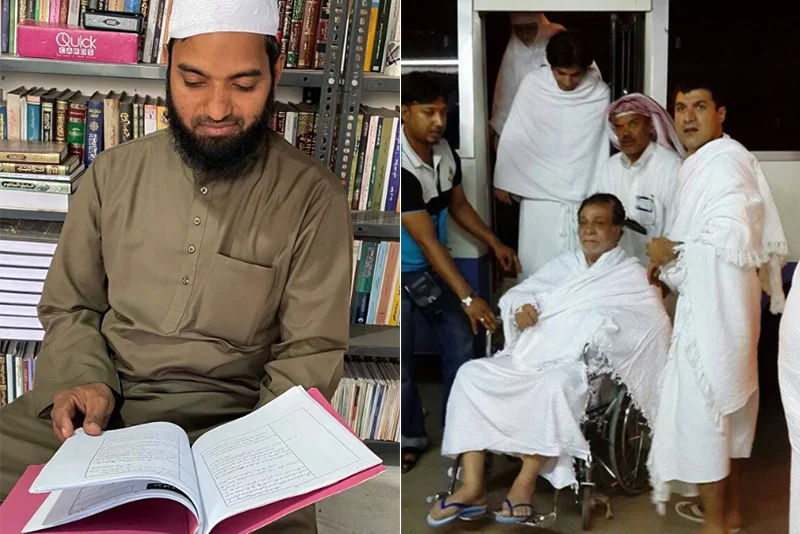
[Sheikh Mustafa Bashir Madni (L) with Kader Khan’s unpublished book on Hadith. The veteran actor with his sons, Shahnawaz and Sarfaraz in Makkah for Hajj.]
Actor Kader Khan, known for his comedy roles, dialogues, scripts in Bollywood, died a man regretting his association with the film industry, and urging Muslims to acquire and understand the true teachings of Islam, for which purpose he himself wrote a book on Prophet Muhammad’s Hadith.
“Kader Khan so strongly wanted Muslims to acquire the knowledge and true teachings of Islam that he himself wrote a book on Prophet Muhammad’s Aha’dith”, Sheikh Mustafa Bashir Madni said while talking to ummid.com.
Mustafa Bashir Madni had met Kader Khan in Madinah when he travelled to Saudi Arabia for Hajj in 2014. Sheikh Mustafa at that time was a student of Jamia Islamia Madinah Munawwarah, the Islamic University of Madinah popularly known as Madinah University.
The two developed a relation, and when Sheikh Mustafa met him in Mumbai in 2015 while he was on vacation in India, Kader Khan handed him his book.
“Mukhtasar Istilahat E Hadees”
Kader Khan had titled his book “Mukhtasar Istilahat E Hadees” and he wanted Sheikh Mustafa Bashir Madni to take a review before it is sent for printing.
“Mukhtasar” – used in Arabic and Urdu languages both, means “short” whereas “Istilahat E Hadees” is a term related to the study of Ahadith.
“Kader Khan’s work on Hadith is a two volume book. It beautifully explains in Arabic and Urdu different types of Ahadith, terminologies used and their classification”, Sheikh Mustafa said.
Aha’dith is the plural of the Arabic word Hadith – the records of traditions, narrations, words, actions, and approvals of Prophet Muhammad (Peace be upon him).
Watch Video
Ahadith have been categorised in different types based on their authenticity, reliability and the number of companions they have been narrated by. The Ahadith of Prophet Muhammad (peace be upon him) have been preserved since last more than 1,450 years because of Isna’d – the chains, that connect and directly reach to the Prophet from one narrator to the other.
“Kader Khan’s book is not the only or unique work as renowned scholars before and after him have volumes of work on the subject. But, it shows his affection for Islam and love for Prophet Muhammad (peace be upon him”, Sheikh Mustafa said.
A Changed Man
Recalling the series of conversations he had with Kader Khan in Madinah, Sheikh Mustafa said the famous actor was a changed man, a reformed person, rather.
“He would pray in Masjid E Nabawi for hours. On his Hajj journey, he was accompanied with his two sons, Sahahnawaz and Sarfaraz, and his daughter in law. But, he preferred praying alone”, Sheikh Mustafa said.
“I had seen him multiple times profusely crying, his hands raised and tears rolling down his cheeks”, he said.
“One day he asked me if I would be pardoned by Allah, The Almighty. I tried to comfort him saying Allah is Al Gafoor (The Ever-Forgiving), Ar-Raheem (Most Merciful), and he should be optimistic, I told him”, Sheikh Mustafa Bashir said.
“He however was not convinced and asked me to take him to some senior scholar. I therefore took him to Sheikh (Dr) Abdul Mohsen Al Qasim – one of the Imams of the Prophet’s mosque, Masjid Nabawi. In a lengthy conversation with Kader Khan, Dr Mohsen consoled him, shared with him glad tidings of Allah, the Almighty, and also advised him few things to do”, Sheikh Mustafa said.
“Aur mein gumrah ho gaya”
During his conversations with Sheikh Mustafa, Kader Khan also shared with him the memories of his early days, about how, when and why he left Afghanistan, his days as a Teacher at Saboo Siddik College in Mumbai and the circumstances under which he joined the film industry – with added details though most of which are already in public domain.
“I had written a play for Sabooo Siddik College students which was staged during the annual gathering. A director who was among the audience was so impressed after watching the play that he immediately called me. After a brief conversation, he handed me a “heavy envelope” and asked me to write dialogues for his film”, Kader Khan told Sheikh Mustafa.
“My salary at that time was around INR 300. The amount in the envelope was multiple times more….. Aur mein gumrah ho gaya… (And hence I went astray)”, Kader Khan said.
“After the success of my first film, another director met me. He handed me an envelope which was heavier than the first one. I could not restrain myself and then there was no looking back”, he added.
“Poor financial condition made me astray and dragged me away from my religion. Will Allah forgive me?” Sheikh Mustafa recalled Kader Khan crying and repeatedly asking while sitting in Masjid Nabawi.
Kader Khan’s dream projects
Besides writing his own book “Mukhtasar Istilahat E Hadees”, Kader Khan had also established a centre – first in Pune and then in Aurangabad, Maharashtra where a team of scholars was hired to translate the books of Ahadith in Urdu.
“He used to say that the translation of Quran in various languages, including Urdu, is already available. He however worried that Kutub e Ahadith are still beyond the reach of common Muslims, and was of the view that Urdu translation of Ahadith should be done and spread to the masses”, Sheikh Mustafa recalled.
A post-graduate in Arabic, the veteran actor had also dreamt of establishing a chain of schools in Mumbai, Dubai and Toronto to teach Arabic, Urdu and Hindi.
He had in fact spent quite a long time in the United Arab Emirates (UAE) during his last leg of life to establish ” K.K. Institute of Arabic Language and Islamic Culture” at Knowledge City in Dubai.
The project however could not see the light of the day in his life time. How and when his sons would convert Kader Khan’s dream project into a reality is unclear. His centres in Pune and Aurangabad, for which Kader Khan spent a huge amount of money, were closed when he was still alive.
Sheikh Mustafa Bashir however has vowed to review the book Kader Khan had handed him and get it printed.
“I am in talk with Sarfaraz, Kader Khan’s son who is currently in Canada. We have decided to print this book as soon as possible. It will inshallah be Sadaqah Jariyah – Charity Ever Flowing, for Kader Khan along with the other charity work he had done”, Sheikh Mustafa Bashir Madni said.
[The writer, Aleem Faizee, is Founder Editor ummid.com. He can be reached at aleem.faizee@gmail.com.]
source: http://www.ummid.com / Ummid.com / Home> Life & Style / by Aleem Faizee, ummid.com / November 04th, 2024
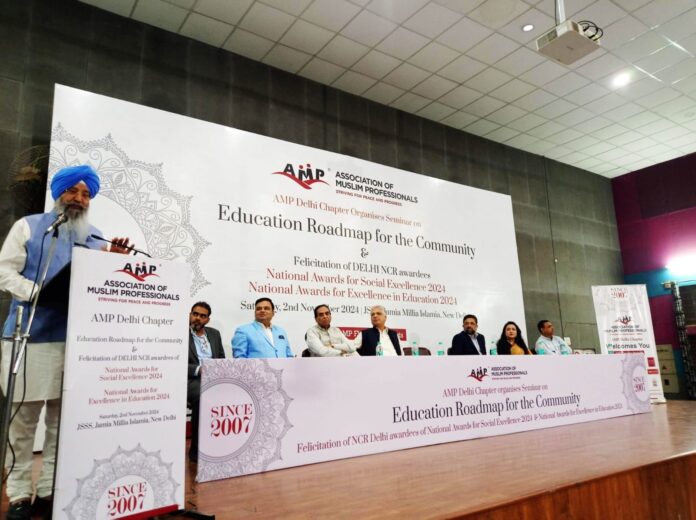
The Association of Muslim Professionals (AMP) organized a national seminar on “Education Roadmap for the Community” on Sunday at the JSSS Auditorium, Jamia Millia Islamia University. The event was attended by notable educators, social leaders, vice-chancellors, deans, senior professors, and school principals from across the country, who discussed strategies to promote education and foster collaboration for national development.
The Chief Guest, Mr. Iqbal Singh Lalpura, Chairman of the National Commission for Minorities (Government of India), praised AMP’s nationwide efforts in promoting education and employment, and expressed his support for such initiatives. He called upon organizations and individuals engaged in community development to collaborate and share their challenges and potential solutions. Mr. Lalpura reaffirmed the government and commission’s commitment to minority welfare and commended AMP’s career guidance and education-employment initiatives. He appreciated the AMP Career Chart displayed at Jamia for student career guidance, calling it a commendable step, and advised AMP to display charts of government welfare schemes in schools as well.
The keynote speakers at the seminar included:
– Dr. Khwaja M. Shahid (Former Vice-Chancellor, MANUU, Hyderabad)
– Professor Khan Masood Ahmad (Former Vice-Chancellor, KMCLU, Lucknow)
– Professor Furqan Qamar (Former Vice-Chancellor, University of Rajasthan and Central University of Himachal Pradesh)
– Prof. Dr. Rehan Khan Suri (Director, Centre for Innovation and Entrepreneurship, Jamia Millia Islamia)
– Professor Wasim Ahmad Khan (Former Faculty, Department of Teacher Training & Non-Formal Education, Jamia Millia Islamia)
– Mrs. Fauzia Mumtaz (Principal, Crescent School)
– Professor Zubair Minai (Department of Social Work, Jamia Millia Islamia)
– Dr. Javed Alam Khan (Economist)
– Mrs. Bushra Khanam (Senior Journalist)
– Dr. Mohammad Arshad Khan (Principal, Jamia Senior Secondary School)
Each speaker shared their valuable insights on promoting educational empowerment within the community.
On this occasion, the AMP National Talent Search 2024 poster was also unveiled by the Chief Guest and other dignitaries.
The program was skillfully anchored by AMP’s National Head Coordination, Mr. Farooq Siddiqui, who highlighted AMP’s 17-year journey, supported by over 150 chapters and thousands of volunteers across India, dedicated to promoting educational awareness and employment.
AMP Delhi Chapter Head, Mr. Altamash Mohammad, welcomed the dignitaries and appreciated the contributions made by AMP under the leadership of its President, Mr. Aamir Edresy, over the past 17 years.
On this occasion, AMP also presented the AMP National Awards 2024 for Social Excellence to the Delhi NCR awardees. The honorees in the national category included:
– Institute of Objective Studies (IOS)
– Association for Protection of Civil Rights (APCR)
– Taraqqui Foundation
In the State NGO category, the following organizations were honored for their impactful work:
– Tasmia All India Educational and Welfare Society
– Muslim Education Foundation (MEF)
– Rahat Welfare Foundation
– The Evangelical Fellowship of India Commission on Relief (EFICOR)
– Hamari Sada Trust
– Rahbar Foundation
– Guncha Foundation
The individual changemaker awards recognized:
– Syed Mahmood Akhtar, IRS (Retd.)
– Syed Zubair Ahmad
– Advocate Maryam Fawzia Rahman
– Dr. Sheikh Mujibur Rahman
– Zia us Salam
– Dr. Mohammad Arshad Khan
– Dr. Hasnain Akhtar
– Hammad Rahman
– Dr. Mohammad Shoaib Akram
– Professor Majid Jameel
– Ali Javed
– Wadood Sajid
– Abdul Majid Nizami
– Advocate Juneis Padalath
– Ashraf Ali Bastawi
– Senior Advocate M. R. Shamshad
– Fatima Khan
– Advocate Abubakr Sabbak
– Adil Meraj
Recipients of the AMP National Award for Excellence in Education 2024 from Delhi NCR included esteemed teachers:
– Prof. Furqan Qamar
– Professor Dr. Reshma Nasreen
– Dr. Irfanullah Farooqui
– Professor Arvinder Ansari
– Professor Nafees Ahmed
– Professor Nisar Khan
– Professor Sheema Aleem
– Rubina Gul Khan
– Fauzia Mumtaz
– Sumera Khan
– Dr. Mohammad Mukeet Khan
The event concluded with a vote of thanks by AMP Delhi Chapter Secretary, Dr. Aftab Alam, who expressed gratitude to the Chief Guest, speakers, Jamia Millia Islamia administration, guests, media, and AMP Delhi team for their hard work and dedication in making this event a success. Key members of AMP Delhi Core Team, including Monu Khan, Faizy Wasik, Adnan Khan, Shafi Ullah, Aftab Fazil, Mohammad Azharuddin, Shadab Ahmad, Arif Hussain, and Anwar Khursheed, provided exceptional support in organizing the program.
source: http://www.indiatomorrow.net / IndiaTomorrow.net / Home> Education / by admin indiatomorrow / November 04th, 2024
Remembering the prolific Urdu writer from Lucknow whose novels and short stories were full of insights about the lives and concerns of women.
Photo: Mehru Jafar/WFS
The prolific Urdu writer, Begum Masroor Jahan, quietly slipped into literary immortality in her beloved Lucknow on September 22 at the age of 81. Though she left behind an astonishing legacy of some 65 best-selling novels and more than 500 short-stories, the news of the passing of this titan did not even make it to the leading Urdu publications of India, what to speak of English and other languages.
Masroor Jahan belonged to that remarkable generation of Urdu women writers, born between 1925 and 1940, which includes novelists Nisar Aziz Butt, Altaf Fatima, Jilani Bano and Khalida Husain; and the short story writer Wajida Tabassum. With her passing, only two living representatives of that generation remain – Butt from Pakistan and Bano from India.
Born on July 8, 1938 in an educated and literary household in Lucknow, Masroor Jahan’s father, Sheikh Hussein Khayal Lakhnavi, was considered a good poet. Her paternal grandfather, Sheikh Mehdi Hasan Nasiri Lakhnavi, also had a collection of poems to his credit and was the author and translator of many books. Masroor Jahan had a passion for reading stories from an early age.
Her first short-story ‘Woh Kon Thi?’ (Who Was She?) was published in the Qaumi Aavaaz from Lucknow in 1960. Just two years later, she published her first novel Faisla (Decision). She began writing under the pen-name of Masroor Khayal – among others – which she later changed to Masroor Jahan at the advice of her publisher.
From her paternal side, her milieu was feudal, while her father was a teacher and the domestic atmosphere was middle-class. She was married at the tender age of 16 to Syed Murtaza Ali Khan, a nawab. Due to this background, her short-stories portray the minds and matters of all these three classes.
She claimed that whatever she wrote was given to her by her personal experience and observation, and was not fictitious. In a few instances, she even mentioned the real names of people living with her in her novels and when asked about this, pat came the response that she did not fear those folks ever going to court.
Her writings were popular with not only older homemakers but also students. Her stories published in the Urdu journals Beesveen Sadddi and Hareem had a seminal role in the upbringing of Lucknow’s middle-class young women. One of the standards of literary success is also that they be read and liked by every class of society. In that respect, many of her novels went into multiple editions.
Though Masroor Jahan’s forte was the novel, she turned her attention to short stories in the later years of her life and it can be said that the real form of her art is manifested in these tales. The simplicity of her story, the popular manner of writing and easy imagination were the qualities that distinguished her from her contemporaries, including her fellow-Lakhnavi, Naiyer Masud, who passed away in 2017, and Altaf Fatima, who hailed from Lucknow and died in Lahore last year.
Masroor Jahan belongs to the pantheon of female writers like Rashid Jahan, Ismat Chughtai, Quratulain Hyder, Hajra Masroor, Khadija Mastoor, Razia Sajjad Zaheer, Sarla Devi, Saleha Abid Hussain, Bano Qudsia, Jamila Hashmi, Zaheda Hina and Jilani Bano who drew attention to the woman who is present somewhere in society in some form through their short-stories and novels. She witnessed the era of the Progressive Movement as well as that of modernism, post-modernism and other trends in literature, but did not attach herself to any movement or trend.
But while presenting them, she did not adopt the conservative manner particular to some female fiction writers; neither did she adopt the kind of boldness which tramples upon cultural values in the heat of realism.
Whether her topics consist of middle-class or lower-class women, or the Anjuman Aras being nourished in high palaces, or the educated woman of the new society, she always maintained a cautious manner in the presentation of these matters and problems, especially when it came to sexual and psychological tension. She was acutely aware of how the decline of feudalism – when the life of Muslim households of northern India scattered owing to economic and moral decline – made women the ‘altar’ of the false honour of men. She created her stories by making women the subject through small incidents and characters.
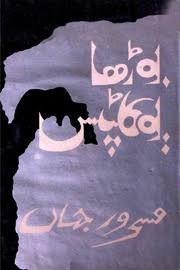
Boorha Eucalyptus. Photo: Rekha
Masroor Jahan also wrote romantic stories like the classic Boorha Eucalyptus (The Aged Eucalyptus) from her eponymous collection published in 1982, as well as stories where a helpless woman is hung on the cross of relationships. Then there are women who are the epitome of love and loyalty at one place, but at other places, create problems in others’ lives.
Many novels and short-stories have been written on the debauchery of nawabs and landlords. Wajida Tabassum had become famous at one time for writing such stories. Masroor Jahan too wrote many stories on this topic. But where she made the sexual waywardness of the nawabs her theme, she also presented the positive traits of their character.
In the character of begums too she tried to present every aspect of their life. These stories of a particular milieu express the solitudes and splendours of this culture, whose traces have themselves now become legend.
‘Kunji’ is a classic story of this milieu. Kunji was an extremely beautiful young dancer. Audiences were enthralled by his performances in the nautankis where he presented his dance. People of the highest rank were devoted to his coquetry and beauty. Nawab Zeeshan lost his heart to Kunji. He arranged for the whole nautanki troupe to stay near his harem and gave a beautifully decorated room attached to his bed-chamber to Kunji. In his love for the male dancer, he even forgot the beauty of his begum Anjuman Ara.
Anjuman Ara was amazed at what had happened to the nawab. She was also embarrassed thinking that her rival was not some woman, but a man. Indeed, she herself liked Kunji’s dance; but found her husband’s attachment to him obnoxious. One day when the nawab was off visiting the nearby village, she went to Kunji’s room. The dancer was bewildered by the unexpected sight of a beautiful woman in front of him. ‘I am Anjuman Ara, the begum of Nawab Zeeshan’, she says.
She looks around the room, which had feminine dresses and other articles of feminine adornment everywhere. But the beautiful youth sitting in front of her bore no relation to femininity. His long black hair appeared artificial. She tells him with great gravity that she liked his dance. Despite this praise, Kunji begins to consider himself inferior in front of her. He is also embarrassed listening to praise from her mouth; and he did not have the courage too to look towards her. Firstly, it was the awe of beauty and then that aspect of ridicule in her praise of him which he felt. Despite primping and preening for several hours, he could not compete with this beauty and femininity. People kept encouraging his coquetry now but real beauty was present before him. For the first time in his life, Kunji’s heart beat in a different manner.
He looked at Anjuman Ara with eager eyes. She too was looking in his direction. Their eyes met and lowered. Anjuman Ara’s beauty and femininity had brought to life a man whom the praise and admiration of others had patted to sleep. Anjuman Ara was stupefied reading the message of yearning in his eyes; and worried too. She immediately got up to leave. Kunji too regained consciousness, and said slowly, ‘You’re leaving so soon.’ Anjuman Ara replied, ‘Yes. The nawab will be here soon and then you too will have to change your appearance.’ When Nawab Zeeshan stepped into Kunji’s room upon his return, he saw that instead of the preening dancer he sought, a man was sitting there; and there was a heap of hair before him.
At the point where Masroor Jahan ends the story, looking at Anjuman Ara and Kunji one by one, the reader feels that he has seen with his own eyes how one beauty gives birth to another. Had she wanted, she could have presented Kunji like Ismat Chughtai’s ‘Lihaaf’ (indeed she cited Ismat Chughtai as an early influence and had attempted to make her female characters bolder after the latter’s advice). The nawab of Lihaaf too was happier with boys and left his Begun Jan. But Masroor Jahan did not let Anjuman Ara become Begum Jan. For her, homosexuality was not the refuge Chughtai hinted at for her protagonist.
Unlike ‘Lihaaf’, with which the former was often compared to, Kunji was based on a real-life character. In an interview conducted just five months before her death, Masroor Jahan named Kunji as her favourite real-life character from her stories.
The short-stories of Masroor Jahan with their absent and present realities are those milestones of her creative journey which will not be easily forgotten. About her own stories, she used to say, ‘Actually life is not unidirectional, it has a thousand aspects; and every aspect is a complete world in itself. The fiction writer is a pulse-reader of life. It is her duty to present every aspect of life in its proper context.’
Among the 65 novels she wrote, the social realist Nai Basti (New Colony) is of special interest. Published in 1982, this was topically different from all her novels. Indeed, to my knowledge, this is the first Urdu novel where the problems of nameless city settlements – which are called ‘illegal’ – have been narrated. Premchand had made the rural poor the subject of his novels, but in this novel are the urban disadvantaged, who have their own problems and life – and values that are being trampled on.
I got acquainted with Masroor Jahan barely a month ago when I read Shafey Kidwai’s lucid review of her two recent collections of short-stories namely Naql-e- Makaani (Migration) and ‘Khuvaab der Khuvaab Safar (A Journey Dream After Dream) in the Friday Review of The Hindu.
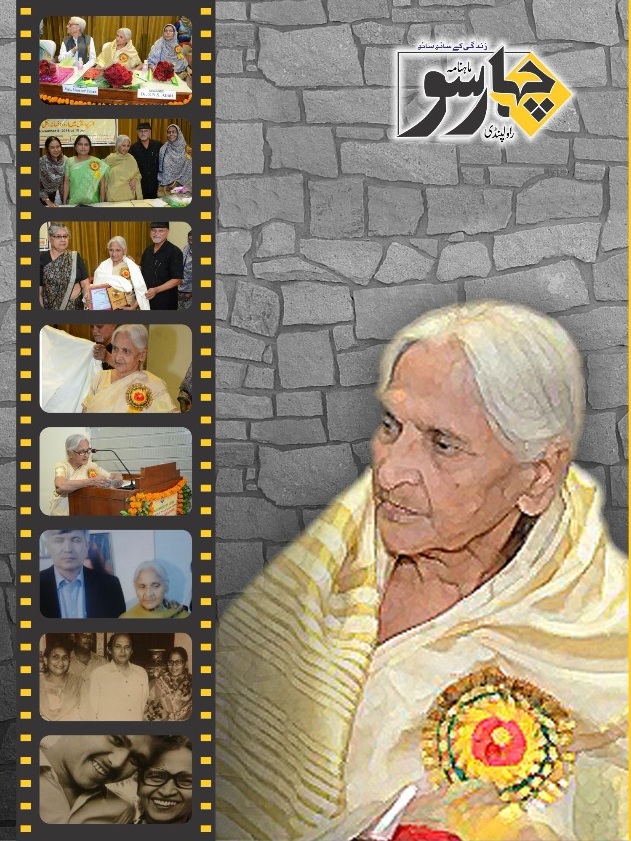
From there, I sought out the January/February issue of the monthly Chahaar-Su, issued from Rawalpindi, which was dedicated to Masroor Jahan and consists of an excellent and quite revealing interview of the writer with the editor Gulzar Javed. These readings also sent me down memory lane to my maiden visit to Lucknow back in 2014 when I was invited to the Lucknow Literature Festival.
It was there too that I made the acquaintance of the lovely and erudite Saira Mujtaba; I sadly do not recall any conversations we might have had with regard to her late grandmother, Masroor Jahan. Now when I think about that visit, I am disconsolate because I know I should have been spending time with the living monuments of Lucknow like Begum Masroor Jahan and Naiyer Masud, rather than admiring the dead buildings of that city. That regret will always be mine!
Masroor Jahan’s quintessential short-story The Aged Eucalyptus talks about the eponymous tree which is a witness to the eras, revolutions, stories and secrets of the haveli where it had stood so proudly for decades in addition to being the recipient of the imprinted affections of the doomed love affair of the two main protagonists, Maliha and Ahmer.
Later on, the aged eucalyptus would provide solace to Maliha as she held it to console herself in her lover’s absence. The story ends with the uprooting of the aged eucalyptus in a storm overnight.
I would like to think that the aged, kind, empathetic eucalyptus was not only a metaphor for the doomed love affair in the story itself but for Masroor Jahan’s own life, patiently accumulating the various sorrows of her life, in which she had to contend with the early deaths of her brother and her son, as well as another brother who went missing in 1973 but never returned (her 1980 novel Shahvar is dedicated to him), and which she never spoke of.
The aged eucalyptus for me also reflects not the physical passing on of Masroor Jahan, but the uprooting of a whole way of life and a system of thinking and feeling which was Lakhnavi culture.
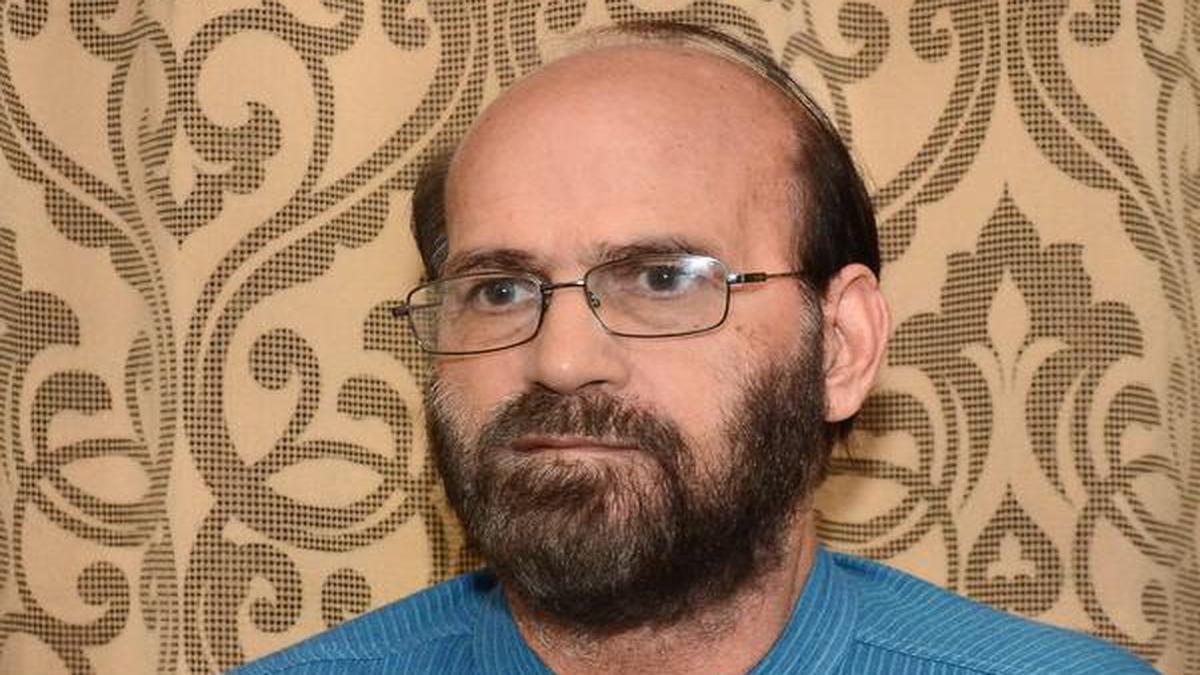
It is now up to her younger successors like Anees Ashfaq and indeed Saira Mujtaba (to whom Masroor Jahan’s last volume of stories Khuvaab Dar Khuvaab Safar is co-dedicated and who is currently translating a collection of her grandmother’s short stories into English) to pen the dirge of Lucknow in our own time.
Raza Naeem is a Pakistani social scientist, book critic and award-winning translator and dramatic reader currently based in Lahore, where he is also the President of the Progressive Writers Association. He can be reached at: (email protected).
source: http://www.thewire.in / The Wire / Home> Books / by Raza Naeem / October 07th, 2019
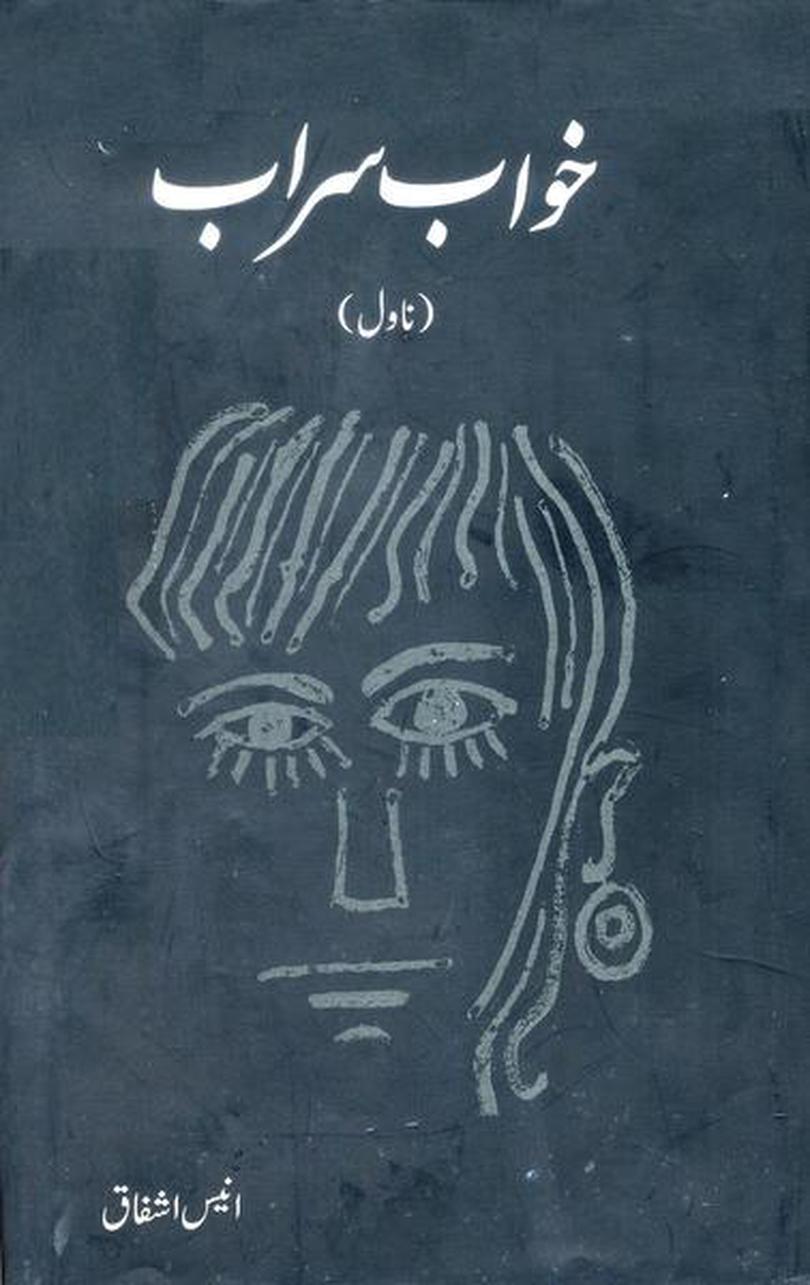
Anees Ashfaq’s ‘Khawab Sarrab’ is destined to blaze a new trail in fiction writing in Urdu.
Presenting a new Avatar – Anees Ashfaq
Truth is not what it appears at first glance. It lurks behind popular narrative and often reveals itself through a text that remained obscure for years.It is a pulsating narrative trajectory to retell an old story that is aptly adopted by an eminent Urdu author Anees Ashfaq in his latest novel Khawab Saraab (Dream, Mirage). The inspired story telling adds a strong sense of dreaminess to the old themes of love grief and cultural isolation. The narrative a sort of transgressional fiction leaps backwards and forward in time and throws light on the powerlessness that people feel in a fragmented world.
The protagonist of the novel desperately looks for an unpublished but widely discussed manuscript of the famous Urdu novel Umrao Jaan rendered into film by Muzaffar Ali. Undeterred by the popular pare down script, the narrator looks for the script that had not seen the light of the day.
Revelatory prose
Anees Ashfaq’s revelatory prose articulates how an old story can be presented as an awe-inspiring cultural force that we need to explore. The story betrays a renewed rendezvous with the literary and cultural history of 20th century Lucknow that was hardly told by the colonial historians and novelists.
A prolific writer, Ashfaq picks up different but equally fascinating narrative threads to weave a story that goes well beyond the mourning nostalgia. It is a story that skilfully blends connection between texts. The plot of Khawab Saraab does not harp on the notion of an absolute truth that is shared by various characters, but zeroes in on multiple and individual truths. It is a world where no master narrative with a definite moral exists. The first edition of Mirza Hadi Ruswa’s famous novel Umrao Jaan carried a concluding line which says that the author prepared another copy of the script. It was widely believed that the author tried to narrate the story with multiple focalisation about a city that was ravaged with the decay and decline. In one of the versions of the story, Umrao Jan was presented more than a dancing girl, she was a mother as well. It is what the narrator of the Anees Ashfaq’s trail blazing novel tries to explore.
Characters with culture
With remarkable narrative skill, the author produces a text that does not draw on the dazzling presence of mass media, consumerism, globalism and corporate world and his characters have not put aside their cultural concerns and values and they are not driven by greed. The protagonist’s painstaking efforts to find out the script that disappeared brings forth a tantalising tale of life that seems real but actually it is not really real. For Anees Ashfaq, reality is what we construct through language and he builds his narrative by referring to the celebrated writer Ruswa time and again. His insistence on the lost script makes his novel closely resemble with “histographic metafiction” It is a text that pins point the historicity of several heritage buildings and cultural practices of Lucknow. The author reveals that famous safed Baradari of Lucknow was the Qasrul Aza (place of mourning) constructed by Wajid Ali Shah and the building which houses Bhatkhande Music College was his ‘parikhana’.
Seldom does one come across with a text bursting with different genres, autobiography, memoirs, anecdotes, romance and some what detective fiction and Anees Ashfaq’s creative dexterity produced such a nuanced and multi-sensory narrative of metafiction .
source: http://www.thehindu.com / The Hindu / Home> Books> Going Native / by Shafey Kidwai / October 27th, 2017
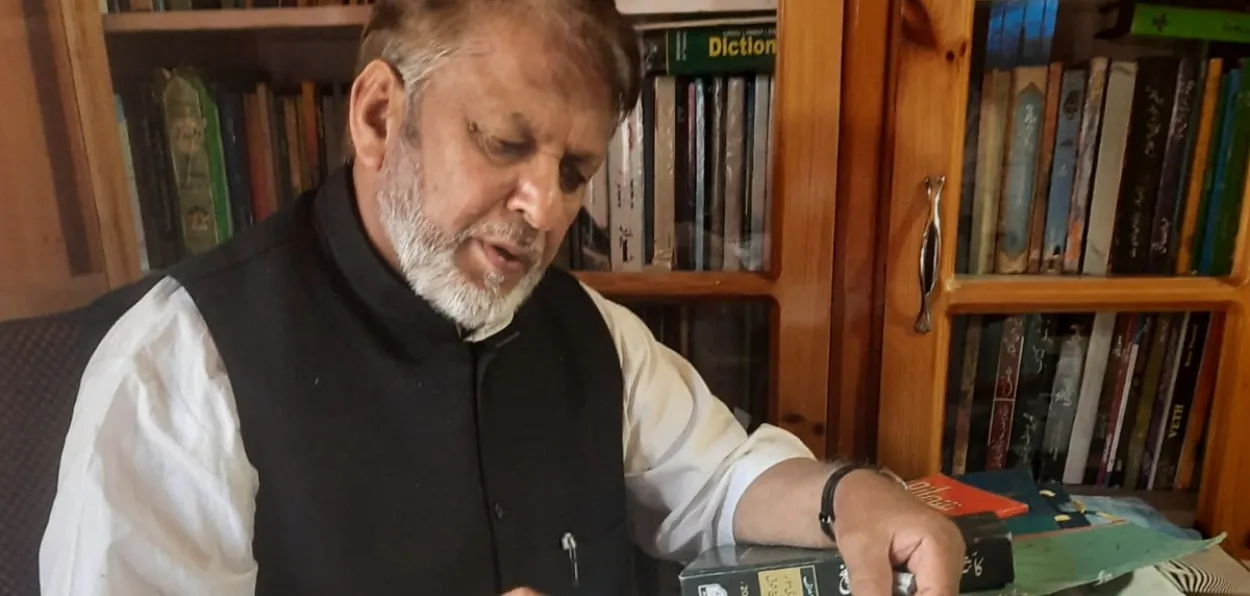
Farooq Fayaz Bhat’s rise in life had a strong link with the place of his birth. The Sahitya Akademi award winner author and historian feels that being born in a locality that was adjacent to Habbakadal, a hub of theatrical activities in Kashmir back then, shaped his personality and mind.
Early in his life, he developed a keen interest in art and culture and gradually moved into the realms of literary criticism, particularly Kashmir’s folk cultural history.
More than five decades of his journey through theatre, Radio Kashmir, Srinagar (now AIR), and teaching, his zest for Kashmiri culture through history has earned him the Sahitya Akademi award for the Kashmiri language in 2022.
The author of many books in Kashmiri and English, Bhat was also conferred with the Jammu and Kashmir State Academy of Art, Culture and Languages award in 2009. He also taught history at the University of Kashmir where he retired as Professor of History a decade ago.
He was also the Director, UGC Academic Staff College.
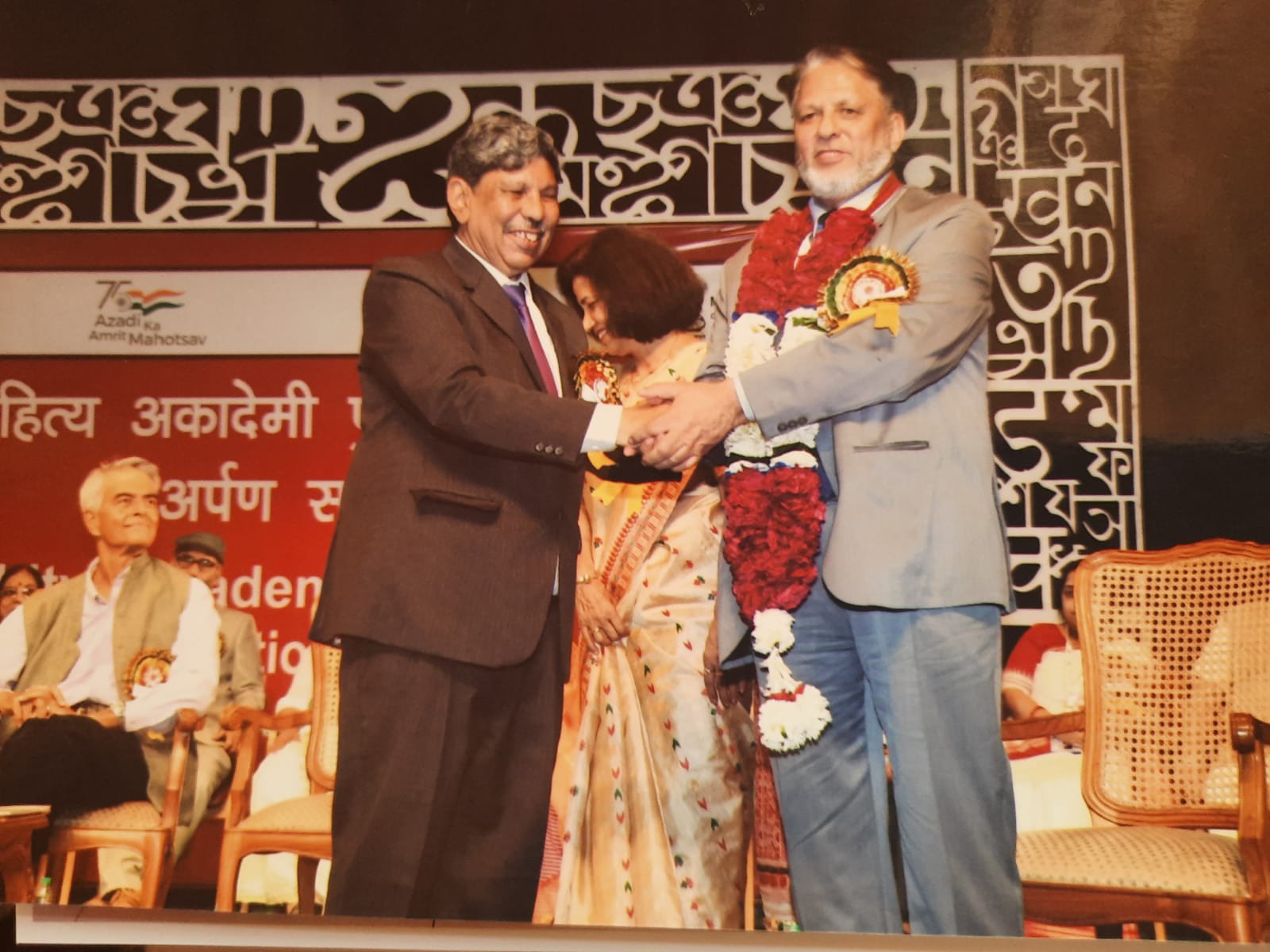
Farooq Fayaz Bhat receiving the Sahitya Akademy award
“Zael Dab, for which he received the Sahitya Akademi award in 2022, is a collection of critical essays on literary personalities of Kashmir. It was adjudged “the best book”.
“For the first time I applied a particular critical theory and it was under the wide frame of a post-modern critical theory, neo-historicism”, Farooq Fayaz said while talking to Awaz-The Voice at his residence at Kanipora on the Srinagar outskirts. “I applied this theory to examine Kashmir’s wide range of writers. It was highly appreciated in literary circles with (at least) 14 reviews published in regional and national media by eminent writers”, he said.
Farooq Fayaz disclosed that he was “working on the second edition of ‘Zael Dab’ in which more contributors would be critically examined”. He hopes to publish it next year.
One of his current projects in which he is working is the Kashmiri translation of Romila Thapar’s “Early India History”, under the aegis of National Translation Mission, Mysore. He said he has completed the work and the book is in the process of printing by the Mission of the Government of India.
Another project of “rewriting the history of Kashmiri literature”, is at the hands of the critic and author, which has been completed up to Habba Khatoon, 16th century Kashmiri woman poet.
The Jammu and Kashmir State Academy of Art, Culture, and Languages awarded Farooq Fayaz for his book “Kashmiri Folklore: A Study in Historical Perspective” (English) in 2009. The book was picked up among 100 entries for the coveted award. The awards were given away on the literary works in 14 regional languages of the erstwhile State of J&K by the then Chief Minister, Omar Abdullah at the Sher-e-Kashmir International Conference Centre (SKICC) in Srinagar.
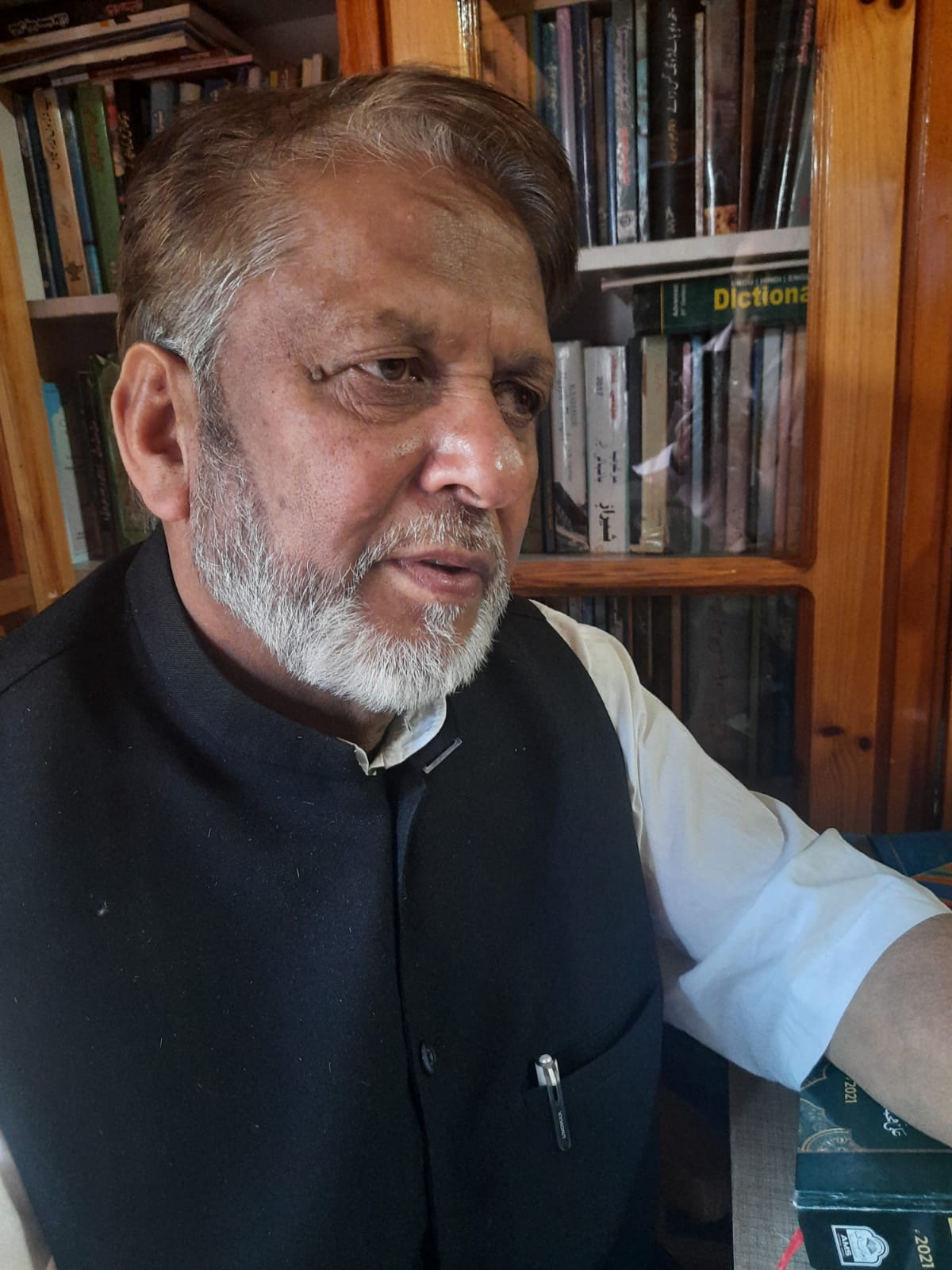
Prof Farooq Fayaz Bhat
This award-winning book was based on his Ph. D thesis under the guidance of renowned Prof Mohammad Ishaq Khan, with more additions to his work on the “Kashmir folklore as source information in an attempt to build a cultural history of Kashmir”, he said. Kashmiri folklore including “Baande paether” (street theater) and “Laddi Shah” have been the only oral evidence of folk culture in Kashmir, through which social and economic issues were being highlighted through street plays, mostly in the rural areas till the end of the last century. “Baande paether”, though being staged in some areas over the past two decades, has taken a back seat now.
Elaborating on his work, Farooq Fayaz said that the peasants, before 1947 were being humiliated and lived a hard life. “I studied and examined “Baande paether”, played by folk artists presenting their plight or torture, etc through their plays. It became a medium between the governments and the common man. I started decoding the coded language. Similarly, there is “Laddi Shah”, a story-telling musical genre, the art of traditional humorous folk singing by minstrels wandering (for alms during harvest season) from place to place. He also referred to the Wanwun, and Rauff, folk songs by Kashmiri women on marriage or other occasions, in his endeavor to build the cultural history of Kashmir.
Farooq Fayaz lamented that women were “marginalized” as there were illustrations of only 13 women who had been directly or indirectly associated with “Durbar”, adding there have been a large number of such women. “I highlighted the plight of Kashmiri women in feudal structure. How they suffered and how they have shown their miseries and plight….all these things were added to the thesis”, he said referring to the award-winning book.
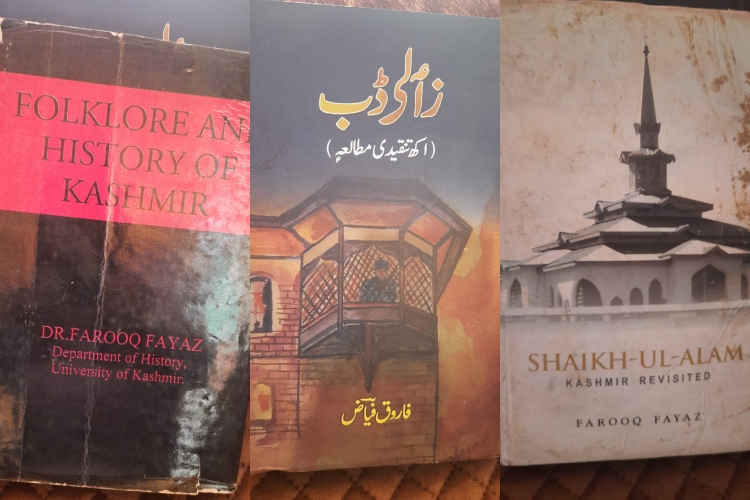
His publications include (a) “Zaban Adab Te Tawareekh”(Language, Literature, and History), (b) Folklore and History of Kashmir, (c) Kashmir Folklore-A Study in Historical Perspective, (d) Zael Dab (Collection of Critical Essays), (e) Fazil Kashmiri (Monograph-Kashmiri) and (f) Ameer Shah Kreeri (Monograph-Kashmiri).
Some books authored by Prof Farooq Ahmed Bhat
Born on April 16, 1954, in Sathu Barbarshah, Farooq Ahmad who is known by his pen name Farooq Fayaz (Bhat), he got schooling at the local Government schools and the nearby SP Higher Secondary School and graduated from S P College in 1973. From early childhood, he was exposed to the “hub of theatrical activities” from the nearby Kralkhud to the Habbakadal area.
“The area was dominated by learned Kashmiri Pandits, great luminaries, having knowledge of Persian, Sanskrit (Urdu as well) theatrics and cultural activities. In the S P college, “there were teachers of eminence whose teachings influenced my passion for writing”, Farooq Fayaz said and referred to many teachers like Prof Mohiuddin Hajini, who was regarded as an authority on Arabic, Urdu, and Kashmir languages, Prof L N Dhar, History, Prof Manzoor Fazili (Political Science) and Prof Ghulam Nabi Firaq.
He was also a regular contributor to the prestigious college magazine, Pratap. With encouragement from the learned men in the vicinity and teachers in the college, Fayaz Farooq developed an “immense literary taste” and got associated with theatrical activities in and outside J&K. In the 1970s and ’80s, Radio Kashmir, Srinagar (AIR) being the “biggest attraction for writers and talented” persons, provided a platform for literary and cultural activities.
“I got motivated to work on the literary history of Kashmir and developed an interest in literature”, he said. Initially, he became a member of Rangmanch Dramatic Club, performing in J&K and also outside in Delhi, Mumbai, Kolkatta, and other places, where the audiences comprised mostly people from Bollywood.
However, his keen interest in History and language led him to pursue a master’s degree in the subject from the University of Kashmir, followed by a Diploma course in Kashmiri language at the newly set up Department (Later, PG Deptt) of Kashmiri at The University of Kashmir. Having served as a school teacher for about five years, Farooq Fayaz, also worked as a Translation Executive at Radio Kashmir, Srinagar from 1989 to 1992. He joined the Department of History as a Lecturer in 1992 and superannuated as a Professor at the University of Kashmir in 2014.
source: http://www.awazthevoice.in / Awaz, The Voice / Home> Story / by Ehsan Fazili, Srinagar / May 29th, 2024
Chinnamandem Village (Kadapa District) / Hyderabad, TELANGANA :
Asif is a big fan of “Victory Venkatesh” from childhood but after watching Mahesh babu movie “Pokiri” he made his mind that even he wants to become a big hero like Mahesh babu.
Asif khan is born and brought from “Chinnamandem” a small village in Kadapa district and currently his family settled in “Madanapalle”. Since his childhood he is big movie lover.
Even though there are four engineering colleges in his native place Madanapalle, he went to Hyderabad to do his engineering so that he can be able to continue his trails of becoming an actor. But nothing worked in his favor.
Then he moved to USA to do his Masters degree and in parallel he joined Acting school in Washington DC in order to fulfill his dream of becoming an actor.
Asif debuted with the recently released Nede Vidudala movie as a Hero. Regardless of his first film as a Hero he has stunned everyone with his looks and acting skills. He made a strong mark with this film. Couple of Producers and directors has already started approaching Asif khan with the movie offers.
His second film “919” which is under post production is getting ready for direct OTT release and the film is directed and Produced by NRI lady “Sandy Sai”.
Now, Asif has made Hyderabad as his permanent location and actively participating in the story discussions of his third film and also for future films.
Asif has amazing looks, personality and importantly he is professionally trained in acting, dance and fights. With his amazingly talented skills Asif khan is sure to reach greater heights in his filmy career and become a big hero!!
source: http://www.m.sakshipost.com / Sakshi Post / Home> AP / by Sakshi Post / March 15th, 2023
Delhi will remain a city extraordinaire only if dilliwalas continue to respect each other as human beings.
Story teller and founder Delhi Karavan, Asif Khan Dehlvi talks to The Citizen about his love for Delhi, and also his concern for the gradual loss of a lifestyle that was once genteel and friendly.
source: http://www.thecitizen.in / The Citizen / Home> Conversations / by Mehru Jaffer / The Citizen Bureau / September 30th, 2024
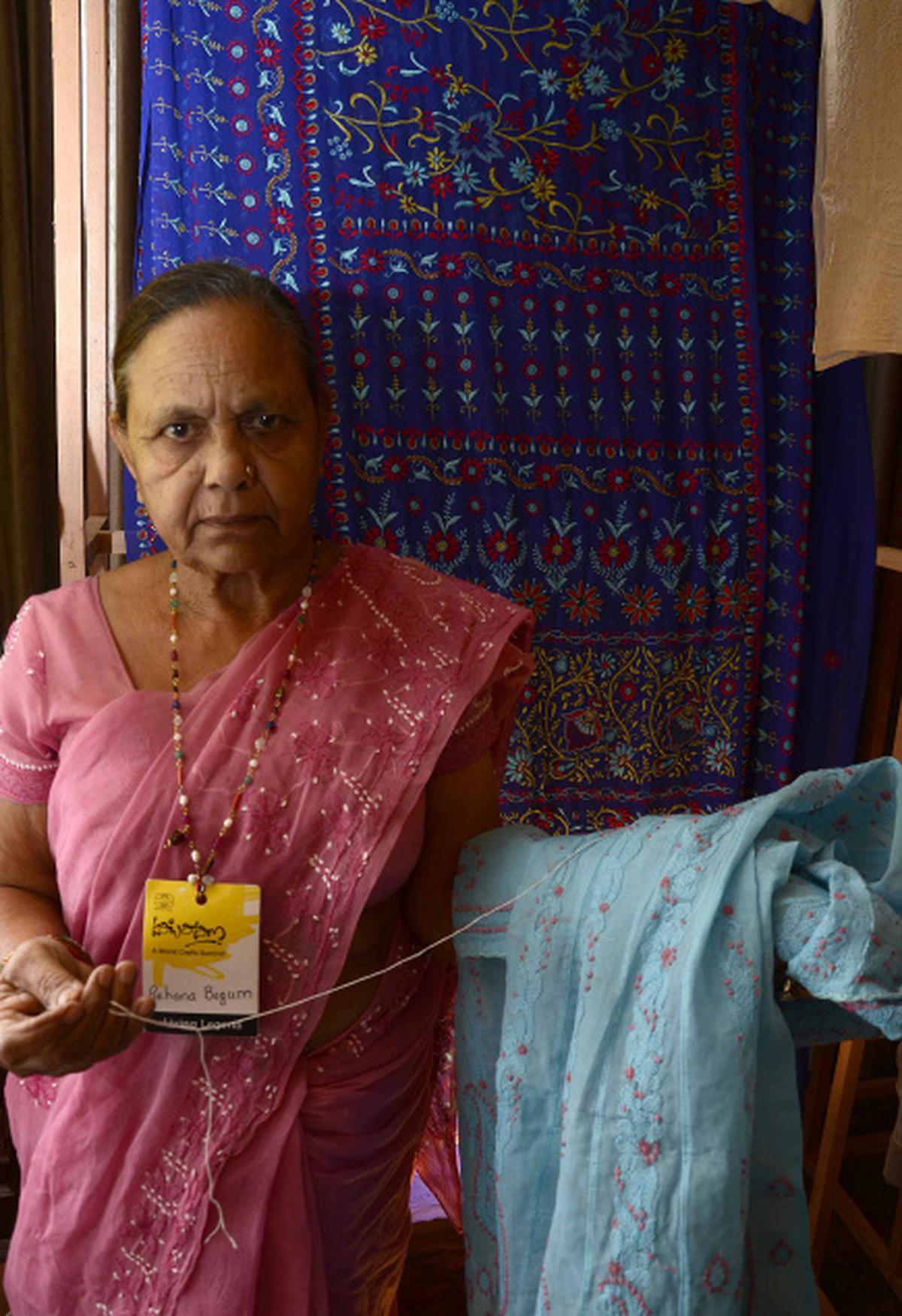
Lucknow’s Rehana Begum has honed the art of embroidery to perfection.
Classy work: Rehana Begum Photo: R.Shivaji Rao
Rehana Begum, a Chikankari artist from Lucknow, U.P., unfolds her most prized possession with reverence – a breathtaking piece of embroidery on a soft white muslin. “I crafted this sample 20 years ago and it took four years to complete,” she says with justifiable pride. Created with stitches called ‘Anokhi Chikan,’ the motif embroidered in white thread resembles a round plate with a flower in the centre, surrounded by motifs inspired by Nawab of Awadh Wajid Ali Shah’s turban ornamentation and accessories. One motif is trellised with miniscule perforations while the tracery of delicate stitches that outlines vines and creepers leaves no impression on the reverse of the fabric! “I did not use a frame to stretch the cloth,” she adds, leaving you even more amazed.
It was under the guidance of her father Shiri Hasan Mirza, master embroiderer and recipient of the National award, that Rehana Begum began honing her skills at age of 13. “No tracing of the design, no outlining with pencil. I work entirely freehand. The design forms spontaneously as I proceed. It’s all stored up there,” she says, tapping her head. By age 20, she had mastered the six basic stitches as well as 35 traditional stitches used in chikankari vocabulary. Samples of her work set off ever-widening ripples of admiration.
Recognition came gradually, in stages – radio and TV interviews, exhibitions conducted by craft organisations such as the CCI, the Uttar Pradesh government’s State Award in 1976 and finally, the prestigious Shilp Guru award conferred by the Government of India in 2003.
Globe-trotter
On her fourth trip to Chennai, she declares she is happy with the response from the public and steady sales. Her trips around the globe have taken her to craft expos and workshops in Holland, Germany, Cuba and Dubai. Her study of market trends finds her team of artisans producing kurtas, kurtis, salwar kameez, saris and shirts.
“My family members assist me and are completely involved in this craft. Along with apprentices trained by me, we work from a room in my house in Thakur Ganj, Lucknow. Earlier, the fabric used was pure white Shehzada cotton or Dhaka ki mulmul, and the white thread used for embroidery called katcha dhaaga was procured from Dhaka or Kolkata. Nowadays, we use Anchor embroidery skeins on soft, thin cotton material and Resham thread on silk fabrics.
A deep purple-blue embroidered sari on display showcases all 35 stitches used in chikankari while a pristine white georgette with classic white on white embellishment radiates an ethereal beauty. “It took two years to complete each sari with such detailed workmanship.”
Chaman Suji and Rehana Begum were among the pan-Indian and international artists featured as Living Legends in recognition of their outstanding craftsmanship at Kaivalam, the World Crafts Council summit.
source: http://www.thehindu.com / The Hindu / Home> Entertainment> Art / by Lalithaa Krishnan / November 02nd, 2024
The Indian group intends to expand further in Saudi Arabia, with schools and other educational institutions, into cities like Jeddah, Al Khobar, and Madinah.
(Photo: Shaheen Group)
Jeddah:
Following the footsteps of leading educational institutions from Europe and the United States, India’s Shaheen Group is now preparing to enter the Saudi market. Saudi Arabia’s ambition to become a global education hub, aligned with Crown Prince Mohammed Bin Salman’s Vision 2030, is rapidly gaining momentum as several prominent academic institutions establish campuses in the Kingdom.
Shaheen Group, based in Karnataka, has achieved impressive results in medical and engineering entrance exams across southern India, known for its strong educational standards.
The group has long been a preferred choice for many NRI students from Saudi Arabia and the Gulf, who study in India to bypass domicile norms and improve their chances of securing spots in professional courses such as medicine and engineering. However, the Shaheen Group’s move to Saudi Arabia aims to address this issue by bringing quality education directly to the Kingdom.
India group expands with new school in Riyadh, Saudi Arabia
The Indian group of educational institutions plans to open a new school in Riyadh, Saudi Arabia, offering classes from Kindergarten through to Class 12, alongside integrated coaching for competitive exams such as NEET, JEE, and the CA Foundation.
Chairman of Shaheen Group of Institutions, Dr Abdul Qadeer, announced the ambitious project, likely to begin operations in March 2025, pending the completion of building and accreditation processes. The school will be located in either Malaz or Sulemaniya.
Additionally, the Indian group intends to expand further in Saudi Arabia, with schools and other educational institutions, into cities like Jeddah, Al Khobar, and Madinah.
At an academic event in Riyadh, Dr Abdul Qadeer highlighted that a large number of NRI students from Gulf Cooperation Council (GCC) countries enrol in Shaheen Group institutions across Karnataka, Telangana, and other regions of India.
Dr Abdul Qadeer also revealed the new leadership team in Saudi Arabia. Syed Wayez Ahmed has taken on the role of managing director for the group in Saudi Arabia and the Middle East.
Mohammed Zaki will take on the role of vice president of operations for Saudi Arabia, while Fahad Saleh Al Jurais will serve as the HR and administrative director and Sarah Mohammed Al Sharief will be the director of the Riyadh school.
source: http://www.siasat.com / The Siasat Daily / Home> News> Middle East / by Irfan Mohammed / November 03rd, 2024