All posts by mpositiveone@gmail.com

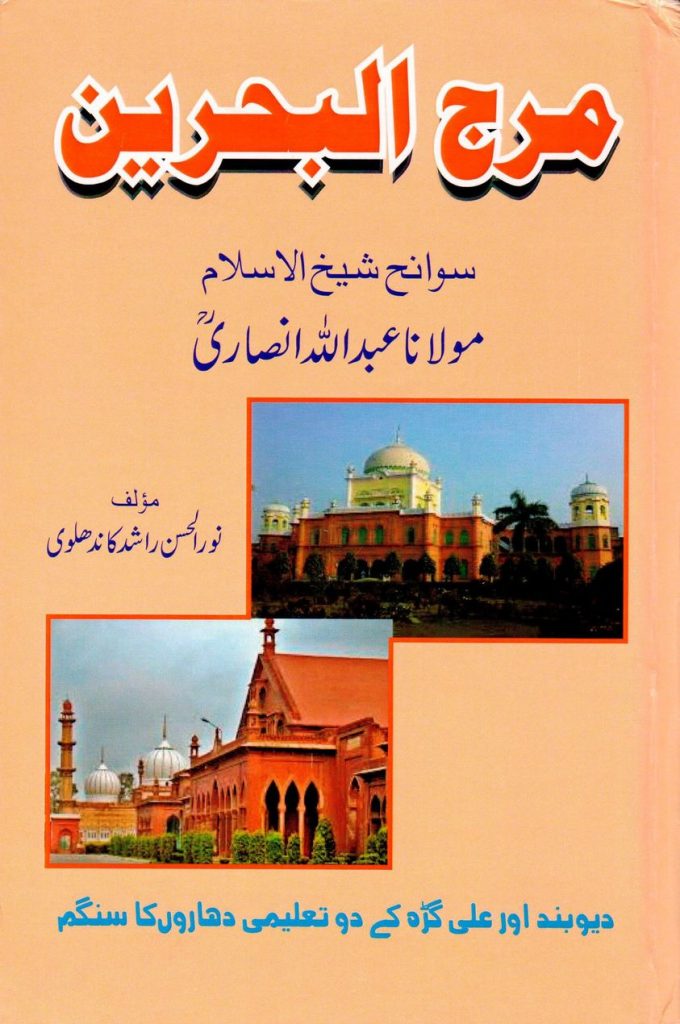
A Very Informative Book on Aligarh and Deoband – ‘Marajul Bahrain’ (The Merger of two Seas)

INDIA:

Marajul Bahrain (The Merger of two Seas)

Author: Noorul Hasan Rashid Kandhalvi

Reviewed by M Ghazali Khan

Pages: 256

Price: 300

Publisher: Iqra Educational Foundation, A-2 Firdaus, 2 Veer Savarkar Road, Mahim (W) Mumbai 400016, India
Email: contact@iqraindia@org

Website:  www.iqraindia.org

Almost 150 years have passed since Sir Syed launched his Aligarh Movement and established the Muhammadan Anglo-Oriental College (now AMU) in Aligarh. But sadly, the campaign of slurs, innuendoes, and ridicule against a sincere and committed benefactor of the community and a great educationist goes unabated. A section of Muslims continues, unabashedly, to stoke hatred against him. If my words sound harsh then please listen to this.

But in contrast to such a lot, some individuals study history with an open mind, analyse past events objectively and present facts as they have been recorded. One such scholar is Noorul Hasan Rashid Kandhalvi, who has dug out and published rare information on the relationship between MAO College, Darul Uloom Deoband, and the founders of these two institutions in his book Marajul Bahrain—literally meaning ‘merger of two seas’.

Although the book is supposed to be a biography of Maulana Abdullah Ansari, a great scholar, who has gone missing in the pages of history, this is also an invaluable documentation on the closeness and cooperation between Aligarh and Deoband in the early days of their inception and at a time when the divide between what is called secular education and religious education looked insurmountable.

Piles and piles of books have been written on the hostility of Muslim theologians towards secular or western education. What has been described in these scholarly works is not entirely untrue. But the allegation that Deoband had declared an all-out war against Sir Syed is a brazen distortion of facts, for, at a time when the Muslim clergy had launched a vicious campaign to declare Sir Syed an apostate, deserving to be killed, the founder of Darul Uloom Deoband, Muhammad Qasim Nanautawi had not only refused to become part of this campaign but went as far as expressing his adoration and admiration for him and his work. For example, responding to a question raised by a common friend Maulana Qasim wrote:

‘Peerji Saheb, this sinner never indulges in arguments with anyone. And why should he? What is there so important to warrant him to involve himself in challenging someone and indulge in a fight? What is the need to disrupt my own good pursuits and get involved in this selfish controversy? There is no doubt that I am an admirer of what I have heard about Syed Saheb’s high-thinking and his heart-felt concern and anguish for the Muslims. It will therefore be justified to express my love for him on this account. However, I am equally, or maybe a bit more, grieved and doubtful by what I have heard about his flawed beliefs.’ (Tasfia-tul-Aqaid page 6)

(This excerpt is from a 39-page booklet in which two great personalities of their time are addressing each other through Peerji Muhammad Arif Saheb. On three pages Sir Syed is clarifying his position while rest of 36 pages contain Maulana Qasim Saheb’s response in which nowhere does he express any hatred against Sir Syed or his disapproval or opposition to western education.)

Please, have a look again at this tribute to Sir Syed by Maulana Qasim: ‘There is no doubt that I am an admirer of what I have heard about Syed Saheb’s high-thinking and his heart-felt concern and anguish for the Muslims. It will therefore be justified to express my love for him on this account.’ (Emphasis mine).

In addition to the rare and well-researched information provided by the author, Marajul Bahrain carries interesting articles by two great-grandsons of Maulana Abdullah Ansari—Late Dr Abidullah Ghazi and Muhammad Tariq Ghazi— Maulana Saud Qasmi, former Dean of Theology Department of AMU and by Dr Rahat Abrar, Former Public Relations officer AMU.

At the time when the storm raised against Sir Syed by Muslim theologians was at its peak, Maulana Qasim’s student, son-in-law and nephew took an even more daring step and joined Sir Syed’s MAO College. But this was not an easy decision. For this, he had to earn the displeasure of some of his spiritual guides. Giving an example of this Dr Abdullah Ghazi quotes Haji Imdadullah Muhajir Makki as having written toMaulana Rasheed Ahmad Gangohi:

‘I am surprised to hear about Maulvi Abdullah. Alas! Despite his claim to be a sufi and the progeny of pious ancestors, he has joined the college which to the ulema-e-Akhirat [scholars whose all emphasis is on the hereafter] is [a symbol of] atheism and which is against faith and religion. And that, as you have written, he has joined the school of naturalists with my permission, is, all praise be to God, is a big accusation… Ulema-e-Akhirat do not regard those associated with this college as religious people. On the contrary, they view them as against religion, be they the scholars or the sons of pious ones…’

Dr Abidulla Ghazi writes:

‘Maulana Ansari had taken such a decision, against the advice of his spiritual guide, and in violation of the principles and etiquettes of [spiritual] allegiance, because of the bright prospects for propagation and preaching [of religion] in Aligarh. But neither Maulana Ansari broke his allegiance; nor did Haji Imdadullah excommunicate him from the circle of his vicegerents. However, it must have definitely affected his relations with Haji saheb and other scholars of Deoband.’

But what was it that warranted Maulana Ansari to earn the displeasure of his spiritual guides? Dr Abidulla Ghazi writes:

‘(1) Maulana Abdullah Ansari’s joining Sir Syed’s mission earned it extraordinary support [from the laity as well as from the ulema]. Those who were so far reluctant [in cooperating with Sir Syed] joined his mission; those who were already associated with it, became fellow travellers; (2) By establishing a theology department and preparing a syllabus for it, following the established traditions of madarsas, he removed the prevalent doubts about Sir Syed’s beliefs. (3) Maulana Ansari’s presence in the institution and his teachings and training to the students created an atmosphere that protected [and promoted] ibadat [worship] and [Islamic] customs. (4) Several institutions in the country benefited from the academic status and work of Maulana Ansari. He made special contributions and provided guidance in the establishment and development of Nadwatul Ulema. (5) The presence of Maulana Ansari [in AMO College] served as a bridge between the ulema and modern intellectuals that paved the way for the mutual cooperation in future. (6) Maulana Ansari’s initial work paved the way for the establishment of Faculty of Theology with separate departments of Sunni and Shi’a theology, Islamic Studies, Arabic, Persian and Urdu.’

Abidullah Saheb adds:

 ‘Sir Syed’s extraordinary appreciation of the services rendered by Maulana Ansari may be judged from the fact that he came up to the expectations Sir Syed had of him and there was not even a slight dent in his respect [for Maulana Ansari] until his last breath [so much so that] he appointed him to be the Imam in his last journey.’ [made a bequest that Maulana Ansari lead his funeral prayer.]’

As for those whose minds are unclear about Sir Syed’s mission even after 150 years, maybe this letter written by Sir Syed, before Maulana Ansari’s appointment would open their eyes. The book contains the full text of the letter. But because of its length, I am producing the translation of some excerpts from it:

‘…Madarsatul Uloom is a place where the majority of the youths are Muslims. Inculcating in them piety; inducing them to adopt high morals, in accordance to the teachings of the Holy Prophetﷺ; spreading the love for Islam;  making them adhere to Islamic duties; creating in them aversion for violence, highhandedness, biases and prejudices, and leading towards godliness is a religious duty and highly rewarding [with God]… Maulvi Abdullah is the son of Maulvi Ansar Ali, grandson of Mamlook Ali, son-in-law of Moulvi Muhammad Qasim. I had personal acquaintance with these pious personalities. I hope that by virtue of being in the company of these pious figures, Maulvi Abduallah has imbibed these qualities and he will perform these tasks as his religious duty and by virtue of his love for Islam.… The tasks that I expect of him during his stay in the madarsa [MAO College] can be summarised as follows. Firstly, he manages the mosque’s affairs, and himself leads five times prayers… This will increase the number of students attending the congregation and enhance their zeal to attend congregational prayers. Secondly, [I expect him to] give a lecture after Friday prayer or, at times, after any of the daily prayers. The students of the College are themselves well educated and know various sciences. [Therefore] This will benefit them immensely if, from time to time, they are briefed about the high morals and noble practices of the Holy Prophetﷺ, virtuous deeds and the conduct of his companions and other religious scholars [and are told about the importance of] piety, love for God, performance of religious duties with sincerity; respect for parents and teachers, mutual sympathy among Muslims, the beauty and simplicity of Islam; Oneness and Greatness of God, the beauty of the Holy Qur’an and the teachings of the Holy Prophetﷺ … My real aim is to create love in the hearts of the students for daily-five-times-prayers, make them realise the importance of offering prayers with jama’t [congregation] and enthuse them with it… [I also want] Those who are absent from prayers be questioned and be persuaded to change their habit… Those who are absent from prayers without any [acceptable] justification… Maulvi Saheb [Maulana Abdullah Ansari] should talk to them privately, do some counselling and explain to them that they should pray and join the congregation … To be precise, in comparison to the worldly punishments administered by the Principal, such affectionate counselling would be more effective.’

These excerpts from a long letter penned by Sir Syed should leave no doubt in anyone’s mind about his real mission and about what he wanted to achieve through this college. Commenting on the impact of religious education and students’ attitude towards religion, Noorul Hasan Rashidi writes:

‘The need of instilling the importance of prayers in the hearts of the students, [asking Maulana Rashidi to] lead prayers himself, and the preaching and counselling that Sir Syed has emphasised upon in his letter, had started showing its effectiveness from the very early days…’

He writes: ‘Maulana Abdullah Ansari’s efforts had created such a discipline in the students that they had willingly become punctual in prayers and used to attend the mosque in such large numbers that the mosque used to be packed, and students were visible all around.’

In this context, he quotes a letter by Allama Shibli Nomani in which Shibli narrates:

‘Maghrib prayer? Praise be to Allah! What a magnificent sight this is! One’s heart starts bouncing with excitement [at this scene]. Syed Saheb [Sir Syed] too joins the prayers. Because he happens to be an Ahl-e-Hadith, he loudly pronounces “Ameen”. The echo of his “Ameen” increases, even more, the state of one’s religious zeal. I feel proud that I have played some part in creating this new life [in the college].’

Commenting on the last sentence of Shibli, the author opines:

Maulana Shibli has given the impression that the change in the students and their interest in religion is the result of his training. It is possible that Shibli had also taken part in giving this training to the students. But Shibli did not have much contact with the Department of Theology, and he only lectured on Qur’an attended by the students with keen interest. Students’ attendance in prayers in large numbers and their keen interest in religion resulted from Maulana Abdullah Ansari’s hard work.

The very special status that Maulana Ansari enjoyed at Aligarh was that not only was he the first Dean but he was appointed in contrast to the standard procedure and through Sir Syed’s personal decision in which neither the members of the College nor the administration were entitled to interfere.

Would that the administration, teachers and the students of AMU had read the rare references and excerpts quoted by the author. But, alas, what to talk of the present generation decline had started in Sir Syed’s own time. Writes Noorul Hasan Rashid:

‘But even during his own life there came such a turning point in this movement that it started losing focus and subsequently these objectives disappeared from sight. What to talk of the real aims and objectives even if a glimpse of these is shown to those who are associated with Aligarh [today], they would react with aghast and say: “was it really so?”’

Countless writings by individuals and coteries with vested interest are replete with misquotations and distorted write-ups of Sir Syed. Rarely would such people refer to this message from him to the youths:

‘It is Islam that you have to live and die with, and you will have to protect it. What is it to us, if anyone among the children of our community rises as high as the shining stars in the sky but does not remain a Muslim? The only progress made while also establishing Islam is the real welfare of the community. We hope that you will always uphold Islam and will progress along with it. It will benefit you and bring prestige to the community, and future generations will benefit from it too.’

Except for the differences between Sir Syed and the Deobandi Ulema, their relationship was pretty cordial in the formative years of these two movements. As far as Sir Syed is concerned, he regarded the presence of Maulana Abdullah as a good omen and a blessing for the college. Sir Syed’s love and respect for Maulana Qasim Nanotvi is evident from his condolence note on him quoted by Dr Rahat Abrar in his essay in the book. Here are a few excerpts:

‘Time has mourned deaths of many and will lament on the deaths of many more in future, but to mourn the death of someone who seemingly leaves no successor to replace him is a matter of great sadness and pain. There was a time when among the ulema of Delhi, some were known and respected for their piety and knowledge. Equally, they had no match in their simplicity and humility. People thought that there would [perhaps] be no one like Maulvi Ishaq in quality after him. However, through his exemplary piety, virtuous values and simplicity, Maulvi Qasim has proved that Allah did produce another one with these qualities, perhaps, more superior than him as far as these qualities are concerned. Even those who disagreed with him on issues would admit that in this time and age, he had no match — he might not have been as deep in knowledge as compared to Shah Abdul Aziz, but in other aspects, he was superior to him. If he was not superior to Maulvi Ishaq in matters of humility, piety, and virtuousness, he was not inferior either. He had an angelic nature and angelic qualities. The departure of such a personality is very painful and tormenting for all those who survive him.’

After receiving the first report published by Darul Uloom Deoband, Sir Syed expressed his impressions thus:

‘Deoband is a small town. Although not a very famous city, by looking at the resolve, determination and pious thinking of its residents, one is forced to give it precedence over well-known cities… Hats off to them, that due to their concern, there has been tremendous progress in quantity and quality within a short period.’

Maulana Abdullah Ansari’s family tree goes back to one of the most prominent companions of the Prophetﷺ, Abu Ayyub Ansari. On this aspect, the book contains a detailed and interesting article by Tarq Ghazi saheb.

An incident, narrated in the book, of the earlier days of the College that relates to the hard work by Maulana Abdullah Ansari and the atmosphere created by him would be of interest to the readers.

The king of Afghanistan Ameer Habeebullah Khan had come to visit the college. When he was taken to the Department of Theology, he refused to give any opinion without testing the boys. For this Maulana Abdullah selected and presented 50 students for the test. The King picked up some of them and asked them to sit close to him. He then asked a student to recite any verse from the Holy Qur’an that he could remember. The student recited a part of Sarah Ali ‘Imranin his beautiful voice in the Egyptian style. The recitation mesmerised the audience. Tears were flowing from the King’s eyes. As the boy finished recitation, the Ameer stood up and made a speech. At times he spoke in Urdu, Persian and English, and kept saying that whatever had been reported to him about the college was wrong.

Later he admitted that he had deliberately asked difficult questions on Islamic jurisprudence and said: ‘I have tested the students and satisfied myself. And now my answer is that everything is fine here, and I am very pleased.’

Reviewer’s Personal Gratitude to the Author:

As someone who does not only come from Deoband but studied at Aligarh as well, feeling indebted to the author is only natural. But now, a very personal reason has been added to this sense of indebtedness.

In my childhood, I had heard from my grandfather, Hafiz Abdul Jalil Khan, and other elders in the family that the grandfather of my grandfather Maulana Abdul Aziz Khan was in the first batch of graduates of Darul Uloom Deoband. They said that he had also taught at this great institution. Among the relatives in Deoband, it is common knowledge that Maulana Abdul Aziz Khan was a great scholar. According to my grandfather, Maulana Abdul Aziz Khan had a strong inclination towards Sufism and devoted much of his time to studying and worshipping. Family sources say that he had a vast personal library, but because no one could carry his academic legacy and look after his books, all of them were donated to Darul Uloom Deoband. His son and my great-grandfather, Abdul Hafeez Khan, was more interested in local politics and little zamindari. He was also an elected member of the local municipal board.

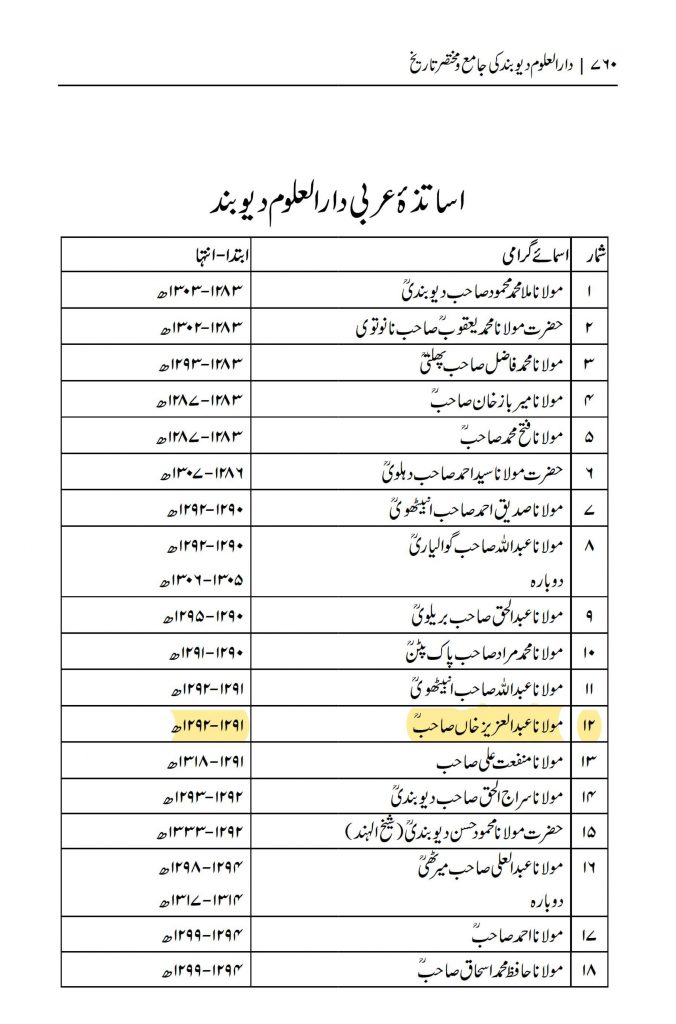
We had heard these stories since our childhood. Still, when Maulana Abdul Aziz Khan’s name was not included in the list of either the students or the teachers published at the centenary celebrations of Darul Uloom Deoband, I, along with other youths of the family, started suspecting the authenticity of what we had been hearing about Maulana Abdul Aziz Khan because all of these were mere oral claims unsubstantiated by documentary evidence. Noorul Hazan Kandhalvi Saheb has indeed done a tremendous personal favour to me and to my family members by providing documentary proof of it.

After seeing Maulana Abdul Aziz’s name in the above-reviewed book, I thought to have a look at ‘Darul Uloom Deoband ki Jame wa Mukhtasar Tareekh’ (A Comprehensive and Brief History of Darul Uloom Deoband). Thankfully this too has his name on page 760. Please see the scanned image below.

Some excerpts from Marajul Bahrain:

‘Generally, it is written and said that the first batch of the graduates of Darul Uloom Deoband was the one that included Hazrat Maulana Ashraf Ali Saheb Thanvi. But despite being prevalent and often referred to in writings, this is not true. The fact is that the first batch of the graduates of Darul Uloom is the one that included Maulana Adullah Ansari et al. It is they who have the credit of being the first graduates of Darul Uloom. Classmates of Maulana Ansari, who have been mentioned in the Roodad [minutes] include:

‘Maulvi Mohammad Murad Pak Pattani, Maulvi Abdullah Khan, Maulvi Abdullah Sahi Anbaitvi and Maulana Abdul Aziz Khan about whom it is claimed that this was the very first batch of the graduates of Darul Uloom.
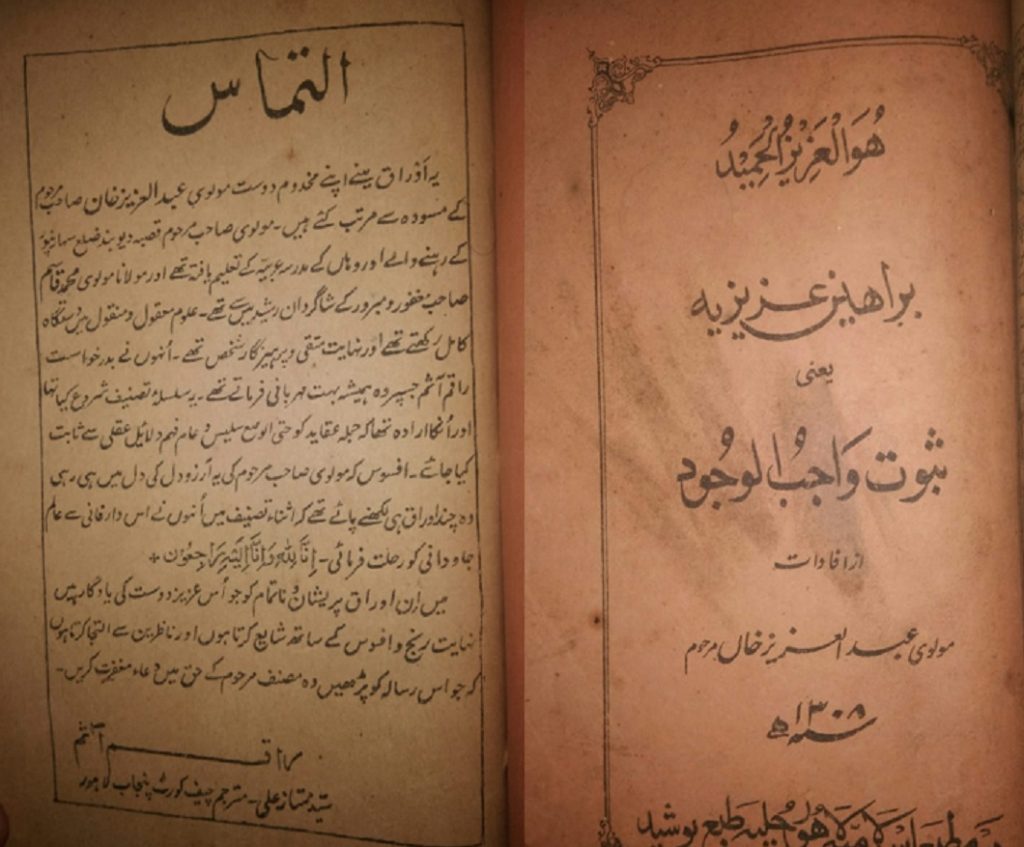
Scanned image of Maulana Abdul Aziz’s book

‘…After the foundation laying [of Darul Uloom] In Muharramul Haram, 1283H (May 1866) when the list of students, who had been awarded degrees was published in 1289H, 1872AD, it had the names of Maulvi Murad Saheb Pakpattani, Malvi Abdullah Khan Saheb Gawaliari, Maulvi Abdul Aziz Khan Saheb Deobandi and Maulvi Abdullah Ansari Ambatvi. The Madarsa [Darul Uloom] Deoband had declared them its first batch of graduates and were awarded degrees. By that time, Dastarbandi [ceremony of putting turbans on their heads] had not been introduced….

‘The Madarsa [Darul Uloom Deoband] had established a good practice since the very beginning that the best answers on the [text] books included in the annual exams used to be included in the annual report of the madarsa.  Following this principle, the questions asked in the exam and the answers given by the first batch of students were also published… It included the answers provided by … Maulana Abdul Aziz Khan Deobandi… These answers reflect the high calibre and deep study, deep thinking and the grasp of the students on the subjects…
source: http://www.ghazalikhan.com / headline edited / October 17th, 2021
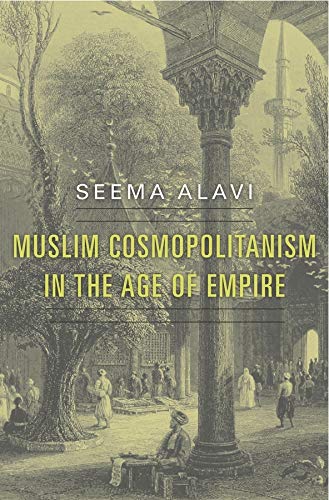
Book Review: Muslim Cosmopolitanism in the Age of Empire by Seema Alavi

INDIA :

Seema Alavi’s narrative is about the little known stories of five Islamic men of learning who played key roles in the 1857 rebellion against the British, fled India and made their way to west Asia, notes Dr Asiya Alam.

Book: Muslim Cosmopolitanism in the Age of Empire 
Author: Seema Alavi 
Publisher: Harvard University Press 
Pages: 504
Price: Rs 495

In Muslim Cosmopolitanism in the Age of Empire, Seema Alavi makes an admirable and successful attempt to rethink some key assumptions of South Asian and global history. Specifically, the book inserts into history five important Muslim men of religion, including Sayyid Fadl, Rahmatullah Kairanwi, Haji Imdadullah Makki, Nawab Siddiq Hasan Khan and Maulana Jafer Thanesri, who were hounded by the British government for their role in 1857 and fled India to seek their fortunes in different cities of the Ottoman Empire.

Alavi’s broader aim is to challenge the paradigms of empire-based, global history. The “contours of global history need to be redrawn at the porous intersection of the British and Ottoman Empires” she argues. By focusing on Indian Muslims instead of Britons as key players, she offers new insights into the understanding of imperialism. Located at the cusp of British and Ottoman empires, these men became significant actors in trans-Asia politics of the 19th century involving the British, Arab polities, Ottomans and the Russian Empire.

Alavi skilfully demonstrates how Mughal pathways of trade and Sufi networks along with later British and Ottoman imperial connections and technological innovations in print, communications and shipping enabled these men to flee in the aftermath of 1857 and travel across the Indian Ocean.

To contextualise the lives of these five men, Alavi hypothesizes the emergence of a ‘Muslim cosmopolis’ in the 19th century, characterized by an intellectual sensibility as well as global networks that allowed these men to navigate imperial boundaries. The cosmopolitan sensibility constituted the eclecticism and compromised of Delhi Naqshbandi Sufi Shah Waliullah reflecting the social diversity of India; proficiency in Arabic, Persian and Urdu that aided these men to access both Indo-Persian society and Middle Eastern Arabic world; and support for Ottoman reforms that advocated ideas of science, reason and rationality. Alavi writes that the Muslim cosmopolis provided a ‘perfect global canvas’ for Ottoman Caliph Abd-al Hamid II to execute his reforms. Muslim emigres, in turn, brought back their cosmopolitanism to India, creating global interconnectedness between Middle-Eastern and South Asian societies.

Alavi also adds new discoveries to South Asian history. The multilingualism of these religious scholars isn’t accidental but an outcome of the Arabicist cultural and intellectual grid that emerged in South Asia in the late 18th and early 19th century. Exemplified by Shah Waliullah, Alavi argues it was based on compromise between the “more liberal Sufi saint Ibn-i Arabi and the conservative Naqshbandi Sufi sheikh Ahmad Sirhindi” which “produced an India-specific Arabic tradition with its stress on the individual, scriptures and social leveling” so that “religious knowledge was slowly disembodied from its hitherto inaccessible encasings: the person of the king, the body of the Sufi saint and single-copy Persian manuscripts”. Alavi attributes this gradual transition to the larger Mughal crisis, its disintegration in the late 18th century.

After laying out this rich, historical backdrop, Alavi foregrounds the individual, devoting a separate chapter to each of the five men, who have their own brand of Muslim cosmopolitanism. The life of Sayyid Fadl highlights the large presence of Arabs — immigrant and Deccan born — in Hyderabad, and signifies ethnic ambiguity and territorial connections of the ‘Indian Arab’, a category coined by the British. Rahmatullah Kairanwi’s life suggests a concern with cosmopolitan education. He started a madrasa in Mecca to combine religious and scientific learning offering a critique of the intellectual environment of the Hijaz that would later become a model for the Deoband seminary.

Haji Imdadullah Makki’s career suggests a vibrant culture of Muslim cosmopolitanism in Mecca, blending different Sufi orders, Naqshbandi reformism and a middle ground on religious issues. Nawab Siddiq Hasan Khan was based in Bhopal and his political career and publications indicate his use of imperial networks and print technologies to further his ideas and connections with the Ottoman world.

Finally, Maulana Jafer Thanesri’s writings highlight a notion of ‘mulk’ or ‘felt community’ and his ideas of ‘Hind’ produced a proto-nationalist critique of British discrimination. In each of these lives, Alavi questions a pan-Islamic approach and repeatedly shows that they weren’t only motivated by religion but operated within imperial rivalries and opportunistically pushed their careers, ambitions and desires.

This excellent book subverts dominant frameworks of our past and should be necessary reading for anyone interested in South Asian and global history.

(Dr Asiya Alam is an Islamic Studies scholar at Nirmala Niketan College.)

source: http://www.dnaindia.com / DNA / Home> Lifestyle / by Asiya Aslam / December 05th, 2017

Naseema Khatoon’s journey as a human rights defender

BIHAR :

Born in a red light chawl, she pioneered the sex worker’s cause. Naseema is now part of India’s national human rights panel. Ramashankar reports.

Naseema Khatoon

Bihar:

The spent her childhood witness to the dark reality of a red light area in Bihar’s Muzaffarpur but she always wanted to chart a different course for herself. Now, she is a member of the National Human Rights Commission (NHRC)’s core group on NGOs and a ‘human rights defender’. Naseema Khatoon’s success demonstrates her indomitable spirit, fighting all odds to carve a niche for herself in this tough world.

Naseema was born in the red light area of Bihar’s Muzaffarpur, known as ‘Chaturbhuj Asthan’. Her father who had a tea stall nearby was adopted by a sex worker as a boy as she herself was brought up by the grandmother.She was given a new life in 1995, when IAS officer Rajbala Verma launched alternate programmes for sex workers and their families. Naseema got herself enrolled in one such programme, called “Better Life Option”, earning up to ‘Rs 500 a month for crochet work.

Inspired by her success, she started running awareness programmes on the rights of marginalised workers, legal awareness and educational programmes.It is her constant endeavour that attracted the attention of NHRC which nominated her to its advisory group. Naseema gives credit to her elders and community for getting the recognition and responsibility to fight for the rights of marginalised people at the national level.  She said, “Disadvantaged people of our community are now coming forward and fighting for their rights.”

Naseema had a chance meeting with a social worker in a conference in 2003 and later she married him in 2008. Her husband is from Jaipur and now she has a son too.But she always wanted to do something different as she launched a handwritten magazine, ‘Jugnu’ in 2004. This magazine publishes handwritten articles from the children of sex workers, who cover stories related to sex workers and rape victims, interviews and other similar issues. Children also edit the 32-page magazine, which is published from Muzaffarpur.

Naseema, who is presently doing her BA from Indira Gandhi National Open University, is founder secretary of an NGO which works to protect sex workers and their families from police atrocities. Naseema also took up the cudgels for providing better employment opportunities to women in the area in collaboration with District Industries Centre manager Dharmendra Kumar Singh under the chairmanship of Muzaffarpur District Magistrate Pranav Kumar. The women here have come forward to work on stitching by forming an organization called the Zohra Promotion Group, and the Jugnu Ready Made Garment.

“I have yet to attend my first meeting as a member of the NHRCs advisory group but I have some suggestions up my sleeve,” she remarked.“NHRC and other government bodies have made arrangements for the protection of human rights but they need to be simplified and should be made transparent so that victims of human rights violations can take benefits of them in a hassle-free manner,” Naseema who is excited about her new role remarked.

She said that there is a WhatsApp number to lodge a complaint related to the human rights violation of human rights but many victims were unaware of it and even if they knew it, they found it difficult to lodge complaints and complete other necessary formalities.Naseema said that the advisory committees constituted at the organisation level or government level to check exploitation at places of occupation have also  remained on paper.

“A female employee of a reputed company complained to her employer about a rape bid made by her colleagues but the advisory committee constituted at the organisation level hushed up the case by assuring that the accused will be transferred to a remote area,” she said.

source: http://www.newindianexpress.com / The New Indian Express / Home> Good News / by Ramkumar, Express News Service / January 01st, 2023

Book Review: Writing as an Act of Resistance for Women Living in a Patriarchal Society

KERALA :

Book Review: Writing as an Act of Resistance for Women Living in a Patriarchal  Society

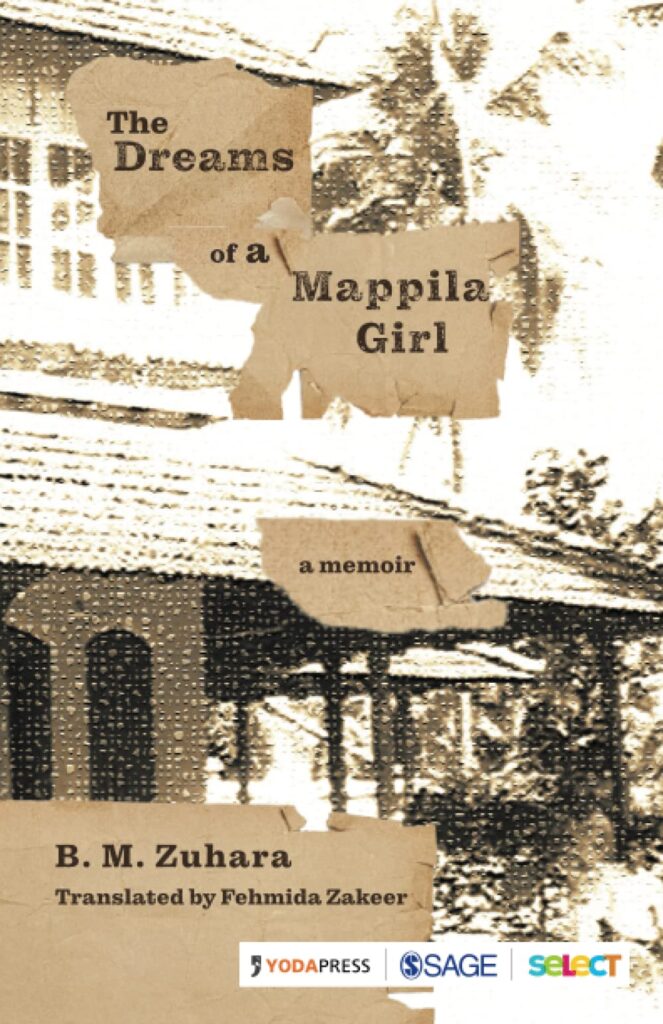
B.M. Zuhara is a writer and columnist from Kerala, a Sahitya Akademi awardee who writes in Malayalam. Her book The Dreams of a Mappila Girl: A Memoir, which was recently translated and published in English,  traces the childhood years of the writer, growing up in the village of Tikkodi in rural Kerala as a young Mappila girl from the Muslim community in post-Independence India.

In the Preface, the author wonders if her work is a “story, or a novel, or a memoir”. The only conclusion that one can perhaps draw as one reads on is that it could be any one of them, and it could be all of them. It is a truth universally known but often unacknowledged that classification of works – fiction and non-fiction, into various genres, is done primarily for the sake of convenience. So while the autobiographical narrative is hard to miss, the memoir also reads like a novel, almost like a bildungsroman – a novel that traces the journey of a protagonist from childhood to adulthood; though in this case, the memoir ends with young Soora moving away from her home in Tikkodi to the city of Kozhikode.

Lifewritings

A memoir can be understood as a narrative written from the perspective of the author, focusing on a certain period of his or her life. Unlike an autobiography, it does not cover the entire life span of the author. In fact, increasingly so, the term lifewritings is being preferred over autobiography when the writing revolves around the life of a woman. While autobiographies are seen as concerned with the journey through which one attains a sense of identity or autonomy of the self; lifewritings looks at identity as relational. It is a significant difference because women in a patriarchal society tend to define themselves in terms of their relationships and therefore the impact of relationships on how women see themselves, define themselves, is to a great extent different from the journey undertaken by men to arrive at a notion of the self.

As the memoir unfolds, we meet Soora, as the writer is referred to by all, surrounded by a large, relatively affluent family with complex dynamics. From the beginning we see Soora as a sensitive child, one who is prone to bursting into tears at the slightest provocation, something she is often teased about. The real and perceived slights that Soora is subjected to, are primarily targeted at her physical appearance, specifically her dark complexion and her tendency to cling to her mother.

But paradoxically for a seemingly timid child, Soora’s propensity to constantly question what is established as normative behaviour for a girl earns her the nickname of “Tarkakozhi” – one who argues. What these contradictory impulses perhaps reveal is a girl who is overwhelmed by the big and small battles she has to constantly fight, a life burdened by gendered expectations, yet a girl whose deepest desire is to be like Unniarcha, a mythological woman celebrated for her fearlessness whose ballads Soora grows up listening to.

It’s a woman’s life

Certain details, such as that of Soora’s grandmother passing away at the age of 30, when Soora’s mother was 15; or that two of Soora’s sisters were married even before she was born; reveal the dark reality of women’s lives in those times. The young girl also constantly faces taunts about being an unwanted child, and while the mother reassures her of that being a falsehood, a sense of being traumatised by the possibility of that fact continues to linger over Soora’s life. Yet, as the memoir unfolds, one senses that Soora’s life is still a privileged one where owing to her class position, she is surrounded by simple comforts of a home where along with her basic needs being well taken care of, her ability to attend school is facilitated by the presence of helps who accompany her to school – a luxury many of Soora’s friends are not entitled to, resulting in their dropping out of school and getting married at a very young age.

But the intersectionality of issues that impinge gender issues is well brought out when one discovers that the advantages of class offer no protection from the various kinds of repression that Soora is made to face on account of her religion. Even after she gets admitted into a prestigious school at Kozhikode, uncertainty looms large over Soora’s life as her mother stays adamant about not allowing her daughter to wear a skirt as a uniform as mandated by the school. There is also always the constant presence of violence, or the threat of violence that this young girl is made to confront, seemingly innocuous but leaving a lasting impact.

Writing without a room

So is this a good memoir? Should one read it? Well, the answer to this question is a little long-winded but it is an emphatic yes. When we look at writing by women, we need to look at it beyond its aesthetic merits as literature. The very act of writing is an act of resistance for women living in a patriarchal society that creates many hurdles that stand in their way of getting an education, their having a room of their own, or a time that they could demand as their own to devote to writing. Also, a memoir such as The Dreams of a Mappila Girl goes beyond giving us a glimpse into one young girl’s life, and offers us an intimate view of a society, a community, and the lives of women who lived in these suffocating conditions, mostly capitulating to their circumstances but sometimes daring to chart a new way of life.

Finally, a word about the translation by Fehmida Zakeer, which is so well done that the memoir reads really smoothly. That is no mean task for a memoir which not only evokes a way of life that maybe culturally unfamiliar to many, but is also situated in a past whose ways are difficult for us to always make sense of.

Shibani Phukan teaches English at a Delhi University college.

Featured image: Deepak H Nath / Unsplash  

source: http://www.livewire.thewire.in / Live Wire / Home> Books / by Shibani Phukan / September 01st, 2022

Indian Muslims who fought against Jinnah’s two-nation theory

INDIA:

For these patriotic Muslim men, nation-building was above petty politics, religion and greed for power as in today’s day in age.

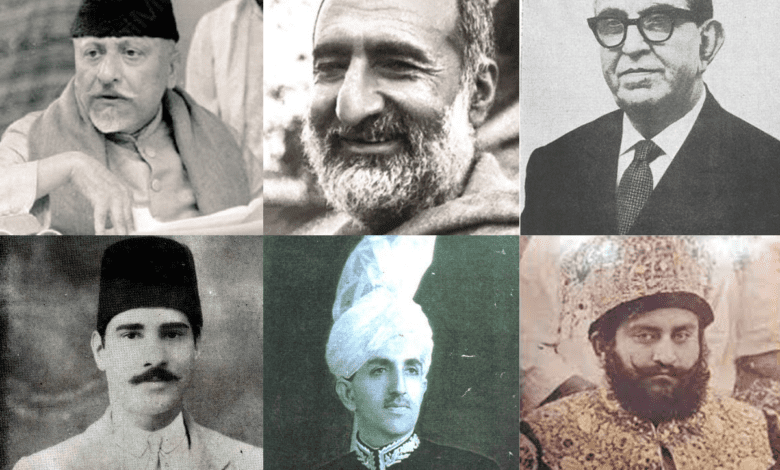
Some of Indian Muslims who fought against Jinnah’s two-nation politics

In the 1940s, as a colonial India inched closer to her independent future, a part of her was weakened by politics of religion.

Fuelled by the insecurity of Muslims not surviving in a Hindu majority country, the demand of Muhammad Ali Jinnah and the All-India Muslim League was finally served when India split into two countries giving way to the formation of Pakistan.

What followed was a blood-soaked partition, an unwanted companion to the road to freedom.

However, there were many Muslims who were against the idea of partition. A partition they believed was unfavourable to the development of people.

As Jinnah stood firm on his demand for Pakistan, hatred against him intensified. Attempts to assassinate Jinnah were carried out several times with no success. Given below is the list of Muslims who never believed in the idea of an all-Muslim nation.

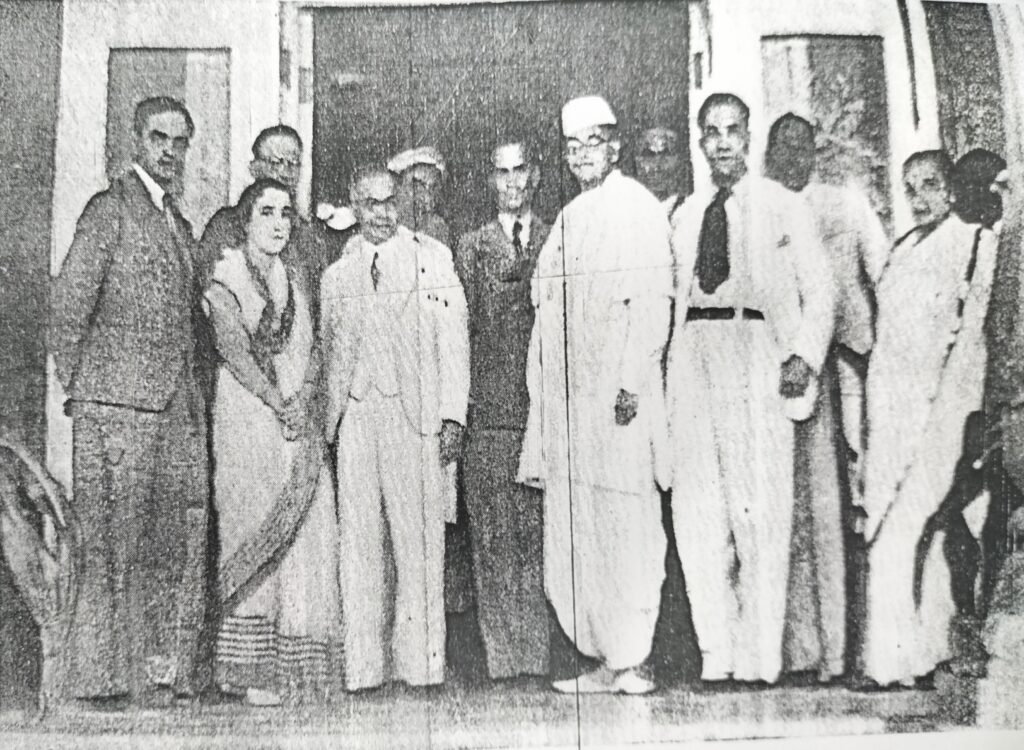
Maulana Abul Kalam Azad

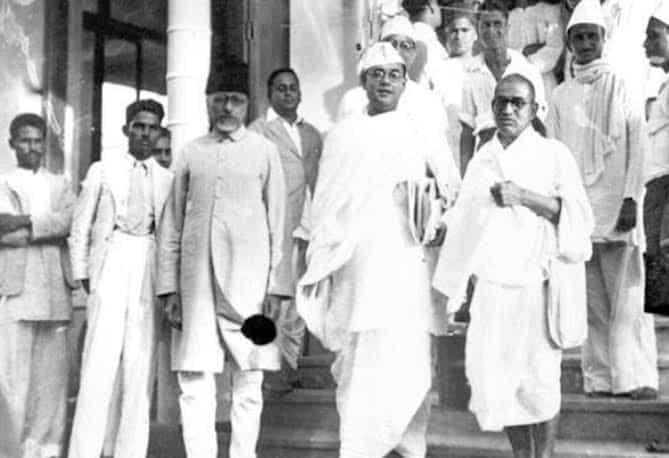
Maulana Abul Kalam Azad with Netaji

Maulana Abul Kalam Azad was born in Mecca in 1888 to an Indian Muslim father and an Arabic-speaking mother. Azad was a young journalist when he founded Al-Hilal, a Muslim newspaper that spoke against the colonial rulers as well as Indian Muslims who were loyal to the British.

In 1920, he joined the Indian National Congress party and was instrumental in awakening the Indian Muslim community. Azad was vehemently against the idea of partition and blatantly blamed Jinnah as well as Congress party leaders for the decision.

He was the first minister of education under Pandit Nehru’s government. He served until his death in 1958.

Khan Abdul Ghaffar Khan

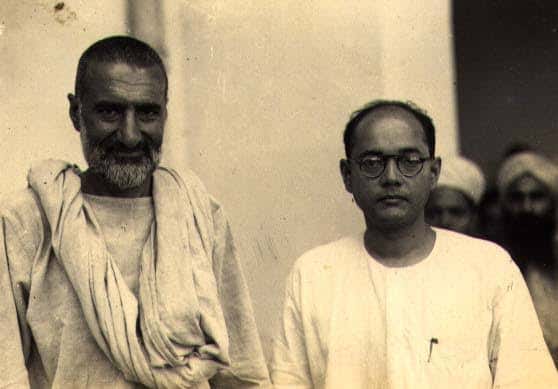
Khan Abdul Ghaffar Khan (left)

A devoted Muslim, Khan Abdul Gaffar Khan, led a nonviolent movement throughout the country against the British and was an advocate for Hindu-Muslim reconciliation in the Indian subcontinent.

He was a political and spiritual leader who was recognised for his peaceful opposition with an oath for non-violence, on the path of Prophet Muhammed.

In 1910, at the age of 20, Khan opened a school in his hometown Utmanzai which provided education to women and children, rebelling against the British Raj. He also founded the ‘Pashtun’ a monthly political journal to ensure that people were well-read and informed.

He felt deeply deceived when the Indian National Congress reluctantly accepted the partition proposal without consulting Khan, who had outrightly opposed the partition. Khan who was upset after his people were pushed into Pakistan, slammed the Congress saying “you have thrown us to the wolves”.

Malik Khizar Hayat Tiwana

Malik Khizar Hayat Tiwana

Malik Khizar Hayat Tiwana was the Premier of pre-Partition Punjab. He belonged to an affluent family who owned 1,200-strong cavalry named Tiwana Lancers.

He was popular among the Congress and the Akali Dal in the pre-Partition Punjab Assembly. Known for his secular, honest, humble and courteous nature, Tiwana was polished in his social interaction and never lost his temper in public.

Citing the dangerous outcomes of extremist groups such as the Muslim League Guards and RSS, Tiwana banned the organisation permanently in January 1947 from Punjab. He remained anti-partition until his death.

A turning point came in his life when he suddenly resigned as the premier on March 2, 1947. It is said that he was introduced to the then education minister, Punjab, Ibrahim Khan Barq’s eight-year-old son who refused to shake hands with him.

The boy said, “Are you the same Khizar Tiwana uncle who is an obstacle in the creation of the Muslim State of Pakistan? I will not shake hands with you.” The words of the child felt like a dagger.

Tiwana later told Sardar Swaran Singh the then development minister said, “I could go on fighting with the Muslim League, but if our children feel that we are the villains of the piece, then let us disappear and let whatever happens, happen.”

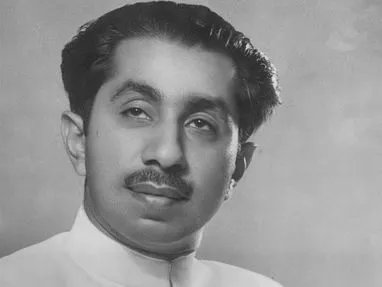
K A Hamied

K A Hamied with Netaji

Born in 1898, Hamied was a freedom fighter who followed Mahatma Gandhi’s nationalism. He was against Jinnah and rejected his offer to move to Pakistan.

He despised Jinnah’s partition idea so much that he urged Gandhi and Vallabhbhai Patel to declare a civil war against the All Muslim League. He founded CIPLA, India’s oldest pharmaceutical company in 1935.

Allah Bux Somroo of Sindh

Allah Bux Soomro

A zamindar, government contractor and politician from the province of Sindh in British India, he was a mass leader who organized the Azad Muslim Conference. He posed a major threat to the divisive Muslim League and its demand for a separate country.

However, as the two-nation demand spread like cancer, Soomro ensured that Sindh will remain away from its influence until his assassination on May 14, 1943.

Born in an affluent family, he served as the chief minister of Sindh from March 23, 1938, to April 18, 1940, and from March 7, 1941, to 14 October 1942.

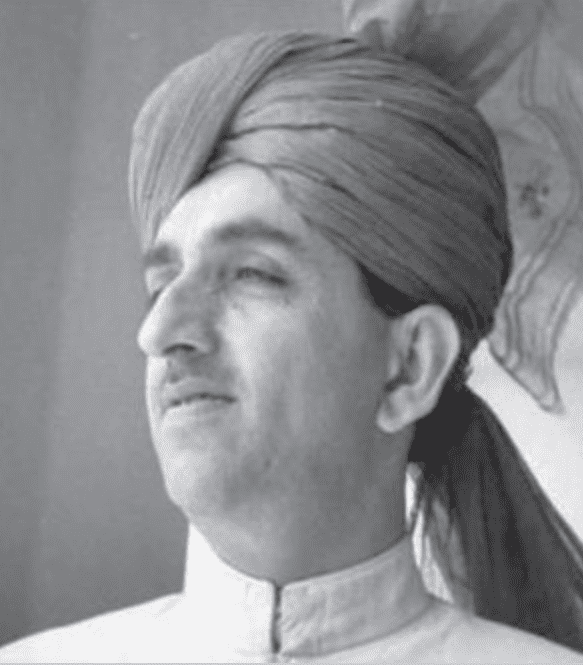
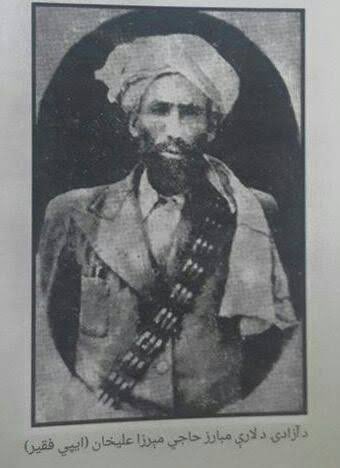
Mirza Ali Khan

Mirza Ali Khan

Popularly known as the Faqir of Ipi, Mirza was a Pashtun tribal chief and freedom fighter from North Waziristan in modern-day Pakistan.

He started a campaign of guerrilla warfare against the British Empire. He joined arms with Netaji Subhash Chandra Bose and asked Pandit Nehru to provide arms to his militia so that Kashmir could be freed from Pakistani invaders.

Inayatullah Khan

Inayatullah Khan

Inayatullah Khan was an Islamic scholar who loved mathematics. Having spent most of his adult life in serving as an educationist and civil servant in British colonial service, he raised a paramilitary Khaksar movement (‘the humble ones’; lit. ‘those with ashes on their head’).

His revolutionary politics that served irrespective of class, sect or religion attracted many south Asian Muslims. His ideology was against the idea of partition. In fact, Jinnah survived many attempts of assassination from him.

Pir Sabghatullah Shah Rashdi

Pir Sabghatullah Shah Rashdi

Pir Sabghatullah Shah Rashdi known as Soreh Badshah fought against the British from the age of 21. He launched the Hur movement. Hur is a Sunni Sufi Muslim community in the province of Sindh, Pakistan.

They fought the colonial powers valiantly. Soreh Badshah coined the famous slogan “Watan ya Kafan, Azadi ya Mout,” meaning “Land or a coffin, freedom or death”. He opposed Jinnah’s demand for a separate nation and also saved many Hindus from Jinnah’s fanatic followers.

Soreh Badshah was finally hung to death in 1943, four years before the British left his land for good.

Maghfoor Ajazi

Maghfoor Ajazi

Maghfoor Ajazi was born in the 1900s in Muzaffarpur district, Bihar. An ardent follower of Mahatma Gandhi and completely against Jinnah’s two-nation idea, he believed the only way forward was working together of both communities towards a common good.

He served as the first General Secretary of the All India Jamhur Muslim League, which was established to counter the All India Muslim League.

Unfortunately, these patriotic Muslim names have hardly found a mention in history books. They favoured the Hindu-Muslim brotherhood. For them, nation-building was above petty politics, religion and greed for power as in today’s day in age.

source: http://www.siasat.com / The Siasat Daily / Home> Featured News / by Veena Nair / August 15th, 2022

Indian Muslims played a role in development of democracy

INDIA:

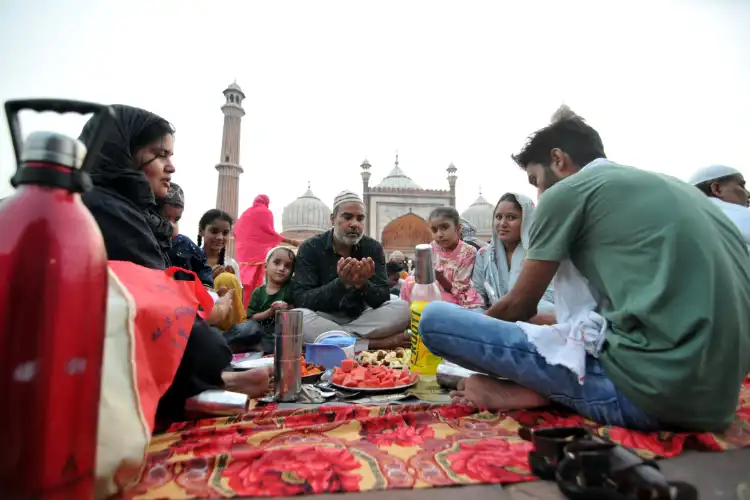
Indian Muslims - families breaking Ramazan fast at Jama Masjid of Delhi (Pics: Ravi Batra)
Indian Muslims – families breaking Ramazan fast at Jama Masjid of Delhi (Pics: Ravi Batra)

The world is celebrating the International Day of Democracy to emphasize the importance, strengths, weakness, and other aspects of this most popular system of government. In India, the largest democracy in the world, people are often misinformed about the commitment of Indian Muslims toward establishing democracy in the country. The misconception mostly arises from taking a few anti-democratic fanatics as representatives of the society

International Day Of Democracy 

Muslims have remained at the forefront of the battles fought for establishing democracies in India. It should not be lost that the equal voting rights for Indian women were won in 1935 after a political battle led by Begum Jahanara Shahnawaz. She was the only woman representative to attend all three Round Table Conferences (RTC) in the early 1930s where discussions over certain autonomies to the Indians were discussed. At RTCs, Begum raised the point that women should be given equal rights when choosing a representative to legislatures.  

After the RTCs were concluded she remained in England and created public opinion in favour of Indian women’s rights by meeting important politicians of England. When the Government of India Act, 1935, was finally drafted, Indian women were given voting rights. 

Begum’s was an important victory but far from what India wanted. The franchise was not a universal adult franchise. Only people with a certain level of economic assets or education were allowed to cast votes. Moreover, Muslims and Sikhs could vote only for their coreligionists, a system called separate electorates. Muslim leaders like K. A Abdul Hamied, Maulana Abul Kalam Azad, Zakir Husain, and others have blamed separate electorates for the ‘success’ of the Muslim League. We often miss noticing that in 1946 Muslim League won a majority of Muslim seats under a system where only affluent people could vote while a majority of Muslims, who were backward, couldn’t.

In 1940, Maulana Ubaidullah Sindhi, a revolutionary and Islamic scholar, chalked a plan for the future of India. He asked his followers to oppose separate electorates and a system where only elites could vote. Sindhi wrote, “our party will obviously work in a Muslim majority province (Sindh), but it will operate on the principles of joint electorates. If Muslims are such cowards that they cannot win the confidence of fellow Hindus and Sikhs to win elections and need crutches of separate electorates then this community should be terminated.” 

During the Constituent Assembly debates, Maulana Hasrat Mohani, the man who coined the slogan Inquilab Zindabad, demanded that a Constituent Assembly elected based on separate electorates should not draft the constitution of a Free India. Hasrat Mohani was one of the members of this Assembly and served on the drafting committee. On 4 November 1948, he moved an amendment saying, “the consideration of the Draft Constitution of India be postponed till the election of a fresh and competent Constituent Assembly on the basis of Joint Electorates and the formation of political rather than communal parties in India.”  

When a proposal to reserve seats for minorities was put in front of the Assembly, Mohani vehemently opposed the idea and got it removed. He said, “there is absolutely no need for reservations after we have made provision for joint electorates and adult franchise.…… On a communal basis, you are making its scope limited as you have already said that you would like to give reservations to the Muslims because they are in minority…..Why do you call the Muslims a minority? They can be termed as a minority only when they function as a communal body. So long as Muslims were in the Muslim League, they were in a minority. But if they elect to form a political party without any restriction leaving it open to any community, then you should remember that whenever political parties would be formed, the Muslims would give fight by forming coalitions.”

In 1951, after the Constitution of India was adopted Maulana Husain Ahmad Madni in his presidential address to Jamiat-e-Ulema-e-Hind, one of the largest body of Islamic scholars, said that now the country had adopted a system where the political rights of every individual irrespective of creed were equal therefore every Muslim must strengthen this democracy. He believed that Islamic scholars could teach and guide Muslims in a way that they work towards a secular and democratic India.  

The list is long and I have tried to show that every kind of prominent Indian Muslim – women, Ulema, and socialists, had put their efforts into making India the largest democracy.

source: http://www.awazthevoice.in / Awaaz, The Voice / Home> Culture / by Saquib Salim / September 15th, 2022

When an Indian Muslim soldier shot his younger brother in war against Pakistan

INDIA :

Don’t grieve Chotey. We are soldiers and we did our duty, cried out Younus Khan after shooting and injuring his brother on Pakistan side of the border.

In my childhood days, there was a rumour in my hometown, Deoband, that Late Haji Mastan had approached the authorities of Darul Uloom Deoband for permission to shoot some scenes in the world-known Islamic seminary for a film he was planning to make. The film’s story was said to revolve around a Hindu lady in pre-partition India who adopts a Muslim boy and brings him up with her son of the same age.

After the tragedy of the partition in 1947, the Muslim boy migrates to Pakistan. The two brothers join the Pakistani and Indian air forces as pilots. In the 1965 Indo-Pak war, they face each other in a dogfight in which their aircrafts crash and both of them die. In the last scene, the mother was stated to be hugging the dead bodies of her two sons on each of her shoulders.

I was reminded of this unconfirmed story after listening to the reallife  episode told in this V-blog of Lt Gen (R) Amjad Shoaib of Pakistan. He describes how Sahibzada Yaqub Khan, who later became Pakistan’s Foreign Minister, was injured by his elder brother Yunus Khan while defending their countries. ((Watch the clip from 9:20-11:09)

Sahibzada Yaqub Khan was born in Rampur in the Nawab family (Gen Shoaib confuses the Nawabs of Rampur with the Nawab of Pataudi). He and his elder brother Yunus Khan had joined the British army in pre-partition days. When partition happened, Yaqub Khan joined the Pakistani side and Yunus Khan, the Indian army. In the 1948 Indo-Pak war, the brothers came face to face leading their battalions as majors on the Kashmir border, and Yunus Khan fired at and injured Yaqub Khan. When he realised that the soldier he had injured was none other than his own brother he shouted: ‘Don’t grieve Chotey. We are soldiers and we did our duty.’

When Colonel Maneckshaw, who retired as Chief of the Indian Army Staff, learnt about the incident, he commended Yunus Khan and also said sorry for his brother. The two brothers met in Calcutta after 36 years at the wedding of Yaqub Khan. They hugged each other and wept.

What it also shows, which the hard and soft-Hindutva elements fail to see, is that the love of Indian Muslims for their motherland is in no way less than all anybody else in the country. They fail to understand that Indian Muslims were neither the ‘enemies within’ in 1947 nor are they today. The Hindutva goons need to realise that they are serving neither their religion nor the country by creating and intensifying the venomous and destructive narrative. Which idiot in the world can imagine himself to be safe when his neighbour’s house is on fire?

In 1947 Indian Muslims were deprived of not only leadership but also educated members of the community, as the clip shows. Their extended families got divided. There are still relatives on both sides of the border who have not seen each other for years and are desperate to see their loved ones at least one last time. Even those born in US and UK with nationalities of these countries but parents of Indian and Pakistani origin face unnecessary bureaucratic difficulties in getting visas to go and see their grandparents in India. Late member of parliament Syed Shahabuddin used to refer to Indian Muslims as the ‘casualties of partition.’

From Major Yunus Khan, Brigadier Usman, and Havildar Abdul Hamid to the martyrs of Kargil, time and again, the sacrifices of Indian Muslims bear testimonies to their patriotism.

source: http://www.siasat.com / The Siasat Daily / Home> Featured News / by M Ghazali Khan / December 31st, 2022

Dr Suhel Ajaz Khan to be next Indian ambassador to Saudi Arabia

INDIA:

He is expected to take up the assignment shortly.

Dr Suhel Ajaz Khan

Riyadh:

Senior diplomat Dr Suhel Ajaz Khan has been appointed as the next ambassador of India to the Kingdom of Saudi Arabia (KSA), the Indian ministry of external affairs announced on Thursday.

He is expected to take up the assignment shortly.

From March 2022, the post was vacant after Ausaf Saeed was promoted as secretary, of overseas Indian affairs in the country’s Ministry of External Affairs.

N Ram Prasad, deputy chief of mission at the Indian Embassy in Riyadh was in charge instead.

About Dr Suhel Ajaz Khan
Dr Suhel Ajaz Khan a 1997 batch IFS officer, is presently serving as Indian ambassador to Lebanon.


Dr Khan’s first foreign assignment was to the Embassy of India, Cairo where between 1999-2001, apart from the other duties at the Embassy, he obtained an advanced diploma in the Arabic language from the American University, Cairo.


He later served at the Indian Embassy in Damascus, handling administration, press and political affairs between 2002-2005.


His next assignment was as Consul at the Consulate General of India, Jeddah between 2005-2008, where he was handling a number of issues including the Haj matters and Haj arrangements for the Indian pilgrims.
Later, Dr Khan worked as Deputy Secretary in the WANA (West Asia North Africa) Division of the Ministry of External Affairs between 2008-2009 followed by a stint at the Indian High Commission, Islamabad between 2009-2011 where he handled Visa and Consular matters.


Between 2011 and 2013 Dr Khan served as a director in the office of the Minister of State for External Affairs Mr E Ahamed.


Between 2013 and 2017 he was part of the Indian delegations to the IAEA (International Atomic Energy Agency), the UNIDO (United Nations Industrial Development Organization) and the UNCOPUOS (United Nations Committee on Peaceful Uses of Outer Space) meetings.


He was also the Head of the Indian Delegation to the Vienna Conference on the Humanitarian Impact of Nuclear Weapons in December 2014 in Vienna.
Dr Khan served as a member of the United Nations Pension Board in 2016 and 2017.


Khan worked at the Indian Embassy in Riyadh between September 2017 and June 2019 as Deputy Chief of Mission.
Khan arrived in Beirut on June 21, 2019.


Dr Khan has a graduate degree in Medicine from M.G.M. Medical College in Indore, India.

Dr Khan is married and his wife Rifat Jabeen Khan has long experience working in International and UN organizations. They have two daughters.

source: http://www.siasat.com / The Siasat Daily / Home> News> India / by Sakina Fatima / December 22nd, 2022

Know Your Nation: Prof. Masood completes 100-lecture series

INDIA:

Hyderabad: 

Who doesn’t chat up with utter strangers during journeys? Everyone does and the talk usually runs around inane things which lead to nowhere. Imagine such casual conversation resulting in something big – even constructive.

It happened with Prof. Masood Ahmed of Hyderabad. Once he was travelling to Mumbai by train and struck a conversation with his fellow traveller, an engineering student. As the conversation progressed, he was surprised to learn that the boy had no inkling of what economy is all about and what inflation is. “This is not part of our syllabus,” the youngster replied when the professor expressed surprise.

That was the turning point. It led Prof. Masood to embark on a journey of lectures on the topic – Know Your Nation. This fruitful lecture series touched the 100th mark recently. “I never thought these talks would last this long,” says the incredulous professor.

Former president of Association of Indian Management Schools, Prof. Masood delivered his first talk on August 1, 2015 to students and faculty of CORE School of Management, Roorkee, UP. The 48-odd participants hung onto each word and were visibly satisfied with the knowledge gained. As word spread, there was demand for such lectures and Prof. Masood delivered ten more lectures that very month in the Master School of Management, Meerut, Birla Institute of Technology, Ranchi, ICBM School of Business Excellence, Hyderabad, Hyderabad Business School, GITAM University, Birla Institute of Management and Technology, Noida.

There was no looking back. The lectures, which focus on India’s economic scenario, education status and employment opportunities, took him all over the country and even abroad. He addressed packed conference halls in business schools, engineering and medical colleges and other institutions. In 2016 he delivered a talk to Deans and Directors of Business School of South Asia, Sri Lanka and next year at the University of Liberal Arts Bangladesh, Dhaka. He delivered similar lectures in Muscat, Jordan and Qatar.  Prof. Masood’s 100th lecture was delivered on December 26, 2022 at the Shaheen Group of Institutions, Bidar.

Prof. Masood makes his talks appealing with power point presentations packed with interesting nuggets of information. What do 7 billion people do? He asks and then goes on to inform that 1.4 billion work in agriculture, 1.7 billion in services, 800 million work in industries while over 400 million are entrepreneurs and 430 million are unemployed. And 1.9 billion are too young to work (0-15 ages). He reels out quick data like South Asia being home to a quarter of world population, India fact sheet about population, health and literacy rate, Central government expenditure, growth projects, human development index, how India ranks in ease of doing business. There are a whole lot of other details too.

There is woeful lack of knowledge about these things both among students and adults. “You should know yourself, your organisation and your nation. This is the prerequisite for progress,” says Prof. Masood. And he believes that thirst for learning, consistency in relearning and adopting unlearning are the keys for professional growth.

What next? A health care management expert, he is now planning to launch 100 interesting lectures on the subject – Know Your Health. Those who want to avoid going to hospitals can look forward to them.

source: http://www.siasat.com / The Siasat Daily / Home>Opinion / by J S Ifthekhar / January 02nd, 2023

More than a Hagiographical Account

Aligarh, UTTAR PRADESH :

What binds the fifteen iconic texts, “High school English Grammar and Composition” (Wren and Martin,1935),” Arithmetic” (Jadav Chandra Chakravarty, 1890), “Algebra (Jadav Chandra Chakravarty,1912), ” An Introduction to the study of Indian History” (D.D. Kosambi,1956),” Sultan Mahmud of Gazana” (Professor Mohammad Habib,  1956),” The Agrarian System of Mughal India” (Irfan Habib,1963),” Toba Tek Singh” (Sadat Hasan Manto,1953),  The Serpent and the Rope(Raja Rao,1963), Twilight in Delhi(Ahmad Ali,1943), Lihaf(Ismat Chughtai 1943),” Aapbeeti” (Abdul Majid Daryabadi,1978), “Aag ka Dariya” (Qurratul ain Haider1951),” Aab-e- Gum(Mushtaq Yusufi,1990), “Isme Azam” (Shaheryar,1968),  and “And Then One  Day (NasiruddinShah,2014) together?

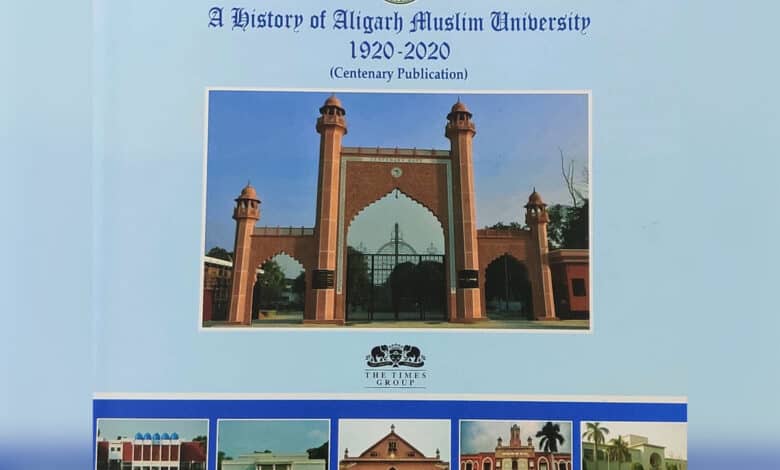
This seemingly perplexing question may leave many to grope for answers. One leaves surprised to learn that these questions are related to Aligarh Muslim University. A well-documented bookmarking of the centennial of the Aligarh Muslim University settles the issue. It is the institution where academicians produced the best graduate textbooks on Mathematics, History, and English Grammar, and its alumni contributed significantly to the collective life of India. These unheard but vital aspects of the university (It has been frequently, though erroneously described as the hotbed of Muslim communalism) are exhumed by the recent archival research in the book. The book,  A History of Aligarh Muslim University, astutely edited by Asim Siddiqui, Rahat Abrar and Faiza Abbasi, is published by The Times of India  Group, 2020).

Not infrequently, one finds AMU is being pilloried for the crimes it never committed. Recently CAA protest and hanging of Jinnah’s portrait, and covid casualties at the AMU medical college disproportionately highlighted by media, dented the academic and secular credentials of the university. The publication, offering more than glowing hagiographical descriptions, seeks to locate the university in shaping the collective life of Indians, especially Muslims, in the last one hundred years. The university’s contribution, not much visible in the public domain, is delineated with a sense of admiration and objectivity in almost equal measure. It is not always prejudice,   discrimination and political hostility that accounts for the university’s decline.

The centenary volume springs up some pleasant surprises as it reveals that the most influential textbook on English grammar in the subcontinent was coauthored by Henry Martin, who was the pro-vice-chancellor of Aligarh Muslim University from 1930-to 1931. Similarly, the author of the two most popular books on arithmetic and algebra was written by Babu Chand Chakravorty (1855-1920), who served in the Department of Mathematics. Eminent Historian and mathematician D.D.Kosambi (1907-1966) and renowned French mathematician Andre Weil (1906-1998), known for his seminal work on number theory, were also associated with the Department of Mathematics.

. The famous scholars of medieval history, Professor Mohammad Habib (1895-1971) and Irfan Habib (1931), were the faculty members and Sadat Hasan Manto (1912-1955), Raja Rao (1908-2006), Ahmad Ali (1910-1994, Ismat Chughtai (1915-1991), Abdul Majid Daryabadi (1892-1977), Qurratul Ain Haider (1927-2007), Mushtaq Ahmad Yusufi,(1923-2018), Shahryar(1936-2012) and Naseeruddin Shah(1950) were the students.

Indeed more than a glossy coffee table book spurring visual spectacle instead of conjuring up cerebral response,  the book is skillfully divided into six sections such as” Important Milestones, Builders of the Aligarh Muslim University, towards the making of Modern India, Realizing the idea of a university, Evolution of university, and Distinguish visitors to Aligarh Muslim University.

Aligarh Muslim University has produced two Barat Ratan awardees, Khan Abdul Ghaffar Khan (1890-1988) and Zakir Hussain (1897-1969) and its contribution to the Indian national movement, despite the marked fascination of its student for the Muslim League in the late thirties and forties, is enormous as its students Shaukat Ali, Mohammad Ali, Hasrart Mohani, Rafi Ahmad Kidwai, Raja Mahindra Pratap, Mohammad Yunus, Saifuddin Kitchlu, Abdul Majeed Khawaja, KM Ashraf,  Qazi Jaleel Abbasi, Sheihk Abdullah,  Abbas Ali and after partition, Mohsina Kidwai, Anwara Taimur,  Saheb Singh Verma,  Arif Mohammad Khan, Azam Khan and many more dominated the political arena.

Not people know that iconic dhrupad singer Rahimuddin Khan Dagar (1901-1976) completed his graduation from Aligarh Muslim University. A Padma Bhushan awardee. Ustad Rahim Uddin Khan Dagar contributed immensely to articulating a distinct variation of Dhrupad, the oldest existing form of Hindustani classical music, The Dagar Bani. He blazed a new trail in dhrupad singing. He preferred a lower octave and hardly used Madhya and taar saptak, the highest notes. Asim Siddiqui, one of the editors and a known scholar of film studies, took pains to highlight the lesser-known contribution of AMU to the Indian film industry. With a marked sense of academic rigour, an awe-inspiring list is produced that includes the name of the original pin-up girl of Hindi cinema Begum para, Renuka Devi, Khwaja Ahmad Abbas, Akhtarul Iman, Jan Nisar Akhtar, Shakeel Badayuni, Talat Mahmood, Rahi Massom Raza, Saeed Jaffery, Surekha Sikri,   Naseeruddin shah, Javed Akhtar, Muzaffar Ali, Anubhav Sinha,  Dilip Tahil and the like. Acclaimed playwrights Habib Tanvir and Asghar Wajahat studied here. Its alumni were globally acclaimed printmaker Zarina Hashmi and famous collage painter Farhan Mujib.

Passion for literature has been the hallmark of the university. It produced many writers who wrote in Urdu, English, Hindi, Malayalam and Assamese and bagged the highest literary awards, including Jnanpith, Sahitya academy award and Iqbal Samman. The celebrated authors groomed by the university seem to be ever-growing, and some prominent are; Hasrat Mohani, Moulvi Abdul Haq, Rasheed Ahmad Siddiqui, Abdul Majid Daryabadi,  Josh Malihabadi, Raja Rao, Ahmad Ali, Majaz, Sadat Hasan Manto, Hayatullah Ansari,  Ale Ahmad Suroor, Qurrarul Ain Haider, Ali Sardar Jafri, Ismat Chughtai, Mushtaq Ahmad Yusufi, Mukhtar Masood, Asloob Ahmad Ansari, Waheed Akhtar,  Munibur Rehman, Reyazur Rehman Sherwani,  Nazeer Ahmad,  Nebakant  Barua, KP   Singh,  Namita Singh,  Ifthikhat Alam Khan, Ather Siddiqui, Azarmi Dukht Nahid Safavi,  Yaseen Mazhar Siddiqui and many others.

It is not that Aligarh Muslim University puts a premium on oriental learning, languages, and literature. It strove to propagate science almost equally in line with its founder’s dream. Many faculty members and students have been recognized internationally and nationally. The book provides an exhaustive list of figures Obaid Siddiqui, Zahoor Qasim, Shamim Jairaj puri, Shahid Jameel, Muzaffar Ali, Fakhruddin Ahmad, Mohammad Shafi, Abrar Mustafa Khan, Narendra Kumar Govil, Premnath Ganju, Piara Singh Gill, Salim uz zaman Siddiqui, Akhlaqhur Rehman Kidwai, Asoke Nath Mitra and Qudsiya Tehsin etc.

The Aligarh Muslim University made a sterling contribution to Urdu, English journalism and electronic media. It was the first university to introduce a course in journalism in 1938, and the course was abruptly scrapped in 1941. The full-fledged department of Journalism came into existence much later. However, its alumni made a mark at the international and national levels. Some of them are Saif Khalid(Aljazeera), Anuj Kumar (the Hindu), Brijendra Prashar (The Hindustan Times), Navaid Anjum(OutLook), Arfa Khanum Sherwani (The wire), Romana Israr( ABP news0, Sumera Khan ( TV9) Hina Zubair(ETV Urdu), Ehtisham Khan ( TV 18 ), Jeelani Khan ( Resident editor, Inquilab), Ismaeel Zafar Khan (group editor, Rashtriya Shara) Mohammad Anas ( Sunday Guardian), Ehtisham Ali Khan (NDTV), Poonam Sharma(Aajtak) and the like.

Since its inception AMU has been known for promoting sports and perhaps it was the institution that set up a cricket club and Rudyard Kipling mentioned it. It hardly surprising to find that Wazir Ali, Nazir Ali, Lala Amarnath Syed Mushtaq Ali, Jhangir Khan, Mohammad shahid, Rizwan shamshad and ace hockey players BP Govinda, Inamur Rehman, Zafar Iqbal, Aslam Sher Khan and many more studied here.

Several books on AMU has been published   in the centenary year. The Sir Syed academy too published three volumes of the collected works of Sir Syed and seminal works of Christian Troll, GFI Graham, David Lelvyeld and Gail Mainult have been published by the academy.  The centenary volume encapsulates what AMU is all about with a sense of ease and objectivity.

Shafey Kidwai is a bilingual critic who got Sahitya Academy Award in 2019 for Urdu. He  is professor of Mass Communication at Aligarh Muslim University.

source: http://www.siasat.com / The Siasat Daily / Home> Featured News / by Shafey Kidwai / April 25th, 2022