All posts by mpositiveone@gmail.com

Arabic meet calls for finishing schools

Mallapuram, KERALA :

Habeebullah Khan, head of Arabic Department at Jamia Millia Islamia, New Delhi, inaugurating a national Arabic conference at Calicut University on Sunday.

Says language is a major factor in employability in the Gulf

A national Arabic conference held at Calicut University under the banner of the Wisdom Islamic Students Organisation on Sunday demanded that finishing schools be set up in the State. “A large number of our professional students are depending on jobs abroad, particularly in the Gulf. Language is widely considered a barrier for our students, and that affects their employability skills,” the conference pointed out.

A resolution passed by the conference pointed out that the problems in communicating through a new language could be solved to a great extent by adding finishing schools to minority coaching centres in the State. The government should set up centres to promote foreign languages, including Arabic.

The conference also asked the government to end the discrimination in offering elective languages for higher secondary students. Higher secondary students should be given choice to select second languages like Arabic, Urdu, and Sanskrit.

The conference also demanded that university syllabi be revamped in accordance with the demands of the changing times. Habeebullah Khan, head of Arabic Department at Jamia Millia Islamia, New Delhi, inaugurated the conference. Wisdom Islamic Students Organisation State vice president P.P. Naseef presided. P. Abdul Hameed, MLA, was the chief guest. Wisdom youth wing president C.M. Sabir Navas, Jamia Al-Hind Al-Islamia director Faizal Ahamed, and organizing committee chairman P.M. Shahul Hameed spoke.

source: http://www.thehindu.com / The Hindu / Home> News> States> Kerala / by Staff Reporter / Malappuram – September 02nd, 2018

Rookie Khaleel is included in squad

RAJASTHAN :

Calcutta/Mumbai:

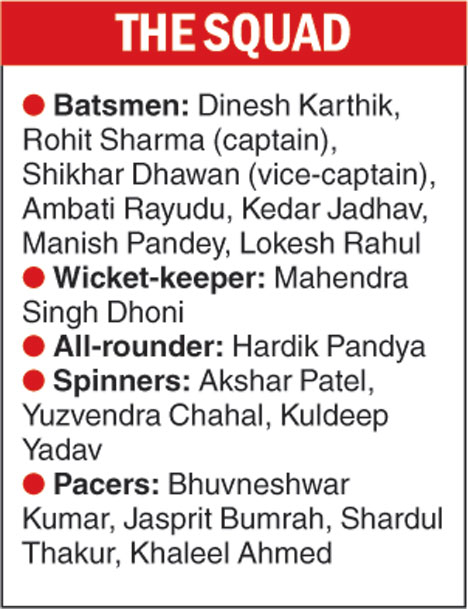
Rajasthan left-arm pacer Khaleel Ahmed is the only new face in the 16-member squad for the Asia Cup, which was picked in Mumbai on Saturday.

The 20-year-old has played only two first-class matches, but has more experience in List A and T20 cricket, having played 29 games across the two shorter formats. He was part of the India A limited-overs squad that toured England in June-July, and also played for India A in the recently concluded 50-over quadrangular series against South Africa A.

Rohit Sharma will lead the side while Shikhar Dhawan is the vice-captain.

Khaleel, who has taken 15 wickets in his last nine limited-overs matches for India A, had been on the selectors’ radar for a while.

Chief selector MSK Prasad said they had identified most of the squad for next year’s World Cup in England, apart from two or three slots, of which one was in the pace-bowling department.

“Two to three slots we are yet to finalise, so for those slots we are trying and we’ll look at these 24 matches (in the lead-up to the World Cup). You’ll come to know the slots more specifically as we go ahead … Among those, one of those seamers’ slot is open. We are looking at a left-arm option in Khaleel,” Prasad said at a media conference.

Khaleel also played in the IPL for Delhi DareDevils in 2016 and Sunrisers Hyderabad in 2017. While Delhi had bought him for just Rs 10 lakh at the auction, the Hyderabad franchise spent Rs 3.2 crore to get him in their ranks.

SquadMPOs05sept2018

source: http://www.telegraphindia.com / The Telegraph,Calcutta,India / Home> Sports / by The Telegraph Bureau & Agencies / September 02nd, 2018

Bhatkal: A food story

Bhatkal, KARNATAKA / Bengaluru, KARNATAKA  :

This sleepy and now maligned town on the Karnataka coast boasts of a unique cuisine embracing Konkan and Middle-Eastern influences

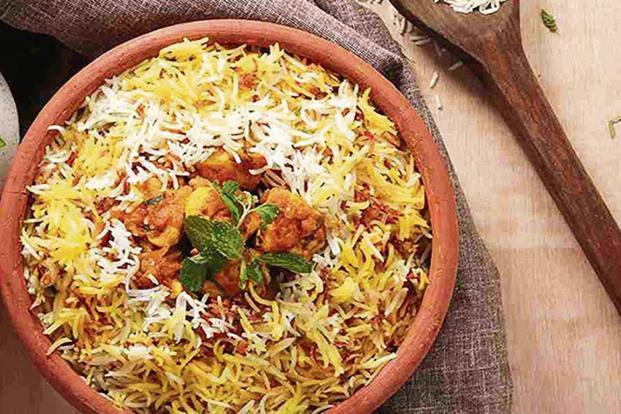
Bhatkali biryani is topped with fried onions, curry or mint leaves.

Bhatkal is a small port town on the Arabian Sea, near Mangaluru. Between the 8th and 15th centuries, it was one of the chief ports on the western coast, specializing in the trade of rice, sugar, spices and horses. Yemeni horses would be brought from the port of Hormuz in Iran to Bhatkal, and traded across the country. Over the centuries, traders from Iraq, Iran and Yemen settled in Bhatkal and formed the Navayath (newcomers) community. Some of them intermarried with the locals, many of whom belonged to the Jain community, and were influenced by their customs, languages and culture. This, in turn, led to a unique and multicultural food practice.

In recent times, however, whenever Bhatkal shows up in the news, it is with reference to radical Islamist elements and polarization between religious communities. As a result, the spotlight is rarely turned on this unique cuisine. Other than the Bhatkali biryani, little else is known and even less represented in mainstream restaurants, even in its home state of Karnataka.

The Alibaba Cafe and Restaurant on Bengaluru’s busy MM Road in Fraser Town is one of the few places that is changing this trend. The décor seems straight out of an Arabian Nights tale. Coloured glass lanterns hang from the ceiling and the mud-plastered walls are reminiscent of a Yemeni village home. There are Indian references too. The restaurant’s heavy wooden door has a lotus motif and large copper cooking pots in the corner look curiously Mangalurean. Shaad Hassan Damudi, the owner, greets visitors while taking orders on the phone in rapid-fire Konkani.

Damudi is from the Navayath community and his restaurant’s menu reflects his heritage. “What you see on the menu here is centuries of cultural amalgamation between the various communities, resulting in a very unique cuisine,” Damudi explains. The meat-heaviness is also reflected in the star dish on the menu—the Shaiyyo biryani, made from vermicelli (shaiyyo) instead of rice. The vermicelli adds a uniquely Konkani touch to the distinctly Middle-Eastern flavours of the dish, featuring layers of delicately spiced meat and a generous helping of browned onions. Shaiyyo is sun-dried in vast quantities in early summer, so it can be prepared and enjoyed throughout the long west-coast monsoon. “Navayath cuisine tends to have milder flavours than traditional south Indian coastal cuisine,” says Damudi. “We use local Byadagi red chillies, known for their bright red colour and slightly sweeter taste.”

Any conversation about Bhatkali food always turns to Bhatkali biryani, made with basmati rice flavoured with saffron and whole garam masala. Tender pieces of mutton, chicken, fish or prawns are cooked separately with spices. Some even describe it as a korma and rice dish which is assembled in layers and finally topped with fried onions, curry or mint leaves.

Seafood is a staple of Bhatkali cuisine. Fish, prawns, mussels, clams, oysters and squid, available in plenty along the Konkan coast, are combined with local spices to create preparations like the laun miriya mhaure, where sliced fish (typically seer) are cooked in a traditional salt and red chilli paste, or shinonya nevri, steamed mussels stuffed with a spicy rice and coconut mixture.

Aftab Husain Kola, a Bhatkal native and a food and travel writer, says that although modern influences have crept into traditional Navayath cuisine, many of the old traditions of seasonal food have been preserved. He also throws light on some of the other Navayath home specialities like haldi pana nevri, rice pancakes steamed in turmeric leaves, and mudkuley, tiny steamed rice-flour balls in a delicately spiced curry. The community also gets together during weddings and festivals, for dawats or feasts which celebrate Navayath fare.

The wide range of Bhatkali desserts reflects the cultural intermingling of communities. Shaufa pana (dill leaves) feature in a variety of desserts, from poli (bread) to appo (pancakes), even puddings. Saat padra navariyo, a baked, layered dessert, reminiscent of Goa’s bebinca, and tariye khawras, a semolina, coconut and cashew pudding, are unique to the region. Some of the desserts have interestingly Middle-Eastern hybrid names too. Al basra poliand aflatoon poli are two such delicious concoctions—baked pancakes made with combinations of milk, coconut, egg and sugar. The Bhatkal version of kheer is godan—it has various manifestations, but the base always comprises coconut milk and jaggery.

The culinary diversity of this little coastal town is quite mind-boggling and more conversations about this and other aspects of Bhatkal’s rich culture could present an alternative narrative to those of terror and violence.

Aflatoon poli

Serves 4

Ingredients

2 tbsp refined flour

2 cups milk

4 eggs, beaten

1-2 tbsp sugar

1 tbsp broken cashews

1 cup coconut milk

K cup condensed milk

2 tbsp ‘ghee’

Method

Add the refined flour to the milk and stir over a low flame until it thickens. Leave aside to cool. Add in eggs, sugar, nuts, coconut milk and condensed milk, and mix thoroughly.

Grease a baking tin with ‘ghee’ and pour the mixture into it. Bake at 160 degrees Celsius for about 20 minutes. Check if it is done by inserting a toothpick into the pancake; it should come out clean. Remove from the baking tin and serve warm.

source: http://www.livemint.com / LiveMint / Home> Leisure / by Sriram Aravamudan / September 02nd, 2018

Mohammed Kamaluddin Ahmed, ex-minister & ex-ambassador, passes away

Hyderabad, TELANGANA :

Hyderabad:

Mr Mohammed Kamaluddin Ahmed, Ex-Central Minister and ex-ambassador to the Royal Kingdom of Saudi Arabia, passed away in Hyderabad in the wee hours of Sunday, September 2, 2018.

Mr Kamaluddin was elected as Member of Parliament for four times. 3 times in 1989, 1991 & 1996 from Hanamkonda & 1 time from Warangal. He had been the Member of Parliament from Warangal from 1980 to 1984. Earlier he was also elected as MLA twice. From Cherial assembly constituency in 1962 & from Jangaon assembly constituency in 1967.

He also served as APSRTC Chairman from 1970 to 1973. He served on several posts including APCC President and NABAD Chairman.

Mr Kamaluddin was born in Maddur Mandal of Salakpoor Village. He was the senior Telangana leader, a good politician & a good advocate. He was a good scholar as well.

He was undergoing treatment at Apollo Hospital, Hyderabad.

source: http://www.siasat.com / The Siasat Daily / Home> Hyderabad> News / by Rasia / September 02nd, 2018

‘Sringaramanjari’: Where oceans of culture meet

Hyderabad, TELANGANA :

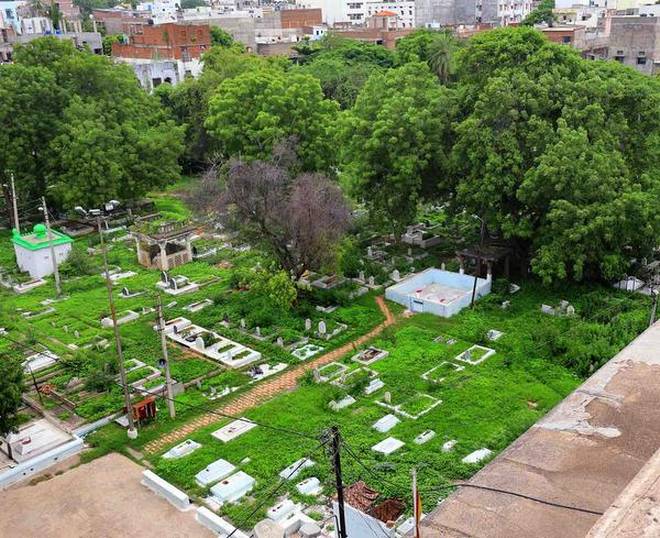
An aerial view of the graveyard

The pages of this Sanskrit trestise eschew a story of timeless love, passion and the strife it accompanies

Misrigunj is one of the old city areas of Hyderabad where it is easy to get lost as the lanes and bylanes double back and are in no particular order. Even a compass will be of little use, forget about online maps. In one of the lanes that lead on from one of the biggest domes in the city is the grave of Syed Kalimullah Hussaini or, as he was known in his lifetime, Akbar Shah. Walking in the lanes and standing near his grave in Misrigunj, it is difficult to imagine that the young man wrote a Sanskrit treatise on love, heroines and their moods called Sringaramanjari. The treatise on the many moods of love begins with a Guru stuti.

Guru Ganapati Durga Vatukam Shivamachutam

Brahmanam Girijam Lakshmim Vanim Vande Vibhoteye

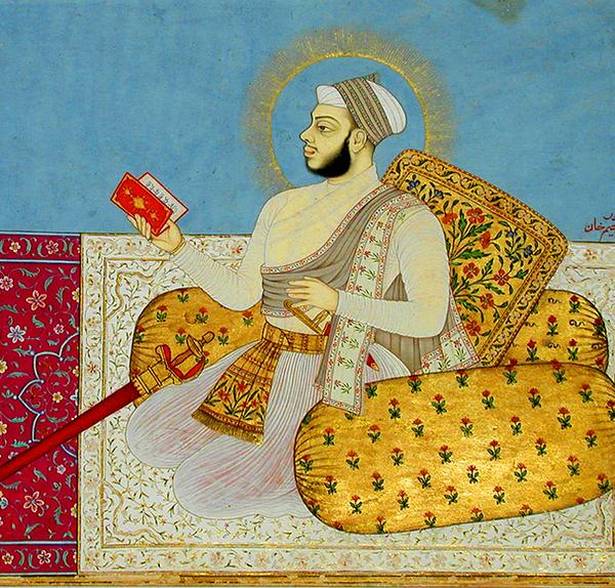
If Akbar Shah wrote the Sringaramanjari, credit has to be given to Sanskrit scholar Venkataraman Raghavan for resurrecting the book based on two manuscripts and giving insights into the life of Akbar Shah or Bada Akbar. Raghavan became curious in 1943 when he saw a Sanskrit manuscript in Government Oriental Library, Mysore. Using other material from Tanjore Library, Raghavan published a book with an exhaustive introduction leading to the adaptation of the work for Bharatanatyam and Carnatic music.

To understand how a book on love written in Sanskrit by a Muslim scholar living in a Sufi khankah came to be written about in the latter half of seventeenth-century Hyderabad would be a challenge. Akbar Shah was the son of Shah Raju Qattal who traced his lineage back to Gesu Daraz credited with bringing Sufism to Deccan. Akbar Shah grew up in his father’s khankah along with another young boy: Abul Hasan, or as Shah Raju called him Tana Shah(young king).

Painting of Akbar Shah

The lines of religion and language in Deccan were like lines drawn in the sand. It was in Deccan that a king moved his capital from Gulbarga down south to Bidar where the linguistic boundaries of Kannada, Telugu and Marathi met. The language and court practices were a blend of the Persian world and those from the native kingdoms. The taj worn by kings became the colourful pugree in course of time.

It is in this flexible world that a Muslim scholar could sit inside a Sufi khankahat the feet of his father and write a work that dwelt at length about the fickleness of love, heroines, beauty and attraction. If the love of your life is angry, Sringaramanjari has a recipe to solve the problem. It suggests a time and a place with a romantic mood like spring and moonlight. It also gives six ways to win over the love: pleading, gift, winning over her friends, indifference, falling at her feet or changing the circumstances.

One of the topics that Akbar Shah ponders is whether a courtesan is capable of real love and after much deliberation concludes that she has love for one person but feigns love with many so that she can carry on her life.

Unfortunately, Akbar Shah died young. Raghavan uses evidence in the book as well as a firman issued by Aurangzeb to prove that he died before 1675. Much before his playmate, Abul Hasan could rise to the pinnacle of giving one final burst of cultural efflorescence.

The mazar (grave) of Akbar Shah is in a much better shape now than it was in 1949.“People still come here and spread flowers,” says the mutawalli of the dargah of Shah Raju Qattal.

source: http://www.thehindu.com / The Hindu / Home> Society> History & Culture / by Serish Nanisetti / September 03rd, 2018

MoU signed to give facelift to Ajmer dargah

Ajmer, RAJASTHAN :

AjmerDargahMPOs04sept2018

To clean and manage the 13th-century shrine, a Swachh Iconic Place, ₹5.68 crore to be spent

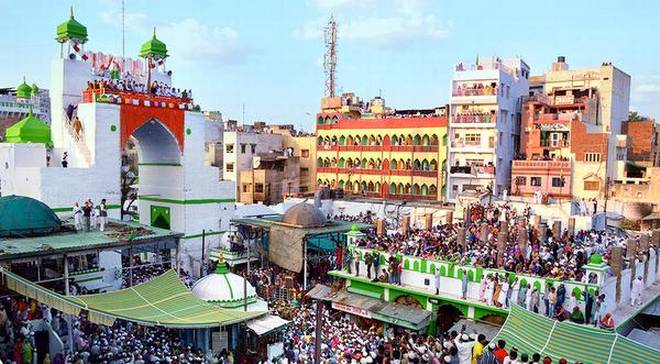
The historical dargah of Sufi mystic Khwaja Moinuddin Chishti in Ajmer is all set to get a facelift as a memorandum of understanding has been signed by the Dargah Committee, the Ajmer Municipal Corporation and Hindustan Zinc for spending ₹5.68 crore to clean and manage the shrine.

The 13th-century dargah has been included among the Swachh Iconic Places, a clean-up initiative focused on iconic heritage, spiritual and cultural places through a multi-stakeholder approach model. The campaign was initiated under the Swachh Bharat Abhiyan in 2016.

Select 100 SIPs across the country will be cleaned and developed at a higher level of sanitation and facility management in collaboration with corporates and leading public sector units as part of the initiative.

In Ajmer, the Collector will act as the project’s nodal agency with the Dargah Committee and ‘khadims’ (workers) being the primary stakeholders. An amount of ₹5.68 crore will be invested in the project’s first phase for establishment of two flower compost making machines, cleaning and basic repair of the Jhalra pond, re-flooring in select areas, procurement of machines for cleaning the floors, risk management system plan, conservation of Shahjahani Gate and initial plans for Nizam Gate.

More amenities

The MoU was signed in Ajmer on Saturday in the presence of Union Minister for Minority Affairs Mukhtar Abbas Naqvi. Mr. Naqvi said the project would help in the dargah’s upkeep and provide more facilities to the pilgrims coming during the Urs and in other seasons.

Two flower compost machines have already been installed in Kayad at a cost of ₹27 lakh for churning out about 25 kg of compost from 100 kg of flowers offered at the dargah. A vision document for the shrine has been prepared by a team of architects and building plan and design consultants.

source: http://www.thehindu.com / The Hindu / Home> News> States> Other States / by Special Correspondent / Jaipur – September 04th, 2018

‘God’s own hands’ make twain meet in Kerala

Vechoor, Kottayam, KERALA :

Imam Azhar al Qassimi with Fr Sanu Puthussery

Bangalore:

When Imam Azhar al Qassimi stopped barely 20 minutes into his Friday sermon, many among the faithful were surprised.

Surprise turned to astonishment when they saw a man in a Christian priest’s robes walking into the jummah congregation.

It was Fr Sanu Puthussery, vicar of St Antony’s Church in Vechoor, Kottayam. The priest from the Syro-Malabar Church walked up to the podium, which the imam quickly vacated, and for the next eight minutes, addressed the 250-odd Muslims.

“It was an unbelievably holy experience,” Fr Puthussery told The Telegraph on Sunday about an event being portrayed as a milestone in communal amity and just the inspiration a flood-battered Kerala needs as it inches towards normality.

“I had gone to meet the imam at the Juma Masjid next to our church to thank him and the Muslim community who helped me feed and take care of the 580 flood-hit families who had taken refuge at our church.”

The imam asked him to wait through the Friday prayers, kept his sermon short and left the floor to the Christian priest.

Faced with a food shortage for the 2,000-odd people sheltering at the church, Fr Puthussery had approached the imam on August 17. He “mobilised food, medicines and volunteers” till the families left nine days later.

In a video clip of his thanksgiving address at the mosque, Fr Puthussery is heard saying: “This mosque came as God’s own hands to help those who took refuge at my church.”

He told this newspaper: “I had never even entered a mosque until then…. I spoke about brotherhood…. I could see tears roll down the cheeks of some elderly people.”

The imam said: “Humanity doesn’t have man-made boundaries. If we can continue to live by the same level of love and brotherhood, we can convert this planet into heaven.”

After the floods, Muslims youths have cleaned up temples. A church and a temple were thrown open for Muslims to offer Bakrid prayers as their mosques were under water.

Yassar Arafat, who had led a group of Muslim volunteers in rescue and relief and helped at the church, said the vicar’s address was “a moment everyone at the mosque would cherish through their lives”.

The man who shared the story on Facebook, Niyaz Nasar, said he had just happened to be at the Vechoor mosque although he usually goes to another mosque.

“Perhaps I was destined to be the messenger to reach this story to the world,” an emotional Nasar said.

source: http://www.telegraphindia.com / The Telegraph,Calcutta,India / Home> India / by K.M. Rakesh / September 03rd, 2018

Shia, Sunni Muslims offer namaz together in Lucknow, special arrangements for women

Lucknow, UTTAR PRADESH :

For the fourth year in a row, Shia and Sunni Muslims on Wednesday offered joint namaz on Eid-ul-Azha at Shahnajaf Imambara in Uttar Pradesh’s capital Lucknow

For the fourth year in a row, Shia and Sunni Muslims on Wednesday offered joint namaz on Eid-ul-Azha at Shahnajaf Imambara in Uttar Pradesh’s capital Lucknow.

The namaz was followed by an Eid Milan programme organised and managed by a team of non-Muslim volunteers.

Several known faces, including former DGP Javeed Ahmad, participated in the joint namaz.

The organisers had made special arrangements this year for women to offer prayers. Participants from Saudi Arabia, the UAE and Qatar, who were visiting Lucknow for the festival, participated in the programme organised to promote communal harmony.

The namaz was led by Maulana Mustafa Nadvi.

Like previous years, citizens from other religious communities were present to witness the event and lend support to the cause during the Eid Milan programme organised by Shoulder to Shoulder Foundation, a non-profit organisation.

In view of the devastation caused by floods in Kerala, the volunteers had kept donation boxes at the venue for people to contribute to help rebuild the southern state.

These were particularly useful for those not adept at net banking and other such means.

The amount collected will be transferred to the Kerala Chief Minister’s Relief Fund.

source: http://www.hindustantimes.com / Hindustan Times  / Home> Cities> Lucknow / by Press Trust of India / Lucknow – August 22nd, 2018

Nagpur Muslims’ Innovative Community Empowerment Campaign

Nagpur, MAHARASHTRA :
SarfarazAhmedMPOs03sept2018

If there’s one overarching lesson from the past few decades about how to break the cycles of poverty and unemployment, it’s the power of mentoring — and of intervening early, ideally in the high school age, that is the time a child’s career is being formed. A new wave of Muslim social entrepreneurs have embarked on path-breaking initiatives in Nagpur and neighbouring Kamptee township with a potential to redefine the community’s social, developmental and educational agenda. A number of innovative initiatives have been launched and their synergy is expected to help the community address a number of critical issues. Nagpur’s model of synergizing multi sectoral approaches is emerging a game changer for the community and has the potential of becoming a replicable model.

Several Commissions were appointed by the government to study the socio economic conditions of Muslims in India.The Sachar Committee and the Justice Ranganath Mishra Commission (2008) recommended a series of affirmative actions to be taken by the Government in order to restore justice to Muslims and improve their plight to the level of national averages.

In order to create awareness about various socio-economic and educational issues of the community specific to the region, and working out local applicable solutions, a think-tank, the Centre for Social Research and Empowerment (CSRE) was launched under the mentorship of Zafar Mahmood, Chairman of Zakat Foundation of India. CSRE is a non-governmental, non-political and non-profit organization.

One of the key objectives of CSRE is to sensitise people to the new changing economic, educational and social environment and to empower them to successfully navigate it. CSRE identified that quality education and proper choice of careers could underpin all these areas and an increase in the community’s participation in various services would have a multiplier effect for generating a life- changing transformation for the community.

The CSRE has been promoted by senior professionals drawn from a vas diversity of professions. It functions unlike the usual career guidance centres being run by government or community organisations. It is managed by sectoral experts and is designed to assist individuals in making and implementing informed educational and occupational choices. Since these professionals are familiar with the governance processes they can enable the aspirants to take the right step on the right ladder.

Among the key mentors at CSRE are: Syed Wasif H. Naqvi (IFS), Ex. Principal Chief Conservator of Forests, Govt of Maharashtra Abdul Rauf Shaikh, Ex. CEO Maharashtra Waqf Board, Mohd Ishaq Shaikh, Ex Director General of MERY, Water Resources Department, Bashir Ahmed Shaikh, Retd Principal District Judge and Judicial Member, State Consumer Forum, Aftab Alam Khan, former Sr. Manager Bank Of Maharashtra, Majeed Parekh, Islamic scholar, Mujib Khan, Ex. Dy. Commissioner, Zafar Iqbal and Hamid B.K. Quraishi, both senior technocrats with the State Govt, Khwaja Rabbani Ex-Director of Archaeology, Mujeebuddin Siddiqui, Senior Mineral Economist, Abdul Waheed, former AGM, State Bank of India, Zafar Khan, former Principal, Qidwai High School and Jr.College, Faiz Waheed, technocrat and social entrepreneur, Rizwan Mirza, Chartered Accountant. Mushtaque Ahsan Quraishi, prominent social organizer and Qutub Zafar advocate and social activist. Irshad Khan, a young research associate handles the backroom pertains.

A R Shaikh and S W H Naqvi are the key architects of the centre and are steering a series of free Career Guidance Camps and Seminars s in local schools and colleges. Apart from guiding students on career choices experts from concerned fields also providing useful tips on various competitive examinations.

Shaikh feels that if the financial strength of Wakfs is properly tapped it can solve all major problems of the community. Most of the 27 state Waqf boards are headed either by not-too-highly qualified CEOs or by government officials holding the post as additional charge.

The Sachar Committee had said, “Up to 200 Group A officers are needed to service the Waqf affairs across India” and recommended, “The government may, therefore, consider creating a new cadre of officers to be recruited by the UPSC so that they can deal with the specific affairs of the Waqfs efficiently.”

The centre has become an established brand in Nagpur. It offers extension services in the field of student scholarships, career counseling, career selection, and entrance exams for professional and technical courses, recruitment in Govt. and Public Sector, job alerts, financial support and guidance for education, online services at nominal charges, etc. Afroz Jahan Memorial Trust, Amravati is a philanthropic partner, providing financial support to the Centre.

A Public Library cum Study Centre has been set up at Jafar Nagar Line with the support of local citizens and the Jafar Nagar Mosque. The centre is expected to be a one point reference and guidance interface for career and competitive examinations. It will soon be upgraded to a digital library with virtual class room facility.

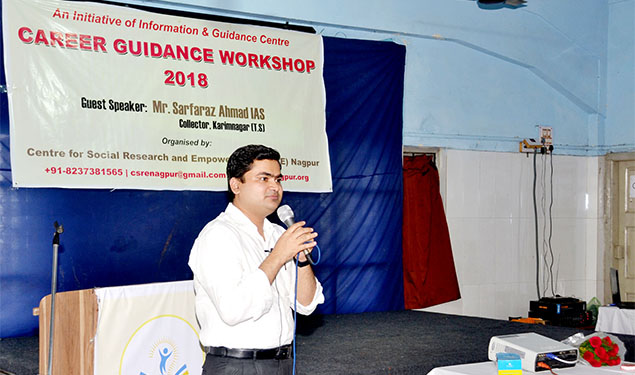
CSRE recently climaxed its third career expo with focus on competitive examinations. Sarfaraz Ahmad IAS Distt Collector of Karimnagar, Telangana and recipient of the 2017 Prime Minister’s Deen Dayal Upadhyay Grameen Kaushal Yojana (DDU-GKY) award for achieving the best performance in employment for unemployed youth, emphasized that aspirants for civil services should shed they myths about civil services.

Ahmed said that the civil series examination is basically aimed at selecting administrators and not subject expert’s. Hence it is focused on assessing the students’ contextual approach to the subject and his analyltical abilities. He also said that most of the successful candidates make the grade not in their first attempt but in later attempts. It was therefore necessary that a candidate should work hard and determinedly with a mission approach to the examination.

A R Shaikh dwelt on various Careers available for students after 12th standard. Mujibuddin Siddiqui explained the importance of timely of goal setting. Afsha Nahid Khan of Andhra Bank outlined the various opportunities in a banking career. Sumit Ramteke who recently cracked the UPSC for Astt Commandants exams focused on the pattern of UPSC examinations and various techniques for qualifying them.

source: http://www.ummid.com / Ummid.com / Home> Education & Career / by Moin Qazi, ummid.com / August 30th, 2018

03 Muslims among 66 cleared by UPSC in Civil Services 2017 Reserve List

UPSC Civil Services 2018 Result: 

The Union Public Service Commission (UPSC) on Thursday released the UPSC Civil Services 2017 Reserve List giving the names and roll numbers of 66 more candidates among them 03 are Muslims.

With this the number of Muslims, who cracked the UPSC Civil Services 2017 exams, went to 54. The UPSC had announced the Civil Services 2017 results on April 27, 2018. A total of 990 candidates, including 51 Muslims, were recommended by the UPSC for various top government posts.

The 03 Muslims who found their place in the UPSC Civil Services 2017 Reserve List are Syed Fraz Haider Nabi, Saqib Yousuf and Mohammed Ali.

“The results of the Civil Services (Main) Examination, 2017 were declared on 27.04.2018 recommending 990 candidates in order of merit for appointment to IAS, IFS, IPS and Central Services Group ‘A’ and Group ‘B’ against 1058 vacancies”, the UPSC said.

“The Commission, in accordance with the Rule 16 (4) & (5) of the Civil Services Examination Rules, was also maintaining a Consolidated Reserve List in order of merit below the last recommended candidate under the respective categories”, it said.

“As sought by the Department of Personnel & Training, the Commission has now recommended 66 candidates which include 48 General, 16 OBC, 01 SC and 01 ST, to fill up the remaining posts based on the Civil Services Examination, 2017”, it said.

The Civil Services (Preliminary) Examination, 2017 was conducted on 18th June, 2017. 9,57,590 candidates applied for this examination, out of which 4,56,625 candidates actually appeared. 13,366 candidates qualified for appearance in the Written (Main) Examination held in October – November, 2017. Of them, 2568 candidates qualified for the Personality Test conducted in February – April.

source: http://www.ummid.com / Ummid.com / Home> Education & Career / by ummid.com news network / September 01st, 2018