An Intermediate second year student B. Padmaja bagged second place with cash prize of ₹25,000 on Sunday for her Telugu essay on the life of Prophet Muhammad.
The competition titled ‘Inspired by Prophet Muhammad’ was an initiative of the Jamaat-e-Islami Hind (JIH) affiliate Student’s Islamic Organisation.
Ms. Padmaja arrived in the city from Jagtiyal specifically to participate in the competition.
Speaking to The Hindu about what inspired to pen the essay, she said, “I read about the virtues of Prophet Muhammad and decided to enter the competition. He saw everybody as equal and took measures to protect women’s rights.” It did not take long for Ms. Padmaja to prepare for the competition. “The JIH gave me a book. I read it for about an hour a day before the competition. Then I spoke to my friends who are Muslims. After this, I wrote the essay,” she said.
And how does she intend to use the prize money? “I will use it to pay for my education,” she said.
With a keen interest on participating in similar competitions centred around different themes, Ms. Padmaja said, “It’s important that people look for good things in different faiths. Only this can help all of us co-exist.”
While Ms. Padmaja was awarded the second prize, the first place went to Syeda Haajer, also an Intermediate second year student. She was awarded a cash prize of ₹50,000. A graduation student, Mariya Gouher, bagged the third place and was awarded ₹15,000.
Around 20,000 students in different parts of the State wrote the essay in Telugu, Urdu and English. The winners were awarded prizes at Khaja Mansion where JIH Telangana and Odisha president Hamed Mohammed Khan spoke of the importance of pluralism and building bridges between different communities.
source: http://www.thehindu.com / The Hindu / Home> News> Cities> Hyderabad / by Syed Mohammed / Hyderabad – December 17th, 2017
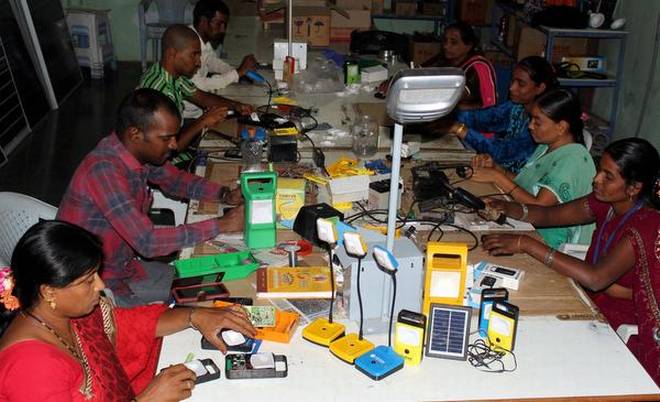
Zubeda Begum (extreme left) and her workers busy assembling solar lights in Sangareddy on Thursday.
Employs 15 divyangans led by Zubeda Begum
Sashikanth, who was affected by polio in childhood, never thought he could earn his living. But life has changed for better since the past three months, thanks to Divyangan Solar Society (DSS).
Led by Zubeda Begum, a differently-abled woman fighting for the rights of divyangans, the DSS has employed Sashikanth along with 14 others who are differently-abled to sell solar-powered lights. It has also given indirect employment to a total of 85 persons. So far, the Society has sold over 20,000 solar lights of different varieties.
Work begins at 9.30 a.m. and workers get ₹3,000 a month as salary. For many, more than the money they get by working here, it’s the respect that they earn by doing so that matters the most. “Everyone considers a differently-abled person a burden both on the family as well as the society. We don’t get jobs easily as the employers see certain limitations in what we can do and refuse to give us a chance to prove them wrong. It’s humiliating. That’s the reason why I began my fight for divyangans and their rights. I can say I have been partly successful in this regard,” Ms. Zubeda told The Hindu.
About two decades ago, she set up a public telephone booth, which took her almost a year, for self-sustenance. Given her grit to live life on her own terms, she was entrusted with the responsibility of running DSS after it was established in 2016. For the past two years, the Society has done business of ₹18 lakh. It produces 10 varieties of solar lights.
The DSS has also established its units in Mahabubnagar, Janagam, Manchiryal and Kamareddy.
source: http://www.thehindu.com / The Hindu / Home> News> Cities> Hyderabad / by R. Avadhani / Sangareddy – March 17th, 2018
21-year-old Afshan Ashiq and team met Union Home Minister Rajnath Singh on Tuesday.
Ashiq, who defends the 24-foot-long and 8-foot-high goal post for her team, said the youth in Kashmir Valley was talented and all that they required was a platform. (Photo: Twitter)
New Delhi:
From the streets of upmarket Srinagar, where she emerged as the face of angry women students throwing stones at security forces, it was a dream walk for football lover Afshan Ashiq through the corridors of North Block where she met Union Home Minister Rajnath Singh on Tuesday.
The 21-year-old Ashiq, captain of Jammu and Kashmir’s all-woman football team which called on the minister, said she was pleasantly surprised to see how he wasted no time in redressing their grievances over the lack of sports-related infrastructure in the state.
“When we told the home minister that Jammu and Kashmir lacks sports infrastructure, he immediately called up the Chief Minister (Mehbooba Mufti) and requested her to do the needful to help us,” Ashiq, who is from Srinagar, said.
Ashiq, who defends the 24-foot-long and 8-foot-high goal post for her team, said the youth in Kashmir Valley was talented and all that they required was a platform.
“The minister also told us that Rs 100 crore had already been sanctioned (under the Prime Minister’s special package) for the state,” the captain of the CM’s-XI team told PTI.
She agree that her life and career had made a remarkable U-turn since the days when her picture was splashed in the national media as a stone pelter. The same hands that threw stones at the forces now ward off many a hard kick as she guards the goalpost.
“I don’t want to look back. My life has changed for ever. I want to be an achiever and do something to make the state and the nation proud,” said Ashiq, whose life story may soon be turned into a biopic now that a renowned Bollywood filmmaker is planning to make a film on her.
During the 30-minute meeting with Singh, the team members conveyed to him that if proper infrastructure — such as training facilities — came up in Jammu and Kashmir, the youth could be motivated to hone their talents and bring laurels to the state, staying away from terrorism and other unlawful activities.
Team manager Tsering Angmo said the sports infrastructure in the border areas was particularly poor and needed urgent attention so that young Kashmiris could be weaned away from illicit acts. “With proper infrastructure in place, the youth can take up sports to nourish their talents and no one can brainwash anyone. No one will join terrorism or indulge in stone pelting,” Angmo, who is from Ladakh, said.
Ashiq and Angmo thanked Singh for listening to them and for speaking to the chief minister about their problems. Later, the home minister tweeted, “Met the young and energetic girls of JK’s first ever Women Football Team. They are highly motivated and driven when it comes to football.”
He also said they were examples for others to follow. “Playing the role of new age ‘Gender Benders’, these girls are setting an example for others to follow. I wish them success and a great future,” he tweeted.
source: http://www.deccanchronicle.com / Deccan Chronicle / Home> Sports> In Other News / PTI / December 06th, 2017
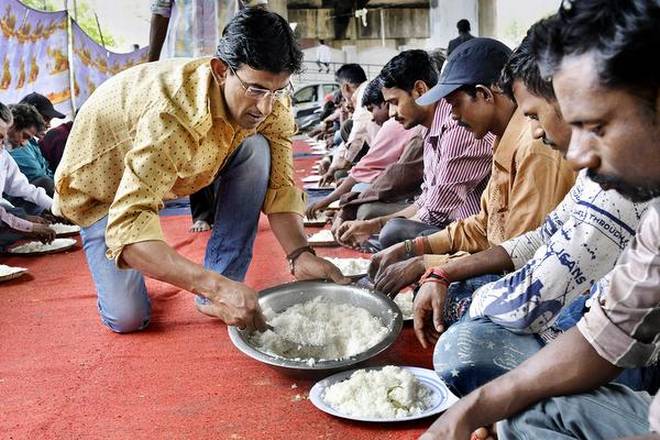
Hunger has no religion: Azhar Maqsoosi serving food to homeless under Dabeerpura flyover in Old City on Saturday.
Azhar Maqsoosi feeds the poor and homeless under Dabeerpura flyover every day
For nearly six years under Dabeerpura flyover, in the eponymous locality of Hyderabad’s Old City, a red carpet is laid out every day for the hungry and homeless. Plates are arranged and food from a makeshift kitchen is brought here. It is then that Azhar Maqsoosi, the man behind the ‘Hunger Has No Religion’ campaign begins to serve food to them as if they were his own.
On Saturday, the campaign entered 2,163rd day. Sitting in his modest one-room shop, the pensive 38 year old recounts the genesis of the campaign. “My father passed away when I was four years old. My mother raised me and my five siblings with much difficulty and there were days when we went hungry. Soon I realised what hunger was and that’s when I decided to fight it,” he says.
While the campaign had its humble beginning in the city, Mr. Maqsoosi says it has now spread to other States such as Karnataka, Uttar Pradesh and now, Assam. His Facebook page keeps his followers informed of the daily developments.
Speaking in the straightforward Dakhni idiom, Mr. Maqsoosi says the campaign was built on goodwill. The support of volunteers and collaboration from other organisations has taken it forward. “The dastarkhwaan at Dabeerpura and at Gandhi Hospital – which has entered the 896th day – is a daily affair. In Assam, it is weekly which is in its 30th week now. We have also partnered with an NGO in Bengaluru which is seeing its 505th day near Siddipura police station,” he says. Dastarkhwaan in Urdu means a table cloth or great spread – apt for Maqsoosi’s generosity. The typical meal is a simple fare of plain rice and Hyderabadi khatti daal. Sometimes, there’s zeera rice and occasionally bottle gourd gets added to the daal, just enough to satiate a person’s hunger. About 60 kilos of rice goes into feeding the hungry souls every day.
Mr. Maqsoosi’s work has attracted even the attention of Bollywood star Salman Khan. Last month, he was invited for an interaction with the actor. “The Being Human Clothing representatives informed me that I have been nominated to meet the actor. When I met Salman Khan, I told him how my wife and I began serving home-cooked food to the homeless in 2012 and today we serve food to around 300 people in Hyderabad alone. He appreciated our work,” he says.
Fund-raising has not been a problem for Mr. Maqsoosi except in the initial days. When people realised his genuine work, kindred spirits flocked to help. “My friends on social media have helped me a lot. They have always come forward for the cause. It’s only about the cause and nothing else. They understand that irrespective of faith, hunger is real. No person should sleep on an empty stomach,” he says.
source: http://www.thehindu.com / The Hindu / Home> News> Cities> Hyderabad / by Syed Mahamood / Hyderabad – March 17th, 2018
Rituals a mix of Hindu-Muslim traditions, says committee
The experts’ committee, constituted by the State government to look at the nature of rituals and worship at the controversial Bababudangiri shrine in Chikkamagaluru, has made it clear that Shah Khadri is the administrator of ‘Sree Dattatreya Bababudan Swamy Dargah’ and also the performer of the rituals.
The committee, headed by Justice Nagamohan Das, said the issue of management of the shrine was part of the “concluded findings” from the historical records.
Shah Khadri is Sajjada Nasheen (hereditary administrator) of the shrine. Syed Ghouse Mohiyuddin Shah Khadri holds the post at present.
The three-member committee submitted its report to the State government and the same has been accepted by the State Cabinet. The government has said that the report would be submitted to the Supreme Court, as the hearing of contempt petition against the government is coming up on April 6. Shah Khadri had moved the SC alleging that the government had been delaying to settle the issue, despite clear instructions from the court.
Ritual status
The committee, after verifying historical records and previous legal proceedings held since 1837, listed seven findings on the dispute. They include the name of the place (which is Sri Guru Dattatreya Bababudan Swamy Dargah) and location of the shrine on the hills. Both Hindus and Muslims are the devotees of the institution, it says. Regarding the rituals at the institute, the report states that the practice of reading Fateha, offering food items, placing flowers on the tomb and paduka, applying sandalwood paste, burning of incense, lighting of Nandadeepa, raising flags, beating of nagara (drums) and offering holy water to the devotees are performed by Shah Khadri. The institution is declared not a wakf property, but one under the jurisdiction of the Muzrai Department.
With regard to allegations against the administrator, the committee states that whenever Sajjada Nasheen committed acts of mismanagement, misappropriation etc., the Muzrai Department had taken action in accordance with the law.
Based on these findings, the committee rejected the Endowment Commissioner’s recommendations filed before the Supreme Court on March 10, 2010. The commissioner had recommended the appointment of a Hindu priest to offer prayers in accordance with Agama. Citing the Places of Worship (Special Provisions) Act, 1991, the committee opined that the Endowment Commissioner’s report was liable to be rejected. The Act prohibits a change in the religious character of any such place after August 15, 1947.
The Endowment Commissioner’s report had cited historian Suryanath Kamath’s article titled ‘KarnatakaDattatreya Aradhane’ to recommend the appointment of a Hindu priest. The experts’ committee stated that Mr. Kamath’s article was “not based on any authentic evidence.”
source: http://www.thehindu.com / The Hindu / Home> News> States> Karnataka / by Sathish G.T. / Chikkamagaluru, March 15th, 2018
Dr Iffat Faridi, a social activist is trying to urge the government to include Kannada Language in Open School System as the poor and Kannada Medium School Children are facing difficulties in continuing their study in Open School System.
Educationist Iffat Faridi wants NIOS to alter its policy so that vulnerable students can go beyond Class 9 — the last class where they are given questions in Kannada
For students like Maya, a Std 4 dropout from a Kannada medium school, the National Institute of Open Schooling (NIOS) would seem like a Godsend.
Far removed from the rigid structure of conventional schools that require compulsory attendance, the NIOS allows for students to have access to education, with many conveniences, distance being one of them.
When Maya, who could read, write and speak fluently in Kannada, heard about the NIOS, she thought it was a dream come true. She could continue her education despite the gap and her long-cherished dream of getting a school certificate would be fulfilled. However when she decided to enroll herself in NIOS for the Std 10 exam, she realised that Kannada was not included as the medium of instruction for Std 10, although up until Std 10, it is. At the Std 10 level, students like Maya would have to choose either Hindi or English as a medium of instruction, for study material and for questions papers.
However, she was told that she could answer the question paper in Kannada since she was not fluent in Hindi or English.
The most crucial exam of a student’s life had become a battle of languages.
Fortunately, students like Maya, have in Iffat Faridi, an educationist and a resident of Bengaluru, a saviour who understands the challenges of studying in one language and being tested in quite another. And Faridi is leading the fight for giving girls like Maya the advantage of doing their Std 10 exams in a language they have fluency in.
Besides taking education to the people from underprivileged sections of society, Faridi is championing the cause to have Kannada as one of the languages of instruction in the NIOS system for Std 10.
Speaking to BM, Faridi said, “A blessing in disguise, the National Institute of Open School plays a pivotal role in the distance education system of India. It is a ray of hope for children who are not fortunate enough to join regular schools or who could not continue their schooling. Despite its obvious significant contribution to the Indian education system, NIOS has a serious issue in its system which needs to be highlighted and must be resolved,” she added.
Not just Maya…
She recounts the story of Renuka, a child of a migrant labourers from Gulbarga district, who is facing similar issues. Renuka started her schooling almost at the age of 10, after going through bridge courses based on modules developed by the Azim Premji Foundation in Kannada, Environmental studies and Math. She was admitted to a Kannada medium school, and initially enrolled in Std 1 as per rules. Later, based on performance tests conducted by the school, she was promoted to Std IV. At the moment, the 14-year-old wants to apply for Std 10 exams through NIOS and she faces the same issues as Maya. She has good command over Kannada but will have to master Hindi or English to learn the study material.
Faridi’s fight
Says Faridi, “Lack of study material in Kannada is a huge setback and injustice to the aspirations of those children who have done schooling purely in Kannada medium. Kids referred to NIOS belong to a class where parents are daily wagers. They earn very little and that too after working very hard from morning till evening. These children have taken the initiative for further education, on their own. Having travelled a fair distance on the road to being fully literate, they are facing setbacks in their path due to non-availability of study material in Kannada. They need full support from NIOS to pursue their dream of completing their education and get on a career path.”
NIOS reacts
When BM contacted Chandrashekar S, director of NIOS, Bengaluru branch, he said, “There is Kannada up to 10th. The 10th class study materials and examinations will be bi-lingual and the students can answer in Kannada. There is no problem in that. The next set of Kannada books are getting ready. Once it is released, students will be getting it.”
KDA slams the system
Reacting to the limitations for Kannada medium students in NIOS, SG Siddaramaiah, Chairman, Kannada Development Authority told BM, “What kind of unscientific methods are these? How can someone who knows only Kannada be made to read in English or Hindi and again write answers in Kannada? How is it even possible? Who is going to punish these type of people who deny access to education to Kannada medium students? This is coming to light now. What about all these years? Thousands of children have been denied education only because of this option.’’
While Faridi continues her fight with NIOS, she’s preparing her students to brace themselves for the language challenge ahead. She has already brought Hindi books from Delhi to prepare her students to learn from study materials in Hindi and English at the Std 10 level.
Why Open School?
Students who fail to qualify for regular school or are unable to pass a class despite multiple attempts have the option of completing studies through Open School. Also, mature students who wish to return to school after a break in studies or those children who have to shoulder the family’s burden pursue studies through Open School.
Are questions set only in English or Hindi?
No. Seven other options are available apart from English and Hindi. These are Urdu, Marathi, Telugu, Gujarati, Malayalam, Odia and Tamil. Note that all South Indian languages are available except for Kannada.
Can they learn and answer in Kannada?
Yes, but only till Class 9. In Class 10, the questions are set only in Hindi or English which is highly unfair for students already struggling with the system.
How many students benefit from Open School?
Last year, 1,64,192 students completed Secondary (equivalent to Class 10) through Open School. Around 500 students study in Kannada each year.
source: http://www.bangaloremirror.indiatimes.com / Bangalore Mirror / Home> Bangalore >Cover Story / by Kumaran P, Bangalore Mirror Bureau / March 16th, 2018
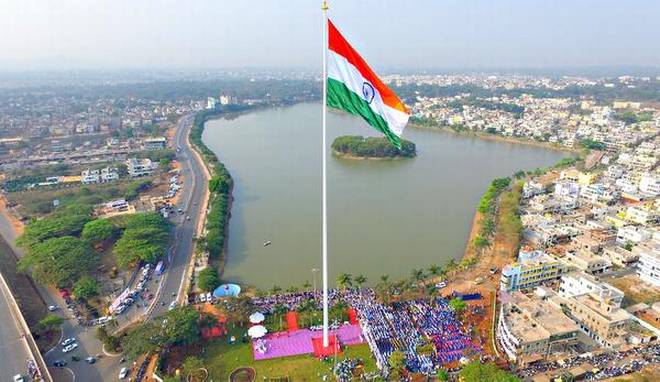
Proud moment: The 110 m tall monumental flag being inaugurated by district in-charge Ramesh Jarkiholi in Belagavi on Monday.
The 110 m tall flag post at Kote Kere is near the historic Belagavi fort
It was a joyous morning in Belagavi on Monday. Schoolchildren, NGO members, leaders and others gathered at the Kote Kere lake front to witness a unique celebration: the unfurling of what is claimed to be the country’s tallest national flag.
The 9,600 sq.ft flag on a 110 m flag pole was unfurled by Ramesh Jarkiholi, District in-charge Minister.
Religious leaders of Hindu, Muslim, Christian and Sikh institutions were present. MLA FirozSait, who has been pushing for the project, was present along with other district officials.
Mr. Jarkiholi said the flag was a testimony to the culture of harmony and togetherness of Belagavi. “BJP is not the sole custodian of nationalism. We are all proud Indians. We respect the principles of unity and harmony enshrined in the Constitution. India is a country of many faiths and all are equal here,” he said.
Mr. Sait observed that various religious and social and cultural groups had flags of different colours, but the national flag symbolised the cultural unity of all. He described this as a historic day and said the people of Belagavi had one more reason to be proud of their city.
Deputy Commissioner S. Ziyaullah, Police Commissioner D.C. Rajappa, ZP CEO R. Ramachandran, City Corporation Commissioner Shashidhar Kurer, Maratha Light Infantry regimental centre officers, and others were present.
The 110 m tall flag post at Kote Kere is near the historic Belagavi fort in the city. It is taller than the post in Pune (107 m) and the one at the Indo-Pak border at Attari (105 m).
“The monumental flag will be flown at all times, and will be well-lit at night. It should be seen by residents of Belagavi from afar and remain visible at all times,” Mr. Sait said.
The flag is made of weatherproof Denier polyester fabric. Two shorter poles with flood lights have been erected around the flag.
Permission granted
Following a judgment of the High Court of Bilaspur in 2010, the Union Home Ministry allows the flying of national flags beyond sunset. However, these flags are considered monumental flags and special permissions are issued on a case by case basis. The Union government has issued a permission for the Belagavi monumental flag.
The Belagavi City Corporation has completed the work under the Chief Minister’s special grant. The flag post is 2 m in diameter at the base and 0.6 m at the top. It has a three horsepower motor to raise the flag to the top.
New park
A park will come up in 1.5 acres around the flag. A committee comprising citizens, district administration, revenue, police and cantonment board officials will be formed to manage the park.
Earlier, the plan was to erect the flag post on an island in the centre of the lake. However, the soil there proved unstable for such a tall structure. Hence, it was shifted to the bank, an officer said.
Five flags
Officers are keeping five flags on standby. “Khadi fabric could not be used for the flag as looms cannot produce a flag of that size and the flag code does not allow stitching of small pieces,” a city corporation engineer working on the project, told The Hindu.
Officials have got Civil Aviation Ministry’s permission to fly the flag that within 25 km of the Sambra airport. A red light is affixed on top of the post to indicate its height to pilots.
source: http://www.thehindu.com / The Hindu / Home> News> States> Karnataka / by Special Correspondent / March 13th, 2018
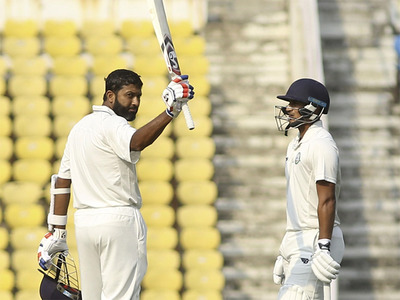
Former India opener and Ranji Trophy record-holder on Thursday ticked off two more milestones in his illustrious career: that of crossing 18,000 runs in first-class cricket and achieving the highest individual score in the Irani Cup.
On day two of the 2018 Irani Cup between his adopted team of Vidarbha and Rest of India(RoI), the 40-year-old, in his 242nd first-class match, went past the 18,000 mark and then surpassed Murali Vijay’s 266 with an unbeaten 285 to hold the highest score in the tournament. At stumps in Nagpur, hosts Vidarbha were sitting pretty on 598/3 against RoI, with Jaffer 285 not out from 425 balls faced and with 34 fours and a six. The total is Vidarbha’s highest ever in first-class cricket.
This was Jaffer’s eighth score of 200 or more, and first since 2009. Overall, the former India batsman has 53 first-class centuries.
The Irani Cup pits the current Ranji Trophy champions against RoI, and Jaffer was a key figure in Vidarbha winning the title with 595 runs in nine matches at an average of 54.09.
For Mumbai, his home city, Jaffer scored 10,585 runs from 130 matches before he shifted to Vidarbha as a professional a few seasons ago. In the Ranji Trophy, Jaffer is the all-time leading scorer with 10,665 runs and also the owner of the most centuries (36).
For India, Jaffer played 31 Tests form which he scored 1944 runs at 34.10 with five centuries – of which two were doubles.
source: http://www.timesofindia.indiatimes.com / The Times of India / Home> News> Sports News> Cricket News / TimesofIndia.com / March 15th, 2018
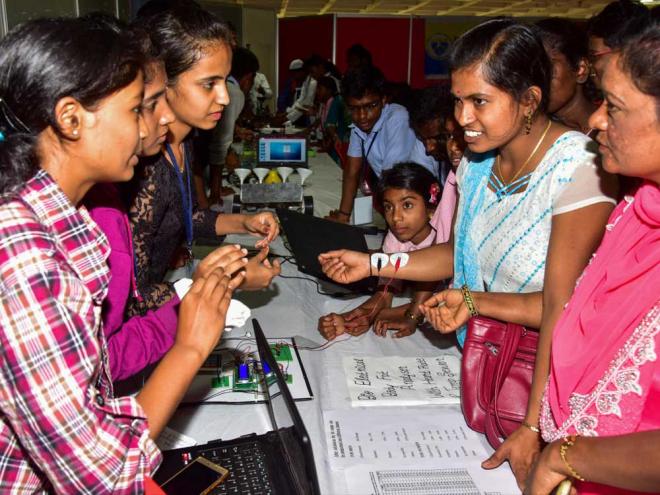
Ramanagara GWPTR College student Arpita B(Ext. Left) and her friends displayed their Invention Bio- Electrical Body Fat Analyser, at the three day ‘Engineering Fair’, at Visvesvaraya Industrial and Technological Museum, in Bengaluru on Thursday. DH photo
Arpita B enthusiastically clamps the sensors to the wrist. With deft plucking of the keys, she feeds her subject’s age, gender and body weight.
Then, five pairs of eyes excitedly watch the display of the gadget as it flashes some numbers. “Here’s your body fat,” 18-year-old Arpita said with a smile.
Know your body fat
The group of five girls from GWPTR College in Ramanagaram, which Arpita is part of, are proud of their invention – bio-electrical body fat analyser.
The model was one of several exhibits at the three-day engineering fair at the Visvesvaraya Industrial and Technological Museum, which showed potential for future mass production.
The girls made this device in two months at Rs 15,500. “We’ve done successful tests on people and several doctors have verified the readings,” Arpita said.
Organised by the ministry of culture for industrial training students between the ages of 18 and 23, the fair displayed several simple innovations that had practical applicability.
Bomb-detection robot
Mohammed Nuhid’s bomb-detection robot is one such invention. The fourth-semester industrial training student from the Government ITI College came up with the solution as he was moved by the scenes of soldiers being ripped apart by IEDs and landmines.
The robot can detect metal, batteries and explosive substances from a distance, Nuhid said. The battery-operated device can crawl several miles, saving the user from harm. Nuhid put the device together in 10 days, spending Rs 4,000.
Wireless CNC tractor
The wireless CNC multi-purpose tractor was one more incredible piece of innovation that five boys from the MEI Polytechnic made for cash-strapped farmers.
“This tractor can perform multiple tasks like removing weeds, tilling land, and sowing and levelling the ground to prevent birds from eating the seeds,” said Dhanush S, who is part of the team that came up with the tractor.
“We designed this exhibit after learning about the troubles farmers go through to hire field hands. This will significantly cut down their labour cost,” Dhanush added.
The team tested the tractor, which they designed in a month and made with just Rs 17,500, at a farm in Hoskote.
Automated sericulture gadget
Three innovators proudly demonstrated the Sericulture and Automation Centre, which would allow farmers to double their silk produce while halving their workload. Works are automatically fed to the centre, where temperature and moisture are moderated. The farmer can monitor the progress on CCTVs or mobile phones.
Hemanth Kumar H A, co-inventor of the technology with fellow students of APS Polytechnic, said the model can also work well for poultry, livestock and pisciculture.
In all, the fair displayed 85 different models ranging from automated money transfers with debit/credit cards, accident safety chambers in aircraft (to ensure passengers do not die in crashes), laser-based thermocol cutters, mobile phone-based home-monitoring devices to automated helmet connector with motorbikes.
A special platform had been given to students from the Association of People with Disability.
source: http://www.deccanherald.com / Deccan Herald / Home> City / DH News Service / Bengaluru – March 16th, 2018
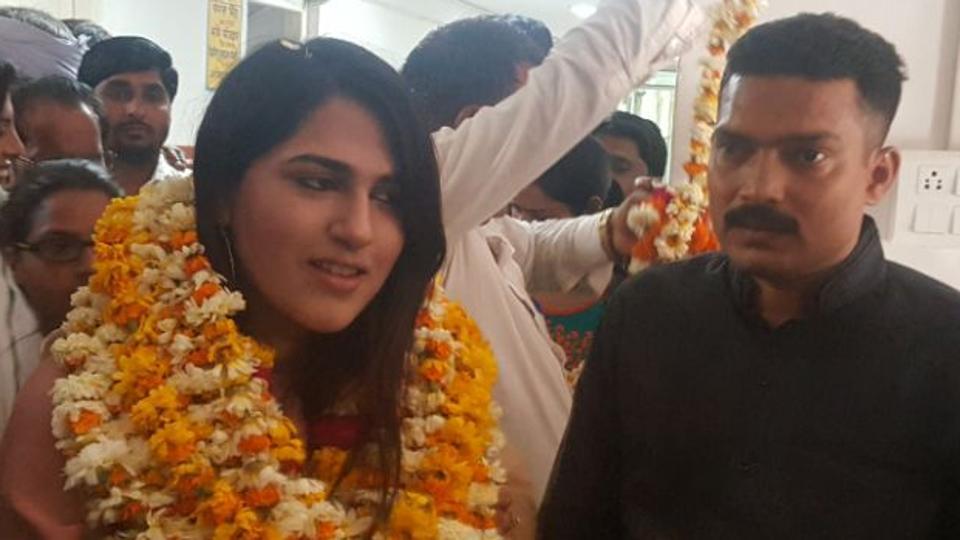
MBBS student Shahnaaz Khan after taking oath as a sarpanch in Bharatpur on Monday.(HT Photo)
The MBBS student will start her internship at Civil Hospital in Gurgaon shortly and take an entrance examination for postgraduate course in medicine later, but is confident of juggling studies and grass-roots level politics
The day the by-election for sarpanch of Garhazan village in Bharatpur was held, poll candidate Shahnaaz Khan was busy taking her MBBS fourth year practical examinations.
A few hours after polling on March 5, the bypoll results came in. Villagers had elected the 24-year-old medical student of Teerthanker Mahaveer Medical College and Research Center in Moradabad, Uttar Pradesh, as their sarpanch.
Shahnaaz is the youngest sarpanch of her village, which is in Mewat region that includes parts of Haryana and Rajasthan. She is also the most educated woman in Garhazan’s history and gets a chance to take forward her paternal grandfather’s political legacy.
“People in Mewat area don’t send their daughters to schools. I will present before them my own example to show what education can do for a woman,” Shahnaaz said after taking oath as sarpanch on Monday.
She will start her internship at Civil Hospital in Gurgaon shortly and take an entrance examination for postgraduate course in medicine later, but is confident of juggling studies and grass-roots level politics.
Shahnaaz’s was elected sarpanch after her grandfather Hanif Khan’s election in 2015 was declared null and void by a court in October last year. The court ruled Hanif Khan had forged educational qualification documents.
The Rajasthan government has made Class 10 mandatory qualification for sarpanch candidates. Hanif Khan had been sarpanch of Garhazan for 55 years.
A young and educated woman sarpanch is a change in Mewat region, which is considered among the most backward areas of Rajasthan. Mewat comprises portions of Alwar and Bharatpur districts inhabited by the Meo Muslims.
“My family is committed towards serving the people. Shahnaaz joined politics to fulfil her grandfather’s dreams. She will serve the Meo community because it is backward.”
The literacy rate in Bharatpur district is 70.1%, which is higher than the state average 66.1%, but less than the national average 74.04%. The difference in level of education of boys and girls in the district is 29.9%.
Shahnaaz said she was equipped to spread awareness about sanitation to prevent diseases in the area. “For instance, people here die of tuberculosis. The disease can be cured with a six-month course but people are unaware.”
Shahnaaz’s parents are also in politics. Her mother Zahida Khan is a former MLA from Kaman constituency in the district. Her father, Jalees Khan, was Kaman pradhan (head of block level panchayat body).
Zahida Khan said, “My family is committed towards serving the people. Shahnaaz joined politics to fulfil her grandfather’s dreams. She will serve the Meo community because it is backward.”
Shahnaaz studied in The Shri Ram School, Aravali, Gurgaon, till Class 10 and did her Class 12 from Delhi Public School, Maruti Kunj.
source: http://www.hindustantimes.com / Hindustan Times / Home> Cities> Jaipur / by Suresh Foujdar, Hindustan Times, Bharatpur / March 13th, 2018