All posts by mpositiveone@gmail.com

Taking a leap of faith

Bengaluru, KARNATAKA :
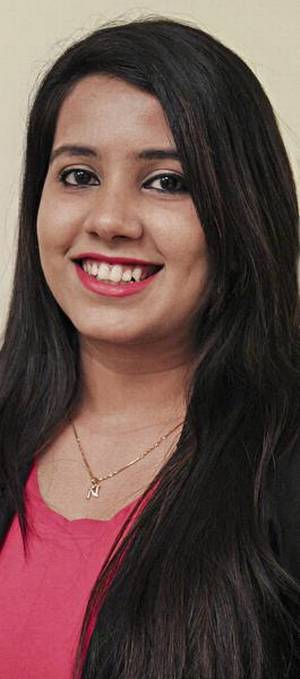
NishaatMPOs06jun2017


Nishaat Ahamed on quitting her media job to take up bridal and fashion photography

She started studying journalism but all it took was a credit course in college to get her interested in photography.

Already Nishaat Ahamed, proprietor of Glaamour Studio (www.facebook.com/glaamourstudio.in), is carving a niche for herself as a full-time bridal make-up artist and wedding photographer.

Choosing photography and consequently make-up seemed like a seamless career option for the young woman. Once done with college, Nishaat worked at a media firm for about a year. “I soon realised I wasn’t meant for a nine-to-five desk job so I quit and was free for about seven months. During that period, I happened to meet a photographer who was already into wedding and fashion photography. I was intrigued by his work and was inspired to take up photography professionally. Once I joined photography school, I realised the importance of make-up in a fashion shoot. Once I finished my photography course, I enrolled for a professional make-up course and then began taking up work in both fields together.”

Currently, Nishaat offers make-up services for all occasions, takes classes in personal and professional make-up, shoots weddings, takes up couple shoot assignments such as pre wedding/post wedding shoots, portfolio and fashion shoots for models, maternity pictures….

The youngster says, “Honestly, if I was doing a regular desk job, I’d probably have more free time than I do now. But at the end of the day, when the client gives me good feedback, it makes up for everything.”

Nishaat enjoys being her own boss. “I always tell everyone, including my husband, to quit their job and do something on their own. It is way more rewarding, at least mentally, and at some point financially too. It is just a matter of taking that leap of faith.”

Nishaat has had her fair share of challenges. “Every business has its ups and downs. But you learn from your mistakes and try to get better. After so many rounds of trial and error, I seem to have figured things out a bit. The world of make-up and photography is massive and I’ve only just set foot into it.”

Looking ahead, the young entrepreneur says: “I want to learn more and get more certifications from international artists. I want to get certified by Aliya Baig, one of the best make-up artists in India. And I’d also want to get certified by Tamanna Roashan from California. Then I will open my own photography and make-up school.”

I always tell everyone, including my husband, to quit their job and do something on their own. It is way more rewarding, at least mentally, and at some point financially too.

source: http://www.thehindu.com / The Hindu / Home> Features> MetroPlus / by Neeti Sarkar / June 06th, 2017
On a short note

Ongole,  ANDHRA PRADESH  /  Hyderabad, TELANGANA :

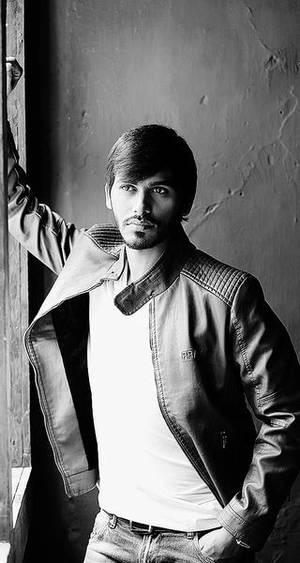
HaleemKhanMPOs06jun2017

Haleem Khan stars in a short film based on dance

Actor-Kuchipudi dancer Haleem Khan will appear in a 30-minute short film titled Dressed to dance that is based on Kuchipudi.

The film relates to Haleem Khan’s issues related to dance, including the female impersonation aspect and what he learned over a period of time through art forms and his tips to younger generation dancers.

Directed by Sravan Jadala, the film has been produced by Srini Reddy and Deccan Kuchipudi Art Academy.

“Kuchipudi is not often associated with mainstream films and short films since a very long time.

We (director Sravan Jadala and I) felt there is a need to expose dance related content through short films. Dressed to dance is a small attempt to create content around our culture,” states Haleem Khan.

Praveen Bangari and Sameer Khan have done the cinematography for the same.

source: http://www.thehindu.com / The Hindu / Home> Features> MetroPlus / June 05th, 2017

Temper that enthusiasm

Hyderabad, TELANGANA :

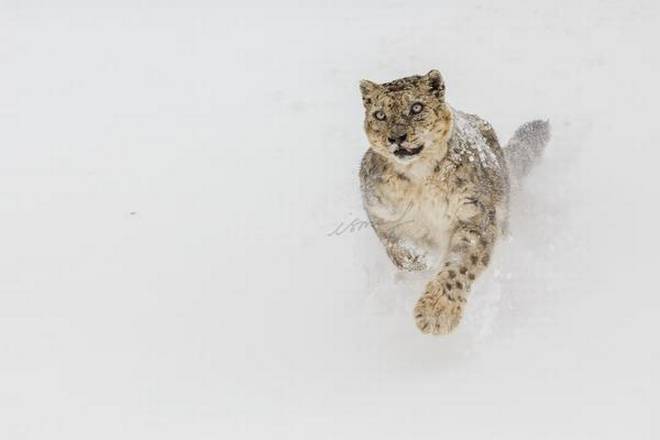
A female snow leopard photographed by Ismail Shariff

Hyderabad-based wildlife photographer Ismail Shariff on how the lens-totting tribe can exercise restraint in wilderness

The photograph of a snow leopard occupies a pride of place in Ismail Shariff’s edgily-designed studio. The Hyderabad-based wildlife photographer says he was blessed, not plain lucky, to have been able to capture the leopard from barely 15 feet distance in Spiti, Himachal Pradesh, this year.

Shariff has been a part of three snow leopard expeditions. Earlier, he had to be content with images where the leopard was a speck in the frame. “Animals in regions like Spiti or Leh are shy. They sense human presence a mile away,” he says.

A cartload of patience helps photographers get the right shot. They wait for minutes or hours, anticipating the animal’s next move. Shariff’s experience was no different, “From where we were staying, we could spot the leopard sleeping and ran out with our cameras. The villagers were also keen to have a glimpse. We felt that when the leopard wakes up, it will walk away from the noise and make its way to a clearing. We positioned ourselves such that we can get images but not be in its line of sight.”

He’s elated to have captured these images, but he mulls over and says, “If the snow leopards could come this close to humans, either they were short of food or they’ve gotten used to human presence.”

Ismail02MPOs06jun2017

Shariff has been an avid wildlife photographer since 2008 and has observed the rise in numbers in his tribe. “There were fewer people exploring wildlife photography back then since not everyone could afford the flamboyant lenses,” he says.

In July, Shariff plans to visit Ladakh to photograph the Pallas’ cat (named after German naturalist Pyotr Simon Pallas). Besides these niche expeditions, he’s also frequented Tadoba National Park (92 times), Kabini and Jim Corbett National Park that are popular among tourists.

The observations while on these trips make him wonder if aspiring photographers compromise on the ethics of wildlife photography for instant gratification on social media.

It isn’t a case of sour grapes or a cry for exclusivity, Shariff clarifies, “There isn’t much money to be made out of photography in India. A few established photographers work with forest departments and voluntary organisations. Their work helps in documentation and conservation activities. For most others, it’s a hobby. There’s nothing wrong with more people exploring this line. The trouble begins when ego kicks in and you want to bend rules.”

There have been instances of photographers getting too close for the comfort of animals and birds — from attempting to veer off course during safaris to getting closer to bird nests. This isn’t limited to India, says Shariff, sharing instances where he spotted photographers getting off a safari vehicle in Yellowstone National Park in the US or crowding to take shots of a Broadbill’s nest in Malaysia.

Dos and don’ts

* The enthusiasm for a great shot needs to be tempered with restraint and respect for wildlife habitats. While on safaris in places like Tadoba, Kabini or Corbett, drive slowly, don’t talk loudly and never get off the vehicle. By irritating or threatening the animal, you also put yourself at danger. “I’ve seen people trying to bribe guides and drivers to take a different route or allow them to get off the vehicle, setting a wrong precedence to others,” Shariff points out.

* Don’t underestimate nature. Respect weather conditions. Shariff recalls being blown five feet high when a gust of wind changed director in Chopta, Uttarakhand.

* Steer clear of mothers with cubs. “Mothers, be it a tigress, lioness, deer, peafowl or a bear, will do anything to safeguard its offspring.”

* Don’t try to film animals in nocturnal situations unless permitted by forest department. Animal movement is pronounced and unpredictable at night. There have been cases of road-kills where vehicles have knocked down animals.

* If one is truly interested in turning their passion for wildlife photography into something meaningful, collaborate with forest departments or organisations that document wildlife and living conditions of people living close to these zones. A niche category that’s emerging, called conservation photography, helps initiate a dialogue.

Factoid: Collaborate for conservation

Dharmendra Khandal is a conservation biologist, researcher, botanist and photographer associated with Tiger Watch in Ranthambore. His efforts have led to capture of several poachers in Rajasthan. Khandal also helped identify several species of spiders.

source: http://www.thehindu.com / The Hindu / Home> LifeStyle> World Environment Day / by Sangeetha Devi Dundoo / June 03rd, 2017

MIT assistant professor completes Okha-Dibrugarh solo ride ahead of schedule

Manipal , KARNATAKA :

S S S Shameem
S S S Shameem

MANIPAL:

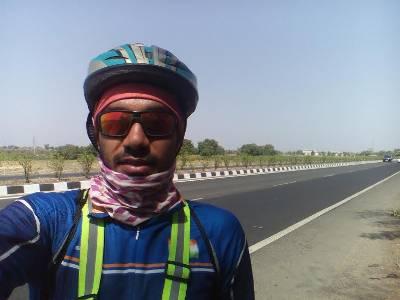
There was no heart break the second time round for intrepid cyclist  S S S Shameem, assistant professor  of MIT, Manipal University. Having fallen agonisingly short of attempted solo cycling journey from Kanyakumari to Kashmir, a 3,500-kms ride in 23-days in 2016; Shameem successfully completed Okha (Gujarat) to Dibrugarh (Assam) solo cycling expedition covering 3,400-kms, a journey that started on May 15 and ended on May 29.

This solo cycling expedition which he decided to complete in just 20 days was not for any record, but to spread message of unity and humanity in a greener and healthier way. Shameem’s endurance and past experience in such long distance cycling events saw him cover the distance in just 15-days. Shameem said, “I just managed those extra miles each day, helping me shave off a good five-days from my earlier journey schedule of 20-days.”

If the Okha to Dibrugarh journey saw Shameem cover 3,400-kms, for his journey from Manipal to Okha he travelled a hectic 2000+ km which saw him undertake a roller-coaster journey of 50 hours. Starting with Gujarat, and followed by Madhya Pradesh, Uttar Pradesh, Bihar, West Bengal , and Assam; each state had its own surprising flavour. During this journey, he passed through six states and UTs, 35 districts, and many cities, NHs, check-posts.

Risk factor of cycling in particular sensitive parts of UP and Bihar was a matter of worry for him, though it turned out all safe and sound without any issues. “Constant support of parents, wishes of friends paid off, and I could finish the feat without any major challenges,” he said. Factoring the summer heat and aiming to cover sufficient distance, he spent most of the day resting while covering major part of the route during early morning, late afternoon, evening, and night hours.

The distance covered daily was around 200km to 300 km. With heat, causing irritation; modified schedules; and focus on extra mileages, Shameem could not enjoy beauty of the nature around; nor could he stop at places to interact with people as he wanted. Throughout the journey; he was getting offers for help and support from many. Since such offers would consume time, forcing him to travel additional distance to reach to them; Shameem avoided it all.

source: http://www.timesofindia.indiatimes.com / The Times of India / News> City News> Mangalore News / by Jaideep Shenoy, TNN / May 31st, 2017

Sarah Cohen and kindred spirits

Mattancherry, KERALA :

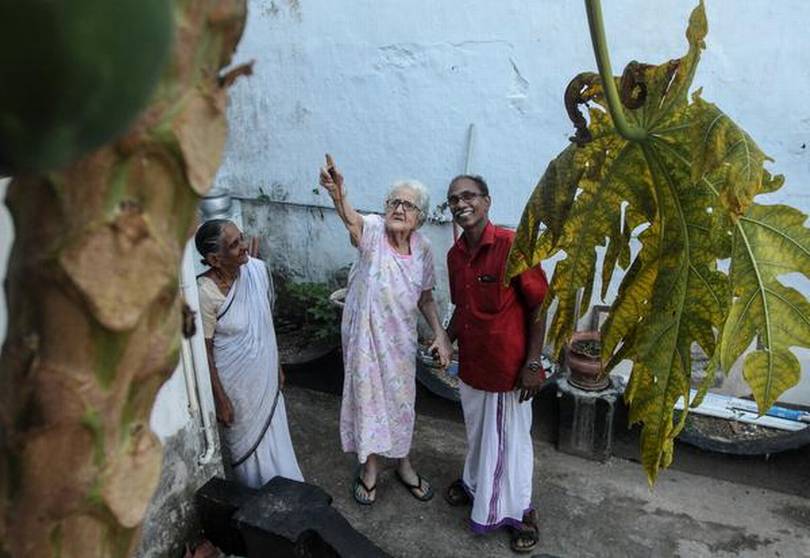
House of lore: Sara Cohen with Thaha Ibrahim in her backyard. PHOTO: THULASI KAKKAT
House of lore: Sara Cohen with Thaha Ibrahim in her backyard.
PHOTO: THULASI KAKKAT

A nonagenarian Jewish woman in Mattancherry in west Kochi finds a pillar of support in a Muslim couple and a Christian maid.

Thaha Ibrahim is as keen on maintaining the sanctity of shabbat as he is of his Friday namaz. The devout Muslim spends almost all day taking care of a nonagenarian Jewish woman, Sarah Cohen, whom he calls aunt.

A strong bond of love binds them together in the sunset years of the Jewish community in Mattancherry in west Kochi, where Jews lived in the thousands in the past, contributing substantially to the city’s growth. The strength of the community waned over the years, with a large number of them migrating to Israel. A few like the Cohens stayed put, determined to live in the land of their birth that gave them the identity of Cochin Jews.

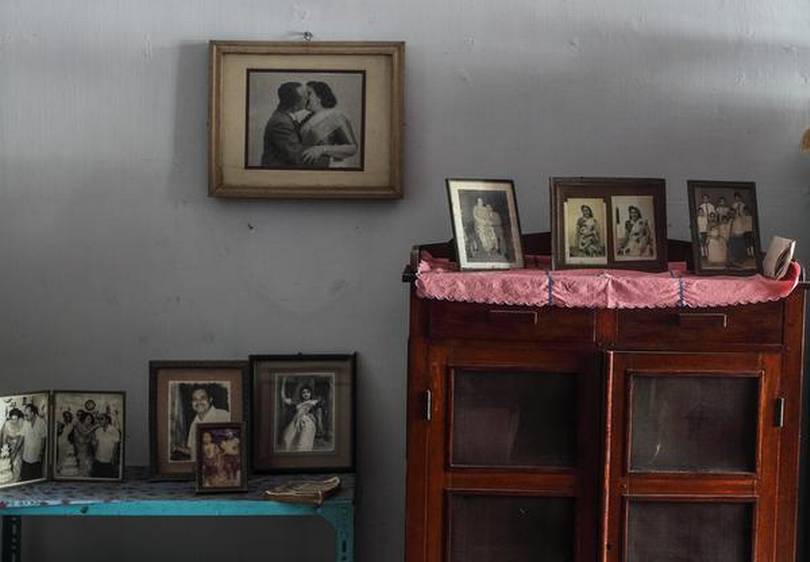
Sepia-tinted memories: A corner of the home dedicated to the past. PHOTO: THULASI KAKKAT
Sepia-tinted memories: A corner of the home dedicated to the past.
PHOTO: THULASI KAKKAT


Mr. Ibrahim found a place in the hearts of the Cohens and the Jewish community as a whole. The middle-school dropout used to earn a few rupees selling souvenir postcards to tourists arriving by ship at the nearby port a quarter century ago. One day, a ship docked and Mr. Ibrahim discovered he had no cards to sell as the place where he had stacked them had been locked by its owner. An inconsolable Mr. Ibrahim found a mentor in Ms. Cohen’s husband, Jacob, who allowed him to store the cards at his place. It soon developed into a familial tie, which got Mr. Ibrahim to take care of Ms. Cohen after Jacob’s death some 15 years ago.

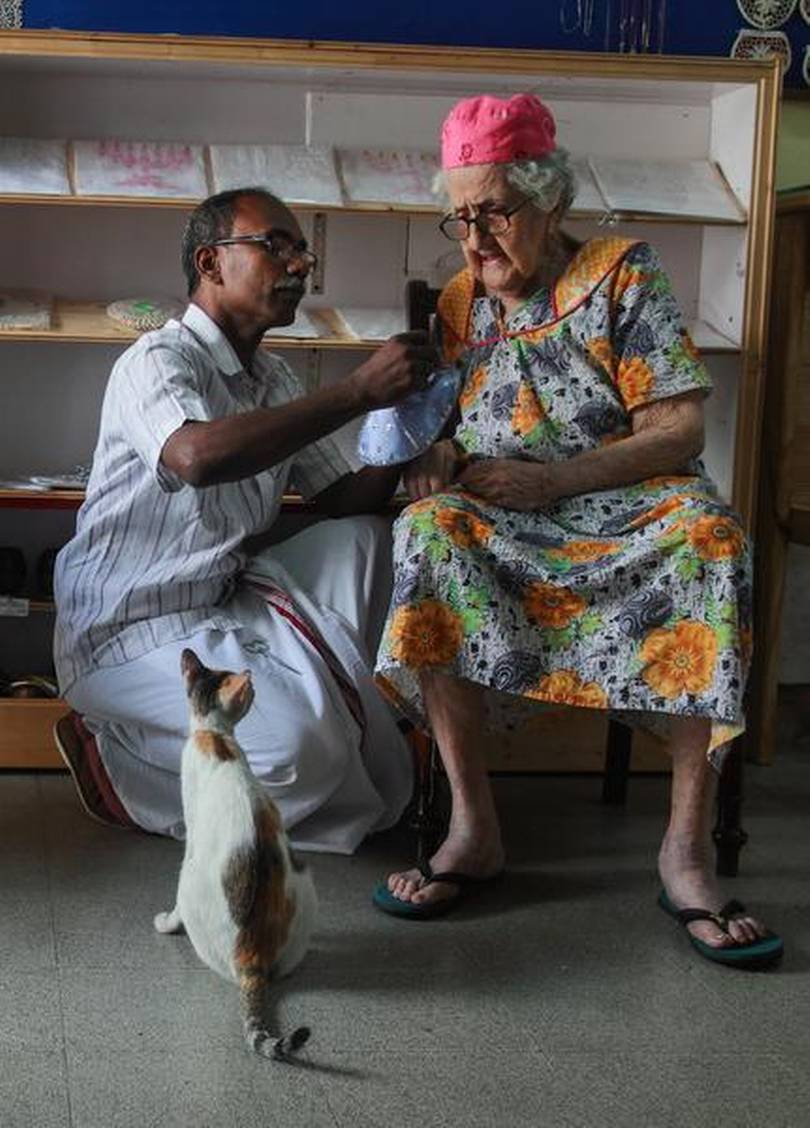
A job shared: Thaha helps Sarah embroider a Kippa, the Jewish skullcap. PHOTO: THULASI KAKKAT
A job shared: Thaha helps Sarah embroider a Kippa, the Jewish skullcap.
PHOTO: THULASI KAKKAT

Mr. Ibrahim and his wife have been a pillar of support for Ms. Cohen, who runs an embroidery shop at the mouth of the narrow alley leading up to Pardesi Synagogue. They take care of the household and run errands for her.

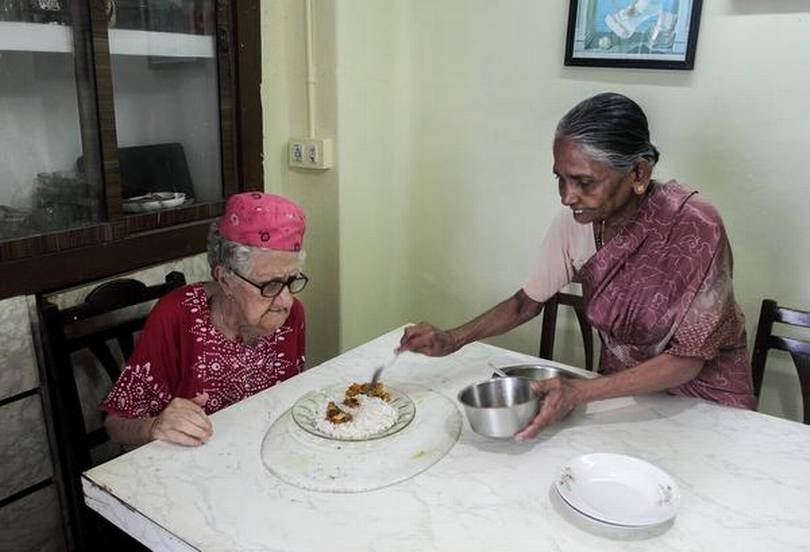
Simple repast: Seli serving lunch to Sarah. PHOTO: THULASI KAKKAT
Simple repast: Seli serving lunch to Sarah.
PHOTO: THULASI KAKKAT

They are like children to the childless matriarch, who is as much a Jew as she is part of the multicultural mosaic of west Kochi. Seli, Ms. Cohen’s Christian maid, who has been by her side for over a decade, adds to the mix.

Text and images by Thulasi Kakkat

source: http://www.thehindu.com / The Hindu / Home> News> States> Kerala / by Thulasi Kakkat / May 28th, 2017

Winning laurels: For the first time ever, 50 Muslim candidates clear UPSC civil services exam

Lucknow,  UTTAR PRADESH :

50 muslim candidates made the cut in the UPSC civil services exam 2016 and 10 figured in the top 100 rank

Lucknow:

The Union Public Service Commission (UPSC) results on Wednesday brought cheers to 1,099 successful candidates. Among those who made the cut were 50 Muslims – the highest number ever to have cleared the exam.

Ten Muslims figured in the top 100 rank and six Muslim women also came out with flying colours in the exams. Jammu and Kashmir led from the front with Bilal Mohiud Din Bhat bagging the 10th rank and 13 others cracking the exam.

“It’s heartening. The credit goes to several non-profit and social organisations which have been relentlessly working for literacy, creating awareness and highlighting the importance of education in the community,” says Salam Siddiqui, former principal of Mumtaz Inter College. Sure enough, among the 50 successful Muslims, 16 candidates were mentored by the Zakat Foundation of India (ZFI) – a charity organisation providing free coaching for civil services exams.

The wake-up call for the community came in the form of the Sachar Committee Report, which was released in November 2006, say educationists. Painting a dismal picture of Muslims in India, concern was expressed in the report over the poor representation of Muslims in government sector jobs.

In 2016, 36 Muslims had cleared the exams, while the number stood at 38 in 2015, 34 in 2014 and 30 in 2013. Although Muslims comprise 13.4% of the total population, they have very little representation in the top government services, often due to lack of education and unavailability of resources. Consequently, the percentage of Muslims clearing the examinations remained roughly around 3% in the last few years.

In 2013, a total of 1,122 candidates had made it to the prestigious civil services, of which 34 or 3.03% were Muslims. In the 2012 UPSC result, only 31 Muslims could make it to the final list out of 998 successful candidates, which translates to 3.10%. In the civil services, Muslims comprise about 3% in Indian Administrative Service, 1.8% in Indian Foreign Service and around 4% in the Indian Police Service, according to data culled by organisations working in the field of literacy and employment.

“But when you compare these figures with the fact that Muslims comprise about 14% of the population, 3% is not a very encouraging figure,” says Agha Pervez Masih, administrator of Lucknow Guidance Centre, a free coaching centre at Halwasiya Market in Hazratganj run by the Aaaghaz Foundation.

The community, he feels, still has a long way to go and a respectable proportionate representation according to population share would be reached when 170-180 Muslims make the mark in the civil services exams.

source: http://www.hindustantimes.com / Hindustan Times / Home> Education / by M. Tariq Khan / June 02nd, 2017

Hashim Amla breaks Virat Kohli’s record as fastest player to 7000 ODI runs

Durban (Natal), SOUTH AFRICA  : (ancestry tracing back to Gujarat) :

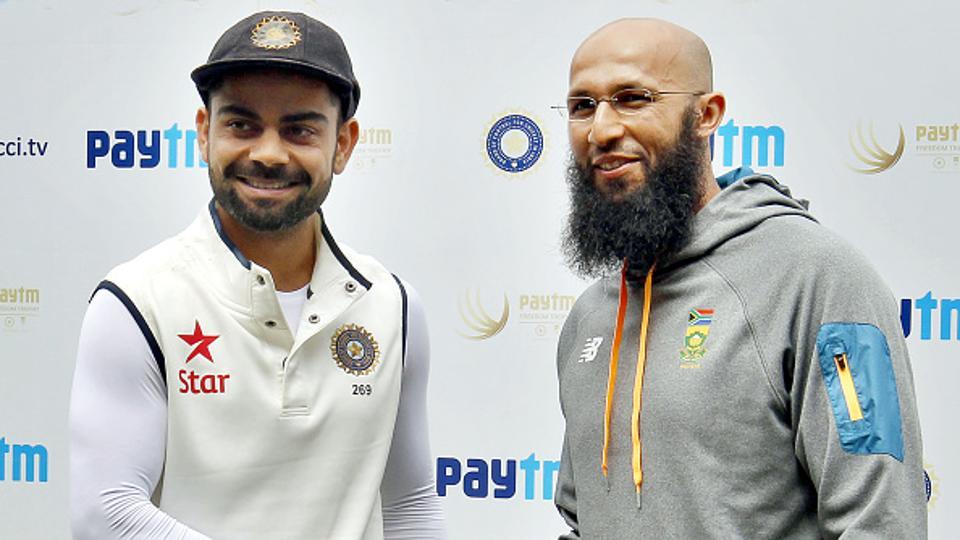
Hashim Amla broke Virat Kohli’s record and became the fastest to 7000 ODI runs during South Africa’s third and final game of the series against England at Lord’s.

Hashim Amla surpassed Virat Kohli to become the fastest to 7000 ODI runs during South Africa’s game against England at the Lord’s on Monday. (Hindustan Times via Getty Images)

Hashim Amla shattered Virat Kohli’s ODI record during the third match between England and South Africa in Lord’s as he became the fastest to aggregate 7000 runs.

The South African opener reached the landmark ( in his 150th ODI innings) in the seventh over of the innings as he pulled England pacer Steven Finn to the deep square leg fence for a boundary.

Virat Kohli had held the record after he went past 7000 ODI runs in 169 innings. The current India skipper reached the milestone during the ODI against Australia in Melbourne in January 2016. It was a memorable match for Kohli as he slammed his 24th century, but India lost by three wickets.

Amla has been in magnificent form in 2017. In the Indian Premier League, he slammed two centuries playing for Kings XI Punjab. Overall, he ended the tournament with 420 runs at an average of 60. In the two matches against England before the Lord’s ODI, he had scores of 73 and 24.

The former South Africa skipper also holds the record for the fastest to 6000 ODI runs, having got there in 123 innings. He was also the fastest to 5000, 4000, 3000 and 2000 runs, having got to the landmarks in 101, 81, 57 and 40 innings respectively.

source: http://www.hindustantimes.com / Hindustan Times / Home> Cricket> CT2017 / by HT Correspondent, Hindustan Times, New Delhi / May 29th, 2017

Twin joys for Bidar boy

Bidar, KARNATAKA :

It’s a double reason for G Naseer Hussain to feel on top of the world. A student of Shaheen PU College here, the boy has secured 3rd rank in the CET for admission to a course in Indian Systems of Medicine and Homoeopathy and 4th rank in the CET for admission to a course in veterinary science.

Naseer is the son of Mehboob, a lawyer, and Ruksana Begum, residents of Sindhanur in Raichur district.
The student has scored 59/60 in chemistry, 58 in physics, 56 in biology and 38 in mathematics. The boy said he used to dedicate 14 hours a day for studies and attended the training programme for CET and NEET in his college. He wants to realise his dream of becoming a doctor and is waiting for the NEET result.

source: http://www.deccanherald.com  / Deccan Herald / Home> States / DH News Service, Bidar / May 31st, 2017

ICSE results 2017: Muskan Abdullah Pathan, Ashwin Rao score 99.4% to become joint toppers

Pune, MAHARASHTRA :

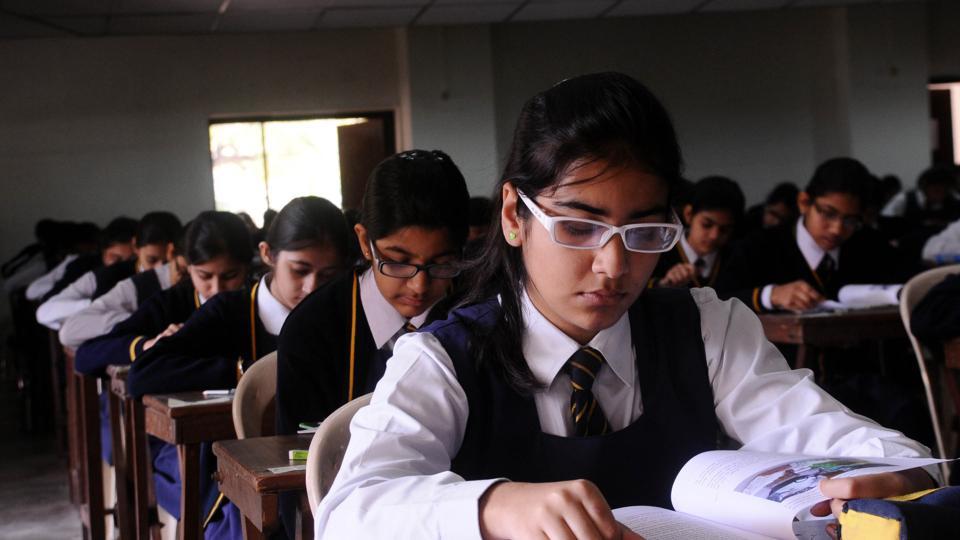
ICSE results 2017: Muskan Abdullah Pathan of Pune’s Hutchings High School and Ashwin Rao of St Paul’s English School, Bengaluru were declared as the joint toppers.

ICSE results 2017: Muskan Abdullah Pathan of Pune’s Hutchings High School and Ashwin Rao of St Paul’s English School, Bengaluru were declared as the joint toppers. (Deepak Gupta/HT photo)

Muskan Abdullah Pathan of Pune’s Hutchings High School and Ashwin Rao of St Paul’s English School, Bengaluru were declared as the joint toppers in the Council of Indian School Certificate Examination’s (CISCE) ICSE or Class 10 exam on Monday.

Both of them scored 99.4% marks.

Nearly 1,76,327 candidates registered for the Indian Secondary Certificate Examination exams this year.

The results for the ICSE and Indian School Certificate (ISC) were delayed this year as the exams began at least a week later than usual because of the assembly elections that were held in five states. Last year the results were declared on May 6.

Candidates can check their results by clicking on the ‘Results 2017’ link on the council’s website – www.cisce.org – or by logging on to the careers portal https://careers.cisce.org/helpdesk/login.aspx. They can also access them by sending a text message to 09248082883.

The CBSE 10th result 2017 will also be announced soon. The Central Board of Secondary Education declared the Class 12 board examination 2017 on Sunday.

source: http://www.hindustantimes.com / Hindustan Times / Home> Education / by HT Correspondent, Hindustan Times – New Delhi / May 29th, 2017

Students go innovative, price of their drone dips

Bengaluru , KARNATAKA :

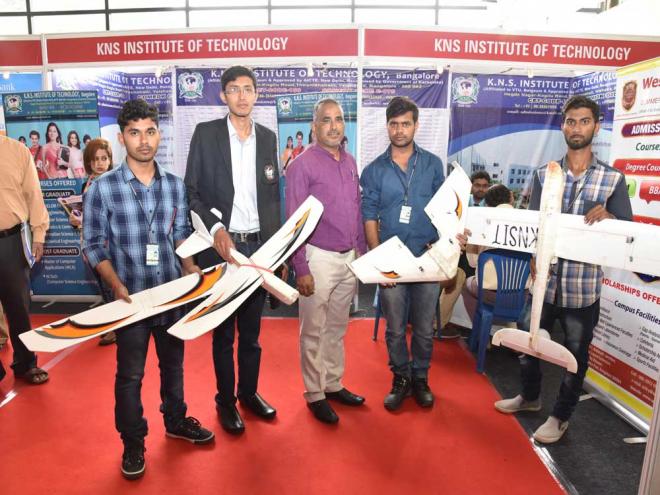
KNS Institute of Technology students display the drones designed by them at Eduverse, the ninth edition of Jnana Degula education expo organised by Deccan Herald and Prajavani, at Jayamahal Palace Hotel grounds on Sunday. DH photo

An unmanned aerial vehicle (UAV) at Rs 1,500? Students of KNS Institute of Technology have done it, without much fanfare. They plan to enhance the design to customise the drones for surveillance and transporting goods.

The makers of the plane – Inayatullah, Debabrata Mondal, Premkumar Singh and Syed Junaid – represented their college along with vice principal Nayeem Ahmad at Jnana Degula-Eduverse event organised by DH and Prajavani.

Inayatullah said the plane was made of simple polymer materials (expanded polyolefin and polystyrene) and can carry 350 gm payload. “It can fly for an hour at a speed of 45 km per hour. We have used a propeller made of composite material with aluminium coating so that it can fly at a height of 500 feet and withstand force of up to 85 newtons,” he said.

The team is also working on a plane specifically designed for surveillance.“While the 45 kmph plane can be improvised to make it a delivery drone, we are working on a plane that flies slower, at 36 kmph, providing opportunities for deeper surveillance of a particular area,” Mondal said.

Inayatullah said the cost of the UAVs will come down further if produced on a large scale. “The UAVs produced by government agencies cost a lot. Our planes are disposable. The army can use the surveillance drone and does not have to worry if one of them is lost or destroyed,” he said.

The planes can be controlled by a 2.4GHz radio frequency device, which has a range of 2.5 km. “The remote controller cost us Rs 3,500. Considering that it is the plane and not the device that is susceptible to damage, we think ours is the most affordable UAV,” he said.

“The turbo is imported from China for Rs 90 and sold in India for Rs 250. The same turbo can be made in India at a cost of Rs 40. Nearly 95% of the materials were imported from China. After a detailed study, we found the cost will come down to Rs 600, if we make these materials in India,” Inayatullah said.

source: http://www.deccanherald.com / Deccan Herald / Home> City / DH News Service / Bengaluru – May 29th, 2017