All posts by mpositiveone@gmail.com

News channels in India are in adolescent phase: Arfa Khanum

UTTAR PRADESH / NEW DELHI :

ArfaKhanumMPOs30sept2016

Television journalism is one of the most glamorous jobs of new India. Arfa Khanum Sherwani as principal correspondent and news anchor for NDTV India holds one of those glamorous jobs. Her home in New Delhi is an example of simplicity. She used to be in front of her camera, but this time she was the subject of the interview. I asked her about television journalism in India which is barely a decade old.

While Ms. Sherwani is very optimistic about the future of news channels in India, she is also brutally honest in accepting the mistakes made by electronic journalists.

Arfa, originally from UP, is a Chemistry graduate. She did a one year course in journalism from Aligarh Muslim University (AMU) and joined The Pioneer. From there she moved to The Asian Age. Realizing that she is more comfortable in a visual medium, she found herself as a TV reporter and news anchor.

Arfa has won accolades and criticism for her courageous and investigative reporting on Sachar Committee Report, Batla House encounter, and a special on the performance of the Ministry of Minority Affairs.

“News channels in India are in adolescent phase,” Arfa argues and that’s why they seem to be moving from one experiment to another, still trying to find a firm footing. She is critical of the abuse of the term ‘breaking news’ and over reliance on TRP, the rating system used by the Indian TV channels.

Arfa does not hesitate in calling the news dished out by TV channels as ‘infotainment.’ She calls for higher standard and believes that viewers are ready to watch quality journalism if given the opportunity.

She is passionate about the media and believes that she has so much to learn and excited about the opportunity to learn something new every day. She wants to be known as a serious journalist who is a face of authenticity who raises people’s issues and concerns and becomes their voice.

A sign of good journalist, she always keeps a notebook to record her thoughts and a book to keep herself informed of the issues.

Watch Arfa’s report on performance of the Ministry of Minority Affairs

source: http://www.twocircles.net / TwoCircles.net / Home> Articles / by Kashif-ul-Huda, TwoCirlces.net / June 16th, 2009

Hameed wins title in Thailand

Guntur, ANDHRA PRADESH / NEW DELHI :

Earlier, Shaik edged Joshua Chow of HongKong in the first all-lefty semi-final, 231-218 to advance to the finals.

Debutant Shaik Abdul Hameed became India’s first-ever title winner at the Asian-level as he captured the Asian Bowling Federation’s Thailand tour event. Shaik defeated Mahmood Al Attar of UAE 242-183 in the final

Both the men’s title contenders had an opened frame each in frame two, but Shaik rolled three consecutive strikes to take a slender lead of 9 pins when Mahmood came back in the fifth and sixth frames. The Indian, however, rolled another three consecutive strikes from frame seven onwards while Mahmood’s form tapered off. Shaik went on to strike out for a comfortable victory over Mahmood. Earlier, Shaik edged Joshua Chow of HongKong in the first all-lefty semi-final, 231-218 to advance to the finals.

Shaik won India’s first-ever medal in the sport during the Commonwealth Tenpin Bowling Championship 2002 in which he won gold medals in Singles and Masters and a silver medal in All Events.
(Express News Service)

source: http://www.indianexpress.com /  Indian Express / Home> ieSports> Sports Others / by Express News Service / New Delhi / April 20th, 2014

Kargil War Remembered, Heroes Forgotten

NEW DELHI :

26 July was observed as the 16th anniversary of the so-called Kargil War or the Operation Vijay which occurred in 1999.

In this three month long war which began on 3 May, the Indian army operation was declared accomplished on 26 July and hence the date is marked as the Kargil Day or ‘Vijay Diwas’ to be particular and has an immense significance in Indian history.

PM Modi said on the eve of the anniversary, “I salute all the brave soldiers who lost their lives in the Kargil war, for their sacrifice and valor, on the occasion of Kargil Vijay Diwas. Kargil war though fought on borders had significant contribution from every village, every town of the country.”

Like him his cabinet colleague and the Minister of Finance Arun Jetly twitted yesterday, “Today, we remember & salute our brave soldiers who gave supreme sacrifice to protect the motherland in the Kargil war.” However, he was reminded by the followers that he was not correctly remembering the day; it was the next one, 26 July. One follower retorted on his tweet, “Sir Kargil Divas is tomorrow, not today dnt be exited to tweet but think twice b4 try to grab voter attention.”

These instances may be found illustrious enough how the national leaders take “supreme sacrifices” of war heroes in a disingenuous way. They are even not publically sure about the date of the sacrifice, then what much should be expected of them. May their act was inadvertent but it gives a message of oblivion.

The American poet Richard Watson Gilder hoped in his composition, “The ballads of martyrs be sung/at each anniversary of martyrdom/so that generations to follow value/the sacrifice of our Heroes./….Lest we forget.”

One Indian poet has paid his homage to the martyrs in these words, “Shaheedon ke chitaon par lagenge her baras mele. Watan pe marne walon ka yehi baqi nishan hoga (On the pyres of martyrs, celebrations shall take place every year, memorial of those shall be kept intact this way for surrendering their lives on the nation).”

However, not only the national leaders but even the public belies such romantic expectations.
CaptHaneefuddinMPOs30sept2016

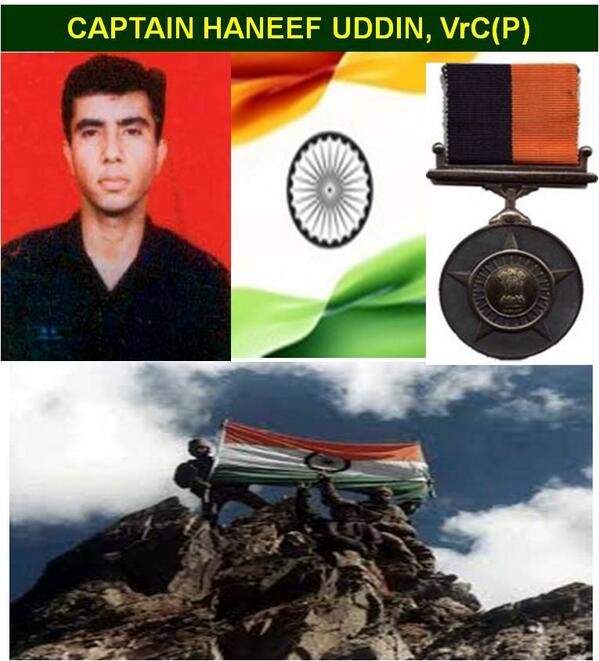
Let  us understand this reality from the instance of one hero of the Kargil War, Captain Haneef Uddin, Veer Chakra (P).

He was an officer of the 11th Battalion, The Rajputana Rifles of the Indian Army laid down his life defending the country at an altitude of over 18000 ft in 1999. When he died on 6 June as one of the first causalities of the War but with much strategic gains, he was less than 25 years of age.

Times of India reported on 23 July when his corpse reached Delhi, “Thousands of Delhiites lined the streets of the capital to salute their brave hero, Captain Hanifuddin, who laid down his life fighting intruders in the Kargil region. When the body was brought to the Sajjadanashin Dargah in Nizamuddin, Hindus and Muslims stood side by side to pay their respects to the martyr. Since people had lined up on both sides of the road, it took almost an hour for the cortege to traverse the short distance between the Dargah and the cemetery. People seemed overwhelmed with the reported heroics of the soldier. “The country is blessed with such brave sons who sacrifice their lives like this,” said a mourner. The captain from the Rajputana Rifles was buried with full army honors as befitting a war hero.”

“16 years on” laments his memorials Facebook account, “Do we still remember? The road leading to Captain Haneef Uddin’s house was named after him. His name engraved on a stone to tell the world, ‘Here lived the Hero’. Then one day, the stone was replaced with a shabby metallic board, at a height convenient for people to stick posters. Alongside, a big blue board was also put up later, but even then no one thought of giving the Martyr the respect due to him. Same is the condition of the school named after Captain Haneef Uddin. No one knows! We honor our Martyrs so that future generations take inspiration but this is how we remember our Martyrs.”

Captain Haneef was a science graduate, multifaceted talent and trained computer expert of Delhi University from its Shivaji College where he himself was crowned as ‘Mr Shivaji’ during his studies before joining the Indian Military Academy in 1996. He was commissioned into the army on June 7, 1997. Exactly two years later he died.

There is no doubt that he could have pursued some other lucrative career or would have become an all-imposing politician and deliver sermons on nationalism seeing his popularity in the college, but he chose to devote himself for the defense of his country and ultimately offered it his supreme sacrifice. His name denotes, “someone single-minded in his religion”. He was truly single-minded in his religion, patriotism.

During parliamentary elections, Narendra Modi created a controversy by using the name of another Kargil hero Vikram Batra for electioneering, quoting his famous rhetoric “Ye dil mange more.” Disgusted with his non-serious and populist stance Batra’s mother joined AAP in annoyance. Sadly, neither Modi nor the AAP leader Arvind Kejriwal could take a little pain to go to Haneef’s house which is not far from their official residences and pay homage to the young man, who left his mother in utter pain and lasting sorrow for defending the motherland. They could have even sent someone to register their concern. But, there is a noticeable silence from both of them and also from their followers. No RSS, no Bajrangdal, no Shiva Sena or any other patriotism vigilantes and no Congress secularists are around. Even, Muslim organizations are as distant on the occasion as others.

At the time of Kargil War I was in my home town in Rajasthan. One day I was waiting for any public transport to reach home from some other place. Hopelessly, after waiting much for it, I signaled to a rider nearing me to give me lift on his bike. He cooperated. He happened to be an RSS Pracharak of our district.

Finding me to be a Muslim he said, “Sir, it is the right time that Muslims should show their patriotism by donating blood to the Kargil combatants.”

I retorted, “Mister, the blood already donated for the purpose is being sold in Delhi from where I am here. Don’t worry, we will make bigger sacrifice for the nation than you, if the time so arise.”

This episode makes me thoughtful and I wonder whether the nation which forgets the highest sacrifice of its citizens like Captain Haneefuddin deserves even a small drop of blood from its people.

Haneef’s father died when he was only seven years old. His widow and Haneef’s mother, Hema Aziz, valiantly responded seeing his dead body, “As a soldier Haneef served his country with pride and dedication. There cannot be a greater statement on his valor than his death which came fighting the enemy.”

Like Captain Haneefuddin, many other Muslim soldiers surrendered their lives on the anvil of Kargil War along with many other fellow countrymen from the cross sections of society. A few names may be noted from the available list: Lance Naik Ahmed Ali, Lance Naik Gulam Mohammed Khan, Havaldar Abdul Karim, Rifleman Mohamad Farid, Rifleman Mohamad Aslam, etc.

It is a common speculation that none of them would have been remembered on the day, including over 500 others.

It has been marked by different commentators that Muslim martyrs’ number should be any figure between 10-25% of the overall casualties, officially endorsed as 527. Since it was explicitly disproportionate to the presumed number of Muslim soldiers in the Indian army, less than 1%, it unbelievably surprised many and also raised election time controversies: who led to the Kargil victory, Muslims or Hindus? The Kargil War is also known for ‘coffin scandal” wherein allegedly people in the establishment at that time took undue advantage in their procurement. Consequently, the erstwhile defense minister had to resign.

The Kargil Day comes and reminds us of many things. It makes us fresh with the great sacrifices of the war heroes and inspires us to make similar sacrifice for a noble cause. It saddens us seeing hypocritical rhetoric from podiums. It makes us ashamed on knowing, how many people use war and war heroes for political and communal goals.

The poet apprehended “Lest we forget” and we really forgot them.

Sorry martyrs! We didn’t deserve your grace!!

Contributor is a social activist, analyst and author of many books including his recent one, Islam in 21st Century: The Dynamics of Change and Future-making

source: http://www.countercurrents.org / CounterCurrents.org / Home / by Abdul Rashid Agwan / July 27th, 2015
Experts make ‘Gaadhis’, ‘Namdhas’ for Dasara Elephants to look Majestic

Mysuru, KARNATAKA :

gaadhasmpos27sept2016

by M.T. Yogesh Kumar

As the city is being spruced up for it to sport a bridal look, inside the Palace too, hectic activities have begun to get the elephants ready for the Vijayadashami grand finale. The main attractions on the last day of the festival are the 12 elephants with Arjuna, carrying the Golden Howdah (Ambari), being the cynosure of all eyes.

Special care is taken by the team of Forest Department officials, mahouts and kavadis to ensure that the elephants are fed well and trained so that they can gain enough weight enabling them to stay composed amidst the cheering crowd at the Jumboo Savari. Care is also taken to decorate them with specially designed robes. Their trunks are painted and metal ornaments with hangings are fixed into their tusks.

Among the specialised team is Pasha and Zakaulla, the two mahouts who have retired from service and who are experts in creating the ‘Gaadhi’ or the cushion and ‘Namdha’ or ‘Gouse’, a robe for the elephants. While the ‘Gaadhi’ is tied to the elephant’s back, a ‘Namdha’ covers the elephant skin and looks like a jacket. The ‘Gaadhi’ and ‘Namdha’ are newly made every year.

Explaining the ‘Gaadhi’, Pasha and Zakaulla say that it makes the uneven surface of the elephant plain and look good when the “Namdha” is spread on the elephant. Each ‘Gaadhi’ has a girth of 1.5 ft and the length depends on the size of the elephant.

While Arjuna, the Howdah Elephant’s ‘Gaadhi’ will weigh 500 to 800 kilograms, the ‘Gaadhi’ made for other elephants weigh 250 to 300 kgs. This is because Arjuna has to carry the 750-kg Golden Howdah with the idol of Goddess Chamundeshwari placed inside. The combined weight of the ‘Gaadhi’ and Ambari is around 1,100 to 1,200 kgs.

A special grass that is grown abundantly on lake and river side is used to make the ‘Gaadhi.’ Locally the grass is called ‘Odake Hullu’ that turns soft when dry. The grass is bundled and filled into a soft but sturdy square shaped cloth specially stitched for the purpose. Along with this grass, dry paddy grass is also used to fill the edges.

“The proportion is important to give a soft and sturdy feel,” say the mahouts. Once the grass is filled, the ‘Gaadhi’ is stitched after covering it with jute gunny bags.

“When I was the mahout before 2006, I used to observe people making the ‘Gaadhis’ and ‘Namdhas’ and slowly I learnt the tricks of the trade. I retired in 2006 and since then I am doing this job every year,” says Pasha.

Pasha and Zakaulla have been a part of the festival and have stitched many ‘Gaadhis’ and ‘Namdhas’ for many elephants in the past. The Forest Department officials too have reposed their trust in their skills and summon them every year for the job. While Pasha is the resident of Gandhinagar in Mysuru, Zakaulla is from Gundlupet.

“I have been the mahout for elephants including Radhika, Jayaprakash, Ramani and Chandrika. I retired 10 years ago and I am happy to serve the Naada Habba. I am willing to teach other mahouts on the making of these specialised equipment,” says Zakaulla.

source: http://www.starofmysore.com / Star of Mysore / Home> Feature Articles / September 26th, 2016

Who’s That – Sameer Uddin: Hyperactive

NEW DELHI / Mumbai (MAHARASHTRA) :
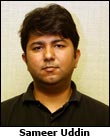
Born into a musically-inclined family in Delhi (his mother is a classical performer and father, a theatre artist), Sameer was exposed to melodies and composition from a young age
SameerUddinMPOs27sept2016

Born into a musically-inclined family in Delhi (his mother is a classical performer and father, a theatre artist), Sameer was exposed to melodies and composition from a young age. But it was his uncle who realised that Sameer had a knack for music when, still a tween, he played a tune on the tabla after hearing it just once. This led to tabla lessons.

In college, Sameer swapped the tabla for a guitar “because that was cooler then, and I didn’t want to be called a ‘tabalchi’,” he laughs. Sameer went on to play the bass guitar in a heavy metal band (Every Mother’s Nightmare), playing covers from bands like Metallica, Megadeth and others. His first creation outside his band, though non-commercial, was for a cookery show on Home TV. In August 1999, he got his first taste of composing for ads when Jeevan Singh of the films department at O&M asked him to create a tune for a Duracell ad, the agency was working on.

But Sameer believes that his first big break in ad films was when he composed the score for a Honda City commercial being produced by Kaveri Productions. The production house managed to convince the client to let a fairly new composer work on the ad. “It was something the Japanese don’t do often,” points out Sameer. Kaveri Productions is where he met some of his closest friends and Neha, who would become his wife. Some of his close friends and mentors include Binoy Mitra of Kaveri Productions, Shoojit Sircar and Vinod P Vijay of Red Ice Films, Harsh Dave of Film Farm, Amit Sharma of Chrome Pictures, Ayyappa of Footcandles.

A few years later, he moved to Mumbai with his wife (his brother runs a school in Himachal in memory of their brother Captain Hanif who lost his life in the 1999 Kargil War) and jumped headlong into work. The ad projects he’s enjoyed most include the latest Parle Lite ad with the floating Sumo wrestlers and the ballerina, the Honda City ad and one for Sri Lanka Tourism, where he spent time in the country understanding their music style and applying it to the ad.

Movies weren’t far away. He worked on creating background scores for films like Yahaan, Ek Khiladi Ek Hasina, Bluffmaster, Pyaar ke Side Effects and Aloo Chaat. However, ad films are his first love. Ask him why and he says, “It’s my sanctuary really for many reasons. Firstly, my mind is always in hyper drive, I love doing many things, so ads let me move from one genre of music to another. One day I might be working on an Indian tune, another day a thrash metal sound like one we created for Titan Octane to a medley tune like Parle Lite’s.”

source: http://www.afaqs.com / afaqs! / by Surina Sayal , afaqs! – Mumbai / Home> In Advertising / September 14th, 2009

Padma award: Ex-Jamia Prof who guided L-G Jung master Deewan-E-Ghalib recommended

NEW DELHI :

Eight names have been submitted online for the Padma awards by the Delhi Government.

Of them, according to an Indian Express report seven names have been recommended for Padma Shri, one for Padma Bhushan.

The report claimed that seven names have come from Lieutenant Governor (LG) Najeeb Jung and one has been sent by a committee under the chairmanship of the chief secretary of Delhi. OKHLATIMES.COM independently could not authenticate the claim.

Of the eight names recommended, on the list is Dr Khalid Mahmood, former Jamia Millia Islamia’s Department of Urdu, in the field of Literature and Education. Sources said LG Jung, when he was vice chancellor of Jamia Millia Islamia, used to regularly take classes in Deewan-E-Ghalib.

Dr Mahmood, who even today visits the L-G’s residence once in a week to discuss Deewan-E-Ghalib, told OKHLATIMES.COM that he is not aware of the development. Born in Saronj-Madhya Pradesh on 15th January 1948, Dr Mahmood is a noted Urdu writer and has won several awards for his literary work.

OKHLATIMES.COM had earlier reported quoting Dr Mahmood that Jung is head over heels in love with Ghalib and has a good grasping power. It is my pleasure to discuss the subject with him, he had said then,

It is understood that Jung as an eight-year-old student used to recite ghazals written by Ghalib whenever Maulana Abul Kalam Azad, India’s first Education Minister, used to visit his swanky Daryaganj house in Old Delhi. Grandson of Moulvi Samiullah, a close associate of Syed Ahmed Khan, young Jung, in his later days lost touch with Ghalib. But after coming to Jamia he had renewed his interest in the great poet and writer.

Dr Mahmood used to interact with Jung four days a week for one hour after 5.30 pm.

Jung, son-in-law of Dr Abdul Jalil Faridi, wants to contribute to the development of Urdu in India and Maktaba JMI, Dr Mahmood had claimed then.

source: http://www.okhlatimes.com / Okhla Times / Home> JMI Campus / September 20th, 2016

My musical journey, Sameeruddin

NEW DELHI / Mumbai (MAHARASHTRA) :

His recent single release – Tera Mera – with singer Neha Bhasin, crossed 2 Lac plus views on YouTube in just a few days!

He is also a winner of two Abby awards for his advertising work. He has scored the background music for films like Yahaan, Bluffmaster and more.

Meet Sameer Uddin. And re-live his journey from Delhi to Mumbai. Don’t miss our special music software and hardware discounts from Sudeep Audio.

Follow us on: http://www.twitter.com/SudeepAudio http://www.facebook.com/SudeepAudio

source: http://www.youtube.com / Published by Sudeep Audio / August 12th, 2012

No Medicos in 16 PHCS across the district

Mysuru, KARNATAKA :

KDP progress review meeting expresses concern over rising cases of dengue, chikungunya

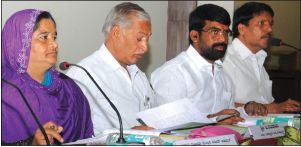
Zilla Panchayat President Nayeema Sulthana and others at the KDP progress review meeting held at ZP auditorium yesterday.

Zilla Panchayat President Nayeema Sulthana and others at the KDP progress review meeting held at ZP auditorium yesterday.

Mysuru :

The Health Department is facing acute shortage of staff with 16 Primary Health Centres (PHC) in the district having no doctors at all. Apart from this, many posts, including doctors and pharmacists are lying vacant in the district.

This came to light during the progress review meeting of Karnataka Development Programme (KDP) that took place at the Zilla Panchayat auditorium here yesterday.

Expressing displeasure over the issue, ZP Social Justice Standing Committee President Beerihundi Basavanna questioned the use of the PHCs when there were no doctors.

He demanded the officials concerned to take measures to fill all the vacant posts immediately.

Expressing concern over rising cases of dengue and chikungunya in the district, the members asked the Health Dept. officials to stop breeding of mosquitoes, which are causing the diseases.

Health Department officials said that the Department had collected blood samples of 1,899 people in the district to check for dengue of which 454 people tested positive for dengue, while 124 persons returned positive for chikungunya from January to September. Out of this, 281 dengue cases and 69 chikungunya cases were reported from the city alone, they said while claiming that no deaths have been caused due to these diseases.

ZP Chief Executive Officer (CEO) P. Shivashankar asked the officials concerned to take preventive measures to check the breeding of mosquitoes.

He also directed the officials to take the necessary action for recruitment of staff under the Natl. Rural Health Mission (NRHM).

ZP Vice-President Kayyamballi Nataraj questioned Food and Civil Supplies Dy. Director Dr. K. Rameshwarappa over inaction against Fair Price Shops (FPS) found indulging in unfair practices.

Dr. Rameshwarappa, in his reply, said that a total of 147 cases have been registered against FPS for violation of rules and procedures and also 97 people have gone to jail for misappropriation of Public Distribution System (PDS) food grains. Pointing out that severe action has been taken against 40 FPS on charges of improper PDS grains distribution, he said that the Food & Civil Supplies Department is yet to dispose off 1.2 lakh BPL card applications and that the applications will be disposed off once the Government sets a deadline.

Other issues like lack of teachers in schools, fodder for cattle, progress of various Government Schemes among others, also came up for discussion during the meeting.

ZP President Nayeema Sulthana asked all TP Executive Officers (EO) to submit the list of beneficiaries under SCP, TSP Schemes by Oct. 2.

Women & Child Welfare Dept. Asst. Director Radha, Health Department Official Dr. Somashekar and others were present.

source: http://www.starofmysore.com / Star of Mysore / Home> General News / September 27th, 2016

Kashmiri woman entrepreneur wins laurels

JAMMU &  KASHMIR :

Srinagar :

A progressive woman entrepreneur of the valley has won laurels for the state by being selected for two different honors both at national and global level. Doctor turned entrepreneur, Gazalla Amin has been selected for Vital Voices Lead Fellowship programme and has been declared winner for the ‘India Today Woman Entrepreneur of the year 2013’ award.

Vital Voices Lead Fellowship is a global initiative that aims to identify, invest and bring visibility to extraordinary women around the world by unleashing their leadership potential to transform lives and accelerate peace and prosperity in their communities. The fellowship is a three year programme wherein only 100 women from across the world are selected after every 3 years.

“The VV (Vital Voices) lead fellowship is a wonderful thing and I am grateful on being selected as a part of this wonderful experience. It’s a huge honour and means a lot to me,” Gazalla Amin told this reporter.

Gazalla Amin chairperson, Fasiam Agro Farms is the first woman entrepreneur to be selected for the prestigious Vital Voices Lead Fellowship programme from Kashmir. “It means a lot to me as interacting with women from across the globe will help me expand my business understanding. It can help me channelizing my dreams, and understanding how to make it better. And most importantly it will help me receive education about realizing goals and I may contribute to women’s issues in my own region,” said Amin.

In addition to this, Gazalla Amin has also won the ‘India Today Woman Entrepreneur of the Year’ award, the grand ceremony of which was held on April 19, in New Delhi. The India Today Women Entrepreneur of the Year Award is a prestigious award which is given for outstanding achievement as an entrepreneur. The award is given on a nationwide level by the India Today Group. Gazalla Amin who was informed through email and a phone call about her feat was declared winner among the three shortlisted candidates.

“It gives me immense pleasure to inform you that a select Jury has nominated you as the winner of the award in “India Today Woman Entrepreneur of the year” category. Three names were short-listed in this category from which you were selected unanimously,” reads the email sent to Amin by India Today group.

Gazalla Amin was invited for the award ceremony ‘India Today Woman Summit and Awards 2013’ which was held on April 19 in the Indian capital. The summit aims to provide women executives in India with the vision, strategies and skills needed to succeed in today’s world, both in their homes and as professionals in the workplace.

“We all work hard to achieve something and it’s absolutely wonderful when you get a chance to learn more. And the recognition one gets for their efforts encourages others also to try and do better,” added Amin.

It was in 2004 when Gazalla Amin swapped from medicine to entrepreneurship and decided to grow Lavender flowers and make a business out of it. Since then there has been no looking back as she has emerged as one of the prominent faces of women empowerment.

source: http://www.worldpulse.com / WorldPulse.com / Home> Public Story / by Khurram Rasool / June 08th, 2013

Sher Ali Khan: A Forgotten Revolutionary


Andaman & Nicobar Islands  :

Andaman Islands:

Sher Ali Khan, a revolutionary deported from the Northern Frontier Province to Andamans by the British, assassinated Lord Mayo, the Viceroy of India on 8th February, 1872. It has been a long wait for this patriot to find a place in history.

February 8, 2006 was just another day for the Islanders. Our sense of history seems to be dead. The apparent silence of the administration as well as media seems more innocent negligence than any shrewd game plan. It was on the night of 8th February, 1872, that Sher Ali Khan, a revolutionary took the life of Richard Bourke, 6th Earl of Mayo, the Viceroy of India.

During the British Rule, occasionally, the media would highlight the sufferings of the prisoners of these Islands and report about the torture methods of the British. As a result of which the government would be pressurised to be lenient to them.

In 1869, Lord Mayo, the Viceroy of India devoted special attention to the issue of the plight of the prisoners. In this regard, he gave some benefits to the prisoners in 1871 which increased his popularity by two-folds. It was his wish that he personally go to the Andaman Islands to see the condition of the prisoners with his own eyes. Hence according to the programme, he visited Andamans in the early morning of the 8th of February, 1872. He was also accompanied by Lady Mayo and other high ranking officials. Since this was the first ever visit of a Viceroy to the Islands, special security measures had been taken.

The Viceroy’s arrival was welcomed with 21 cannon fires and the officers lined up to meet him. He spent his entire day touring the workshops, barracks, and factories of the prisoners where they dwelled and worked. At night fall, he insisted visiting Mount Harriet. The place was quite high and had been renovated as a tourist resort for the special guests. There, he marvelled at the beauty of the Island and witnessed sunset from atop Mount Harriett. So much was he immersed in the surroundings, that he was not aware that darkness had set in. It was then that he decided to go back. On the way, he had to pass through the small bridge called ‘Hope Town Bridge’ in order to board a Launch that was ready to transport him back to the Royal Navy Ship where he would be spending his night. Two men with torches were walking ahead of him to light up the path and his private secretaries and bodyguards were on his either side. An armed police guard was following them as well. But these were traditional methods and the Viceroy and his secretaries were walking with their own pace enjoying their trip.

As soon as they boarded the small ship, there was some noise. When the private secretary looked back, he saw that a man was stabbing the Viceroy in his back. The security personnel reacted immediately and snatched the knife from the attacker. The private secretary succeeded in saving the life of the attacker who was a prisoner; otherwise the security personnel were ready to kill him. In all this mayhem, the torch lights also died out creating an atmosphere of fear. When the torches were lit, they saw that the Viceroy had fallen down the tier after being stabbed. For two to three minutes, the Viceroy tried to keep his balance, but then his feet started to shake and he fell. He tried to get back up on his feet again and managed to tell somebody, “Hold my Head”. These were his last words after which he died.

This assassination attempt was made by a prisoner, ‘Sher Ali Khan’. He belonged to Tirah Valley in Khyber Agency. By nature, Sher Ali was a kind man, but a family feud had brought him to this situation. Sher Ali was a man who gave great respect to everybody. The English officers were served well by him. His overall nature was well cultured even after receiving the death penalty. His death penalty was switched to deportation to Kalapani, when he made an appeal. In 1869, he reached the Andaman Islands to serve his sentence. By this time, he had already made up his mind to kill a high ranking English Officer for revenge.

The little amount of money that he would earn while serving here would always be given away to other poor prisoners as charity. Moreover, every second or third month, he would provide some food for the orphaned prisoners as well. The officers did not strictly monitor his activities because of his charitable nature. It was not long that he was appointed as a barber for the labourers in the Islands. Lord Mayo’s murder sent shockwaves throughout the British Empire. Sher Ali Khan told the courts that he had waited for almost all day near the small ship which the Viceroy would board. After killing the Viceroy, he was asked by the courts about who had hired him to do this job. He would simply reply that, “I killed him by the Order of Allah!”

Sher Ali was again tried for murder and was given the death penalty once again. On the 11th of March 1873, when he was brought to the gallows, there was a look of satisfaction in his eyes. He kissed the rope from which he would be hanged and exclaimed, “When I made this intention (of killing the viceroy), I had already envisioned myself over here”. He addressed the gathering who had come to watch the penalty being enforced, “Brothers, I killed your enemy. You be witness that I am a Muslim.” With this, he recited the Kalma Shahadah. Twice he was able to complete it. The third time, he was not able to do so because of suffocation.

(The writer is based in the Andamans and can be reached at zubairpbl@gmail.com)

source: http://www.islamicvoice.com / Islamic Voice / by Zubair Ahmed / March 2006