All posts by mpositiveone@gmail.com

Sania Mirza’s Unlikely Stardom

Hyderabad, TELANGANA :

A tennis player blazes a trail for Indian women.

“For a girl to pick up a tennis racquet and to want to be a professional—it was unheard of,” Sania Mirza says. “People thought it was a joke.” PHOTOGRAPH BY GREG WOOD / AFP / Getty
“For a girl to pick up a tennis racquet and to want to be a professional—it was unheard of,” Sania Mirza says. “People thought it was a joke.”
PHOTOGRAPH BY GREG WOOD / AFP / Getty

On the last day of August, Sania Mirza, currently the No. 1 women’s doubles player in the world, was on one of the smaller side courts at the U.S. Open grounds, in Flushing Meadows, about to play her first match in this year’s tournament. She and her partner, Barbora Strýcová, of the Czech Republic, were squaring off against the Americans Jada Myii Hart and Ena Shibahara. The sun had begun to sneak behind the bleachers, where a few dozen fans had settled in. Occasionally, a roar from Arthur Ashe Stadium or the grandstands could be heard over their polite clapping. Mirza’s black hair was tied back in its usual businesslike bun, her dark eyes focussed beneath a neon-pink headband. Mirza’s gruelling summer had included her third Olympics, which had ended just a couple of weeks before, with a fourth-place finish in mixed doubles. Her longtime partnership with the tennis icon Martina Hingis was also coming to an end. Now she was gearing up again, knowing that millions were paying attention in her native India, even if only a handful were watching in New York.

Mirza, who will be thirty in November, is wildly famous in one hemisphere and virtually unknown in the other. She has nearly twelve million Facebook fans – more than double the number that Serena Williams has—plus four million followers on Twitter, and two million more on Instagram.  She is, without hyperbole, one of the most popular athletes on Earth. She has, to date, earned $ 6.3 million in career prize money, a fraction of what Williams has made, but more than a thousand times the annual per-capita income in her home country.

She is also Muslim, and has sparked the ire of clerics for competing in tennis clothes that leave her arms and legs exposed. Though roughly one in twelve people on the planet is a woman from India, few Indian women have succeeded in professional sports, for reasons that are not hard to pinpoint. Last year, in the World Economic Forum’s Global Gender Gap Report, India ranked No.108, out of a hundred and forty-five countries listed. For years, women in India were largely discouraged from participating in high-level sports—and, unless the women were wealthy, good facilities were hard to come by, anyway.

Mirza is helping to change this. She’s an advocate for women’s rights, and has spoken up about ending the practice of female feticide in India. She has criticized government policies on domestic violence and sexual assault, as well as lopsided pay schemes, including in sports. She was the first South Asian woman to be appointed as a Goodwill Ambassador for the United Nations, and she often calls out reporters for asking her, and not her male counterparts, about her “family plans.” She told me that, after she and Hingis won Wimbledon last year, she was asked by a reporter when she’d be having a child. “I was, like, ‘I won Wimbledon two days ago!’ ”

Though Mirza makes light of her reputation, in India, for what some there see as arrogance, the truth is that her outspokenness has only made her more popular back home. Her stardom is an unlikely outcome, considering where she started. “For a girl to pick up a tennis racquet and to want to be a professional—it was unheard of,” she told me. “People thought it was a joke.”

Mirza grew up in Hyderabad, a city of nearly seven million. It was only half that size when she was a child, and, back then, sanitation, let alone access to a tennis court, was not a given—only a handful of courts existed, and many that did were riddled with potholes or made with cow dung (a surface that was thought to offer a middle ground between clay and hard courts). Today, as Mirza is well aware, the city center of Old Hyderabad is a hub for human trafficking, and domestic violence is an urgent problem. Though technically illegal, child marriage persists. Local police blotters in and around Hyderabad regularly carry gruesome stories: a woman who hanged herself by her sari when a dowry went sour, a husband setting his wife on fire. Just a few weeks after last year’s U.S. Open came news, from south of Hyderabad, in Bengaluru, that a woman had been raped by two security guards outside of tennis courts in Cubbon Parks. It was the third such attack in the city in a month. According to local reports, the victim later told police, “I want to be like Sania Mirza.”

The Mirzas moved to Hyderabad, from Mumbai, when Sania was an infant, one of many families drawn to the burgeoning technology mecca. Mirza’s father, Imran, held a number of jobs, working mostly as a printer and, later, in construction. Mirza’s mother, Naseema, also had a mind for business, and she and her husband often worked together. They were ambitious, and forward-thinking in their attitude toward girls; still, they tried to avoid placing too much stress on their daughters. (Sania’s sister Anam is seven years younger.) It was on a whim that Imran signed up Sania, then six years old, for tennis lessons, at Hyderabad’s Nizam Club. There were cricketers in the Mirza family, but women’s cricket had not yet taken off in India. Tennis seemed like something she might enjoy.

A couple of months later, Sania’s coach suggested that Imran come to watch his daughter play. He put it off. When he finally saw her on the court, he immediately realized that she was a standout talent. Soon, the sport became as much a part of her childhood routine as brushing her teeth or doing her homework. Sania attended the Nasr School, a progressive all-girls private school, which adapted her academic schedule to accommodate her tennis travels. “Always in tracksuits, coming directly from practice straight to school!” Nirmal Gandhi, a teacher at Nasr who had Mirza as a student, said. “I don’t think I ever saw her serious. She was always laughing with her friends.” At the time, the Indian system for youth tennis was, Imran said, “nonexistent.” It’s not unheard of for the parents of tennis players to spend fifty thousand to a hundred thousand dollars, or more, annually on coaching, travel, and equipment, an expense that was far beyond the Mirza household budget at the time. So Imran began to coach his daughter, and set about researching local tournaments, learning what he could through word of mouth and follow-up phone calls. Sania’s mother stayed at home “to hold down the ranch,” tending to Mirza’s little sister and various pieces of family business, a pattern that would continue for twenty years—Sania’s tennis career becoming another joint family venture.

Mirza eventually won a berth in the 2003 Wimbledon junior girls’ competition, as a doubles player with Russia’s Alisa Kleybanova. They won the tournament. When Mirza stepped off the plane back in India, a mob of people greeted her and her family at the airport, fanfare that surprised them. Government dignitaries took photos with her and bestowed her with awards. The Indian press began to cover her every move, and it hasn’t stopped since. “At fifteen or sixteen, you’re still trying to get in touch with yourself as a person, as a teenager,” Sania Mirza said. “You have pimples. You have baby fat, in front of millions of people. You have to kind of grow up in front of the media, and you’re growing older and the following is getting larger and larger. You’re still getting in touch with who you are.”

“The Indian media, too, was just growing up,” Imran said. “They grew up along with Sania. They were really not geared or didn’t know how to handle a female sporting icon. They might have handled a film star, but here was the first sporting woman from India. It wasn’t easy for her, but it probably wasn’t easy for the media to deal with, either.” In 2005, as she was competing on the international circuit, a group of clerics issued a fatwa against Mirza, calling her skirts and T-shirts “un-Islamic” and “corrupting.” The cleric Haseeb-ul-hasan Siddiqui told the Guardian that the clothing she wore on court “ leaves nothing to the imagination .”

“You get hate mail,” Mirza told me. “You get love mail, but hate is a lot harder to digest than love. That’s the way it is.” She continued to wear Western-style pants and heels, and slogan-bearing T-shirts, including a popular one that declared, “Well-behaved women rarely make history.” The increased attention, and Mirza’s handling of it, gained her even more Muslim fans, a broad demographic that had largely been overlooked by the tennis-marketing establishment. And she excelled on the court. As a professional singles player, she reached a ranking of twenty-seven, the highest spot achieved by an Indian woman.

Privately, though, Mirza was battling a series of injuries. The hypermobile joints that helped give her flexibility on the court also led to extreme pain, which she often hid. She underwent operations on both knees and a wrist. Upon examining her body and her demanding competition schedule in 2010, doctors gave her the devastating news: she was done playing singles.

Mirza had been engaged to a longtime family friend, but in January of that year it was reported that she had called off the engagement. Then, in April, she became engaged to the Pakistani cricketer Shoaib Malik, whom she had met through mutual friends and had seen occasionally thereafter on various sports-related travels. The new wedding plans were a major story in India: Malik had served for two years as a captain of the Pakistani national cricket team, and cricket is something of a religion in that part of the world. Ordinarily, this would have made Mirza and Malik the Beyoncé and Jay Z of South Asian sports—but marriage to a Pakistani, even one who is an élite athlete in a treasured national pastime, is still “a huge taboo” in India, according to Bappa Majumdar, the Hyderabad bureau chief for the Times of India, who has covered Mirza. “It showed huge guts on her part,” Majumdar said.

The couple had planned an Islamic wedding ceremony in Hyderabad, with another ceremony to follow in Pakistan, adhering to that country’s customs. Within hours of the announcement, dozens of journalists had camped out in front of the Mirza home, to cover the tale of the star-crossed lover-athletes. The story then took an additional soap-opera turn: a woman from Mirza’s home town went to the press, saying that she was already married to Malik, and had been since 2002. He initially disputed this; they had merely met online and exchanged photographs—though, he said, the pictures she sent him were of someone else. But he ultimately admitted to the marriage and got a quick divorce, according to local news reports, days before his wedding to Mirza.
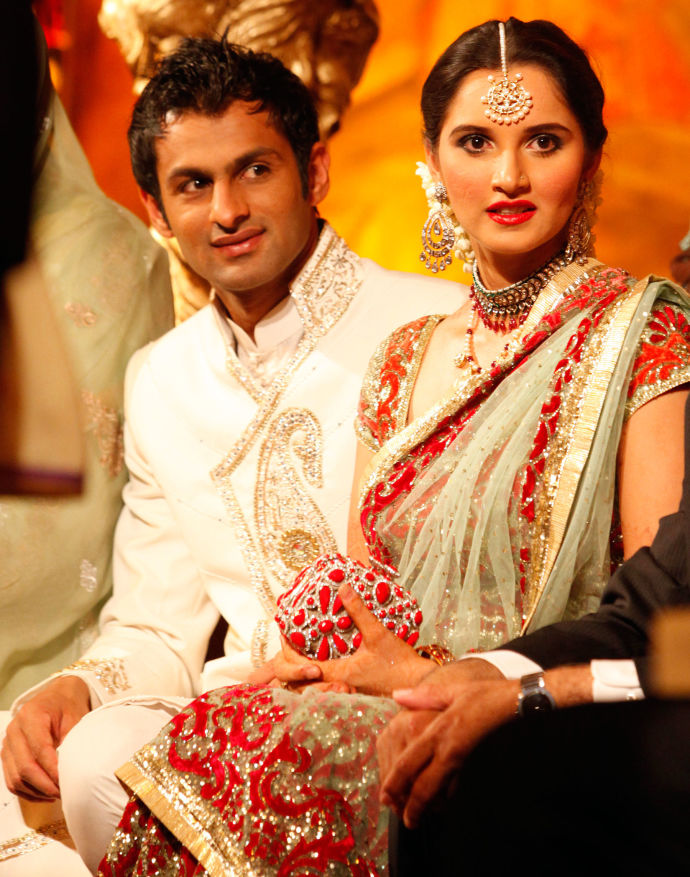
Mirza at her second wedding to the Pakistani cricket star Shoaib Malik, in his home country. His nationality drew criticisim of Mirza in India./ PHOTOGRAPH BY FAISAL MAHMOOD / REUTERS
Mirza at her second wedding to the Pakistani cricket star Shoaib Malik, in his home country. His nationality drew criticisim of Mirza in India./
PHOTOGRAPH BY FAISAL MAHMOOD / REUTERS

On account of her marriage, some of Mirza’s critics in India have called her the “daughter-in-law of Pakistan.” In an interview with a New Delhi television station, in 2014, she burst into tears, saying she was exhausted by the need to “keep asserting my Indianness.” “I have no problem if they attack me about my tennis or they attack me about what I’m doing,” Mirza told me, adding, “I come from a country of 1.2 billion people, and I’ve accepted the fact that I’m not going to be liked by all of them.” Her family, in any case, approved of the union, Imran said. “She wasn’t getting married to a country but a person.”

Mirza and her father spend much of the year on the road, but when they’re not travelling they can often be found at the Sania Mirza Tennis Academy, a set of nine hard courts nestled among farmland and jungle, with a sweeping view of Hyderabad. The family bought the plot of land four years ago, with the goal of making it a hub for tennis in India. Some hundred children are now enrolled in the academy, almost all of them having heard about it by word of mouth. Some are the children of Hyderabad’s rising middle and upper-middle classes, but others have never seen a tennis court prior to joining, and rely on scholarships, which are offered according to financial need. Backing from sponsors was not forthcoming when the academy opened, in March of 2013, so the program was jump-started with funding from the Mirza Family Trust.

Here Mirza can practice in relative seclusion. She and her father also talk to parents about the nuances of a good backhand, what competition is like internationally, and the grit required to make it as a professional. Some aspiring players have shown up at the academy’s gates on rickshaw, their parents willing to relocate some or all of the family to Hyderabad or nearby villages solely in pursuit of tennis. “They thought Sania was an overnight success, and they want results in six months,” Imran told me when I visited the academy last year. “And I keep telling them it takes ten years to find out whether they even have a chance. It cannot be done for the money or the fame. It has to be done for the passion.”

When I spoke with Mirza in Flushing, a year later, she said it had been two months since she’d been home to India. She and Strýcová won their first match at the U.S. Open, convincingly, 6–3, 6–2, and she noted afterward that the dynamic she shares with Strýcová on the court is not dissimilar from her partnership with Hingis: Mirza is strong and powerful, sweeping the back of the court, while Strýcová is nimble and poppy at the net. The two have known each other since they were teen-agers on the junior circuit, which has helped with the transition. But earlier this week they were knocked out of the Open by Caroline Garcia and Kristina Mladenovic, the tournament’s top seeds. (Garcia is ranked No. 3 in the world in women’s doubles, and Mladenovic is No. 4. Hingis is No. 2.)

Mirza published an autobiography in India this summer. She said she doesn’t know how long she’ll play, or what the future holds for Indian women, but she pointed to India’s victories at the Rio Games as a sign of progress. The Indian Olympic Committee, which had been banned, was reinstated in 2014, and the country sent its largest-ever delegation, a hundred and seventeen athletes. They won two medals: a silver in badminton, for Pusarla Venkata Sindhu, and a bronze in wrestling, for Sakshi Malik. “It was amazing,” Mirza said. “And it was the women who won!”

Mary Pilon is the author of “ The Monopolists,” a book about the board game Monopoly. She previously worked as a staff reporter at the Times and the Wall Street Journal, where she wrote about sports and business.

source:  http://www.newyorker.com / The New Yorker / Home> Sections> The Sporting Scene / by Mary Pilon / September 10th, 2016

Tayabun Nisha to train twelve school athletes

Guwahati, ASSAM :

Guwahati :

The uncertainty over the state’s Class XII examinations, scheduled from Monday, has not curbed the “sporting” instincts of the Assam Higher Secondary Education Council.

The council has roped in former five-time national discus champion Tayabun Nisha to train 12 athletes, who were picked up from among the participants at the first higher secondary and junior college students meet here in December. The shortlisted athletes will attend a special coaching camp under Nisha at the NF Railway stadium in Maligaon.

The council’s novel brainchild, the three-day meet at the Nehru Stadium had attracted 297 boys and 146 girls in seven disciplines — 100m, 200m and 1,500m-sprint, high jump, long jump, discus and shotput events.

It had formed a four-member committee — comprising Nisha, Assam Amateur Athletics Association secretary Sarif Ullah, Thaneswar Saikia and district sports officer of Nalbari, Bhupen Choudhury — to spot talent at the meet.

“The council should be lauded for its efforts. I will contribute my mite to make the camp more meaningful. The trainees will be accommodated at the railway sports hostel. We need more such initiatives for the state to do well in the National Games,” Nisha said.

“The camp will begin after the higher secondary exams. It will be a short camp of maximum 10 days,” chairman of the council D.K. Kakati said. The next course of action will be taken after the council’s physical education committee is formed.

“We hope the sports administrators of the state will take a look at our selected players because some of them could be groomed for the 2005 National Games,” he said.

THE SELECTED PLAYERS

Boys: Kamal Hainary (Darrang); Robin Baishya (Nalbari); Gagan Baruah (Kamrup); Dwipen Rabha (Darrang); Biju Barman (Kokrajhar) and Tultul Saikia (Dibrugarh). Girls:Mina Deka (Nalbari); Jonali Devi (Kokrajhar); Sundari Barman (Kokrajhar); Rupamoni Bora (Jorhat); Puspha Bora (Golaghat); Gitanjal Bora (Golaghat).

source: http://www.telegraphindia.com / The Telegraph, Calcutta,India / Front Page> Northeast> Story / by Umanand Jaiswal / Guwahati – February 19th(20th), 2003

Expat gets creative with his Rolls-Royce for National Day

Kasargod District, KERALA / UNITED ARAB EMIRATES :

Indian expatriate, Iqbal Abdul Hameed, with his car decorated with Shaikh Hamdan's photos. - Supplied photo
Indian expatriate, Iqbal Abdul Hameed, with his car decorated with Shaikh Hamdan’s photos. – Supplied photo

Dubai :

A regular face at car parades, Hameed chooses Dubai Crown Prince’s photos to decorate his car this time.

His craze for displaying distinctive car decorations during UAE National Day celebrations has been hitting headlines for many years. Indian expatriate Iqbal Abdul Hameed has done it once again.

This time, the young businessman came up with a special design dedicated to Shaikh Hamdan bin Mohammed bin Rashid Al Maktoum, Crown Prince of Dubai, on his Rolls-Royce car that caught all the eyes at the National Day parades organised by major police stations in Dubai.

An ardent fan of the Crown Prince, Iqbal chose special photos of Shaikh Hamdan from his childhood till date to decorate his car.

Married to an Emirati, Iqbal said his wife helped him select Shaikh Hamdan’s pictures.

“We have selected memorable pictures of Shaikh Hamdan’s life, especially the ones that show his adventurous nature and love for sports,” he told Khaleej Times.

“I decided to get his photos designed in the shape of UAE postal stamps for this year’s car decoration.It took a couple of months’ preparations to get the car ready with this design,” said Iqbal who has won accolades for his car decorations for the past seven years.

While the luxury cars’ both sides have been splashed with the young prince’s pictures this time, the car’s bonnet features the portraits of the UAE President His Highness Shaikh Khalifa bin Zayed Al Nahyan; His Highness Shaikh Mohammed bin Rashid Al Maktoum, the Vice-President and Prime Minister of the UAE and Ruler of Dubai, as well as His Highness Shaikh Mohammed bin Zayed Al Nahyan, Crown Prince of Abu Dhabi and Deputy Supreme Commander of the UAE Armed Forces.

Images of the UAE flag, Martyr’s Day’s emblem and emblem for the Spirit of the Union on the 44th National Day have also been used. A regular invitee at the car parades of Dubai Police, Iqbal won appreciation at the parades organised by four police stations this week. The photos of his car have also gone viral on social media.

“I am so glad and proud that the Emiratis and expatriates appreciate my efforts in this. This is just a small gesture from my side to show how much I love and feel indebted to this country that has given me everything including my life partner,” he said.

“I have travelled to many countries in the world. But I have not seen any other country that has embraced so many nationalities and cultures with both hands like the UAE has done.”

Chairman of Alia Al Hathboor Group, Iqbal has been seen as a cultural ambassador among Emiratis and Indians here.

Hailing from Kasaragod district in south Indian state of Kerala, the entrepreneur has been known for his charitable activities as well.

sajila@khaleejtimes.com

source:  http://www.khaleejtimes.com / Khaleej Times / Home> National Day 2016 / sajila@khaleejtimes.com / December 02nd, 2015

Bantwal: Author Bolwar Mohammed Kunhi Bags Vishukumar Award

Bantwal (Mangalore), KARNATAKA :

Bantwal:

Noted author and story-writer Bolwar Mohammed Kunhi has been selected to receive the annual Vishukumar award instituted by Yuva Vahini Kendra Samiti.

Kunhi holds the credit of introducing the lesser-known facets of Muslim way of life to the field of Kannada prose. He has written over 250 short stories in Kannada. Atta itta sutta mutta, DevarugaLa rajyadalli, Anka, Akashakke neeli paradey, Ondu tunDu goDe, Ruqia and RoTTi Patumma are some of his best-remembered works.

Author Upadhya will confer the award on him at a function to be held in the Birwa auditorium at Melkar next week. The award comprises Rs 10,000 in cash, a memento and a citation.

source: http://www.mangalorean.com / Mangalorean / Home> Agency News> Regional / by Jyothi, Team Mangalore / August 03rd, 2015

Melody manzil

NEW DELHI :

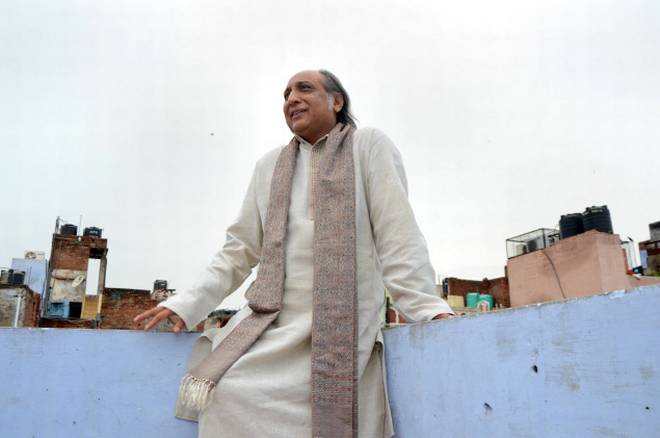
Family harmony: Ustad Iqbal Ahmed Khan on the terrace of his home, Mosiqui Manzil. Photo: Monica Tiwari


RAJAN about the hoary tradition of the Dilli gharana of which he is the torchbearer

A family that sings together stays together. Ustad Iqbal Ahmed Khan and his clan — that spreads itself genially through the rooms, nooks and surprise terraces of “Mosiqui Manzil” in Delhi’s Darya Ganj — exemplify this adapted adage. It takes some perseverance to reach the ustad, the khalifa or senior most exponent of the Dilli gharana of Hindustani music. Leaving the main road, automobiles and ‘Delhi now’ behind, we proceed deeper and deeper into the bylanes behind Golcha cinema. The helpfulness of the bystanders and shopkeepers is inversely proportional to the width of the streets. As the lanes get progressively slimmer, there is less and less need to ask for directions by house number. ‘Iqbal Bhai’ is well known to his neighbours. As he is, indeed to India and much of the world.

The 200-year-old house does not get its name from a passing flight of fancy. For generations, it has been the seat of the stalwarts of the Dilli gharana. As the ustad reels off a battery of eminent names, one can just catch those of the past few generations: “Ustad Sangi Khan, father of Ustad Mamman Khan, then Ustad Chand Khan, then my father Zahoor Ahmed Khan, then me, my sons, and by God’s grace my grandson Aalif.” That makes seven generations, though the musical family tree goes back much further, to Miyan Achpal, a musician at the Delhi Sultanate.

He names many a celebrated vocalist who has been a student at Mosiqui Manzil, learning from his great grandfather, grandfather and granduncles: “Mallika Pukhraj, Siddheshwari Devi, her sister Kamleshwari, K.L. Saigal, Madhubala, Mumtaz…they all learnt here. Others too, like Vidushi Krishna Bisht, my guru-behen,” he says, adding, “And I too learnt in this very room.”

He notes fondly, “I was born in this house. Nafeesa Begum, my mother, is Ustad Chand Khan’s daughter.” Thus, he has been gifted both his music and his house as a precious inheritance.

Soon to complete 60 years, he has already performed for 50 of them, and the golden jubilee of his career was celebrated not long ago by Sursagar Society of Delhi Gharana. When he was eight, he performed under the auspices of Gandharva Mahavidyalya, and last week he was there again, singing at the Vidyalaya’s annual Vishnu Digambar Jayanti Samaroh.

As a baby, Iqbal Ahmed was virtually adopted by his maternal grandfather and guru. “I was three months old. My mother tells me she used to take me only to feed me. I can’t remember those days, but she tells me that when I was two, he would hold me to him and pat out talas on my back. When I was three, he started teaching me a bit, and by the time I was four I had started formally training. He always kept me by his side.”

He points out an old newspaper clipping where he is seen as a tiny tot sitting beside his grandfather-guru. The paper is dated 1957, and, ironically, the article heading shows that preserving the tradition was a significant concern even then.

Mehfils and impromptu concerts were common occurrences, he recalls. “Any musician coming to Delhi visited our house. It was the focal point.” They would stay at hotels like the Haji Hotel nearby, but meals were at Mosiqui Manzil. The concerts would be held on the ground floor of the house in a portion that is no longer free, since with the expansion of the family, many new rooms have been built and partitioned off.

The memories come out like landmarks in Hindustani musical lore. Ustad Amir Khan came when the film with which he was associated, Baiju Bawra, was released. “ Kya buzurg, kya kalakaar (Such revered elders, such artistes)! Bade Ghulam Ali Khan, Bhai Lalji Lahorewale, Ravi Shankar, Vinayakrao Patwardhan, Vilayat Khan Saheb Agrawale, Rahimuddin Khan Saheb Dagar, Shiv Kumar Sharma’s father…you name them, and they came. My grandfather loved to invite them and arrange feasts and concerts for them.”

Surrounded as he was by loving gurus, friends and family, there was one special cousin, Zohra, who became his wife. “She has been the support I needed to accomplish anything in life,” he says affectionately. The ustad, a graduate of Dayal Singh College, also informs us, “My wife is the first woman graduate in our khandaan. She went to Mata Sundari College. That is why our children too have studied well.”

Life is different today. The city around him has changed beyond recognition, and, despite his protective zeal in preserving the layout of the room in which he and his forefathers practised music, life in Mosiqui Manzil too has changed. The ustad weeps freely when he remembers the various festivals when the gurus and shishyas got together to sing bhajans in praise of the relevant deity or genres of the season. “On Holi we would sing horis one after the other, during Bahar, we would sing Bahar ke prakaar (varieties of raga Bahar). On Durga Puja we would have mehfils till midnight, then make a round of the temples. All that is over. I feel very alone when I remember those days,” he sighs.

But on a more cheerful note, he sings a bhajan composition in a silky-sandy voice. “ Kripa samudram sumukham trinetram…I have composed hundreds of bhajans,” he recounts with relish. He also likes to compose music for classical dancers and promptly comes out with a Sanskrit shloka to Shiva, the lord of dance, “ Angikam bhuvanam yasya…”

The ustad spends a few months of the year in the U.S. where he has a number of disciples. “It is because of them that I go,” he says. “I do my bit to propagate art and culture.”

What brought him back from a three-month stint there this summer was the pull of his grandson. As he takes him in his lap and starts to sing, the five-month-old needs no patting, no soothing. He is all alertness. The parivar parampara, it is obvious, is in full flow.

Changing tunes, one raga

One can imagine that Mosiqui Manzil used to be a sprawling mansion when Ustad Iqbal Ahmed Khan was a child. Dividing it up between family members, adding rooms and floors, has changed the structure substantially. “The house number was once 1071, then it became 1593, then 1594,” he says. Now his portion is number 1595. But then the city is no longer an expansive place either. From the terrace of his house, the ustad says, the Qutub Minar was once clearly visible. Later, only Jama Masjid, being closer by, could be seen. But now, all around Mosiqui Manzil are buildings and more buildings, rising in crooked verticals to a smoggy sky. A few intrepid young residents fly kites from precarious perches. The ustad waves to a neighbour looking over from his terrace. “We have grown up together,” he says with a contented smile. There’s always room for harmony.

source: http://www.thehindu.com / The Hindu / Home> Music / by Anjana Rajan / New Delhi – August 23rd, 2013

Suhana Zafar

Mumbai, MAHARASHTRA :

Zafar Karachiwalla talks of his career on stage, television and film with MINI ANTHIKAD-CHHIBBER

Sitting pretty Zafar Karachiwalla believes theatre is the purest form of performance / Photo: D. Gopalakrishnan
Sitting pretty Zafar Karachiwalla believes theatre is the purest form of performance
/ Photo: D. Gopalakrishnan

From the idealistic bureaucrat (Chai Pani etc) to a paan chewing nawab (Womanly Voices), from the slightly stuffy manager (Manasarovar) to the besotted lover (Romeo and Juliet), Zafar Karachiwalla has done them all and is looking for fresh peaks to conquer.

A born and bred Mumbaiite, Zafar went to a Jesuit school and studied commerce in college. “I was a regular college guy you know totally lukha, bunking classes and all. The first play I did was in French that was because I was studying in Alliance Francaise. And that is when I realised that theatre is a fun thing. I started off with Shakespeare and contemporary Indian writing and kind of worked my into professional theatre.”

Theatre for Zafar is not a stepping-stone to films. “No way! I know it is difficult to make a living out of theatre but last year I did 150 shows in 365 days. I earned enough but it is difficult to sustain that kind of momentum.”

Theatre for Zafar is the “purest form of performance. You have to hone your craft to the nth degree, as there can be no goof ups. Theatre gives an instant feedback. You know it is like a drug. Once you do it you keep coming back for more and more. I believe film is a director and cinematographer’s medium, television is a writer’s medium and theatre is an actor’s medium.”

Zafar feels “theatre in India is changing. We are finding our own voice. College kids come in droves to watch a play. The culture is changing and that is heartening.”

Zafar has done a fair amount of television including the hugely popular Hip Hip Hurray and Neena Gupta’s Pal Chhin apart from the mega budget Sansar. Zafar is not taking up any telly assignments now, as he cannot “give that kind of time commitment.”

His filmi foray started with Mahesh Bhatt’s Zakhm. “Working with Bhatt saab was a wonderful experience.” Now there is “Anup Kurien’s Manasarovar, Anand Sivakumaran’s Detour and Karan Kandari’s Bye Bye Miss Goodnight. I am also doing a bilingual for a Los Angeles based director.

“I need to be doing something all the time. I make sure the whole day is choc-a-bloc with things to do. It is good to get home with a nice fatigue.” And work apart from theatre and film includes running the family business of material handling equipment.

With such a packed schedule, chilling out earlier meant, “hitting the discs and clubbing. Now it is more about getting together at a friend’s place and just chilling or catching a movie or something.” A self-confessed Star Wars freak, Zafar watched the latest, Revenge of the Sith. “I know nothing can match the original three but here you have Yoda fighting which is mind-blowing.”

Zafar is all set to direct his own play. “It is an adaptation of this anonymous work called Timely Manoeuvre and I am not going to act in it because unless you are bloody good or Clint Eastwood, it would be better to stick to one thing.”

Zafar’s formula for acting is “first think stupid. I cannot think of anyone more stupid than Romeo and Juliet,” he says categorically of the bard’s star-crossed lovers. So has he been crossed in love? “I was in a relationship for a long time now I am enjoying being single and when the right girl comes along, it will happen I guess.”

So all ye girls looking for a hyperactive, super talented Virgo, your search ends here.

source: http://www.thehindu.com / The Hindu / Home> Metro Plus Hyderabad / Home> Features / Wednesday – June 01st, 2005

Indian men and women 4x400m relay teams on verge of making Rio cut

INDIA :

indianrelaympos27sept2016

Bengaluru :

Indian men’s and women’s 4x400m relay race teams virtually qualified for Rio Olympics  after clocking impressive timings at the 3rd  Indian Grand Prix athletics event  on Sunday.

The men’s 4x400m relay quartet of Kunhu Muhammed , Muhammed Anas ,  Ayyasamy Dharun and Arokia Rajiv (running as India A) smashed the national record by finishing the race with a timing of 3:00.91secs at Sree Kanteerava Stadium here.

The quartet clipped more than one second from their four-week old earlier national record of 3:02.17secs which they clocked at Erzurum, Turkey.

The men’s  4X400m relay team today leaped to 13th spot in the current world rankings from last night’s 18th. The top 16 countries in the world at the deadline of July 11 will qualify for Rio Olympics.

The women’s 4x400m relay quartet of Nirmala Sheoran, Tintu Luka, M R Poovamma and Anilda Thomas (running as India A) also made tremendous improvement in their timing, clocking 3:27.88secs – the fourth best time ever – to also virtually qualify for Rio Olympics.

The women’s 4x400m relay team, which yesterday slipped to 14th spot due to the ongoing European championships in Amsterdam, today bounced back to its original 12th place after this performance.

Athletics Federation of India Secretary C K Valson said that both the men’s and women’s 4x400m relay teams are certain to qualify for Rio Olympics.

“The women’s and men’s 4x400m relay team have virtually qualified for Rio Olympics. The women’s and men’s relay teams, are now placed 12th and 13th position,” Valson said.

To make the event eligible for Olympic qualification, athletes from Sri Lanka and Maldives have been invited to take part in the relay races. At least, two international teams are required to make the event counted for Olympic qualification.

With the addition of the men’s and women’s 4x400m relay teams, the Indian track and field contingent is likely to swell to 33 as 24 have already qualified for the Rio Games.

Muhammad Anas (men’s 400m) and Nirmala Sheoran (women’s 400m) and Tintu Luka (women’s 800m) have already qualified for the Olympics in their individual events and since they are expected to be in the relay teams, another nine will be part of the two relay squads of six each.

This will take the total number of Indian sportspersons for Rio Olympics to 114 as 105 have already qualified.

Today’s results meant that Athletics Federation of India’s idea to provide another chance to its athletes with Olympic ambitions paid off well. The 3rd and 4th (to be held tomorrow) Indian Grand Prix events were hurriedly decided to be held here with this idea.

Mohammad Kunhi, the men’s 4x400m relay team coach, said his boys did really good to virtually qualify for Rio.

“I had the target of 3:01.31s, but the boys did extremely well to clock 3:00.91s. I am very happy that the boys will make it to Rio Olympics because right now we are placed 13th, which makes us a strong contender for qualifying. Only a miracle performance by other countries’ athletes trying to qualify can better our timing and position,” Kunhi said.

Asked what preparation went into the sterling performance put up by the boys, Kunhi said their participation in international meets in Poland, Turkey and France had given them good exposure, which helped them to achieve this feat.

On whether the team stands a good chance of winning a medal in Rio, Kunhi said, “If my boys are able to clock 2.58.57s, we stand good chance to win a medal. I will work on the aspects of speed endurance.”

Asked about other competitions in the run up to the Rio Olympics, Kunhi said he would take his boys to Columbia for training as the climate there is similar to Rio.

In other events of the day, Railways’ V Neena, who has been dominating the long jump scene in the current season, was once again on the spotlight as she produced a wind-aided 6.57m (+2.3 m/s) to win the gold.

Neena, the National Inter-state Championships winner with 6.45m, had also clinched the gold in Thailand Open with another personal best 6.46m less than a week ago.

The men’s long jump event witnessed keen contest between Inter-state victor Yugant Shekhar Singh and Muhammed Anees.

Anees opened with 7.78m and Shekhar responded by improving his personal best to 7.76m in the fourth round. Both the jumpers had an identical 7.80m in the fifth round.

However, Anees was adjudged the winner with his better series of jumps at the end and hence avenged his defeat at the National Inter-state Championships.

Fresh from his Inter-State victory, Amit Kumar (Services) once again toppled Rajinder Singh (75.40m) and Vipin Kasana (73.85m) in men’s javelin throw with 76.25m.

In other events, Rio qualifier Inderjeet Singh (Oil India) was an easy winner in men’s shot put as he tossed the iron ball to 19.85m. That effort was more than a metre ahead of second placed Tejinder Pal Toor (Punjab, 18.66m) and national record-holder Om Prakash Singh Karhana (ONGC, 18.64m).

National record-holder Siddhant Thingalaya failed in his bid to qualify for Rio in 110m hurdles as he hit the third hurdle very hard that cost him dearly in his timing (13.75 secs) in a thin field.

Kerala’s Shilpa Chacko (13.41m) outclassed her Kerala team-mate N V Sheena (13.29m) in women’s triple jump. Sheena, having a season best of 13.58m registered during the Kosanov international meet at Almaty, Kazakhstan last month could not find her rhythm today.

Maldives’ Hassan Saaid was the fastest man of the meet as he ran the 100m dash in 10.37secs ahead of Krishna Kumar Rane (Customs, 10.46secs) and national record-holder Amiya Kumar Mallick (Odisha, 10.49secs).

Some of the biggest names in Indian athletics, who also have qualified for Rio, took part in the Grand Prix. Among them were Dutee Chand (women’s 100 metres), Ankit Sharma (men’s long jump), Tintu Luka (women’s 800m), Mohammad Anas (men’s 400m) and Srabani Nanda (women’s 200m).

Other prominent athletes who took part in the event include two-time Olympian Renjith Maheshwari (men’s triple jump), Amiya Kumar Malik (men’s 100m), Jyoti HM, Merlin Joseph (both women’s 100m), M R Poovamma, Priyanka Panwar, Ashwini Akkunji, Juana Murmu (all women’s 400m) and Sahana Kumari (women’s high jump).

source: http://www.timesofindia.indiatimes.com / The Times of India / News Home / PTI / July 10th, 2016

Amjad Khan, the Gabbar of Sholay, died 23 years ago on this day: Some facts you should not miss about the Sholay actor

On Amjad Khan a.k.a Gabbar’s 23rd death anniversary, read on to know more about him.

Mumbai, MAHARASHTRA :

Amjad Khan in Sholay

Amjad Khan portrayed the character of Gabbar in the movie Sholay and immortalised him as the scariest villain in the Indian cinema. He played the role so perfectly that the laughter of the scariest robber, Gabbar, can still give you chills on the back of your neck. He was only 11 years-old when he was offered his first role for the movie Nazneen.

He died on July 27, 1992. On his 23rd death anniversary, read on to know some facts about him:

  • Amjad Khan was born as Amjad Zakaria Khan. He was born to the actor Jayant in a small village of Peshawar, British India
  • Khan was educated at St. Andrew’s High School in Bandra. Later, he attended R. D. National College
  • In college, he was the general secretary which is considered to be the highest student body representative
  • Before entering films, Khan used to be a theatre actor
  • Khan was only 11 years old when he got his first role in the film Nazneen. He got his next role at the age of 17
  • Amjad Khan was not the first choice for the character of Gabbar. It is believed that Javed Akhtar initially thought that his voice was too weak for the role
  • He was a post-graduate in Philosophy
  • Amjad Khan had command over English, Persian and Urdu
  • To prepare for the role of Gabbar, he read Abhishapta Chambal which is a book on Chambal dacoits. The book is written by Jaya Bachchan’s father, Taroon Kumar Bhaduri
  • It is said that Amjad Khan took 40 retakes to perfect his dialogue “Kitne Aadmi The?”
  • Khan continued to play negative roles in many Hindi films from 1970s to early 1990s, after the success of Sholay
  • He also ventured into directing in 1983 . He directed and also starred in the movie Chor Police
  • Amjad was the president of the Actors Guild Association
  • In 1986, Khan met with an accident. The drugs caused him a serious weight problem for the rest of his life. As a result, he died in 1992 from a heart failure.

source: http://www.indiatoday.intoday.in / IndiaToday.in / Home> GK & Current Affairs> Listicles> Microfacts> Story / New Delhi – July 27th, 2015

Royal Musician

KASHMIR :

Ghulam Qadir Langoo has been singing since he was a court singer of Maharaja Hari Singh

For 60 years Ghulam Qadir Langoo sang for rulers and the people of Kashmir, and his passion for music gave Kashmir, singers like Raj Begum. Shaziya Yousuf reports.

Ghulam Qadir Langoo, 95, spends his days reminiscent of his contribution to Kashmiri Sufiana music. Very few people know Langoo was a court singer for Maharaja Hari Singh.

Langoo’s family had a long association with the royal courts.  His grandfather Shabaan Langoo was a Nakaal (entertainer) in Maharaja Pratap Singh’s court. As a child Qadir would accompany his father Mohi-ud-din Langoo to the court of Maharaja Hari Singh where he would watch him play santoor.  “Maharaja would get happy and flung a gold coin, that meant much those days,” Langoo says.

Langoo learned music from his father to carry the legacy forward. Langoo’s father would also teach Hafiz Nagma to female dancers at his home.

And like his ancestors, Langoo’s stints in the court hardly brought him any riches. He lived a poor life and spent 60 years singing for the rulers, though he was a little better off than his relatives, who mostly were cobblers.  “I sang for the kings, the kings kept changing. I was like an instrument that played for anyone who stroked its cords,” says Langoo.

Apart from Hari Singh, Langoo sang for Sheikh Abdullah, Bakshi Ghulam Mohammad and has also entertained Jawaharlal Nehru and other guests.
He has shared stage with Indian musical greats like Lata Mangeshkar, Aasha Bhonsle and Mahinder Kapoor, mostly playing Tanpura. His mastery over Tanpura (musical instrument) put him into a different class.

The Maharaja’s court, he tells, was different from the royal courts seen on television, with some resemblance though.

A lady dancer, called tawafan would do Hafiz Nagma by dancing and singing to the tunes of Sufi music that Langoo, with his choir, would play. “Guests would relish royal feasts, and sweets would be distributed among musicians. We would take sweets home. I still remember there was a cardamom plant in the royal lawns,” Langoo recalls.

Many decades later, when Radio Kashmir was inaugurated, Langoo sang for whole night in Polo Ground.

“Bhakshi Ghulam Mohammad once told that we can have our own radio station if I get many more singers for it. I worked day and night to gather the artists,” he says.

He was appointed in the station, as a singer and artist but says he would even compose music at times. Once, he says, the station required female singers for some contract. The station had none then. But Langoo was eager to secure the contract and the contract form required photograph of a female singer.
He did something, he now calls his madness. “I used my wife’s photograph (who was not a singer) despite her objections. I left her crying. It was my madness, all I could see was Radio Kashmir.”

Meanwhile they started searching for female singers, in which Langoo had a major role.

“Those days singing and performing arts was an affair of lower class people like my family. So I searched there,” he says. Thus he found and trained singers like Raj Begum, Zoon Begum and Naseem Akhtar.

Slowly music industry grew in Kashmir, and with it grew his passion for it. When Langoo’s only daughter was born, he named her after Raj Begum, who by then was a household name.

“I would sing in her ears…Later I took her to famous musician Shambo Nath Sopori for professional training, but did not let her join Radio Kashmir. It wasn’t a good place for girls,” he says.

In 1964 When Sheikh Abdullah was released from jail after 11 years, Langoo was taken to Pune by Shiekh’s fellow leaders where he sang his favourite song, Walo haa baagwaano and keam sana badlow soan takdeer, qaid-e-azam sheri Kashmir

Langoo and his group were also invited by Jawahar Lal Nehru to his mansion.
At the prime minister’s house where they sang for his Russian guests, Langoo remembers how their group was terrified by the sight of two pet bear cubs, and how a tea that the guests were praising tasted like “poison”.

Among his hosts, Langoo enjoyed singing most for Bakhshi Ghulam Mohammad.

“Just a song of mine and he would forget who he was. He would join the choir and play some instrument mostly Noutt. I still remember how happy he would get,” Langoo recalls.

He sang on the foundation stone laying ceremony of new secretariat building where he says, “My photograph hung in corridors later, I don’t know if it is still there.”

Langoo: A portriat
Langoo: A portriat

While Langoo survived on royal patronage, the performing artists of the time were in a bad state. “It was pathetic. They would be always given leftover food. Most famous among the local populace was bacha nagmawhere a small boy dressed in women outfit would dance before men, he had to entertain each person individually, if he forgot to address someone, the poor boy would be beaten to pulp.”

Since his retirement from Radio Kashmir, some 30 years back, Langoo has been living a private life. For his contribution he has been honoured with Fazil Memorial Award, Bhakshi Ghulam Mohammad Award but the “metallic toys” as he describes them, hardly sum up his contribution to the Kashmiri sufi music.”

source: http://www.kashmirlife.net / Kashmir Life / Home> Music / June 08th, 2010

Teen Muslim girl gets bravery award for saving Hindu classmate from kidnappers

Agra, UTTAR PRADESH :

naziampos27sept2016

Nazia  said her actions were spontaneous and she didn’t hesitate even for a second to think about her won safety.

Agra :

Amidst the communally surcharged atmosphere in Agra  following, the killing of VHP leader Arun Mahor, this is a story that both communities need to take lessons from and then celebrate it.

15-year-old Nazia was on Tuesday awarded the Rani Laxmibai bravery award by chief minister, Akhilesh Yadav, for saving a 6-year-old Hindu girl from kidnappers in August last.

It was the afternoon on August 7, when Nazia, a student of Saghir Fatima Mohammadia Girls Inter College, was returning home when she heard cries for help from a young girl, who was being forcibly pulled on a motorcycle by two youths.

Unmindful of her own safety, Nazia rushed to the girl’s help and held her hand and managed to pull her away from the kidnappers, who then fled the spot.

It was only after she had rescued the girl, Dimpy, Nazia learnt that she was her junior from school. Today, when tension prevails between the two communities, Dimpy’s parents treat Nazia as their own daughter and are indebted to her for saving their child from the clutches of the kidnappers.

Talking to TOI on phone after receiving her award, Nazia said her actions were spontaneous and she didn’t hesitate even for a second to think about her won safety. “It was about 12.30 PM when I heard Dimpy’s cries for help. I just rushed to her and caught hold of her hand”, she said.

Recalling the moment, Nazia said, “It was like a tug of war for 2 minutes. While they tried pulling her on the motorcycle, I kept pulling her back”, she said adding that the suspects finally gave up and fled.

Nazia said since the incident had happened near Sadarbhatti area, which is just 100 meters away from their school, she immediately rushed there with Dimpy and informed the Principal. “Dimpy was crying. After the school authorities informed the police, I took her home to her parents”, she said adding that she is now treated as a daughter in Dimpy’s home.

When contacted, Dimpy said she was very happy that “didi” had been awarded for her bravery. “Agar didi uss din na hoti to woh log mujhe le jaate (they would have taken me away that day if ‘didi’ hadn’t been there)”, she said.

Describing the award ceremony as a moment of “pride” of her, Nazia said she would do the same if something like this ever happens again. The award also carries a cheque of Rs one lakh.

Haji Jamiluddin Qureshi, Manager of Saghir Fatima Mohammadia Girls Inter College, said, “there is no religious discrimination in our school. Even the students do not discriminate between themselves because of their religious beliefs”.

He said, “in our school we have Muslim girls learning Sanskrit and Hindus girls taking lessons in Urdu”.

http://timesofindia.indiatimes.com/city/agra/Teen-Muslim-girl-gets-bravery-award-for-saving-Hindu-classmate-from-kidnappers/articleshow/51314889.cms

source: http://www.kractivist.org / Kractivism / Home / by Anuja Jaiswal , TNN / posted by Kamyani / March 10th, 2016