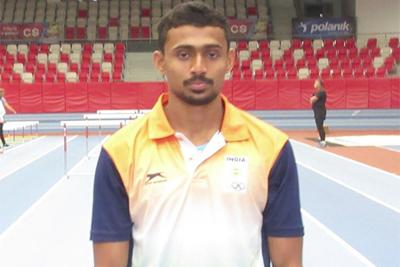
Indian quartermiler Mohammad Anas qualified for the Rio Olympics by shattering the men’s 400m national record on the second day of Polish Athletics Championship at Bydgoszcz.
21-year-old Anas clocked 45.40secs, the exact Rio qualification timing, to book the Olympics ticket last night and become the 21st Indian track and field athlete to qualify for the upcoming Games.
The Kerala athlete shattered his own national record of 45.44secs which he set on Friday on the first day of the same competition at this Polish city.
Rajiv Arokia, whose national record of 45.47secs Anas broke on Friday, finished second with a timing of 45.60secs.
Anas had won a silver in the Federation Cup of National Athletics Championships in April with a timing of 45.74secs.
source: http://www.timesofindia.indiatimes.com / The Times of India / News Home> Sports> More Sports / PTI / June 26th, 2016
It looks like Resul Pookutty is on an award-winning spree. The Academy Award-winning Slumdog Millionaire sound designer was recently honoured with yet another award.The Rocheston Accreditation Institute has honoured the sound designer with Rocheston’s Distinguished Engineer award, for his contribution to the field of sound and music in cinema.
Academy Award-winning musician AR Rahman, took to his micro-blogging page to congratulate Resul. He posted, “Congrats Resul for getting the most distinguished engineer award from Rocheston”. Rahman and Resul share a cordial working relationship.
source: http://www.timesofindia.indiatimes.com / The Times of India / News Home> Entertainment> Tamil / TNN / June 26th, 2016
Here is an inspirational story that needs to be told and a young woman whose path breaking effort needs to be applauded.
Nadiya Nighat
On a late peak summer afternoon in 2007, Nadiya Nighat walked into the sprawling lawns of Srinagar’s Amar Singh College along with half a dozen boys from Ram Bagh, the locality within a stone’s throw, where they all lived. The boys were carrying a football with them and soon Muhammad Abdullah Dar, a local coach, began to teach them, and about 40 others — all boys — learnt how to roll and tackle the ball on the ground.
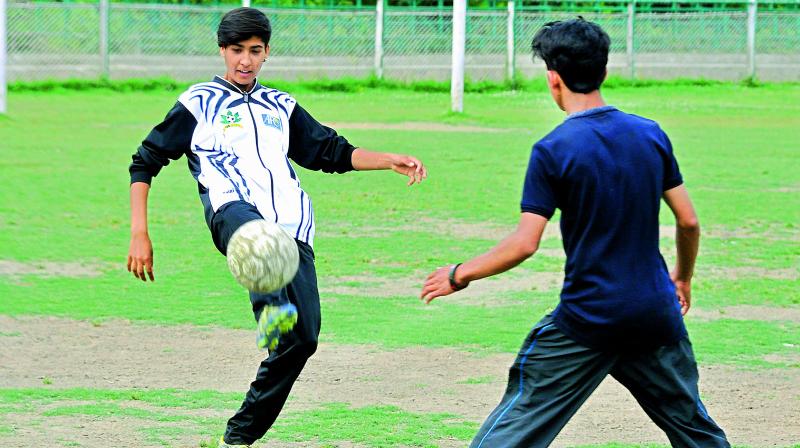
“I just kept watching their pursuit for a while and then requested the coach if even I could join them. He agreed and in about half an hour, I came to know what the game is all about,” Nadiya recalls. “Until then I knew football only as another ball game. Later, I learnt you can work wonders with it. I found it to be a very interesting game and have not moved away from it since then,” Nadiya says who has since, stepped into Dar’s shoes and is incidentally Kashmir Valley’s first female football coach and referee now.
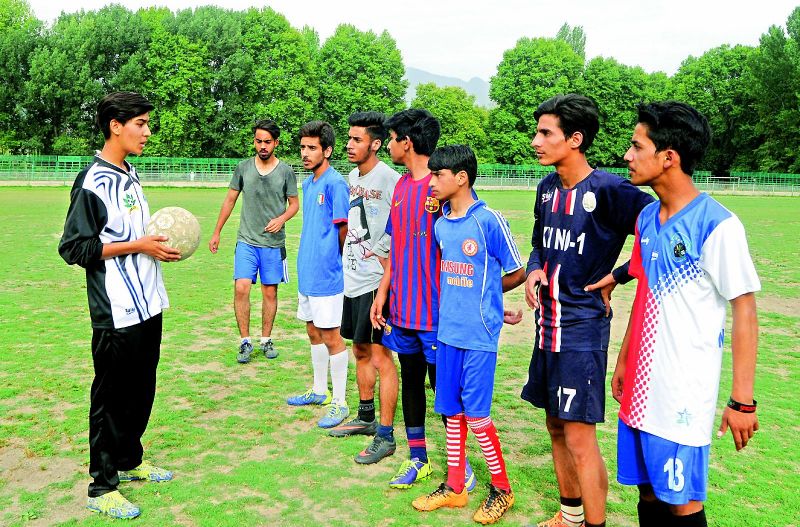
Also, she is the youngest among all the game coaches of the Valley, who just at the age of 19, is training about 30 under-19 players of her own club and a team at the government-run Women’s College at Srinagar’s Maulana Azad Road. She also engages 29 young boys and girls in the 6-12 age group in soccer coaching drills and games at the ‘Grassroots Centre,’ which is being run by Jammu and Kashmir Football Association (JKFA) in the Himalayan state’s summer capital.
“In fact, I teach them and at the same time, I learn as well. It has been a wonderful experience,” she adds.
(above) Nadiya Nighat training under-19 players at the government-run Women’s College at Srinagar’s Maulana Azad Road
She passed her 12th Class examination as a regular student of a J&K government-run school (Channapora) a couple of months ago and is now trying to get admission in a physical training institution outside Jammu and Kashmir to pursue a career in sports, with football being “her life”.
“I would like to go outside J&K. A few have suggested Punjab. But then I learnt that Haryana has better options to offer when it comes to football,” says the girl from a middle class background. If she gets enough girls to join her in the Valley, then she might dedicate her time and skills to build a powerful home- team instead. Unfolding her future plans, she reveals, “If that happens, I might seek admission in the Women’s College here and while pursuing my studies, I will train and form our own girls’ football team.”
So far, she has been able to find 18 girls, most of them are of her age and are willing to join her team. But, in most cases, it is their personal longing for the game, which is not backed by their families. “Unfortunately, only a few are being supported by their families. The rest are willing to play but their parents are discouraging them,” she laments.
Nadiya herself had to face resentment from her mother as it was considered a taboo for women to get into a professional employment, leave alone sports. “My mom cautioned me that people will start spreading unpleasant rumours about me joining (a sport), which may ruin my life. But, my papa put his foot down and said that, “If she is interested in making a career in football, nothing should stop her.”
Luckily, I now find a hardened supporter in my mom as well and I do hear encouraging words from neighbours, relatives and friends, who would earlier raise their eyebrows,” Nadiya spoke to the correspondent after holding a tough 60-minute-long soccer training session with half-a-dozen boys at Srinagar’s Polo Grounds sports facility run by the JKFA.
Sameer Gulzar, a trainee, says, he is being trained by Nadiya from the past five months. “I, like the others, have learnt a lot about the game. She is a good coach who trains us with utmost care and tenderness. She never loses her temper. If one of us makes a mistake, she graciously tells him where he went wrong and how he can rectify it,” said the 17-year-old aspirant.
Like Sameer, others in the group were astonished when they first came across a female coach and when they were told that she would be training them. “Now, it is normal. We come here, do our drills and return home happy, with a resolve to return here for the next session. She is really good and there is no problem in communicating with her,” he adds.
Not only in football, but across almost all sports in Jammu and Kashmir and the entire country, the dearth of women coaches is felt by all aspiring sports women. “This is one of the main reasons why women are not coming forward to play and make a career in football and other games in Kashmir. The JKFA has been very helpful to me. It has given me access to use its facilities, including grounds and tools to train both males and females, but the girls are reluctant as they don’t find these secure enough. For instance – Bakshi Stadium, it is a sheltered place but the round-the-clock presence of security forces within the premises dissuades girls from relocating there to train or play the game,” she said.
As far as polo grounds is concerned, parents are not ready to allow their children to play while being watched by men, “If the government comes forward, releases funds and provides the required facilities, including secure locations for girls to play, we would soon be able to put forth a women’s football team of international standards,” Nadiya says, hoping that, “What is important is changing a person’s thinking about women pursuing a career in sports. Culture badalna chahiyen.
There are many there (who like me) who are inspired by Cristiano Ronaldo and Lionel Andrés ‘Leo’ Messi or want to follow the footsteps of Lotta Schelin and Kim Little. But, before they actually give it a try, the Kashmiri society has to change and it must welcome women who are interested in male-dominated career options,” she concludes.
source: http://www.deccanchronicle.com / Deccan Chronicle / Home> Sunday Chronicle, Headliners / by Yusuf Jameel / June 26th, 2016
In the 2014 polls, Mr. Sayeed defeated Congress candidate Mr. Shah by 6,000 votes and the margin has doubled this year.
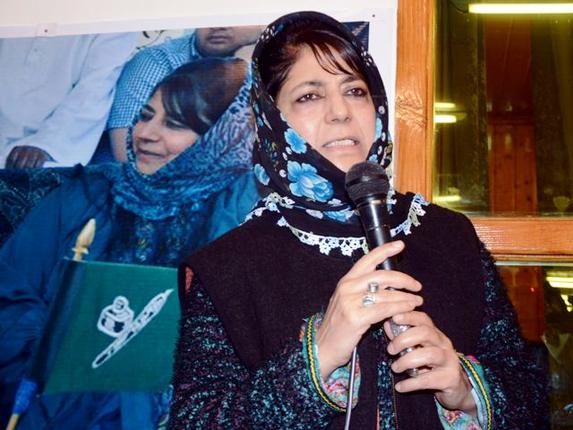
Chief Minister Mehbooba Mufti on Saturday won the Anantnag Assembly seat by 12,085 votes, driving home a point that her popularity remains unaffected by the Peoples Democratic Party’s decision to join hands with the BJP in Jammu and Kashmir.
Of 28,500 polled votes, the PDP candidate Ms. Mufti has secured 17,701 votes, followed by Congress’ Hilal Shah with 5,616. National Conference (NC) Iftikhar Misger stood a distant third with 2,811 votes.
The PDP’s winning margin has considerably gone up in Anantnag despite the NC and the Congress pegging its campaign on the anti-BJP wave and cornering Ms. Mufti over her alliance partner.
In the 2014 polls, Mr. Sayeed defeated Congress candidate Mr. Shah by 6,000 votes and the margin has doubled this year with 12,000 lead by Ms. Mufti.
Earlier in the day, the counting was stopped immediately after the first round results were announced because of the Congress’ protests.
“An Electronic Voting Machine (EVM) was not properly sealed and should not be counted at all,” alleged Mr. Shah, as he and his supporters left the counting hall in protest.
However, after 15 minutes the counting was restarted.
The NC also alleged EVM tampering. “A lot of EVMs in Anantnag (were) without mandatory seals/locks. Electoral staff says since teachers were incharge, their inexperience is the reason!” alleged NC spokesman Junaid Azim Mattu, who later congratulated Ms. Mufti on her victory.
However, district magistrate Syed Abid Rasheed Shah refuted the allegations of tampering of EVMs.
The Anantnag seat, which fell vacant after sitting chief minister Mufti Muhammad Sayeed died on January 7, went to polls on June 22. Around 28,500 voters participated in the election out of 80,000 registered voters, with poll percentage pegged at 34 per cent, down by five per cent compared to the 2014 Assembly polls amidst separatists’ boycott call.
Considered bastion of the PDP, it’s Ms. Mufti’s fourth win to the State Assembly from south Kashmir since 1996, when she started her political career as Congress candidate and contested from Bijbehara constituency.
She was also elected to the Lok Sabha from Anantnag Parliament seat in 2014 general elections but returned to the State politics in April this year to take over as the State’s chief minister after her father’s demise.
source: http://www.thehindu.com / The Hindu / Home> National> Other States / Peerzada Ashiq / Srinagar – June 25th, 2016
Around 3am during the month of Ramzan, a group of people from Andhra Pradesh carrying drums and sticks shout in Urdu: “Those who are asleep, wake up, declare your loyalty to God and get up to eat the dawn meal”.
This is like an alarm for Muslims in Udupi to have their ‘Sehari’ and start the fast. These people, called ‘Athala Kotti'(fakir), have been following the tradition for the last four decades. They will do this for 30 days and on Eid-ul-Fitr, Muslims offer them money, food and clothes. The offering is considered as their monthly earning.
These folks are not invited to one place and keep changing places every year. A few of them prefer to visit the coastal district every year.
However, the importance of ‘Athala Kotti’ is decreasing year by year as people are now more depending on alarm clocks and mobile phones to wake up. Earlier, there was no such facilities and these people used to go to each Muslim family and wake them up. Keeping the ancient tradition, some Muslims still prefer to wake up by listening to their voice.
Nazeerulla Shah Khalifa Raphayi from Anantapur district, a member of the group, said, “I have been coming to Udupi for years. We use drums made from animal skin. We sing songs and hold the lamp while moving from one house to another. We start the journey at 2.30am every day and continue till 4am. After the duty, we choose a Muslim house, and in that house we have our Iftar (evening food). The Muslims in the coastal district are used to our visit.”
“We never demand anything from people. This is considered as a service to God. During the month, some of us go to dargas across the country and dedicate their service there,” he said.
Munavvar Alifa, a member of the group, said: “Earlier, there were only few houses here; now, the number of houses has increased, so responsibility is more as we have limited time to wake them up. Even Hindu families give us offerings here.”
According to tradition, the first fakir in Islam was Bilal bin Rabah, who lived between the sixth and seventh centuries, used to wake up believers with his clear voice. Since then, the role passed down from generation to generation, until it became formalized at the beginning of the ninth century.
A person was appointed to carry out the role in every neighbourhood during the month of Ramzan.
source: http://www.timesofindia.indiatimes.com / The Times of India / News Home> City> Mangalore / TNN / June 24th, 2016
Four senior coaches will act as selectors to pick the Tamil Nadu men’s team for the Santosh Trophy South Zone qualifying round to be held tentatively from February 8 to 18 at the Nehru Stadium here.
P. Thulasi, C.M. Ranjit, SyedSabirPasha and Robin Charles will name the TN team after the selection trials which is scheduled at the Nehru ‘B’ ground at 6 a.m. from January 11 to 13.
“There will be no office-bearers involved in the selection process of the players. And there will be no interference and recommendations,” said T.P. Thangaraj, Administrative Officer, Tamil Nadu Football Association, to The Hindu here on Saturday.
The team will be selected on January 13 and then the chief coach will be finalised by TFA thereafter.
SeenuMohideen, former president, TFA and vice-chairman of the Selection Committee, said while in all probability the chief coach will be Robin Charles, the other three coaches/selectors have been appointed to ensure fairness in the selection process.
A camp for the State team will be held at Gateway International School from January 15 till a few days prior to the start of the South Zone qualifying round.
source: http://www.thehindu.com / The Hindu / Home> Sport / by K. Keerthivasan / Chennai – january 09th, 2016
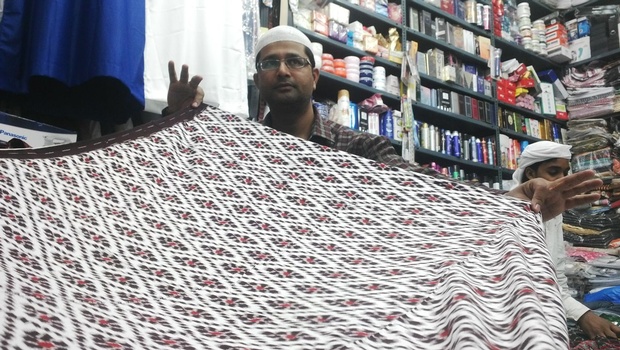
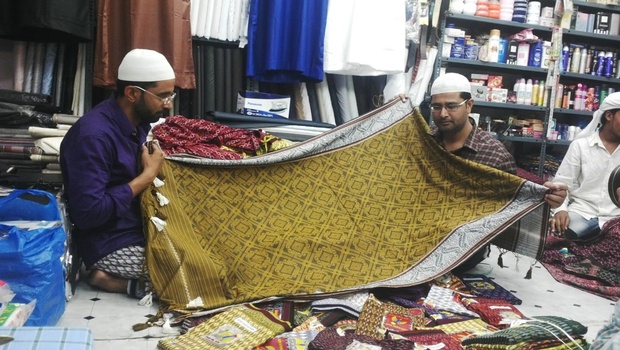
A shopkeeper displaying a Yemeni lungi | (Vinay Madapu/EPS)
Hyderabad :
While the colourful lungi is fast disappearing giving way to the trendy Bermudas, the casual wear is making a comeback among certain communities in the Pearl City.
Sale of imported Yemeni lungis or Futah (also called Izaar in Saudi Arabia) has more than doubled during the holy month of Ramzan in Barkas, the area where Arab-origin Hy derabadis reside in Old City.
While big shops in the area have recorded a whopping 60-70 per cent rise in the sale of lungis, small-scale textile dealers say that there is a 50 per cent rise in demand for lungis.
A shopkeeper displaying a Yemeni lungi | (Vinay Madapu/EPS)
“The lungis form part of our identity,” said 23-year-old Khaled Umar, who doesn’t mind shelling out some extra bucks for it.
Young or old, every male in Barkas prefers the Arab lungis along with full or half-sleeved shirts over any other dress. This is said to be the reason for the spurt in sale of the simple casual wear during Ramzan.
“People gift lungis to their relatives in Barkas and elsewhere during Ramzan and Eid, and a customer will order for multiple number of lungis,” said Md Sarfaraz Khan, a dealer.
Though the price range of lungis starts from Rs 350, high-quality Futahs cost up to Rs 7,000.But, one needs to be extremely careful in handling the lungis. “They are not for rough use. They should be cleaned with care and not squeezed too hard, or else small holes may appear,” said the shop-owner, whose great grandfather, like many other residents of Barkas was brought to Hyderabad as soldiers in the Nizam’s Army.
source: http://www.newindianexpress.com / The New Indian Express / Home> Cities> Hyderabad / by Aishik Chanda / June 20th, 2016
Members smile during a rehearsal break The group is performing qawwali at Goethe Zentrum for World Music Day Celebrations. Photo: G. Ramakrishna
A group of women qawwals share their experiences and the issues they highlight in their qawwalis
Hyderabad :
Away from the hustle and bustle of the bazaars in Charminar, a quiet lane in Sultanshahi resonates with qawwal claps and inside Shaheen Resource Centre, the chatter and laughter of young girls fills the air.
Amidst the harmonium preludes, the group wearing cheery yellow duppattas and feather caps sing a qawwali — Kab tak mera maula, dil mera pukara hai, shaadi meri marzi se kabhi hoti nahin hai, mujh ko kya pasand hai koi poochta nahin hai... Clearly this is not a regular qawwali where singers confine their performances to a spiritual context. The lyrics here carry a message that’s contemporary and temporal though it’s packaged in familiar qawwali tunes.
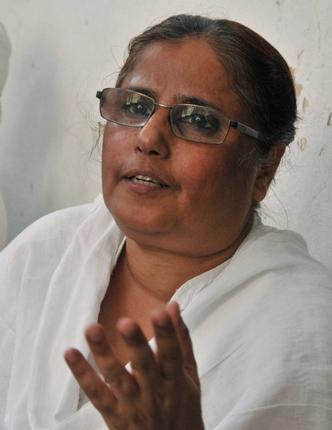
Jameela Nishat of Shaheen Resource Centre Photo: G. Ramakrishna
Jameela Nishat, the founder of Shaheen talks about using qawwali as a beacon of change. “Women are not given space in public; they are allowed to write poetry but not allowed to perform in public. This is our effort to bring a change in that mindset,” she shares.
A feminist Urdu poet who writes the songs which depicts reality, Jameela encourages women to take a step towards this change. As a result, the group from Shaheen has performed qawwalis at schools, colleges and other events for three years now.
Sania Fatima, a staff teacher and volunteer, shares the impact of qawwalis. “When we perform for special days like a Mother’s Day or Women’s Day, we intersperse the songs with messages like ‘beti bachao beti padao’ and highlight the abuse women face daily in their lives. The response is amazing as qawwalis are enjoyed by all,” she points out. Some popular tunes of classics like Tere mehfil mein kismet, aajmaake hum bhi dekhenge from Mughal-E-Azam have been used with lyrics changed to highlight contemporary social issues.
Tackling themes like dowry, education, taking care of one’s health, being independent and making life’s choices; lyrics in the songs asks tough questions. Sultana, who is a graduate, believes qawwalis can be used as instruments of change.
Zehra Jabeen recalls the experience of performing qawwali recently during the ‘Salaam Telangana’ event at Ravindra Bharati. “The crowd was restive and making lots of noise; it did not stop even when we started the qawwali. But within a few seconds, there was pin drop silence and they heard us with full attention.” .
It is a mixed group, comprising members of various ages and stages in life. A first year student Swati Kulkarni is also part of the group. “I have knowledge of music but singing a qawwali was new. Everything, from the costume, changing one’s voice, to singing in rhythm to the claps was different,” she smiles. The cheerful group looks forward to the qawwali performances.
“It is a big challenge to come out and stand courageously on a platform to sing. We hope our songs inspire many others too,” chips in Sania, the lead singer, and adds, “We brush aside minor issues of high notes and low notes. We make our voices heard as a group.”
The rehearsals for a forthcoming performance over, the girls break into a smile. “When we wear the costume and sing in rhythm, we feel so excited that we forget the world.”
(The group is performing as part of World Music Day celebrations at Goethe Zentrum on June 26; Entry: Free)
source: http://www.thehindu.com / The Hindu / Home> Features> Metroplus / by Neerja Murthy / Hyderabad – June 24th, 2016
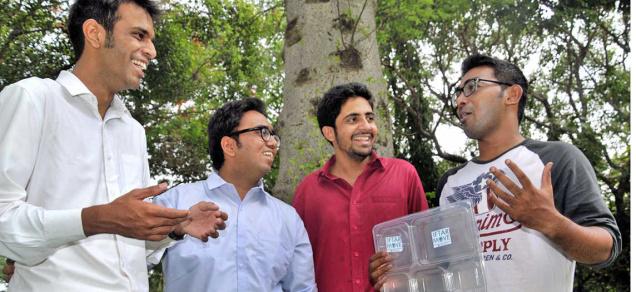
Young entrepreneurs:Kareem, Umair Abdullah, Sharjeel Siddiqui and Syed Adil the team behind the startup ‘Iftar Move’, a food delivery service that caters to people fasting during the Ramzan season in Hyderabad.- Photo: G. Ramakrishna
For the devout observing fast during Ramzan but unable to enter the kitchen for Iftar, the service floated by four youngsters is the perfect solution.
Keeping in mind the limitations of techies, bachelors and also the unwell, Ahmed Kareem, Umair Abdullah, Sharjeel Siddiqui and Syed Adil started ‘Iftar Move’.
The team behind the startup say that the need for hygienic and economical food coupled with a reliable service made them give wings to their idea.
“I have come across people who live alone or are working professionals, who want to break the day’s fast with home-cooked food but cannot. This service is for them,” said Ahmed Kareem Uddin Naseer, Digital marketing Head of ‘Iftar Move’. “This is the first time we are venturing into the food space and it is for a noble cause. We have taken utmost care to prepare food in hygienic conditions.”
The meals can be ordered through whatsapp, website, call or even by posting on the Facebook page. A set of seven items will be delivered which include Haleem, paneer samosas, chicken rolls, bhajiye, dates, fruit chat and Frooti.
Two kitchens, one in Jubilee Hills and the other in Malakpet, have been set up for the service.
With increasing number of orders coming from IT parks, the main focus of the service is also the Hi-tec city and surrounding areas. “We started with 20 or 30 orders but within a week we started getting lot of enquiries. Last weekend we accepted 200 orders,” said Ahmed Kareem who says they might plan to make this a yearly affair every Ramzan season.
source: http://www.thehindu.com / The Hindu / Home> News> Cities> Hyderabad / by Staff Reporter / Hyderabad – June 15th, 2016
With a UK court on Tuesday rejecting India’s arguments regarding the ownership of 35 million pounds lying in the Nat West account, the case would now proceed to trial, unless settled. After 68 years, the court has arrived at who are the litigants in the case so that a trial would be started.
Though it happens to be a snub at India, experts see a bright possibility of the issue being resolved in the next couple of years. “The initial euphoria is as if the entire money is handed over to Pakistan, which is not the case. I had suggested a formula earlier, to divide the money into three equal parts -one each part to Governments of India and Pakistan and Nizam’s family (two of his eldest grandsons as he wished) and this would have been logically acceptable to all the parties. Eventually, I think that is going to happen,” said Md Safiullah, a city based historian and managing trustee of Deccan Heritage Trust
The sum of `310 crore in his opinion is quite a small amount to government of India. “The amount was huge at the time of transfer. Imagine what would have the amount been today had it been invested in business then?,” he asked.
Over the years, Pakistan had been trying to convince the court that money was sent by the Nizam to the newly formed state of Pakistan which did not have any funds at its disposal. The seventh Nizam had in fact sent `20 cr to that country by then. The Nizam’s agent General Nawab Fazal Jung Bahadur, had transferred one million pound to Habib Ibrahim Rahimtoola, the high commissioner of Pakistan, in 1948 at a time of political uncertainty when the future of the then princely kingdom of Hyderabad was in the balance.
“In fact, immediately upon knowing of the transfer of funds to the Pakistan high commissioner, the Nizam sent a telegram that the amount was transferred without his knowledge,” Saifullah added.
source: http://www.newindianexpress.com / The New Indian Express / Home> States> Andhra Pradesh / by Express News Service / June 22nd, 2016