All posts by mpositiveone@gmail.com

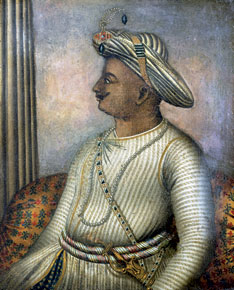
VOICES – Tipu Sultan: Noble or Savage?

TipuSultanMPOs30nov2015

In 1791, the Swami of Sringeri Math wrote to his ruler, and most generous patron, to relate a tragic tale of murder, temple destruction and violent iconoclasm.

The great temple, he related, had been attacked by a large armed party of cavalry. The invaders had mercilessly sacked the complex, stealing over Rs 60 lakh of offerings, including the temple vessels and other valuables. But it was not just a matter of looting and plunder— the raiders had deliberately violated the sanctum sanctorum. The idol of the presiding deity, Sarada, had been desecrated and pulled out of its socket.

The Swami knew that his patron was likely to be sympathetic. He was, after all, locally well-known for taking most seriously his role as protector of his Hindu subjects and their places of worship—as had been his father before him. It was the father who had begun the special relationship between the family and Sringeri, writing earlier to the Swami that ‘you are a great and holy personage. It is nothing but natural for everyone to cherish a desire to pay respects to you.’

The son had continued where his father had left off. From the beginning of his reign, he had loaded the temples of his realm with presents, honours and land. Few of his chancery records survive, but from the temple archives of the region we know, for example, that in 1784 he gave a land grant to one Venkatachala Sastri and a group of Brahmins, begging them ‘to pray for the length of his life and prosperity.’ A year later, he sent the temple complex of Melkote 12 elephants and a kettledrum, while also sending a Sanskrit verse recording his grant of lands ‘to the temples and Brahmins on the banks of the Tungabhadra.’ So it continued at the rate of at least three or four major endowments or gifts of money, bells, pensions, villages, jewels or ‘padshahlingams’ per year, for the rest of his reign, mostly in return for requests for prayers, pujas ‘for the success of the King’s armies’ or temple processions.

But it was Sringeri that had always received both the most generous presents, and as a stash of correspondence discovered within the temple in the 1950s bears witness, Tipu Sultan rose to the occasion and wrote a most heartfelt letter in response to the Swami. He put on record his horror at what the Maratha raiding party, led by their general Parasurambhau, had done to his favourite temple during their 1791 invasion of Mysore: ‘People who have sinned against such a holy place are sure to suffer the consequences of their misdeeds,’ wrote Tipu, ‘In accordance with the verse, Hasadbhih kriyate karma rudabhih anubhuyate, those who commit evil deeds smiling, will reap the consequences weeping. Treachery to gurus will undoubtedly result in the destruction of the line of descent.’

Sending a large sum of cash and a consignment of grain ‘for the consecration of Goddess Sarada’ and to ‘feed one thousand Brahmins’, Tipu asked the Swami ‘to pray for the increase of our prosperity and the destruction of our enemies.’ Shortly after this, he sent another note, along with a present of an elephant, writing that ‘wrongdoers to gurus and our country will soon perish by the grace of God! Those who took away elephants, horses, palanquins and other things from your Matha will surely be punished by God. Cloth for the Goddess has been sent through Narasimha Sastri. Please consecrate the Goddess, and pray for our welfare and the destruction of our foes.’

That the Marathas could desecrate a Hindu temple, and that Tipu Sultan could restore it, goes so firmly against all our modern expectations that it is worth examining what was going on here. How exactly could this happen?

The reality is that the pre-modern rulers of India tend to be more layered and complex figures than the one dimensional gallery of angels or devils we sometimes reduce them to. Moreover, they usually tend to behave in a far less straightforwardly sectarian manner than we might imagine. It was quite normal, for example, for Hindu rulers to endow mosques and Sufi shrines within their Kingdoms—as for example the Marathas did in the 1760s when they took over Burhanpur and Khandesh— just as it was not unknown for them to destroy the temples and state deities of their enemies when they invaded neighbouring lands. This was an old tradition, a normal way to humble an enemy and remove the sources of his power.

The Cholas, for example, were especially ruthless in this respect: when they invaded Sri Lanka and attacked Anaradhapura in 993, they sacked the town, plundered the stupas and destroyed all the temples. According the Culavamsa, the Anuradhapura chronicle:

‘They violently destroyed here and there all the monasteries,

Like blood-sucking yakkhas, they took all the treasures of Lanka.

They took away all valuables in the treasure house of the King,

They plundered what there was to plunder in vihara and the town.

The golden image of the Master [Buddha],

The two jewels which had been set as eyes in the Prince of Sages,

All these they took.

They deprived the Island of Lanka of her valuables,

Leaving the splendid town in a state as if it had been plundered by yakkhas.’

They also laid waste the temples of Manyakheta, the Rashtrakutan capital, and according to western Chalukyan inscriptions, did the same in Kalyana, ‘slaughtering women, children and Brahmins’, even raping Brahmin girls, and taking a large black stone guardian image back to Thanjavur, where it was displayed to Rajaraja Chola’s subjects as a trophy of war. Captured Chalukyan women were enslaved and also taken back to Thanjavur where they formed what one scholar has described as ‘reproductive pools’ for breeding a cadre of military men, the kaikkolas, loyal only to the Chola king.

Indeed, places of worship in state capitals often bore the brunt of successive conquests and reconquests: when Warangal fell to the Delhi Sultanate in 1323, the Tughlaqs destroyed the state temple of Svayabhu Shiva and built a congregational mosque in its place as the centre piece of the city they renamed Sultanpur. But then, at the breakup of the Sultanate, at the Hindu reconquest of the city by Kapaya Nayaka in the 1330s, the mosque seems to have been demolished and the temple restored and rebuilt over its ruins.

This was the world—often surprising to our eyes—that Tipu Sultan inhabited, and we have to make an effort to try and understand the mores of the times if we are to make sense of all this.

There is no question that Tipu was ruthless in war. He routinely and brutally converted to Islam captive enemy combatants and internal rebels, both Hindu and Christian, Indian and British, frequently destroying the temples and churches of those he conquered. He did this on a particularly horrific scale in Malabar, Mangalore and Coorg. Portuguese missionaries wrote that ‘he tied naked Christians and Hindus to the legs of elephants and made the elephants move around till the bodies of the helpless victims were torn to pieces.’

When he defeated the British in 1780, of the 7,000 prisoners he captured—one of whom was my ancestor James Dalrymple—around 300 were forcibly circumcised and given Muslim names and clothes. It is also true that he liked, especially towards the end of his reign, to describe himself as a ghazi, a Muslim Holy Warrior. Yet he clearly did not see this as being in contradiction with his duty to protect the lands and temples of his own Hindu subjects. We may see this as a massive paradox. He and his contemporaries did not.

Tipu’s patronage of the Hindu institutions of Mysore was no doubt as much a recognition of political realities, as any inherent liberalism or ‘secularism’. Tipu recruited a large number of Hindu warriors into his army—especially from the Telugu huntsman caste of Bedas or Beydaru—and he employed Brahmins to run much of his administration, particularly the revenue department, under a Hindu prime minister, Purnaiya. The palace coup which brought his father to power had been financed by Hindu bankers.

The Ranganatha Temple in his capital was not just protected but loaded with gifts which are still on display today, as are all the beautiful Vijayanagara-era images, not one of which has suffered from iconoclasm, despite standing in the middle of the capital of a ruler denounced by his British enemies as an ‘intolerant bigot’, a ‘furious fanatic’ who had ‘perpetually on his tongue the projects of Jihad’. In return for this royal patronage and protection, the Brahmin priests of his capital were expected to pray for Tipu’s success, and by studying his horoscope and the stars, to help augur his fortunes. On one occasion after a group of Malabar Christians had sided with the British, he destroyed churches in Mangalore and northern Malabar and gave the magnificent Dutch-cast bells to one of his state temples, the Venkaramana Temple in Nagar.

Yet it was not all realpolitik. Tipu, despite being a devout Muslim, believed strongly in the power of Hindu deities: in his dreams, which he diligently recorded every morning in a dream book which survived the British sack of Srirangapatna, Tipu encounters not only long-dead Sufi saints, but also Hindu gods and goddesses; in one dream sequence, which he saw on 16 November 1798, there are references to him encountering in a ruined temple idols whose eyes moved: one talked to him, and as a result, Tipu ordered the temple rebuilt. Tipu also strongly believed in the supernatural powers of holy men, both Hindu and Muslim. As he wrote in 1793 to the Swami of Sringeri: ‘You are the Jagatguru,the preceptor of the world… in whatever country holy personages like you may reside, that country will prosper with good showers and crops.’

Moreover, it is clear that for all his self-portrayal in his letters to other Muslim rulers such as Zaman Shah of Kabul, or the Ottoman Sultan in Constantinople, as a Muslim ghazi, intent on kafir conversion, his personal beliefs and cosmologies were imbricated with Hindu ideas of holiness and the supernatural: it is recorded , for example, that he made all his troops, Hindu and Muslim, take ritual baths in holy rivers ‘by the advice of his augers’ in order to wash away cowardice and make them superior in battle to the Marathas.

In this deeply syncretic world view, Tipu was a man of his time, and this vision which saw two cosmologies, Hindu and Islamic, profoundly intertwined, was one that he shared with many of his contemporaries: the Maratha leader Mahadji Scindia, for example, was well known at the time for his deep devotion to various Sufi saints.

Where Tipu does stand apart from almost all his contemporaries, however, was in his prescience about the intentions of the British, his profound alarm at the power of their East India Company, and his determination to attempt to root it out of India. He tried to warn other Indian rulers of the dangers of the increasingly arrogant and aggressive Company: ‘Know you not the custom of the English?’ he wrote in vain to the Nizam of Hyderabad in 1796. ‘Wherever they fix their talons they contrive little by little to work themselves into the whole management of affairs.’

It was these British enemies of Tipu who did most to create the image of Tipu so widely held today. In 1799, before sending into the field the largest army the East India Company ever gathered together, the Governor General, Lord Wellesley, began a campaign of vilification against Tipu, portraying him as an aggressive Muslim Monster who divided his time between oppressing his subjects and planning to drive the British into the sea. This essay in imperial villain-making opened the way for a lucrative conquest and the installation of a more pliable regime which would, in the words of Wellesley, allow the British to give the impression they were handing the country back to its rightful owners while in reality maintaining firm control.

It is, however, a truth universally acknowledged that a politician in search of a war is not necessarily over-scrupulous with matters of fact. Until recently, the British propaganda offensive against Tipu has determined the way that most people in India remember him. But as with more recent dossiers produced to justify pre-emptive military action against mineral-rich Muslim states, the evidence presented reveals far more about the desires of the attacker than it does about the reality of the attacked. For recent work by a succession of modern scholars has succeeded in reconstructing a very different Tipu to the one-dimensional fanatic invented by Wellesley. Tipu, it is now clear, was in fact one of the most innovative and far-sighted rulers of the pre-Colonial period.

What really worried the British was less that Tipu was a Muslim fanatic, something strange and alien, but that he was in fact frighteningly familiar: a modernising technocrat who used the weapons of the West against their own inventors. Indeed in many ways he beat them at their own game.

Tactically the Mysore forces were fully the match of those of the East India Company, and Tipu’s sepoys were every bit as well trained by their French mercenary officers as those of the Company were by theirs; indeed the steely discipline of the Mysore infantry amazed and worried many British observers. The Mysore army was strong in those areas where the Company was weakest and the Mysore light cavalry was ‘the best in the world’, according to Arthur Wellesley, the future Duke of Wellington.

Moreover the sepoy’s rifles and canon were based on the latest French designs, and their artillery had a heavier bore and longer range than anything possessed by the Company’s armies. Indeed, in many respects the Mysore troops were more innovative and tactically well ahead of the Company armies: firing rockets from their camel cavalry to disperse hostile cavalry, for example, long before William Congreve’s rocket system was adopted by the British army. Tipu also developed a large bullock ‘park’ of white Deccani cattle to allow him rapidly to deploy infantry and their supplies through his kingdom, a logistical innovation later borrowed by the British for their wars against the Marathas.

More worrying still for Wellesley, the defences of the island fortress of Srirangapatna were state-of-the-art and designed by French engineers on the latest scientific principles, following Sébastian de Vauban’s research into artillery-resistant fortification designs, as adapted by the Marquis de Montalembert in his book, La Fortification Perpendiculaire. These provided the most up to date defences that the 18th century could offer and also took into account the newly increased fire-power of cannon, bombs and mines, as well as the latest developments in tactics for storming and laying siege to forts. Haider and Tipu even tried to create a navy which by 1766 comprised two ships, seven smaller vessels and 40 gallivats, all commanded by a European sailor named Stannett.

All this made Tipu by far the Company’s most formidable enemy. He was responsible for a unique and catastrophic defeat of the armies of the East India Company at Pollilur in 1780 which led to the slaughter of an entire army and the capture of one in five of all the British soldiers in India: no less than 7,000 British men, along with an unknown number of women, were held captive by Tipu in his sophisticated fortress of Srirangapatna. Many were circumcised and forcibly converted to Islam. Even more humiliatingly, several British regimental drummer boys were made to wear ghagra cholis and entertain the court as nautch girls.

At the end of ten years’ captivity, one of these prisoners, James Scurry, found that he had forgotten how to sit in a chair or use a knife and fork; his English was ‘broken and confused, having lost all its vernacular idiom’, his skin had darkened to the ‘swarthy complexion of Negroes’ and he found he actively disliked wearing European clothes. This was the ultimate colonial nightmare, and in its most unpalatable form: the captive preferring the ways of his captors, the coloniser colonised.

Tipu was just as innovative in peace as he was in war. He tried to import industrial technology through French engineers and experimented with harnessing water-power to drive his machinery. He sent envoys to southern China to bring back silkworm eggs and established serriculture in Mysore—something that still enriches the region today. He introduced irrigation and built dams so that even his British enemies had to admit that his kingdom was ‘well cultivated, populous with industrious inhabitants, cities [including Bangalore] newly founded and commerce extended.’ More remarkably still, he created what amounted to a state trading company with its own ships and factories dotted across the Persian Gulf. He even asked his ambassadors to Istanbul to secure for him the ijara—farm— of Basra so that, like Europeans, he could establish an overseas settlement which would be both a base and a safe haven for his vessels. No wonder the British were terrified when they discovered that ‘Citizen Tippoo’ was in communication with Napoleon Bonaparte, whom he formally invited to visit India to liberate the country and expel the British. He had even sent Ambassadors to Paris along with a draft treaty in which he proposed an alliance to drive the British out of India.

As Christopher Bayly nicely put it, Tipu attempted to fight ‘European mercantilist power with its own weapons: state monopoly and an aggressive ideology of expansion.’ He failed only because the resources of the Company were expanding faster than those of Mysore. British propaganda might like to portray Tipu as a savage barbarian, but he was in fact something of a connoisseur and an intellectual, with a library containing some 2,000 volumes in several languages, and a large collection of modern scientific instruments including thermometers and barometers. The culture of innovation Tipu fostered in Mysore stands record to a man very different from that imagined by the Islamophobic propaganda of the British and the startling inaccuracy of Lord Wellesley’s ‘dodgy dossier’ of 1799. The fanatical bigot and savage was also something of an economic and political visionary.

Tipu knew what he was risking when he took on the British, but as he said himself, “I would rather live a day as a tiger than a lifetime as a sheep.” He duly went down fighting: when Wellesley’s army finally closed in for the kill and surrounded Srirangapatna in mid-April 1799, Tipu resisted with characteristic ingenuity and tenacity. As one British observer wrote, he ‘gave us gun for gun… night time skirmishes were made with desperate exertion… Soon the scenes became tremendously grand; shells and rockets of uncommon weight were incessantly poured upon us from the SW side, and fourteen pounders and grape from the North face of the Fort continued their havoc in the trenches; while the blaze of our batteries which frequently caught fire… was the signal for the Tiger sepoys [Tipu’s élite forces dressed in tiger-striped uniforms] to advance, and pour in galling vollies of musketry.’ It was a brave and skilful defence that ended with Tipu falling, sword in hand, at the breach in his defences near the water gate.

How should we remember Tipu today? He is certainly a complex figure, and it is anachronistic to call him ‘secular’: his was an Islamic state, albeit one run with a Hindu administration and a partially Hindu army, and led by a man who firmly believed in the power of Hindu deities. It is perfectly reasonable for the descendants of his victims—and I can count myself among them—to remember his horrible savagery in victory: in Coorg, Malabar and Mangalore he was responsible for what we today would call war crimes.

 But he was beloved by his own people, as the British discovered to their surprise when they seized his state: ‘numbers of his confidential Hindoo servants who during the war fell into our hands, acknowledged him to be a lenient and indulgent master.’ At his funeral, people lined the streets ‘many of whom prostrated themselves before the body, and expressed their grief by loud lamentations.’ So it is not far-fetched to see him as a brave proto-nationalist. For while it is true that modern ideas of nationalism and patriotism were only in their infancy, he nonetheless firmly identified the British as dangerous outsiders and there is no question he did more than any other ruler of the time to stop them taking over the country.

source: http://www.m.openthemagazine.com /  Open / Home> Quiz> Voice / by William Dalrymple / November 26th, 2015
Four faiths thrive in Falaknuma

FalaknumaMPOs30nov2015

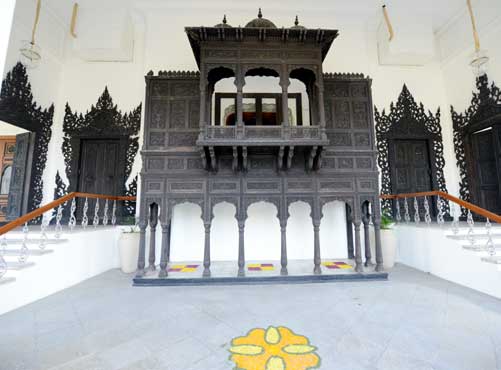
The Coronation Hall at Taj Falaknuma, which has been thrown open for public viewing after months of cleaning and refurbishing, is all set to give visitors a great experience of witnessing four different faiths under one roof. The restoration of the hall was done under the guidance of Princess Esra Birgin and experts from UK. It was in a decrepit condition with the roof falling apart and the carving turning black due to pigeon poop.

It is after several months of cleaning and polishing that fragrance of sandalwood filled the room, allowing one to cross the corridors admiring its art, sculpture and wood carvings. Sharing his views, raconteur Prabhakar Mahindrakar said, “In 1903, when the sixth Nizam Mir Mahboob Ali Khan attended the coronation of King Edward at Dilli Darbar, a lot of artists and craftsmen came to showcase their work at the mela expecting huge sales.

Unfortunately, no ruler took interest in purchasing the works and the artisans were left disappointed, except for the Nizam of Hyderabad who bought this ‘four-religion art’, which was immediately shipped to the city.” The Coronation Hall, which was used by royal women members and the Nizam, has many interesting facts to entice visitors. It took nearly three years for the Nizam to get the single unit art work to be put on proper display at the hall.

The intricate wood carvings are made in sandalwood and rosewood, which have certain unique features that pinpoint to the secular rule which prevailed during the Nizamera. Palace historian PrabhakarMahindrakar said, “The hall is divided into five sections, each dedicated to a distinct faith. The room begins with the Mughal art and is followed by Thai, Buddhism and comes to an end with Hinduism.

The first section of the room has intricate carving of ‘Tree of life’ in sandalwood on both sides of the hall, and on to the right one can also see the replica of ‘Emperor Jahangir darbar’ which was used by the Nizam to look at the city.” Walking down further, one would be welcomed with huge sandalwood arches which depict the temples of Thai monks and other carvings include Yali and peacocks which play a prominent role in Thai culture.

The next is Buddhism arch which depicts the royal life of ‘Gautam Buddha’ on one side and enlightenment and penance on the other side. The last depicts, Hinduism, where there is a replica of Panchavati, the abode of Ram-Sita while in exile along with many other mythological figures related to Lord Krishna, Goddess Lakshmi, Lord Vinayaka and many more.

source: http://www.metroindia.com / Metro India / Home> LifeStyle> Places / by Metro India News / November 28th, 2015

U-19 tri-series: Sarfaraz stars in India’s title win

Preserving his best for the decider, Sarfaraz Khan scored a quick fire, unbeaten 27-ball 59 to fetch the win in just 13.3 overs after the Indian bowlers had restricted the visitors to a modest 116 in 36.5 overs. Deciding to bat first, Bangladesh started faltering from the very start against a disciplined Indian bowling attack.

Sarfaraz Khan was awarded the man of the match for his quickfire fifty. – PTI

Continuing its unbeaten-run in the tournament, India downed Bangladesh by seven wickets in the final to win the Under-19 one-day cricket tri-series crown here at the Jadavpur university Salt Lake Campus ground on Sunday. Preserving his best for the decider, Sarfaraz Khan scored a quick fire, unbeaten 27-ball 59 to fetch the win in just 13.3 overs after the Indian bowlers had restricted the visitors to a modest 116 (in 36.5 overs).

Deciding to bat first, Bangladesh started faltering from the very start against a disciplined Indian bowling attack. The Indian left-arm spinners Mayank Dagar and Mahipal Lomror caused most of the damage, picking up three and two wickets respectively, finishing off the Bangladesh top and middle order.

Dagar and Loror restrict Bangladesh

Bangladesh was looking at a bigger total when Njmul Shanto (45) and Joyraj Imon (28) set up a 54-run partnership for the third wicket. Subham Mavi picked up Imon in the 19th over as the batsman went for an adventurous flick just to be caught at deep backward square leg by M. S. Washington Sundar. Dagar clean bowled Shanto in the next over to make it 68 for four. Dagar and Lomror ran through the rest of the Bangladesh batting, with Avesh Khan and Mavi picking one each towards the end, to see the visitor’s innings fold up at 116.

India started the chase well but lost its way a bit losing three wickets between the fifth and seventh overs. Rishabh Pant (26), who became the man-of-the-tournament for being the most prolific batsman with an aggregate of 282 runs, and Washington Sundar (12) paired in a 38-run stand for opening wicket. But the two departed in haste playing loose shots and were joined in the pavilion by Amandeep Khare (0) soon after.

Sarfaraz and Bhui put up a 75-run partnership

Sarfaraz joined captain Ricky Bhui in the fourth wicket to resurrect the Indian innings. Khan raced to 51 in 23 balls with a glut of boundaries (7 fours and 3 sixes) and made it the quickest half-century of the tournament. Sarfaraz was most severe against the Bangladesh left-arm spinner Shawon Gazi, who conceded 35 runs in two overs (ninth and 11th over of Bangladesh). Sarfaraz put up an unbeaten 75-run partnership with Bhui (20 n.o.) for the fourth wicket to seal the title for India. He was named the man-of-the-match for his effort.

source: http://www.sportstarlive.com / SportStar Live / Home> Cricket – India / by Amitabha Das Sharma, Kolkata / November 29th, 2015

Israeli academic hails Kerala’s multiculturalism

Says the system preserves the identity of every community

Kerala’s traditional multiculturalism has much to offer to the policy and decision makers in modern times, says Ophira Gamliel from the University of Ruhr, the Israeli academic who has been closely associated with Kerala studies.

Ophira Gamliel says the traditional festivals and performing arts in Kerala are highly structured so as to ensure the collaboration of the various communities at different levels

Speaking to The Hindu on the sidelines of the third International Kerala History Conference here on Friday, Prof. Gamliel says a closer look at the multiculturalism inherited by the State would point to a dynamic system which preserves the identity of every community, even as it provides space for each of them to integrate into one system.

“You don’t lose your identity. Even small communities do not get swallowed. Your literature, culture, everything are well preserved. Instead of getting integrated at the personal level, you are integrated at the community level,” she says.

Prof. Gamliel says the roots of this unique system, still preserved, could be traced to the ancient long-distance trade exchanges which were exceptionally different in character from the modern global trade. “Unlike the modern global trade, which is marked by brutal expropriation of resources and labour, the ancient trade between the western coast of India and west Asia was marked by a great amount of cultural and knowledge exchanges at the community level,” she adds.

Documents

The more-than-1,000-year-old Cairo Documents (referring to deals between west Asian traders and those from Kerala) and the 9th century Tharisapalli plates (referring to a grant issued to Syriac Christians of Kerala) are rich evidences to this multiculturalism. “In fact, the Tharisapalli plates are signed in three languages: Persian (in Hebrew script), Pahlavi, and Cufic Arabic,” she says pointing to the efforts taken to preserve the identity of the different trading organisations.

Even the traditional festivals and performing arts here are highly structured so as to ensure the collaboration of the various communities at different levels. Beyond the complexity of what happens on the stage, this underlying structure assured collaboration at the communal level even in performing art forms, she says.

This unique system of multiculturalism should be subject of in-depth research, especially at a time when traditional communities are under threat of being swallowed up in the wave of globalisation, leading to tensions and conflicts at the community and societal level, she adds.

source: http://www.thehindu.com / The Hindu / Home> National> Kerala / by George Jacob / Kottayam – November 29th, 2015

Felicitation

Mysuru, Karnataka :

Rifa-Hul Muslimeen Educational Trust, and Farooqia Educational Institutions, Mysuru, is felicitating city Police Commissioner B. Dayananda on Nov. 30 at 11.30 am at Aiwan-e-Tipu Sultan, Farooqia Dental College Hospital, Farooqia Educational Complex, Eidgah, Mysuru and distribution of Gold medals to meritorious students of Farooqia Institutions.

Dr. Fouzia Choudhary, Chairperson, Karnataka Urdu Academy, Bengaluru, will be the chief guest. Trust President Prof. Riyaz Ahmed will preside.

source: http://www.starofmysore.com / Star of Mysore / Home> In Brief / Sunday – November 29th, 2015

Shabana Azmi recalls her ancestral village Mijwan

Lucknow :

Mijwan, a small village in Azamgarh that did not even have a pin code to its name, has empowered the village women such that Hollywood actress Naomi Campbell and several Bollywood actors are clients of their embroidery. Similar stories from the village were shared by Shabana Azmi at the Lucknow Literature Carnival organised by Lucknow Expressions in association with TOI here on Saturday. Mijwan is the village where her father Kaifi Azmi was born and where he founded the Mijwan Welfare Society in 1993, now run by Shabana.

“Students there are now getting English tuitions through Skype by volunteers in America and London,” she said. She also shared how the women are running beauty parlours and organizing fashion shows all by themselves.

Sharing success stories of the villagers, Azmi said people generally undermine the impact of music and theater in personality development. “My mother Shaukat Azmi used to give the girls lessons in theater and there was, and still is, an evident change in their personalities,” she said.

She also claimed that the village now has no girl married before the age of 18 which was possible only after a long struggle to bring about such positive change in the lives of women.

Parallel cinema alive in new avatar’

Maintaining that parallel cinema still survives in India, Shabana Azmi said that it has only assumed a new avatar. Quoting the example of Meghna Gulzar’s Talvar and others like Masaan and Kissa, Azmi said that filmmakers today work on current issues that interest and provoke them. “Parallel cinema does not only mean making films on villages or on feudalism only. The latter has long been left behind. To go out of the formula and have a discourse around it can be called parallel cinema too,” said Azmi.

Kaifi Azmi Academy likely to come up by 2016

The much-awaited All-India Kaifi Azmi Academy in UP might see the light of the day by March 2016, said Shabana Azmi on Saturday. She was responding to a question from the audience at the Lucknow Literature Carnival. She said she was hopeful of the assurance made to her by the UP chief minister. “Last time when I met the CM, he assured me that I shall have the key to the academy by March,” said Azmi. She also added that the CM felt bad Azmi had to make consistent efforts in the matter. She said she wishes to make the academy “a sort of an adda for intellectual arguments, debates and discussions.” Praising the people of the state, she said that UP has a lot of talent which she pines to make a part of her academy. “The advantage of good language, pronunciation and finesse comes as a natural talent to people here,” she said. The UP cabinet had cleared a proposal to provide financial assistance for setting up the All-India Kaifi Azmi Academy in July 2014. UP Rajkiya Nirman Nigam had been appointed nodal construction agency for it.

source: http://www.timesofindia.indiatimes.com / The Times of India / News Home> City> Lucknow / TNN / November 29th, 2015

Kaifi Azmi Academy likely to come up by 2016

Lucknow  :

The much-awaited All-India Kaifi Azmi Academy in UP might see the light of the day by March 2016, said Shabana Azmi on Saturday. She was responding to a question from the audience at the Lucknow Literature Carnival. She said she was hopeful of the assurance made to her by the UP chief minister. “Last time when I met the CM, he assured me that I shall have the key to the academy by March,” said Azmi. She also added that the CM felt bad Azmi had to make consistent efforts in the matter.

She said she wishes to make the academy “a sort of an adda for intellectual arguments, debates and discussions.” Praising the people of the state, she said that UP has a lot of talent which she pines to make a part of her academy. “The advantage of good language, pronunciation and finesse comes as a natural talent to people here,” she said.

The UP cabinet had cleared a proposal to provide financial assistance for setting up the All-India Kaifi Azmi Academy in July 2014. UP Rajkiya Nirman Nigam had been appointed nodal construction agency for it.

‘Parallel cinema alive in new avatar’
Maintaining that parallel cinema still survives in India, Shabana Azmi said that it has only assumed a new avatar.

Quoting the example of Meghna Gulzar’s Talvar and others like Masaan and Kissa, Azmi said that filmmakers today work on current issues that interest and provoke them.

“Parallel cinema does not only mean making films on villages or on feudalism only. The latter has long been left behind. To go out of the formula and have a discourse around it can be called parallel cinema too,” said Azmi.

source: http://www.timesofindia.indiatimes.com / The Times of India / News Home> City> Lucknow / TNN / November 29th, 2015

Cricket star sells kachoris to make a living

Vadodara  :

Ten years ago, he slammed crucial half centuries that helped India win the cricket World Cup for the deaf and mute cricket. His allround performance promoted him to the captainship of Indian team three years ago.

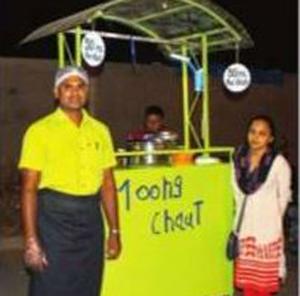
Imran runs a road-side stall with his wife Roza.

But life has bowled a wrong one to 30-year-old Imran Sheikh, who is forced to sell ‘moong kachori’ at a roadside stall on the Old Padra Road. Imran started selling kachoris a week ago to make ends meet. “Cricket is my passion and I want to keep playing. But my financial condition is not good enough to support my family . Playing deaf and mute cricket matches doesn’t earn me much money. So I started a nutritious kachori stall with the help of my wife Roza for earning extra income. I also got a temporary job in Gujarat Refinery, thanks to my coach Nitendra Singh,” Imran told TOI in sign language.

Standing six-foot tall, Imran started playing cricket at the age of 15. “I used to watch matches on television and later began playing at Bhutadizampa ground. But my coach Nitendra Singh mentored me for higher level of cricket. I got into Gujarat team and then in Indian team,” Imran recalled. He scored 70 runs against Nepal, 60 against New Zealand and then scored a match-winning 62 against Pakistan in 2005 world cup semi-finals.

Imran scored a valuable 40-run knock and bagged three wickets in finals against England to help India win the World Cup. “He is a genuine talent and has worked hard to play cricket at the highest level.

He last captained Indian deaf and mute team in the Asia Cup T20 tournament in April this year. Sadly, he wasn’t picked up for U-19 tourney in BCA years ago as he is deaf and mute,” Nitendra alias Munna, who keeps helping Imran, said.

Nitendra is said that Imran wants to quit cricket for good. “It will be unfortunate if he does this,” he added.

“We recently moved out of our family house. Barodians have been very supportive and queuing up to eat at our stall.

We would be glad if the government helps us get a permanent place for our eatery,” said Imran’s wife.

source: http://www.timesofindia.indiatimes.com / The Times of India / News Home> City> Vadodara / by Tushar Tere, TNN / November 28th, 2015

Muslims collect Rs 50k to bail out Hindu convicts

Bareilly  :

As the controversy rages over “intolerance” in the country, here is a group of Muslim men who have quietly done for 15 Hindu men what even their own kin could not.

The Muslim men pooled in money to be able to pay a fine of Rs 50,000 to secure the release of the Hindu prisoners languishing for want of money in the district jail. They had been lodged in jail on charges of petty crime like ticketless travel. Unable to cough up the fine to make reparation for their misdeeds, the men were serving an additional sentence. Once the money was paid, the 15 men walked out free birds.

Outside the jail, the Muslims who paid for their release welcomed them into freedom with a warm embrace. As the 15 men stepped out of jail on Wednesday evening, there were smiles and tears all around.

One of the inmates, Nand Kishore, had served out the period of his sentence for ticketless travel, but was not released as he failed to pay a Rs1,000-fine. But as he left the jail premises and strode towards home, Haji Yasin Qureshi and his friends, all Muslims, hugged him and walked along.

Qureshi shrugged off the effusive gratitude that the men showed him and his friends, and said it is just the Almighty who needs to be thanked. He told the 15 men that they should swear never to repeat their mistakes.

The Muslim men had also made arrangements for Nand Kishore’s travel back to his native village. He was given a small sum as “pocket money” too. His eyes moist, Kishore bid the Muslim youth adieu as jail staffers watched, awe-struck.

Among the others to taste freedom were Ajay Kumar, Kishan Sagar, Pappu and Tilak. All of them were warmly embraced as they emerged from the jail, all deeply moved by the gesture of their benefactors who had come to their aid in a time of crisis.

Qureshi, who led the group that collected funds for the release of the men, told TOI on Thursday, “When we learnt of their plight from jail authorities, we decided that we should do what we could. We are never guided by the feeling that our efforts should be directed only towards members of our own community. We believe that if we help in releasing a man from captivity, Allah will bless us. Moreover, what better occasion than a time when there is all this talk about who should live in this country and who should leave.”

Haji Mohd Anees, a businessman, who too had contributed to the release of the men, said, “Sahib yeh to hamara watan hai aur Hindu hamare bhai hain. Hum yahin paida huwey hai aur yahin khaak mein milengey” (This is our land too, Hindus are our brothers. We were born here, we will be buried here and mix with the soil here.)

BR Maurya, superintendent of the Bareilly district jail, said, “The 15 inmates were charged with petty crimes. Some were arrested on apprehension of breach of peace. They were serving out sentences ranging from 6 months to 10 years. The majority of them had served out the full sentence, but could not pay the fine imposed on them by the court.”

source: http://www.timesofindia.indiatimes.com / The Times of India / News Home> City> Bareilly / by Mrigank Tiwari, TNN / November 26th, 2015

Tipu Debate: Scholarship in history is about coming to terms with contradictions

There is hardly any ‘historical fact’ which has remained unchallenged and the remoter the event the greater the chances of an absence of consensus.

The brouhaha over Tipu Saheb simply refuses to die down. Every day we are treated to statements from differing quarters one portraying him as a hero and the other presenting him as a villain with comparable passion.

The debate has taken deep political overtones and there is hardly any newspaper whose editorial and op-ed columns have not been saturated with the ‘Tipu debate’ Additionally we have the television channels where Tipu detractors and Tipu protagonists have exercised their vocal chords to exhaustion.

My frustration over the issue is somewhat different – we seem to have simply forgotten what the squabbling is all about. We are debating over the merits and demerits of the character of someone who has been dead for over two centuries and extrapolating that as being relevant to the present day scenario.

Let us set aside our own perceptions about Tipu. That at least to me is simply irrelavant. Some may well see him as a hero while the others may see him as a villain. But is it a hallmark of wisdom to let a historical debate cloud the contemporary context which is any case is bound to be minimal? The answer is self-evident. But the surprising feature is that none of the newspapers have picked this up -neither have the television channels.

When I was working towards my doctorate in the history of medicine at Cambridge, Ludmilla Jordanova ,one of the leading historians of science spoke at a seminar and pointed out that scholarship in history is all about coming to terms with contradictions – both in terms of extrapolating the facts as well as analysing them. There is hardly any ‘historical fact’ which has remained unchallenged and the remoter the event the greater the chances of an absence of consensus.

And she was absolutely bang on. A few instances from modern history serve to illustrate her point.

About the same time as Tipu, France was going through the ravages of the French revolution. One of the prime figures in this revolution was Maximillian Isadore Robespierre who is credited with the dreadful Reign of Terror that had gripped Paris in which thousands lost their lives. Robespierre is generally regarded as one of the most despicable figures in European history. Yet there is a very strong Robespierre Society in Paris which views him as a hero of the first order. The two sides indulge in robust debates but the issue is perceived as a historical one and there has never been any violence.

Sticking to France, Napoleon Bonaparte (who incidentally had sent a handwritten letter to Tipu seeking his cooperation to drive out the British) evokes very strong passions but his supporters and detractors have never been known to indulge in violence in recent times.

Moving on to a figure more recent, consider Winston Churchill. He is widely regarded as a saviour of the United Kingdom but there is a very strong section in the country that has not yet forgiven him for his role in breaking up the worker’s strike. Fierce debate rages between the two but I have not known any instance of violence. This very columnist has presented evidence of his racial instincts which lead to more than a million deaths in the Bengal famine-my British friends passionately disagree with me on that count.

Neville Chamberlain is a tragic figure who generally evokes derision for entering into a pact with Adolf Hitler. Some very eminent historians now believe that Chamberlain actually saved the country by buying time as Britain following the First World War was in no position to wage a battle with a better armed Third Reich.

And even more recent, disruptive ‘historian’ David Irving has spent his entire professional career attempting to deny that the holocaust ever existed which I am sure rankles the Jews, the Slovaks, the Russians and the other millions who lost their loved ones.

The price of democracy is learning to dismiss not just the likes of Irving but even those who hold a view of history that contrasts with ours while extending them their constitutional rights of expressing them without resorting to violence. It is deeply unfortunate that we seem to be forgetting this principle which is surely a sine qua non in any functioning democracy.

Let us recall the words of Justice Anthony Kennedy, perhaps the best exponent of pristine judicial wisdom we have today in the landmark Texas vs. Johnson flag burning case:

For we are presented with a clear and simple statute to be judged against a pure command of the Constitution. The outcome can be laid at no door but ours. The hard fact is that sometimes we must make decisions we do not like. We make them because they are right, right in the sense that the law and the Constitution, as we see them, compel the result. And so great is our commitment to the process that, except in the rare case, we do not pause to express distaste for the result, perhaps for fear of undermining a valued principle that dictates the decision. This is one of those rare cases.Though symbols often are what we ourselves make of them, the flag is constant in expressing beliefs Americans share, beliefs in law and peace and that freedom which sustains the human spirit. The case here today forces recognition of the costs to which those beliefs commit us. It is poignant but fundamental that the flag protects those who hold it in contempt.

The ultimate tragedy of this unseemly saga is that two people lost their lives. I am sure their families did not partake in the Diwali festivities. All of us must shoulder some  blame for this monstrosity for not upholding the fundamental principles of democracy.

source: http://www.thenewsminute.com / The News Minute / Home> Tipu Jayanti / by Ashoka Jahanavi Prasad / Thursday – November 19th, 2015