All posts by mpositiveone@gmail.com

Hyderabad misses glitter of Nizam’s priceless jewels

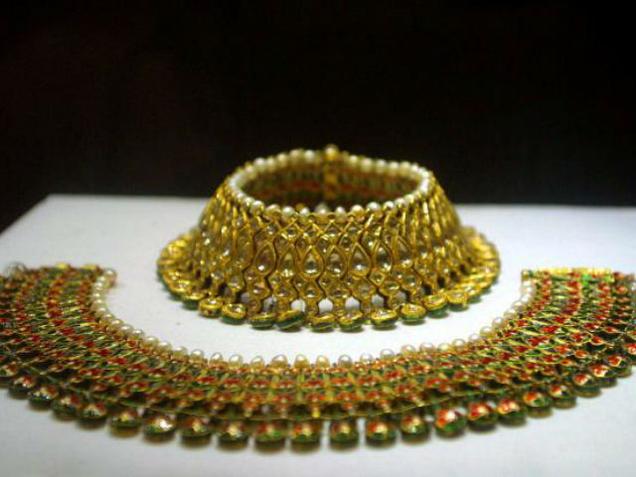
In the absence of any concrete effort, the jewels are confined to RBI vaults in Delhi. Photo: AP

In the absence of any effort, they are confined to RBI vaults in Delhi.

Vows forgotten and proposals put on backburner have resulted in priceless heritage of Hyderabad staying away from the city and remaining confined to Reserve Bank of India (RBI) vaults in New Delhi.

It had been almost a decade since the Nizam’s jewels, a precious collection with value running into several thousand crore rupees, was exhibited on temporary basis in the city. The then A.P. government vowed to have the collection brought to the city and put on a permanent display here and several proposals were drafted too.

Comprising 173 exquisite pieces, including the famed 184.50-carat Jacob diamond from the treasury of the erstwhile Nizams of Hyderabad, the collection has been with the Union government and deposited in the safe vaults of the RBI.

Few other pieces of the royal compilation include priceless uncut Colombian emeralds, rare carat Alexandrite ring, a necklace with 12 flat diamonds and emerald armbands weighing 150 carats said to have belonged to the Mysore ruler, Tipu Sultan.

Hyderabad, the city to which the jewellery actually belongs, twice hosted exhibition of the collection in the year 2001 and 2006 at Salar Jung Museum which had large crowds thronging for a look.

‘Security not an issue’

Former Director of Salar Jung Museum A.K.V.S. Reddy, who supervised the temporary exhibitions in the city, says the priceless collection belonged to the city and argues a permanent facility to display them here was not unviable.

“Security is key aspect for such galleries and a decade ago when it was displayed here, we had to deploy nearly 120 security personnel. However, with more advanced technologies in the form of camera surveillance and alarms, the requirement will be less,” he says.

Salar Jung Museum officials rule out the possibility of hosting a permanent exhibition of such precious collection at its premises now given the developments at the museum.Telangana Deputy Chief Minister Mohammad Mahmood Ali describes the collection of erstwhile Nizam rulers as an asset of the city and says all efforts will be made to get it here for a permanent display.

source: http://www.thehindu.com / The Hindu / Home> National> Andhra Pradesh / by T. Lalith Singh / Hyderabad – October 28th, 2015
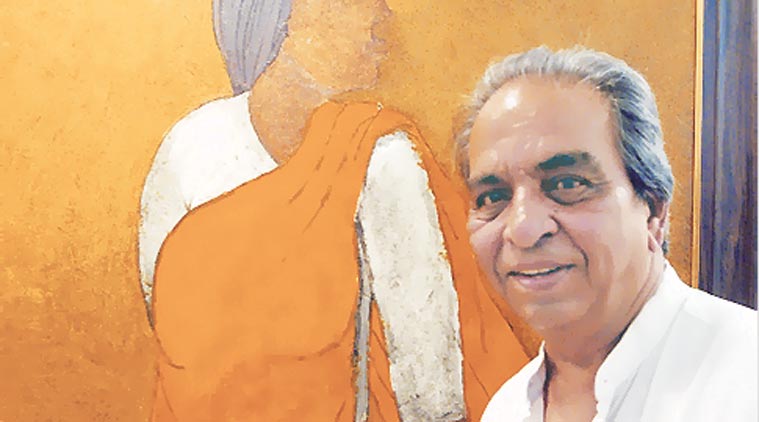
M F Husain’s son dies of liver cancer at 69

Known for flattened surfaces and uncluttered depictions, Shamshad Hussain’s often dealt with social concerns in his works that ranged from oils to acrylics

Shamshad Husain was best known for flattened surfaces and figurative depictions in a subdued palette.

He lived under the shadow of his father in the world of art where he strived to paint a picture that would be reckoned as his masterpiece.

Shamshad Husain, son of late veteran artist MF Husain, breathed his last on Saturday evening at his Delhi home. Diagnosed with liver cancer in September, his condition rapidly deteriorated. He was admitted at the Institute of Liver and Biliary Sciences, Vasant Kunj.

The 69-year-old artist is survived by two daughters. “He had developed a style of his own. A gentle person, his figuration was modest and had a personal quality, unlike the more flamboyant works of his father,” says artist Vivan Sundaram.

Postgraduate from the Royal College of Art, London, Shamshad was best known for flattened surfaces and figurative depictions in a subdued palette. His themes ranged from environmental and social concerns to dark realities and human relations. Primarily working with oils and acrylic, his popular works include a series based on ‘Love In The Time of Cholera’, Gabriel Garcia Marquez’s famous book. He also reportedly worked on a series dedicated to his father.

“He was great fun and liked to party; one of the nicest guys I knew. My father (J Swaminathan) really liked him. Husain saab used to say ‘yeh ghar ka gau hai’. It’s sad that he and Mrinalini Mukherjee passed away in the same year. I can’t think of the Delhi art scene without them,” says art writer S Kalidas.

Known to be close to his father, “his death in 2011 left a deep impact on Shamshad”, says photographer and activist Ram Rahman, who is close to the Husain family.

“He was one of his favourites and very sensitive,” says Rahman, who met Shamshad last month at an art exhibition marking MF Husain’s 100th birth anniversary in Delhi.

source: http://www.indianexpress.com / The Indian Express / Home> India> India-News-India / Top News / October 2015

Mark Zuckerberg visits ‘stunning’ Taj Mahal

Agra :

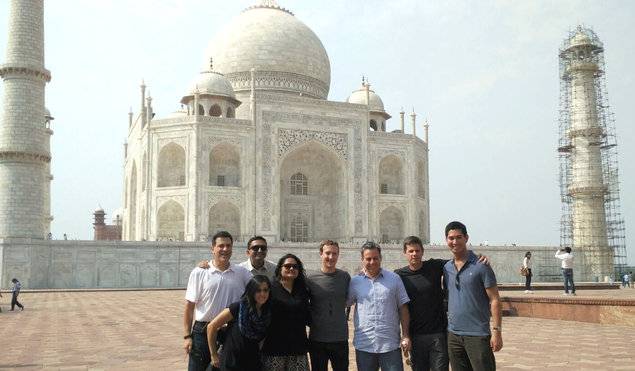
Facebook CEO Mark Zuckerberg visited Taj Mahal on Tuesday, along with group of seven people who were supposedly his colleagues.

At around 4:20pm (GMT + 5:30) Zuckerberg posted an image of him which was clicked by his colleagues while he was sitting on the east side of Taj Mahal watching the magnificent structure.

ZuckerbergTajMahalMPOs28oct2015

Confirming Zuckerberg’s visit to Taj, Image Public Relation Pvt Limited — which handles Facebook public relation in India — said, “Yes, CEO of Facebook did visited Taj Mahal on Tuesday.”
However, Ram Ratan, Archaeological Survey of India conservation assistant, Taj Mahal claimed, “We had no idea about his visit to Taj. It might be possible that he wanted to keep his visit low profile to avoid unnecessary attention.”
According to CISF official source, “Since nobody knew about Mark visit, he must had walk through long queue of security check like all ordinary tourist do.”

The tech entrepreneur will visit IIT Delhi tomorrow to interact with students and faculty at the Indian Institute of Technology in Delhi in a town hall.

Last month during PM Modi visit to US, Zuckerberg had shared an anecdote about his earlier visit to India and claimed that, “when things weren’t really going well — we had hit a tough patch and a lot of people wanted to buy Facebook — I went and I met with Steve Jobs and he said that to reconnect with what I believed was the mission of the company, I should go visit this temple in India that he had gone to early in the evolution of Apple, when he was thinking about what he wanted his vision of the future to be.”
source: http://www.timesofindia.indiatimes.com / The Times of India / Home> Tech / by Arvind Chauhan, TNN / October 27th, 2015

Amidst Sahitya Akademi row, President Mukherjee gives away Sangeet Natak Akademi awards

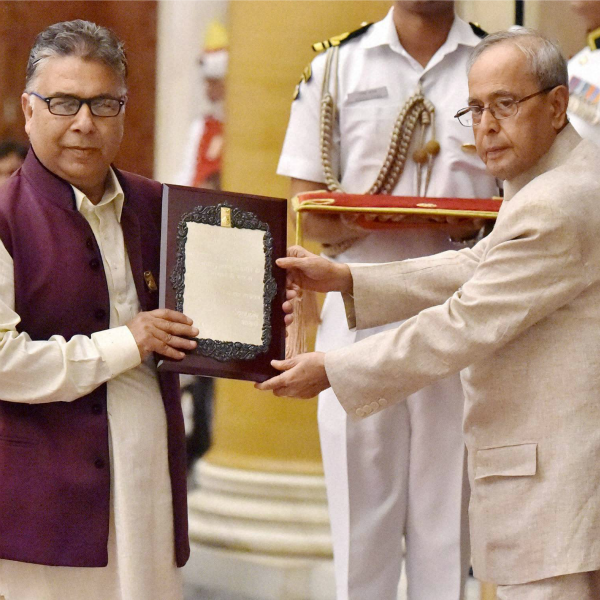
Eminent folk singer from Jammu and Kashmir Abdul Rashid Hafiz who is known for his renditions of traditional singing Chakri was among eight artists facilitated for their contribution in traditional arts.

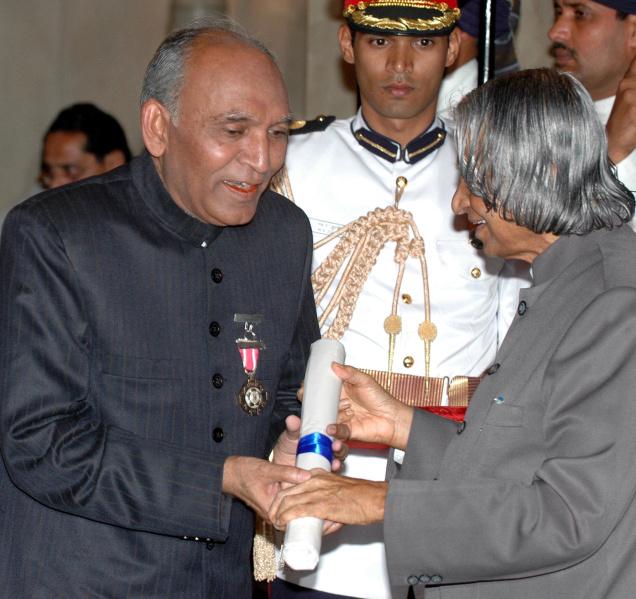
Doyen of Indian theatre M S Sathyu, eminent vocalists SR Jankiraman, Vijay Kumar Kichlu and Harmonium player Tulsidas Borkar were on Friday awarded the coveted Sangeet Natak Akademi  fellowship by President  Pranab Mukherjee.

Along with them, 35 other noted personalities from various disciplines of dance, drama and music were conferred Akademi awards for 2014 by the President at a glittering ceremony in the imposing Darbaar Hall of the Rashtrapati Bhavan in New Delhi.

Eminent folk singer from Jammu and Kashmir Abdul Rashid Hafiz who is known for his renditions of traditional singing Chakri was among eight artists facilitated for their contribution in traditional arts.

Noted Kashmiri folk singer Abdul Rashid Hafiz receiving the Akademi Award from President Pranab Mukherjee at Sangeet Natak Akademi Awards 2014 function at Rashtrapati Bhavan in New Delhi on Friday. PTI

61-year old Hafiz, who trained under Sarangi Nawaz Gulam Muhammad Dar, is known for giving Chakri his own touch. Chakri is one of the most popular types of traditional music played in Jammu and Kashmir. The responsorial singing uses harmonium, and traditional instruments like the rubab, the nout, the geger and the chimta. The Akademi Awards carries purse money of Rs 1 lakh in cash, a Tamrapatra and an Angavastram.

Sangeet Natak Akademi Fellowships (Akademi Ratna Sadasyata) and Sangeet Natak Akademi Awards (Akademi Puraskar) are recognised as the most coveted national honours bestowed on performing artists as well as teachers and scholars in the field of performing arts.

Among the eminent artists awarded fellowship of the Akademi, 85-year-old Sathyu is doyen of Indian theatre known for his classic movie ‘Garam Hawa’ on partition which introduced actors like Farooq Sheikh to Indian cinema.

Besides, he has designed and directed productions for many theatre groups including Hindustani Theatre, Alyque Padamsee’s Theatre, Herbert Marshall’s civic theatre, Balraj Sahni’s Juhu Art Theatre among others. His play Mudra Rakshas will be performed on October 27.

source: http://www.dnaindia.com / DNA Analysis / Home> News> India / Place:New Delhi, Agency:PTI / Friday – October 23rd, 2015

Kashmiri journalist bags media award

Former Director of AJK Mass Communication Research Centre, Jamia Millia Islamia, Obaid Siddique, also congratulated Aliya.

Independent journalist from Kashmir, Aliya Bashir, was conferred award by Schizophrenia Research Foundation and Press Institute of India for her reportage on mental health issues from Kashmir.

The award, SCARF-PII Media for Mental Health Awards, running in its third year, was given to her in Chennai for her piece ‘Kashmiri Women Explore Spiritual, Psychiatric Treatment for Mental Illness’ in which she chronicles the lives of three women with mental illness and how they cope up with the problem.

Aliya bagged the first prize in the English category while the second prize was given to Divya Chyandrabbau of The Times of India.

Meanwhile, senior journalists and academics have congratulated Aliya on her feat.

“For us, it is a moment of pride and happiness. Congratulations Aliya,” veteran Kashmiri journalist Yusuf Jameel wrote on social networking site, Facebook.

Former Director of AJK Mass Communication Research Centre, Jamia Millia Islamia, Obaid Siddique, also congratulated Aliya.

In her talk at the awards ceremony, Aliya has noted that there is need of telling more stories of people with mental illness and how they live.

source: http://www.greaterkashmir.com / Greater Kashmir / Home> Kashmir / by GK News Network / Srinagar – October 22nd, 2015

Aslam Takes Charge as MANUU V-C

Hyderabad  :

Amid protests and counter protests by students and faculty members for the past one week, the Maulana Azad National Urdu University (MANUU) finally got a regular Vice-Chancellor, Dr. Aslam Parvaiz,  after nearly four months on Tuesday.

Dr Aslam, who had earlier served as principal of the Delhi-based Zakir Husain Delhi College, holds a PhD in Botany. Though he teaches science, he is well known for his command of the Urdu language.

On his first day as V-C, Dr Aslam held a meeting with the MANUU Joint Action Committee which was formed by MANUU Teachers’ Association (MANUUTA), Officers’ Association and the Employees’ Association of the university, to address issues that led to unrest on the campus. The V-C assured the faculty members and others that he would resolve their problems soon. Since the students and a group of faculty members have been making allegations and counter allegations against each other, he asked both the parties to submit written complaints.

Speaking to Express, Dr. Aslam, said, “I am not aware of a majority of the problems here. The faculty and students have brought some issues to my notice. But I need some time to look into the matters and make a plan to resolve them.”

Referring to the university’s recent restriction on girl students on the campus, he said so far, he had not received any complaint from students in this regard. However, he promised to find an appropriate solution to the issues if the students come up with formal complaints.

source: http://www.newindianexpress.com / The New Indian Express / Home> States> Telangana / by Express News Service / October 21st, 2015

The Ustad and his times…

Ustad Ghulam Sadiq receiving the Padma Shri / Photo Sandeep Saxena / The Hindu

Ghulam Sadiq Khan, an eminent Khayal singer, rues that ustads do not get the same kind of reverence as they used to.

Ghulam Sadiq Khan, an eminent Khayal singer of the Rampur Sahaswan Gharana, recently released a three CD pack titled “Dharohar”. His dulcet Raga Darbari testifies to his range as a noted singer.

A recipient of Padma Shri, Sadiq Khan’s first guru was his father, the late Sarangi Player Ustad Ghulam Jafar Khan (1908-1981) and his second guru was Ustad Mushtaq Husain Khan (1878-1964). As a student, he was told to treat his guru as God but rues that ustads these days do not get the same respect.

Excerpts from an interview:

What affected you deeply when you wanted to establish yourself as a singer?

Slow recognition but when it came there was no looking back. From the age of 15 to 27, I faced difficulties and had to work very hard. In 1956, I became famous countrywide as if a bomb had burst. My struggle was to learn music, practice and appear before audiences and mehfils. Allah took me sky high and my first concert made me. I never looked back after that. Earlier I had to go to people and ask for programmes and tell them who I was. Later things became smoother.

Did these problems discourage you?

I struggled in riyaaz for 10 to 12 years and practised for over 10 hours a day for five years. Programmes started coming regularly and I became known after a hard time. A yug of riyaaz went by but my lineage and gharana helped me stand on my own feet. Others helped too.

What did you learn from your difficult days?

I learnt that honesty is the greatest thing in music. Also, belief and dependance on the Ustad is paramount. They are to be regarded as God. Today’s Ustads don’t have that respect from others and this has led to a decline in North Indian classical. I learnt to believe in the Guru and to regard him as God is the biggest thing.

Today I am happy with what God has given me – ilm (art), izzat (respect), shoharat (name) throughout the world. My CDs have been released in London and Singapore. What more can one ask for?

source: http://www.thehindu.com / The Hindu / Home> Features> Friday Review / by Atul Mittal / October 22nd, 2015

Poetic touches in Urdu

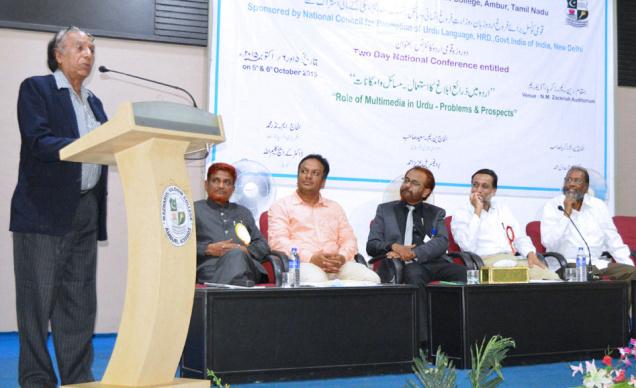
Urdu poets share their verses at a mushaira in Ambur.

Urdu poets met recently at a mushaira (symposium) in Ambur to bring alive the beauty of the language. The event, organised by the Department of Urdu of the Mazharul Uloom College, Ambur was part of a two-day national seminar on “Role of Multimedia in Urdu: Problems and Prospects,” sponsored by the National Council for the Promotion of Urdu Language (NCPUL) attached to the Union Human Resource Development Ministry, New Delhi.

A group of poets from the Southern States brought alive the brilliance of Urdu poetry and captivated a large audience with their couplets and ghazals that spoke of love, peace, national integration and communal harmony.

The highlight was the versatile renditions of internationally renowned poet, Althaf Hussain Shadaab ‘Bedhadak’ Hyderabadi. His couplet — “Ameero, Ghareebon ki dua bhi lelo; davayen sirf lene se ho saktha hai” got him a standing ovation.

Niyaz Ahmad Niyaz of Vaniambadi chose the famous ghazal, ‘Chupke Chupke Raat Din Aansoo Bahana Yaad Hai’ penned by Maulana Hasrat Mohani, a freedom fighter and Urdu poet.

Poets Mahmood Shahid ‘Kadpavi’ of Kadapa, Andhra Pradesh, Haamid Akmal of Gulbarga, Karnataka and Raahat ‘Haraarat’ of Ambur, too shared their shaiyiri, some old and some new, much to the delight of the literary lovers.

M. Nazar Mohamed, secretary and correspondent, Mazharul Uloom College, presided.

source: http://www.thehindu.com / The Hindu / Home> Features> Friday Review / by Syed Muthahar Saqaf / October 22nd, 2015

Nadia royal family bears Puja torch since Akbar era

Krishnanagar  :

Illuminated by earthen lamps and torches (mashals), the idol of Ma Raj Rajeshwari looks resplendent in the Akbar-era Natmandir at the Krishnagar Maharaja’s palace.

The serenity is suddenly shattered by the town crier’s shrill call: “Attention! Agnihotri Bajpeyi Raj Rajendro Maharajadhiraj Nabadwipadhipati Mahashaya Krishno Chandro Roy Bahadur is arriving.”

On cue, 108 dhakis beat drums to frenzy.

The Maharaj arrives in an elaborately carved silver palanquin that was gifted to one of his forefathers by Emperor Jahangir. He approaches the pulpit. Shortly thereafter, the palace cannon booms, a signal for the beginning of sandhi puja. A hundred and eight buffaloes are assembled before the Goddess. At shandhikshan, the heads are severed and placed before the Goddess as offering to cleanse the human spirit of its evils. “As a child, I grew up watching these rituals being performed while sitting on my grandmother Maharani Jyotirmoyee Debi’s lap. Growing up, I always held a grudge against Ma Raj Rajeshwari. How could the divine mother, the supreme protector of good and the destroyer of evil, devour so many harmless, helpless lives? I would often bring this up with my father. Being a God-fearing man, he would stick to tradition till the resistance melted away when he saw my infant son Manish crying on witnessing the sacrifice.The practice was stopped in 1987,” said Saumish Chandra Roy , the 39th descendant of Nadia royal family .

Nadia Rajbari’s Durga Puja remains the oldest puja in what was then Anga-Banga-Kalinga or undivided eastern India region. Started in 1603 by Maharaj Rudra Rai, the great grandfather of Krishno Chandro, it has continued uninterrupted till date. “The puja began two years before the death of Emperor Akbar. Since it all happened at the height of the Mughal era, the influence is very strong in the architecture of the natmandir,” said Saumish’s son Manish. However, though the grandeur of celebrations have shrunk over the centuries, the rituals have remained intact.

Ma Raj Rajeshwari has seen Nadia during the most tumultuous of times. In medieval India, persecution and heinous tyranny on the grounds of religion was common.

Blood was spilt for the protection and defense of Nadia’s “honour”, for the protection of the freedom to choose and profess the religion of our choice.”Jato dharma Stato jayo” (Stay in the path of good dharma and victory will be yours) is embedded in the Krishna gar royal family’s coat of arms.

Ma Raj Rajeshwari’s power was tested during Partition. Nadia had initially been ceded to what was then East Pakistan on grounds of religion. “For three nightmarish days, we were Pakistanis. My father Saurish Chandra Roy , the last officially recognized maharaja, had told Sir Cyril Radcliffe (the chairman of the Boundary Commission in British India) that if Nabadwip was lost to Pakistan, then what would remain of the great Hindu faith in the Anga-Banga-Kalinga region?

 
After three days of rioting, rape and arson, a significant portion of Nadia was returned back to India. The entire population went wild with joy when the news was broadcast over All India Radio. People arrived in trucks from far and wide and assembled in front of the palace gates, shouting ecstatically “Ma Raj Rajeshwari’r Jai!”

Though the princely order was abolished by former Prime Minister Indira Gandhi, some royal customs are still followed. The Maharaj was believed to be the protector of his people.Accordingly a clay model of a “shatru”, symbolizing evil, is created which is slain by the Maharaj every year during the Durga Puja. Saumish does the slaying now.

source: http://www.timesofindia.indiatimes.com / The Times of India / News Home> City> Kolkata / by Subhro Niyogi, TNN / October 19th, 2015

Ph.D Awardees

Karnataka :

KSOU has awarded Ph.D in Political Science to Shivananja for his thesis ‘Karnatakadalli Budakattu Janangada Mahileyara Sabalikaranakke Rajya Sarkarada Yojanegalu: H.D. Kotege Sambandisidanthe Ondu Vishesha Adhyayana’ submitted under the guidance of Prof. K.J. Suresh.

The JSS University has awarded Ph.D in Life Sciences to Ayesha Sulthana for her thesis ‘Studies on Wastewater Models and Anaerobic Digestion of Municipal Sludge using Lab Scale Reactor’ submitted under the guidance of Dr. S. Balasubramanian.

source: http://www.starofmysore.com / Star of Mysore / Home> In Brief / October 19th, 2015