Blowing from Guns in British India (1884) by Vasily Vereshchagin. This painting depicts events of 1857 with soldiers wearing (then current) uniforms of the 1880s.-http://www.vokrugsveta.ru
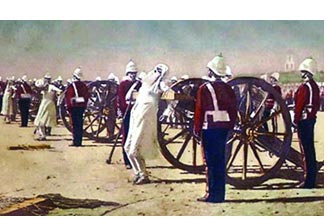
[Picture printed above and commentary was forwarded to me. Someone with more interest in history asked about the picture, associated story and procedure of blowing up from canon as punishment. Others have previously asked about capital punishment in seventeenth & eighteenth century India. Only for those interested in history of the Raj.]
“Lets salute the first martyred journalist in the Independence movement against the British back in 1857.
Moulvi Mohammed Baqir editor of ‘Urdu Akhbar Dehli’ was the first journalist to be martyred by the British army through Taliban-e-Pakistan style execution.
He was tied with canon and blown up for his ‘seditious’ writing against British colonial rule in the First War of Independence 1857.
Unfortunately the brave martyr hardly got any recognition in the history books.
The photograph below shows how the “benevolent” and “humane” British army blew up these unarmed captured Muslim civilians with cannon. This even beats the “humanity” of the Taliban-e-Pakistan.
Share as much as you can, if you want his legacy to live on.”
My Comments
“The very ink with which history is written is merely fluid prejudice”. Mark Twain
Few things should be kept in mind as a backgrounder. There is a narrative of the victor and a completely different one by the vanquished. Facts are interpreted in different ways and that is fine. Selective use of facts to support one’s point of view is also common especially in post 1947 India and Pakistan (the fact that Bengal army that was two third Hindu Brahmin revolted and came to Delhi to fight under the Mughal flag will never be acknowledged by the right wing of both India & Pakistan as it does not fit into their respective narrative). However, sometimes folklore is mixed with facts and this adds to the confusion rather than bringing clarity. Few basics; It is a painting and not a photograph and this painting has nothing to do with the story narrated above. It is simply a folklore and not based on any historical event. Below is the copy of the print of the original painting (from Library of Congress collection) and my explanation.
Blowing from guns in British India (Library of Congress)
This painting is by a Russian painter Vassili Verestchagin (1842-1904). He visited India in 1874-76. He painted many scenes of India and Central Asia. This is artist’s imagination of how the sentence was carried out and probably not based on any individual case or any eyewitness portrayal by the painter. This was painted in late 1870s when this practice had been abandoned. The uniform of British soldiers standing next to guns is of late 1800 era and not 1857. Vassili like many artists abhorred war and painted many works showing horrors of war. In fact, at one time German and Austrian military high command banned their officers to visit Vassili’s exhibitions of paintings as they viewed his work as anti-war.
I have my own theory about this particular painting. One of last incident of large scale blowing up from canons occurred in January 1872 in the small princely state of Malerkotla in Punjab. A small sect of Sikhs called Namdharis is very strict against cow killing and there were incidences where they attacked slaughterhouses and killed butchers. An ox was slaughtered in the presence of a Namdhari. He narrated the incident to his kin and a band of about 200 Namdharis attacked Malerkotla and in the ensuing firefight fifteen people were killed and some arms looted. Remaining Namdharis escaped to neighboring Patiala state. Nawab of Malerkotla Ibrahim Ali Khan was a minor and Superintendent of Council of Administration Mr. Heath was administering the state under the supervision of Deputy Commissioner of Ludhiana L. Cowan. Cowan rushed to the scene and many Namdharis who had escaped were brought back to Malerkotla from Patiala. Cowan interpreting this act as rebellion summarily executed sixty six Namdharis by blowing them from canons (brought from neighboring Patiala and Jind states) over two days time period without trial. Later, when this act was denounced, Punjab government fully supported Cowan but Government of India disapproved. Cowan was sacked while Commissioner of Ambala division Forsyth transferred to Awadh.
This incident occurred in January 1872 close to the time of Vassili’s visit to India in 1874-76. He may be referring to this recent incident of Namdharis in his painting. The only person clearly visible in painting is the first gentleman tied to the canon in the front. He has white beard, all white clothing and wearing a turban. The remainders three tied to the guns are also wearing white clothes. Namdharis wear white home spun cotton clothes and tie their turbans horizontally different from other Sikhs. It is not likely that Vassili painted this based on an eyewitness account (he didn’t mention any such incident in his autobiography) as to the best of my knowledge; there was no incident of blowing from canons for mutiny at the time of Vassili’s visit to India in the time period of 1874-76. It is quite possible that the gentlemen in the painting are all Muslims as from clothing one can guess that they are not Hindus. Vassili may have painted 1857 incidents when he became aware of this during his visit.
Maulvi Muhammad Baqar Ali (1810-1857) was a Shia intellectual of Delhi. He was educated at Ghaziuddin Madrassah that later became famous Delhi College. Baqar owned a printing press and published first Urdu weekly newspaper called Dehli Urdu Akhbar in northern India in 1836 (in July 1857, it was renamed Akhbar al Zafar). His paper mainly covered social and literary activities of only Delhi. He also published many works translated from English. In 1857, he continued to publish his newspaper after the fall of Delhi to rebels. He praised the cause of rebels and supported last Mughal emperor Bahadur Shah Zafar.
Baqar was arrested on September 15, which was the second day of assault when Delhi was not yet secured by British. His son Muhammad Hussain after putting rest of the family on a journey out of Delhi came back to Delhi to look for his father. A Sikh general who was friend of Baqar helped Hussain to stay under his protection. This Sikh fellow took Hussain to the field on September 17 where prisoners were awaiting their trial and execution. Father and son just looked at each other before Baqar was hanged (This is described in detail by Darlymple in his excellent account of the time period in The Last Mughal). During British assault on Delhi, majority of people were killed by swords, bayonets and firearms. Later, after securing the city, summary executions were carried out mostly by hanging.
Baqar was supporter of the rebel cause and Zafar. However, near the end of July when things started to deteriorate and doubts were raised about victory of rebels, many residents of Delhi now had second thoughts. A number of residents including members of royal family opened up communication with British camp through intermediaries in contact with British (Hakim Ahsanullah Khan, Maulvi Rajab Ali etc.). Many wrote intelligence reports giving information about happenings in the city. Baqar also sent a report to the Ridge (Translation of a letter from Munshee Mahomed Bakar, July 1857 at Delhi Commissioner’s Office Archives quoted in Darlymple’s The Last Mughal) and its text gives an idea of feeling among Delhi inhabitants. He wrote, “We, the respectable portion of the inhabitants are reduced to the last extremity by the violence of the sepoys, and have no hope of escaping with our lives. The General Bakht Khan’s spies dog me wherever I go. There are sentries over the house of Mufti Sadruddin Khan and all exit and entrances prohibited. Through Zinat Mahal I suggested to the King to open the gates and invite the English to come and seize the city, telling him that if he could destroy the mutineers it would be great advantage to himself and his children.”
Somewhere in my own humble collection of materials on military history of the Raj, I have a note where someone named Hobson then present at the Ridge during the siege mentioning that it has been communicated to Baqar to publish in his paper that if the city surrenders it will be spared destruction and also to encourage people to leave the city at once. He mentions that if Baqar publishes this notice then his life may be spared. Unfortunately, I do not have reference for this anecdote.
Residents of Delhi were in a very precarious situation and self preservation demanded careful maneuvering. Ordinary folks could stay neutral but those well known or wealthy had to declare openly. Some may have genuinely believed that old order was gone and they had to profess loyalty to Bahadur Shah to stay on the right side of the power. Even those not sure about the change, silence on their part could label them as sympathetic to British cause and hence punishment from rebels (many were killed by rebels and same happened to some unfortunate native souls at the Ridge where they were accused of in sympathy with rebels and killed by British). Delhi inhabitants were at the mercy of rebels in control of the city but after two months, they were not sure about victory of rebels. Baqar tried to balance this by supporting rebels in the editorials of his papers while also keeping channels open with British at the Ridge to safeguard his life in case of return of the British. The chaos of assault, vengeance on part of British soldiers and hatred of Sikh, Punjabi Muslim and Pathan allies of British meant that even the lives of friends of British were not safe in Delhi. Many who provided valuable information to British about Delhi during the siege were killed by the victorious British army and its Indian allies. All able bodied males were summarily executed and whole city was turned out. Thousands perished from extremities of weather and starvation all around Delhi.
Baqar’s son Muhammad Hussain Azad survived the mutiny despite writing a poem praising rebels in his father’s newspaper. He left Delhi with twenty two members of his family. His one year old daughter was killed by a stray bullet. After wandering for four years through Madras, Niligiri hills and Lucknow, Azad later settled in Lahore and under the patronage of great Orientalist Gottlieb W. Leitner became celebrated Urdu literature critic.
“History will be kind to me, if I intend to write it”. Winston Chuchill
Top Dum – Execution by Blowing Up from Canon
Throughout human history various methods of execution have been used. Execution by blowing up from canon was used during Mughal times but it was limited to those guilty of armed rebellion and used very rarely. Beheading, hanging and later firearms were more common methods. In fact, these were considered more humane methods of execution compared to slow and torturing death by other means. Cutting off limbs, flaying and skinning alive, crushing by elephants, tying all four limbs to four horses and whipping them to run in opposite directions thus dismembering the victim and throwing the victim from the top of a building were more gruesome methods used against enemies. A particularly cruel method was amputating one limb at a time but pouring boiling oil on the wound that not only caused severe pain but also had a cauterizing effect on blood vessels that prevented quicker death from blood loss. The purpose of these tortuous and painful deaths was not only to punish the culprit but also to instill fear among general population.
East India Company used occasionally the method of blowing up from canons only in cases of mutiny. The last case of blowing up from canons prior to 1857 was in late 1820s. In 1857 rebellion, this method was used on large scale for a variety of reasons. The main reason was a deterrent effect on general population. There was no preference for any particular ethnic or religious group. This method was used more in areas where rebellion was large scale and affected civilian population like Delhi and its surrounding areas and Rohilkhand (majority Muslims) and Central India (majority Hindus). In individual cases, a variety of factors were at play when decision was made to use this method of execution.
The method included lowering the muzzle of the gun to about three feet from the ground. The condemned man was then tied to the muzzle of the canon where small of the back touched the muzzle of the gun (in some cases, victim faced the gun where his stomach was touching the muzzle). Hands were tied to the wheels of the gun and in some cases legs were secured by tying ropes to tent pegs driven in ground near victim’s feet. About a quarter of the powder was used in cartridge shell; double charged in case of more than one person tied to the muzzle. The gunners stayed behind a back board to light the charge to avoid being sprayed with the blood and flesh of the dying man. Most of the time, one man was tied to the gun for each shot but in some cases four to six were tied together. Torso was disintegrated by the blast while head and limbs scattered over a wide area.
In May 1857, 55th Bengal Native Infantry (BNI) was stationed at Nowshehra with one detachment in Mardan on the frontier. 55th BNI mutinied and sepoys ran away with their weapons (their heart broken commanding officer Colonel Henry Spottiswood committed suicide). Legendry John Nicholson chased the mutinous 55th with the help of his Pathan allies killing and capturing many. Forty men of 55th BNI were brought to Peshawar and blown away from canons. In June 1857, ten sepoys of 5th BNI were blown from guns in Umbala. In Bengal, Colonel George Sherer of 73rd BNI got hold of three ringleaders of sedition in his regiment and executed them by blowing from canon. In June 1858, 300 captured rebel soldiers were executed at Kirwee by this method. In view of large numbers condemned to die by this method, six were tied to each muzzle at a time.
The main reason for using this punishment during mutiny was a salutary effect on other soldiers and civilian population as sight was terrible. Another reason was to instill the fear of eternal damnation among both Hindu and Muslim sepoys. Among Hindus, proper disposal of ashes after cremation is an important step while for Muslims burial after appropriate rites is considered important for eternal bliss. Blowing up bodies to pieces where remains could not be collected and disposed off with religious rites was a terrible thought. Usually, all soldiers of the station as well as native population was invited to witness this horrible scene which suggests that the main purpose of this punishment was to instill fear among spectators.
In some cases opposite was true where blowing up from canon was considered a better option and in some cases as a favor to the condemned man. Hangmen were usually ‘untouchables’ and for a Brahmin to be hanged by an untouchable was a terrible thought. Any other method was preferable than coming in contact with an untouchable on the final journey from the world. Two sepoys of 35th BNI were arrested on charges of sedition and awarded death sentence. Brigadier Neville Chamberlain addressed the assembled soldiers and told them that “these men have been blown from a gun and not hung, because they were Brahmins, and I wished to save them from the pollution of hangman’s (sweeper) touch, and thus prove to you that the British government does not wish to injure your caste and religion”.
In Central India, Commander-in-Chief and Commandant of Artillery of the deposed Raja of Satara were arrested on charges of sedition. They were awarded death sentence. One of the condemned prisoners was told that he will be hanged. Fearful of being polluted by the touch of a low caste hangman, he requested that instead he should be blown away from a canon but his request was denied. In Ferozpur, fourteen sepoys of 45th BNI were sentenced to death. Two low caste men were hanged while twelve Muslims and Brahmins were blow from canons.
Almost all eyewitness accounts of this punishment give grudging tribute to the behavior of the victims. They never showed any sign of fear or panic and faced their end with remarkable courage. In one case, when few ready to be blown complained and asked for mercy, their fellow soldiers waiting for their own turn rebuked them with comments that ‘you have fought for your religion’ and ‘die like a man not like a coward’. In another case, a group of soldiers of a mutinous regiment were sentenced to be blown from canons. Soldiers of the Grenadier company of the regiment requested that as they are always on the right side of the regiment during the battle and go forward first, therefore they should be given the honor to be placed on the right side and blown first. Many tried to explain this behavior in various terms such as passivity, native fortitude, stoic demeanor, acceptance of fate and belief in the righteousness of their cause.
In the immediate aftermath of the mutiny, defeated soldiers and civilians faced the brunt of retribution. Summary court martial and special civilian commissioners with powers of life and death were instituted. This was a mere formality as no proper trials were conducted and sentences were passed summarily. Death sentence was the rule rather than exception (although there are cases where British acted with extreme restraint such as in case of 45th BNI in Ferozpur. Over 200 rebel sepoys were arrested and their trial lasted for a month. One hundred were convicted but only fourteen were awarded death sentence). Most common method was hanging followed by use of firing squads and the least common blowing up from canons. There were no specific laid down procedures for capital punishment and the method of execution was decided by the presiding officer. In some cases, when large number were condemned to death at the same time, it was not unusual to have gallows set up on one side of the ground, a firing party to the other side while canons on another. Condemned men were sent in batches to different sites of execution; some hanged, some facing a firing squad while others blown from canons.
Notes:
* Vassili Verestchagin . Autobiographical Sketches (London: Richard Bentley & Son, 1887)
* George Dodd. The History of the Indian Revolt and of the Expeditions to Persia, China and Japan 1856-7-8 (London: W and R Chambers, 1859)
* Charles John Griffiths. A Narrative of the Siege of Delhi (London: John Murray, 1910)
* Sir George Forrest. The Life of Field Marshall Sir Neville Chamberlain (London: William Blackwood & Son, 1909)
* William Darlymple. The Last Mughal (New York: Borzoi Books, 2006)
* Christopher Hibbert. The Great Mutiny (New York: Viking Press, 1978)
* Anna Bigelow. Punjab’s Muslims: The History and Significance of Malerkotla,
* http://www.global.ucsb.edu/punjab /journal_12_1/4_bigelow.pdf
* http://www.expressindia.com /news/fullstory.php?newsid=50074
Hamid Hussain
coeusconsultant@optonline.net
source: http://www.bdj.com.bd / Bangladesh Defence Journal / by Hamid Hussain / Home> Facts & Fiction