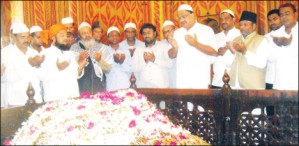
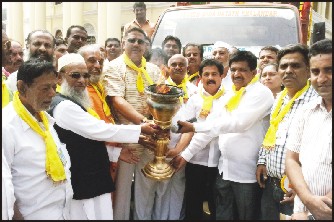
Chairman of Tipu Sultan Wakf Estate and MLA Tanveer Sait along with Islamic scholars and religious heads seen offering prayers to the tomb of Tipu Sultan at Srirangapatna yesterday.
Srirangapatna :
The 263rd birth anniversary of Tipu Sultan was celebrated in a grand manner at Srirangapatna yesterday.
Chairman of Tipu Sultan Wakf Estate and MLA Tanveer Sait along with Moulana Sajjadin of Jamia Masjid and other dignitaries offered prayers to Tipu tomb.
Speaking to SOM, Sait said that the Government should celebrate the birth anniversary of Tipu Sultan on the lines of Basavanna, Valmiki and other Jayanthis and added that there was no need for a holiday which was put forth by some organisations, but instead remember the day as the day of those who laid down their lives fighting for the country.
The MLA welcomed the announcement of Shadhi Bhagya by the government to the minorities and added that this scheme should be extended to the poor people of all communities.
Stating that there were plans to open a residential school on the lines of Moraji and Kittur Rani Chennamma Residential Schools, he said a proposal in this regard would be given to the Government soon.
A rally was taken out from Ganjam Circle to Tipu tomb.
source: http://www.starofmysore.com / Star of Mysore / Home> General News / November 11th, 2013
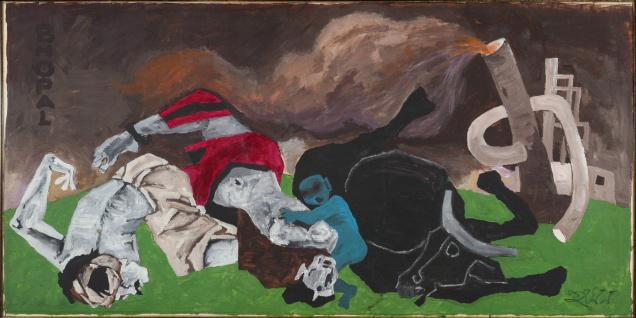
M.F. Husain’s “Bhopal”. / Photo: Special Arrangement / The Hindu
The oil on canvas has been valued at £200,000-300,000
‘Bhopal’, Maqbool Fida Husain’s anguished representation of the terrible consequences of industrial negligence in Bhopal, is to go under the hammer on October 8 at the Bonhams Auction House in London.
Husain’s framed and signed oil on canvas, with ‘Bhopal’ painted boldly on the side of the canvas — as if to leave no doubt on which disaster he is depicting — has been valued between £200,000 and 300,000, a press release from the auctioneers said.
“Just as Pablo Picasso’s passion and outrage towards the Spanish Civil War had inspired him to create ‘Guernica’ (1937), ‘Bhopal’ was the result of Husain’s horror at the long-lasting effects of the leak,” the press release said, though attributing the work’s energy to Husain’s own genius that was moulded by life around him. The Bhopal disaster occurred on December 3, 1984 when a poison gas leak from a Union Carbide factory killed around 2000 people.
Headlined by Husain’s ‘Bhopal,’ the October 8 auction of Indian and Islamic art will also auction ‘Bindu’ by Syed Haidar Raza (b.1922) that has been valued between £100,000 and 150,000, and ‘Untitled’ by Francis Newton Souza (1924-2002) valued between £40,000 and 60,000.
Raza started painting the Bindu series in the 1980s. “An act of meditation and the ‘Bindu’ is the centre of calm” the press release says.
Yet another highlight of the auction is ‘Four Figures” by Pakistani artist Sadequain (1937-1987) with an estimated valuation of £45,000-65,000.
This is not the first time that Husain’s paintings have been sold by Bonham’s, which specialises in Asian art. This April, an untitled Husain painting of horses was sold for £205,250; and in 2007, at the height of Husain’s troubles with right wing Hindu nationalist groups who hounded him for painting disrespectful and nude representations of Hindu goddesses, the same auction house sold his ‘Nude Woman’, a masterly painting of the naked female form, one that unfortunately had to find its home outside the country that inspired all his art.
source: http://www.thehindu.com / The Hindu / Home> Arts / by Parvathi Menon / London – September 20th, 2013
The remarkable feature about Mohammad Shami’s career, thus far, has been his ability to perform at various levels whenever opportunities came his way.
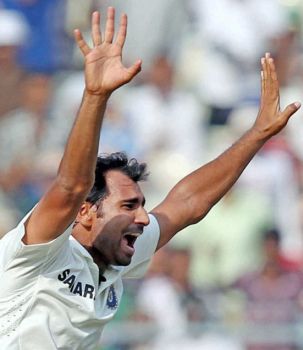
Kolkata: Indian bowler Mohammed Shami reacts after dismissing West Indies batsman M Samuels during the 3rd day of the first test match at Eden Garden in Kolkata on Friday. / PTI Photo by Swapan Mahapatra
There is a charm that is unique to the Eden Gardens and it was rather fitting that Sachin Tendulkar played the penultimate Test of his illustrious career at that venue. There was a plethora of activities orgainsed by the officials of the CAB to make the Test extremely memorable for “Sochin” (the way Bengalis pronounce Tendulkar’s first name), but once again the game proved that it was the master of all. A debatable decision decreed that the cricket lovers in the ‘City of Joy’ did not get to see the Little Master for long at the crease. Not surprisingly, however, the spotlight remained on Tendulkar and the Test match at Eden will be remembered by locals for long while. A couple of debutants, too, will never forget it, probably right through their lives.
Though the deeds of batsmen are generally recognised and remembered for obvious reasons, it will not be an exaggeration to say that Mohammad Shami made a lasting impression with his outstanding ability to bowl straight, quick and swing the ball prodigiously. Of course, Rohit Sharma did make for pleasant viewing, but for a bowler to make one and all sit up and take notice on a placid track takes some doing. The young bowler’s story is perhaps something out of a movie script, but there is only reality when it comes to his inherent talent. I had the pleasure of seeing him during my stint with the Bengal team and as the saying goes the first impression was the best, which has now proved right. He was in the shadows of Ashoke Dinda, but it was obvious that he was quicker than his senior colleague. This prompted me to convince the Bengal selectors to pick him at the earliest possible opportunity (2010-11) and since then the young, strong lad has only spiralled upward.
The remarkable feature about Shami’s career thus far has been his ability to perform at various levels whenever opportunities came his way. Normally, some players stutter a wee bit when they get to a higher level, especially pacers as they don’t really get seamer-friendly tracks in the sub-continent. But that did not deter Shami from picking up wickets on a consistent basis. If the ascent to the Duleep Trophy and India-A level was smooth enough, the start to his ODI career was smoother. Bowling three maidens in an ODI even on the most conducive of tracks is not done every other day in cricket. Of course, he did get carted for a few in the recent ODIs but when the stage is dominated thoroughly by batsmen it will be reasonable and prudent not to dissect the bowler.
The Test debut was a dream for Shami in every manner, but the young lad was self-effacing in his interaction with the media, which is rare in current day where youngsters deem it fit to display their attitude at every possible occasion. The journey will definitely not be so smooth always, but one thing is for sure, the ability to reverse the ball is rare and if Shami can preserve that facet of his game, I am certain that he will go on to be very successful. At a time when Zaheer Khan, another good exponent of reverse swing, is not in the radar, Team India desperately needed someone to bring in this critical element to the table. Besides, the frequent injuries have also resulted in India fielding bowlers on the basis of them being fit than on efficacy. Shami is naturally fit and can bowl long spells but I will be more than pleased if he can translate his words into action — his acceptance of wanting to train harder than he has done so far. Well, hopefully he will sustain his hunger and attitude in the years to come as India is in dire need of a strike bowler.
source: http://www.sportstaronnet.com / Sport Star ( The Hindu) / Vol. 36, No.47 – November 23rd, 2013 / by W. V. Raman, Column .
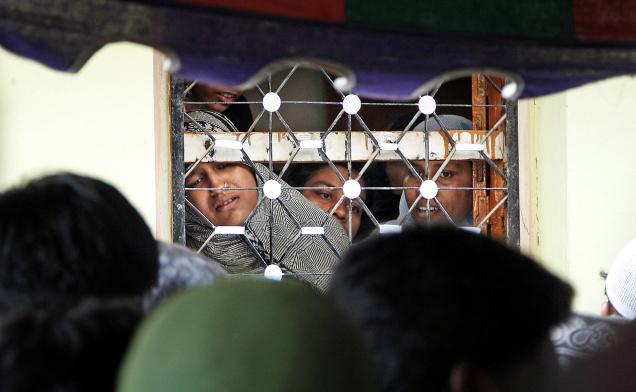
Nasreen Fatima, left, cries during the funeral ceremony of her husband Indian army soldier Firoz Khan, as she looks out from the window of her home in Hyderabad on Thursday./ Photo: AP / The Hindu
Indian Army soldier Mohd. Firoz Khan, who died in Pakistan’s shelling across the Line of Control (LoC) in Poonch district of Jammu & Kashmir on Tuesday, is given a tearful farewell and buried with military honours
The city bade a tearful adieu to martyred soldier Mohd. Firoz Khan on Thursday. Businesses and commercial establishments voluntarily shut down in the Nawab Sahab Kunta area of Old City to pay respects to the soldier who died in Pakistan’s shelling across the Line of Control (LoC) in Poonch district of Jammu & Kashmir on Tuesday.
Hundreds of people from various parts of the city converged at a local burial ground where the jawan was buried with full military honours on Thursday.
Procession
The funeral prayers were held at the ‘Masjid-e-Saliheen’ after which his body was draped in the national flag and taken out in procession led by a military band.
Onlookers raised slogans denouncing Pakistan and praising the martyr.
Women and children too participated in the procession by climbing on to the rooftops to have a final glimpse of the body of the brave soldier. Before burial, the martyr was offered a gun salute by Army personnel while Additional DCP South, K. Babu Rao offered the wreath on behalf of the State government along with other officials of the armed forces.
Labour Minister D. Nagender, YSRC president Y. S. Jaganmohan Reddy, BJP leaders Bandaru Dattatreya and G. Kishan Reddy, MIM leaders Asaduddin Owaisi, Akbaruddin Owaisi, Ahmed Pasha Quadri and Mohd Moazam Khan and Mayor Majid Hussain visited the house of the slain army man and offered condolences to the family.
The leaders demanded government to take all necessary steps to extend every possible assistance to the family and also provide adequate ex-gratia. They also called upon the Central Government to take strong measures to prevent frequent skirmishes at the LoC.
Mr. Akbaruddin Owaisi offered to take the responsibility of providing education to the three children of the slain army man.
IANS reportrs: Earleir, heart-rending scenes were witnessed at Firoz’s house. His mother Razia Begum and wife Nasreen Fatima were inconsolable.
Many were in tears after seeing his four—year—old daughter Afshin Fatima, two—year—old son Arshad Khan and eight—month—old daughter Aisha Fatima.
Firoz has been serving with the Madras Regiment for 12 years.
Firoz Khan had last visited his family on the occasion of Eid—ul—Fitr two months ago.
According to family members, he spoke to his wife over phone a couple of days ago to express his inability to come home on Eid and asked her to buy new clothes for the children.
source: http://www.thehindu.com / The Hindu / Home> News> Cities> Hyderabad / by Staff Reporter / Hyderabad – October 17th, 2013
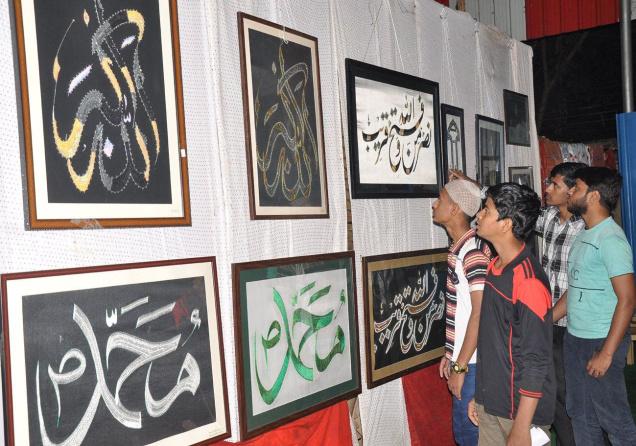
The works of 20 artists are on display at a calligraphy exhibition organised at the Barid Shahi Palace Hall in Bidar. / The Hindu
Mohammad Azmathulla goes around old monuments in Hyderabad collecting pigeon feathers lying on the ground. He comes home to clean them and fix artificial pearls at one end.
His real work starts now. He picks up his calligraphy pen to inscribe letters, names of friends and lines from Holy scriptures. “As far as I know, I am the only one who does feather calligraphy,” says the retired railway employee. He is among the 20 artists whose works are featured in the calligraphy exhibition organised in the Barid Shahi Palace function hall in Bidar.
The exhibition is organised by the Shaheen group of institutions and Siasat, the Hyderabad-based Urdu daily.
“It is very difficult to write on feathers as they are slippery. The pen gets stuck in the feathers and the letters can be distorted. That is why no one else seems to do this,” he said.
The artist has painted hundreds of names and sayings from Holy scriptures in English, Hindi and Urdu. He usually uses a single colour. But some times, he coats the feathers in a light shade of colour and uses multiple colours for the writing.
So does spot painter Abdul Lateef Farooqui. He creates stunning portraits in less than five minutes. Interestingly, he does not ask them to sit before him, but keeps observing and drawing sketches while they are doing something else. “I keep a bunch of sheets ready always, as I would be attracted to a face and feel like producing a caricature anytime,” he said. He has perfected the art of using geometrical designs in calligraphy. He also draws lines and letters on paintings of events described in the Holy Quran and other scriptures.
However, the master of the group is the 86-year-old Abdul Nayeem Saberi. He not only produces great works of calligraphy, but also trains young people in the art. He has trained more than 2,000 young people in the last 12-15 years.
Mr. Saberi also teaches young people how to make pens from bamboo shoots. He also helps women’s groups who recreate the calligraphic designs in embroidery and other craft forms.
The exhibition also displays wood work art where pieces of discarded wood pieces are joined to produce replicas of buildings or monuments.
Artists have produced copies of the original images of the house of Prophet Mohammad, the Kabah and the holy well at Makkah.
Some artists use a style that includes English letters, numbers and geometric designs. Some rearrange letters to create images of birds, animals and nature.
The Siasat trust was promoting the art of calligraphy among youth, Editor of the daily Zahid Ali Khan told The Hindu. He said their art works were showcased in exhibitions in New Delhi, Bangalore and Hyderabad. “We are training more than 300 women in various types of handicrafts and home industries. The trust also offers a total of Rs. 1 crore in scholarships to students per year,” he said.
“We are working at providing an online platform for artists to sell their wares,” said Managing Editor of the daily Zaheer Ali Khan.
Shaheen education society secretary Abdul Quadeer, spoke of plans to organise calligraphy classes for youth. The exhibition concludes today.
source: http://www.thehindu.com / The Hindu / Home> News> National> Karnataka / by Special Correspondent / Bidar – November 05th, 2013
Salar Jung Museum in Hyderabad and (top) the British musical clock, one of the rare clocks housed there
Hyderabad’s Salar Jung Museum plans to evaluate & tabulate its antique clock collection.
The Salar Jung Museum in Hyderabad, will begin work on evaluating and tabulating its clock collection, considered by clock enthusiasts as among the finest in India. Speaking to dnaover the phone from Hyderabad, Dr Nagender Reddy, director, Salar Jung museum said that this would be the biggest such exercise since the clocks were taken over from various private collectors in the 1960s.
“We want to do it in a scientific way, to add value to what is already a glorious collection of more than 400 of the rarest clocks in the country. It is a tedious and delicate process which includes the showcases that hold these clocks, evaluating the individual parts. All of this has to be done in such a way that no damage, whatsoever, comes to the clocks,” said Reddy. The process would be done along with the Lucknow-based National Research Laboratory for Conservation (NRLC), which is the apex body in the country for the conservation of cultural heritage.
The plan to evaluate the clock collection has already begun creating excitement among watch-lovers with Dr Reddy admitting that several people had contacted the museum to be part of the process. However, he said that it calls for a lot of formalities at various levels of the government as outsiders are not allowed to be part of these processes.
dna has learnt that among the people who have shown willingness to be part of the process is a senior railway officer from Mumbai. Saurabh Mitra, an Indian railway accounts service officer with Western Railway. Mitra, a watch enthusiast and collector, however, refused to comment.
About Salar Jung Museum
The museum was established in 1951. A major portion of the collection was acquired by Salar Jung III. In 1958, it was taken over by the Indian government. It is now run by an autonomous board chaired by the governor of Andhra Pradesh.
source: http://www.dnaindia.com / DNA / Home> Mumbai> Report / by Binoo Nair / Place: Mumbai, Agency: DNA / Friday – November 08th, 2013
” Britain is not fully aware of the fact that thousands of Indian soldiers were used as cannon fodder in this war and sent to various parts of the world to fight the Germans and their Turkish allies ”
“Why do hearts break
And minds bend?
Why isn’t there a stick
With only one end?
Why does day break
The sun set
And the moon wax and wane?
—For heaven’s sake
What was the debt
That Abel owed to Cain?”
From Booch Sakhat Booch (A Parsi Discourse on Stoppers) by Bachchoo
Britain has been commemorating the end of the First World War this last week. The Queen and other Royals laid wreaths at the cenotaph in Whitehall, London, marking the memory of the war dead and in the war cemeteries in Belgium. The populace buys and wears red paper poppies on their left lapels or their blouses.
This is the last ceremony of remembrance before the 100th anniversary of the war. Next year will see a tsunami of books, TV dramas, stage plays, songs and services about the First World War. I hereby confess that I’ve been commissioned to write a stage play about it — but from a slightly unexplored angle.
With the commission in hand I began to explore this angularity. The play is to be about the soldiers from Imperial India who were recruited to fight this “Sahib’s War”. Britain is not fully aware of the fact that thousands of Indian soldiers were used as cannon fodder in this war and sent to various parts of the world — the Western Front in Europe, Africa, Malaya and West Asia — to fight the Germans and their Turkish allies. What Britain can recall if it will was that several hundred of these Indian wounded were hospitalised during the war in the Brighton Pavilion, a building or folly conceived it would seem for a film set of Ali Baba. Some bright spark thought its oriental structure with domes and frills would make the Indians feel at home.
Several Indians who displayed bravery in the field were rewarded with the Victoria Cross and other decorations.
One story that sticks in my memory is what our family cook Hukam Ali told me when I was a child. When he was a teenager he used to be a ball-boy on the tennis courts of the Poona Club. A British officer took a shine to him and offered him employment in his house. Hukam Ali took it on and by his own account gave good service. The officer was then summoned with his regiment, which consisted of “native” companies and British officers to war and suggested to Hukam Ali that he enlist as an infantryman, which Hukam Ali did.
He recalled his experience in this war — a British war against other “goras”. I was too young to appreciate then which war this was or who was fighting whom, but “Hukams” said he went on a long voyage by ship and then by train and his regiment was joined by Australians and South Africans, all “goras”. The Indians were bivouacked separately from the whites for a few days.
Then the fighting began and in Hukam Ali’s words the cry went up “Kaaley ko aagey dhaklo! Kaaley ko aagey dhaklo! (Shove the blacks forward)”. At the tender age at which I heard the story I didn’t think of querying the fact that the British officers were shouting this command or slogan in Hindustani. The import of Hukams’ story was clear and the end of it tragic. He said hundreds of his regiment, thrown on the enemy lines died. He survived and must have been in his sixties when he found employment in our household which helps me date his war.
My play begins with the memory of this story. I have discovered that long before Subhas Chandra Bose’s Indian National Army fell on the tactic of recruiting Indian Prisoners of War in Japanese camps to fight for Indian Independence by siding with the Nazis and Japanese, a similar initiative was attempted in the 1914-18 War. The Germans set out to persuade Muslim soldiers of the Raj whom they had captured to switch sides.
Their argument was that Germany was allied with Turkey and the Ottoman Emperor was the Caliph, the leader of world Islam. No Muslim should be fighting him and his forces. The other argument was, of course, that the British had manifestly used Indian troops as cannon fodder and thrown badly trained, badly equipped and badly led Indians against superior German forces, which proved how little the Raj cared for Indian lives. No doubt some argument about a victorious Germany granting India its political and economic Independence was dragged in.
Though several Muslim soldiers are reported to have been persuaded to switch sides, no such force was consolidated or ever put into the field by the Germans. Perhaps there were too few of recruits to this cause or perhaps the Germans didn’t trust their conversion.
Nevertheless, my researches have thrown up a story that’s not very well known. Britain is, despite all the trumpeting about heroism, deeply ambivalent about this centenary. Yes, the British and their allies defeated Willhelm’s troops in the end but can a victory which cost both sides millions of deaths be “celebrated”? Will the centennial be dedicated to the utter futility and meaninglessness of this slaughter?
Historians repeatedly claim that they can’t conclusively say why the assassination of the Archduke of Austria by a Balkan patriot in Sarajevo should lead to millions of men fighting each other in the soggy trenches of Belgium.
Their confusion is confusing. The usual answer to the causes of the First World War is that all the participant nations were obliged by treaty to join battle with and against each other. This explanation may satisfy addicted domino players but anyone with any sense ought to know that treaties are pieces of paper.
That war was Germany’s attempt to eliminate all the other Imperial powers and become the only one. If it had succeeded, with or without the help of its Indian Muslim PoW converts, would it have ended the colonial exploitation of India — or taken it a step further?
source: http://www.asianage.com / The Asian Age / Home> Opinion> Columnist / by Farrukh Dhondy / November 16th, 2013
Marking the birth anniversary of Tipu Sultan (Nov. 10), a Sadbhavana Yatra from Mysore to Bangalore began here this morning.
The yatra was launched from the Town Hall premises by MP A.H. Vishwanath in the presence of Sir Khazi of Mysore Moulana Mohammed Usman Shariff, Prof. Bhashyam Swamiji of Sri Yoganarasimha Swamy temple, Tipu Sultan Sadbhavana Yatra Committee President Mohammed Ali and others. The yatra will pass through the thoroughfares of city before proceeding to the tomb of Tipu Sultan at Gumbaz in Srirangapatna, where special prayers would be offered to the tomb.
Later the yatra would proceed through Mandya, Channapatna, Ramanagar to Bangalore and reach Ravindra Kalakshetra on J.C. Road where Chief Minister Siddharamaiah would receive the Yatra Jyothi.
MLAs Tanveer Sait and M.K. Somashekar, former Corporator M.Shivanna, Showkath Ali Khan and others took part in the yatra function.
source: http://www.starofmysore.com / Star of Mysore / Home> General News / November 14th, 2013
Eight records took a tumble on the opening day of the 32nd Bharathiar University inter-collegiate athletic meet at the Nehru Stadium here on Wednesday.
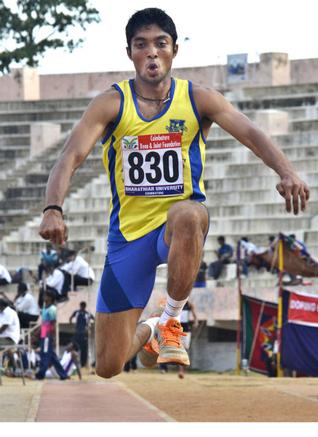
S.N. Mohammed Salahuddin of PSG College of Arts and Science accounted for one of them with a new meet record in men’s triple jump.
Son of former international Mohammed Nizamuddin, the 19-year-old junior national gold medallist came up with a big leap of 15.72m in his sixth and final attempt.
His effort erased his existing meet mark of 15.44m set last year.
He also bettered his personal best of 15.71m set in the Asian athletics championship in Pune this year.
R. Saravana Kumar (20km walk, STC-Pollachi), R. Muralidharan (hammer throw, PSGCAS), R. Ghana Sowndaran (high jump, Sri Krishna CAS), S. Jeeva Kumar (800m, Dr. NGP), R. Poongodi (half marathon, Gobi CAS), K. Subhashini (shot put, Nirmala) and S. Padmavathi (800m, Dr. NGP) were the other record-breakers of the day.
The athletes were also taken by surprise with the presence of NADA. Although it is a routine affair in an inter-varsity meet, it is the first time that a measure of this order has been introduced by the Bharathiar University at its meet.
This comes in the wake of a couple of students found carrying syringes and performance-enhancing drugs in one of its competitions held recently. It is probably the first time a university has come up with such an effort in the country.
The results:Men: 100m: 1. R. Suresh (Dr. NGP) 11.4s; 2. A. Ajesh (Dr. NGP); 3. A.S. Shek Allavdeen (Sree Saraswathi Thyagaraja). 800m: 1. S. Jeeva Kumar (Dr. NGP) 1:55.0s (NMR); 2. Karthi (PSGCAS); 3. P. Karthikeyan (Sri Krishna). 5000m: 1. N. Senthil Kumar (Sri Krishna) 15:54.7s; 2. Siva Sakthi (Gobi CAS); 3. B. Venkateshwaran (PSG CAS). 20km walk: 1. R. Saravana Kumar (STC, Pollachi) 1:43.31s; 2. M. Jeyasuriya (PSGCAS); 3. S. Nagendran (GAC, Ooty).
Half marathon: 1. M. Deenathayalan (Dr. NGP) 1:13.07s; 2. S. Vairavanthan (STC); 3. T. Dhayalan (Bharathiar). Hammer throw: 1. R. Muralidharan (PSG CAS) 43.70m (NMR); 2. R. Hariharan (Dr. NGP); 3. R. Dharaniraj (PSGCAS). Shot put: 1. R. Vishnuvardhan (Sree Saraswathi Thyagaraja) 12.41m; 2. T.S. Gowtham (PSGCAS); 3. R. Hariharan (Dr. NGP). High jump: 1. R. Ghana Sowndaran (Sri Krishna) 2.06m (NMR); 2. A. Khassan Khan (BACAS); 3. T. Maradona (Dr. NGP). Triple jump: 1. Mohammed Salahuddin (PSG CAS) 15.72m (NMR); 2. Mohammed Shefil (Dr. NGP); 3. A. Khassan Khan.
Women: 100m: 1. A. Manju Sri (Nirmala) 14.01s; 2. T. Sownderya (PSGRK); 3. M. Cladis Anclo (PKR). 800m: 1. S. Padmavathi (Dr. NGP) 2:21.4s (NMR); 2. Parameshwari (PKR); 3. P. Vinosha (Nirmala). 5km walk: 1. S. Sowmya Sri (Dr. NGP) 32:13s; 2. S. Vidya (Dr. NGP); 3. M. Banu Priya (Gobi CAS).
Half marathon: 1. R. Poongodi (Gobi CAS) 1:23.57s (NMR); 2. R. Sangeetha (Sri Krishna); 3. P. Uma (Nirmala). Hammer throw: 1. J. Karthika (PSGRK) 45.22m; 2. P. Madhupriya (Nirmala); 3. S. Ponmani (Nirmala). 5000m: 1. E. Vasanthamani (Gobi CAS) 19:30.9s; 2. D. Gayathri (Gobi CAS); 3. A. Tamilarasi (PSGRK). Triple jump: 1. M.A. Siva Anbarasi (PSGRK) 11.99m; 2. R. Neethu Krishna (Nirmala); 3. M. Keerthana (PKR). Shot put: 1. K. Subashini (Nirmala) 11.10m (NMR); 2. G. Divya (Nirmala); 3. S. Ponni (PKR). — Special Correspondent
source: http://www.thehindu.com / The Hindu / Home> Sport / by Special Correspondent / Coimbatore – October 10th, 2013
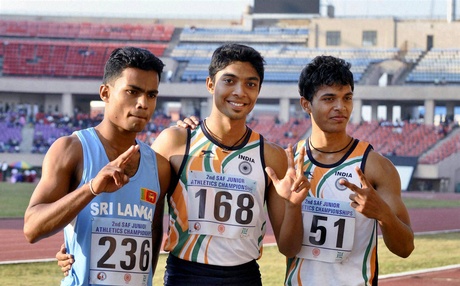
India finished on top of the table with 52 medals at the second South Asian Junior Athletics Championships though they shared the honours on the second and concluding day with Sri Lanka on Tuesday.
The hosts secured 20 gold, an equal number of silver, a dozen bronze medals. The Indians got more medals but one gold lesser than the inaugural edition held at Colombo in 2007.
Sri Lanka, who shared with India the 16 gold on offer today, improved their previous performance by winning 10 gold, 10 silver and 14 bronze medals (total 34) to finish second. Bangladesh were third with three bronze while Pakistan were fourth with a lone bronze medal.
Other participating nations Afghanistan, Maldives and Nepal could not win any medal.
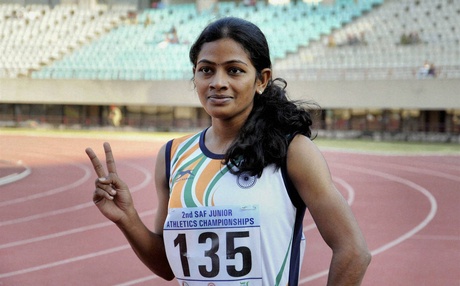
As expected, Indian sprinter Archana Suseentran and distance runner P U Chitra completed a double by pocketing the gold in 200m (24.32 secs) and 3000m (9:51.13) respectively.
Indian sprinter, Archana Suseentran won the gold in 200m in 24.32 seconds. (File/ PTI)
Supun Viraj Randeniya of Sri Lanka delivered the best performance of the day while winning boys’ 110m hurdles in 13.64 secs that bettered the previous meet mark (14.62s).
Ranchi Winners of triple jump, SN Mohammed Salahuddin and Mohd. Zuber of India and Atheetha N Karunasinghe of Sri Lanka (Left). (File/ PTI)
There were five other meet marks on the last of day of competitions. Pazhanivel Anburaja, who showed initial hiccups in long jump, went on to win the title with a notable 7.41m leap on his fourth round.
Half-miler Jessy Joseph, a prodigy of lndian athletics legend P T Usha, clocked an impressive 2:08.38 to win gold. Meghana Shetty in 100m hurdles (14.54s) and Sachin Kumar in discus throw (54.44m) were the other Indians who bettered meet marks.
Lankan sprinter Himasha Eashan posted a meet mark in 200m as he clocked 21.44 secs.
Sri Lankan athletes made a clean sweep of medals in all the four relay races.
Meanwhile, Sri Lankan capital Colombo was chosen to host the next edition of the SAF Junior Athletics Championships in 2015.
source: http://www.newindianexpress.com / The New Indian Express / Home> Sport / by PTI – Ranchi / November 13th, 2013