All posts by mpositiveone@gmail.com

Hamid Ansari’s lecture at Oxford Centre for Islamic Studies, London

Following is the text of the lecture delivered by the Vice President of India, M. Hamid Ansari, on “Identity and Citizenship: An Indian Perspective” at Oxford Centre for Islamic Studies in London, United Kingdom on November 1, 2013.

“It is a privilege to be invited to address this august audience. Conscious of the gap between the immensity of the honour and the inadequacies of the speaker, I am humbled by the realisation that six decades earlier Sarvepalli Radhakrishnan, a very distinguished predecessor of mine as Vice President of India, was for long the Spalding Professor of Eastern Religion and Ethics at this University.

A few years back, when I was in the vicinity of Oxford in a group dabbling in the unfathomable mysteries of the Iraq quagmire, Dr. Nizami provided a welcome distraction by inviting me to see the site, and the plans, for the new building of the Centre. He also mentioned the debate on the proposed architectural design, and of the view in some quarters that it would change the inherited landscape of a hallowed community.

The change, as I understood it, implied an assertion of identity. It is now conceded, I am told, that the new structure did no aesthetic or spiritual damage to the skyline of Oxford. Perhaps, the injection of diversity has enriched it.

Speculating on the ‘ifs’ of history, Edward Gibbon had visualised a course of events that might have resulted in the teaching of the interpretations of the Qur’an at Oxford. He could not foresee a happier, intellectually more rewarding, happening that the concluding decades of the twentieth century would bring forth. Among its manifestations is the establishment of this Centre.

This is a tribute to Oxford’s capacity to accommodate the unusual.

II

Encouraged by this accommodative approach, I wish today to share some thoughts on the twin concepts of identity and citizenship and the manner of their impact on the building blocks of modern States.

Needless to say, it is an Indian perspective and draws in good measure on the Indian experience. It may be of relevance to some of the objectives of this Centre, since India counts amongst its citizens the third largest Muslim population in the world and the largest Muslim minority anywhere.

It is a truism that the human being is a social creature and societies consist of individuals who come together for a set of common purposes for whose achievement they agree to abide by a set of rules and, to that extent and for those purposes, give their tacit or explicit consent to the abridgment of individual free will or action. They, in other words, do not get subsumed totally in a larger whole and retain their individual identity. This identity, as pointed out by William James and sustained by more recent social-psychological research, is a compound of the material, social and spiritual self. Further more, and when acting together in smaller groups, they develop group identities and these too are retained. Thus in every society we have identities at three or four levels, namely individual, group, regional and national. We can also, in this age of globalisation, add an international dimension to it. The challenge in all societies, therefore, is to accommodate these layered identities in a framework that is harmonious and optimally conducive to social purpose.

Much has been written about identity, its theoretical framework and practical manifestations. An eminent sociologist has defined it as ‘the process of construction of meaning on the basis of a cultural attribute, or a related set of cultural attributes, that is given priority over other sources of meaning. For a given individual, or a collective of actors, there may be a plurality of identities.’ The question is to determine how this identification is expressed in every day life of individuals who are members of such specific groups?

Conceptually and legally, citizenship of a modern state provides this framework and encapsulates the totality of rights and duties emanating from the membership of the citizen body, inclusive of the right of representation and the right to hold office under the state. By the same logic, a certain tension is built into the relationship, even if the society happens to be relatively homogenous, in itself a rarity in modern times. Rabindranath Tagore described his family background as a ‘confluence of three cultures, Hindu, Mohammedan and British’. Away from India but in our own neighbourhood, Abdolkarim Soroush depicted the Iranian Muslim as ‘the carrier of three cultures at once’ having national, religious and Western origins.

Thus instead of a narrow concept of a singular identity implied by the classical concept of citizenship, the need is to recognise and accommodate the existence of a plurality of social identities. The contours of this were explored earlier by Thomas Marshall, and more recently by Will Kymlicka, Manuel Castells, Charles Taylor, Gurpreet Mahajan and others. Put simply, it has been argued that identity encapsulates the notion of authenticity, the demand for recognition, the idea of difference and the principle of equal dignity.

What then has been the Indian approach to, and experience of, the concepts of identity and of citizenship in a modern state? What is the accommodative framework for identities in modern India?

A distinctive feature of Indian society is its heterogeneity. The historian Ramachandra Guha depicts our recent history as ‘a series of conflict maps’ involving caste, language, religion and class and opines that conflicts relating to these ‘operate both singly and in tandem’. Each of these also brings forth an identity of varying intensity; together, they constitute what the opening line of the Preamble of our Constitution depicts as We, the People of India.

In other words, the superstructure of a democratic polity and a secular state structure put in place after independence on August 15, 1947 is anchored in the existential reality of a plural society. It is reflective of India’s cultural past. Our culture is synthetic in character and, as a historian of another generation put it, ‘embraces in its orbit beliefs, customs, rites, institutions, arts, religions and philosophies belonging to different strata of societies in varying stages of development. It eternally seeks to find a unity for the heterogeneous elements which make up its totality’. It is a veritable human laboratory where the cross breeding of ideas, beliefs and cultural traditions has been in progress for a few thousand years. The national movement recognised this cultural plurality and sought to base a national identity on it. The size and diversity of the Indian landscape makes it essential. A population of 1.27 billion comprising of over 4,635 communities 78 percent of whom are not only linguistic and cultural but social categories. Religious minorities constitute 19.4 percent of the population; of these, Muslims account for 13.4 percent amounting in absolute terms to around 160 million. The human diversities are both hierarchical and spatial. ‘The de jure WE, the sovereign people is in reality a fragmented ‘we’, divided by yawning gaps that remain to be bridged.’ Around 22 per cent of our people live below the official poverty line and the health and education indicators for the population as a whole, despite recent correctives, leave much to be desired.

The contestation over citizenship surfaced early and was evident in the debates of the Constituent Assembly. The notion of citizenship was historically alien to Indian experience since throughout our long history (barring a few exceptions in the earliest period) the operative framework was that of ruler and subject. There was, of course, no dearth of prescriptions about the duties of rulers towards their subjects and about the dispensation of justice but none of these went beyond Kautilya’s pious dictum that ‘a king who observes his duty of protecting his people justly and according to the law will go to heaven, whereas one who does not protect them or inflict unjust punishment will not’. The constitution-makers therefore had to address three dimensions of the question relating to status, rights, and identity, to determine who is to be a citizen, what rights are to be bestowed on the citizen, and the manner in which the multiplicity of claimed identities is to be accommodated. This involved addressing three aspects of the question: legal, political and psychological. The outcome was the notion of national-civic rather than national-ethnic, emphasizing that the individual was the basic unit of citizenship whose inclusion in polity was on terms of equality with every other citizen. At the same time and taking societal realities into account, the concept of group-differentiated citizenship was grafted to assure the minorities and other identity-based groups that ‘the application of difference-blind principles of equality will not be allowed to operate in a way that is unmindful of their special needs, and that these needs arising out of cultural difference or minority status will receive due attention in policy, and that the polity will be truly inclusive in its embrace’.

The crafting of the Constitution was diligent and its contents reflective of the high ideals that motivated its authors. The Preamble moved Sir Ernest Barker to reproduce it at the beginning of his last book because, as he put it, it seemed ‘to state in a brief and pithy form the argument of much of the book and it may accordingly serve as a keynote’. The Constitution’s chapter on Fundamental Rights addresses inter alia the protection of identities, and accommodation of diversities. These identities could be regional, religious, linguistic, tribal, caste-based, and gender-based. The right to equality and equal protection of the laws and prohibition of discrimination on grounds only of religion, race, caste, sex, or place of birth is guaranteed. Affirmative action is mandated by law in favour of those historically discriminated against on grounds of caste or tribal origin as well as all those who are identified as socially and educationally backward. Also guaranteed is freedom of conscience and the right to freely profess, practice and propagate religion. Yet another section safeguards the right to have and conserve language, script or culture and the right of religious or linguistic minorities to establish and administer educational institutions of their choice. The purpose of these, taken together, is to bestow recognition, acknowledge the difference and thereby confer dignity that is an essential concomitant of equality.

An inherent problem nevertheless was evident to the constitution-makers, or at least to some of them. This was expressed candidly, almost prophetically, by Ambedkar in words that need to be cited in full:

‘On the 26th of January 1950, we are going to enter into a life of contradictions. In politics we will have equality and in social and economic life we will have inequality. In politics we will be recognizing the principle of one man one vote and one vote one value. In our social and economic life, we shall, by reason of our social and economic structure, continue to deny the principle of one man one value. How long shall we continue to live this life of contradictions? How long shall we continue to deny equality in our social and economic life? If we continue to deny it for long, we will do so only by putting our political democracy in peril. We must remove this contradiction at the earliest possible moment or else those who suffer from inequality will blow up the structure of political democracy which this Assembly has so laboriously built up.’

Thus the objective of securing civic, political, economic, social and cultural rights as essential ingredients of citizenship was clearly delineated and the challenge squarely posed to the beneficiaries of the new dispensation. The dire prognosis of the last sentence, however, has not come to pass! The very complexity of the landscape impedes linear and drastic happenings. One serious student of Indian polity has noted that ‘the Indian model of development is characterised by the politicisation of a fragmented social structure, through a wide dispersal and permeation of political forms, values and ideologies’. As a result and in a segmented society and unequal economy, the quest for substantive equality and justice remains work in progress. Nevertheless, the slowing down of the egalitarian social revolution that was envisaged by the Constitution-makers and the implicit social contract inherent in it, does give rise to wider concerns about its implications.

Two questions arise out of this and need to be explored. Firstly, what has been the impact of this on the perception of identity? Secondly, how has the challenge been addressed?

Identity assertion in any society has three sets of impulses: civic equality, liberty and opportunity. Identity groups are a byproduct of the right of freedom of association. They can be cultural, voluntary, ascriptive and religious. They are neither good nor bad in themselves but do present challenges to democratic justice. This is true of India also. The functioning of democratic institutions and the deepening of the democratic process along with the efforts to implement constitutional mandates for affirmative action induced higher levels of political mobilisation. These manifested themselves, most visibly, in demand groups each with its own identity. A multiplication of identities seeking social status and economic wellbeing through the route of politics thus emerged as a logical consequence.

It has been argued that ‘casteism in politics is no more and no less than politicisation of caste which, in turn, leads to a transformation of the caste system’. The same holds for religious and tribal minorities. In an evolving quasi-federal state structure, yet another imperative emanates from the requirements of regional or state identity. ‘The new politics of caste has also reinforced old, upper caste solidarities. Brahmin, Kshatriya, Bramharishi Sabhas have reemerged and the logic of electoral politics has forced the forces of social justice to strike strategic alliances with them’. These, together, have induced political actors to develop narrower foci on their electoral management methodologies; these have been reinforced by the shortcomings of the first-past-the-post electoral system and the ability of a high percentage of candidates to win on a plurality rather than the majority of votes cast in an election.

III

A society so diverse inevitably faced the challenge of integration. It was two fold, physical and emotional. The former, involving the merger of 554 large and miniscule princely states with those parts of the former British India that became the Indian Republic, was attended to with commendable speed and was almost completed by the end of 1949. Emotional integration, on the other hand, was a more complex process. As early as 1902, Tagore had cautioned that unity cannot be brought about by enacting a law and in 1949 Sardar Patel, the architect of integration of states, had laid emphasis on the process taking ‘healthy roots’ and bringing forth ‘a wider outlook and a broader vision.’ The challenges posed by it were aptly summed up by a political scientist:

‘In the semantics of functional politics the term national integration means, and ought to mean, cohesion and not fusion, unity and not uniformity, reconciliation and not merger, accommodation and not annihilation, synthesis and not dissolution, solidarity and not regimentation of the several discrete segments of the people constituting the larger political community

‘Obviously, then, Integration is not a process of conversion of diversities into a uniformity but a congruence of diversities leading to a unity in which both the varieties and similarities are maintained.’

Thus the Indian approach steers clear of notions of assimilation and adaptation, philosophically and in practice. Instead, the management of diversity to ensure (in Nehru’s words) the integration of minds and hearts is accepted as an ongoing national priority. Some have described it as the ‘salad-bowl’ approach, with each ingredient identifiable and yet together bringing forth an appetising product.

The question of minority rights as a marker of identity, and their accommodation within the ambit of citizenship rights, remains a live one. It is not so much on the principle of minority rights (which is unambiguously recognised in the Constitution) as to the extent of their realisation in actual practice. A government-commissioned report on Diversity Index some years back concluded that ‘unequal economic opportunities lead to unequal outcomes which in turn lead to unequal access to political power. This creates a vicious circle since unequal power structure determines the nature and functioning of the institutions and their policies’. This and other official reports delineate areas that need to be visited more purposefully.

How far can this to be taken? A Constitutional Amendment in 1977, adding a section on Fundamental Duties of citizens as part of the Directive Principles of State Policy, carries a clause stipulating promotion of harmony and spirit of brotherhood “transcending religious, linguistic and regional or sectional diversities.” It is at this point that the rights of identity and the duties of citizenship intersect. The identification of this point, with any degree of precision, is another matter. The litmus test, eventually, must be the maintenance of social cohesiveness through a sense of citizenship premised on equality of status and opportunity so essential for the maintenance of democracy. The need for sustaining and reinvigoration of this sentiment is thus essential.

IV

The Constitution of India was promulgated in 1950. The past six decades have witnessed immense changes in social and political perceptions in societies the world over. Theories and practices of ‘assimilation’, ‘one-national mould’ and the ‘melting pot’ have been discredited and generally abandoned; instead, evolving perceptions and practical compulsions led individual societies to accept diversity and cultural pluralism. In many places, on the other hand, a process of reversal induced by xenophobia, Islamophobia and migrant-related anxieties, is also under way. The concept of multiculturalism, pioneered to address accommodation of diversity within the framework of democracy, is being openly or tacitly challenged. An ardent advocate of multiculturalism concedes that ‘not all attempts to adopt new models of multicultural citizenship have taken root or succeeded in achieving their intended effects’ because ‘multiculturalism works best if relations between the state and minorities are seen as an issue of social policy, not as an issue of state security’.

There is an Indian segment to the debate on multiculturalism. It has been argued that ‘while a multicultural polity was designed, the principles of multiculturalism were not systematically enunciated.’ It is asserted that multiculturalism goes beyond tolerance and probes areas of cultural discrimination that may exist even after legal equality has been established; it therefore ‘needs to explore ways by which the sense of alienation and disadvantage that comes with being a minority is visibly diminished, but in a way that does not replace the power of the homogenising state with that of the community. It should therefore aspire towards a form of citizenship that is marked neither by a universalism generated by complete homogenisation, nor by particularism of self-identical and closed communities’.

These debates and practices vindicate in good measure the vision and foresight displayed by the founding fathers of the Republic of India. The vindication is greater when considered in the context of the size and diversity of India and the stresses and strains it has withstood in this period. And yet, we cannot rest on our laurels since impulses tilting towards ‘assimilationist’ and homogenising approaches do exist, suggestive of imagined otherness and seeking uniformity at the expense of diversity. Indian pluralism, as a careful observer puts it, ‘continues to be hard won’. Hence the persisting need of reinforcing and improving present practices and the principles underlying them. Such an endeavour would continue to be fruitful as long as ‘the glue of solidarity’ around the civic ideal remains sufficiently cohesive, reinforced by the existential reality of market unity and the imperative of national security. There is no reason to be sceptical about the stability of the tripod.”

*****

Endnotes :

i Castells, Manuel. The Power of Identity (2nd edition, Wiley-Blackwell 2010) p.6

ii Sen, Amartya. Identity and Violence: The Illusion of Destiny (London 2006) p.169

iii Soroush, Abdolkarim. Reason, Freedom and Democracy in Islam (Oxford 2000) p.156

iv Waldron, Jeremy: ‘Cultural Identity and Civic Responsibility’ in Will Kymlica nd Wayne Norman. Citizenship in Diverse Societies (Oxford 2000) p. 157

v Guha, Ramachandra. India After Gandhi: The History of the World’s Largest Democracy (London 2007) pp ix-xx

vi Tara Chand. The Influence of Islam on Indian Culture (Allahabad 1922) p. i

vii Verghese, B.G. Race, Reconciliation and Security: Managing India’s Diversities (New Delhi 2008) p.216

viii Kautilya. The Arthashastra – ed. L.N. Rangarajan (Penguin 1992) p. 140

ix Jayal, Nirja Gopal. Citizenship And Its Discontents: an Indian history (New Delhi 2013) pp. 16 and 273-75. Also, B. Shiva Rao (ed) The Framing of India’s Constitution – A Study (2nd revised ed. 2012) p.150

x Barker, Ernest. Principles of Social and Political Theory (Oxford 1951) p vi

xi Constituent Assembly Debates, Volume X, p. 979 – November 25, 1949

xii Kothari, Rajni. Rethinking Democracy (New Delhi 2005) p. 98

xiii Patnaik, Prabhat. ‘Independent India at Sixty-Five’ in ‘Social Scientist’ (New Delhi) Vol.41, No. 1-2, Jan-Feb 2013 pp 5-15.

xiv Gutmann, Amy. Identity in Democracy (Princeton 2003) pp. 3-7, 37

xv Kothari, Rajni. ‘Rise of the Dalits and Renewed Debate on Caste’ in Partha Chatterjee. State and Politics in India (Oxford 1999) p. 444

xvi Apoorvanand. ‘Democratisation of communalism.’ DNA (Mumbai) September 23, 2013

xvii Menon, V.P. The Story of the Integration of Indian States (New Delhi 1956) p. 469

xviii Rasheeduddin Khan. Bewildered India – Identity, Pluralism, Discord (New Delhi 1995) p.295

xix Report of the Expert Group on Diversity Index (Submitted to Ministry of Minority Affairs, Government of India 2008) pp. vii-viii.

xxi Kymlica, Will. Multiculturalism: Success, Failure and the Future (Minority Policy Institute, Europe, February 2012) pp 1-2

xxii Mahajan, Gurpreet. The Multicultural Path: Issues of Diversity and Discrimination in Democracy (New Delhi 2002) pp. 15, 17, 217-218.

xxiii Guha, Ramachandra. ‘Politicians and Pluralism: The inclusive ideals of the Republic must not be lost sight of’.’ The Telegraph (Kolkata) September 7, 2013

source: http://www.thehindu.com / The Hindu / Home> News> Resources / November 04th, 2013
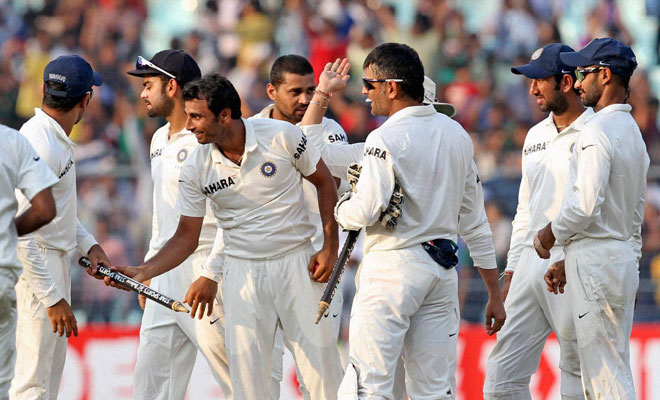
At Eden Gardens, ‘Shami, Shami’ takes over from ‘Sachin, Sachin’

Indian players celebrates their win over West Indies in the first Test match at Eden Garden in Kolkata on Friday. India won by an innings and 51 runs./  PTI Photo
Indian players celebrates their win over West Indies in the first Test match at Eden Garden in Kolkata on Friday. India won by an innings and 51 runs./ PTI Photo

Minutes before the Eden Gardens Test began Wednesday, Mohammed Shami was handed over his maiden Test cap by Ishant Sharma.

Ironic, considering Shami had just replaced Ishant in the eleven for the match against the West Indies. But by the time the Test finished Friday, one that Shami helped end prematurely, the debutant had snatched away Ishant’s long-held title of ‘pace spearhead’ as well.

With a breathtaking display of reverse swing bowling, Shami scissored through the West Indies batting order late on day three to finish with a five-wicket haul in the second innings.

His figures of 5/47 in the second innings ensured that Darren Sammy’s side were bowled out for just 168 and India won the match by an innings and 51 runs. The burst took his match haul to 9/118 — the most by an Indian pacer on debut, bettering Munaf Patel’s 7/97 in Mohali in 2006.

All this took place at his home ground.

The packed house at the Eden had witnessed something rare from an Indian bowler at an Indian ground — speed of over 140 kmph, banana-swinging deliveries and flying stumps.

So special was the unfolding drama that by time the players left the field, the usual crowd chorus of “Sachin, Sachin” had changed to “Shami, Shami”.

M S Dhoni was certain that India had finally been blessed with what they were looking for — a true tearaway.

“Shami is a fantastic find, someone who has great skills,” the Indian captain said at the presentation ceremony. “Everyone was reversing the ball today. But what made Shami’s reverse swing special was the length he bowled.”

West Indies captain Darren Sammy agreed.

“Our bowlers were either too full or too short. Shami had that nagging back-of-a-length spot,” he said. “That’s how it ought to be done.”

That length confused West Indies’s batsmen. Caught in two minds to either push forward or stay back, Shami’s victims ended doing neither. Several middle stumps were flattened.

He did not take any wickets in his first couple of spells with the new ball. But once the leather was about 30 overs old, scruffed up through wear and tear, he was unstoppable.

All his wickets came after over number 31. Two of them fell together in the 49th over. Off the second ball, Sammy positioned himself to block one swinging in wildly from well outside off stump. But the drastic dip in the ball’s height hid under the West Indies captain’s willow. Then it pitched and straightened, boomeranging against the middle stump.

Sammy looked like he had seen a ghost. Just like Shane Shillingford, two balls.

Kapil Dev, however, looked like he had seen a prodigy.

When Ramiz Raja – the former Pakistani player who had captained the gurus of reverse swing, Wasim Akram and Waqar Younis – asked him to point out Shami’s stand-out feature,  Kapil said: “I can’t.   A true fast bowler has many facets — brains, pace, swing and a big heart.  Shami ticks all the above.”

source: http://www.indianexpress.com / Indian Express / by Aditya Iyer / Kolkata,  Saturday – November 09th, 2013

Shami reverse-swings India to fabulous win at Eden Gardens

Kolkata : 

Pacer Mohammad Shami gave an awesome exhibition of reverse swing to cap a dream debut with five second innings wickets as India inflicted an innings defeat on a hapless West Indies inside three days in the first Test to mark a fabulous start to the Sachin Tendulkar  farewell series on Friday.

Scorecard

Shami followed up his 4-71 performance in the first innings with a 5-47 show in the second to claim an enviable match haul of 9-118 — the best ever by an Indian pacer on debut.

Shami’s performance propelled India to an innings and 51-run victory in the first Test at the iconic Eden Gardens.  Offie Ravichandran Ashwin followed up his exploits with the bat (124) with admirable figures of 3-46.

Needing 219 runs to escape the ignominy of an innings upset, the West Indies collapsed like a pack of cards in the final session — 98 minutes into the post tea session — to be bundled out for 168. Veteran Shivnarine Chanderpaul (31 not out; 101 b, 2×4) put up a gritty resistance, but in the end ran out of partners.

In the morning, Ashwin struck his second Test ton (124) and extended his seventh wicket stand with Rohit Sharma  (177) to a staggering 280 to enable the hosts finish at a mammoth 453. The visitors had notched up 234 in their first innings.

Beginning their second knock in the post-lunch session, the West Indies raised the promise of a fightback by reaching 101/1, courtesy a 68-run second wicket stand between Darren Bravo (37; 78 b, 4X4) and  Kieran Powell (36; 83 b, 5×4), but Ashwin began the Caribbean demolition by foxing Powell with a flighted delivery that hit the batsman on the pad plumb in front of the stumps.

Shami – after a listless effort in his first spell – returned with a vengeance close to tea, and saw the back of Marlon Samuels (4) with one that reversed and got him leg before.

In the second over after tea, Bravo tried to cut Ashwin, who had pitched outside the off stump, and the ball dipped into the hands of a diving Rohit Sharma at point. The West Indies were then 120/4.

Shami then jagged one back after pitching on a length just outside the off stump, inducing an inside edge from Windies wicketkeeper Denesh Ramdin (1), which was lapped up by his Indian counterpart.

With half the side gone, Chanderpaul (23) and skipper Darren Sammy (8) tried to put up resistance briefly, but they crumbled in Shami’s 11th over – the 49th of the innings.

The Bengal pacer again pitched on a length outside the off stump, and got the ball to reverse, uprooting Sammy’s middle stump.

Two deliveries later, Shane Shillingfored got a similar ball which unsettled the off stump by breaking through the gate.

There was a further tragedy for the Caribbeans after the next delivery. Shami again extracted reverse swing, and Veerasammy Permaul (0) was struck on the pads. As the Indian fielders appealed, Permaul took a few steps out of the crease, but the alert Dhoni was quick to throw down the stumps to get a run out decision.

The writing on the wall was more than clear, and the West Indies were reeling at 152/8. The formalities were soon completed with Ashwin claiming Tino Best (3) and Shami castling Sheldon Cottrel (5).

Earlier, Resuming at 354/6 overnight, Ashwin and Rohit batted fluently to notch up a stand of 280 – an Indian highest for the seventh wicket – which catapulted the hosts to a strong position.

Ashwin, who had taken the partnership to 200 in the morning’s second over with a streaky boundary off Best, brought up his delightful 100 in the fourth over by pushing the same bowler through the sweeper cover.

Reaching the three-figure mark, a visibly ecstatic Ashwin punched the air as Tendulkar clapped in appreciation in the dressing room balcony. The landmark was reached off 159 balls.

All the four wickets in the morning session were equally shared by the visiting spinners on a track which played slow but gave turn. Shillingford (6-167) claimed his fifth five-wicket haul in 11 Tests. Left armer Veerasammy Permaul (2-67) was the other successful bowler.

Rohit finally departed as he deliberately padded an offering from Permaul which pitched around the off stump and turned away.

Aswhin was claimed by Shillingford with a flighted delivery which beat the batsman and dislodged the middle stump.

source: http://www.timesofindia.indiatimes.com / The Times of India / Home> Sports> Cricket> Series & Tournament> West Indies in India 2013 / by IANS / November 08th, 2013

She flies high with her wings of passion

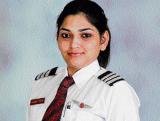
Meet Saara Hameed Ahmed, all of 24 and flying commercial flights for the last 18 months! In her words, she is living the dream she dreamt for herself every moment of her life.

SaraHameedMPos08Nov2013

Often seen piloting a private airline’s Boeing 737 out of Bangalore to destinations such as Pune, Ahmedabad, Kolkata, Kochi, Chennai, she was one among the 70 pilots recruited by the company from among 600 candidates holding commercial flying licence in 2010.

Several hurdles

Saara had left for Florida (US) immediately after her PUC at Jyothi Nivas College in 2007 to join a pilot training school in Orlando. A year’s rigorous training which entailed logging 200 flying hours within the course period, yielded her a commercial pilot’s licence. But that was not all. Several hoops lay ahead on return to India. Supply was more than the demand and several were in the queue for fewer jobs. Conversion of the American licence to an Indian one required a waiting period. Even recruitment was not the end of the road to success. A month’s further training in Lithuania for learning the nitty-gritty of specific aircraft types preceded the start of her entry into the cockpit.

The kickstart

Saara says she loved heights from her childhood and had several sessions of training in climbing mountains, trekking, rappelling in Kanteerva Stadium before the choice of a career in flying got crystallized.

Her mother recalls that she was adventurous type from the very childhood and would not balk at doing what is normally expected of boys.
Some counselling. Some support.

But it was participation in a career counseling session by an Australian pilot in her college which actually lit the initial spark. From then on, there was no looking back. She began to see herself being a pilot from 2006 onwards. Her father’s friend, Atif Fareed, a pilot with the South West Airlines in the US, was a major support for her. He got her enrolled in Paris Air Inc. flying school in Vero Beach in Florida.

Religion no bar

She says, odds were formidable from the beginning itself. “I would think, wouldn’t the authorities at the US Consulate in Chennai think twice before issuing visa to a Muslim girl after 9/11? But by God’s grace, it took just five minutes for them to decide. No questions were asked and I was out with a visa in hand within five minutes. It was as if all the forces of Nature were propelling me forward towards my goal,” she muses.

Child’s wings of dreams

While her mother remembers Saara asking her permission to join bungee jumping even while in high school, father Hameed says she had jumped from a balcony to a lower parapet at the age of three inviting reprimands. She would look at planes flying low in skies while approaching former HAL Airport while they stayed in a house in Madiwala during her childhood.

Fly, girl! Fly!

While admitting inhibitions mainly stemming from the way a girl child is brought up in Indian families, she says she never faced any prejudices on the basis of faith. As for the pilot training school in the US, she says gender did not make any difference there. “Of course, women comprised merely 20%, but the stress was on physical fitness, perceptivity and basic aptitude for learning,” she reveals.

Male world?

Didn’t she ever feel she was risking her life for a career which has so far been dominated by males? Saara says, “Be it male or female, you have to be courageous to take up a career such as this. It demands tremendous self confidence and gender does not make women any less confident with the right kind of upbringing.”

On flying high, eternally.

Saara says all airlines make the atmosphere extremely safe for the women staffers with element of gender sensitivity forming part of the training. Intelligence and decisiveness play a very crucial role while commanding an aircraft.

Saara has so far put in 1,200 flying hours in 18 months and hopes to continue her career in the skies till retirement, regardless of circumstances.

source: http://www.deccanherald.com / Deccan Herald / Home> Supplements> She / by M A Siraj / October 19th, 2013

WINNER : Every grain of sand

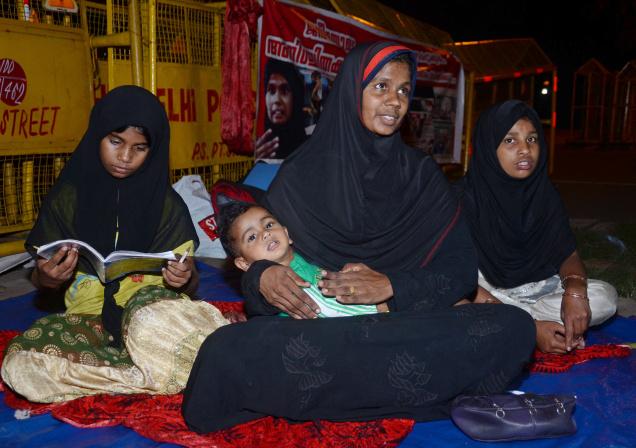
Jazeera V., with her children, peotesting against illegal sand mining in Kerala, at Jantar Mantar in New Delhi./  File Photo / The Hindu
Jazeera V., with her children, peotesting against illegal sand mining in Kerala, at Jantar Mantar in New Delhi./ File Photo / The Hindu

“If there’s a nexus working that wants the blatant exploitation to thrive, it has to be met with equal force”

She calls herself a ‘daughter of the sea’. It’s not a borrowed label, but one that Jazeera Vadakkan believes in with passionate conviction. She builds literal ties to the description, “I was born at home, right on the Neerozhukkumchal Beach in Kannur (north Kerala).”

Clad in a burqa, surrounded by her three children, Jazeera makes an unlikely sight on the pavement outside Kerala House in New Delhi. As unlikely as when she was protesting outside the Secretariat in Tiruvananthapuram in her home state. But this is no home-maker accidentally caught up in the public sphere. Get closer and you will see that she is conviction personified.

Jazeera’s is a lonely battle, but she is the face of an amazingly courageous defiance against the all-powerful sand mafia that rules the coastal hamlet where she was born. Her zeal is in many ways incredible. Her battle is not built on academic research or environmental laws. It is a personal and intuitive battle. Returning to her village a short while after her marriage she found the landscape virtually unrecognisable, altered by the relentless mining of sand. “Why is it so difficult to see? If the miners can inflict so much damage on one beach in a few months, what will we have left to pass on to our children’s generations?” she asks.

The 31-year-old has been threatened countless times and even physically assaulted. But nothing seems to dent her mission to prevent even a grain of sand being shifted from ‘her’ beach. As she says, the sand being removed in tonnes to building sites has caused severe damage to Kerala’s fragile coastline.

Criticism of Jazeera, an auto driver by profession, ranges from dismissing her as a fake seeking media attention to vilifying her as an irresponsible mother and wife. She protests with her three children in tow, the youngest barely two. When Jazeera moved base from her hometown to the Kerala capital in August this year, her children came along. Her husband, Abdul Salaam, a madrassa teacher in Kochi, is not with her but is a source of support, she says.

The unending monsoon, the harsh heat wave, the criticism, the threats — nothing seems to affect Jazeera and her children. They had become permanent fixtures near the north gate of the Secretariat building. A huge demonstration organised by the Left Front had even veteran vendors a little worried because of the sheer numbers. But not Jazeera, who refused to budge. Her two girls, Rizwana and Shifana, seemed more preoccupied by their colouring books than the crowds and red flags all around.

Finally, Kerala Chief Minister Oommen Chandy met her on the third day of her protest. He promised her that action would be taken, but Jazeera wanted a written statement. When this did not happen, Jazeera went to Delhi. “There are laws that prohibit this sort of activity. But when the local people, the police, local leaders are all part of a nexus that wants the blatant exploitation to thrive, it has to be met with equal force,” she says.

None of the attempts to frighten her into going back to her hamlet have worked so far. Jazeera continues to protest, asking for a written assurance from the Kerala government to rein in the sand miners, something the authorities have strangely refused so far. Here is one woman fighting an organised mafia, but with enough courage to beat the odds.

sourceZ: http://www.thehindu.com / The Hindu / Home> Features> The Yin Thing / by Kaavya Pradeep Kumar / October 13th, 2013

‘There is anger because the Muslim world feels targeted, essentially for 9/11. And its millions of people had nothing to do with that’

AgaKhanMPos07nov2013

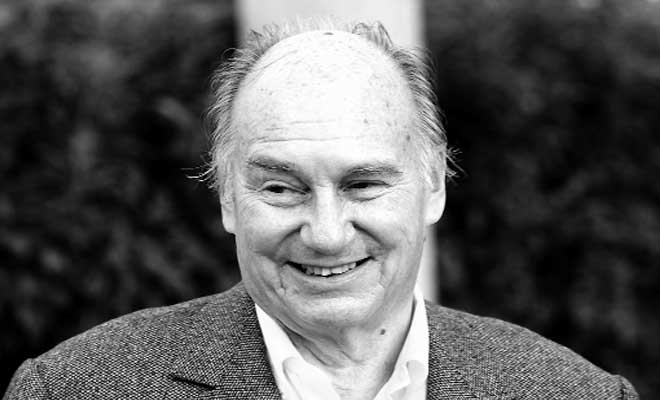
In this Walk the Talk on NDTV 24X7 at his foundation’s latest initiative, the Aga Khan Academy near Hyderabad, His Highness the Aga Khan talks to The Indian Express Editor-in-Chief Shekhar Gupta about the growing Shia-Sunni tension that worries him, and the roots of the lack of understanding between the Western and Muslim world. However, he adds, most of the conflicts one sees today have little to do with faith but have a political dimension.

It’s been said about you that no human being today bridges so many divides as gracefully and as powerfully as you do. And how many divides: the East and West, Islam and Christianity, material and the spiritual and, if I may add, ancient to the medieval, the modern and the future.

Thank you very much and I’m very happy to talk with you.

And welcome to a country which is in many ways your homeland.

Yes, yes. My grandfathers… way back.

He was born in undivided India.

He was, and the place where he was born is still there. Still in the family.

And the first school set up (as part of the Aga Khan network) was in India.

In Mundra (Gujarat).

And now there are 80-90,000 students… So what’s this thing about the Aga Khans and education?

My grandfather and I have always felt that education is an essential part of a community’s life, a country’s life, an individual’s life. It is the unavoidable building block for all people all around the world. This academy (the Aga Khan Academy on the outskirts of Hyderabad) is a part of that exercise.

Education is also a healer of the mind.

It’s a healer of the mind, but it’s also a way of making rational judgments. What we need in society is rational judgment. It helps evaluate, it helps position issues…

So before we get into the more profound discussion on making rational judgments in times when all wisdom is presumed to be given, tell us a little bit about the Hyderabad academy.

Some 10 years ago we started asking ourselves, ‘Where are we? What do we need?’. We came to the conclusion that there were a number of countries where secondary education was a critical issue. We decided that instead of trying to respond on a country-by-country basis, we would try to make a network of institutions to move intelligent children from one society to another, from one language to another, so that we would try and build global capacity and bring it in at the secondary level of education, not retard it until tertiary education or career.

And an academy like this is not limited. Access is not confined to your followers or only people of one faith?

No, no, not at all.

Purely on merit?

Purely on merit and, it goes further than that, it’s ‘means blind’. So the moment a child is qualified, it’s our responsibility to find the ability to fund that.

I haven’t heard this wonderful expression before, ‘means blind’. It’s fascinating to hear it from somebody who doesn’t like the word ‘philanthropy’.

Well I think philanthropy is very close to the notion of charity. And in Islam it’s very clear — Charity is desirable, necessary, but the best form of charity is to enable an individual to manage their own destiny, to improve his or her condition of life so that they become autonomous.

I remember something you said in an interview. You said becoming an imam doesn’t mean you distance yourself, you renounce the world. It actually means engaging with your community even more, improving their quality of life and giving them protection. It doesn’t mean sanyaas, if I may use something from the Hindu way of life.

No. And it’s not just in the Hindu way of life, there are Christian schools where engaging in life is not desirable. In Islam that doesn’t exist. It’s the contrary actually. Imams are responsible for the security of their community, for the quality of life of their community — they must engage, but they have to engage ethically.

You make a very unlikely imam. You don’t look like one — as we know the stereotype now — don’t talk like one, don’t act like one. And don’t play like one — you still suffer skiing accidents.

If you look at the life of the Prophet, he led a normal life. And in a sense he showed that Islam is part of life. It’s not separated from life.

And that’s the inspiration for you.

It’s what I believe to be correct.

And that’s what should apply to all Muslims.

All Muslims, I think, live in the real world. I don’t know of many leaders who have removed themselves totally from life. It’s not part of our religious tradition.

What about the Sufis, the dervishes?

The whole domain of mysticism, as we all know, it exists in many, many, faiths. And that is an evidence of a personal search, not of an institutional search.

And religion and spirituality should be a personal exercise.

It’s both in Islam. It’s a community approach to life, there are community responsibilities, social responsibilities, but there are also personal responsibilities. Certainly, in my interpretation of Islam, the two must go hand in hand. You can’t abandon one for the other.

There’s another fascinating thing you said — there is no clash of civilisations, there’s a clash of ignorances. But that clash of ignorances — what someone called ‘scars on our mind’, in a different context, the Cold War — is now a reality. How do you deal with it?

I’ve used all the methods I thought I had to try and help bridge civilisations rather than have them continue to look at each other in ignorance and discover each other in conflict, and all the rest.

Why call it a ‘clash of ignorances’? Let me add something to that. If the stereotypes about Islam are today cast in stone, you defy all those stereotypes.

That’s very kind. I did my degree at university on Islamic history, so I should know…

And you went to Harvard.

So in that sense, I may have had a certain amount of comfort. But if I take what was the definition of an educated child in 1957 (when he became the imam) and ask you, what was the composition of the curriculum at that time, there was nothing on Asia, nothing on Islam, very little on Africa, if anything. The industrialised world was turning around on itself. And today you still see decisions taken between the industrialised world and the Muslim world that would not have been taken if they had known each other back then.

If I can take a little chance and be sort of indiscreet, in a way the Islamic world knocked at the doors of the Western world — in the form of those planes slamming into the World Trade Center buildings.

Yes…

I’m oversimplifying.

Well it would be difficult to associate what we call the Ummah — the totality of the Muslim world — with that. I don’t think that would be right.

But that stereotype did get built.

That stereotype did get built, without doubt. But I don’t think you can attribute that to the totality of the Ummah. That’s simply not correct. So the stereotype itself is massively incorrect, which then raises another question: what is the form of communication we’re living in? How can miscommunication be as acute as it has been?

What do you tell your friends in the Western world about their new stereotypes of Islam? And what do you tell your Muslim brothers and sisters and followers about their stereotypes of the Western world?

Well I would start by asking a very simple question: in 2013 — what is the definition of an educated person? The knowledge that that person requires is more and more understanding the world, not understanding little parts of it. Understanding the world is a massively complex goal, but I think that we’ve got to admit that that’s what’s necessary. It’s unavoidable. We’re more of one world than ever before.

Because your community has also suffered, it has now come to be represented by people of a certain kind. People who hog the headlines, sort of prime-time TV, and whose silhouette usually has as an AK-47 or worse. How much damage have they done to your community?

I don’t think the community is seen as a community that is in any way engaged in this sort of concept.

Because a Muslim passport at a Western airport… I’m again using a stereotype, but it is a reality.

Well I’m not sure that is really true of all Muslims. I think there are certain areas of the Muslim world which are more, let’s say, questioned than others, but I don’t think that’s universal. And that has happened in other faiths — let’s be quite clear.

Absolutely. The Muslim world, the Ummah exists in so many countries. Your own followers are all over the world, including India.

There exists right there a fundamental point. Unless you understand the plurality of the Ummah, you are not going to think correctly with regard to that part of the world. You need to have a basic understanding of its pluralism. We are, in our part of the world, as pluralistic, if not more pluralistic, than others.

source: http://www.indianexpress.com / The Indian Express / Home / by Shekhar Gupta / Tuesday – October 08th, 2013 

Women’s world

A few years ago, when a bilingual (Urdu and English) quarterly magazine ‘Nisa’was started by a small group of Muslim women from Hyderabad, it was seen as a ‘ray of hope’ and perhaps rightly so. For the most part, it was a pleasant surprise. The idea behind its initiation, as researcher and activist Kaneez Fatima, explained once to this writer, “is to examine women’s problems and create debate based on particular issues, and to draw the attention of women writers and research scholars to such questions.”

Kaneez, who is also one of the founders and editors of the magazine, went on to say, “This was also needed because there was hardly any research magazine in Urdu that focused on women’s issues in particular. We strongly felt the need for one for quite some time, before we decided to fill this gap on our own.” In these observations on Urdu magazines, she couldn’t have been further from the truth, especially as far as Urdu women’s magazines are concerned. Today, while there is no dearth of Urdu magazines and journals, there is no substantive representation of women’s issues in them.

All that one can find in the name of Urdu women’s magazines are ‘family magazines’ like Khatoon Mashriq, Mahankta Aanchal, Huma, and Pakiza Aanchal, etc. And these magazines, often published months in advance, hardly discuss contemporary issues and debates about questions relating to gender. However, it is important to note that this was not the state of Urdu women’s magazines a few decades ago, especially before partition. There were magazines for women in Urdu, debating and discussing a range of socio-political, cultural and educational issues of that time.

THE NEW PUBLICATION: Kalam-e-Niswan.

A new compilation, Kalam-e-Niswan, carried out and published by Nirantar, a Centre for Gender and Education, under the editorship of Purwa Bhardwaj, takes us to the debates of those days. Apart from the debates, the compilation includes well researched pieces of women’s writings, in the forms of travelogue, reportage, opinions, letters, portraits and profiles.

This compilation is a Hindi transliteration of original Urdu writings published in magazines likeTahzeeb-e-Niswan, Ismat, Payam-e-Ummid and Ustani, mostly before independence or a few years just after it. Lesser used Urdu words are defined as footnotes as and when required. Broadly divided into four sections and further classified into nine sub-sections, it systematically chronicles issues of culture, education, curricula, governance, and women’s right to vote, gender relationship and women’s rights movements. It also presents the socio-economic and educational situation of those days. The range of the issues are so vast and fresh that one thinks that these writings were done in the present times, and not decades, or a century ago. One is simply surprised to see extensive articles on subjects such as the Children of Chhattisgarh (Ismat: 1936), Women’s Education Department of Egypt University (Khatoon: 1911), and Activities and Education of Turkey Women (Ismat: 1951).

Purwa says, “While these writings help us to understand the minds of Muslim women, at the same time, it also compels us to think, rethink and question our understating and popular notions about Muslim women, their thinking, choices, dreams and contributions.”

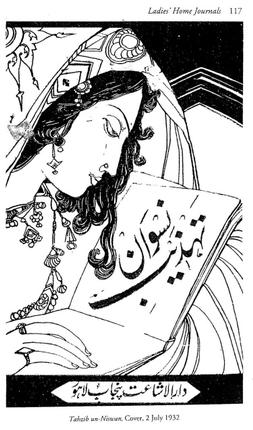
THE ORIGINAL MAGAZINE: Tahzeeb-e-Niswan from where original Urdu writings have been transliterated.

According to Nirantar, this compilation is the result of a project initiated by them in order “to develop a deeper understanding of Muslim women’s education” and, while working on it, they “came across important writings by Muslim women”. Though it’s true that all the articles included in this compilation were written decades ago, a look at the debates surrounding Muslim women, both in the society at large and Muslim societies, as well as in the mainstream media, shows that issues were not very different even in those days.

The compilation, with its wide range of subjects such as women’s dress, to veil or not to veil, women’s education and their position in society, activities of women folk, right to vote and women, English medium schooling, polygamy and remarriage makes it relevant even today.

source: http://www.thehindu.com / The Hindu / Home> News> Cities> Delhi / by Mahtab Alam / October 21st, 2013

Former President Kalam to grace Motilal Nehru National Institute of Technology’s convocation

Allahabad :

Motilal Nehru National Institute of Technology, Allahabad (MNNIT-Allahabad), is poised to hold its 10th Annual Convocation-2013 on Thursday at the Rajiv Gandhi MP Hall Complex. The occasion will be graced by former President APJ Abdul Kalam as the chief guest while Prof VK Saraswat, chairman, Board of Governors, would preside over the function.

Speaking to newspersons on Wednesday, director, MNNIT, Prof P Chakravorty, said that during the convocation, 693 BTech, 77 MBA, 72 MCA, 9 MSc, 6 MSW, 404 MTech and 34 PhD students will be awarded degrees. For academic session 2012-13, 23 gold medals will be awarded to postgraduate students and nine to the undergraduate students.

Further, 18 sponsored gold medals are to be awarded across various academic programmes. This is in addition to the medals to be awarded to the toppers of the first, second, third and fourth years of undergraduate programs.

The coveted and prestigious Institute Gold Medal will be awarded to Shobit Srivastava of BTech (Computer Science & Engineering) for standing first amongst students of all branches of the Institute in the Final Year Examination of 2013. He will also receive a gold medal for standing First in BTech (Computer Science & Engineering) Final Year Examination 2013.

Archan Mudwel of Mechanical Engineering will be awarded the gold medal for standing first at BTech third year examination 2013, while Tanu Agrawal and Priyanshu Srivastava, both of Computer Science & Engineering, will be awarded gold medals for standing first in the second and first year examination 2013, respectively.

He said that the institute has continued to take large strides in its mission of academic excellence. In 2012, 66 new faculty members were inducted in various departments. This has taken the total faculty strength to 199, with 50 professors, 36 associate professors and 113 assistant professors.

During academic session 2013-2014, 1,485 students were admitted for various programs of BTech, MBA, MCA, MSc, MSW, MTech and Ph.D, out of which 92 students are from other countries.

In a new initiative, the institute has organized 22 Short Term Training Programs, Faculty Development Programs and Workshops during 2012-2013. Under the TEQIP II program, the Institute has been sanctioned an amount of Rs 12.5 crores towards implementation of several schemes such as innovative research, curriculum development, educational tours, training programs, networking, procurement of equipments, purchase of books, international visits and laboratory upgradation.

The Institute has maintained its excellent record of placements up to 85% during the session with ongoing placements of post graduate students also.

In terms of providing technical assistance to industries, government organizations, the institute has offered more than 290 testing and consultancy activities during the financial year 2012-2013. Altogether 40 research projects, with total sanctioned amount exceeding Rs 10.91 crores have also been sanctioned from various funding agencies, notably DRDO, DAE, ICSSR, DST, CSIR, UGC, DBT and UPPCB.

The Institute is looking at further initiatives towards renewable energy, rainwater harvesting, reusage and recycling of waste water, disaster management and energy conservation as its focus in coming years, he added.

source: http://www.articles.timesofindia.indiatimes.com / The Times of India / Home> City> Allahabad> Mnnit / TNN / October 31st, 2013

Azim Premji wins Business Leaders Award in UK

London :

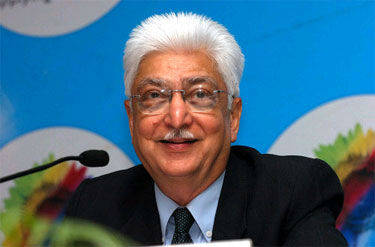
Well-known Indian IT czar and philanthropist Azim Premji  has received the Asian Business Leaders Award in the UK.

“For both his business acumen and his notable contributions to Indian social causes, Mr Premji is a very well-deserved recipient of the Asian Business Leaders Award,” UK business  secretary Vince Cable said in his welcome address at a ceremony yesterday.

(Well-known Indian IT czar…)

“With 40 per cent of the world’s High Growth Markets located in Asia, it is more important than ever to recognise the role of Asian businesspeople in contributing so much to the strength and breadth of the UK economy ,” he added.

The chairman of Wipro Limited  joins the likes of former Tata Group  chairman Ratan Tata  and Lord Green, UK minister of state for trade and investment, as a recipient of the honour presented by Asia House, a non-profit pan-Asian organisation based in the UK.

The annual award recognises individuals who embody the principle of ‘Servant Leader’ – economic success and professional excellence accompanied by moral leadership and service to society.

“We are delighted to honour a business leader admired greatly by the Asia House community. Azim Premji has achieved outstanding success as a global business leader. He has demonstrated a lifetime commitment to social and education issues through both organisations and people making him a most deserving recipient of the Asian Business Leaders Award,” said Sir John Boyd , chairman of Asia House.

The award itself was presented to Premji by Britain’s Foreign Office minister, Hugo Swire.

source: http://www.articles.economictimes.indiatimes.com / The Economic Times / Home> News> News By Company / Corporate Trends / by PTI / October 15th, 2013

The game where one cannot forget

All eyes will be on world record holder Amaan Ali as National Memory C’ship comes to Mumbai.

AmaanAliMP05nov2013

They can identify criminals with ease, as well as track down lost vehicles. Facts, features, faces, numbers — everything is stored in their mind like a picture. No, they don’t belong to any Hollywood science fiction film but are normal human beings. However, their brain makes them no less than a superhero — they are memory athletes. And they are all set to participate in the fifth National Memory Championship in Mumbai from today.

Hyderabad have hosted the touney since four years. Among the Mumbaikars who have thrown their hats in the ring is Amaan Ali, who made a world record last year.

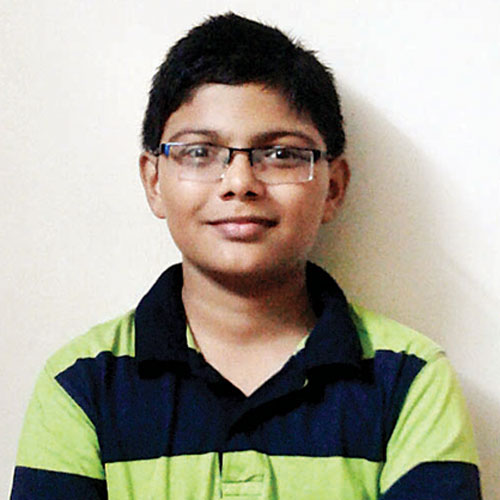
In the category called ‘Names and Faces’ — the 13-year-old lad retained 27 names in a span of 22 minutes. The contestants are given containing names and corresponding photographs and they have five minutes to memorise. After a break of two minutes, they have to match jumbled up contents in 15 minutes.

“Names of Israelis, Taiwanese, Chinese and others are provided initially. Later, they are provided in a jumbled up manner from where the participant has to connect the names with faces,” said National Memory Council of India (NMCI) member Altaf Shaikh, who is also Ali’s father.

So how does a memory athlete practise? “There are various techniques. You make connections in your mind and have to remember numbers. You have to make codes in your mind as well. Each number stands for an object and random numbers have to be remembered like a story. That’s how I do it,” said Ali.

Being a memory athlete has also helped Ali’s academics. “I hated Mathematics. Now, knowing numbers well and with the memory power I have, it becomes easy. I also use my techniques for other subjects like Geography,” he added.

The best part of the tournament is that there is no age bar. Hence, another extreme among the participants is 65-year-old Prakash Joshi — a retired multinational company employee.

Joshi thought of staying fit during his superannuation and hence, chose to jump into the numerical river. “I started last year when Vikrant Chaphekar (a memory trainer) made me believe that one could remember a pack of 52 cards in 10 minutes,” he said.

He added that memory athletes can remember faces, even their features, so if they are shown a wanted criminal’s photograph, they would  easily remember and identify the subject if they ever cross paths.

“I would love to help the police. Even Vikrant suggested it. If our brain can be used to kill corruption, that would be the best possible gift for us,” he added.

Ten categories of memory test
1. Spoken Numbers
2. Playing Cards
3. Historic/Future Dates
4. Binary Numbers
5. Random Words
6. Abstract Images
7. Names and Faces
8. Random Numbers
9. Speed Numbers
10. Speed Cards

source : http://www.dnaindia.com / DNA / Home> Sport> Report / by Wriddhaayan Bhattacharyya / Place:Mumbai, Agency:DNA / Sunday – October 20th, 2013