Category Archives: Amazing Feats

‘Baghi Banjara’ traces life, works of Barkatullah Bhopali

Bhopal, MADHYA PRADESH :

Bhopal :

Centered on the life of freedom fighter Maulana Barkatullah Bhopali, a play ‘Baghi Banjara’ was staged at Shaheed Bhawan on Friday. Scripted and directed by Waseem Khan, the play was staged for the first time in the country.

Abdul Hafiz Mohamed Barakatullah, known with his honorific Maulana Barkatullah (7 July, 1854-20 September 1927), was an anti-British Indian revolutionary with sympathy for the Pan-Islamic movement.

The whole journey from birth to death of the great freedom fighter was beautifully shown in the one-hour-twenty-minute-long play.   Barkatullah was born on 7 July 1854 at Itwara in Bhopal.

He fought from outside India, with fiery speeches and revolutionary writings in leading newspapers, for the independence of India. In 1988, Bhopal University was renamed Barkatullah University in his honour. He was educated from primary to college level at Bhopal.

Later he went to Bombay and London for his higher education.  He was a meritorious scholar and mastered seven languages: Arabic, Persian, Urdu, Turkish, English, German, and Japanese. Despite a poor background he topped the list of successful candidates in most of the examinations for which he appeared, both in India and England. He became the Quondam Professor of Urdu at the Tokyo University Japan.

He was one of the founders of the “Ghadar” (Rebellion) Party in 1913 at San Francisco. Later he became the prime minister of the Provisional Government of India established on 1 December 1915 in Kabul with Raja Mahendra Pratap as its president.  He died in 1927 at San Francisco.

The play was presented by mainly young cast of Swabhiman Shikshan Samiti. Suggestive sets, costumes and lights were used.

A patriotic song ‘rang de basanti chola…,’ of movie ‘Shaheed’ (1965) was used in the play. Gaurav Jaat as Maulana Barkatullah, Badra Wasti as Tarik Nigar, Shakeel Chand as Kadar and others  were in lead role.

“For the first time, the play centered on the great freedom fighter is being staged for the first time in India. I don’t know why no play was staged on the tenacious fighter. I wrote the play at the instance of Shriram Tiwari, former director of culture. The writing took one year and the rehearsals lasted for one-and-a-half- months,” said Waseem Khan.

source: http://www.freepressjournal.in / The Free Press Journal / Home> Bhopal / by A Staff Reporter / January 28th, 2017

Eighty years after death, nobody cares for ‘architect of Bihar’

BIHAR :

Unsung hero

Known as one half of India’s legendary barrister brother duo, he has been hailed as the co-architect of modern Bihar.

However, on his 80th death anniversary on Friday, the legacy of Syed Hasan Imam, a nationalist leader, patriot and a freedom fighter, remains forgotten.

Born in 1871 in Neora village near Patna, Imam died on April 19, 1933 and lies interred on the banks of river Sone in Japla, a small village in the border of Bihar and Jharkhand.

After suffering years of neglect and facing encroachment around his tomb, his grandson, Bulu Imam, now living in Hazaribagh, is striving to restore the lost honour.

“Today, on the occasion of his 80th death anniversary, I feel heartbroken to remember the legacy of my grandfather who, instead of being remembered, let alone celebrated for his immense contribution to the cause of Bihar and India at large, has been consigned to oblivion,” said Bulu Imam.

‘Some honour restored’

“We went to his tomb in Japla and cleaned it up on the anniversary and also put a chhadar on it, trying to restore some honour to his forgotten legacy. There were encroachments around the tomb and Hasan Imam’s house,”“ he said.

“I have evicted all the encroachers and now I am trying to preserve the place as his lasting memorial,” said Bulu Imam over phone from Hazaribagh, Jharkhand.

Syed Hasan was educated in Patna and in the UK, and was called to the Bar in Middle Temple in 1892. When he returned to India, he practiced in Calcutta High Court, where he became a judge in 1912.

After the establishment of the separate province of Bihar with Patna as its capital in 1912, and with the Patna High Court opened in 1916, Imam resigned from the judgeship of Calcutta High Court to practice in Patna, according to The India Gazette’s Who’s Who in India, 1927 edition.

He was elected president, special session of the Indian National Congress, in September, 1918. He was also elected as a delegate to the London Conference on the Turkish Peace Treaty in 1921.

He and Sir Al Imam along with barrister Sachchidananda Sinha and Mahesh Narayan were instrumental in getting the British empire grant a separate province of Bihar out of Bengal in 1911, as announced by King George V at the historic Delhi Durbar that year.

Despite his exemplary contributions to Bihar and to India, Hasan Imam remains a forgotten hero, much like his elder brother Sir Ali Imam.

The two brothers or ‘Imam Brothers’ as they were popularly known, will possibly go down in history as ‘faded icons’, much like their fabulous house, all but gone now.

source: http://www.deccanherald.com / Deccan Herald / Home> Metro / New Delhi – April 20th, 2013

Cricket is my bread and butter: Jaffer

Mumbai, MAHARASHTRA :

Guiding light: The seasoned Wasim Jaffer, who notched up valuable runs for the new Ranji champion, wants to continue contributing to the fortunes of Vidarbha. | Photo Credit: PTI

Veteran run-machine is convinced Vidarbha has the talent to go places after this momentous triumph

Wasim Jaffer has not lost his appetite to score runs in the Ranji Trophy.

A joy to watch because of the elegant stroke-play he brings to his batting, Jaffer has stacked up impressive numbers. After playing 22 seasons — 19 for Mumbai — Jaffer is on the top of the pile with 10738 runs and some of those helped the team he represented this season to win the Ranji Trophy. And he is ready for another stint.

Injury prevented him from turning out for Vidarbha last season, but he regained fitness and returned to nurture the talented cricketers of the Central India team. He played in nine matches, scored 595 runs, with one century (158 not out against Goa) and three half centuries for an average of 54.09. Two years ago, he played nine matches and scored only 382 runs at 27.42.

The sheer love for the game, which he calls “bread and butter of his life”, enabled him to stretch his First Class career once he was through with his long association with Mumbai with which he won eight Ranji Trophy titles.

After going through the grind of a home First Class season the last two decades, Jaffer kept himself occupied in the Yorkshire, Birmingham and Liverpool leagues for almost 20 years and this season he will be playing in the Lancashire league.

The 39-year-old believes that he took the right decision by opting to play for Vidarbha. “Playing for India is not the be all and end all….I had been there and done it. I just wanted to continue playing. I wanted to stay fit, face fresh challenges and do my bit for other teams. It also helped me to make some money. I don’t do anything other than play cricket.  That’s why I go to UK every year with my family,” said Jaffer.

After being raised in a city rich in cricket culture, Jaffer found the cricketing environment in Vidarbha different.

“There was no quantity, only quality; players were equipped with good skills. There were only 25-30 probables who played across all formats.

“They were happy winning at home and fine with it. When they lost ‘away’ matches, I don’t think they were hurt. It’s here that Chandu (Pandit) played the decisive role. He took them out of the comfort zone and pushed them hard. He did not praise them enough, but criticised them. Two years ago, I found out that when the match was in a 50-50 situation, they did not really go for it and show the killer-instinct. Chandu changed their attitude completely. Vidarbha needed someone like Chandu.”

Jaffer said when Mumbai won the Ranji Trophy in 2003 and 2004, Pandit did not form any committees within the team. “But here we had committees for entertainment, travel, food etc. This helped in team bonding. Chandu also changed room partners to prevent players forming groups. This was one way he took them out of the comfort zone and pushed them really hard.”

The two ex-Mumbai players also impressed upon opener Sanjay Ramaswamy to change his attitude, from being an introvert and not listening to others, to take good suggestions and implement them.

“I also impressed upon Chandu to give opportunities to Aditya Sarwate and what a partnership developed between him and Akshay Wadkar against Delhi. Vidarbha has good players in Lalit Yadav, Rajneesh Gurbani and Akshay Wakhare. Faiz Fazal has years of experience. Someone like Karn Sharma had to sit out.”

Jaffer says that Vidarbha, “having tasted success”, will look for more at all levels. “They have the confidence now. Chandu has instilled that attitude in the team.”

source: http://www.thehindu.com  / The Hindu / Home> Sport> Cricket / by G. Vishwanath / Mumbai – January 03rd, 2018

Many facets of an activist

GUJARAT / Mumbai, MAHARASHTRA :

ducationist par excellence: Kulsum Sayani (Centre) with her sons, radio broadcaster Ameen Sayani (left) and Hamid Sayani. (Courtesy: Sayanis)

She was inspired by Mahatma Gandhi to unite Hindi and Urdu. Kulsum Sayani also worked tirelessly for adult literacy…

“Each one, teach one”, one of the most effective schemes to promote education today was popularised by a woman few remember, but who was a pioneer in the field of adult literacy in India.

Kulsum Sayani’s name might not ring a bell for many but her life and work are truly remarkable. Mother of the well-known radio personality Ameen Sayani, Kulsum was born in 1900. Her inspiration was none other than Mahatma Gandhi. Her father, Dr Rajabally Patel, was the personal physician to Gandhiji and Maulana Abul Kalam Azad.

During the several protest meets organised against the visit of the Prince of Wales to Bombay in 1921, the city had become volatile. The result was baton charges, arrests and martial laws. There were dozens of people wounded, and seriously injured.

Describing those trying times, Kulsum Sayani wrote, “A new Congress hospital was founded to care for the wounded. My late husband Jan Mohamed Sayani was the first physician to be put in charge of it. We had a small Saxon car with the Red Cross badge prominently showing on it. My husband would go to the hospital daily, practically on totally deserted roads lined up with policemen on both sides. I would be sitting by the phone until he called from the hospital telling me of his safe arrival.”

Sayani’s interactions with Gandhiji and the importance attached to education in her family made her realise the need to eradicate illiteracy. In 1938, with a capital of Rs. 100 she employed two teachers and made the rounds of Muslim localities to get students. Considering the conservative attitude towards female education even now, imagine the effort it must have taken on Sayani’s part to convince families about the importance of educating girls at that time. There were times people used to slam their doors on her face, exclaiming, “Why should women learn to read?”

Her tireless efforts proved that there was a tremendous need to work in the field of education, which needed a more organised set-up. Her experience made her a part of several committees, which were formed to increase literacy among adults in Bombay, now Mumbai. She was associated with the first National Planning Committee that was set up by the Congress government in Bombay in 1938. The Bombay City Social Education Committee, formed in 1939, asked Sayani to take over their 50 centres catering to Muslim women. Slowly and steadily the classes grew and reached 600 in number. Of course, her efforts were not limited to the Muslim community alone. She was also appointed the general secretary of the All India Women’s Conference in 1944 and worked for the empowerment of women.

But it was in spreading the word on education that she is best remembered. The New Delhi edition of ‘The Times of India’ (March 10, 1970) noted, “From 1939 when she (Kulsum Sayani) took charge of the Bombay City Social Education Committee five lakh adults have become literate through one of the five languages – Urdu, Hindi, Gujarati, Marathi and Telugu. Her days are a mad rush of dashing to schools to enthuse children into teaching adults and her nights are spent dreaming up new schemes of literacy.”

Dedicated

Sayani was very pragmatic and initiated several schemes to spread literacy, notably including “Each one, teach one”. She used to visit several schools and encourage young students to devote 15 minutes every day to teach one adult. Under the scheme, students were supposed to teach and read one new alphabet every day to any adult in their family, neighbourhood or domestic helpers. Highly conscious of the importance of moral values, she encouraged students to request adults to tell them a folk tale or a story from the epics.

“The lower middle-class women, who are forced to work, have no help but to abandon their children to the streets after school, while the fashionable ones have no time left for children after bridge and mah-jong parties,” she once said.

Another literacy initiative she initiated was reading out aloud. School students were encouraged to gather friends and adults and each one had to read out aloud. This, she believed, was necessary to improve the confidence and interest of neo-literates. To ensure the success of these schemes she used to visit three to four schools every week meeting and egg students on.

During the freedom struggle hundreds of political prisoners languishing in jails improved their Hindustani by reading out aloud ‘Rahber’, the newspaper she brought out. ‘Rahber’, started in 1940, was aimed at the new learners. It was published in three scripts – Nagari, Urdu and Gujarati. The language of ‘Rahber’ was Hindustani, a mixture of Hindi and Urdu. Those were the times when the Hindi supporters were using heavy Sanskrit words and the proponents of Urdu were lacing the language with Persian and Arabic in their efforts to distinguish the two languages and establish their superiority.

Support

Gandhiji was in favour of Hindustani written in the Nagari or the Urdu script. ‘Rahber’ sought to take forward Gandhiji’s idea of Hindustani. In a letter dated June 16, 1945, Gandhiji addressed Sayani as ‘Beti Kulsum’ and wrote: “I like the mission of ‘Rahber’ to unite Hindi and Urdu. May it succeed.” The newspaper was read by hundreds of political prisoners lodged in jails across the country; anyone interested in learning Gandhiji’s Hindustani picked up the paper.

When the Constituent Assembly deliberations began in the months leading to India’s Independence, the language controversy erupted again. A letter dated July 22, 1947, from Gandhiji to Sayani, shows his resolve to stick with Hindustani. He wrote: “Heaven knows what is in store for us. The old order changeth giving place to new. Nothing is settled. Whatever is decided by the C.A., Hindustani with the two scripts remains for you and me.”

Sayani also represented India at several international forums on education across the world. She attended the UNESCO conference in 1953 in Paris (France) and shared ideas and gained new perspectives after talking with representatives from several countries. Her other interest was to promote peace and increase understanding between India and Pakistan. Her well known status as an activist helped her get audiences with top leaders in both the countries. Among Pakistani politicians, she directly met Pakistani presidents, Ghulam Mohammad and Ayub Khan, among other senior leaders.

In India, her reputation as ‘Rahber’s’ editor helped her get appointments with Nehru, B.G. Kher, V.K. Krishna Menon, Rafi Ahmed Kidwai and Indira Gandhi. She received encouragement and support from politicians of all hues in India for her efforts to forge a friendship with Pakistan. However, after the passing away of Nehru and Rafi Kidwai, who shared her concerns on improving relations with Pakistan, she devoted her energies to propagating Hindustani.

Sayani’s life is an inspiration to many. Married when she was only 18, she managed her family and pursued her social interests with equal elan. Her sons, Hamid and Ameen, both radio broadcasters, created their own identity. Ameen Sayani attributes his “basic grounding in clear and credible communications in Hindustani” to his involvement in assisting his mother in bringing out ‘Rahber’.

Old age and bureaucratic red tape forced her to stop ‘Rahber’ in 1960 after she had single-handedly brought it out for 20 years. She continued to be associated with the Hindustani Prachar Sabha and organised several lectures and seminars

She never lost focus from her lifelong passion to eradicate illiteracy. She received the Padma Shri in 1960 and was also awarded the Nehru Literacy Award in 1969.

Sayani, who died in 1987, belonged to an era when people believed in giving their best to the nation without expecting anything in return.

(© Women’s Feature Service)

source: http://www.thehindu.com / The Hindu / Home> History / by Danish Khan / August 14th, 2010
Muslim family that sheltered Bhagat Singh’s mother

Ludhiana, PUNJAB :

Ludhiana:

Sardar Abhay Singh Sandhu nephew of the great freedom fighter and martyr, Bhagat Singh, said here while talking to media persons that the sacrifices of the families of founding Ulama of Majlis Ahrar-e Islam of Ludhiana are unparalleled in the history of India’s war of independence.

He said “this is the only family which has been continuously fighting against the British from 1857 to 1947.”

Maulana Habiburrahman with the son of Bhagat Singh’s brother

He said that there are no two views that the crusader of freedom, Raeesul Ahrar late Maulana Habibur Rahman Ludhianvi, while following in the footsteps of his great grand father Shah Abdul Qadir Ludhianvi was in the forefront of the fight against the British rule.

Sardar Sandhu said that he felt proud that ‘our relationship with this family is very old’. This family helped our family at a time when because of the British, people had been keeping a distance from the family members of Bhagat Singh.

He said that Raeesul Ahrar late Maulana Habibur Rahman Ludhianvi had secretly given shelter to his grand mother (Bhagat Singh’s mother) even at the risk of his own life.

He also said that Shaheed Bhagat Singh’s brother, (late) Sardar Kaltar Singhji greatly respected this family because of this reason. He said that what is needed today is that all the heirs of the crusaders of freedom should once again get united and try to set up a clean and honest political system in the country.

Abhay Singh said that Punjab’s Shahi Imam Maulana Habibur Rahman Sani Ludhianvi deserves congratulations for keeping the traditions of his forefathers alive and he salutes the Shahi Imam who enabled Muslims of Punjab to once again achieve a respectable and high place in the field of politics.

In reply to a question he smilingly said that this Shahi Imam is the pride and glory not only of ours but of the entire Punjab.

source: http://www.milligazette.com / The Milli Gazette / Home> Online News / January 02nd, 2013 (Print edition 16-31 December 2009 )

The Maulana who bridged the water divide

Ludhiana, PUNJAB :

In 1929, Maulana Habib-ur-Rehman Ludhianvi forced the British government to end the system of different water pitchers for Hindus, Muslims at

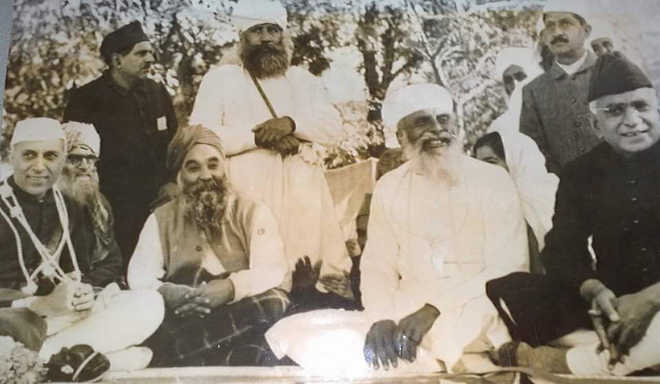
(From left) Pandit Jawaharlal Nehru, Maulana Habib-ur-Rehman Ludhianvi with Master Tara Singh, Satguru Pratap Singh and Saifuddin Kitchlu at a convention at Bhaini Sahib near Ludhiana in 1931. A file photo

When the entire nation was suffering under the Divide and Rule policy of the British, there was one man, who stood up and raised his voice.  Voices calling out Hindu paani lelo, Muslim paani lelo were common at the railway stations as there were separate pitchers of water for the Hindus and the Muslims.

But in 1929, Maulana Habib-ur-Rehman Ludhianvi raised his voice against this and protested at Ghaas Mandi Chowk and, with the help of his volunteers, broke earthen pots.As a result, the British government was forced to install one common pitcher at all railway stations across the country giving the message sabka paani ek hai. In this activity, nearly 50 volunteers were arrested and sent to jail.

“We have heard a lot about our great grandfather. He was instrumental in India’s freedom movement and the Hindu paani, Muslim paani issue was taken up by him,” said Usmaan Ludhianvi Rehmani, the great grandson of Maulana Habib-ur-Rehman Ludhianvi.

Ludhianvi hoisted the Tricolour on the banks of the Ravi to oppose the idea of partition of India and Pakistan. As many as 300 British policemen were sent to stop Ludhianvi from doing so, but he managed to hoist the flag and was arrested and sent to jail for a year.

Even Partition didn’t deter his spirit and he helped thousands of families stranded across the new border in uniting with each other.

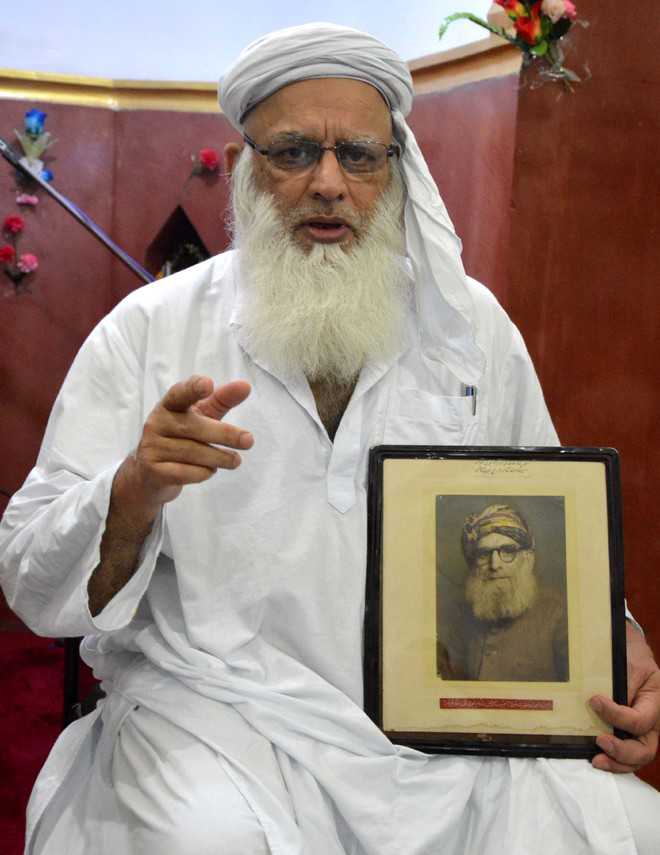
Maulana Habib-ur-Rehman Sani Ludhianvi, Shahi Imam of Punjab

Maulana’s grandfather Maulana Shah Abdul Kadir Ludhianvi in 1857 had issued a fatwa against the British rulers and the present Shahi Imam of Punjab, Maulana Habib-ur-Rehman Sani Ludhianvi, is his grandson.

The Shahi Imam of Punjab, said: “Our ancestors laid down their lives for the country. My only request to the present generation is not to waste the effort of our ancestors and be grateful to them.”Maulana, though not a poet, was well-versed in poetry and used to host poetic evening once a month.

He had spent 14 years of his life in various jails at various places, including Dharamsala, Shimla, Mianwali, Multan and Ludhiana.

source: http://www.tribuneindia.com / The Tribune / Home / Ludhiana – August 12th, 2017

Sify columnist releases book on Indian Muslim freedom fighters

NEW DELHI :

FreedomFightersMPOs22dec2017

Patna:

In a glittering ceremony, two books on the Muslim community’s contribution to the Indian freedom movement were launched in Patna last week. The function was presided over by Harsh Mander, former IAS officer and human rights activist.

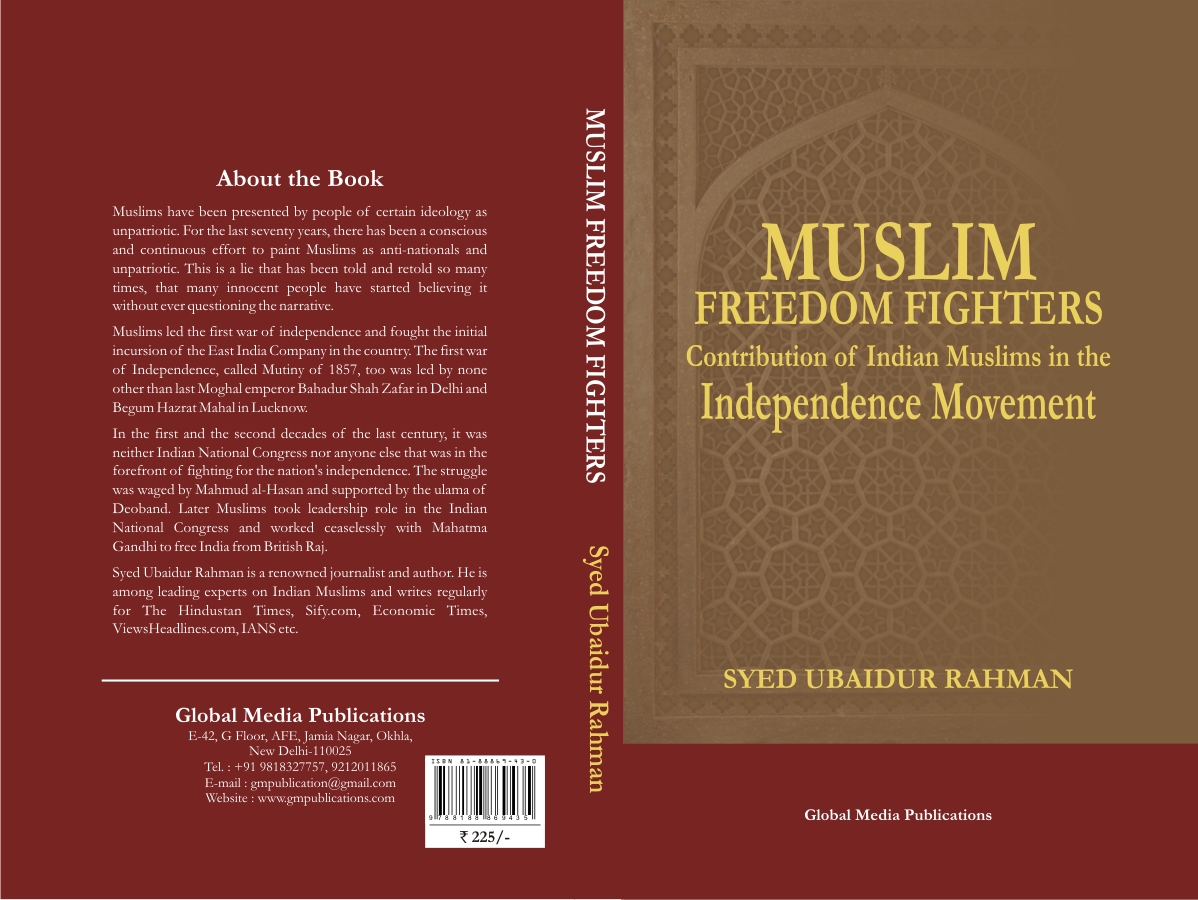
The books ‘Muslim Freedom Fighters: Contribution of Indian Muslims in the Independence Movement’ and its Urdu version ‘Muslim Mujahideen-e-Azadi aur Tehrik-e-Azadi Mein Unki Khidmat’ have been authored by well-known Delhi based author and journalist Syed Ubaidur Rahman.

The two books try to fight the oft-repeated allegations that Muslims are anti-national and have not contributed for the freedom of the nation. The books nail the lie and prove that Muslims not just participated in the freedom movement, they went on to lead the freedom struggle for a long time. The first war of Independence or Mutiny of 1857 was led by Mughal emperor Bahadur Shah Zafar in Delhi and Begum Hazrat Mahal in Lucknow.

The Independence Movement in the first two decades of the twentieth century was led by Mahmud Hasan and ulama of Deoband and they had respect and support of everyone including Hindus and Muslims.

If anyone has any doubt about the Muslim contribution in the freedom movement, the fact that the Indian National Congress had as many as nine Muslims as its president till the year 1947 will remove such doubts.

While speaking on the occasion, Harsh Mander said that the divisive forces in the country are trying to divide the nation on the basis of religion and faith. He said that the danger from such forces for the national fabric and its unity has become grave.

Mander added that the threat to the communal amity in the country was never so high as is today as divisive forces are doing every thing to pit one community against the other and create a fear psychosis among the majority community prompting it to turn it against minorities.

Khursheed Mallick, a Chicago based urologist, philanthropist and director of IMEFNA said that the book is a timely reminder to the nation that Muslims and Hindus both sacrificed for the nation and this fact must be clearly told to our young generation. He said Muslims sacrificed heavily for the cause of the freedom of the nation and efforts must be made to tell the history.

Syed Ubaidur Rahman, the author of the two books, while speaking on the occasion said Muslims have been rather loath to write about the sacrifices they have made for the cause of the Independence and freedom. He said Muslims suffered badly throughout the freedom movement. They were the worst suffers in the wake of the mutiny of 1857 and its aftermath when Muslims were hounded across North India and beyond. Tens of thousands of Muslims lost their lives for the freedom.

Syed added that ulama of Deoband played a stellar role in the freedom movement. Unlike the common perception, they were secular to the core and when they established a government in exile in Kabul in 1915, they appointed Raja Mahendra Pratap as its President and Maulana Barkatullah Bhopali as its Prime Minister.

The book documents the lives of forty renowned Muslim freedom fighters including, Shaikhul Hind Maulana Mahmud al-Hasan, Maulana Barkatullah Bhopali, Hakim Ajmal Khan, Maulana Ubaidullah Sindhi, Maulana Abul Kalam Azad, Maulana Mohammad Ali Jauhar, Dr Maghfoor Ahmad Ajazi, Dr Mukhtar Ahmad Ansari, Ashfaqulla Khan, Maulana Hasrat Mohani, Maulana Muhammad Mian Mansoor Ansari, Asaf Ali, Husain Ahmad Madani, Aruna Asaf Ali (Kulsum Zamani), Peer Ali Khan, Saifuddin Kitchlew, Mohammed Abdur Rahiman, Captain Abbas Ali, Abdul Qaiyum Ansari, Prof. Abdul Bari, Moulvi Abdul Rasul, Nawab Syed Mohammed Bahadur, Rahimtulla Mahomed Sayani, Syed Hasan Imam, Sir Syed Ali Imam, M.C. Chagla, Yusuf Meherally, Justice Fazal Ali, General Shah Nawaz Khan, Allama Fazle Haq Khairabadi, Maulana Shaukat Ali, Syed Mahmud, Maulana Mazharul Haque, Badruddin Tyabji, Col Mehboob Ahmed, Begum Hazrat Mahal, Maulana Shafi Daudi, Rafi Ahmed Kidwai, Syed Mohammad Sharfuddin Quadri, Batak Mian .

The book launch function was organized at Anjuman Taraqqi Urdu and was presided over by Abdul Qaiyum Ansari, chairman of Anjuman Taraqqi Urdu Bihar.

Syed Ubaidur Rahman is a New Delhi based writer and commentator. He has written several books on Muslims and Islam in India including Understanding Muslim Leadership in India.

source: http://www.sify.com / Sify.com / Home> SifyNews> National / by SIFY.com / Friday – December 22nd, 2017

Bengal awaits the return of two Everesters

Ichhapur (Barrackpore subdivision of North 24 Parganas District), WEST BENGAL :

Kuntal and Sahabuddin during the Everest expedition

KOLKATA:

Forty eight hours after they had scaled Mount Everest on Sunday, Shaikh Sahabuddin and Kuntal Karar were flown off to Kathmandu. Families of both of them are now praying hard for the speedy recovery of Karar whose tryst with the mountains has left him battling serious frostbite. However, Karar has assured his family that all is well and he would be back soon to savour home-cooked ‘doi chicken’ with naan.

Sahabuddin, who works in the Metal & Steel Factory of Ichhapur, has become a big hero for his colleagues. “Having scaled many mountains, my husband was always a hero in office. But with the Everest mission, he has become a bigger hero. His office colleagues and bosses are in Kathmandu to receive and congratulate him. Even my father is hoping to come down on May 28 from Kashmir to wish him,” said Sahabuddin’s wife Ruksana, who hails from Kashmir.

SahabuddinEverest02MPOs15dec2017

His younger brother, Shaikh Salauddin, works as a heating ventilation air conditioning engineer and is proud of his sibling’s achievement. Apparently, two months before the expedition, Sahabuddin underwent a surgery. Yet, nothing could stop him from wanting to reach the Everest. Salauddin is waiting to begin the celebrations back home once he returns. “Whatever happens, we were always sure that he would make the summit,” said Salauddin, who also dreams of scaling the Everest one day.

The family has been told that Sahabuddin is perhaps the first Indian Muslim mountaineer to have scaled the Everest. “We have been living in Ichhapur for 30 years. For us, divisions based on religion, caste or creed don’t matter,” he said.

Sahabuddin’s two-and-a-half-year-old son Shaikh Uzair is excited. He keeps on telling everyone he meets about his father having reached the top of the world. “On Tuesday morning, my husband made a video call at 8.30am. Both of us started crying. There were tears of happiness. He kept on saying that it was our collective good wishes that had helped him reach the Everest. My son was asleep when the first call came. When he later called at 11 am from Kathmandu, the entire family spoke to him,” Ruksana added.

 Initial euphoria of having reached the summit died down when the Karar family heard about Kuntal’s frostbite. On Monday evening, the family got tense after news trickled in about Kuntal being seriously ill. “We couldn’t sleep the whole of Monday night. In the morning, we were thinking of organising funds so that we could reach Kathamandu. But thankfully, he called up at 8.30 in the morning and assured us that he is fine. He even sent us photos from the hospital,” said Kuntal’s sister-in-law Mamomi from their Howrah residence.

Mountaineering has been an addiction for Kuntal. After completing his diploma in engineering, he took up a job before shifting to his own business. “Kuntal’s teacher Anol Das had died in the mountains. A year later, Kuntal had rescued his body. However no amount of persuasion could dissuade him from being smitten by the mountaineering bug,” said his brother, Kanchan.

While at the summit, Kuntal had wanted to use a satellite phone to speak to his family. “But a fellow-mountaineer who had the phone was too exhausted. Kuntal couldn’t ask him to lend the satellite phone so that he could speak to us from there. That’s his only regret,” she said.

source: http://www.timesofindia.indiatimes.com / The Times of India / News> City News> Kolkata News / by Priyanka Dasgupta / TNN / May 23rd, 2017

Bird named after Salim Ali

Mumbai, MAHARASHTRA :

The bird has been described from northeastern India

Twenty-nine years after the demise Dr. Salim Ali, the birdman of India, an international group of ornithologists named a newly discovered species after him, thus paying homage to the man who shaped generations of ornithologists and also contributed to the better understanding of birds.

Himalayan Forest Thrush, Zoothera salimalii, thus goes the name of the species, which has been described from northeastern India and adjacent parts. The research team that identified the species included scientists from Sweden, India, China, the U.S., and Russia.

Earlier, a bat species — Salim Ali’s fruit bat — that was first collected from Western Ghats region of Theni district, Tamil Nadu, was named after the legendary ornithologist.

The present study was initiated in June 2009 by Per Alström of Uppsala University, Sweden and Shashank Dalvi of the Alumnus of the Post Graduate Program, Wildlife Conservation Society- National Centre for Biological Sciences, Bangalore, while studying birds at high elevations of Western Arunachal Pradesh. The researchers had discovered that there were two species of Plain-backed Thrush breeding in sympathy in Arunachal Pradesh, India. These were completely “segregated by elevation and habitat, one occurring in mostly coniferous forest up to the upper tree limit and the other in alpine habitats above the tree limit. Their songs were strikingly different, although no definite morphological differences were detected in the field.”

The research findings were published in Avian Research.

According to the researchers, “it was realised that what was considered as a single species, the Plain-backed Thrush Zoothera mollissima, was in fact two different species in northeastern India. While the Plain-backed Thrush in the coniferous and mixed forest had a rather musical song, those individuals found in the same region, but on bare rocky habitats above the tree-line had a much harsher, scratchier, unmusical song.”

The studies of “specimens from 15 museums in seven countries revealed consistent differences in plumage and structure between birds from these two populations. It was confirmed that the species breeding in the forests of the eastern Himalayas had no scientific name. Later, the new species was named as Himalayan Forest Thrush Zoothera salimalii. The high-elevation Plain-backed Thrush is now renamed as Alpine Thrush while it retains the scientific name of Zoothera mollissima,” said a communication.

The analysis of plumage, structure, song, DNA and ecology from throughout the range of the Plain-backed Thrush revealed that a third species was present in central China, which was already known. This was treated as a subspecies of Plain-backed Thrush and was called as Sichuan Forest Thrush. The song of the Sichuan Forest Thrush was found to be even more musical than the song of the Himalayan Forest Thrush, the communication said.

source: http://www.thehindu.com / The Hindu / Home>  Sci-Tech / by K. S. Sudhi / January 24th, 2016

Azadi in the underground, when freedom came late in Hyderabad: Muhammad Khaja Moinuddin

Hyderabad,(undivided Andhra Pradesh) , TELANGANA :

Freedom fighter Muhammad Khaja Moinuddin | Photo Credit: K.V.S. Giri

Moinuddin knew Nizam’s men had found their hideout; freedom had not yet arrived in Hyderabad

As August 15, 1947 dawned in Hyderabad, fear and anticipation built up in the Nizam’s dominion about the fate of the kingdom. Muhammad Khaja Moinuddin, 19, was underground, hiding in a house in the Asifnagar area of the city, along with the top Communist ideologues Raj Bahadur Gaur, Maqdoom Moinuddin and Jubbar Rizvi. Muhammad Moinuddin says he was the “gunrunner” of the Communist Party.

At the rail station

Elsewhere in the city, Snehalata Bhoopal, scion of a Samasthanam (feudal state), drove her beige-and-white Wolseley to Secunderabad station to see how the day unfolded in the garrison town. At the end of the day, nothing happened at the railway station, and Ms. Bhoopal, seven months pregnant, drove back to her home at Bholakpur.

Mr. Moinuddin, a feudal lord from Mongol (where Chief Minister K. Chandrasekhar Rao now has a farmhouse), took the role of gunrunner with elan. As a Muslim, nobody would suspect him as a courier for Communists, and as a feudal lord, nobody dared to stop him.

While the whole country was gripped with the fervour of Independence and chants of Azadi, Hyderabad’s fate was left to the whim of one person: Mir Osman Ali Khan, the seventh ruler of the Asaf Jahi dynasty. Only a decade earlier, the Time magazine ran a photograph of the ruler on its cover with a caption: “Richest man in the world.” He didn’t want to let go of the power and privilege in the last remnant of the Mughal rule.

“We were stirred into action by Maqdoom’s song: Ye jung hai jung-e-azadi, azadi ke parcham ke tale… (It is a war, a war of Independence under the flag of freedom),” he says. Once the freedom movement gathered pace, we wanted Hyderabad to merge with India. “We were fighting against feudalism and wanted to see the end of it,” says Mr. Moinuddin, who was in the thick of action in the Telangana Rebellion — or as it was called, the Telangana Armed Struggle.

Crass feudalism

“The armed struggle was against the crass feudalism in the region where doras(landlords) had absolute power of life and death over citizens. I used to have a servant whose job was to stand outside the mansion waiting for my orders. I had the bastion outside the house demolished, and I told the man I would call him when I needed his services,” says the wheelchair-bound Mr. Moinuddin in his robust voice.

Armed with a pistol and double-barrel gun, Mr. Moinuddin played the role of a guard of top Communist leaders.

“By the evening of August 15, we learnt that our hideout had been discovered and we had to move. While some of the leaders walked away and others were driven away, I had the job of destroying evidence in the house. It was a huge house where we had to go hungry. I collected all the papers in the house and slowly burnt them in the kitchen. Then I put the ashes in the drain and poured water and escaped from the place,” Mr. Moinuddin says.

Hyderabad had to wait an additional 13 months before being integrated with India, with soldiers marching in on September 18, 1948 and the Nizam’s soldiers surrendering their weapons.

source: http://www.thehindu.com / The Hindu / Home> Independence Day / by Serish Nanisetti / August 14th, 2017