Here is a very special tribute from team Kootathil Oruthan to the one person who, Till date continues to inspire everyone with his words and deeds and raised India to its heights – Honorable Dr. APJ Abdul Kalam.
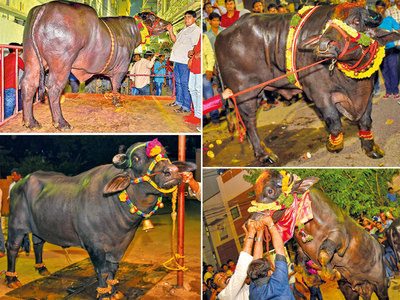
Eemaata, eemaata, yuvarajula sye aata… (What a delight it is, this dance of the princes…) Thus goes the popular song that best encapsulates the essence of Sadar festival aka Telangana’s very own ‘Dunnapothula Panduga’. Its English translation, ‘Buffalo Carnival of Telangana’ doesn’t quite have the same ring somehow. That’s besides the point though. For this festival is a celebration of the buffaloes — the ‘dancing princes’ that the aforementioned lines of the Sadar song extol. And the star attraction of this year’s festivities were the magnificent Murrah quartet — Raja, Dara, Maharaja and Shahenshah — each weighing well over 1,200 kilos!
As their proud handlers rave about the USP of these hulking bulls, your jaw drops in amazement. “The 4-year-old Raja weighs close to 1300 kg and is a 12-time National Livestock Champion. Maharaja, 6, from Chevella is a 6ft 2 inch-tall 1400-kg alpha male who makes for a breathtaking sight. Then there is Dara, son of the 24-time National Livestock Champion, Yuvraj, who’s fathered over 2,00,000 calves. Like his massive father, Dara tips the scales over 1,300 kgs. And the most expensive of them all is four-and-a-half year old Shahenshah who towers at a staggering 7 ft and weighs a whopping 1500 kilos,” say brothers Mahesh Yadav and Madhukar Yadav, organisers of the Sadar festivities which were held in Srinagar Colony on Friday night.
Bred and raised in Hyderabad, Shahenshah is hailed as the pride of Telangana by E Haribabu Yadav, state general secretary, All India Yadav Mahasabha. “Recently a buyer offered `25 crore to buy Shahenshah but his owner Ahmed Alam Khan refused to sell,” says Haribabu, adding, “Shahenshah was bred and groomed with the intention of beating the celebrated super bull Yuvraj of Hissar (Haryana),” says Haribabu who organised the Sadar festivities in Musheerabad on Saturday night.
And it seems like he’s already living up to expectations. Shahenshah recently entered the record books as the ‘World’s Most Expensive Bull’. “Shahenshah is one of the finest specimens of the murrah breed of buffalos that is ethnic to India. Standing 7 ft tall and 15 ft long, this bull is the pride of India,” says Suman Palle, CEO, High Range Book of World Records.
“The price of a bull is determined by the value of it’s semen which is much in demand. Each ejaculation fetches anywhere between `1,00,000 to `1,50,000. Hundreds of doses are prepared from the semen discharged during every ejaculation which is frozen in liquid nitrogen and sold to dairy farmers,” explains Ahmed Aalam Khah.
These bulls lead a charmed life indeed. “We spend about `4,000- `5,000 every day. They are given oil baths three times a day and it has a couple of attendants looking after it all day. Shahenshah drinks 30-40 litres of milk mixed with raw eggs every day. It’s diet consists of 100-150 apples, laddus made of kaju, pista, badam and dates, concentrates, green grass and hay.”
source: http://www.timesofindia.indiatimes.com / The Times of India / News> City News> Hyderabad News / by Karthik Pasupalate / TNN / October 23rd, 2017
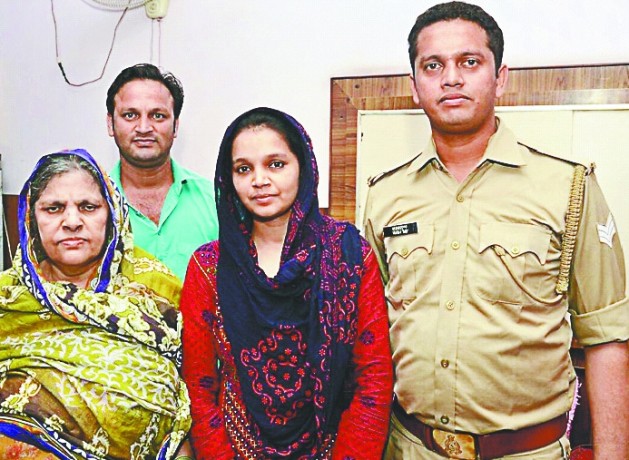
At the age of four, Anjum Saifi lost her father who was gunned down for standing up against extortionists in a market at Muzaffarnagar in western Uttar Pradesh where he had a hardware shop. She has a faint memory of how her father used to ask her to become a judge.
Her happines knew no bounds on Friday when she saw her name in the list of successful candidates who cracked civil judge junior divison exams conducted by the Uttar Pradesh Service Commission.
Her eyes were moist as becoming a judge for Anjum, who is now 29, was significant not because it was her dream, but for the reason that it was the wish of her father, who lost his life in 1992.
“My father died fighting for what was right. His sacrifice will not go waste. My only aim has been to uphold his values and keep people’s faith in righteousness intact. Now god has given me the power to initiate that change and I will try to make a difference in whatever capacity I can. I wish he was here to see it happen,” the only daughter among five sons told The Times of India.
Rasheed Ahmad, her father, was killed in broad daylight after he protested against goons who were extracting money from a hawker.
Cracking the prestegious examination was not an easy job for the young woman. She had to face “unspeakable hardships” all these years. The entire family went through a lot to see the realization of the father’s dream.
It was a struggle at many fronts, monetary concerns were just a small part. They had to even withdraw the case pertaining to his murder because the priority was to educate children and not put their lives at risk.
An overwhelmed Hamida Begum added, “Today, I am a content woman. The seed of values and principles that my husband had sown into my children has started yielding fruit.”
Anjum’s eldest brother Dilshad Ahmad, who is now 40, did not marry because he had to support his family after his father’s death.
source: http://www.muslimmirror.com / Muslim Mirror / Home> Editor’s Pick / by admin – Muslim Mirror Staff / October 16th, 2017
Twelve Muslim aspirants (seven girls and five boys) caracked Uttar Pradesh Provincial Civil Service Judicial or UP PCSJ examination whose result was declared on October 13. Girls outshined boys in this prestigious examination.
All these successful women have different stories of sacrifice, hard work and firm determination to achieve their goals.
Rumana
With 12th rank, Rumana – who has graduated from Aligarh Muslim University (AMU) – has secured the best position among the Muslim candidates.
Naghma Khan
UP’s Sambhal resident Naghma Khan has got 29th rank, Samina – who is from the same district – has secured 34th rank in the prestigious examination to enter into judicial services in the state.
Daughter of an engine mechanic, Naghma has done masters (LLM) from Jamia Millia Islamia in New Delhi. She has earlier been invited for lectures in Australia, Switzerland and Japan.
Talking about his daughter’s success, Mubeen Khan says, “It is like a dream come. Naghma has proved where there is a will, there is a way. She can be an inspiration for many daughters who have potential and want to achieve something in life.”
Samina Jameel
She is privileged to have an educated family background. She got all the support she needed during studies. Her father Jameel Ahmad was an employee of UP Secreteriat and her brother Mohsin Jameel is a Deputy SP in the state police.
Zeba Rauf
Hapur’s resident Zeba Rauf got 35th rank.
She comes from a Rajput Muslim family at Hapur in western Uttar Pradesh where female literacy rate is extremely low.
She got all the support from her father Rauf Ahmad and brother Samiullah Khan who studies at Jamia Millia Islamia.
Arshi Noor
She was posted at Bulanshahr as the Assistant District Prosecution Officer (ADPO). She prepared for the judicial services examination without any specialised coaching while doing her.
She is from Eatah and her father Noorul Hasan was an administrative assistant with the district court.
She is quite active on social media and runs a page titled ‘Our Dream PCS J’ on Facebook.
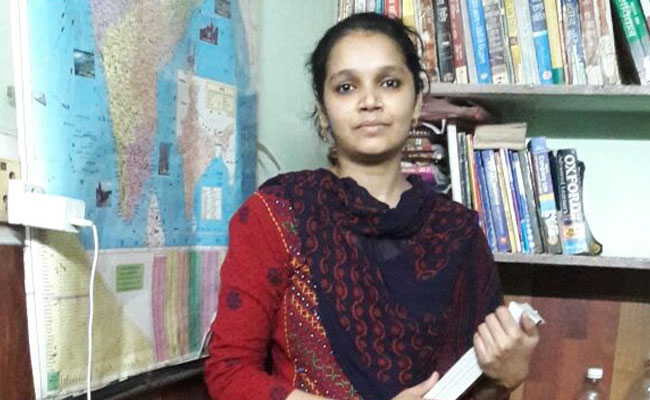
Anjum Saifi
Muzaffarnagar resident Anjum grabbed headlines of almost newspapers after the result was declared. She lost her father – who was gunned down 25 years ago by goons for raising voice against extortionists – when she was just four year old.
Her father, who had a hardware shop, wanted to see her as a judge. To fulfill his father’s dream and pay tribute to the departed soul, Anjum’s brother took the financial burden of the family on his shoulder.
He did not marry to ensure that her sister faces no economical hindrance in her preparations.
Kisa Zaheer
Kisa Zaheer from Lucknow was ranked at 74th, Arshi Noor from Etah at 117th and Anjum Saifi from Muzaffarnagar at 159th positions.
Five Muslim men also became judge this year. While Sharjeel Khan secured 19th rank, Arif Siddiqui got 36th position. Naved Muzaffar was ranked at 46, Zeeshan Masood at 64 and at Wakeel 218.
source: http://www.muslimmirror.com / Muslim Mirror / Home> Editor’s Pick / by admin – Muslim Mirror Staff / October 20th, 2017
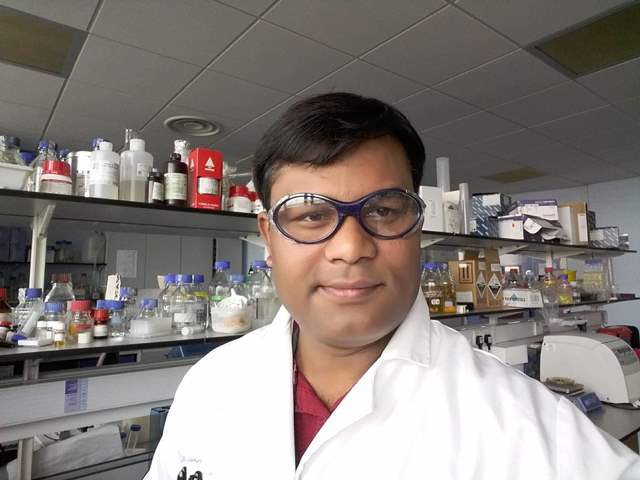
In a development that is something Bihar should be proud of, Dr Mumtaz Naiyer, a UK-based scientist from Kishanganj district, has come up with an ‘exciting’ discovery on path to develop new type of vaccine to treat global viruses.
He along with other scientists from the University of Southampton has made a significant discovery in efforts to develop a vaccine against Zika, Dengue and Hepatitis C viruses that affect millions of people around the world.
In a study published in Science Immunology, researchers have shown that natural killer cells (NK cells), which are a fundamental part of the body’s immune system, can recognise many different viruses including global pathogens such as Zika, Dengue and Hepatitis C viruses, through a single receptor called KIR2DS2.
The Southampton team have shown that this NK cell receptor is able to target a non-variable part of the virus called the NS3 helicase protein, which is essential in making the virus work properly. Unlike other proteins, the NS3 helicase protein does not change, which allows the immune system to grab hold of it and let the NK cells deal with the threat.
Lead researcher Salim Khakoo, professor of hepatology, said the findings are very exciting and could change the way viruses are targeted by vaccines but warned that the research is still at an early stage, and animal studies/clinical trials will be needed to test the findings.
It is very exciting to discover that other viruses similar to Hepatitis C, such as Zika virus, dengue virus, yellow fever virus, Japanese encephalitis virus and in fact all flaviviruses, contain a region within their NS3 helicase proteins that is recognised by exactly the same KIR2DS2 receptor.
“We believe that by targeting this NS3 helicase region, we can make a new type of vaccine based upon natural killer cells, which can be used to help protect people from these infections,” said Khakoo.
In an exclusive interview with MuslimMirror, Dr Naiyer, a postdoctoral scientist at the University of Southampton who the first author of the paper, talked at length about his roller coaster journey from Bihar to the United Kingdom and study.
Here are the excerpts:
MM: Please tell us about your journey from Bihar’s one of the most backward districts of Kishanganj to the University of Southampton, United Kingdom?
Dr Naiyer: I was born in one of the remotest village of Kishanganj in Bihar. The place earlier was referred to as ‘Kala Pani’ because of sheer backwardness and no access to mainland India. You can consider my small village as ‘Kala Pani’ with no access to schools etc. So much so, electricity in my village arrived in 2016 after 70 years of independence.
I was born in the 80s in a humble family of farmers. My parents were illiterate but had great quest for education. I was youngest among my siblings with five elder brothers and two sisters. The eldest brother did not attend school, one studied up to class V and three attended college. One of them did masters and later PhD in English literature.
My father passed away when I was 8 years old. It was extremely difficult for my mother to support us. As madarsas are cheaper, my mother even asked me to attend the Islamic seminary and become an ‘Aalim’ (Islamic scholar). After my father’s demise, one of my eldest brothers Mr Zainul Abedin had to discontinue his studies to support the education of two younger brothers.
As there were no schools nearby, I studied at home and a single teacher used to teach all the children in the village. I was directly admitted to standard three in a government school, which was 4 km away from my village. There were no roads and the situation in rainy season was like a nightmare. There was a strict discipline in our family for education. No matter how bad the day, one cannot miss the school.
I studied up to high school in my village. After that, I moved to Patna. Since my medium of instruction was Hindi till high school, it was difficult to switch to English books at 10+2. Contrary to my elder brothers who studied arts, I choose science with biology, physics and chemistry. I had a dream to become a doctor as I had seen young children die in my village without medical facilities.
However, after repeated attempts I could not clear Premedical Test (PMT) conducted by Central Board of Secondary Education (CBSE) and Bihar Combined Entrance Examination (BCEE). I moved to Delhi from Patna in the year 2000. I cracked BDS (Bachelor of Dental Surgery) entrance examination of Karnataka and B.Pharm (Bachelor of Pharmacy) entrance examination of Jamia Hamdard, New Delhi. Unfortunately, I could not afford any of these two. Then, I decided to do a simple B.Sc. course.
I appeared in the entrance test of B.Sc. (Biosciences) at Jamia Millia Islamia, New Delhi, and I got selected for the course. That year, Jamia had lauched B.Sc. (Biotechnology) programme. The central university gave us an option to choose either of the programme. In addition, those who were top in the merit list have an option to choose biotechnology. I choose biotechnology.
Teachers were very supportive. Till that time, I had no predefine goals for an academic career like this. But later, I attended lectures of prominent academicians and scientists in my university. That changed my attitude completely towards higher education.
Surviving in a metro city like Delhi was not an easy job. The money I used to get from my family was not enough. I used to give tuitions in the posh colonies of Delhi to earn some bucks and support myself. Apart from that, I received Merit Scholarship by Central Wakf Board, Ministry of Minority Affairs, Government of India, for consecutive two years at bachelors level. I must say my brothers tried their best to support me throughout my academic journey.
After my bachelors, I joined Jamia Hamdard, New Delhi in its master’s programme in biotechnology, which was one of the best in the capital. Here too, my teachers were very supportive and encouraged me to do pursue research. I got training in institutions like Institute of Genomics and Integrative Biology (IGIB), New Delhi. I got an exposure to quality research at my masters level. I was the recipient of Tasmia Merit Scholarship for best academic performance at masters level university exams in Jamia Hamdard.
My M.Sc. final year was full of turmoil. I lost my mother just a month before my final year’s examination and my family was going through financial crisis. Somehow, I managed to continue my studies.
I appeared in national level exams like National Eligibility Test (NET) jointly conducted by CSIR-UGC. I was awarded NET -Lectureship and Junior Research Fellowship by the UGC to pursue Ph.D. I also cleared GATE with 97 percentile.
After my masters, I joined National Centre for Cell Science (NCCS), Pune, an autonomous institution of the Department of Biotechnology, Government of India, for my Ph.D. This is one of the top biotechnology research institutes in India. It is also a national cell repository. One of the best Immunologists in the country Dr Bhaskar Saha who is also a Shanti Swaroop Bhatnagar Awardee mentored me.
During my Ph.D., I gained knowledge in molecular immunology and cell signaling. I worked on Human Visceral Leishmaniasis also called Kala-azar. My research work ‘Identification and Characterisation of Interleukin-10 Receptor Antagonist’ was published in the journal ‘Human Immunology’. The financial support was provided by the UGC for five years in which I was awarded Junior Research fellowship (JRF) for two years and senior research fellowship (SRF) for three years.
At the end of my Ph.D., I received offers for postdoctoral fellowships from University of Montreal, Canada; John Hopkins University, Baltimore, Maryland, USA; National Institute of Health, Bethesda, USA; and Imperial College London, UK. Previously, Khakoo lab was in Imperial College London, which was later shifted to University of Southampton where I work now since March 2012.
Although I had options to join other labs in the USA and Canada, I decided to join Professor Khakoo’s lab for my postdoctoral research as my research goals were best matched with the objectives of Khakoo lab.
At University of Southampton, I started working on clinically important viruses such as Hepatitis C virus, Dengue, Zika, etc. and tried to understand how Natural Killer cells – which are fundamental part of body’s immune system – can clear the viruses.
MM: Tell us about your research.
Dr Naiyer: This is a well-presented study and a significant advancement in this field that identifies the important role of the receptor KIR2DS2. Since I come from India, which has thousands of cases of dengue each year, I can understand the suffering of patients with dengue. Nothing would give me greater pleasure than to ease the suffering of these dengue-affected patients.
Natural Killer Cells play important role in fight against cancer and viral clearance. Our study focuses on how a single vaccine can be effective against multiple viruses. Our findings, which was recently published in prestigious journal “Science Immunology” also suggests that this strategy for virus therapeutics could be easily translated into the field of cancer.
2. What kind of encouragement did you find from your family and friends?
Dr Naiyer: My family was supportive. My brothers would often say, ‘Do not think about money, you just focus in your studies and leave rest to us’.
I had a very healthy competition with my friends and some of them genuinely motivated me.
MM: given the literacy rate of your area, what did inspire you to select this stream in higher studies?
Dr Naiyer: During my growing up years in the 90s, the sentence I often hear in my surrounding was “padh likh kar kuch nahi hota” (education gives you nothing). Most of the parents would send their school going to children to Delhi, Mumbai, Punjab and other metro cities of India to earn money and livelihood. That was such a discouraging period for education in my area called Seemanchal, which resulted in very high number of unskilled labour force.
Nevertheless, I was never tempted to leave my school or studies and determined to prove that education is the most powerful tool. Despite hardship, I keep going systematically. Even during my bachelors and masters in Delhi, people from my area would say “kab tak padhte rahoge miyan” (how long would you study)?
MM: Why did not you go for engineering and other short-term professional courses like others belonging to humble family background do to support their families?
Dr Naiyer: As I said before, I wanted to become a medical doctor, so engineering or any other short-term courses were never in my mind.
MM: What are your future plans?
Dr Naiyer: I want to contribute more to science and use my knowledge and expertise against the serious threats to humankind posed by dangerous viruses such as Zika, Dengue, Ebola, etc.
I would like to establish my own lab and become a principal investigator. If given the opportunity, I would like to return to India and want to contribute to the Indian science.
MM: Is there anybig project in your mind?
Dr Naiyer: I am contemplating to write grants for my own funding to support my research work. I shall apply for grants in Medical Research Council, UK, and Wellcome Trust, UK.
MM: Where do you want to see yourself 10 years down the line?
Dr Naiyer: After 10 years, I want to see myself as a successful scientist who has contributed a bit for the welfare of humankind by doing high-level science. I want to become an expert in my field.
Do you have any plan for the educational upliftment of your area, especially for Muslim youth?
Dr Naiyer: This is interesting question. I would definitely plan and would happy to contribute for the educational upliftment of my area. I along with some other friends from Bihar are trying to develop a unique platform where we can support meritorious students from Seemanchal (Bihar) irrespective of their financial conditions.
I have a dream to establish school/colleges, hospitals and healthcare in every block of Seemanchal. I would also focus in girls/women education. I would share the road map at appropriate time.
MM. Do you want to give any message to the youth of the community?
Dr Naiyer: Our community has some deeper problems and the youth are looking for microwave solutions. Our community has limited resources, please use them effectively. You must work hard, and should not waste time and resources.
The message I would pass to the youths is that there is no short cut for success. You cannot bypass the stairs of education and reach on the top through a side-lift. If you try, it would be disastrous for your career. Do not fear failures as failures are there to make you strong.
source: http://www.muslimmirror.com / Muslim Mirror / Home> Health / by admin – Muslim Mirror Staff / October 10th, 2017
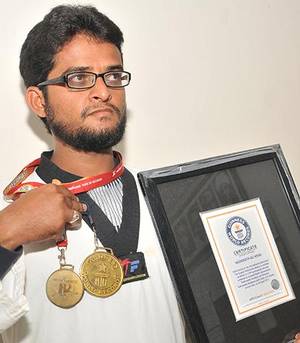
Hashmath Ali Khan. | Photo Credit: CH_VIJAYA BHASKAR
Hashmath performed 16 steps of Taekwondo for 65 times in 30 minutes
Hafez Hashmath Ali Khan, Taekwondo and Karate coach who hails from Vijayawada, is on a mission to make bigger achievements in the world of Taekwondo for several years. His spirit has got a boost after the successful participation in a recent event that found a place in the Guinness Book of World Records. Hashmath performed the 16 steps of Taekwondo for 65 times in 30 minutes. It was a result of rigorous training for six months, he says.
Hashmath, also an Imam who occasionally teaches in masjids in Andhra Pradesh, is one among the few persons in Hyderabad who successfully performed the feat of delivering 300 perfect punches in 180 seconds. This feat secured a place in the High Range Book of World Records.
As a profession, Hashmath teaches Taekwondo and Karate at many schools in Hyderabad and simultaneously grew stronger in the martial art under the guidance of his master Jayanth Reddy of the JR International Taekwondo Academy in Hyderabad, which is known for its Guinness records in Taekwondo.
‘Governments attention needed’
“Taekwondo is an important sport that needs the attention of the Union and the State governments. However, there is not much encouragement from the State governments even as the sport is an Olympic event since decades,” says Hashmath.
“Government should take Taekwondo seriously and focus on providing the training facility for the students who could get into Olympics and bring medals to the nation. I am confident that I can compete in Olympics and also nurture my students including national fighters to rise up to the level of Olympics,” said Mr. Hashmath, who also trained the police in Hyderabad.
Hashamth, 30, was born in Vijayawada. He moved to Nellore for education and then moved to Hyderabad where he learned Karate 12 years ago and then took up Taekwondo in 2012.Now, he is a Master Instructor as recognised by the Korean Cultural Centre India as per the World Taekwondo Federation rules.
source: http://www.thehindu.com / The Hindu / Home> News> Cities> Vijayawada / by Tharun Boda / Vijayawada – October 08th, 2017
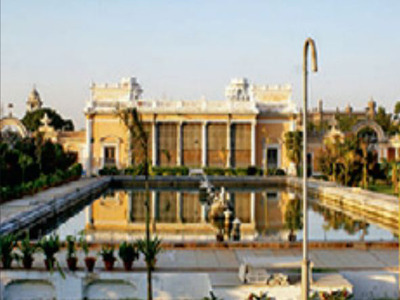
The city’s magnificent Chowmahalla Palace has added another feather to its cap, bagging the National Tourism Award for being the best maintained monument. The award was among other honours presented by the Government of India, on the occasion of World Tourism Day observed on September 27.Speaking about the recognition, G Kishan Rao, director of the palace said: “It is a matter of great pride. Earlier in 2012, Chowmahalla received the award of merit from UNESCO.”
Pointing out how the palace is among the most sought-after tourist destinations in the city, Rao said the heritage structure is equipped with all the necessary facilities for visitors, including those who are differently-abled.
On an average 800 to 1,000 tourists visit the 250-year-old Chowmahalla Palace in Khilwat every day . Its construction, ordered during the reign of the third Nizam, was completed during the time of his successor. Since, it was used primarily to hold official functions. Over time, the ex panse of the heritage property, once spread over 45 acres complete with 16 palaces, shrunk to a meagre 12 acres. Yet, the impressive collection of artefacts, including crockery, garments, cars and rare photographs from the Nizam’s era – housed within, are in impeccable condition.
“After the death of seventh Nizam of Hyderabad, the palace was in a deplorable state. It was in 2001 when Princess Esra (first wife of Mukarram Jah) took it upon herself to restore it that things changed for the better. In 2006, we opened the place up for public. Today , the palace is also a central place for mega cultural events in the city,” said Rao, sharing how the paraphernalia on display also comprise items brought in from the King Kothi Palace, where they were in the cellar.
source: http://www.timesofindia.indiatimes.com / The Times of India / News> City News> Hyderabad News / TNN / September 29th, 2017
Abdul Wajid, a jobless village boy, built a plane from scratch to prove that he is not worthless!
The youth of this country have to face one huge challenge – that of unemployment. Whatever the government waxes on about all day, the fact of the matter is that the educated and even brightest of the youth sometimes have to settle for less than satisfactory jobs or just stay at home because there are no takers or no vacancies. While for those in metro cities the situation is relatively easier, for those in the rural areas, it is extremely terrible. They do not even have access to technology or means to reach out and if they do not leave their village, the chances of them getting a job in the village itself are negligent. While many disillusioned youth give up and go back to their village and take up the family profession, there are some like Abdul Wajid who decide to take matters in their own hands.
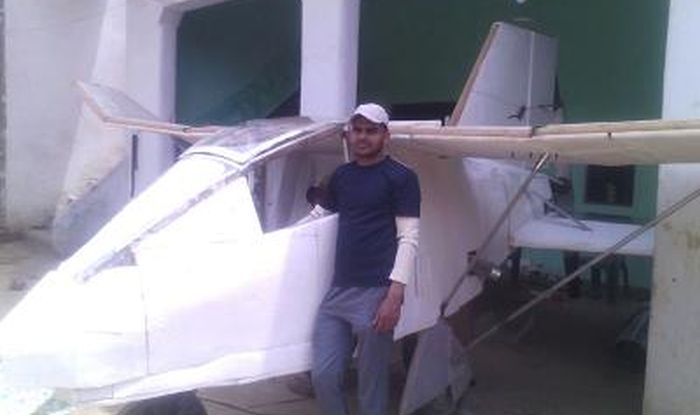
Image Credit: The Times of India
Abdul Wajid is a 26-year old youth residing in Muzaffarnagar village in Meerut, Uttar Pradesh. He completed his National Cadet Corps (NCC) training and since then has been hunting for a job but so far, has been unsuccessful in all his attempts. While training for the NCC, he had completed a course in aero-modelling at Safdarjung airport and used the skills he learned at the course to desgin and fashion his own aircraft! His one-seater plane was built entirely by himself at the cost of Rs 5 lakhs! How did a jobless youth get the amount? With the help of family, friends and the generous villagers! His plane is completely designed and made by him – from metal scraps and engines of old cars and Abdul Wajid is confident that it will definitely run.
He has already applied for a request and approval from the aviation board to try test-flying the plane. The plane he has created is made of wood and weighs a whopping 350 kgs. The plane is meter long in structure and is supported by steel frames and the engine is that of an old Maruti van he purchased specifically for this purpose. The plane was initially fitted with 2 bike engines but they had to be changed as the engines would not be adequate to give the required thrust. The plane uses petrol for fuel and comes fitted with a 25 litre fuel tank which is expected to carry Wajid Abdul through a distance of up to 10 kms. The only obstruction in front of him is how to get the permission to fly the air-craft!
The first request was placed at the Muzaffarnagar council where just like the villagers, everyone was stumped. The local civic body visited Abdul Wajid and even they were confused as they could not provide the permission. They then asked Abdul to write to the aviation ministry and Abdul has vowed to do just that. Although people in his village earlier mocked him, now everyone is proud of him. He is filled with hope that if he can make a plane all by himself, then he can definitely get a green signal from the aviation ministry! Also, he hopes that once he flies his plane, people will take notice of his abilities and offer him atleast a decent job. He also expects to get some monetary compensation from the Chief Minister for his efforts.
source: http://www.india.com / India.com / Home> News> India / by Rutu Ladage / May 26th, 2016
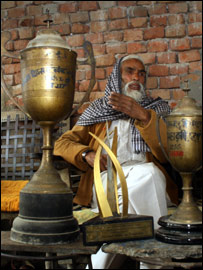
Saidullah has won many trophies (Pictures: Prashant Ravi)
Mohammed Saidullah, a resident of Motihari in the Indian state of Bihar, has received many awards and trophies in the last few years for his innovation.
In 1975, when his Jatwa-Janerwa village was swamped under flood waters – an annual monsoon menace – he pleaded with a local boatman to take him to safety.
When the boatman refused to give him space unless he paid for it, the young Saidullah looked for other ways to tackle the floodwater.
Necessity met creativity and in just three days, he made an amphibious bicycle which could easily negotiate the floodwaters.
He modified the conventional bicycle by adding four rectangular air floats to support it while it moved on water. Two fan blades were attached to the spokes of the rear wheel which enabled it to run on both water and land.
The blades were arranged in such a fashion that the cycle could be driven in reverse direction too.
Shining moment
Later, Mr Saidullah demonstrated the prowess of his vehicle before a stunned crowd, which included the then state governor, AR Kidwai, when he crossed the river Ganges in Patna city.
His big shining moment came in January 2005 when the then Indian President, APJ Abdul Kalam, presented him with the National Innovation Foundation’s (NIF) lifetime achievement award.
In the same year, he was selected as one of the 12 finalists for the prestigious Wall Street Journal Asian Innovation Awards.
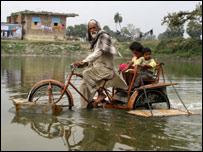
Saidullah takes his grandchildren for a joy ride in his cycle-rickshaw
He was also profiled for the Discovery Channel’s “Beyond Tomorrow” programme.
In fact, he has won so many awards that he has lost count of them all.
An impressed NIF took away his bicycle and offered to get it patented.
But three years later, Mr Saidullah has neither got the patent nor the bicycle.
Today, he lives in penury.
Everyday, he pedals about 30 kms on his bicycle to sell honey so that he can feed his family of 16.
But the work brings him a paltry 1,500 rupees ($37) a month.
Grinding poverty
Unable to make the ends meet, he has now put up his roadside half-thatched, half-concrete house and the small plot of land – in Mathia Dih locality of Motihari in East Champaran district – on sale.
His disillusionment is such that Mr Saidullah wants to return all his awards and trophies.
“If you want to destroy someone, give him an award,” he says.
After the bicycle, Mr Saidullah also invented an amphibious cycle-rickshaw which he demonstrated before the BBC team in a nearby pond.
“On this, I can take my grandchildren for a joy ride in the water,” Mr Saidullah told the BBC.
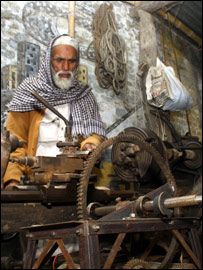
The workshop is his favourite place
“But I feel hurt by what the NIF has done to me. They used us for their promotion,” he says.
“May I know how many innovators like me have been benefited and how many of us have been destroyed by them?” asks Mr Saidullah, with pain creasing his face.
NIF executive chairman, Anil Gupta, is sympathetic to Mr Saidullah’s plight: “We tried a lot, are still trying and will keep trying to explore things being done for Mr Saidullah’s amphibious bicycle. But yes his frustration is completely understandable.
“Despite our best efforts, for some reasons we failed to generate any entrepreneurship for his bicycle. We’ve given him the innovation fellowship of a fixed amount and we are ready to support him in future too,” Mr Gupta said.
There is still a chance that things may look up for him.
A senior official in Bihar state’s science and technology department, Ajay Kumar, told the BBC he would do all he could to help Mohammed Saidullah.
“Though there is no structured schemes for commercialisation of such innovations in my department but we would certainly help him in getting his product patented after talking with the NIF,” Mr Kumar said.
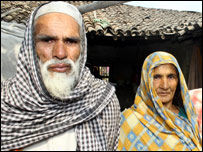
According to Mohammed Saidullah’s son, Mohammed Shakilurrahman, the family was not always poor. Mr Saidullah inherited acres of land, orchards, elephants and a big house from his father.
But, the rural scientist sold all his property to pursue his innovations, his son says.
New things
He blames his father’s “sheer madness” for the family’s poverty.
He too sells honey in the state capital.
However, Mr Saidullah’s bitter past experience has not stopped him from moving on to new things.
After the amphibious bicycle, he developed a key-operated table fan which can run non-stop for two hours, a mini-water pump that needs no fuel and a mini-tractor which can run for two hours on just five litres of diesel.
Saidullah names all his innovations after his wife, Noor
Now, he claims he’s making a helicopter which would cost the equivalent of $62,500 and a car that would be powered by air energy.
His dark, dingy workshop is crammed with a hand-made lathe machines and countless corroded nut-bolts littered on long rusty iron racks.
But it’s his favourite place. “I love to be here all the time,” he says.
Where would he go once his house and land is sold off?
“I’ll make a three-storey moving car with folding cots, pack my family in and park it on an open government land by the roadside anywhere,” he says.
The maverick innovator says he draws inspiration for his innovations from his everyday experiences. He has named all his creations after his loving wife, Noor Jahan.
“Noor means light and Inshallah a day would come when there would be light in our life too,” says Saidullah.
source: http://www.bbc.co.uk / BBC News / Home> South Asia / by Amarnath Tewary / Motihari – Bihar / March 03rd, 2008