Category Archives: Amazing Feats

An inspirational message from India’s only woman Muslim pilot

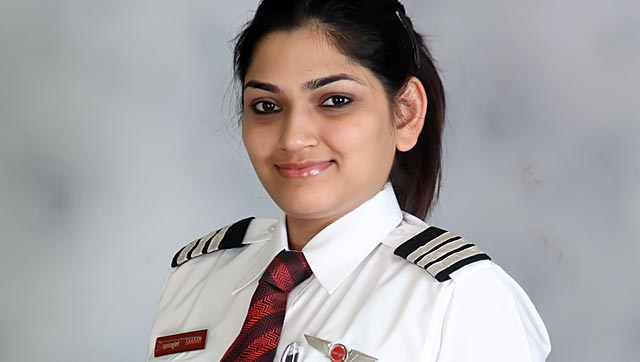
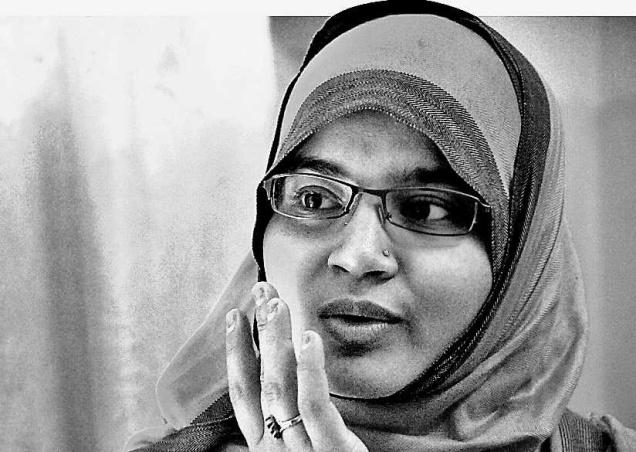
Saarah Hameed Ahmed, India's only Muslim woman pilot
Saarah Hameed Ahmed, India’s only Muslim woman pilot

“People initially think I’m Christian and then gawk when I tell them my full name,” laughs Saarah Hameed Ahmed (25) the Bengaluru girl who is the only known Muslim among the 600-odd women pilots employed in the Indian aviation sector. “I just love the look on people’s faces when they discover I am Muslim.”

People’s reaction to her choice of profession is a constant source of entertainment for Saarah. Many want to know how a girl can handle a machine that’s many times her size, she says as she cracks up again. “Poor things; they don’t know that my fingers are all I need to fly,” she says twiddling her thumbs.

Of course, the reactions are not always amusing or sensitive. Saarah says she too has had to face the brunt of Islamophobia that gripped the world post 9/11. But each time she has managed to win people over with a combination of humour and tact, she says.

However, Saarah’s first battles were fought at home and within the community. She says that she still faces taunts from people who believe a girl’s only job is to get married and produce children.

“Initially none of us encouraged her. In our community girls don’t usually take up professions where they have to stay away from home and live in hotels without an escort,” confesses her father Hameed Hussain Ahmed, a professional photographer. When Saarah showed no signs of relenting, he spoke to his friend Atif Fareed, who is a senior pilot in the US.

“Fareed told me that I should consider myself lucky because most Muslim girls don’t even dream of flying. If he hadn’t convinced me, I might have made the blunder of killing Saarah’s dreams,” he says.

In 2007, when she was just 18, Saarah enrolled with a flying school in the US. “Those days most Muslim students were being denied US Visas. When she got the Visa without any trouble I saw it as a final message from God,” says the deeply religious Ahmed.

Saarah’s mother, Naseema Ahmed, says she never had any doubts about sending her to the US. Her proudest moment, she says, was when a group of Muslim girls surrounded Saarah at a wedding and started asking her for tips to become a pilot.

Saarah has other dreams too. “I really want to get married and have children,” she says. But finding the right man is proving to be tough. “I don’t understand people who just look at my photo and want to get their sons married to me. Don’t they want to know what I have studied or where I work?”

Many of her suitors have either wanted her to quit her job or move cities. “My father has shooed away people asking them to get their sons to quit his job and move cities,” Saarah says letting out another blast of laughter.

She also has a Women’s Day message for Muslim girls like herself: “Don’t fret over what the community thinks of you. And don’t let them kill your dreams.” And what is she planning on women’s day? “Fly, of course! My airline [Spicejet] is very keen that I fly on Women’s Day.”

Waiting in the wings

Ayesha Aziz, 18, is another aspiring pilot. A native of Baramulla, Kashmir, she has already obtained a basic flying licence.

Fatima Salva Syeda, 26, is a licenced commercial pilot. But she has to qualify additional training before she can be a professional pilot.

source: http://www.hindustantimes.com / Hindustan Times / Home> India / by Sudipto Mondal – Hindustan Times, Bengaluru / March 08th, 2015
One step short of making history

CaptFathimaTELANGANA07mar2015

Capt. Fatima, the only Muslim woman in India to hold commercial pilot’s licence, needs financial help for additional training

She looks the typical Muslim woman next door – plain, timid and hesitant. It will be a surprise if she can drive a four-wheeler. Hold your breath – she can even fly an aircraft. Meet Capt. Syeda Salva Fatima, the only Muslim woman in India to hold the commercial pilot’s licence.

She is the shining example of Muslim women’s empowerment. What makes her ascent interesting is that she hails from the poverty-stricken old city of Hyderabad where life is a continuous struggle. Even more surprising is her decision to step into a domain which is predominantly male. But her black burqa and red scarf doesn’t betray her accomplishments.

Right from her school days, Fatima used to collect newspaper articles about aviation and pour over pictures of aircraft for hours. Her father, Syed Ashfaq Ahmed, a bakery worker, never imagined that his daughter would become a pilot one day. The dice was cast when she took admission in an institute which offered free EAMCET coaching. “What would you like to become,” the instructor asked. Pat came the reply, “Pilot”. It was a pleasant surprise to everyone present, more so to her father who struggled to make the ends meet. Seeing her determination, Zahid Ali Khan, Editor, Siasat daily, who was present at the time, asked Fatima to meet him later. “I couldn’t believe my ears when he offered to support me financially to undertake the pilot training,” recalls an overwhelmed Fatima.

After five years of rigorous training at the Andhra Pradesh Aviation Academy, Fatima obtained Commercial Pilot’s Licence, Private Pilot’s Licence and Flight Radio Telephone Operator Licence on March 11, 2013. She has logged in a total of 200 hours of flying on Cessna 152 and172, including 123 hours of solo flight. Now she has hit a rough weather. She needs to undergo Type Rating, an additional training beyond the scope of the initial licence and aircraft class training, on Air Bus A-320 or Boeing to be able to fly any aircraft. The training costs about Rs. 30 lakh which the 26-year-old couldn’t think of. But having come this far, she doesn’t want to give up. The Captain courageous has sent an SOS to the Civil Aviation Minister, Ashok Gajapathi Raju. She can be reached on: 9966073368.

Capt. Fatima, the only Muslim woman in India to hold a commercial pilot’s licence, needs financial help for additional training

source: http://www.thehindu.com / The Hindu / Home> News> Cities> Hyderabad / by Swathi V / Hyderabad – March 07th, 2015

A rare felicity

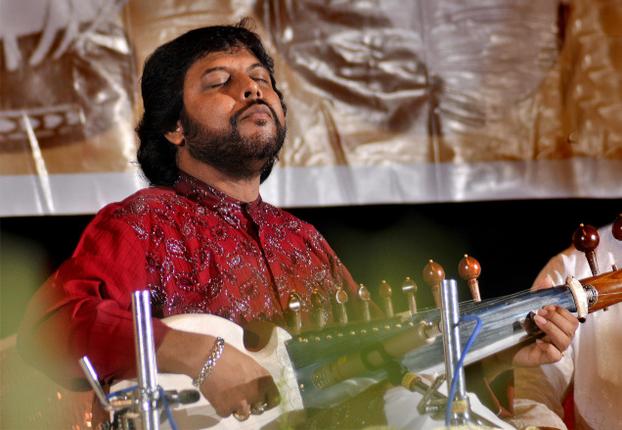
Joydeep Ghosh
Joydeep Ghosh

Sarod exponent Joydeep Ghosh tells Meena Banerjee his musical education allowed him to take uncommon ragas in his stride.

One discovered an intriguing fact from versatile musician Joydeep Ghosh, the concluding artiste of the annual soiree organised recently by Kolkata’s Ballygunge Maitreyee Music Circle, dedicated to the late Sangeetacharya Radhika Mohan Moitra (Radhubabu). On this occasion his sarod etched a rare raga, Kedari-Marwa, with admirable clarity. In this both Kedar and Marwa remained intertwined; like in a braid; without giving up their identity. Such an interpretation, replete with unexpected bends, does not allow complacency, either to the player or to his listeners. This was definitely a show by a maestro for initiated listeners only. The latter is a dwindling community even in Kolkata nowadays; but going by Ghosh’s usual selection of ragas, one was inspired to ask:

What encourages you to choose rare ragas for concerts?

I was only five when I started learning at the feet of great masters Anil Roychoudhury and Radhubabu; and later from Buddhadev Dasgupta. They all belong to the famous Senia Shahajahanpur sarod gharana and they are revered for their enviable melodic treasures. I also learnt tabla and vocal music from venerable gurus. Subsequently, I came under the wings of the erudite and versatile master Bimalendu Mukherjee, a doyen of the famous Imdadkhani gharana of sitar and surbahar. Under their priceless guidance I assimilated vocalism, instrumentalism and the style of rhythmic play along with raga elaboration.

The simple fact is that my gurus did not tell me what were common and what ‘rare’ ragas were. They all came naturally as sister ragas, with their key phrases loud and clear, during the learning process of one major raga; even the jod-ragas (blend of more than one) were taught to me without much ado; just as they did not categorise any instrument and made me learn to play sarod, surshringar and mohanveena.

Isn’t the mohanveena a newly invented instrument?

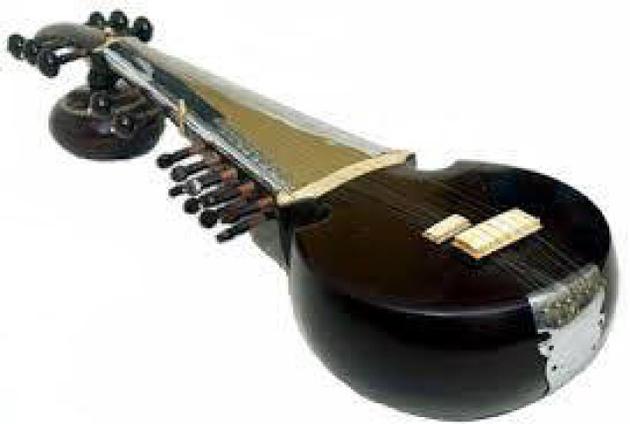
Radhubabu's mohanveena.
Radhubabu’s mohanveena.

Unfortunately, very few remember the history of the original mohanveena, conceived and invented by Radhubabu in early 1948! Once, around 1944, he played the surshringar in a jugalbandi (duet) with the famous beenkar (Rudra veena player) Ustad Sadiq Ali Khan in Lucknow. The concert inspired him to design a unique instrument in which the playable materials of both the sitar and the sarod could be appropriately exploited and the tonal quality of the Rudra veena could be equally maintained. Since he was proficient in both, having had his training from Ustad Mohammad Ameer Khan of the Shahajahanpur gharana and Ustad Inayat Khan of the Etawah gharana in the sarod and the sitar respectively, Radhubabu’s experiment succeeded.

The instrument’s majestic tonality impressed Thakur Jaidev Singh, the renowned musicologist who was then Chief Producer, All India Radio, Delhi. In 1950, Thakur Saheb named the instrument ‘mohanveena’ and also arranged an archival recording for AIR, followed by an extensive interview of Radhubabu, its inventor. Radhubabu was invited in several music festivals all over India to play the mohanveena. Some of his rare recordings for AIR archives are available in compact discs as precious documents.

So, despite the emergence of another, Hawaiian guitar-based instrument of the same name almost fifty years later, the original mohanveena exists along with its own unique excellence till date, through some of the devoted torchbearers of Radhubabu’s legacy. I am also a humble exponent of the mohanveena.

In a city on the move, destitute find an angel of mercy

Chennai :

Should you chance upon a 50-something, bespectacled man giving a haircut or a bath to a destitute person in the city, stop by and ask him how you can help, if you can buy a bottle of water or medicine, or some food for the less fortunate individual he is caring for.

Siddique Ali, a resident of Sidco Nagar, owns a small shop and sells and repairs bags. He also delivers cooking gas cylinders to commercial establishments. He has a family to look after, a wife and an 18-year-old daughter, though his two sons now have jobs of their own. But he also does what he can to make the lives of society’s outcasts a little less miserable.

With medicines, soap and towels, a set of clothes, bottles of water, biscuits and food, Ali goes around the city on his two-wheeler to help people who have been abandoned by their families, the orphans and beggars and the other abject people whose presence others usually refuse to acknowledge.

Ali, who steadfastly refused to give an interview to this correspondent for three days because he did not want any publicity, says most barbers will not give homeless people a haircut even if they had the money for one. “Restaurants will turn them away even if they can pay for food,” he says.

“I wanted to do so much for my father but, when he passed away a decade ago, I decided to do something for the needy,” he says. “When I someone in tattered clothes, I stop and ask them if they will change their clothes if I gave them a new set and Rs 10. Most agree,” Ali says, recalling how one homeless man slapped him because he suspected that he was trying to steal his money.

“When I clean, bathe and shave the needy, poor and destitute and cut their hair and change their clothes, there are times when they cry in joy,” he says. “That is the most wonderful moment for me. What greater blessing can a man want?”

Everyone can do small things to make the world a better place, Ali says. “Place water on the terrace for thirsty birds to drink. Don’t throw away rotten tomatoes… Squirrels love them. Keep them on a compound wall and they’ll find them.”

Sometimes people stop and offer him money. “I don’t accept money. Depending on the condition of the person I am helping, I ask them to buy medicine, water or some curd rice,” Ali says.

source: http://www.timesofindia.indiatimes.com / The Times of India / Home> City> Chennai / by Daniel George, TNN / February 20th, 2015

Indian-American Rashad Hussain appointed as the Special Envoy and Coordinator for Strategic Counter-terrorism Communications

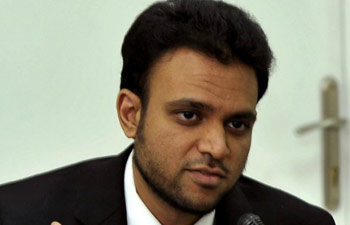
Rashad Hussain
Rashad Hussain

Indian-American Rashad  Hussain has been appointed as the Special Envoy and Coordinator for Strategic Counter-terrorism Communications.

According to the state department of US, the appointment will expand the global engagement and partnerships of the US in order to counter violent extremism.

Hussain is currently the US special envoy to Organization for Islamic Countries (OIC).

The 37-year-old will also serve as the Coordinator of the Centre for Strategic Counter-terrorism Communications to coordinate, orient and inform the government wide strategic communications which are focused on violent extremists and terrorist organizations.

ABOUT RASHAD HUSSAIN:

  • Hussain has completed his bachelor’s degree in Philosophy and Political Science from the University of North Carolina at Chapel Hill. He holds a Masters degree in Arabic and Islamic Studies from Harvard University
  • He has received Juris Doctoral from Yale Law School and has served as an editor of the Yale Law Journal
  • He has worked as a legislative assistant for the House Judiciary Committee and reviewed the USA Patriot Act
  • In January 2009, Hussain was appointed as the Deputy Associate Counsel to US President Barack Obama, whose role was to focus on national security, new media and science and technology issues
  • Before he joined the White House, Rashad Hussain, a Hafiz of holy Quran, was a member of legal staff for the Presidential Transition Team.
  • Earlier, he has also served as Trial Attorney at the US Department of Justice
  • In January 2013, he received the Distinguished Honor Award for outstanding service to the agencies of the US Government which has marked national or international significance

source: http://www.indiatoday.intoday.in / IndiaToday.in / Home> Current Affairs> News Digest> Story / New Delhi – February 19th, 2015

Municipal Corporation to light up memorial of 257 freedom fighters

Bareilly :

The Bareilly Municipal Corporation is all set to light up the memorial of 257 freedom fighters who laid down their lives during the country’s first war of independence in 1857.

The tower built in their memory is situated in the compound housing the office of divisional commissioner.

Though the memorial was built in 2006, there are no lights at the venue, plunging the place into darkness after evening hours.

The municipal authorities will install high mast lights around the memorial so that the venue is well lit and easily visible to commuters on the road running in front of the park during late evening hours.

After divisional commissioner Pradyuman Yadav took over as Bareilly commissioner, he asked municipal authorities to light up the park where the memorial is situated

“It was disappointing to learn that the tower built in the memory of 257 freedom fighters is lying in darkness. A majority of the locals are unaware about the importance and historical significance of this place,” said Sheeldhar Yadav, municipal commissioner.

Teams of municipal corporation visited the park where the memorial tower is situated on Sunday to survey the area. “We will install white or cream-colour high mast lights around the memorial so that it is able to grab the attraction of commuters moving on the opposite side of roads,” said the commissioner, adding that the work will be completed in the next 10 days.

Explaining the significance of this memorial, Yadav said these 257 freedom fighters were hanged to death on the branches of the banyan tree situated next to tower. During the first revolt of Independence against the British, Bareilly was the headquarter of Rohilkhand region, which included districts of Bareilly, Moradabad, Badaun, Pilibhit, Bijnor, Rampur and Shahjahanpur. On May 31, 1857, the freedom fighters killed British officials, including the principal of Bareilly College, during the revolt.

After their victory, the freedom fighters had made Khan Bahadur Khan, who was the grandson of Hafiz Rehmat Khan, the ruler of Rohilkhand region. Khan formed his own government and ruled the region till May 5, 1858. However, on the morning of May 5, the army of British forces gheraoed the city from all four corners. The British forces defeated the freedom fighters the next day by bombarding the city.

“Khan, along with his trustworthy 257 sepoys, fled to Nepal but British forces, with the help of Nepalese, captured them,” said Abhay Singh, associate professor, department of ancient history and culture at Mahatma Jyotiba Phule (MJP) Rohilkhand University.

On March 25, 1860, Khan was sentenced in the district jail of Bareilly, but 257 freedom fighters, who fought with him, were hanged to death with rope on the branches of the banyan tree in the presence of locals. The state government had constructed the tower next to the banyan tree in 2006 in memory of these freedom fighters.

source: http://www.timesofindia.indiatimes.com / The Times of India / Home> City> Bareilly / by Priyangi Agarwal, TNN / February 16th, 2015

One boiled egg can lift 200 Kg Royal Enfield Bullet !

Thousands of people thronged Sawday Road, Mandi Mohalla in city during the recent Eid Meelad celebrations to witness a Royal Enfield Bullet bike weighing 200 kg being hung from a boiled egg. The owner of the bike and the man behind this creativity is Inayath Ulla Shariff, a two-wheeler mechanic by profession. Curious people were seen clicking pictures of the bike in their cellphones. Inayath Ulla has been repairing and tuning two- wheelers such as Lambretta, Java, Royal Enfield Bullet, Yamaha RX 100, Yezdi, Road King, Vespa and Bajaj Chetak for the last 25 years. He started his career as a mechanic when he was just 15-years-old. Now he is 40. Inayath Ulla, who owns a two-wheeler garage by name ‘Track Point’ on Sawday Road in Mandi Mohalla, is the son of Late Mahmood Shariff, a Milkman and Late Chhoti Jaan. Star of Mysore caught up with Inayath Ulla Shariff for a tete-a-tete. Excerpts…

Inayath Ulla Shariff poses alongside his 200 kg Royal Enfield bike, hung from a boiled egg, at his garage 'Track Point' on Sawday Road in city. [Pic. by Golden Babu]
Inayath Ulla Shariff poses alongside his 200 kg Royal Enfield bike, hung from a boiled egg, at his garage ‘Track Point’ on Sawday Road in city. [Pic. by Golden Babu]
 by Arafat Ahmed Aizaz

SOM: How did you get an idea of hanging such a heavy bike from a single boiled egg?

Inayath Ulla: I have been a mechanic for the last 25 years. During the past Eid Meelad processions, I had seen people hanging bikes from a bottle-gourd, ridge-gourd, brinjal and other vegetables. So, I too thought of hanging a heavy bike (Royal Enfield bullet) from an egg as nobody had tried it.

SOM: How can a single boiled egg hold such a heavy bike? Have you done any gimmick?

Inayath Ulla: No gimmick at all. It is all about balancing. Myself, along with six others, lifted the bike and hung it from the egg with the help of ropes and two 7mm rods. It took an hour to hang and balance the bike. One should have the skill to balance through ropes and know how to do the centring properly.

Even if a single person does not balance properly or shakes the bike while hanging, then the bike will fall down.

SOM: You have inserted two 7mm rods into the egg to lift the bike with the help of ropes. How did you insert the rods? Didn’t the egg break while inserting the rods?

Inayath Ulla: First I boiled the egg. After boiling it, I did not remove its shell. I slowly made two small holes in the egg with the help of a drilling machine. Then gradually I increased the sizes of the two holes by inserting pencil into the holes and rotating the pencil clockwise. Later, I inserted the two rods. So the egg did not break.

SOM: Doesn’t the bike fall when the egg gets shaken by the wind?

Inayath Ulla: The bike does not fall due to wind. Even the egg does not break into two parts during the wind. But the bike will fall only if someone shakes or pushes the bike manually. You should ensure that nobody touches the bike when it is hanging.

SOM: You have been an expert in repairing bikes and earned a name for yourself. Do you want your children also to become famous mechanics like you?

Inayath Ulla: I have two children. One is studying in 8th standard and the other in 2nd PUC. I don’t want them to be mechanics. I want them to study well and become Officers. I am working very hard to provide them good education. I do not want them to suffer as I did.

[Inayath Ulla is married to Reshma Banu and resides in Hanumanthanagar in city. To meet Inayath Ulla, one can visit his shop on Sawday Road in Mandi Mohalla in city or call:97430-28265].

source: http://www.starofmysore.com / Star of Mysore / Home> Feature Articles /  Wednesday , January 07th, 2015

7 Keralites on Hurun Philanthropy List

Kris Gopalakrishnan,  Ravi Pillai
Kris Gopalakrishnan, Ravi Pillai

Kochi :

Infosys co-founder Kris Gopalakrishnan has been named the most generous person from Kerala according to the Hurun India Philanthropy list 2014.

The IT behemoth’s executive vice chairman who is ranked 8th in the list donated Rs 255 crore mainly in healthcare charities.

The list prepared by Hurun Report, a media group based out of Shanghai, states that region-wise, South Indians were the most generous, donating Rs 13,300 crore, five-times that of the amount given in charity by North Indians.

Ravi Pillai of RP Group is ranked nine in the list with a contribution of Rs 145 crore, mainly in healthcare. As many as seven persons from Kerala have found a place in the list of 49. They together donated Rs 609 crore for charity. Keralites in the list include Azad Moopen (Rs 100 cr),  S D Shibulal (Rs 48 cr),  P N C Menon (Rs 26 cr),  M A Yusuf Ali (Rs 18 cr) and Sunny Varkey (Rs 17 cr).

“It is heartening to see that Indian businessmen are contributing more to philanthropy. This will create a more equitable society. Business is necessary for economic progress and with philanthropy business is also good for overall development of society. I feel proud to see this,” Kris Gopalakrishnan told Express.

The list has Wipro Chairman Azim Premji who gave away Rs 12,316 crore on top.

In September Hurun Report had published a Kerala Rich List topped by Emke Group Chairman M A Yusuf Ali who has a net worth of Rs 11,400 crore. RP Group’s Ravi Pillai came second with Rs 9,600 crore followed by Sunny Varkey, founder and executive chairman of Dubai-centered Gems Education with Rs 9,000 crore.

The India Philanthropy List, which highlights charity contributions made by India’s most generous measured by the value of their cash or cash equivalent donations, debuted in 2013. Donations made by a corporation in which an individual has more than 50 pc holding were recognised as being part of that individual’s personal donation. The period of calculation was from April 1, 2013, to October 31, 2014.

source: http://www.newindianexpress.com / The New Indian Express / Home> States> Kerala / by Express News Service / December 30th, 2014

‘Celebrate November 20 as Tipu Sultan Jayanti’

The Tipu Sultan Art and Cultural Trust has condemned the State and Union governments for ignoring Tipu Sultan’s contribution to the struggle against British colonialism. The trust has urged the State and the Centre to celebrate Tipu Sultan Jayanti on November 20 every year, and declare it a public holiday.

Speaking at the 214th death anniversary of Tipu Sultan here on Saturday, trust president Irshad Ahmad Bisti said Tipu Sultan was one of the most neglected icons of the freedom struggle. He was a national leader who should be venerated by all regardless of caste, creed or faith, he said.

Mr. Bisti said it was a pity that some people with communal leanings were trying to defame Tipu Sultan and project him as a fanatic.

The trust had been fighting to make sure that Tipu Sultan received the recognition he deserved.

The trust wanted Tipu Sultan Jayanti to be celebrated as a State function, and had demanded that a train be named after him, and a memorial built in Hubli and Dharwad.

It said it submitted several memoranda to Governor H.R. Bhardwaj and Chief Minister Jagadish Shettar, but there was no favourable response, Mr. Bisti said.

If action was not taken, the trust, in association with like-minded organisations, would intensify the struggle, Mr. Bisti added.

source: http://www.thehindu.com / The Hindu / Home> National> Karnataka / by Staff Correspondent / Dharwad – December 05th, 2013

The old world charm

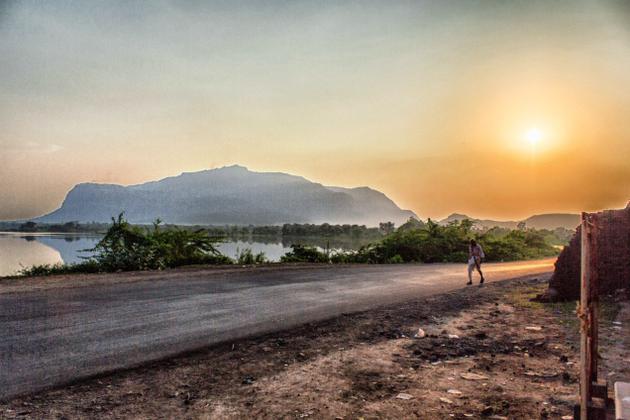
Sites of Champaner. Photos: Mohit Goel and Aakash Mehrotra / by Special Arrangement

History has shaped Champaner as a fascinating city,

A few faint images cross your mind when you talk of Champaner: a strategic trade route, the capital of arguably the most influential sultanate, a graceful example of urban landscaping, mesmerizing Muslim and Jain architecture. But the loudest of all images is that of a ransacked, deserted city. In Champaner, history speaks in its ruins. A city which grew from a town of moderate importance to become the capital of an influential sultanate, flourished for decades only to be attacked, ransacked and left deserted and lost to wilderness, all in one century.

Champaner has everything of the old world charm; there are mosques, an old palace, a fort, a step-well and ancient streets you can walk on. Along with the hill fort and temple of Pavagarh it is now called the Champaner and Pavagadh Archaeological Park. An hour’s journey from Vadodara, brings you to this UNESCO World Heritage site.

Champaner has a fairytale history. It was founded by the Rajput king Vanraj Chavda of the Chavda Kingdom in the 8th Century. The neighbouring city Pavagadh worked as a buffer area between Mandu and Gujarat, and a key strategic point on trade routes emanating from Gujarat to whole of India. After flourishing for years under the Rajput rulers, Champaner was captured by Mahmud Begda in 1484. He renamed the city Mohammadabad and moved the capital from Ahmedabad to here. In 1535, the city was captured by Humayun, and since the Mughals had control over both Gujarat and Malwa then, the city no longer enjoyed the status of a strategic buffer area. This marked the start of decline of Champaner and rise of Ahmedabad. When it was rediscovered by British, only 500 people inhabited the city.

Twenty years under the reign of Mahmud Begda gave this city models of urban planning to speak of. Being a capital and a strategic center, the city has huge fortifications. We entered through stoned road with huge ramparts on both sides. These ramparts led to mosques that still stand sound, with some wounds of history. The mosques of that bygone era lied unassumingly in the middle of the ruins of the citadel. One such elegant piece is the Jami Masjid. The intricate carvings in the pillars, walls and the mehrabs can give rise to many an artist. . One interesting thing about the mosque is the eclectic mix of Persian and Hindu style of design in the walls and the frescos. An evident piece is the kalash, a Hindu religious symbol on the mehrabs.

Our next halt was the Shehar ki masjid, contrary to its name which indicates it been a civilian place, it was the mosque reserved for the royal family. A little plain in design, the mosque is constructed on a raised plinth and the central arched entrance is planked by two minarets. At some distance in a secluded corner are the Nagina Masjid and the Kamani Masjid. Kamani Mosque is different from other mosques of Champaner as it follows the arcuate style (column and arch) indicating that it was built towards the end of sultanate period in Gujarat when this style had started gaining popularity.

Uphill enroute holy Pavagarh trail, is the Pavagarh Fort, located on the summit of the abrupt hills. The wide fortification walls, which once ran upto six kilometers, now stand in ruins with remains of variable height extants. Between the southern and the northern Gate, one can still find the patterns of the urban planning. In these complexes, one can find streets, civil baths, town patterns and even rows of shops, all having lived through the vagaries of time. The whole area is now an excavation site and the ASI never misses finding some rare jewels here. There are also graveyards, mausoleums and even richly decorated temples in these ruins.

As one moves uphill, following the Patha (pilgrim’s route) leading to the ropeway to the Kalikamata temple, one comes across many architectural structures that were forerunners of the architectural styles adopted later. The elements indicate a fine import of Hindu design in the Muslim architectural ideology. Unlike the present mosques styles, some tombs are almost all square in plan, with a dome resting on columns.

Another elegant structure on the hills is the seven arches (saat kamaan) of which only the six arches remain. Built from yellow sandstone in arch form, this served as a military base. One thing that makes Champaner stands out among all its contemporaries is the adroit townsman-ship, which one can still trace in the ruins. Arranged in a circle with the Jami Masjid in the center, the water arteries run upto all nine gates of the city. Over hills there are evidences of large reservoirs and earthen beams which drained into these reservoirs to collect the rain water running downhill. This entire series of arteries and water reservoirs, eventually ended into the largest lake, the bada talao, on the plain below the city. The big mosques like the Jami masjid also had elaborate water harvesting structures in their compounds.

We headed towards the bada talao, where another beautiful, dilapidated structure draped in bright orange of the dusk, was waiting for us. Even though only the walls remain of Khajuri mosque, this structure deserves a long stay.

With my feet tapped in the bada talao, I looked at the Pavagarh hill, and the mystery draped in the evening mist. I saw a small town spreading across the floor of valley and trailing up the bare hills, with a lake in the middle and ruins of a fort looking down at it as guardian; the setting seemed a miniature painting of a place inextricably caught in the web of history; tucked on the horizon.

The author is a blogger at handofcolors@wordpress.com

source: http://www.thehindu.com / The Hindu / Home> Features> MetroPlus> Travel / by Aakash Mehrotra / December 14th, 2014