Category Archives: Arts, Culture & Entertainment

Refugees crisis of our time

Kolkata, WEST BENGAL :

MokterMPOs10jul2018

The world saw its worst refugee crisis between 1988 and 1994, coinciding with the end of the so-called Cold War, increasing globalisation and civil wars along ethnic lines.

After two decades of relative ease, 2015 and 2016 again witnessed an upsurge in refugee population, starting with the Syrian crisis and the latest, the Rohingya exodus from Myanmar.India is home to nearly 2 million refugees, with a large percentage coming from China (including a large number of Tibetan refugees) and Sri Lanka (which was torn by civil war from 2006-09).

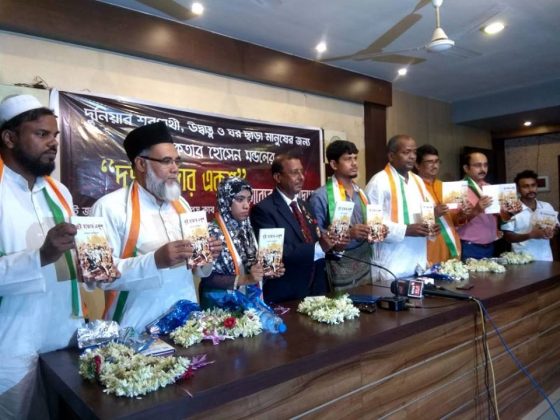
A book called “Dui Hazar Ekush”for the Refugees worlwide is published today at Kolktata Press Club. Renown Poet & Journalist Mokter Hossain Mondal has written this book for the Refugees people in Mynanmar and Syria. He dedicated this book to the refugees people across the globe.
The cover of this book has been unveiled by Ayesha Noor, three time gold winner in karate championship who dwelt in a slum area in Kolkata.
The life story of the footpath dwellers and the life story of the Refugees of Syria, Somalia & Rohingya people were narrated in this book. Here the poet tried to make the way to solve their problems.
This book has been published by Disha Prakashani.
source: http://www.financialsamachar.com / F Samachar / Home> Metrolife / July 05th, 2018

KT Impact: Dubai honours Indian boy for using Eid money to send out green message

Dubai,  U.A.E :

(KT File / Kiran)
(KT File / Kiran)

Mohammed distributed hand-decorated reusable ‘World Cup’ bags to a number of groceries.

A 10-year-old Dubai student who turned his love for the World Cup into an innovative way to reduce plastic bag waste, has been honoured by the Dubai Municipality (DM).

Following the Khaleej Times article on June 25, ‘Boy uses football frenzy to send a message against plastic waste’, Abdulmajeed Abdulaziz Saifaie, director of waste management department, was keen to meet the boy behind the story , Faiz Mohammed. And during a meeting between the two on Tuesday, he named the youngster one of the municipality’s ‘Sustainability Ambassadors’.

Using his own Eid money, Mohammed distributed hand-decorated reusable bags to a number of groceries near his home in Karama, after he grew tired of seeing so many plastic bags being wasted on home deliveries.

His own investigations revealed that on average, each small grocery was using about 1,200 bags a month to deliver goods. To combat the excess wastage, he distributed the free tote bags in replace of plastic ones. And it was that smart and sustainable thinking that caught the attention of Saifaie.

“I was so proud and happy to see the story. If you keep doing what you’re doing, we will see big change. Going forward I want you to keep in close contact with my team and give more ideas to help tackle waste here in the UAE,” Saifaie told Mohammed.

The municipality’s Ambassador for Sustainability initiative was launched in 2013 with the aim to train students on how to carry out lectures and workshops on various environmental topics.

“The fact that this boy didn’t use that Eid money to buy a ball, toy, something for himself, is commendable. He has a good hobby. If his family and community keep encouraging that, he will have a good future and so will the environment.”

Discussing different ideas to work on together in the future, Mohammed said his plan is to scale up his reusable bags initiative to groceries across Dubai. Only this time, Saifaie told him that the DM will help fund his move.

“We will visit you at your school and speak to your fellow students to spread awareness about what you are doing. We spend millions per year to bring this idea of sustainable practice into students’ minds, but you are doing it on your own. We will support you. You do not need to take money from your own pocket anymore.”

Thanking the municipality for the opportunity, Mohammed said he felt honoured to be named a Sustainability Ambassador.

“I feel so glad to be here. It gives me much encouragement to meet the director of waste management. He has been telling me to continue in my path to help curb waste so I will keep urging friends, family and shop workers about the importance of using reusable bags in place of plastic ones.”

kelly@khaleejtimes.com

source: http://www.khaleejtimes.com / Khaleej Times / Home / by Kelly Clarke , Dubai / July 04th, 2018

Dine Like a Nawab of Bengal

BENGAL :

BengalNawab01MPOs08jul2018

Mir Qasim Ali Khan Bahadur was the Nawab of Bengal between 1760 and 1763. He is most famous for his dealings with the British: he was put on the throne through the intervention of the East India Company, but a few years later was defeated by their forces at the Battle of Buxar. This defeat marked the decline of the political power of the Nawabs of Bengal and was an important moment in East India Company imperial consolidation in Bengal.

All of this is important, of course, but I’m here to discuss a far more pressing question: what did the Nawab and his contemporaries eat?

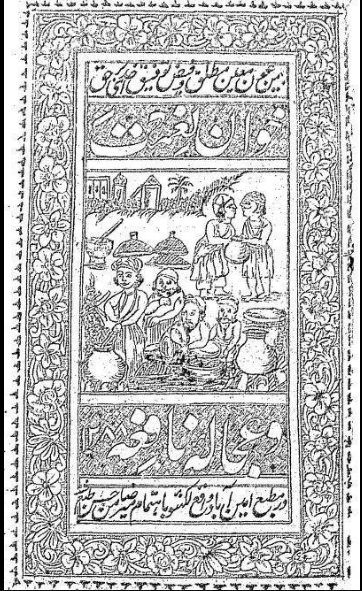
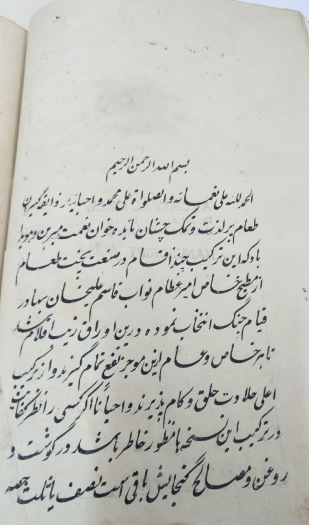
I encountered this manuscript, titled Khwan-e Nimat, “The Beneficent Table,” at the library of Jamia Millia Islamia here in Delhi. Composed in Persian, the text promises its readers a description of “the art of cooking from the private kitchen of the chef of Nawab Qasim Ali Khan Bahadur.”

BengalNawab02MPOs08jul2018

The text describes how the Nawab’s chef prepared fish kabab with rice, several types of meat kababs, fried eggs, sweets made with almonds, a few different types of pickles, pulao, khichri, qorma, various dals, mango jam, sheermal (a sweet bread), and on and on.

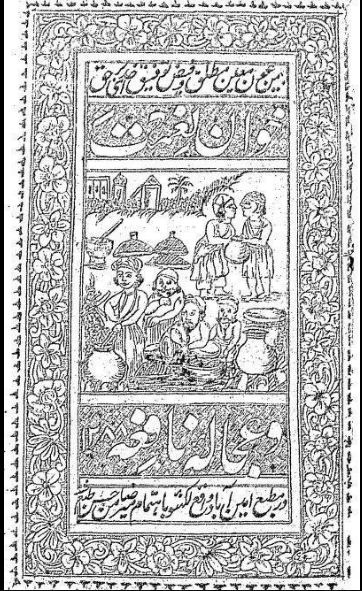
Although I originally encountered this work in manuscript form at Jamia, after some hunting I discovered that a lithographed version was printed in 1871 in Lucknow.

BengalNawab03MPOs08jul2018

The printing was done by a small press, but it means that there was at least some awareness of and interest in the text in the late nineteenth century, a century after the political power of the Nawabs of Bengal had waned. As such, it offers us insight into not only the culinary preferences of Mir Qasim and his court, but also the culinary interests and understanding of food history among North Indians in the high colonial era.

Over the course of my research I’ve stumbled on several cookbooks written in Persian and Urdu over the course of the eighteenth and nineteenth century, but I’ve found there is very little written on colonial-era traditions of writing about food in these languages. Many of the Indian food histories written on this period focus on the British adaptations of Indian cuisine, and exchanges between British and Indian cooks and palates. This text and its later publication tell an alternative (and I’d argue more interesting!) story: that of Indian interest in various local cuisines, and the desire of members of broader literate classes to know and perhaps try to prepare cuisines cooked by regional elites and leaders.

I’m craving fish today, so here’s a rough translation of how the Nawab’s chef prepared his fish kabab. Following these recipes is a bit of a challenge because most of the units of measurement appear to be regionally or temporally specific, and have changed significantly; many are not in any of the Urdu or Persian dictionaries I’ve consulted. I’ve therefore taken educated guesses based in large part on what I know about cooking, and the limited information I could find on the units used.

Ingredients:
Fish (type not specified, perhaps about 650 grams)
Butter (possibly referring to ghee; approximately 80 grams)
Onion (perhaps two-three)
Curd (approximately 15 grams)
Malai (approximately 20 grams)
Coriander (approximately 20 grams)
Black pepper (approximately 15 grams)
Gram (Chickpea) Flour (approximately 60 grams)
Pepper (mirch, presumably red?) (approximately 20 grams)
Cloves
ٓA pinch of lemon juice
A pinch of cardamom
Several pinches of salt

Cut the fish into chunks in the size of kababs and place them aside. Prepare the gram flour well (toast it?). After that, mix it together with the salt, pepper, crushed coriander, and some of the butter. Mix this into each kabab. Then finely chop up the onions, and fry them in some butter and then also mix the onions with some butter into the kababs. Then mix the lemon juice, cloves, and cardamom together. Drain the curd of water and strain the malai, and coat the kababs with these things. Then place these kababs in pot with the (cooked?) rice, and take the remaining spices and sprinkle them into with the rice and kababs. Roast/fry (prepare over a hot surface) and enjoy!

source: http://www.archivaldistractions.wordpress.com / Archival Distraction / by Amanda Lanzillo / July 07th, 2018

Hyderabad man takes up noble initiative, serves food to the underprivileged daily

Hyderabad, TELANGANA :

Hyderabad man takes up noble initiative, serves food to the underprivileged daily

A man from Hyderabad is winning hearts across the city as he serves food to the underprivileged every day.

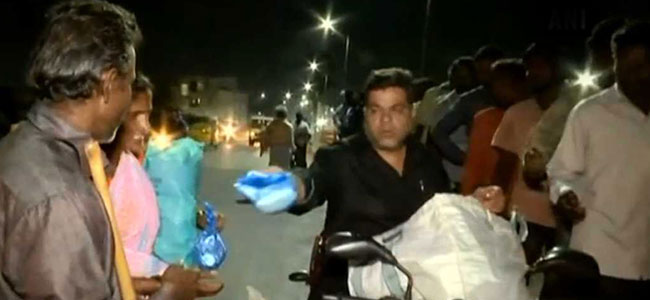
Hyder Moosvi, along with his team serve food to the needy and homeless every day. The team prepares 100 packets of food which are distributed to the homeless and the underprivileged on Dabeerpura Bridge.

Speaking to ANI, Mr Moosvi said, “We started this in 2015. Earlier we distributed food only 8 to 10 times a month, but from March 2017, we have started serving food daily.”

He further said that people from neighbouring localities such as Secunderabad, Kachiguda and Vijay Nagar come to the Dabeerpura Bridge for their food packets. The entire effort leads up to a monthly expenditure of Rs. 1.2 lakh with each food packet costing Rs 40 to prepare.

The noble initiative is surely winning him huge respect among the people of the city.

source: http://www.thehansindia.com / The Hans India / Home> Telangana / by Deepthi Reddy , The Hans India / July 03rd, 2018

Afghan architecture in sandstone

Mandu, MADHYA PRADESH :

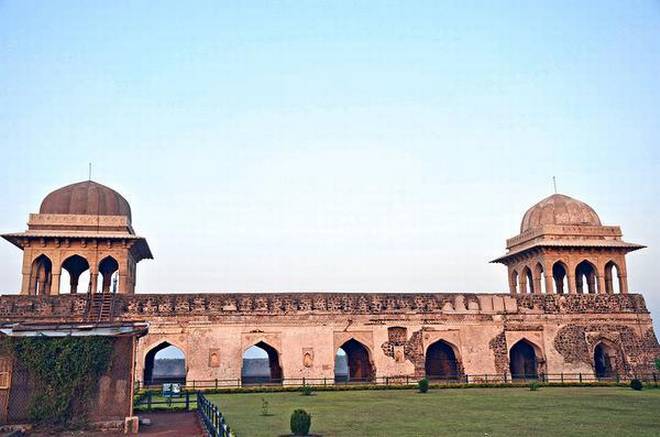
A section of Rani Roopmati Pavilion | Photo Credit: mail

Roopmati Pavilion is perched regally on the edge of a 365m precipice overlooking the Nimar Valley and to the south of the Baz Bahadur Palace in Mandu, Madhya Pradesh. A look by Chitra Ramaswamy

Among the plethora of monuments that dot the landscape of the historical city of Mandu in Madhya Pradesh, is the Roopmati Pavilion, an ode to love. The sandstone structure is perched regally on the edge of a 365m precipice overlooking the Nimar Valley and to the south of the Baz Bahadur Palace. It stands as testimony to the legendary tragic love story of Baz Bahadur, the mid-16th century Sultan of Mandu, a great musician, and his queen, Rani Roopmati, a singer of repute.

We traverse a broad, winding pathway to come upon a flight of stairs that brings us to the 16th century monument. The 72m high fort, Roopmati Pavilion, the southern-most monument in the city, is a magnificent expression of Afghan architecture in sandstone. It is evident that the monument underwent construction in phases during different time periods. The original design, sans pavilions, was built as an observation post for the royal army as a low, large hall with a pair of rooms on each side and a heavy sloping base. A symbol of their undying love, it was later transformed into the abode of Roopmati with a western side extension along the plinth. It was extended so as to enable the queen, who fervently worshipped the Narmada, to see the river and perform religious rites without stepping out of the fort.

The basement of the pavilion is characterised by corridors that have several arched openings along their width. The western ledge has a large reservoir from which rainwater collected during the monsoons would be channelled from the roof of the structure to a tank below by means of conduits.

However, it is the pavilions on the terrace of the original block that we access via spiral stairs, a later addition, which lends the structure its distinctive allure. The square-based pavilions are crowned with hemispherical domes that are fluted on the interior and exterior. We are treated to a visual delight as we climb a flight of steps to reach the pavilion top. Nature’s enchantment leaves us mesmerised as lush forests, plateaus, valleys and vast stretches of far away hills stretch before us.

Twin-storeyed palace

The Baz Bahadur Palace, closeby, lies on the hill-slope to the east of Rewa Kund and is set in the midst of picturesque verdure. Tall, sleek arches welcome us at the entrance to the twin-storeyed palace which is accessed by well laid, broad steps with landings at intervals. In its days of glory, an aqueduct ran on top of the arches, transporting water from Rewa Kund, the adjoining tank, to the pool in the palace courtyard. The water would be drawn upwards by Persian wheels that were powered by animals.

An inscription in Persian on the arch states that the palace was built in 1508 by Nasir-ud-Din. Incidentally, Nasir-ud-Din Shah Khilji, the Sultan of Malwa, is credited with designing this aesthetic structure which underwent repairs and renovations during the period of Baz Bahadur. Big courtyards and high terraces are distinct aspects of the palace that is an aesthetic blend of Mughal and Rajput architectural styles.

Halls and rooms with arched gates skirt the huge courtyard which is adorned by a stunning cistern with crystal clear water in the centre. The palace terrace is further adorned with a couple of chhatris or elevated domed pavilions. One of the big rooms, that even today has astounding natural acoustics, served as the music and dance hall of the palace.

source: http://www.thehindu.com / The Hindu / Home> Life & Style> Homes & Gardens / May 11th, 2018

Hubballi mosque sets an example

Hubballi, KARNATAKA :

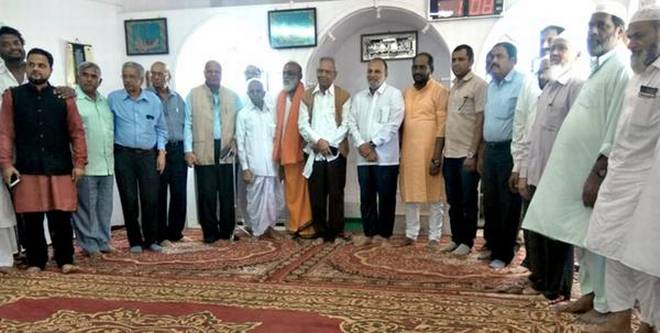
Special occasion: Authorities of the Hubballi mosque organised the programme on Sunday in association with Sadbhavana Vedike Karnataka. | Photo Credit: Special Arrangement

Masjid-e-Usman Ghani throws open its doors for Hindus for Id party

Masjid-e-Usman Ghani, located at Vijayanagar here, witnessed a special Id party on Sunday as authorities of the mosque had invited members of the Hindu community for the occasion.

The organisers said it was for the first time that an Id party was being held by inviting Hindu members on the mosque premises.

Mosque authorities, in association with Sadbhavana Vedike Karnataka ,  took this initiative to promote religious harmony and brotherhood in society.

Vedike secretary Akbar Ali Udupi said he was elated to see the Muslim community members opening the doors of a mosque for their brethren from the Hindu community. “It should have happened long back, but I am happy that it has happened no less than 70 years after Independence,” he said, and asserted that other mosques too should hold similar programmes.

He said the core essence of all religions was the same but they were presented in different ways. The prime reason for violence over religious issues was lack of proper knowledge about religions among their followers. Even those who resort to violence in the name of Islam do so because their knowledge of Islam was limited, he said. There were several examples in the life of Prophet Muhammed where he respected other religions and asked his followers to follow suit, Mr. Udupi said. Truthful knowledge of religion helps achieve peace and harmony, whereas unfair information of religion leads to disturbances in society. Therefore, every human being should strive to gain truthful knowledge of their respective religion in the larger interest of society, Mr. Udupi said.

Venkatesh Savadatti and Subhas Hosmani and others who were present on the occasion appreciated the move. They said division on religious lines was the creation of power-hungry politicians and common people should not fall prey to their devices.

source: http://www.thehindu.com / The Hindu / Home> News> States> Karnataka / by Staff Reporter / Hubballi – July 02nd, 2018

Good News! Delhi Cop Donates Her Salary to Keep a Family Going

NEW DELHI :

A DCP from Delhi has been helping to keep a family of five in Jammu going after their sole breadwinner was murdered in Delhi.

Delhi DCP (Northwest) Aslam Khan has been sending half of her salary every month to the family residing in RS Pura’s Flora village in Jammu and Kashmir. She also speaks to the family every day to make sure they are safe and doing okay.

I somehow got in contact with them and realised that they are very poor. So since February onwards, I started sending them a part of my salary. I’ve also been approached by people who want to help them.
Aslam Khan, Delhi DCP (Northwest) told ANI

The family’s breadwinner was a truck driver who was murdered in Delhi’s Jahagirpuri on 9 January 2018. Sardar Maan Singh was killed by a group of robbers, leaving his family helpless. During this time, Aslam Khan contacted the family and decided to help them, reports ANI.

“We were scared, but Ma’am started helping us and we are thankful to her”, the family told ANI.

The 42-year-old truck driver is survived by his wife, two daughters, and a son, who are being taken care of by DCP Khan.

source: http://www.thequint.com / The Quint / Home> India / July 02nd, 2018

Former cricketer Azharuddin flags off ‘Save Lake Campaign’ at Hussain Sagar

Hyderabad, TELANGANA :

AzharuddinMPOs02jul2018

Hyderabad :
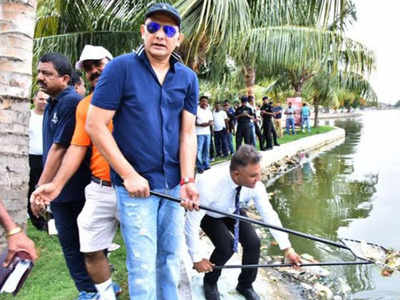
A human chain with more than 6,000 students was formed around the Hussain Sagar in the city on Sunday as part of the “Save Lake Campaign ” organized by the Military College of Electronics and Mechanical Engineering (MCEME) Secunderabad.
Former Indian cricket captain Mohd Azharuddin  and Seema Singh , chairperson, Family Welfare Organisation, MCEME flagged off and participated in the 3.5 km Green Brigade Walk.
The programme was organized in connection with the annual Hyderabad Sailing Week. With the theme “Fit Hyderabad Swachh Hyderabad”, the green brigade walk was organized. Students from Army Public Schools, NCC cadets, army personnel, youth and general public participated in the walk from Sailing Club to Sanjeevaiah Park  to promote fitness and health awareness amongst the citizens of the twin-cities.

As part of the Swachh Bharat Campaign, participants undertook a cleanliness drive promoting ecological awareness.

IT minister K T Rama Rao will inaugurate the “Hyderabad Sailing Week” on July 3, 2018. During the Hyderabad Sailing Week, a national seminar on “Race Management” will be organized.

Major General TSA Narayanan, cice commodore, EME Sailing Association said Hyderabad was a popular destination for the sailing in the country. The wind conditions in June – July are most favorable in the Hussain Sagar Lake to hone the skills in boat handling and understanding wind shifts, he said.

This is a landmark year for the EME Sailing Association as this year the event has been accredited as the Yachting Association of India (YAI) National Ranking event where in the performance of the sailors will be ranked, which will give them points for selection into National Team. The eco friendly sports are getting popular day by day and 200 sailors from all over the country are expected to participate in this year’s event, he said.

Major Alok Kumar, honorary secretary, EME Sailing Association informed that the event will see the biggest congregation of sailors in the country. “Sailing is an eco friendly sport which requires immense technical skills to negotiate wind conditions and water. The concepts of sails and boat handling have undergone huge advancement, however the sport still retains the old world charm of explorers and discoverers who used their wind propelled boats to discover the world,” he said.

source: http://www.timesofindia.indiatimes.com / The Times of India / Home> News> City News> Hyderabad News / Ch. Sushil Rao / TNN / July 01st, 2018

The Nizams’ lost wheels

Hyderabad, TELANGANA :

NizamsCarsMPOs30jun2018

From missing White Steams to a recently found Duesenberg, a new coffee-table book — Automobiles of the Nizams — looks at the Hyderabad royal house’s expansive car collection

Once upon a time, Duesenbergs, Napiers, Rolls-Royces, White Steams and Hispano-Suizas were the playthings of the Nizams, the ruling family of Hyderabad. Then they disappeared. “There were 400 of them; I’ve been able to trace around 50. The others remain missing, scrapped, hidden or in private collections,” says Muhammad Luqman, a Hyderabad-born, Dubai-based banker and vintage car collector who has chronicled the royal wheels in his book, Automobiles of the Nizams. Containing never-before-seen photos, the tome tracks significant cars from production lines to palatial palaces. It is set to be released at the Pebble Beach Concours D’Elegance in California in August.
NizamsCars02MPOs30jun2018

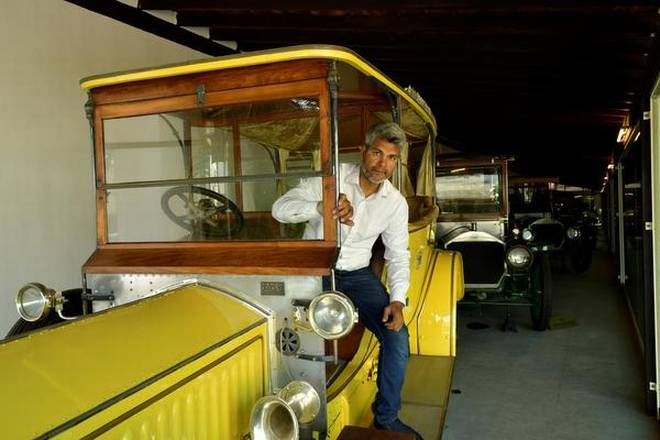
As we walk around the Chowmahalla Palace over the weekend — where some of these cars ferried the sixth Nizam, Mir Mahbub Ali Khan (1869-1911), and later his son, Mir Osman Ali Khan (1911-1948) — Luqman spins a fascinating yarn about the wealthy monarchs’ love affair with automobiles. The first to catch the motoring craze, he says, was Mahbub Ali. The story goes that to acquire one of the first Rolls-Royce Silver Ghosts, he roped in the services of the British Resident (an appointee of the British government), shelled out ₹25,000, and then got it modified to his taste. Painted yellow, as a sign of royalty, he ordered a crest shaped like the dastaar (traditional headgear) and metal work with a delicate lily pattern for the roof fringe. However, by the time the customisation on the Throne Car was completed, he passed away.

The Ghost chronicles

Last year, at Cartier’s Concours d’Elegance at Falaknuma Palace, his great-grandson, Prince Azmet Jah, sat in the Silver Ghost and reminisced about being driven around in Hyderabad. “This was a ceremonial car used on special occasions. The prince recalled how, to celebrate the golden jubilee of Osman Ali’s ascension in 1936, the courtiers wanted him to get a new car. But the Nizam, known for being frugal, asked the Railways (he had his own railway network) to spiff it up instead. They did so by adding horrible fenders,” says the author, who relied on the archival material at Chowmahalla Palace’s royal library for much of his research. “After being left to the elements, it was restored by Rana Manvendra Singh (one of the country’s foremost authorities on vintage vehicles) in 2012, with Cartier picking up the tab.” As we talk, I also spot a massive, newly-restored Wolesley beside the shiny Silver Ghost.

While the sixth Nizam bought cars in pairs and preferred the ultra-luxe versions, his son picked the simpler Humbers and Fords. Today, one of the 1933 Dodges used by Osman Ali is taken out for a spin every Sunday by Captain Kerman Pestonjee, a Hyderabad-based collector, who acquired it with a unique number plate: King Koti Hyd A. So does Luqman’s book overlap with Singh’s 2003 compendium, The Automobiles of the Maharajas, a sweeping history of Indian royalty and their tryst with cars? No, he replies, because his work is a micro history, with details about the vehicles and anecdotes about how the Nizams acquired them. “It has been my obsession for the past 30 years; this book is a culmination of the love story,” says Luqman, who houses his collection of 12 vintage cars, including a small 8 HP post-war Wolseley, in Hyderabad.

Disappearing act

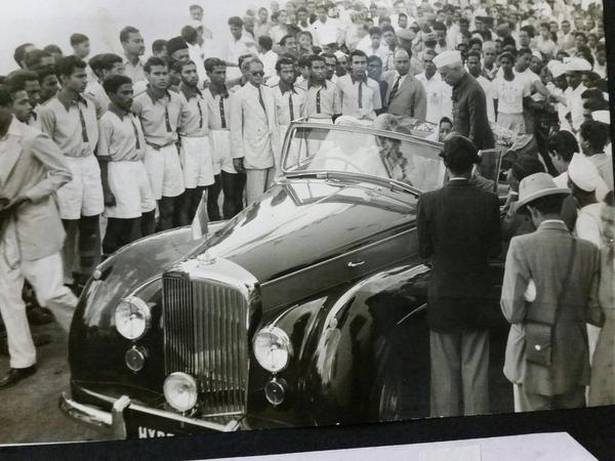
One of the cars he has been able to trace is a Bentley. When Prime Minister Jawaharlal Nehru visited in the ’50s, he was photographed in the vehicle with the Hyderabad number plate intact. Nizam Mukarram Jah had also used it extensively and once, in the ’60s, crashed it near Visakhapatnam — into a cart carrying coconuts. “The glass was smashed, the radiator twisted out of shape, but the Nizam continued with his programme and went to Calcutta. When he relocated to Perth, he took the Bentley with him. I traced it to a collector there,” says the writer, who also traced a Duesenberg to General William Lyon’s collection in the US.

But the mystery of the missing 350 cars remains. How do large automobiles just disappear? Luqman explains that after the 1948 merger with India, Hyderabad’s royal family simply lost interest in the vehicles — till Nizam Mukarram Jah Bahadur, an outdoorsman who loved tinkering with engines, took charge. His biographer, John Zubrzycki, talks about Jah’s fascination with everything with wheels, including earth movers and heavy machinery. “One of the Jeeps he had, had mounted guns,” he says. An interesting story that could explain a few of the disappearances, involves an electrician. “About 10 years back, the family wanted to install an AC at their Chiran Palace. Once done, a grateful Nizam asked the technician for the fee. ‘I want that Jeep,’ he replied, and the generous prince obliged. Now the Jeep, with the 8386 number, has passed on to another Hyderabadi family,” concludes Luqman, who hopes that more stories about the Nizams and their cars will come out once his book hits the market.

Automobiles of the Nizams, planned as the first of a multi-volume series, is published by Oxford Printing Press.

source: http://www.thehindu.com / The Hindu / Home> Life & Style> Luxury / by Serish Nanisetti / June 29th, 2018

Award for Mangaluru City Corporation

Mangaluru, KARNATAKA :

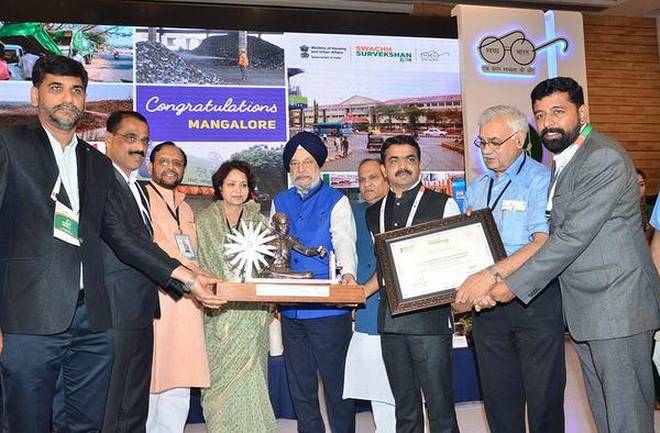
Mangaluru officials receiving the award from Union Minister for Housing and Urban Affairs Hardeep Puri in Indore, Madhya Pradesh, on Saturday. | Photo Credit: Supplied

The Mangaluru City Corporation received ‘India’s best city in solid waste management’ award under the categories of cities having a population between three lakh and 10 lakh under Swachh Survekshan 2018 at Indore, Madhya Pradesh on Saturday.

Union Minister for Housing and Urban Affairs Hardeep Puri presented the award at a function.

Bhaskar K., Mayor, Mohammed Nazir, commissioner of the city corporation, Naveen R. D’Souza, chairman, Standing Committee on Health and Education, and Madhu S. Manohar, Environment Engineer at the corporation, received the award. Mangaluru was among the 23 cities selected in the country for the national award under different categories.

The survey by the Union Ministry of Housing and Urban Affairs assessed 4,203 urban local bodies under the aegis of the Swachh Bharat Mission (Urban) between January 4, 2018 and March 10, 2018. The survey team was in Mangaluru for four days in February, 2018.

The on-field survey for Swach Survekshan had been conducted by an independent agency and the data for ranking the cities were collected through direct observation, citizen feedback and service-level progress..

source: http://www.thehindu.com / The Hindu / Home> News> Cities> Mangaluru / by Special Correspondent / Mangaluru – June 23rd, 2018