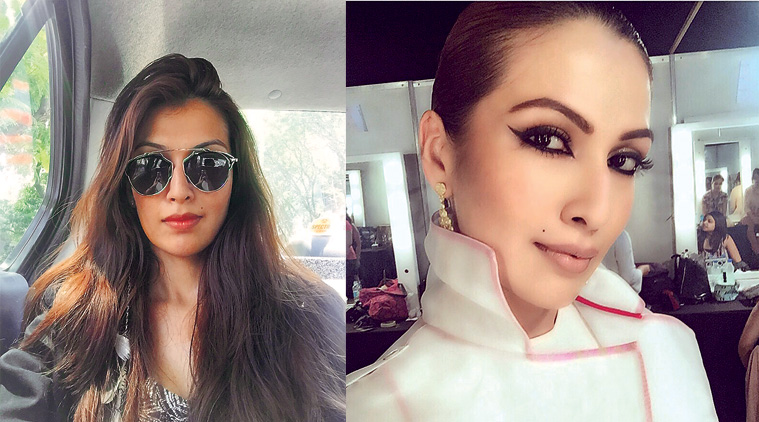
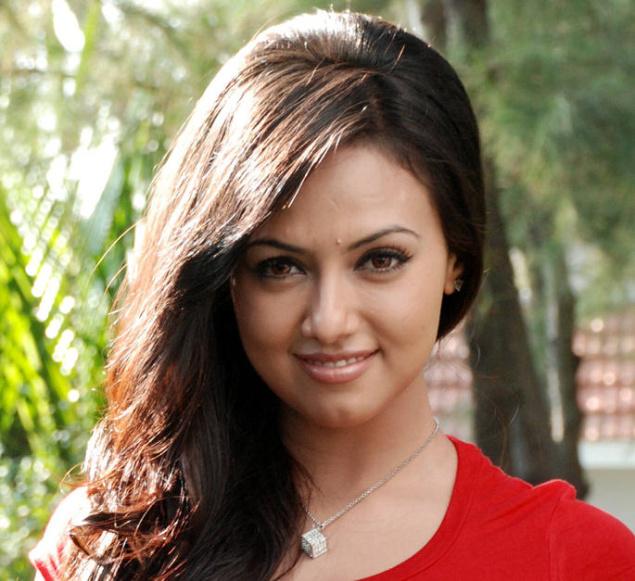
Mumbai-based model Sanea Sheikh on loving fashion shows and growing flowers in her garden.
Sana Sheikh
At Home
I love spending time at home as work usually involves travelling all the time. At home, I like to unwind with my three cats — Posh, Spanky and Momo — and dabble in a bit of gardening. I grow hibiscus, Chinese roses, mint and chillies. I can practically sit in my bed and watch television shows all day, especially my favourite, Game of Thrones. Travelling and photography are also my passions. Spending time with my family, especially my three sisters, rejuvenates me the most.
At work
During show season, it gets hectic; we have fittings, make-up sessions, rehearsals and shows. I try to step out of the venue as much as I can to get some fresh air. But I love fashion weeks because they’re one big, happy reunion. Between shows I’ll catch up with friends. Walking the ramp is like an adrenaline rush for me. Owning the ramp for a minute or two, with all eyes only on you, can give you quite a high. Plus, I get to look my very best all the time, thanks to different members of the fraternity who’re working on me.
A feature on the spaces and objects that define our work and home life through the selfie
source: http://www.indianexpress.com / The Indian Express / Home> Lifestyle> Fashion> Eye 2015 / Express News Service / New Delhi – May 31st, 2015
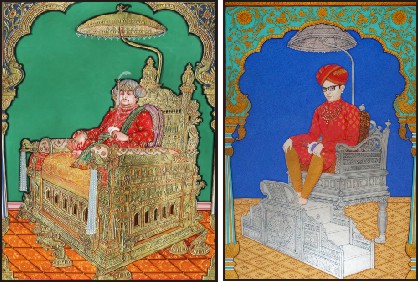
1) Mysore style portrait painting of Srikanta Datta Narasimharaja Wadiyar seated on the Golden Throne based on the 2013 Khas Darbar. Artist: K.S. Shreehari, 2014. Size: 41×51 cms. Collection: Ramsons Kala Pratishtana, Mysore. 2) Portrait painting of Yaduveer Krishnadatta Chamaraja Wadiyar seated on the silver Bhadrasana. Artist: Manish Verma, 2015. Size: 37×51 cms. Gouache on paper. Collection: RKP, Mysore.
by R.G. Singh, Secretary, Ramsons Kala Pratishtana, Mysore
Peacock pavilion of the Mysore Palace is where the coronation of the new Scion of the Mysore Royal family is scheduled to be held tomorrow. In the hall adjacent to this pavilion is the portrait gallery that has on its walls the official portraits of several Wadiyar rulers along with their family members. It is here that one begins to realise the importance that a royal portrait played in private and public life of the nobility.
Nalwadi Krishnaraja Wadiyar IV
But it was also special events that were to be immortalised on canvas or photographed or painted. The Daly Memorial Hall of the Mythic Society in Bengaluru greets the visitor with a portrait officially commissioned of Nalwadi Krishnaraja Wadiyar IV on the him being conferred the honour of Knight Grand Commander Star of India on January 1, 1907.
The oil on canvas portrait shows the king partly in profile. The Honour is pinned to a sash. The bejewelled necklace covering the neck of sherwani only adds to the richness of the attire. The fluted and feathered plume with a jewelled brooch holding it in place to the turban also adds to the portrait’s grandeur.
11-year-old Krishnaraja Wadiyar IV
Royal portraits have hidden sutras embedded in them that takes the viewer back in time. The Official Coronation portrait of the 11-year-old Krishnaraja Wadiyar IV is one such portrait.
This is a stylised photographic portrait and has several artfully placed emblems; the jacquard seat of the chair, the three-legged table with a curved triangular holder, a clock and some leather covered folders. The young prince is shown resting one hand on them while the other is on his hip. A Beagle stands motionless under the table.
Photographer Buranuddin of Mysore has used all possible elements that signify royalty in composing this photograph.
Nalwadi Krishnaraja Wadiyar
The autographed official photograph of Nalwadi Krishnaraja Wadiyar to mark the Silver Jubilee of his coronation in 1927 shows the then King dressed sombrely resting one hand on the back of a chair. The single-row bejewelled necklace and the chain and fob in the upper coat pocket add a touch of elegance. Even the Mysore peta is unembellished. The photograph was printed in Germany on water-marked archival paper.
Chamaraja Wadiyar
Another painting at the Jaganmohan Palace is the coronation scene of Maharaja Chamaraja Wadiyar. The painting was created by the artist Venkata Subbu in 1868.
There is an official portrait of Chamaraja Wadiyar on being conferred with the Knight Grand Commander of the Order of the Star of India in 1892. The above photograph reproduced here was ‘clicked’ by the famous Raja Deen Dayal of Hyderabad.
While the English royalty painters used pastoral themes their Indian counterparts used the very ‘Indianness’ of such public events of those days to display their virtuosity.
For instance, the 1927 Silver Jubilee of Nalwadi’s coronation has been commemorated with a beautiful portrait done by artist Keshavaiah; this masterpiece is on display at the Banquet Hall of the Vidhana Soudha. Interestingly, the advent of photography did not deal a death knell to the art of portrait paintings. Instead it led to another innovation – the painted photograph.
Jayachamaraja Wadiyar
By the time Jayachamaraja Wadiyar ascended the throne, both photography and painted photographs were very much in vogue. But such was the ingenuity of the Indian photographers that their photographs of the Royalty was a marriage of these several stylisations. Thus you have photographs of Jayachamaraja Wadiyar shown in what was supposed to be a candid form. At various times you had special photographs of Jayachamaraja Wadiyar ‘clicked’ by the then well-known City Studios like Star Studio, Palace Studio and Raj Studio. The variation was of course the painted photograph of Jayachamaraja Wadiyar by M.N. Murthy.
The photograph taken by the unknown photographer of Palace Studios of Jayachamaraja Wadiyar in 1940 to commemorate the king’s coronation has been replicated as a painted photograph by artist M.N. Murthy and is now in the RKP collection. But at no stage did photographs or painted photographs replace the portrait painter.
The tradition of painting historical events continues to this day. The last scion of the Royal House of Mysore, the late Srikanta Datta Narasimharaja Wadiyar along with his sisters and their husbands have been painted as several individual portraits by M. Ramanarsayya, the former Superintendent of Jaganmohan Palace.
Keeping the art of Painted Portraits alive
Ramsons Kala Pratishtana, in its efforts to keep alive the art of painted portraits, first commissioned artist K.S. Shreehari in 2014 to paint a classical portrait of Srikanta Datta Narasimharaja Wadiyar in the Mysore style (see pic. top right) based on photographs of 2013 Navaratri Khas Darbar.
This was followed by commissioning artist Manish Verma to recreate a Mysore style painting using a photograph of the Yaduveer Krishnadatta Chamaraja Wadiyar. This classic Mysore style portraiture shows the young scion accoutred in his royal vestments and Mysore peta adorning his head while his posture follows the classic from that can be seen in many of the older Wadiyar portraits. He is seated on the silver Bhadrasana which suggests that he has just been invested with the (symbolic) royal authority of Mysore Kingdom.
source: http://www.starofmysore.com / Star of Mysore / Home> General News / Wednesday – June 02nd, 2015
The observance of the death anniversary of Shah Jahan and Mumtaz Mahal still fascinates people
The 360th Urs or death anniversary of Shah Jahan was observed at the Taj Mahal last week, but there were ripples of it in Delhi too with a busload of people reaching there to pay homage to the Emperor. Mohammad Saquib of Suiwalan was one of them. He has been attending the Urs for years as one of his ancestors was among the artisans who worked on the inlay work at the mausoleum, or so he claims. Another interested visitor was Shahnawaz Khan of Basti Nizamuddin who went for the first time to offer fateha in observance of a vow. Earlier Khan Abdul Haye Khan was a regular Delhiwallah who never missed the Urs. Abdul Haye was a Pathan who was very fond of fishing. One remembers that in 1966 during the monsoon he sat down on the rear side of Etmad-ud-Daulah to fish in the Yamuna, which was in flood and whose waters were beating against the mausoleum where rests the father of Nur Jahan and grandfather of Mumtaz Mahal. A rohu caught by Abdul Haye was so big that it sufficed for dinner for the whole family when cooked in Matia Mahal.
Shah Jahan like the unlucky Mohammad bin Tughlak was fond of Yamuna fish and so also presumably Mumtaz Mahal, but he did not drink wine till the age of 23 when he was persuaded by his father, Jahangir to do so. He however, never drank after the death of Mumtaz at Burhanpur on 16th June 1631. Accordingto Dr Ishwari Prasad, Shah Jahan died in January 1666 aged 74. Why his Urs was celebrated in mid-May is not understandable unless the date is fixed according to its proximity to Mumtaz Mahal’s death or some lunar calculation or as per the convenience of the khadims (caretakers). One remembers attending an Urs in 1958 when among those who prayed for the Emperor’s soul was Nawabzada Farouqur Rehman Khan of Datoli. Earlier the Nawab of Chhatarhi, Chief Scout of India and Freemason Grandmaster, had offered his obeisance. The first Urs of Shah Jahan, a year after his death, was presided over by Prince Muezzim, eldest son of Aurangzeb, who came from Delhi partly on horseback and partly in a horse-driven carriage, past Akbar’s Tomb at Sikandra, where he dismounted to offer fateha at the grave of his great-great grandfather. Aurangzeb came a month later. The same thing happened at the first Urs of Mumtaz Mahal at the Taj after Shah Jahan’s death.
A special feature of the Urs of Shah Jahan, which was later merged with the Urs of Mumtaz Mahal, is the laying of a gigantic multi-coloured Hindustani Chadar at the grave. This was offered on Friday May 17, with the Urs continuing on the subsequent Saturday and Sunday. Entry to the Taj was free from the afternoon of Friday (which is usually a closed day for visitors). The shehnai was played, along with the naqarra drum, at the top of the main entrance to the monument and on the following days the big kettle drums were beaten to mark the occasion, as in Mughal times when Shah Jahan is believed to have once remarked to Mumtaz: “Naqqare tumhari amadh ka ailan karenge aur tum Manno Malika kehlaugi” (The drums will announce your arrival and you dear will be called Emperess). Not much information is available of the first Urs of Shah Jahan but the one for Mumtaz Mahal is recorded, as follows, by father in his 1977 memoirs: “The celebrations traditionally begin with the washing of the tombs of the Emperor and his wife with rose water and the lighting of ‘agarbattis’. Prayers are offered with and flowers and cloth ‘chadars’ — one of them on behalf of the Department of Archaeology — are placed on the graves.
Occasionally a visitor whose prayers have been heard sends a ‘chadar’ as a token of thanksgiving. Atop the gate facing the mausoleum sit shehnai players and as evening advances, qawwalis in praise of the dead couple attract a big audience from neighbouring Tajganj, where reside the descendants of the builders of the monument. In keeping with tradition, food is distributed to the poor. The entire cost of the Urs is borne by the khadims from offerings made at the tombs. The first Urs of Mumtaz Mahal was performed by Shah Jahan himself in 1631. The Emperor wore a white dress and the nobles were in mourning habit. A covering with strings of pearls worth several lakhs of rupees was spread over the tomb. Prayers were offered for the soul of the queen and fateha was performed. Asif Khan, father of Mumtaz Mahal, was assigned a prominent place at the ceremony. A lakh of rupees was sanctioned for the ceremony, Rs 50,000 of it was given in alms to the poor.”
This time the Urs followed the recent earthquake which did not have any significant effect on the monument, except Sahilion-ki-Burj. Believe it or not, Mufti Ehsan Sahib of Mehrauli thinks Shah Jahan and Mumtaz Mahal always protect those who come to offer homage to them.
source: http://www.thehindu.com / The Hindu / Home> Features> MetroPlus> Society> Down Memory Lane / by R.V. Smith / May 24th, 2015
One-of-its-kind silver ‘zarih’ is being made in Lucknow to commemorate the ‘wiladat’ (birth anniversary) of Bibi Sakina, great grand daughter of Prophet Muhammad and daughter of Imam Hussain, the martyr of Karbala, celebrated on 19 Rajab, falling this year on May 9. Zarih is lattice work, often gilded, that encloses an Islamic tomb. Handcrafted by 10 skilled artisans for past six months, it is replica of the original zarih in Syria.
The estimated cost of the lattice made of 25kg pure silver is Rs 15 lakh, an amount collected from donation at Hazrat Abbas dargah. It is 3 feet wide, 4.5 long and 3.5 feet high and has Quran verses and story of Bibi Sakina’s pilgrimage carved on it in Arabic.
Once construction work is complete the existing zarih made of plain iron will be replaced with the silver one to enclose the holy shrine of Bibi Sakina situated on the premises of Dargah Hazrat Abbas in Rustam Nagar.
One of the most revered shrines in Lucknow built in 1819 this Dargah is perhaps the oldest shrine of the Shia Muslims in the city, popular among non-Muslims too.
Speaking to TOI, member Hazrat Abbas Dargah committee Arif Hasan said, “Donation was received from members of all communities.”
Artisan Nisar Hussain said, “Though original zarih in Syria is placed on a stone we will be installing the zari on a wooden platform.”
Plan is to make a 100gram gold crown embellished with multicolored semi-precious stones to be placed next to the zarih.
source: http://www.timesofindia.indiatimes.com / The Times of India / Home> City> Lucknow / by Uzma Talha, TNN / May 01st, 2015
West Bengal State Music Academy will confer this year’s Allauddin Purashkar on sitar maestro Pandit Budhaditya Mukherjee.
The award, instituted in the name of legendary classical musician Ustad Allauddin Khan in 1987, carries a citation and a cash prize of Rs 25,000. Previous recipients of the award include Pandit Buddhadev Dasgupta, Pandit Manilal Nag and Manna De.
Mukherjee, who earlier won the Allauddin Khan Memorial Fellowship offered by the Madhya Pradesh government, plays sitar and surbahar in the Imdadkhani tradition of Etawah. Speaking to TOI, he said, “I am pleasantly surprised and honoured that the state government considered my name for this award.”
Academy’s member secretary and deputy director of information and cultural affairs department Malabasri Das said, “We will also honour dancer Vidushi Rani Karnaa with Uday Shankar Purashkar, tabla maestro Pandit Gobinda Bose with Jnan Prakash Ghosh Purashkar and Agra gharana vocalist Subhra Guha with Girija Shankar Purashkar for their contribution to various forms of performing arts.”
“I was born in Sindh in Pakistan. But Kolkata has been my second home for the last 40 years. It is great to see that the Bengal government has selected me for this honour,” said Karnaa, a disciple of Odissi legend Guru Kelucharan Mohapatra.
Chief minister Mamata Banerjee will hand over the awards to the maestros at an event at Nazrul Mancha on Tuesday.
source: http://www.timesofindia.indiatimes.com / The Times of India / Home> City> Kolkata / TNN / May 26th, 2015
It has been nine years since the wonder of Indian film music, Naushad Ali, has left us. The maestro, who was a name to reckon in the Hindi film music world, put his indelible stamp on Malayalam film music in 1988 by directing music for the film Dhwani, in which evergreen names such as Prem Nazir, Jayabahrathi, Jayaram and Shobhana starred. Naushad had given life to compelling music in about 67 Hindi films.
Naushad was born to Wahid Ali, a city court Munsif in Lucknow on December 25, 1919. He learned music under Ustad Gurbat Ali, Ustad Yousaf Ali and Ustad Babban Saahib. Devoted to music, Naushad left home early in the pursuit of music. His initial years in Mumbai were full of difficulties and he even had to sleep on the footpath.
His life took a positive turn when he started working as an assistant to Ustad Jande Khan. It was during his tenure as Jande Khan’s assistant that he met music director Karamchand Prakash, commonly known as Guru. That association developed him into an independent music director. He never had to look back after directing the music for Prem Nagar in 1940.
After Prem Nagar, Naushad created many musical hits and he became one of the best known music directors in the Hindi film industry. Songs tuned by him and sung by Mohammed Rafi are still a hit with music lovers.
Even though his Malayalam venture was restricted to Dwani, his music remains in the heart of Malayalees. The film Tajmahal, released in 1986, was his last film.
In 1981, he was presented with the Dada Saab Phalke Award and in 1992, he was presented the Padmabhushan. On May 5, 2006, when Naushad Ali passed away, Indian film music bid adieu to one of greatest Indian film music director of the last century.
source: http://www.english.manoramaonline.com / On Manorama / Home> Entertainment> Music / by Manu P / Tuesday – May 05th, 2015
I am basically a dancer and wanted to work in films. I have acted in more than 50 ad films. Silambattam,Silambarasan came to Mumbai looking for a fresh face for his film Silambattam. There he saw me and selected me. After a make-up test, I became the heroine for his Tamil film.
How it felt
Working for Silambattam was an enjoyable experience. I knew that he chose me after seeing so many girls and that I had to work hard to make it big in the Tamil film industry. I wanted to see how I looked in the film. I was also eager to see people’s reaction to my acting. So when the film released I went to Arora theatre in Kings Circle with my family and friends numbering 200 to watch it. When I appeared on the screen, all of them clapped — we had a great time. Everybody appreciated my acting. But after that I did not do many films; I was waiting in the wings to land the role that would help me showcase my talent.
How life changed
It has not changed much. Nearly two years after the film, I got a chance to act in Thambikku Indha Ooruwhich stars Bharath as the hero. Two more films are in the pipeline — Ayiram Vilakku and Santhu Pottu— for which shooting is under way. I am glad to be in the Tamil film industry and wish I get powerful roles to play.
source: http://www.thehindu.com / The Hindu / Home> Features> Cinema Plus / by S. R. Ashok Kumar / February 18th, 2010
In an exclusive interview, costumes designer Reza Shariffi talks about how he devises a frame to design and create costume, how he tries to retain the integrity of the character and the costumes that he has designed so far.
What inspired you to be a costume designer?
I was exposed to a wide variety of fabrics very early in life. I was the first born in my family, having six maternal aunts. For the first five years of my life, they never made me wear a single garment repeatedly. When I grew up I naturally returned that favour and till the date I always wanted to dress them up in my creations. I think this is the source of my inspiration.
When I started working as a designer in a Boutique in Bandra, Mumbai, one of the top designers bought my outfit to style a famous Bollywood actress. It gave me immense satisfaction when I saw the outfit on the screen. That satisfaction germinated into a strong desire.
Since you have designed for almost all the well known B-Town celebrities, How do you manage to pull out the best for everyone?
As a professional costume designer, I devise a frame within which I need to design and create a costume. I keep in mind a few things before I design like the comfort zone of the star, physical attributes of the celebrity, purpose of the costume (is it for movie, live performance, appearance etc.), the time it will be worn (day, night, how much time on the body) and finally my vision of the costume. After I create the costume I evaluate it on all the five parameters very stringently. The outcome rarely falters.
What are the key points, you keep in mind while designing for actresses like Shilpa Shetty, Shraddha Kapoor and others?
As I told you earlier, my five parameters work for each and every costume I create. For movies I try to retain the integrity of the character as much as possible. Tanu Weds Manu and Tanu Weds Manu Returns are the cases in point. I believe ‘clothes maketh the character’ and my costumes are very loyal to the characters my actors play.
Sanjay Leela Bhansali is said to be the perfectionist in traditional attires, how did you manage to meet his expectations?
Yes he is a perfectionist. For a Filmfare award function he wore a black kurta designed by me that was the biggest compliment from him. When I worked with Sanjay Leela Bhansali in Devdas, I had extensively made research on my outfits for the movie. It was during Devdas that I crystallised my principles of ‘character integrity’. That we worked again in Saawariya was a compliment in itself.
Kangana Ranaut has worked in movies like Fashion, Queen and Tanu weds Manu, What were the challenges you faced while designing for her upcoming sequel of Tanu weds Manu?
Tanu Weds Manu Returns is the fourth project I have worked for Kangna. As I have designed for both Tanu Weds Manu and soon to be released Tanu Weds Manu Returns, I had a definite line of thought to work on, right from the beginning. Tanu (Kangna as Tanuja Trivedi) is still the feisty lady who could say “Darti to Main kisi ke baap se bhi nahin” in Tanu Weds Manu and “Haalat dekhi hai? Adrak Ho gaya hai ye aadmi” in TWM Returns. Obviously the clothes need to match up!! The colours are bold (as in part one). I have given her costumes which have inherent shock value adding quirky twist using hounds tooth print in pink, Shibori fabric, tie and dye, kilim fabrics with leather and suede combination trimmings and jackets. I have designed printed draped dhotis in ethnic colours and mildly embellished kurtis
In Tanu Weds Manu Returns Kangana also plays Datto aka Kusum. Kusum has a wardrobe of printed floral Salwaar kameezes paired with sporty jackets, knits and sweaters. The colours used for her are more subtle. Datto (a ward of Delhi University from Haryana) wears sporty track suits while practicing her sport on field.
What are your hobbies other than designing?
I love road trips. Shopping from every nook and cranny of the places I stop on the way to my destination gives me happiness beyond compare. When I shop, I focus on its aesthetics first and price later. Though I love small / miniature artifacts, I am not averse to life size animal statues too. I love taking care of stray animals.
Out of all the costumes that you have designed so far, which was your favorite?
A film costume needs to be appealing and independent in the current fashion trend. Then they become memorable because of the way they are carried by the actor in the movie and how they are shot. I don’t think I would deliver a costume unless I love it myself.
Among my many favorites are Devdas – Dola re Dola; Wajood (Madhuri Dixit Nene), Kismat- particularly the dance costumes (Priyanka Chopra), Garv (Shilpa Shetty), Main Madhuri Dixit Banna Chahti Hoon (Antra Mali), Shabri (Isha Koppikar), Rahena Hai Tere Dil Mein- Zara zara song (Dia Mirza). Latest is Kangna’s white suit in Tanu Weds Manu (Rangrez song). The list is endless, I can pick one (at least) per project I have done so far. There are times when some outfits are chopped on the editing table or used in a shot for just a few seconds and so on, they never get registered or see the light of day.
You have achieved many awards and designed for almost all the stars. What is your ultimate goal in life?
Keep working.
The film industry has a lot of well known designers, who among them is your role model?
Bhanu Athaiya and Leena Daru.
What is your message to all the aspiring designers?
I maintain that for any chosen field the basics need to be strong. Get your foundations right and then slowly keep building on it. More than theory, practical working knowledge is important. Remain a student all in your life, learn more and more, evolve…
We have learnt that you are currently working for Jacqueline Fernandes and Mallaika Arora Khan, would you like to share about the projects?
Yes, I have been doing lot of work with Jacqueline Fernandes and Mallaika Arora Khan for their live performances.
source: http://www.newindianexpress.com / The New Indian Express / Home> Entertainment> Fashion / by Nibedita Mohantha / April 27th, 2015
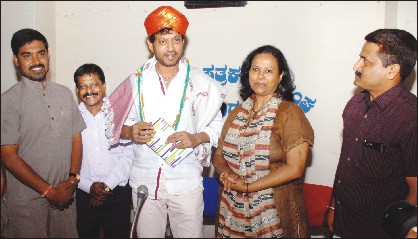
Bollywood actor Irrfan Khan, who was felicitated by Mysore District Journalists’ Association (MDJA) in city yesterday, is seen with (from left) MDJA President K. Deepak, Rangayana Director H. Janardhan, Irrfan’s wife Sutapa Sikdar and MDJA General Secretary K. J. Lokesh Babu.
Mysuru :
Bollywood actor Irrfan Khan arrived in Mysuru yesterday along with his wife Sutapa Sikdar to extend his support to the Badanavalu Satyagraha, which has been promoting sustainable living and has gained momentum throughout the State.
Irrfan Khan also stayed overnight at Badanavalu with his guru Prasanna, former Rangayana Director. On his arrival, Irrfan had an interaction with media persons at Mysore District Journalists’ Association (MDJA) office on his association with the Badanavalu movement.
During his interaction, Irrfan Khan said that it was important to stop villagers from migrating to cities which are already overloaded with people and suffering from unplanned development. “If villagers leave their lands and come to cities, they will be left with nothing. In fact, they would be forced to work under someone,” he added.
Citing the example of Mahatma Gandhi’s support to cottage and small industries, the actor said that the villagers should become self-efficient in the interest of country’s development. “It is important to create awareness among the people that products from villages are important to us. Dependency on foreign products will grow if we do not support our own products,” said Irrfan Khan.
When asked about Badanavalu movement, the actor said that he was curious when he came to know about the movement. He added that he was eager to visit Badanavalu, the place which Gandhiji visited to witness the function of handloom industries. “It is a unique concept and such movements should happen to protect our tradition, instead of adopting the western culture which is a use-and-throw culture,” he said.
To a question related to Deepika Padukone’s much talked ‘My Choice’ video that has gone viral, Irrfan said, “Come out of it. It’s over. You only need give it the importance that it deserves. Watch ‘Piku’, my upcoming movie, in which I have acted with Deepika. You will enjoy.”
Continuing with ‘Piku’, Irrfan said that the movie had come out well and that people who watch the movie will start loving their parents and those with kids will start enjoying parenthood.
Irrfan also said that he would be off to the US soon, to shoot his upcoming Hollywood flick ‘Inferno’ in which he will be starring alongside Tom Hanks.
Later, he left for Badanavalu where he stayed overnight along with theatre person Prasanna and others involved in the Badanavalu movement. His wife Sutapa Sikdar, Rangayana Director H. Janardhan, MDJA President K. Deepak and General Secretary K. J. Lokesh Babu were present during the interaction at Pathrakarthara Bhavan.
source: http://www.starofmysore.com / Star of Mysore / Home> General News / Friday – April 10th, 2015
The much-awaited Chinnara Mela summer camp organised by Rangayana got off to a colourful start at Vanaranga in Rangayana premises here this morning.
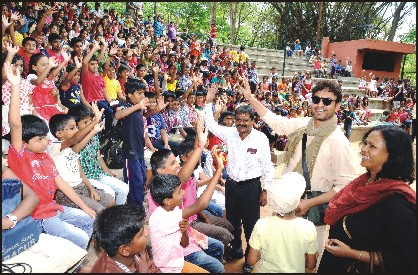
The camp was inaugurated by Bollywood actor Irrfan Khan, who was in city to extend his support to the ongoing Badanavalu Movement.
There was joyous moment at the venue on the arrival of the actor by around 400 children who cheered and shouted with joy on seeing the versatile actor.
Irrfan obliged his young fans by signing autographs and posing for pictures with them. He wished the children best of luck before leaving the premises.
Today being the first day of Chinnara Mela, children were seen arriving at the venue with their parents. They were in total excitement as they had no idea what was in store for them.
Around 400 children will be participating in the camp which concludes on May 4. Children will be treated with fun games and personality development activities. They will be divided into 40 groups headed by a mentor during the camp period.
On the occasion, Rangayana felicitated Irrfan Khan and his wife Sutapa Sikdar. Rangayana Director H. Janardhan, Chinnara Mela Co-ordinator Krishna Prasad and others were present.
source: http://www.starofmysore.com / Star of Mysore / Home> General News / Friday – April 10th, 2015