Chief Minister along with his cabinet reached MLC Mohammed Saleem’s residence for Eid Milap on the occasion of Eid-ul-Azha. He stayed there for more than an hour. During the period he discussed party position in Telangana state and Minority welfare.
According to sources KCR had made a vow (mannat) to visit Dargah Hazrat Khaja Moinuddin Chishti after formation of Telangana and now he wishes to visit Ajmer Shareef through a special train.
He told Mohammed Saleem that he plans to construct a building with the cost of Rs. 5 crore in Ajmer Shareef for the convenience of devotees.
He directed Mohammed Saleem to contact Rajasthan government and try to obtain land for the same.
Siasat news
source: http://www.siasat.com / The Siasat Daily / Home> Hyderabad / Wednesday – October 08th, 2014
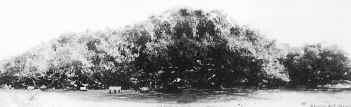
The 700-year-old banyan tree, Pillalamarri, which will appear on a special cover being brought out by the Postal Department.
Hyderabad :
Pillalamarri, the famed 700-year-old banyan tree near Mahabubnagar, will appear on a special cover being brought out by the Department of Posts.
The magnificent tree with its branches stretching over an area of three acres is acclaimed as a “living legend” of the district. Over the years, the heritage symbol, located in the fields 4 km from Mahabubnagar town, attracted tourists from far and near. From a distance, it presents the look of a small hillock covered with thick foliage. As one draws closer, the majestic tree stands out like a giant umbrella, which can shelter upto 1,000 persons. There is a tomb of a Muslim saint underneath the tree.
On its part, the Postal Department has resolved to do its bit to commemorate the tree by releasing a special cover during a philatelic exhibition at Mahabubnagar on August 29 and 30. The special cover will be released by T.S.Govindarajan, Chief Postmaster General, Andhra Pradesh Circle.
A special video show for children on “stamp collection-an educative hobby”, philately workshop, essay and quiz competitions for students will be the highlights of the two-day exhibition. As an on-going effort to popularise stamp collection, the facility of philately deposit account is provided at all head post offices through which children can get newly released stamps with an initial deposit of Rs 200.
source: http://www.thehindu.com / The Hindu, Online edition / Home> Southern States – Andhra Pradesh / by The Hindu Special Correspondent / Thursday – August 14th, 2003
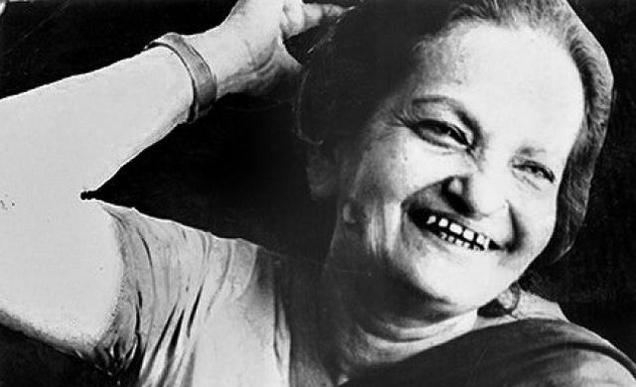
As the Centre rolled out a year-long commemoration of the birth centenary year of ghazal queen Begum Akhtar on Tuesday, the lament of her disciples and close confidantes is that Uttar Pradesh – the State where she was born and lies buried – has shown no interest in keeping her legacy alive.
Coins released
The official launch of the birth centenary commemoration with the release of commemorative coins at National Museum here saw another disciple Rita Ganguly enthral the houseful gathering with a rendition of her teacher’s aye mohabbat tere anjaam pe rona aaya…’’
But for recent efforts by individuals to salvage what remains of `Pasanda Bagh’ in Lucknow – where Begum Akhtar was buried in October 1974 – even her grave would have been lost to encroachers. Now, the space around her grave and that of her mother’s has been restored — courtesy a grant from the Department of Archaeology of the Government of India – and this evening resonated with the voice of Shubha Mudgal.
“But not many people will be able to attend Shubha’s musical offering as `Pasanda Bagh’ has shrunk to almost the size of a room where not more than 40 people can be accommodated. Our effort is to have an annual ‘Urs’ on her ‘barsi’ but we need a bigger venue so that the public can participate in larger numbers. But this is not something that the few of us can do on our own,’’ said Salim Kidwai, founder-member of Sadbhavna Trust.
“We maintain the mazaar from our own pocket,’’ Mr. Kidwai said; adding that successive Uttar Pradesh governments ignored efforts to get some local governmental support. “We are hoping that the State Government will at least include her mazaar in the tourism map as people have begun visiting it ever since we redid the place two years ago.”
Website soon
Vocalist Shanti Hiranand – a disciple of Begum Akhtar who along with Mr. Kidwai drove the effort to restore the mazaar — told The Hindu that one of the pressing tasks ahead is the setting up of a website on the ghazal queen who was equally accomplished in the `dadra’ and `thumri’ genres of Hindustani classical music. The website will be set up as part of a project of the Indira Gandhi National Centre for the Arts which will also organise a three-city showcase of Begum Akhtar as part of the commemoration.
source: http://www.thehindu.com / The Hindu / Home> News> National / by Anita Joshua / New Delhi, October 08th, 2014
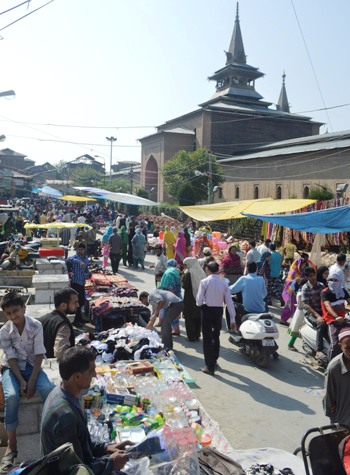
With the major business streets of Srinagar in Lal Chwok, Jawahar Nagar, Dalgate and Karan Nagar devastated by the historic flood, people see the ‘old city’ as the only address for shopping. Safwat Zargar spent a day in the busy markets of the ‘down town’ to argue if trade in Srinagar is returning back to its roots?
On the front side of the compound wall 15th century king Budshah’s tomb at Maharaj Gunj, a young lady, hand in hand, with her three-year old son is walking past a display of bright coloured shoes. Shahida has come from Dalgate to buy apparels and shoes for her son, Burooj.
“You can’t refute the desires of children,” Shahida says, adding “otherwise, there is very less to celebrate this Eid.” Since her marriage, five years back, Shahida, a government employee, has shopped for Eid at Lal Chowk, but this season, nature seems to have broken her habit.
Kashmir is in mourning and Eid is a day far. With Srinagar’s heart, Lal Chowk, weeping mud and dust, the old city or Shahr e Khaas, a week before Eid, is witnessing the festival buzz. While floods washed away the rush of Lal Chowk seems, it is old city’s narrow lanes and streets, bustling with traffic and people.
The two, century-old markets – Maharaj Gunj and Jamia Masjid – are the prime attractions for shoppers. Circled around the archetypal dome of mother’s tomb of Sultan Ghiyas-ud-Din Zain-ul-Abidin’s, well known as Bud Shah, on the banks of Jhelum, floods seem to have livened up Maharaj Gunj’s past glory for now. Known for textiles, spices and marriage items, Maharaj Gunj, in past, would have everything for everyone. It was hard to imagine for a citizen of old city to buy anywhere except Maharaj Gunj.
Over the years with city expanding “un-naturally” and haphazardly to upper areas in flood basins, it triggered the migration of better economic class. The old city dwindled into a myth. For many living in the posh-neighbourhoods and housing colonies, downtown became synonymous with protests, backwardness and stone-pelting. Politics dominated the air but businesses struggled. Now, with floods having ravaged all the new and mostly peaceful markets and destroying stock, people are now flocking back to the old city.
82-year old Hajira of Kadi Kadal still recalls the pinnacle days of Maharaj Gunj to her grandchildren. Young, Hajira, with lunch and fresh curd in a copper jug in her hand, would navigate through crowds of shoppers, vendors and carts men, to reach Zaina Kadal where her father had a jewellery shop. “There is hardly that kind of rush and business now,” she says. “I haven’t been there for years.” However, Hajira believes “it would be beautiful if the grandeur and finery of the old city comes alive again.”
President, Gada Bazar, Maharaj Gunj Traders Association, Nisar Ahmad feels that the damage to Lal Chowk and other uptown area markets have stirred up sales in old city markets. “For last few days, we are realizing the upward trend of new customers visiting our shops. Though, the overall market is sunken but people, with whatever need and money they have, are thronging markets,” he says. “Most of the sales are compulsive sales.”
On the other hand, Fayaz Ahmad, owner of Janta Bakers at Aali Kadal, one of the best bakeries in old city, says people from places outside downtown might be turning in numbers in the old city markets but the average sales are down. “It is as if there is an implicit understanding of spending less. My sales are down by 70 per cent as compared to the previous year,” he says.
Fayaz also says there is indirect shopping taking place this year. “Relatives of flood affected areas are also buying, though in very less quantity, for their flood affected friends and relatives. It includes all those families who are putting up at their relatives’ homes’ in old city.”
The Nalla Mar road, once a water canal of Jhelum and now a two-way macadamized road, cuts the city into two halves. While the Maharaj Gunj market flurries with wholesale dealing mostly, Jamia Masjid market retails all the items ranging from readymade garments to kitchen items.
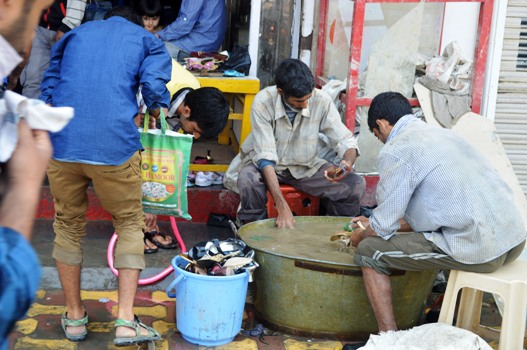
At one of the gates of Jamia Masjid, Tariq Ahmad, who owns a sprawling showroom of crockery, kitchen and household items, a lady from Raj Bagh is checking rates of the plastic water buckets. “Ninety per cent of my business from last week has been from the people belonging to flood affected areas. They usually look for water buckets, jugs, wipers, mops; to clean their homes,” Tariq says.
We are witnessing huge rush of customers, says Tariq, but we aren’t selling items beyond a price of few hundred rupees. “On Eid, a customer would prefer to buy expensive items. Last Eid, a customer won’t step out from my shop without spending 3-4000 rupees, at present, 500 rupees is a blessing,” he says.
Some traders trying to salvage whatever is possible
Noted poet and historian, Zareef Ahmad Zareef, believes the trend is an indication of city returning back to its roots but more than that it also evidences the quality of city planning and development of towns. “Old city stretched from Habba Kadal to Safa Kadal – city of seven bridges – and the quality of city planned by British engineers is still in front of us. What happened to Lal Chowk and other surrounding areas raises many questions about the quality and procedure followed in planning,” Zareef says.
Zareef who lives on the foothills of Koh–e–Maraan while recalling past says Maharaj Gunj used to be a wholesale market, its another arm, Gada Bazar, sold retail items, Bohri Kadal was a fruit and vegetable market, transported there from Dal lake through Nalla Mar on boats. Bohri Kadal was also known for herbs and organic medicines. On Chattabal bridge, fish from Wullar lake would be sold in huge numbers, every day.
“Water transport was the major transport. Roads for carts and tongas came later,” he says. “I feel that people, particularly business class, has realized the importance of old city vis-a-vis vulnerability to dangers. Whatever they will plan in future, it would be solely based on introspection and safety in future.”
One of the best textile garment and fashion wear shops in old city, Taj Fancy Store, has relatively thin footfalls, this Eid. The shop owner, Abdul Rashid Chonka, says whatever sales are taking place is due to the compulsion only. “Nobody wants to buy like before. We have people affected by floods coming here and asking for cheap clothes. Some of them even say they have only what they are wearing,” he says.
The sales graph of Chonka might have downed but he agrees his customer diversity, however short-living, has risen. “Many customers, who used to buy clothes from Lal Chowk and uptown shops, came to my shop, but even they don’t seem to be in good mood of spending.”
Major axe of floods seems to have fallen on the several-hundred crore mutton industry. There is no rush of Gujjars and Bakerwals at Eidgah with their flock except some dispersed huddles around them. Last year, more than three lakh sheep worth 250 crore rupees were sold on Eid-ul-Azha by wholesale mutton dealers throughout Kashmir valley. This year, mutton dealers are already experiencing the flood onslaught. According to Mehraj-Ud-Din Ganaie, President, Wholesale Mutton Dealers Association, Kashmir, only 30 per cent demand is in the market, despite that sheep are available with mutton dealers. In downtown interiors, herd-owners are sitting at main intersections with their flock of few sheep to attract buyers. At Nowhatta chowk, Shah Khan, a Bakerwal from North Kashmir, is mulling to return back. “People seem to have been lost. By this time last year, I had disposed of half of my flock. This year, I pray only for that half to sell,” he says.
“In the first week of floods, more than 5000 marriages were cancelled in Kashmir valley. It means thirty thousand sheep weren’t consumed at all. The mutton industry lost 15 crores in a single week,” Ganaie says.
The major demand for sheep on this Eid used to be in the city, Ganaie says, now when most of the city is in ruins, we are targeting downtown. “But that can’t help us to recover losses. No government agency or department is talking about us,” he says.
“Our fingers are crossed. We are hopeful, a day or two before the Eid, the sales might pick up as many prefer to buy the sacrificial animal a day before, to avoid the burden of sheltering and feeding the animal,” Ganaie says. “However, the damage has been already done.”
In a consumerist economy, the growth of market is directly related to the mood of society, says Zeeshan Ahmad, a student pursuing Masters in Marketing. “Kashmir is grappling with one of the severest catastrophe in its history. It is very hard to expect the flow of money in economy like before,” adds Ahmad, who studies at a university in New Delhi.
“As far as the revival of old city market is concerned, it is just situation driven. Once the other markets are restored the focus will shift back again” he adds.
Historian Zareef says whatever the case, lessons have been learnt,
“Nature is a brutal teacher.”
source: http://www.kashmirlife.net / Kashmir Life / Home> Latest News> Special Report / Sunday – October 05th, 2014
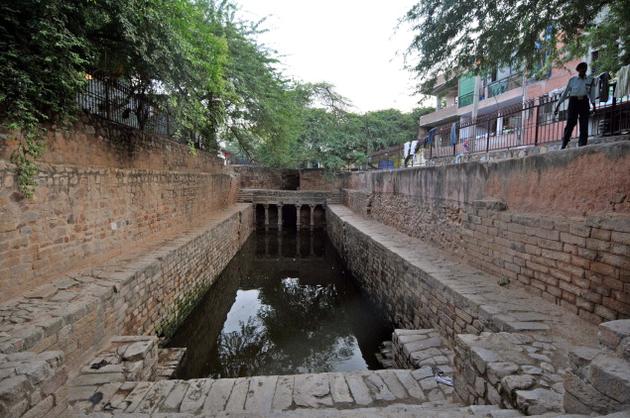
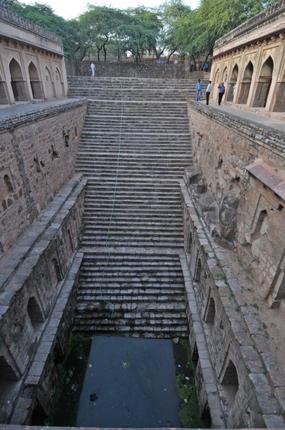
The 13th Century Gandhak ki Baoli. — PHOTOS: SUSHIL KUMAR VERMA
The Archaeological Survey of India (ASI) has revived three water bodies — Rajon ki Baoli, Gandhak ki Baoli, and Hauz-i-Shamsi or Shamsi talab — inside the Qutub premises.
All these baolis, except Shamsi talab, were nearly dry till recently. But for the last couple of months, the water level in these baolis has increased despite negligible rain this season.
“The more the level of water went down in Delhi, the water level in these baolis increased,” said an ASI representative, reasoning constant cleaning of these baolis, which till sometime ago were filled with mud and filth thrown by visitors and people living close by.
While water conservationists opined that the water level increased due to sealing of several borewells in the area, ASI representative argued that the same happened after the cleaning of the choked openings in the baolis, something even the locals agree with.
Ghulam Mohammad, an 80-year-old old resident of Mehrauli village, said: “Sumant Dogra of the ASI used to come here even when the temperature was nearly 49 degrees Celsius and get the baolis cleaned every day for past many months. Soon after the cleaning, we saw water gushing up despite the poor monsoon this year.”
A visit to all the baolis, however, reveals the careless attitude people have towards them.
The 13th Century Gandhak ki Baoli. — PHOTOS: SUSHIL KUMAR VERMA
The Rajon ki Baoli, which dates back to the 15 Century, “was chocked with 20 feet of filth — meaning two storeys of the baoli, leaving only the third or the last storey was visible. We got it cleared. It took us six months. Now the water level has come up to 20 feet. We had to stop intermittently due to lack of funds. We completed the cleaning, which the ASI started in 2004-05, in 2014.”
The baoli is filled with stagnant water covered with algae. One can reach it by climbing down nearly 60 stairs. The ASI official adds: “Visitors throw wrappers, packets and even spit in it. If we don’t clean it every day, the filth will reach 20 feet within a week.”
Gandak ki Baoli is located about 200 meters from this one. The water there “started rising two-three years ago. It now has about 40 feet of water,” he added.
Built in the 13 Century, the water in this baoli, as the name suggests, is mixed with Sulphur, which supposedly has medicinal qualities. Due to this, the locals bathe and wash their clothes in it.
When the reporter visited the spot, a man who has just finished washing his clothes was then seen urinating in the baoli, as a guard looked on helplessly. The ASI official, who comes here daily for inspection, said: “The locals use the baolis as their personal property. Vagabonds roam this area and it turns dangerous by the evening. If we ask them not to dirty the baoli, they take out knives in no time. Even the police is scared of them.”
The third water body or the Shamsi talab, is located in the middle of the Mehrauli market, most of which is unauthorised. The talab was once spread over a huge area, with a tomb in the centre. As the talab started shrinking due to lack of water, the tomb, which is still visible, has been relegated to a side. Water beyond it has dried up already. But “it now has 15 to 20 feet water,” the official adds.
The area around this talab remains unspoilt, filled with the chirps of thousands of birds. A reminder of what the baolis may have looked like in the past.
source: http://www.thehindu.com / The Hindu / Home> News> Cities> Delhi / by Rana Siddiqui Zaman / New Delhi – October 0th, 2014
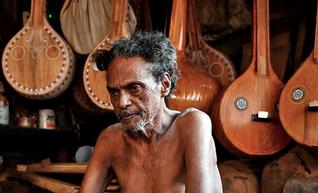
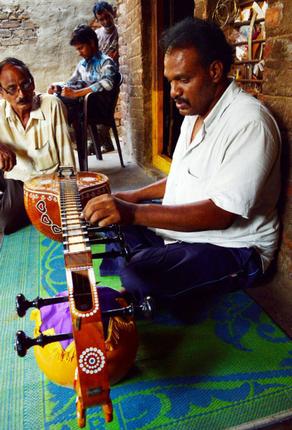
vanishing tribe:Sheik Meera Saheb with the musical instruments he made in the background.— photo: T. APPALA NAIDU / The Hindu
Of the 20 ‘veena’ makers in town, only nine are active
One among the three first generation ‘veena’ makers in Nuzvid, Sheik Meera Saheb, 63, has quit the art form, owing to his poor health condition. His inability to continue the age-old tradition has a very direct impact on the small scale industry, leading to dwindling number of artisans.
Of the 20 ‘veena’ makers in Nuzvid, barely nine of them are left now despite having a handsome number of orders flowing in from different parts of the country.
“My son Basha, one of the finest artisans, died a year ago due to heart attack. My two grandsons do not make the instrument. Now it is my turn to quit the work,” Mr. Meera Saheb told The Hindu .
In his illustrious journey spanning a half-a-decade of making of the traditional Indian classical instrument (made from wood of jackfruit tree), Mr. Meera Saheb has an excellent list of ‘veena’ players who were his customers. “Among Indian classical vocalists, I made the instrument for the Caranatic vocalist Mangalampalli Balamuralikrishna’s team, V.L. Narayana of Tamil Nadu and Nookala Chinasatyanarayana,” added Mr. Meera Saheb.
Lying on the bed for most of the time amid unsold Veenas, he sometimes helps his son Sheik Mabu Saheb by giving a hand in fine-turning the product before it is sold to the customer.
“The happiness in my life springs from spending time with the other ‘veena’ makers in Nuzvid and sharing experiences of glorious past of our job,” he added. Among the three first generation artisans, Sheik Gani now does the pot that is attached to the lion-shaped head and another one had died.
Mr. Meera Saheb had learnt the art from Machilipatnam-born Guru Nookalla Venkataratnam when he was 15.
Of the 20 ‘Veena’ makers in Nuzvid in early 2011, barely nine are left now
source: http://www.thehindu.com / The Hindu / Home> National> Andhra Pradesh / by T. Appala Naidu / Nuzvid – April 21st, 2014
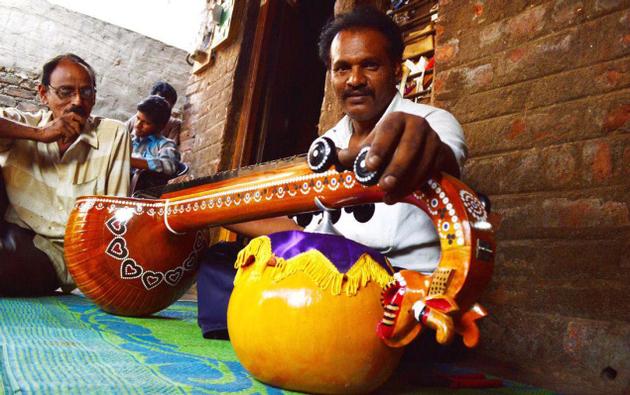
Nuzvid Veena maker Sheik Mabu Saheb training youths at his residence in Nuzvid in Krishna district. Photo: T. Appala Naidu / The Hindu
Sheik Mabu Saheb, a renowned Nuzvid veena maker of Krishna district, has received the Best Artisan Award-2013 from the Andhra Pradesh Handicrafts Development Corporation Limited for his work – Veena with peacock design.
He bagged the award in the category of Veena Making in which artisans from Bobbili were also in the competition. Mr. Saheb had stolen the hearts of the jury members with his small size veena that produces vibrations and sound like any other professional-size veena. “The award is recognition to the art rather than an individual artiste. Despite having a great demand for veena from the world of Indian classical music, shortage of veena makers is still creating problems for the industry’s growth,” Mr. Saheb told The Hindu.
Nuzvid Veena maker Sheik Mabu Saheb training youths at his residence in Nuzvid in Krishna district. Photo: T. Appala Naidu / The Hindu
Handicrafts Department Assistant Director K.N. Murali Krishna said plans were afoot to use the services of Mr. Saheb in training youth in veena making and designing. In a guru-shishya parampara, Mr. Saheb learnt that art from his father Sheik Meera Saheb, one of the first generation veena makers alive. According to Mr. Mabu Saheb, there were only nine veena makers engaged in the profession, spreading the art.
source: http://www.thehindu.com / The Hindu / Home> News> Cities> Vijayawada / by T. Appala Naidu / Nuzvid – July 10th, 2014
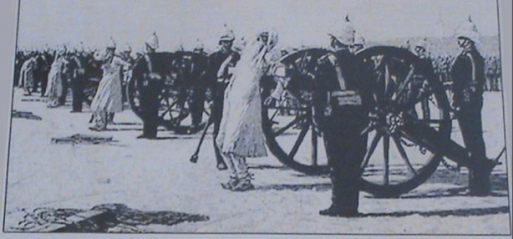
[A sketch of Maulvi Baqir’s execution. He and other scholars were tied to canons and were publicly blown away]
Maulvi Muhammad Baqir was a great advocate of Hindu Muslim unity. When in order to weaken the freedom struggle the British started to sow the seeds of discord among the public Delhi Urdu Akhbar challenged them. On 4 June 1857 Maulvi Muhammad Baqir warned the masses of the conspiracies of the British and appealed to them to remain united. ‘Remember whoever misses this opportunity, falls prey to the tricks and is thumped by the inducements, tricks, and promises or is overwhelmed by the pomposity of the British, he is destined to face embarrassment in this world and the hereafter. No remorse will be of any help then and everyone will have to repent.’
.
By Laiq Rizvi
History of the Freedom Struggle is a live and self-narrating tale of dedication and selfless sacrifices. No one knows how many mothers lost their sons, how many women got widowed and how many spent their lives in prison cells and died there in the struggle to get their motherland freed from the clutches of slavery. Urdu writers too played active and leading role in this struggle. Pens became the swords and words banners of expression. The first name among those journalists who did not hesitate in sacrificing their lives for their country’s liberation by all means is that of Maulvi Muhammad Baqir, editor of Delhi Urdu Akhbar.
An sketch of Maulvi Baqir. He was tied to a canon and was publicly blown away.
A sketch of Maulvi Baqir’s execution. He and other scholars were tied to canons and were publicly blown away.
Maulvi Muhammad Baqir came from a respectable and educated family of Delhi. His father Maulana Muhammad Akbar Ali was a known Shi’a scholar and a known Mujtahid of his time of Delhi.
After finishing his religious education Maulvi Muhammad Baqir went to Delhi College for further education. After completion of his education he took up several jobs such as teaching at Delhi College and as a Tehseeldar in the Revenue Department but that was not his final goal.
In 1836 when the Government, after amendment in the Press Act, allowed publication of newspapers, he entered the field of journalism that became his art and identity.
In January 1837 Maulvi Muhammad Baqir launched weekly Delhi Akhbar. After Jam Jahan Numa of Calcutta this was the second Urdu language newspaper in the Indian sub-continent and first in north India. This newspaper survived for about 21 years during which its name was changed twice. On 3 May 1840 it was renamed as Delhi Urdu Akhbar while on 12 July 1857 Delhi Urdu Akhbar was renamed after the Mughal Emperor Bahadur Shah as Akhbar-al-Zafar. And then its ten last issues came out with this name.
Delhi Urdu Akhbar is the pioneer and founder of National Urdu journalism. Maulvi Muhammad Baqir used and introduced modern technology in the newspaper and shaped it to meet and fulfil contemporary demands. He focussed on news creating interest and newsworthiness in headline and newswriting and classified the news items. The section for Court (government) news was headed as ‘Huzoor-e-Wala’ while [East India] Company’s news was carried under ‘Sahib-e-Kalan Bahadur’.
In order to get latest news he had developed a network of authentic and reliable waqa-e-nigar [narrators or correspondents] who had access to higher authorities.
Delhi Urdu Akhbar was the proclaimer of the feelings of the nation. That was the period when there was no political party in the country. In such an atmosphere the newspaper played vital and leading role in creating political awakening in the masses and uniting them against the foreign rulers. It ignited the love of freedom and gave the courage and confidence to rally against the British Raj. An official report of 1853 described it as a wide-mouthed and outrageous newspaper.
Soon after the start of freedom struggle it became a freedom fighter itself. The fire of Freedom that got ignited in Meerut on 10 May 1857 helped Mujahideen [freedom fighters] reach Delhi by 11 May. Following this started a series of events of the magnitude that shook the ground underneath the feet of the Britishers. Maulvi Muhammad Baqir responding to this call to freedom was busy doing jihad with his pen. In its report of 17 May 1857 Delhi Urdu Akhbar carried a detailed report of the advance of Mujahideen. Following is an excerpt from the report.
’11 May 57 AD, due to the summer weather court proceedings were being held in early morning. Saheb Magistrate was busy presiding in the court room… At about 7 am Bridge In charge came and informed, “Some Turk soldiers have gone on a violent spree and started beating us. They wanted to plunder the collected revenue. Under some pretexts I engaged them in chatting and ulocked the barrage so that they could not advance further. They have burnt down the Revenue office and Saheb’s Bungalow at Sleempur Road.” As Saheb became thoughtful for a while and then stood up and went to Col Magistrate who was holding a session in the adjoining room. After some ghitpit [chatting in English] he went to the Treasury Room and in consultation with the Treasury Officer secured the treasury and ordered the treasury guards to get ready. As per order they loaded their guns and stood in a stand by position. Security was also deployed at the Jungi Darvazah at Kachehri. It spread panic in the court room and its staff. Then with that information Magistrate Saheb went to the Commissioner. In the meanwhile rumours said that the Turk riders had gathered under the Jharonka of the Fort… A little later reports were heard that Qiladar, Bade Saheb, Dr Saheb and maim log [English ladies] had been killed at the gate and the riders had managed to enter the fort. His Lordship, wearing the ritual turban and an English sword also came to the court.
‘Initially these were few riders who came to the city and slaughtering the Britishers in Daryaganj, setting fire to the bungalow sent Dr Chaman Lal to the real Darul Shifa [killed him]. They were later joined by more riders and voices were heard and [rumours] that such and such British had been killed here and another such and such is lying killed there.’
In addition to eyewitness report about Delhi this issue also carries the news of freedom struggle from various parts of the country including Meerut, Saharanpur, Lucknow and Ambala. Reporting the causes of the revolt it reads, ‘There was already discontentment among Turk Riders and the fact that cartridges are greased with pig fat and tallow… For refusing to carry orders 85 soldiers have been imprisoned and on Monday inspired by religious spirit [Islam] and the zeal to defend religion flared up. All of a sudden all those in the platoon and the riders, in whatever state they were, took up their arms and freed their brethren from the jail and attacked the platoon and the whites.’
In order to encourage freedom fighters Maulvi Baqar commended them strongly and persuaded the masses to cooperate with them and participate in their struggle. Such stimulating writings may be seen in several issues of Delhi Urdu Akhbar. ‘This gallantry of yours and the courage and zeal with which you have shattered the perversity of such a strong and arrogant empire and have humbled its Pharaoh like ego and Shaddad like pride will be remembered in channels of history…and you have relieved the masses of India from the unseen curse that had fallen upon them.
‘O my countrymen, Rule has changed; time has changed. System and management of government has changed. Now you too should change your habits, get rid of easy life style and your love for comforts that you have been accustomed since your childhood. Reform yourselves. Discard your habit of carelessness and fearfulness and embrace courage.’
Delhi Urdu Akhbar did not carry Maulvi Muhammad Baqir’s byline but researchers are of the opinion that most of the writings came from his forceful pen. At times Maulana Muhammad Hussain Azad also gave a helping hand to his father. The issue of 24 May 1857 includes his poem Tareekh-e-Inqalab Ibrat Afza [History of change is a lesson] that enthused in masses a new spirit and zeal. Some of the verses are:
Hai kal ka abhi zikr keh jo qaume nasara thi
Saheb-e-Iqbal o jahan bakhsh jahandar,
Allah hi Allah hai jis waqat keh nikle
Aafaq men taigh-e-ghazab Hazrat Qahar,
Sab jaohare aqal unke rahe sab taq pe rakhkhe
Sab nakhun tadbeer-o-khirad ho gai bekar,
Kaam aaee na ilm-o-hunar hikmat-o-fitrat
Poorab ke tilangoN ne liya sab ko yahan maar.
This forceful and armed resistance shook the British badly. In order to intimidate the masses notices from officials were displayed at various points. Maulvi Muhammad Baqir reproduced the text alongwith a strong and well-argued rebuttal. To defeat the British he uses their own phoney claims:
‘They [the British] call themselves the protectors and custodians of their subjects. Therefore it is incumbent upon them to return the trust, i.e. India back to the Indians unchanged and unaltered.’
Delhi Urdu Akhbar linked journalism to social issues as well. [Political] Situation coupled with the conspiracies of opportunists would lead to the shortage of food items and commodities of daily use. [Hence] Dishonest shopkeepers started charging prices as they pleased. It also created a situation of loot [illegal profiteering] and hoarding. Delhi Urdu Akhbar showed the mirror to those who were involved in such activities like this:
‘Shopkeepers of the city have gone on a rampage of high handedness and are behaving in a very cruel manner. With regard to cereals and other essential items people are suffering as most of the commodities are not available and if available then they are very expensive. In every market only small number of shops remains open and what remain open they present the [proverbial] scene of customers as ek anar sau beemar [one pomegranate for one hundred patients]. Similarly cereals [sold] are rotten and other commodities are of inferior quality. But hunger is powerful and lacks mercy and desperation worsens the situation. Helpless customers have no choice and buy whatever is available thinking it a blessing.
‘Because of this profiteering and black market masses are worried and confused. Be they the city dwellers or the outsiders most of them have resorted to plundering and the power and writ of police stations has become nil… The city is being looted. Many disguised as soldiers indulge in extortion and loot.’
Maulvi Muhammad Baqir was a great advocate of Hindu Muslim unity. When in order to weaken the freedom struggle the British started to sow the seeds of discord among the public Delhi Urdu Akhbar challenged them. On 4 June 1857 Maulvi Muhammad Baqir warned the masses of the conspiracies of the British and appealed to them to remain united. ‘Remember whoever misses this opportunity, falls prey to the tricks and is thumped by the inducements, tricks, and promises or is overwhelmed by the pomposity of the Christians [the British], he is destined to face embarrassment in this world and the hereafter. No remorse will be of any help then and everyone will have to repent.’
By the beginning of September 1857 when Mujahideen became weak and started facing defeats, somewhere along the lines Maulvi Muhammad Baqir also started losing heart. The issue of 13 September 1857 reflects this and this proved to be the last issue [of Delhi Urdu Akhbar]. Maulvi Muhammad Baqir was arrested for revolt and without being tried, on 16 September 1957 was tied to a canon and was publicly blown away in front of the Khooni Darwaza. But this martyrdom strengthened the ongoing freedom struggle and sharpened the resolve of Mujahidana zeal of Urdu journalism. Contemporary publications and later newspapers and magazines followed the same national spirit and the mission to fight for liberation that had been set by Maulvi Muhammad Baqir.
Maulvi Muhammad Baqir’s newspaper had played a key role in igniting the spirit and courage in his fellow countrymen to fight for freedom. Any description of the freedom struggle will always remain incomplete without mentioning this brave and selfless Urdu journalist. Garabchand Chandan writes, ‘The short comments in Delhi Urdu Akhbar criticised the nepotism of the British, inefficiency of its police and bad practices of government departments. Therefore this newspaper did a tremendous service in creating an environment for and in providing complete information about the great rebellion of 1857.’ (Urdu Sahafat, Urdu Academy, Delhi, Page 88)
Delhi Urdu Akhbar was part of a mission. It was not launched for financial gains or fame and recognition. After paying for the expenses whatever return remained Maulvi Muhammad Baqir used to distribute it to help the poor. Its issues from January 1840 to September 1841 are available in the National Archive. In 1843 Maulana had also launched a religious magazine Mazhar-e-Haq that lasted until 1848.
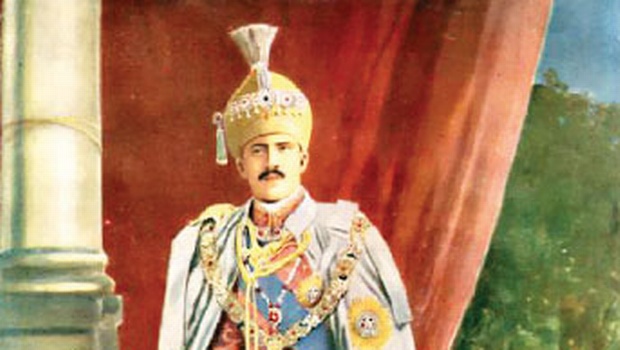
His name was Mir Osman Ali Khan Siddiqi. He used a 185-carat diamond worth $200 million for a paperweight, had enough pearls to pave Piccadilly Circus and a stable of horses that would’ve put Godolphin to shame.
His ancestor Mir Qamaruddin Khan started a dynasty on behalf of the Mughals on July 31, 1720, which ended in a sheep farm.
Qamaruddin Khan was Hyderabad’s first Nizam—Urdu for Administrator of the Realm— and Osman Ali Khan was the 7th and last Nizam who has been declared the world’s richest Indian ever—after adjusting his wealth to current inflation figures. In the 1940s, his fortune was estimated to be $2 billion, which was about 2 per cent of the US economy while Independent India’s annual revenue then was only $1 billion.
The British gave him the title of His Exalted Highness because of the taxes he paid to the Empire—his main palace had 6,000 staffers. The only job 38 of them were entrusted with was dusting chandeliers.
The world’s richest Indian was also an enigma: the Nizam was so stingy that he wore the same fez cap for 35 years, wore crumpled pajamas, ate off a tin plate and smoked cigarette butts, refusing to buy even one fresh pack all his life.
His treasury would have put to shame the wealth of the richest oil sheikh: hundreds of millions of pounds worth of gold and silver overflowing in his coffers as well as jewels worth £400 million. He had a prodigious appetite for sex, and had one of the largest private pornographic collections in the world—using hidden cameras inside his zenana and private guest quarters.
Before he died, he sired children from 86 mistresses in his harem and had more than 100 illegitimate children. He also left behind a legacy of legal disputes with hundreds of descendants fighting over money and real estate.
By the 1990s, claimants to his wealth had gone up to 400 legal heirs. Of the Nizam’s 34 children, two sons and three daughters are still alive while there are a total of 104 grandchildren.
The most helpless of all of them is Prince Mukarram Jah who was nominated by his grandfather, the 7th Nizam, to succeed him: he didn’t think his sons deserved to be ruler after his death.
Unfortunately, His Exalted and Imperial Highness Rustam-i-Dauran, Arustu-i-Zaman, Wal Mamaluk, Asaf Jah VIII, Muzaffar ul-Mamaluk, Nizam ul-Mulk, Nizam ud-Daula, Nawab Mir Barkat Ali Khan Bahadur, Sipah Salar, Fatah Jang, Nizam of Hyderabad and Berar, Imperial Prince of the Ottoman Empire and Honourable Lieutenant-General, or simply, Mukarram Jah lives as a frail old diabetic in Istanbul, amidst memories of untold wealth, expensive ex-wives and 14,718 courtiers who bled his inheritance dry.
Of his life in Australia as a sheep farmer decades ago, an aide told an Australian newspaper that “Jah loves to be surrounded by court jesters, just like the maharajahs of the past”.
The remains of his inheritance lie in NatWest Bank, London—£1m deposited by his grandfather in 1948. Now the money is worth almost Rs 3 billion.
When the 7th Nizam deposited the money, the future of Hyderabad was at stake. India wanted Hyderabad to be part of the Union, but the Nizam was inclined to make Hyderabad part of Pakistan—like an Indian West Berlin in the 1940s.
As Mir Barkat Ali Khan remained in a state of indecision, his finance minister Moin Nawaz Jung, who was in charge of the money—£10,07,940 and nine shillings— signed it over to H I Rahimatoola , Pakistan’s new high commissioner in London.
The Indian government came down on the Nizam with all its newly acquired might and forced him to cable Westminster Bank to freeze the account. In September 1948, the Indian Army formally annexed Hyderabad.
The British government converted the money into war bonds and subsequently turned it into a fixed income deposit as it remains to the day.
National Westminster Bank, now incorporated into the Royal Bank of Scotland, refuses to release the sum unless all three parties—India, Pakistan and the Nizam’s heirs—come to an agreement.
The Nizam’s heirs have wanted the foreign ministers of both India and Pakistan to sort it out when they met in Islamabad in September, but they were disappointed.
Nawab Najaf Ali Khan, the other grandson of the seventh Nizam, had even written to President Zardari seeking help. India has offered an out-of-court settlement, but Zardari has not been forthcoming. There is even a Nizam Family Welfare Association.
In 2008, they met Prime Minister Manmohan Singh and then foreign minister Pranab Mukherjee to help them. They are also pressuring the Pakistan government to initiate a dialogue with the Indian government. If the dispute ever gets resolved, the money would be shared between all three as India was owed crores of rupees in back taxes.
Meanwhile, Mukarram lives in penury in a small Istanbul apartment.
He and his brother Muffakam Jah share a London lawyer—Allen & Overy— in a case against NatWest; at one time, he was so poor he couldn’t afford legal fees. Mukarram wasn’t as prolific as his grandfather, but he had married five times only, including a former Miss Turkey who was his third wife.
Turkey has a karmic link with the Nizam—his mother and his first wife Princess Esra were Turkish. So was his last wife, Princess Orchedi.
In the 1980s, when he was moving to raise sheep in Perth, he met and married Helen Simmons, who died of AIDS later.
The third wife was Turkish. The match was arranged by his Turkish aide, Demir Bukey, who was sent to Istanbul with $100,000 to find him a bride. Bukey introduced Manolya Onur, whom the Nizam married in 1990 because on their first meeting in Istanbul, she seemed to him as a woman who “might open a station gate”.
The marriages and subsequent divorces cost him a lot of money in alimony—Esra got alimony of £12 million.
It’s thanks to Esra who returned to India a decade ago with her two children, that the Nizam’s royal residences—Chowmahalla and Falaknuma—were renovated and a semblance of order was brought to the accounts.
Legal wrangles have cost the once flamboyant Mukarram dear: when the Indian government forced the Nizam’s trustees to sell the famous jewels in lieu of tax, the price the court fixed for it was only £43m, lower than the £230m the Nizam’s family had estimated. Mukarram’s share was £13m, but he did not get the money thanks to litigation by his grandfather’s illegitimate dependants.
Mukarram faces 800 writs from relatives—legitimate and illegitimate—who are challenging his entitlement for the privileged share in Nizams’ private estate. In the end, he got Rs 218 crore for the jewellery.
Mukarram’s inheritance originally included one of the world’s most expensive jewellery collection, starting from the 18th century to fin de siècle 20th century. The collection comprised 173 jewels that include over 25,000 diamonds, Colombian emeralds, diamonds from the Golconda mines, Burmese rubies and spinels, pearls from Basra and the Gulf of Mannar. The diamonds alone weigh over 12,000 carats; 2,000 emeralds weigh over 10,000 carats; and pearls exceed 40,000 buddums—the Satlada, the seven-stringed Basrah pearl necklace which has 465 pearls embedded in it is a legendary piece of jewellery.
Mukarram would already have known that his grandfather was the world’s richest Indian ever. In the small Istanbul flat he shares with his fifth wife Princess Orchedi, does he remember his own words to a journalist, “I’m not supposed to have financial problems… I’m supposed to have good advisers.” It seems a fitting epitaph to one of the most legendary royal treasures of all time.
source: http://www.newindianexpress.com / The New Indian Express / Home> Magazine / by Anika Mohla / October 21st, 2014
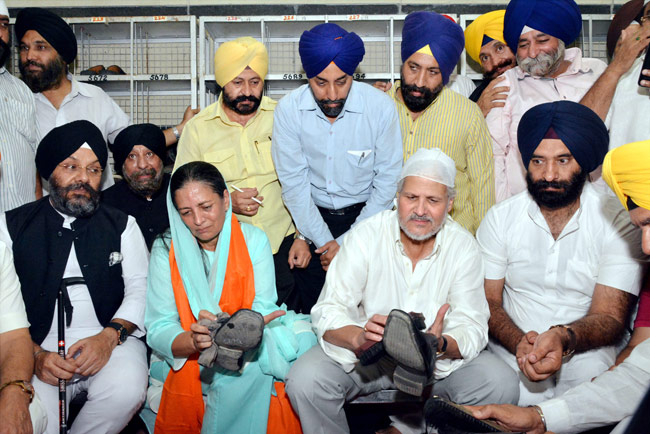
Delhi Lt Governor Najeeb Jung at the Bangla Sahib Gurudwara (Photo: PTI)
Taking Prime Minister Narendra Modi’s Swachh Bharat mission forward, Delhi Lt Governor Najeeb Jung on Thursday morning visited the Bangla Sahib Gurudwara and performed kar sewa.
The Lt Governor, who was accompanied by his wife Ameena, polished shoes of devotees as part of the kar sewa at the gurudwara in the heart of the capital.
Kar sewa, which translates as a form of selfless service, is a Sikh ritual.
“A clean India was the vision of Mahatma Gandhi and government has done a symbolic gesture by starting the drive today to make it come true. The cleanliness drive in Delhi is a five-year mission and will go on till 2019,” Jung said.
“I request the government, municipal bodies, hospitals, and the people to make combined efforts to keep Delhi clean. Let cleanliness become a habit,” the Lt governor said.
Describing polishing shoes as a “humbling experience”, Jung said he wanted to visit the gurudwara since a long time and this is the reason he chose it to launch the campaign.
Jung was also given a tour of the temple’s heritage museum where he interacted with the staff.
“My message to public is that India is a secular country and that I feel very happy coming to this place of worship,” he said.
source: http://www.indiatoday.intoday.in / IndiaToday.in / Home> India / New Delhi – October 02nd, 2014