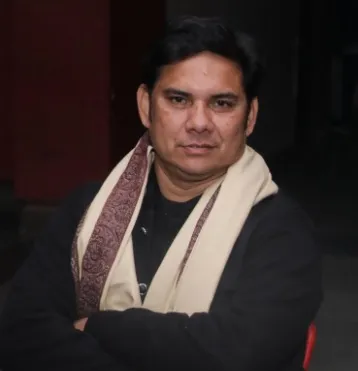
Abid, a painter, puts immense effort to help bring back stranded people to India, the act which brings cheers to the families. He has mastered the skill, how to deal with embassies, journalists, officials and celebs to raise each issue and bring back the lost person.
Syed Abid Hussain
Bhopal:
A man has been quietly helping Indian citizens caught in difficult circumstances in countries across the world for years.
Known for lending a helping hand to any family whose kin is trapped far away, he uses all his links and puts energy into the efforts to bring the person back home.
Syed Abid Hussain has mastered the skill to deal with the bureaucracy in different countries and with the use of social media, reunites such people with their families.
By profession, Abid is neither a bureaucrat nor a politician, who has contacts and departments to follow their instructions but he is just a painter and single man army.
And even not being associated with any government organisation, he has so far helped hundreds of people stuck in countries spread over the Middle East, West Asia, Europe and other parts of the world. Abid keeps getting calls and messages from families who have their kin caught in a country and even those whose whereabouts are not known.
The ‘Mesiah’ has developed a style of his own to resolve these cases. Whether it’s the case of a person who is untraceable or has been kept unlawfully by someone in a foreign land, Abid uses social media, particularly Twitter, to bring focus on the disappearance of the person or his plight. He tags officials of the particular country, their embassies and the Indian Embassy.
He also messages prominent personalities of the particular country, including peaceniks or activists, film actors, journalists and urges them to raise the issue. Subsequently, it comes in media in those countries, gets attention and opens the door to the person’s return.
During the Russia and Ukraine crisis, he helped dozens of youth to return with his efforts.
“I don’t have a strong financial background but I never take a penny for this work. It’s just for the sake of humanity and social work”, he says.
The number of people Abid helped bring back to the country is uncounted now. “I don’t do it for any number or statistics, I stopped counting, the figure is more than 500,” he says. “Whenever I get a call I start working on the mission. I feel that the victim’s family must not get depressed and lose hope”, he adds. One of the first cases that brought him nationwide attention was when he helped the family of a missing boy, Kailash Arjunwar.
“I found through a newspaper report about Kailash, who is from Madhya Pradesh that he had somehow overstayed on the other side of the border and was caught, and kept in jail. I began my efforts. After a long process, Kailash was rescued with the help of the foreign ministry. I constantly kept raising his issue until it got resolved”, he recalled.
Recently, Abid helped get 12 people from a country in West Asia to return to India. These people, Harendra Ram, hails from Siwan (Bihar), Jai Soorat (Ghazipur), Dharmendra Kumar (Deoria), Sheetal Singh (Kapurthala), Husan Lal (Jalandhar), Surendra Verma (Sant Kabir Nagar), Ved Prakash (Kushinagar), Hardas Prakash (Ghazipur) and Shiv Locahn of Mau along with others were reunited with their families.
From yet another country, he helped bring 48 persons back to India, in January. A painter by profession, he was born in Faizabad, UP.
Abid, 38, says that when he started helping people stuck in foreign lands, he came to know about a lot of factors, especially how some people who are less educated are fooled by their employers or agents who take them to those countries but they end up working as bonded labourers sometimes & are even not allowed to contact families.
When Abid comes to know about a family that has a person ‘lost’ in a country, he takes documents and contacts the government, foreign ministry, the particular country’s consulate and embassies in both countries. Mostly he manages to get them returned. Former Minister for External Affairs Sushma Swaraj also used to know him for his efforts. Sandeep Kumar, who was helped rescued by Abid recalls, “Our company had promised a job in the construction sector. After paying money to the agent, we were cheated.” “Our families told Abid bhai, who started the campaign because we couldn’t do anything. He also ran a hashtag to save us and this led to action (return),” says Sandeep, who is thankful to the activist for his role.
In the case of Babar Ali, who was stuck in Mozambique, the family approached Abid. “Babar was promised a big salary but when he reached there, he was not paid and made to work 18 hrs daily apart from harassment and torture”, said his family members. “He made a video and managed to send it. Then Abid took up the case and the Embassy acted, bringing Babar back”, a family member mentioned.
Abid has been felicitated many times and got awards too for his work.
Abid has been affectionately called ‘Bajrangi Bhaijan’ because of the movie and the similarity of his work with the Salman Khan starrer Bollywood flick.
source: http://www.enewsroom.in / eNews Room India / Home> Freshly Brewed> Madhya Pradesh / by Shams Ur Rehman Alavi / February 02nd, 2023
The cemetery and those who lie buried in the soil of time and fate are the witness to the the lost romance, their epitaphs bear a testimony to a history of prose and poetry.
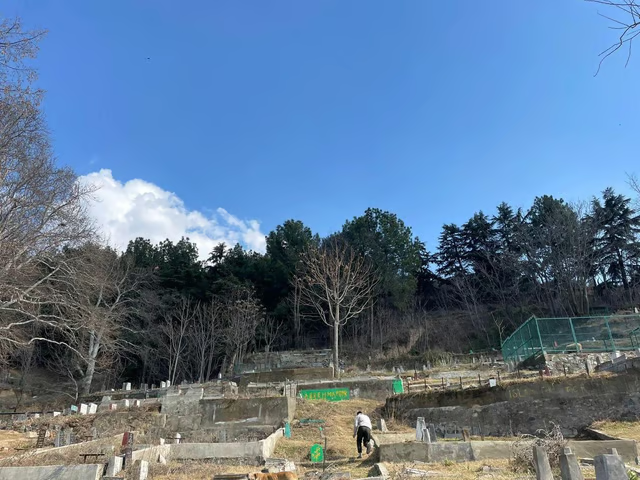
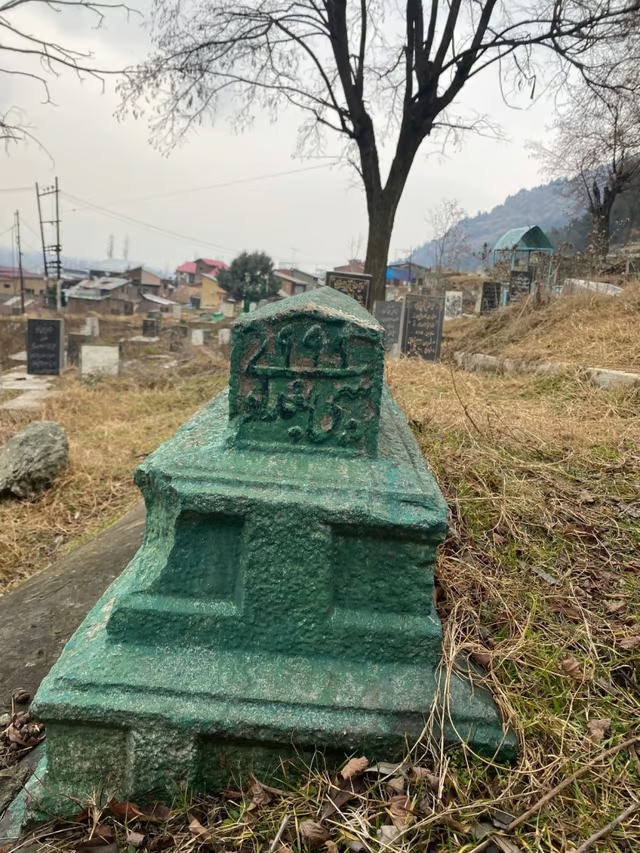
The forgotten poet cemetery of Kashmir / Photo: Shakir Mir / Internet
خاک میں کیا صورتیں ہوں گی کہ پنہاں ہو گئیں
(In the soil- what faces must be hidden)
Beauty finds its way at odd places; away from the flamboyant commotion of Boulevard, far from the amorous colours of Zabarwan and distant from the prospects, perspectives and spectre of present. Beauty finds its way at odd places: along the sombre shores of the lifelessness, in the weed, litter and rubbish of a graveyard, the withered tombstones of a cemetery,
The Cemetery of the Poets
The cemetery and those who lie buried in the soil of time and fate are the witness to the the lost romance, their epitaphs bear a testimony to a history of prose and poetry.
Laala tooram, na humchoon ghuncha gulboo zadaem
Shaula jae bakhya bar chaak-e-gereban meezenam
(I am the Tulip of Sinai and not the bud borne of a rose
To my torn collar, I apply the needle of my fire to stitch it)
Cries out poet Mazhari, having penned down 6000 Persian verses throughout his travels from Iran, Khorasan, Hindustan to Kashmir, but now lost in graves and indifference of another necropolis, Malkhah.
Founded in year 1587 C.E during by the Mughal emperor Akbar, the cemetery of poets, also called Mazar-e-Shoara is situated along the banks of Dal Lake. The burial ground for the once eminent poets seems to have been selected carefully to give the dead souls a serene eternal sleep. The historical records show that there were five poets and men of letters buried in the cemetery, all of them the eminent avant grade of Iran, associated with the literary upper class of Mughal court. However, as of today only three of the tombstones can be located in the mazar, rest covered in debris of time and apathy.
There seems to be some confusion regarding the first grave in the cemetery, largely appearing due to the mistakes in copying the previous historical accounts. In this regard the first reference comes from the great historian and author, Mohammad Azam Dedmari in his Waqiat-e-Kashmir. Dedmari was a scholar, researcher, and also a poet of his time and was born during Aurangzeb’s era when Abu Nasr was performing the duties of sobedar (Governor) of Kashmir. Therefore, due to his temporal proximity to the rule of Akbar and his other meticulous documentations, his record can be taken as more authentic.
According to him the great Iranian savant and scholar of his time, Shah Fatehullah had come from Iran to Deccan. According to M. A Alvi and Abdur Rahman’s seminal work, “Fathullah Shirazi: The great Indian scientist of 16th century” and Mohammad Akmal Makhdum’s, “A Great Man: Shah Fateh Ullah Shirazi”, Fatehullah was brought up in Shiraz and learnt under great teachers like Kamal-ud-din Masood Sherwani and Khwajah Jamaluddin Mahmud, a disciple of the logician Jalal-al-din-Davani. Shirazi furthered his knowledge in medicine, mathematics, and science under the instruction of Mir Ghayasuddin Mansur. After completing his education, Shirazi embarked on a career in education in Shiraz. Among his notable students was Abdul Rahim Khan-i-Khanan, who served as the close confidant of the Mughal Emperor Akbar. In 1583, Shirazi received an invitation from Mughal Emperor Akbar and subsequently joined the imperial court in Agra.He soon earned the title of Amir and a rank (mansab) of 3000. Two years later, in 1584, Akbar appointed him as the Amin-ul-Mulk, also known as the Trustee of the State.Shirazi’s first task was to reexamine and rectify the Mughal Empire’s vast transaction records, which he accomplished with diligence and success. Along with his administrative work, Shirazi also undertook the task of regulating the intrinsic and bullion values of coins. He identified and corrected discrepancies in the currency, ensuring its reliability and trustworthiness. Shirazi’s skills and talents also earned him various honors and titles. In 1585 and 1587, the emperor selected him to lead diplomatic missions to the Deccan, where he was recognized for his efforts with the title of Azud-ud-Dawlah, or the Arm of the Emperor. He also received a horse, 5000 rupees, a robe of honor, and the office of the Chief Sadr of Hindustan.
A great poet, he also made significant contributions to the fields of philosophy and logic, particularly in his work, Takmilah-i-Hashiyah. Additionally, he played a crucial role in compiling the Tarikh-i-Alfi, a thousand-year history of Islam, demonstrating his vast knowledge in the field of history.
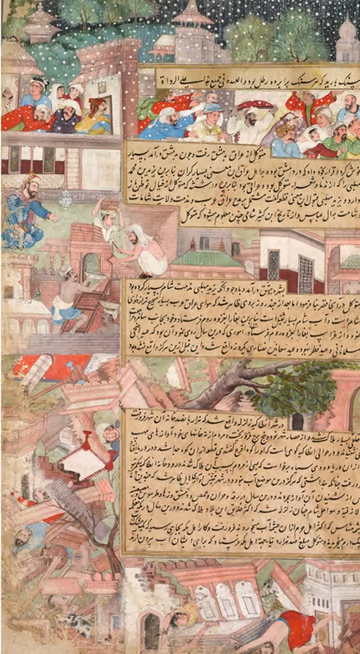
Page of disasters, from Tarikh-i-Alf
One can try to estimate the scholarship of Shah Fatehullah by the brief introduction Abul Fazal (Grand Vizier of Emperor Akbar the Great) writes about him. Abul Fazal being a royal minister and himself a great scholar did not recognise anybody at par with his own scholarship, but about Shah Fatehullah he writes:
“if all the books of all the subjects and sciences and crafts are destroyed then Shah Fatehullah, with his scholarship and knowledge, and with his memory, will create a parallel new library of books.”
Emperor Akbar mourns his death in following words:
“Had he fallen in the hands of Franks and had they they demanded all my treasures for him, I would gladly have entered such profitable traffic and brought the jewel cheap”
Shirazi was a great inventor and is credited with numerous innovations like improved cannons and guns, wagon mllls, mirrors that would make far things appear closer, travelling baths etc.
Two references are made to the death of Shah Fatehullah by Kashmiri scholars, one by Dedmari who says that he developed Typhoid and self treated it by over-eating Harisa. Another reference is made by Hassan Kuehami in his Tareekh-e-Hassan in which he refers to him (probably mistakenly) as Shah Abu Fateh and cites tuberculosis as his cause of death. The mistake (viz a viz name) seems an error while copying from Waqiat-e-Kashmir, where a poet called Mir Abu Fateh is mentioned immediately after Fatehullah, whom Kuehami seems to have skipped and probably mixed with the former. The location of his burial is mentioned atop Takht-e-Sulaiman, in Mazar-e-Shoara.
M.A Alvi and Abdur Rahman refer to Abdul Qadir Badaoni’s, Muntakhab-ut-Tawarikh, which narrates a story similar to that of Dedmari in which Fathullah Shirazi dies because of over-eating porridge made of meat while having an episode of febrile illness. But there is a very important historical fact that is referred to in this version. According to them Fathullah was buried on koh-e-sulaiman, in the monastery of Sayyid Ali Hamadani. However, today we do not know any such monastery that exists on koh-e-sulaiman (or takht-e–sulaiman). So could this be reference to the lost monastery of Sayyid Ali Hamadani’s student Mohammad Ismael Kubravi which is historically known to exist around the same place. It was a matter of reverence to teachers that the students would name their schools and shrines after them. The great scholars would be buried in graveyards adjacent to these monasteries. So, is the location of the Mazar-e-Shoara the place where the monastery of Mohammad Ismail Kubravi actually stood?
(The lost monastery has a history of its own, allegedly destroyed by Chak rulers, the location where it stood has been a centre of academic debate in archaeological and academic circles.)
Cemetery
Second grave in the cemetery is of Haji Jan Muhammad Qudsi Mashadi popularly called Qudsi Mashadi. He was a native of the Mashhad in Iran. He joined the court of the Mughal emperor Shah Jahan where he rose to become Malik-al-Shura (poet laureate). It is said that Mughal empire had Qudsi weighed in gold, which was then presented to him as a reward for his poetic excellence. On the occasion of the installation of the famous Peacock Throne in 1635, for example, Qudsi composed a dedicatory chronogram that was cast in glazed tile and inserted inside the throne canopy. Qudsi wrote several topographical poems as well, the most famous of which is his description of the journey to Kashmir.
When his son Mohammed Baqir died in the prime of his youth in Mashhad, Qudsi was heartbroken and decided not to go back to his native land but remain in India. Later he settled permanently in Kashmir. His works includes the poetical composition Zafarnama-yi Shahjahani, devoted to the king’s conquests, containing some 7000 rhymed couplets, and covering the first fourteen years of Shah Jahan’s reign and is by far Qudsi’s longest work, though it remained incomplete at the time of his death it was later completed posthumously by Kalim Kashani; a mathnawi entitled Wasf-I Kashmir. The poet remains buried in the Mazar-e-Shoara.
The third poet lying at rest in the graveyard is Abu Talib Kaleem. A native of the Persian city of Hamadan when Abu Talib Kaleem heard about Qudsi’s reception at the court of Shah Jahan, he was perturbed and said, “The man who was to be held by neck, it is strange, was weighed in gold”. He travelled Deccan and other Indian cities and later became a courtier of the Emperor at Shahjehani Darbar. Kaleem soon attained fame as a poet. The great Urdu poets Sauda and Mir Taqi Mir have written Tazmeens (poems formed by inserting verses from another’s poem) of his ghazals. Kaleem was assigned the task of writing a history of the Mughals, Padshah Nama or Shahnama Shaham Chugtia, in poetic form and sent to Kashmir so that he could do his work undisturbed. Hw wrote qasidas and mathnawis about every important event of his time, be it the fight of young Aurangzeb with an infuriated elephant, the famine in Deccan or his visit to a paper mill in Kashmir. He also composed a poetic chronicle sahgihannama Like Qudsi, he was a great admirer and friend of Ghani Kashmiri who wrote an elegy on his death (in 1650 C.E) in which he also remembered Qudsi and Saleem as great and noble poets. In the elegy he compared his friend to Moses ‘Kalimullah”, the pen being his miraculous rod, and gives chronograph of his death in the line:
The Sinai of inner meaning became radiant by Kalim
The fourth poet, another native of Iran, Mohammed Quli Saleem went to India in the reign of Shah Jahan. He joined the court of the prime minister Nawab Islam Khan. He was a man of high poetic calibre and is famous for his works ‘mathnawi-qadha-wa-qadar’ and another mathnawi in praise of Kashmir. Saleem was accused by the Iranian poet Sa’ib of plagiarising his poetry. During his stay in Kashmir he fell ill and passed away to be buried in the cemetery of the poets.
The last poet buried in the graveyard is Tughra Mashadi. Nothing is known of Tughra’s childhood and youth, other than that he probably was born in Mashad. Tughra moved to Mughal India and the court of Jahangir towards the end of the latter’s reign. During the reign of Jahangir’s successor, Shah Jahan, Tughra joined the court of one of Shah Jahan’s sons, Murad Bakhsh, and accompanied him on the Mughal campaign in Balkh (1646). Although unsuccessful, this campaign is nonetheless commemorated by the poet as a victory in his panegyric to Murad Bakhsh, Mir’āt al-futūḥ (Mirror of victories), which appears near the end of the present collection. Tughra subsequently settled in Kashmir, where he lived in a shop at Rainawari on the banks of Nayidyar canal, where he died in solitude. Tughra composed verse in all the popular forms of Persian poetry, but he is most famous for his prose works known as risālahs (epistles) which include Risālah-ʼi Firdawsīya and Mir’āt al-futūḥ.
Every grave in the cemetery has thousands tales to tell. Every epitaph bears signs of a glorious past. However, today the cemetery, just like our past, lies in shambles, withered and perishing.
References:
Waqiat-e Kashmir by Muhammad Azad Dedmari
Tareekh-e-Hassan by GH Khuehami
Muntakhab-ut-Tawarikh by AQ Badyuni
The Islamc literature of India by Annemarie Shimmel
Haji Jan Muhammad Qudsi by Prof. Zia-i-Ahmad
Fathullah Shirazi: A Sixteenth Century Indian Scientist by MA Alvi
A Great Man: Shah Fateh Ullah Shirazi by MA Makhdum
Encylcopedia Iranica
source: http://www.outlookindia.com / Outlook / Home> Culture & Society / by Khawar Khan / October 06th, 2024
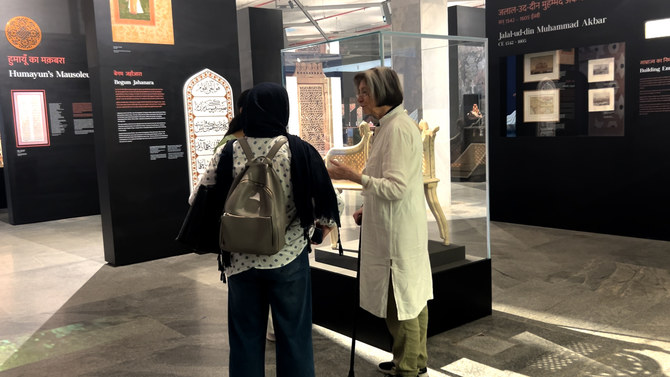
Humayun World Heritage Site Museum in New Delhi opened for visitors on Tuesday
Latest addition to 16th-century tomb complex ‘brings alive 700 years of heritage’
Visitors look at artifacts at the Humayun World Heritage Site Museum — the newest addition in Humayun’s Tomb complex — in New Delhi on July 29, 2024. (AN Photo)
The second Mughal emperor Humayun was widely known as an avid reader fond of journeys, architecture, and storytelling. Almost half a millennium after his death, a new museum in the heart of New Delhi highlights his role in shaping India’s cultural heritage.
Opened for visitors on Tuesday, the Humayun World Heritage Site Museum is the newest addition in Humayun’s Tomb complex — a landmark 300-acre area in New Delhi’s Nizamuddin that features dozens of historical monuments and includes Sunder Nursery, a 16th-century heritage park.
The advent of the Mughal dynasty, which ruled the Indian subcontinent between the 16th and 19th centuries, marked the global revival of Islamic architecture, with works that until today are examples of the highest quality and refinement.
Originally from Central Asia, the Mughals carried cultural elements borrowed from Arabs, Persians and Ottomans. As they settled in India, they fused these with the various local styles found in their new domains.
Humayun was the son and successor of Babur, founder of the dynasty, and ruled the empire from 1530 to 1540 and again from 1555 until his death the following year.
The new museum, established by the Agha Khan Trust for Culture and the Archaeological Survey of India, traces Humayun and his descendants’ lives, as well as the 700-year-old history of the whole Nizamuddin locality and its influence on Indian culture.
“There are hundreds of stories to be told, which the stones don’t speak,” Ratish Nanda, conservation architect and projects director at the AKTC, told Arab News. “The idea is to bring alive 700 years of heritage.”
The museum is located in Humayun’s Tomb, a UNESCO World Heritage Site, and the first of the grand mausoleums that became synonymous with Mughal architectural innovations and, three generations later, culminated in the construction of India’s most iconic monument, the Taj Mahal. About 7 million tourists from across India and abroad visit the complex every year.
“The idea is that people who now visit the World Heritage Site come with a deep understanding of the site,” Nanda said.
“We’ve been able to … combine architectural elements with incredible manuscripts, miniature paintings, calligraphy, textiles, coins, metalware, architectural elements — one is two one scale — with lots of films and digital technology, and models and so on.”
Spanning five galleries, the underground museum has over 500 artefacts sourced from the collections of the National Museum in New Delhi, ASI and AKTC.
“It captures the 700 years of history that is associated with the region of Nizamuddin and the World Heritage site of Humayun’s Tomb …This museum really captures the history,” said Ujwala Menon, AKTC conservation architect.
“The principal gallery talks about Humayun. There’s very little known about this emperor, and one of the things with this museum is to really address that … Then we have a second section of this gallery which talks about the personalities that are associated with Nizamuddin.”
Among the famed figures featured in the second gallery are Nizamuddin Auliya and Amir Khusro. Auliya was an 13th-century Indian Sunni Muslim scholar, Sufi saint of the Chishti Order, and is one of the most famous Sufis from the Indian subcontinent. His shrine and tomb are located near Humayun’s complex.
Khusro was a 13th-century poet and scholar who remains an iconic figure in the culture of the subcontinent.
Both Auliya and Khusro lived during the period of the Delhi Sultanate, which Humayun’s father conquered, leading to its succession by the Mughal empire. The museum shows how the empire did not come to its bloom in a cultural vacuum, but drew from and incorporated the culture of its predecessors.
“There was this idea of pluralism that existed during the Mughal period,” Menon said. “And this (museum) really captures all of that.”
source: http://www.arabnews.com / Arab News / Home> World / by Sanjay Kumar / July 31st, 2024
A phrase in Kannada “murthi chikkadaru keerti doddadu” meaning icon looks short but performance is enormous, goes well with M. Sadulla, a great personality of Islamic literature in Kannada.
One of the pioneers of the popular Kannada weekly Sanmarga published from 1978, Sadulla was its manager and publisher till he breathed his last on 22nd August 2022.
Around 5 feet tall, M. Sadulla was born in 1945 in the Kandak area of coastal city Mangalore. He was the third son of Abdul Jabbar Ibrahim and Mariyamma. He lost his father at a young age.
He had his primary education at Badriya Educational Institution and matriculation from Rosario Educational Institution with distinction.
Sadulla began his professional career as an Accountant. He was a student of Moulana Syed Yusuf, the Imam of Kachi Masjid in Bundar area. Under his guidance, he learnt Quranic studies, Islamic jurisprudence, Arabic, and Urdu.
In Kandaka area, his father Abdul Jabbar was popularly known as Ijjabaka; he was a great admirer of Syed Abul Ala Maududi, the founder of Jamaat-e-Islami. Ijjabaka was the first person to translate Fatiha, the first chapter of the Holy Quran from Urdu into Kannada. Sadulla resolved to follow in his father’s footsteps.
During that time, there was a noticeable lack of Islamic literature in Kannada. To fill this gap, Sadulla not only translated works from Urdu and Malayalam into simple Kannada but also contributed original articles. Unlike his peers, he did not take much interest in public debates or speeches. However, anyone met him personally was impressed with his simplicity, integrity and depth of knowledge in various fields.
He contributed significantly to the translation of the extensive Urdu commentary Tafhim-ul-Quran and Sahih Bukhari, and other hadith collections like Dari Deepa (Guiding Light). Two of his original works, Namaz Shafi’i Krama and Kannada Kaliyiri (Learn Kannada) are very popular and published multiple times. He translated around 30 works into Kannada. Dari Deepa, the hadith collection, has reached thousands of people, transforming many lives of Muslims and non-Muslims alike.
Sadulla was known for his simplicity, discipline, minimal talk, and high productivity, always wearing a gentle smile. His special qualities included excellent office management, patience, courage, generosity, and keeping calm even under pressure. He never let anything bother him and always remained content with what he had.
Despite being a profound scholar of the Quran and Hadith, he used to attend the Quran and Hadith classes of other scholars seriously, listening attentively.
Sadulla was very meticulous about the Quranic knowledge. Even when he was unwell, he would listen carefully as family members read it, correcting their mistakes if any. He couldn’t tolerate even minor mistakes in Quran recitation or references, and was keen on immediate corrections.
He was like a ready reckoner of the Quran. Anyone could call him to inquire about any issue related to the Quran, and he would promptly provide the answer, satisfactorily.
source: http://www.radiancenews.com / Radiance News / Home> Features > Latest News / by Radiance News Bureau / September 24th, 2024
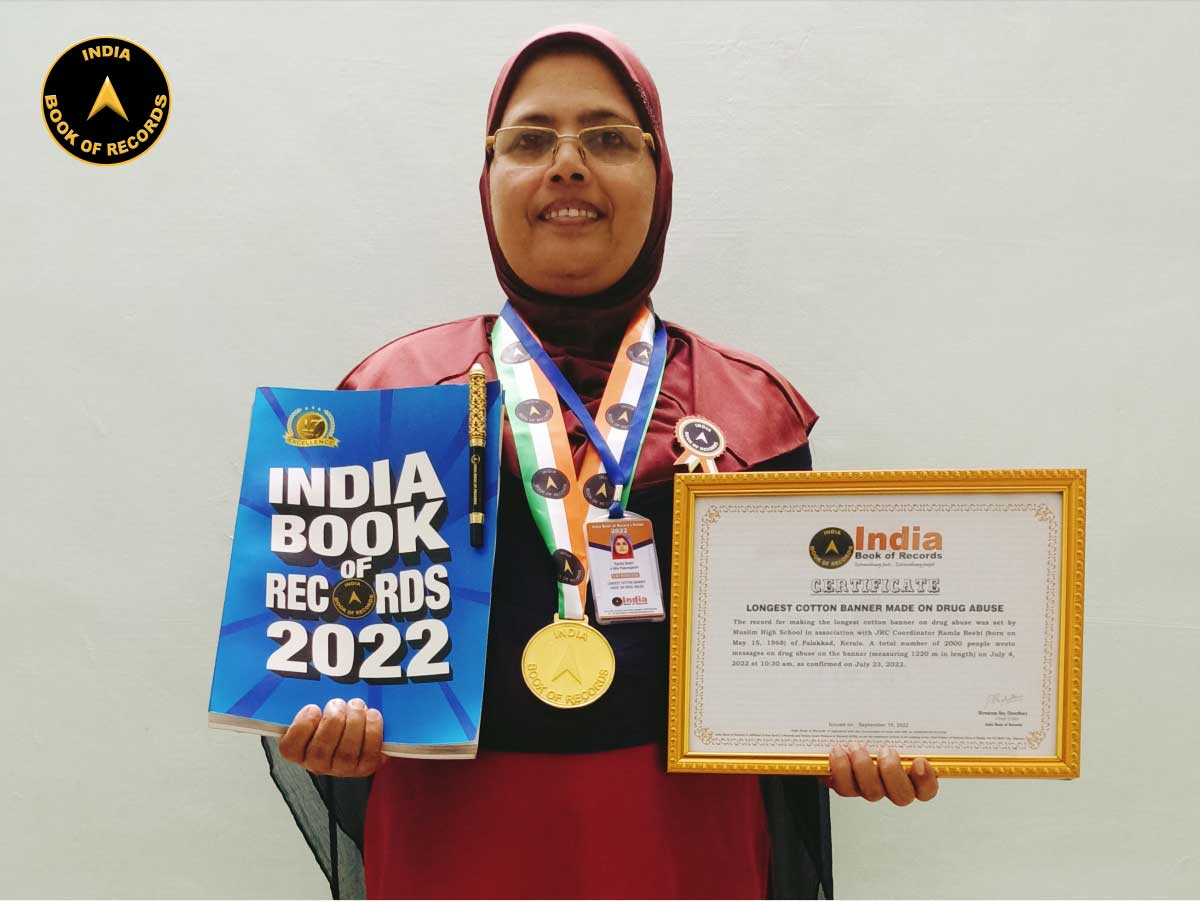
The record for making the longest cotton banner on drug abuse was set by Muslim High School in association with JRC Coordinator Ramla Beebi (born on May 15, 1968) of Palakkad, Kerala.
A total number of 2000 people wrote messages on drug abuse on the banner (measuring 1220 m in length) on July 4, 2022 at 10:30 am, as confirmed on July 23, 2022.
source: http://www.indiabookofrecords.in / India Book of Records – IBR / Home> Culture & Creativity / by ibr editor / November 01st, 2022
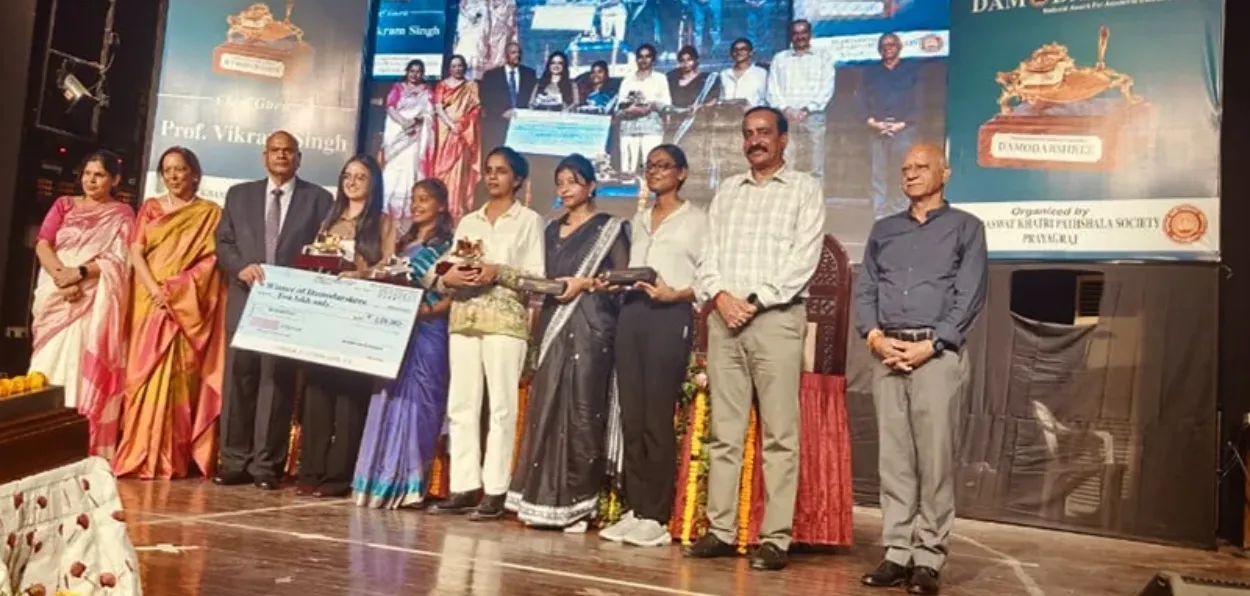
Areeba Anwar, an undergraduate student of the Department of Biosciences, Jamia Millia Islamia (JMI), has won the prestigious Damodarashri National Award for Academic Excellence 2024.
Her essay on the topic “Victory Will Be of Human Spirit” emerged as the best among participants from across the country. The Prayagraj-based SS Khanna Girls Degree College, affiliated with Allahabad University, has been giving away this award for 15 years.
This year, more t2,000 participants submitted their essays in the competition, out of which only 10 essays were selected for the final round.
Areeba Anwar’s essay not only featured in the top 10, but was also declared the winner for the best undergraduate essay across the country.
The award comprises a cash prize of Rs 30,000, a memento, and books worth Rs 5,000.
The award is given every year in a function on October 2. Areeba Anwar represented the university in the competition organized under the aegis of Literature, Fine Arts, Quiz and Debate Club under the DSW (Dean Students Welfare) office of Jamia Millia Islamia.
Before leaving for Prayagraj for the final defense of the essay, she presented her essay and discussed her ideas with Dr. Rumi Naqvi, a member of the Sahitya Club. Dr. Naqvi gave her important suggestions to make the essay stronger.
This 5,000-word essay by Areeba Anwar underlined the resilience of the human spirit. She explained how this spirit is important not only for our survival but also for the development of the nation.
Her essay was adjudged the best among 2,003 essays received from central universities, making her eligible for this prestigious award. This achievement is a proud moment for both Ariba Anwar and Jamia Millia Islamia, a testimony to the academic quality of the institution and the creativity of the students.
source: http://www.awazthevoice.in / Awaz, The Voice / Home> Story / by posted by Aasha Khosa, ATV / October 09th, 2024
The development of Urdu prose and journalism and the parallel agenda of social reform in 19th-century Hyderabad played a vital role in setting the ground for the emergence of the Progressive Writers’ Movement a few decades later. The aims and objectives of the Progressive Writers’ Movement (PWM), which began in the 1930s in North India, resonated with students, poets, writers and scholars in Hyderabad. The PWM urged writers and poets to organise and break away from the hackneyed tropes, themes and genres of classical, romantic poetry that had dominated the literary milieu of Hyderabad and were associated with great cultural capital. Instead, the PWM wanted to create a new, more meaningful aesthetic that would represent changing political and social conditions and confront the material realities and experiences of everyday life. Apart from class struggle and class injustice, which was a major concern for the PWM, progressive writers also stressed the need to fight for political freedoms, resist political repression, and forge grassroots connections with the people 1.
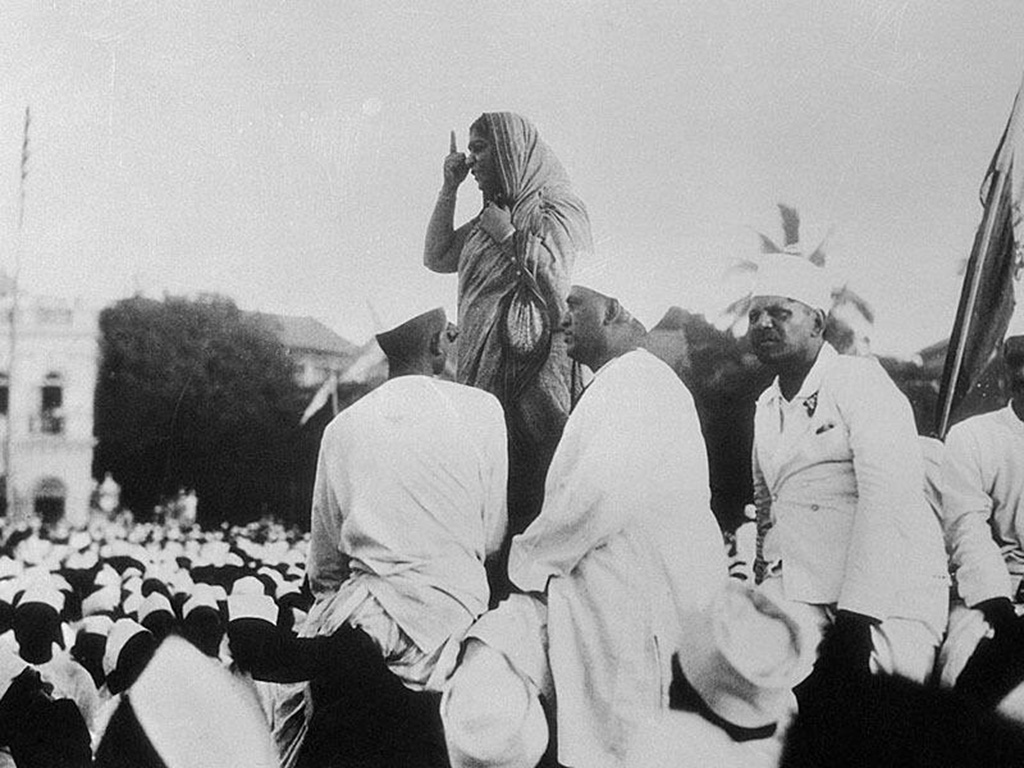
The Hyderabad chapter of the Progressive Writers’ Association (PWA) was established by Makhdoom Mohiuddin along with Akhtar Hussain Raipuri and Sibt-e-Hasan in 1936. Sarojini Naidu offered her home, The Golden Threshold, as a venue for PWA gatherings and, later, for meetings of the banned Communist Party of India (CPI) 2. Among the women writers, journalists, intellectuals and activists associated with the PWA in the 1940s and 1950s were Jahanbano Naqvi, Zeenath Sajida, Rafia Sultana, Azeezunnisa Habibi, Brij Rani, Jamalunnisa Baji, her sisters Razia Begum and Zakia Begum, and Najma Nikhat. Amena Tahseen emphasises that the period after 1936 was critical for the history of women’s writing in Hyderabad because although women had been publishing their work, forming associations, and leading and participating in social, educational and literary initiatives for decades before the formation of the PWA, these endeavours were limited largely to women’s gatherings alone 3. The PWA changed this forever, and women began to attend and participate in literary and intellectual gatherings which had previously been restricted to men only.
Sarojini Naidu’s first collection of poems, named The Golden Threshold was published in 1905. (Photo: Getty Images)
The most vivid example and description of this shift comes from Jamalunnisa Baji’s autobiography, Bikhri Yaadein (Scattered Memories; 2008), which not only documents and assesses the political and literary events that took place in Hyderabad over the span of almost a century, but also furnishes information and reflection on what these events meant to women like Baji. Pardah is an important preoccupation in this account. Baji had long considered it her bane but had been unable to give it up. She describes how her younger sisters—who had had more freedom than her, were better educated, and were allowed greater choice in choosing their partners—had discarded the pardah at a young age. Literary gatherings with the leading Progressive figures of the day began to take place in Baji’s house in the 1940s on her and her brother Akhtar’s initiative. She had always been interested in literature and politics and was supported by parents and siblings who had an apparently insatiable appetite for education and literature. This drew her all the more to discussions that were happening beyond the curtain that separated her from gatherings where her sisters and other women who did not observe pardah, listened and spoke 4. Such gatherings offered her the opportunity to gradually emerge out of pardah.
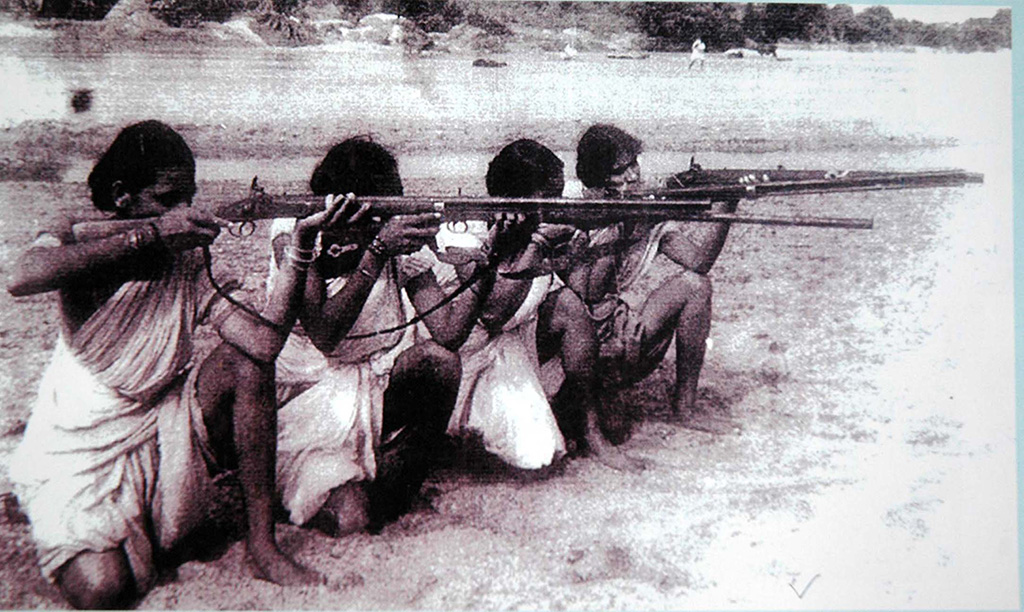
The Telangana people’s armed struggle. (Photo: People’s Democracy)
The Progressive writers and the Telangana People’s Struggle
Between 1946 and 1951, the rural districts of Telangana had risen against the feudal structure of the Hyderabad state and the oppression it had wreaked on peasants and agricultural labourers for generations. The struggle began organically, with a tenant cultivator named Chityala Ailamma refusing to hand over her harvest to the landlord’s men. Within a few months, however, the Communist Party entered the fray and began to operate under the aegis of the Andhra Mahasabha, which had been formed in 1930 to champion the cultural and social rights of Telugu-speaking people. At its height, the Telangana People’s Struggle involved three million people from 3,000 villages 5. The struggle also made its way to the cities, as factory workers and students protested and went on strike. Many Progressive writers also identified as communists and were active members of the CPI. As the people’s struggle intensified in Telangana, the CPI was banned in Hyderabad and many PWA members had to go underground. So,
PWA meetings began to take place at Baji’s house at night, which was less conspicuous than the Golden Threshold, Sarojini Naidu’s house, and offered better cover to the likes of Makhdoom, who was well-known and easily recognised.
Baji formally discarded the pardah during the All-India Progressive Writers’ Conference in 1945, which was held in Hyderabad. She, her sisters, and one other woman were the only women to sit in the open with the men 6. What enabled the participation of a large number of Hyderabadis, especially women, in the Progressive movement was the PWA’s approach right from the start to not limit their membership to committed socialists 7. To be sure, there was always a core group of socialist writers at its centre, but the only expectation from all member writers—irrespective of ideological persuasions—consisted of them sharing the basic agenda of the manifesto, i.e. to build a sturdy organisation of writers who opposed reactionary social tendencies and stood for a literature rooted in reality. Indeed, so successful was this broadly defined manifesto that there were many writers who would not fall easily into this category if it had been ideologically restricted, but who nonetheless identified as Progressive and were closely connected with the PWM.
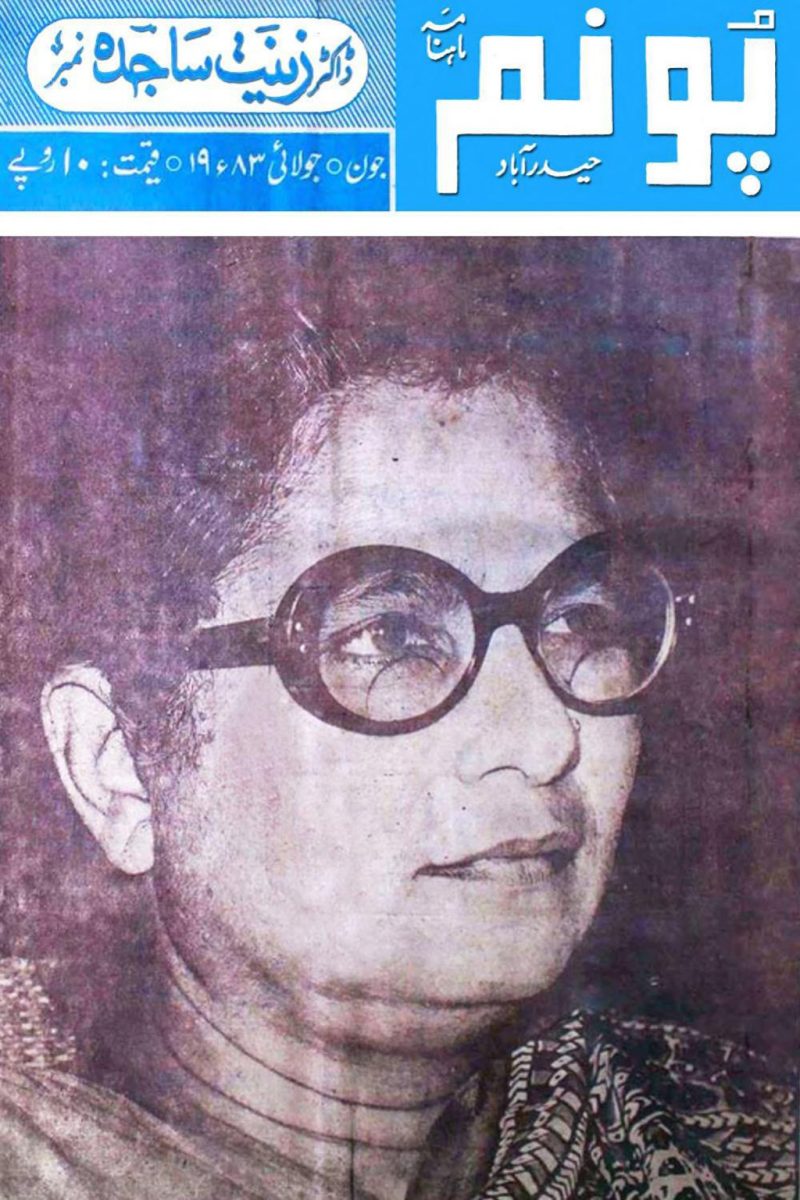
Dr. Zeenath Sajida on the cover of Poonam, Urdu monthly magazine in Hyderabad. (Photo: archive.org)
Zeenath Sajida (1924-2009) and a thriving culture of women writers
Zeenath Sajida was one such figure who dominated the literary and cultural circles of Hyderabad. She is a good example of a Progressive writer who not only wrote works criticising social injustices and exposing the hollowness of middle-class values, but also those that were less political and consisted of humorous essays as well as classic, romantic short stories. Sajida was most prolific in the decades spanning the 1940s to the 1960s, publishing an anthology of short stories in 1947 and several academic manuscripts on literatures of the Deccan. But the most fascinating literary writings she produced consisted of her essays in the genres of tanz-o-mizah (humour and satire) and khaake (pen-portraits), which were published in different newspapers and literary magazines and compiled only after her death in 2009. They cover subjects as varied as the gendered perspectives and lived experiences of women from different walks of life, critiques of social manners and everyday human folly, and nuanced documentation of the history and heritage of her beloved Hyderabad.
In the most political and radical of these texts, Sajida artfully and rigorously debates provocative social questions and taboos while disguising them in the genre of inshaiye or light sketches.
In these, she shows herself to be far ahead of her time, writing about things that we know today as gender fluidity, gender privilege, the mental load of women in relation to household management, the invisibility of domestic labour, and the unfair and unrealistic demands made of middle-class women professionals.
These essays also reveal the narrator’s most disarmingly vulnerable thoughts, feelings, and frailties; in the process, Sajida emerges as a writer who knows how to use emotion to extract both empathy as well as laughs from her readers.
There was a thriving culture of women writers of humour, satire and pen-portraits in Hyderabad right from the 1940s, which both received individual and institutional support from male writers and scholars and was also subjected to ridicule by them 8. Sajida’s work marks the best of this tradition of women’s non-fiction and is important to read and know also because non-fiction is generally neglected in favour of fiction and poetry, which have greater cultural capital; have come to form well-defined and durable stereotypes of Urdu literature; and, thus, capture the attention of translators, scholars and publishers alike.
Among Sajida’s younger contemporaries were Jeelani Bano (b. 1936), Najma Nikhat (1936–1997), and Wajida Tabassum (1935–2011). Nikhat was a writer of short stories whose loyalty and commitment to the PWM exceeded the heyday of this organisation. Like Sajida, although Nikhat produced a relatively modest number of short stories, her oeuvre demonstrates skill and is important for its sustained engagement with her lifelong preoccupations and concerns. Her stories about life in the feudal deodis of Hyderabad are insightful and instructive in establishing how women of both working as well as upper classes lived and negotiated feudal patriarchy and the conservative social world of princely Hyderabad. She also wrote hopeful stories about the revolution and depicted the lives of the poor in the rural districts of Telangana and Andhra, where she lived for many years.
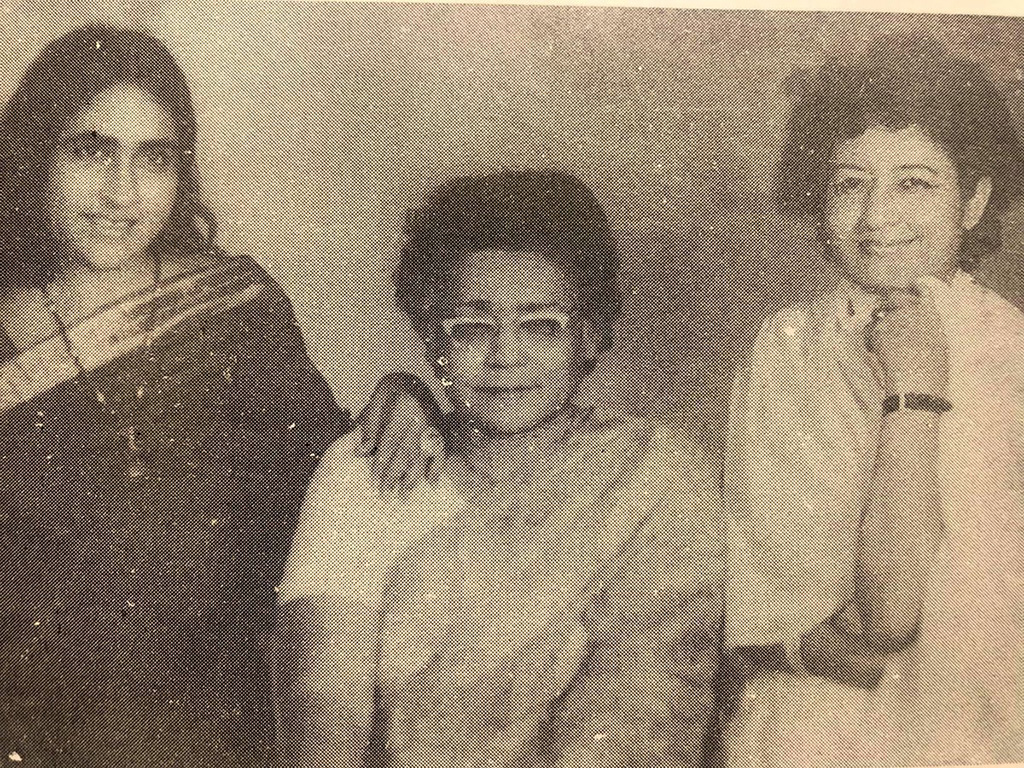
A rare picture of R-L Qurratulain Hyder, Ismat Chughtai and Wajida Tabassum – known names in Urdu Literature. Twitter- FaseehBariKhan
Wajida Tabassum is understood today to be more of a feminist than an avowed Progressive. This is because she writes defiantly and unselfconsciously about female sexuality, caste patriarchy and sexual violence against women in feudal homes.
Although her many novels and short stories were successful and popular and the latter, in particular, are enjoying a resurgence of interest among youth after the Me Too movement, many Hyderabadis, including scholars, look down on her work as “obscene” and “unjust” towards the feudal aristocracy 9.
The “shock value” of Tabassum’s approach often belies her profound and nuanced understanding of the precise workings of culture and society towards concentrating and maintaining power in a few hands. Until recently, only a couple of Tabassum’s stories were available in English translation.
Other continuities
Over time, the PWM—its ideology and aesthetic—acquired a hegemony that ensured the marginalisation of writers who did not consider themselves Progressives. This became a big problem when in the tension between the “creative section” and the “political section” of the PWA (Progressive Writers’ Association), the latter prevailed, and this often resulted in didactic writing dominated by socialist themes and motivations 10. The ambivalence and even disenchantment of writers in other places towards the PWA, which increasingly adopted a rigid, even conservative stance towards the choice and treatment of themes employed by its members, is well known 11. But given that it had such a compelling social message, an influential platform, and an overarching visibility and influence, it is understandable that many women writers would continue to operate under the aegis of the PWA and utilise its many resources.
Other writers who did not subscribe to Progressive writing often represented literary and cultural continuities that were desirable and significant in other ways. After 1948, Urdu had been relegated to a secondary place in Hyderabad, and its resources and institutions were severely undermined by the minoritisation imposed by the new regime. Despite this, nuha, marsiya, azadari and salaam, traditional poetic genres that belong to the Shia practice of Muharram, continued to be regularly published in magazines and newspapers and also performed in ashurkhanas. Other religious or mystical genres, such as hamd and naat, and ghazals, nazms, and qasidas that did not represent Progressive thought or aesthetics persisted too. Many women poets wrote and published in these genres. Additionally, nazms for children were very popular in Hyderabad, and women were enthusiastic proponents of this genre as well 12. Often, these engagements revealed completely different ways of engaging with social and political discourses from Progressive writing, as can be seen in the way the poet Syeda Bano “Hijab”/Hijab Bilgrami juxtaposed the battle of Karbala with the struggle for freedom from colonial rule 13.
New woman, new writing
The next major shift in Urdu literature came with jadeediyat or modernism in the 1960s, which turned the subject of literature inwards and focused on the psyche of the individual, allowing for much experimentation in genre, mode and language. Some of the short stories and novels of Jeelani Bano and Rafia Manzoor ul-Ameen are good examples of jadeediyat from Hyderabad. Both wrote short stories and novels about contemporary protagonists struggling with the human condition as well as a variety of issues associated with the modern state and society. They also produced scripts and screenplays for successful TV serials, documentaries and films.
Jeelani Bano
Rafia Manzoor ul-Ameen
Rafia Manzoor ul-Ameen is best known today for her novels, especially Alam Panaah (Refuge of the World; 1983) and Yeh Raaste (These Paths; 1995), and the immensely popular TV series that was based on the former text and whose screenplay she wrote too. Both novels fall in the genre of romantic fiction and testify to her craft with language, narration, plot, and pace. The most attractive feature of this writer’s work is her psychologically and emotionally complex heroines, who represent a new world after the transfer of power in Hyderabad, in which young women were stepping out of the ostensible “protection” of the zenana, seeking education, professional employment and financial independence, and negotiating a society that did not appear to be prepared for their entry and often openly expressed its disapproval. These novels also offer multifaceted commentary on the social culture and ethnography of groups associated with Hyderabad and the Nilgiris respectively.
The significance of Jeelani Bano’s modernist writing can be appreciated from PWA co-founder Sajjad Zaheer’s comment in a letter to Sulaiman Areeb, editor of Saba (Hyderabad), that as long as Jeelani Bano is in Hyderabad, they need not worry about the Naya Afsana (New Short Story), a genre that had picked up pace in Urdu-Hindi literature in the 1950s and focused more on the inner state of the individual subject than on the external world or its ideological preoccupations 14. Over more than 50 years of writing, Bano’s nationally and internationally acclaimed short stories span three identifiable schools of Urdu literature: taraqqi-pasand adab (Progressive writing), jadeediyat (modernism), and tajreediyat (abstractism), although she has consistently refused to declare her affiliation or identification with any of these schools, explaining that there are many influences in her work and that she seeks only to represent the world around her and does not adhere to any particular ideological position.
Although some of Bano’s work has been admirably translated into English by Zakia Mashhadi, her two novels have not been given their due by English-language readers and scholars. Aiwan-e-Ghazal and Baarish-e-Sang represent the most serious and rigorous engagement with the history of princely and post-princely Hyderabad in creative writing. While the former narrates the lives of four generations of an aristocratic family against the backdrop of transformative change during and after the transfer of power, the latter represents the lives of landless tillers and labourers tottering under the weight of crushing debts in the rural districts of Telangana. Both texts offer rich and sombre insight into urgent questions of class and gender and offer a remarkable degree of depth where class, in particular, is concerned.
Radio continued to be an important medium for women’s voices in Hyderabad after the transfer of power, and the work of most Progressive writers in Hyderabad (and elsewhere) as well as those who did not subscribe to this category remained in demand. Among the many women who wrote for All India Radio (AIR) and read out their stories and essays were Zeenath Sajida, Najma Nikhat, Fatima Alam Ali and Badrunnisa Begum. Another vital development for women’s literary culture was the establishment of the Mehfil-e-Khawateen (Women’s Gathering) in 1971 at Urdu Hall (f. 1955), which became a flourishing platform for Hyderabadi women writers. Women poets of Progressive and other persuasions, such as Azmat Abdul Qayyum, Azizunnisa Saba, Ashraf Rafi and Muzaffarunnisa Naz, were instrumental in founding and running the Mehfil over the years. Monthly meetings and annual events are conducted and are well attended. The association also publishes an annual magazine.
Life-writing and auto/biography
Another important feature of Hyderabadi women’s writing in Urdu is an enduring affinity for different forms of life-writing. While Jamalunnisa Baji’s autobiography is the richest example, meaningful deployments of auto/biography emerge also in other genres that demonstrate a strong element of self-construction and self-performance, usually through first-person narration. The travelogues of Sughra Humayun Mirza and the humorous essays and pen-portraits of Fatima Alam Ali (1923-2020) are a good example of this trend. Fatima Begum grew up in an environment suffused with literary, political and intellectual discussions in the 1930s and 1940s, for her father was Qazi Abdul Ghaffar (1889-1956), the immensely popular and admired Progressive editor of Payaam. Her humorous essays were published in Siasat from the 1960s to the 2000s and also read on AIR. Some of them were compiled into a book called Yaadash Bakhaer (May God Preserve Them; 1989), which also furnishes a selection of her pen-portraits of the poets and scholars she knew. These portraits animate in words the rich and potent milieu of the mid-20th century and vividly perform and re-create the development of Fatima Begum’s own subjectivity.
Fatima Alam Ali (Photo: Scroll.in)
Finally, scholar and translator Oudesh Rani Bawa (b. 1941) writes a weekly column, titled Mujhe Yaad Hai Sab Zara Zara Sa (My Blurred Memories of Yesteryear), in the Urdu daily Munsif, where she engages with popular and historiographical narratives of the past, filtered usually through her memories and research on the material and linguistic heritage of Hyderabad. She also uses this column as a platform for her political and social critique, and has, most recently, begun to actively criticise local and national events, with respect to government policies, heritage and development, and growing right-wing intolerance and violence.
Hyderabad continues to have a thriving culture of humorous writing among women in both prose and poetry, besides other modes of writing, such as the short story, novel, novelette, plays and ghazals.
Stree Shakti Sanghatana, We Were Making History: Life Stories of Women in the Telangana People’s Struggle, New Delhi: Kali for Women, 1989, 3.
Jamalunnisa 2008: 103. Op. cit.
Ordinary Hyderabadis were suspicious of communists because they were all thought to be atheists. Ibid. 121).
Habeeb Ziya, who is a humourist herself and has compiled and edited a collection of Hyderabadi women’s humorous writings, reveals that Mujtaba Hussain, the most prominent and celebrated humourist from Hyderabad, had criticised her article on Hyderabadi women’s humour in the Siasat newspaper. He had wondered if men are supposed to sweep and mop, while women write humour in large numbers. Ziya Hyderabad ki Tanz-o-Mizah Nigar Khawateen. Hyderabad: Shagoofa Publications, 2005, 7.
See e.g. Ashraf Rafi, “Hyderabad ki Afsana-Nigar Khawateen,” in Tahseen 2017: 173.
Mir and Mir 2006: 28. Op. cit.
See Ayesha Jalal, The Pity of Partition: Manto’s Life, Times and Work across the India-Pakistan Divide, Noida: Harper Collins, 2013, 162–72; Jalil 2014: chapter 7; Mir and Mir 2006: 33.
Tahseen 2017: 136. Op. cit.
Riyaz Fatima Tashhir, “Hyderabad mein Khawateen ki Rasaai Shayari,” in Tahseen 2017: 219.
Mosharraf Ali, Jeelani Bano ki Novel Nigari ka Tanqeedi Mutala, Delhi: Educational Publishing House, 2003, 21.
Nazia Akhtar is an Assistant Professor (Human Sciences Research Group) at the International Institute of Information Technology (IIIT), Hyderabad (India). In 2017, she was awarded a New India Foundation fellowship to write a book on Urdu prose by Hyderabadi women. Bibi’s Room: Hyderabadi Women and Twentieth-Century Urdu Prose went into print in July 2022.
source: http://www.thethirdeyeportal.in / The Third Eye / Home> Praxis / by Nazia Akhtar / January 19th, 2023
The fifth in an exclusive series of essays to mark the 75th anniversary of India’s independence, by winners of the New India Foundation Fellowship for writers.
Fatima Alam Ali.
As India completes 75 years of Independence, it is important to ask: what is the place of women in its historical imagination? Where in the corridors of memory – official, scholarly, and popular – are the women of this country to be found? The lives of women, whose voices have at best been indifferently preserved, necessitate that we think differently to locate and retrieve these marginalised histories. This also applies to the way literary historiography treats women writers.
Let us examine these questions through the archive of Fatima Alam Ali (1923-2020), an Urdu writer who lived in Hyderabad and wrote non-fiction essays in the genres of khaaka (pen-portrait) and tanzo-mizah (humour and satire). These essays were published in newspapers or read out over All India Radio, and later compiled into a book.
When Fatima passed away two years ago, her literary drafts, scholarly research, and college notes were found preserved in diaries and re-used school notebooks. She was also a fastidious record-keeper and left behind several hisaab ki kitaabein – books of expenses.
The way Fatima organised and conducted her writing offers us glimpses into not only her writing process but the realities of her life – as a busy homemaker with a husband and three children, and as a respected and active member of social and literary organisations.
She wrote on every available paper surface, demonstrating middle-class thrift in the way she used the blank pages of school notebooks discarded by her children and nieces at the end of every school year. She re-used institutional diaries – a common practice in the subcontinent – disregarding the outdated calendar year printed in them and putting them to any purpose she wished.
She produced entire drafts of essays, speeches, and letters on the backs of calendars, wedding invitations, and grocery receipts. She wrote with regular pencil, colour pencil, fountain pen, and ball-point pen, in inks of different colour. She did not follow any particular system of filling one notebook or diary before moving on to another, but moved back and forth between different ones with no apparent pattern that I have been able to discern thus far.
She wrote draft upon draft of some essays across notebooks and diaries. Sometimes she used the same notebook or diary from both ends for the same or different purposes. What we learn about her from this flexible approach to pen and paper is how versatile she was with these possessions and their applications in her full and hectic days, both because of the weight of the mental load she carried and because it was cheaper and more responsible to re-use things.
Among her papers are the many hisaab ki kitaabein Fatima maintained conscientiously over a number of years in re-used school notebooks. These contain details of her homemaking and domestic activity as well as documentation of important personal and family events, alongside drafts of her essays.
In fact, it is clear from the way these expense books were used that they were meant to serve as multipurpose sites for documenting and recording meaningful things in relation to her professional as well as her personal and family life.
The varied contents of these expense books give us insights into the social culture and domestic economy of the period; the contemporary history of her family; and Fatima’s writing process and the circumstances in which she produced her work.
Even in its most basic definition, a hisaab ki kitaab is of great importance to a historian or a sociologist for a time when people relied on writing to keep domestic records, something the advent of digital technology has changed forever for many of us. No longer do we maintain the kind of meticulous handwritten accounts that we may once have done. After all, online statements and instant text messages from the bank tell us when and what we have spent on groceries or school fees.
Itemised invoices sent by retailers and organisations give us a breakdown of what we have bought or how much we have paid for any service. Note-taking apps and other digital organisers help us to make sense of our everyday transactions and track our needs and wants.
But much before the arrival of digital technology, in the decades after Independence – that golden period in the history of this country when women finally had broad access to education and writing – these written accounts of domestic economy give us indispensable insights into middle-class households, lifestyles, and aspirations.
How did women manage homes? Can we tell from these accounts and lists how much time they spent in homemaking, ie, planning, management, and execution? What does that tell us about the quality of their lives?
What were the items – food and other necessities, such as fuel or paper – that were regularly consumed in a home, and what can that tell us about social position, class, and caste affiliations? Can we learn something about the aspirations of a particular family and, perhaps, by extrapolation, a certain society at a specific period of time, by looking at these weekly, monthly, or annual accounts and lists?
What commodities were sparingly purchased? What were the occasions for which special items were ordered, and what can we tell about the age from the things that were considered grand or fashionable? Can we learn something broader about the state of the economy and its impact on individual households by comparing prices, quantities, and substitutions that may have been made over months or years? What kind of wages were paid to domestic help and other service staff? How many such domestic helpers were there, and what role did they play in the family? Again, what can we learn about a family’s social or economic status from these things?
In short, there is a world of information and insight waiting for the willing in these unassuming accounts. These records of expenses are metaphor and synecdoche for aspirations, anxieties, and lived realities. They embody and document the everyday realities, banalities, and priorities of women’s lives.
A hisaab ki kitaab also often contains other kinds of lists and information about dates, events, people, and places. Fatima’s expense books contain lists of wedding and travel expenses as well as lists of books to buy or consider buying, which help us to re-create both everyday moments and unique experiences in her life as well as those of others around her.
But the most extraordinary and poignant documentation in her expense books consists of a single date on an otherwise blank page, bookmarked by an open blue Reynold’s pen: 8.6.2002. The eighth of June in the year 2002. Written at the top right corner of the right page, the date is the only writing on those two facing pages. Several pages – perhaps fifty on either side – are left blank. The date is significant, although no outsider could possibly know what it may have meant or why it is there. Fatima’s daughter Asma Burney, however, recognised it immediately: it was the day Alam Ali – Fatima’s husband and Asma’s father – had died.
Fatima and Alam Ali had been married for 53 years, and she had privately recorded the date of their earthly separation. The significance of this moment is marked in the brevity of what is written on the page. No words are needed to describe what had happened.
Fatima writes the date and places an open (still functioning) pen to mark the page, in recognition of its import and the magnitude of her loss. The blank pages before and after the recorded date appear to gesture towards the nature of bereavement. With grown-up children and grandchildren living elsewhere, Fatima was unarguably the one most affected by Alam Ali’s death, and so in some ways her grief stands alone.
One is reminded of Helen Macdonald’s words in H is for Hawk (2014), her deeply moving account of losing her father and trying to come to terms with her grief. “It happens to everyone,” she explains. “But you feel it alone. Shocking loss isn’t to be shared, no matter how hard you try.”
That Fatima allowed this date to vanish among the blank pages around it – separated from her accounts and lists – suggests that her loss was so profound that it isolated her from the bustle and activity of everyday life. She lived through it alone, despite the presence of family and friends who rallied around. Life was not the same again, and perhaps such an inscription was part of acknowledging that reality and coming to terms with it on her own.
And yet, the ink still flows from the pen that marks the page. Fatima continued to write and was an active member of various literary and social organizations, writing letters, giving interviews, and attending literary gatherings almost up to the year of her passing.
For women writers like Fatima, a hisaab ki kitaab can go even further than documenting domestic economy and important events in the life cycle. It may start out with the intent of being used for one purpose alone. But soon, the overburdened mind of the busy homemaker gives in to the demands of the writer, who begins to intrude quite aggressively on the business of the day.
In fact, Hyderabadi writer Zeenath Sajida (1924-2009), whose life and work are explored in my new book, once wrote that women’s expense books represent the daily struggle they undergo to find time and space for themselves and their craft.
Zeenath was one of Fatima’s dearest friends. She writes that every homemaking woman has a diary, in which household accounts, laundry lists, and knitting patterns jostle for space with nazms and ghazals. This, she stresses, is the reality of not only women who write, squeezing their compositions between lists and expenses, but also women who may not write but still indulge their creativity by copying a sher or nazm that has caught their fancy.
What she refers to, of course, is what we today call the mental load of women, ie. the constant pressure on the homemaker’s mind of the all-consuming labour and management involved in making a home and caring for a family, while also trying to juggle a writing career from home and even perhaps keeping a full-time job. Women write in the margins of time and space – at “the edges of the day,” as a weary Toni Morrison once explained.
And indeed, amid the pages of Fatima’s own expense books, sandwiched between the relentless and hectic paraphernalia of everyday life, are welcome drafts of her essays, worked and re-worked, again and again, with faithful and constant rigour. These drafts tell us how much labour and planning went into essays which seem so spontaneous and natural in published form, belying the workings of the craft that went into their making.
They demonstrate to us also what a normal day for her would have been like: full of the work that goes into making a home, her mind would still be preoccupied with her essays, so that she would stubbornly write and re-write until she deemed them ready to see the light of print.
Fatima’s expense books are also excellent illustrations of the workings of mind and memory. After all, neither thought nor memory is linear: it rambles and is frequently fragmented, disjointed, and interrupted, organising thought, feelings, and sensibility in shifting and fluid ways.
There are quick shifts in content and register in Fatima’s expense books as she goes from recording expenses to documenting an experience of intense loss to contemplating the title of an essay. These multiple registers of language, thought, and sensibility illuminate different aspects of women’s experiences and subjectivities.
They perform as well as demonstrate the gendered making, maintenance, and transmission of personal and family memory among women. There is so much more, then, to these multipurpose diaries, which encapsulate a way of life when seen in their entirety.
It is rare to come across such records in official or public archives, betraying our collective lack of understanding of not only the importance of hisaab in itself as a source, but also the multipurpose nature of the hisaab ki kitaab.
Furthermore, archives are not only sites of memory, but also sites of power, representing forms of national, public, and collective remembering. They embody official and institutional positions about what is believed to constitute knowledge deserving of transmission, who can thus be validated as a legitimate agent of such deserving knowledge, and what textual materials, therefore, are considered worthy of preservation. The inclusion of women in these archives is limited and conditional upon these constraints.
The circumstances of women’s lives and the conditions in which they work call for a redefinition of the archive. The dense, multipurpose notebooks and diaries that Fatima and no doubt many other women of her generation owned demand other ways of looking at women’s histories and also women’s writing, ie, the process and conditions in which texts are produced by women.
What Fatima’s hisaab ki kitaabein bring to us is a world gone by, where educated middle-class women used writing to document and capture their everyday lives, experiences, and aspirations. With the advent of digital technology, this world is rapidly changing for many women of this demographic.
It remains to be seen how digital records of home-making will fare in the choppy tides of history. Whether these will even take the same shape is debatable. What would a digital archive of homemaking by a woman writer today look like? It has never been easier to keep accounts and lists using apps with increasing degrees of sophistication and convenience, but it has also never been easier to delete data or lose it forever to the vagaries of short-lived technology.
In an age where there is so much information saturation and quick shifts in digital technology, data and the vessels in which we put them are, by definition, ephemeral. They become rapidly obsolete, moving along and beyond the conveyor belt of our days. With the ease of classification and separation into folders and labels, will digital records demonstrate the overlaps and variety of registers that Fatima’s work demonstrates and which Zeenath reveals to us as the reality of home-making women who write? Or are our records going to be equally chaotic, as we move from one app or device to another, depending on where we are and what we are doing? The mental load of women, after all, remains the same.
Also, how would the absence of tactility and materiality affect what we can learn from this digital archive? The smell, texture, and sound of paper; the conditions and locations in which records are preserved; and the uniqueness of an individual’s handwriting – shifting and changing with age, health, mood, and other circumstances – are particular to the written page and document the circumstances in which texts are produced and preserved. The ease of digital reproduction smoothens an individual’s handwriting down to the uniformity and anonymity of a font on a screen, so that critical dimensions of the human experience are lost from the archive.
Accounts such as the hisaab ki kitaabein of Fatima Alam Ali are vital for the historian of modern India. Such sources unravel and unmoor standardized notions of both history and archive, demanding greater creativity and, therefore, more effort to interpret and understand.
They attest to an age when writing became an important and accessible technology for educated women to harness in the management of their lives as well as in the channelling of their creative expression and aspirations.
While magisterial didactic tomes of domestic economy, such as those of Sultan Jahan Begum of princely Bhopal or Isabella Beeton of Victorian England, are known and celebrated and have been used by historians and scholars to make sense of domestic economy, the more modest everyday offerings – often interspersed with literary writings – have been neglected and deserve the attention and regard of both the social historian and the literary historian. Only then can we write more inclusive histories that represent the experiences of women in this country.
Nazia Akhtar is a Fellow of the New India Foundation whose book Bibi’s Room: Hyderabadi Women and Twentieth-Century Urdu Prose has just been published by Orient Black Swan.
source: http://www.scroll.in / Scroll.in / Home> Literature & History> Hyderabad> / by Nazia Akhtar / August 16th, 2022
Yousuf Tekri is a bungalow built by Syed Yousufuddin Mohammed who was a Subedar during Nizam rule. This building was a farm house built during 1850’s which later served as a residence for his progeny.
Tolichowki:
This building is now in the list of heritage structures in Hyderabad and is being restored by the hereditary family Syed Mohammed Aliuddin grandson of Yousufuddin, and his great grandsons Syed Mohammed Najmuddin and Syed Mohammed Mawaheduddin are financing and restoring the building independently.
This building is beautifully constructed uphill, which gives a scenic view of the city which was all farm and isolated landscape, which is now a concrete jungle. Syed Aliuddin said “Yousufuddin was born in the city of Hyderabad and was appointed as an officer in the revenue services working for Asaf Jah VI, Mahbub Ali Khan. Yousufuddin was later entitled as a Subedar for Gulbarga District”.
The bungalow was built by Yousufuddin as a farmhouse as it was away from city back in those days, surrounding the area of about 290 acres. During land acquisition most of it was acquired by Indian Army and colonies were build, Yousuf Tekri colony is where our family lives. Now we are renovating the structure with plaster and cement, because preparation of lime takes much effort and time.
Syed Mohammed Najmuddin said “We are restoring the building independently there as is no financial aid from the government. In spite of being in the list of the heritage structure, government is taking no initiative”.
source: http://www.thehansindia.com / The Hans India / Home> News> Cities> Hyderabad / by Mayank Tiwari / Abhyudaya Ya Karamchetu / March 05th, 2015
Hyderabad, TELANGANA / SAUDI ARABIA / California, U.S.A :
Hyderabad:
Syed Burhan Badshah Quadri alias Salik, a well-known media person in the Kingdom of Saudi Arabia, lost a five-year long and painful battle with cancer in Santa Clara, California, the USA, on Thursday (December 22).
Burhan, as he was known among most of his friends, came from a traditional and elite family of Hyderabad. He was 74 years old.
His father Syed Kaleemullah Qadri was the last Subedar of Hyderabad of the Nizam era. After the Police Action of 1948 he was arrested and released after some time. After he was reinstated he worked as head of several departments before his superannuation.
Burhan is survived by his wife Shahnaz and four children–two daughters and two sons.
Burhan after completing his bachelor’s degree with the Nizam College had joined Nizams Sugar Factor as a management trainee and moved over to the Kingdom of Saudi Arabia somewhere in the mid-seventies.
Within few years of him arriving in the Kingdom, he became one of the topnotch executives from India. He worked with several companies and finally began his own advertising agency Zee Ads which counted many major companies among its clients. He was one of the few Indian executives in the Kingdom at that time who owned a BMW and lived comfortable, if not luxurious, life. The company had to be closed down owing to some managerial issues. From there started the next phase Burhan’s life.
Among a host of his close friends who are deeply bereaving his loss are Mohammad Majid Ali, Nadir Yar Khan, Zahyr Siddiqi and Syed Inamur Rahman Ghayur.
Burhan a photographer by passion took keen interest in the political developments taking place in India and expressed his opinion without any hesitation. His talk which he considered free and frank was painful for many of his friends. Among his favourite personalities was Nawab Mir Osman Ali Khan, the last Nizam of Hyderabad. He would never keep quiet if he heard any negative comment about the Nizam. In his eyes the Nizam was a symbol of tolerance, development and Hindu-Muslim unity.
It is not yet known when and where he would laid to rest.
source: http://www.siasat.com / The Siasat Daily / Home> Obituaries / by Mir Ayoob Ali Khan / December 23rd, 2022