The couple decided to donate its 28-cent ancestral land to LIFE Mission, the Kerala government’s flagship housing scheme for the landless.
Haj (Photo | PTI)
Pathanamthitta :
Aranmula residents Jasmine and Haneefa were making arrangements for their long-cherished dream of going on haj and were prepared to sell their land to raise funds for the trip when they had second thoughts.
Instead, the couple, married for over three decades, decided to donate its 28-cent ancestral land to LIFE Mission, the State government’s flagship housing scheme for the landless.
The couple’s decision came after it saw the plight of a neighbour-family living on a rented premises and found it difficult to cremate the body of a family member who died recently.
“We were planning to sell our property and use the funds for haj pilgrimage. But, in the past couple of months, we saw some incidents in which certain families find it difficult to cremate their family members as they don’t own a property. Such incidents made us rethink our Haj plans,” Haneefa told PTI.
He said recently, a person passed away in his locality and a community leader donated his four cents of land to that family to conduct last rites and cremation.
“After that incident, we decided to make use of the land to help the needy instead of going for haj,” Haneefa said.
Local Self-Government Minister M V Govindan hailed the decision of the couple and said it was an inspiration to society.
Minister Govindan said the couple was an inspiration to the forward journey of society which needs to embrace every human being.
“People like Haneefa and Jasmine have set an example of humanity and are role models for society,” Govindan said.
Health Minister Veena George on Sunday visited the house of 57-year-old Haneefa and received the agreement to hand over the property for the Life Mission from the couple on behalf of the Aranmula Grama panchayat.
The land, owned by 48-year-old Jasmine, was received under the ‘manasodithiri mannu’ campaign of the Left government, Govindan said.
“Till now, the government has received 926.75 cents of land in 13 locations for the Life Mission scheme. Also in 30 locations, 830.8 cents of land have been assured for the Life Mission. The project has also received a sponsorship of Rs 25 crore to construct 1,000 houses,” the Minister said.
Govindan said he hopes more people would come forward to help the poor and draw inspiration from the couple.
The Left government has till now handed over 2,95,006 houses to beneficiaries under the Life Mission scheme, he said.
He also added that 34,374 houses are currently under construction.
There are 27 housing complexes that are also under construction, he said.
source: http://www.newindianexpress.com / The New Indian Express / Home> Good News / by PTI / May 29th, 2022
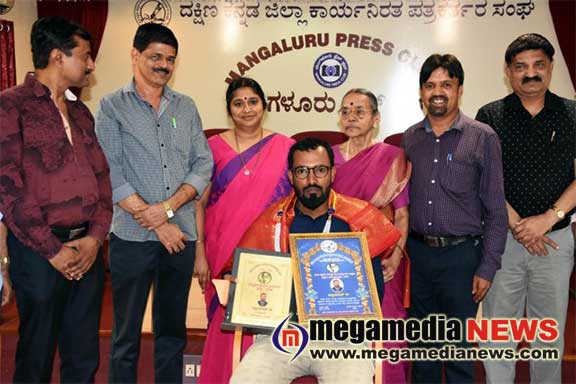
Pa Gopalakrishna Memorial Award 2018 for ‘Best Rural Reporting’ was presented to Journalist Imtiaz Shah Tumbe at Patrika Bhavan.
His article on Kodagu natural calamity, published in Vartha Bharati, was selected for the award.
Shah, a sub-editor in Vartha Bharati, said he had stepped into the field of journalism without any proper background. He said his parent organisation had honed his skills and provided him with an opportunity. “I feel privileged to receive the award.”
Dakshina Kannada District Information and Public Relations Senior Assistant Director K Rohini presented the award to Shah.
Speaking on the occasion, Rohini said the family members of veteran journalist late Pa Gopalakrishna, who had instituted the award, had set an example for others.
DK District Working Journalists’ Association Srinivas Indaje presided over the programme. Secretary Ibrahim Adkasthala, Mangaluru Press Club President Annu Mangaluru, Patrika Bhavan Trust President K Ananda Shetty, Pa Go’s spouse Savitri and senior journalist Manohar Prasad were present.
source: http://www.megamedianews.com / MegaMedia News / Home / March 02nd, 2019
The Imperial Sweet House in Hyderabad’s Sultanpur area was started by Nafees and her daughter-in-law Nasreen Hussaini in the 1960s. Over the years, they’ve expanded their business across India and the world.
A paradise for food lovers, history geeks and street shopaholics, the Charminar city of Hyderabad has a special place for everyone. Being the soul of Hyderabad, Nawabi dawats (delicacies) like Biryani, Qubani ka Meetha and Kaddu ki Kheer are certain to tickle the taste buds of tourists and locals alike.
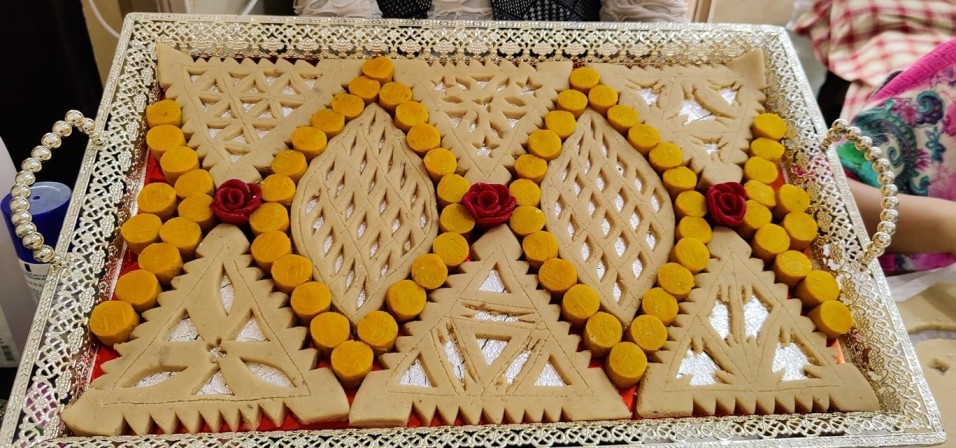
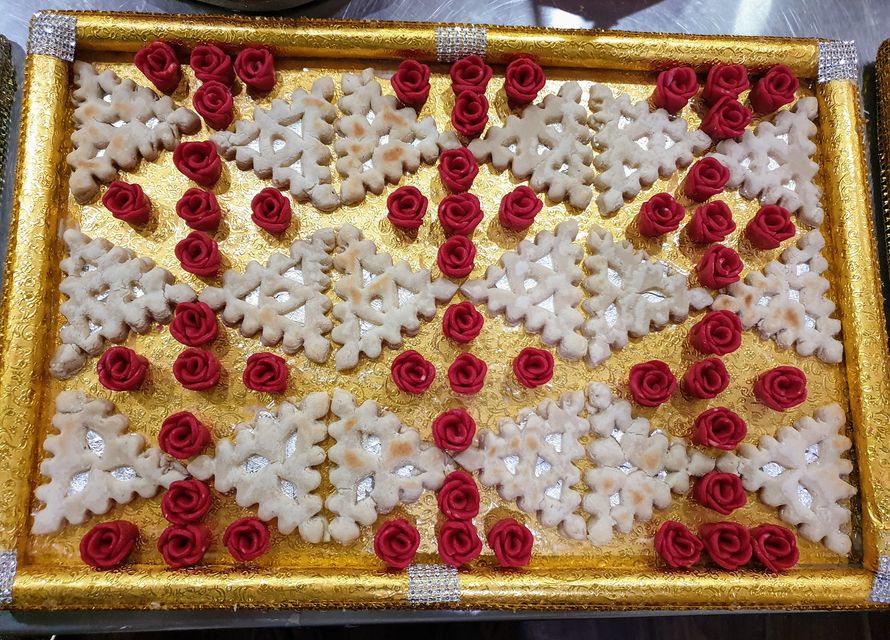
But among the popular dishes, there is a lesser-known sweet dish called ‘Badam ki Jali’ that often goes undetected by foodies. Primarily made with almonds, cashews and sugar, the recipe of this confection is known to have been passed on from one generation to another.
However, according to reports, there are only a handful of families left in the city that serve Badam ki Jali, which originated in the old Madras and Acrot areas of Tamil Nadu. It travelled to Hyderabad through inter-community marriages, where brides also had their closely guarded recipes in their elaborate wedding trousseau.
One of the few remaining families that make this dish in its authentic form is the Hussaini. As per the family’s accounts, Syeda Aijaz Fatima brought the recipe with her when her family moved to Hyderabad 60 years ago. She passed her recipie to her daughter-in-law, Nafees.
She would make the dish during family gatherings, festivals and weddings but she never considered selling them or making a business out of it.
Cut to 2022, the women of the house run a successful store, ‘Imperial Sweet House’, in the Sultanpur area near Noorkhan Bazar. With an average daily turnover of Rs 20,000, the family supplies their best seller Badam ki Jali and other sweets not just across India but the world.
A Woman’s World
The Hussaini matriarch turned into homepreneurs in the ’60s when their community and the society was reluctant to see women of the house earning money.
It was with the entry of Nafees’ daughter-in-law, Nasreen, that they decided to sell the sweets during festivals. They converted the ground floor of their house into a store to save money on rent. This also ensured they were able to manage both household work and sweet making.
Recalling the early days of their business, Nafees says, “It is a Nawabi mithai that we made accessible to everyone. Initially, we started with a few orders of 1-2 kg and gradually increased to 10 [kg]. I still remember that cashews were priced at Rs 8 per kg and almonds were Rs 10 when we started. The help we hired 50 years ago is still with us. But nowadays there are grinders to grind almonds and cashews but back then it was a tedious process.”
Now 87, Nafees credits her husband, Syed Mohammed, who supported her dream to expand the store’s business.
“Whether it was completing an order of 52 trays of Badam ki Jali, delivering the sweets on his way back from work or working overnight while streaming movies on VCDs [to accompany the sweetmakers], he always helped,” she adds.
As part of their expansion plan, Nasreen introduced new colours, shapes and sizes like stars, betel leaves, flowers and fruits, to the recipe with help from her husband, Mansoor. Meanwhile, Nafees added an ‘ashrafi’ design, which is achieved by pressing the dough between two Nizami coins to get their inscriptions.
Explaining the process of preparing Badam ki Jali without revealing much, she says, “We soak almonds in hot water and then dry it. Cashews and almonds are then ground into flour and then made into dough with sugar. The mould is then given different shapes and kept for baking. The whole process takes around 4-5 hours. The texture of the sweet is like cookies but the taste is similar to Kaju Katli.”
Nafees passed down the recipe to her daughter-in-law Nasreen who then taught her daughter-in-law, Aisha. Under the late Nasreen, the orders multiplied and she was the one to get new machines like grinders for easing the cooking process.
To ensure the quality of the ingredients, Nasreen and Nafees would themselves visit the Begum market to taste cashews and almonds.
When Aisha, the fourth-generation entrant, took over six years ago, she expanded the deliveries outside the city and country. She used online platforms like Whatsapp and social media for marketing. She was also instrumental in customising trays to get special shapes.
“Currently, our selling capacity is 300-400 kg per month. We also make Puran Poli, Gajar Halwa and other sweets. Every dish is made fresh and if there is an exhibition in the city, we do not sell in bulk and make fresh sweets if they get over. Although the shelf-life of this sweet is four to five days if covered in butter paper and packed properly. In case a customer is unhappy with the quality, we replace the entire order. We care about our reputation and family legacy more than anything,” says Aisha, who is a software engineer.
Over the years many competitors have arrived who make the same dish but the Husaainis are not worried.
“We prefer forgoing profits over compromising on taste and consistency. My grandmother, Nafees taught us this. It is due to these principles that we have a global footprint. Even actor Dia Mirza Rekhi had ordered our Badam ki Jali for her wedding last year,” says Ali, Aisha’s husband.
Both Aisha and Ali left their respective jobs in Dubai to continue the family’s legacy.
“The women of this house have a business acumen without having any business-related degrees. They hold magic in their hands to be able to make thousands of people smile with delight with their Badam ki Jali. So leaving a job abroad was totally worth it. We hope our next generation continues the family tradition,” he adds.
When the businessman, Yusuff Ali, paid a visit to the palace in 2012 Marthanda Varma had expressed his wish to gift the car to him. A year later Varma died (December 16, 2013) and the transfer was delayed due to many reasons.
Earlier, the German luxury carmaker Mercedes-Benz came back to Marthanda Varma with an offer of two new high-end cars, but the royal entity refused to part with his favourite vehicle. (SOURCED.)
Marthanda Varma’s favourite car — a 1955-model Benz nicknamed “Mile a Minute,”– will soon join the fleet of well-known business tycoon MA Yusuff Ali. Varma was the patriarch of the erstwhile Travancore royal family.
The royal family and Uthradam Tirunal Marthanda Varma Foundation have said the late royal figure’s announcement in 2012 in this connection will soon be fulfilled. Many vintage car collectors and businessmen have eyed the vehicle for quite some time. Even the German luxury carmaker Mercedes-Benz came back to him with an offer of two new high-end cars, but the royal entity refused to part with it.
What is amazing is that the old beauty had travelled 40 lakh miles, a rare achievement for a vehicle. People close to the royal family said he bought the car when he was 38, in 1955, and he drove a major portion of the miles it covered on his own and the rest as a passenger. Built in Stuttgart in Germany, Varma bought it for ₹12,000 and got it registered in Karnataka, CAN 42. It got its nickname “Mile a Minute” after it used to cover one mile in one minute.
When the businessman, Yusuff Ali, paid a visit to the palace in 2012 Marthanda Varma had expressed his wish to gift the car to him. A year later Varma died (December 16, 2013) and the transfer was delayed due to many reasons. Though delayed, the royal family members decided to fulfil his desire and informed the business magnate about it. He is yet to react to the royal offer.
The car is with his son Padmanabha Varma and in good road condition. Benz had presented many honours to the car and some of them are placed in front of the car and bonnet, said royal members. Palace old timers say even on his sick bed Varma used to watch his trusted companion. “He was so attached to it and looked after it as his progeny,” said one of them. A multinational businessman, Yusuff Ali, owns the Lulu group. He had a miraculous escape after his chopper crash-landed in Kochi last April.
source: http://www.hindustantimes.com / Hindustan Times / Home> Top News> India News / by HT Correspondent / April 04th, 2022
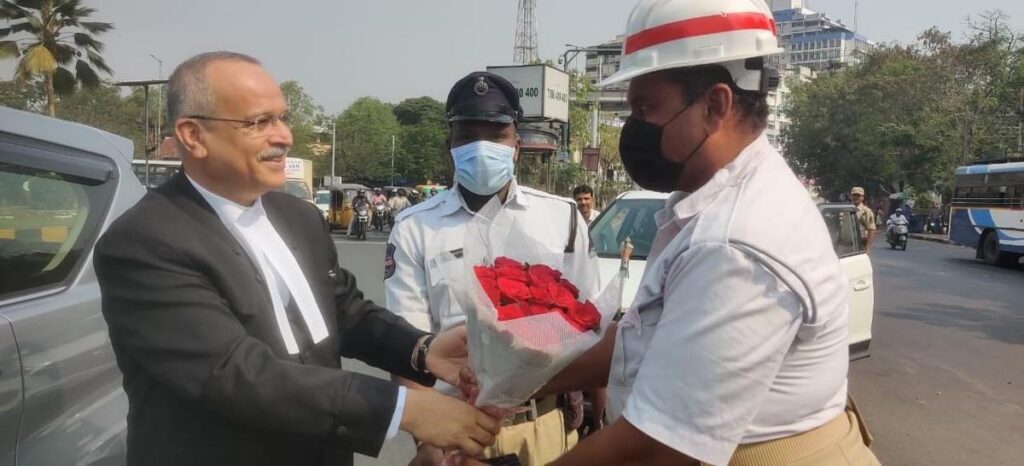
Chief Justice Satish Chandra Sharma felicitating homeguard Mohammed Ashraf Ali in Hyderabad on Friday. | Photo Credit: Arrangement
Justice Satish Chandra Sharma was impressed by Ashraf Ali’s commitment to duty
‘Arey maine ye kya kardiya?’ (What wrong have I done?) was relentlessly ringing in the mind of homeguard Mohammed Ashraf Ali (43) when the convoy of Chief Justice of Telangana High Court Satish Chandra Sharma started to approach him at a slow pace and stopped on Friday morning.
Mr. Ali, who works at Abid Road Traffic police station, was performing his duty at Babu Jagjivan Ram statue near Nizam College when he had a shock of his life as Justice Sharma himself got down from the vehicle and felicitated the officer with a bouquet.
Nonplussed by this development, the homeguard couldn’t believe what was happening in front of his eyes. A visibly impressed Chief Justice, while patting Mr. Ali, said that he had been observing him every day on his way to High Court and was pleased by his commitment and sense of duty.
“I see you every day. You are a good police officer,” Justice Sharma told Ali.
Speaking to The Hindu about the ‘once in a lifetime’ moment, Mr. Ali said that he was still in a state of shock and couldn’t believe that the Chief Justice took time from his busy schedule, and stopped the entire convoy to felicitate him, a homeguard rank police officer.
“It is a rare opportunity and a lifetime memory which I will recollect every single day and share with near and dear ones at every opportune time,” he said.
Mr. Ali’s family members and friends circulated his photo with Justice Sharma to every possible person they know and soon he was flooded with phone calls.
source: http://www.thehindu.com / The Hindu / Home> News> National> Telangana / by Abhinay Deshpande / Hyderabad – April 08th, 2022
One such is a miniature version that can be worn as an amulet
Ramzan marks the revelation of Koran and families go into a huddle reading it through the night. The Abul Kalam Azad Oriental Research Institute in Public Gardens is now hosting an exhibition of copies of some rare Korans.
One of them has been created in Hyderabad with Persian and Urdu translation and explanatory passages on the side. Another Koran is a miniature version which could be worn as an amulet. “This is among the 5,000 Koran amulets commissioned by Hasan Nizami, a legatee of Nizamuddin Aulia of Delhi. It is a priceless object as very few are in circulation,” informs S.M. Ahmed Ali of the institute.
Then there is a Koran which is a gift of Reza Shah Pehlavi, first Shah of the House of Pahlavi of the Imperial State of Iran, when his wife visited the city in 1960. It has the Persian translation along with the Arabic original.
A few facsimile copies show how different writing styles have evolved. A 7 th century Koran in Kufic script is without the diacritical marks. “This is one of the earliest copies and unique. It will be difficult to read as we are used to seeing the sound markers,” adds Mr. Ahmed.
source: http://www.thehindu.com / The Hindu / Home> News> National> Telangana / by The Hindu Bureau / Hyderabad – April 14th, 2022
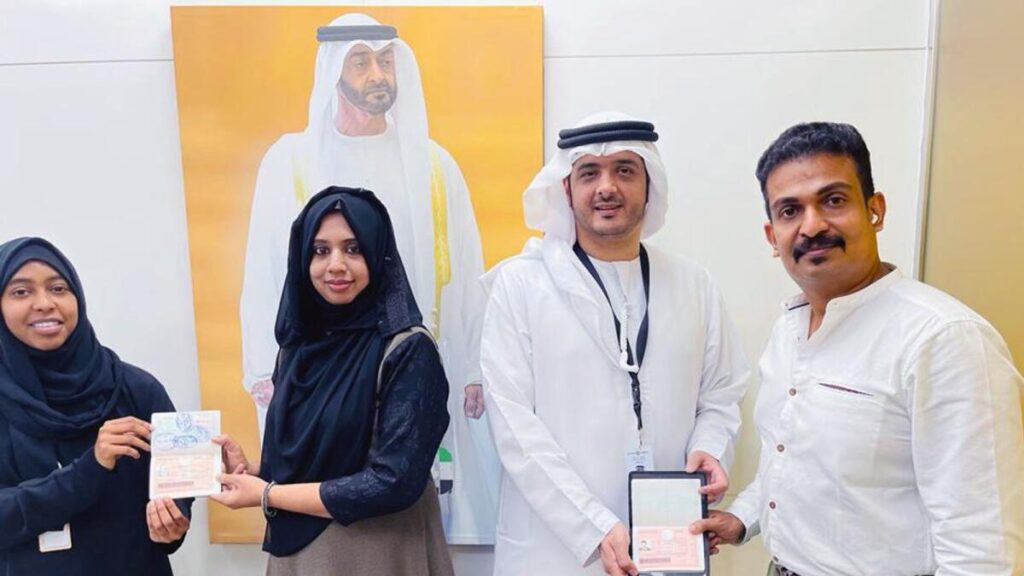
Abu Dhabi-based dentist couple Abdul Rahiman Nizar and Simi are the latest recipients of the 10-year UAE Golden Visa.
Abu Dhabi :
Abdul Rahiman Nizar gained popularity for amassing a rare collection of all the teeth extracted so far in his career.
Abu Dhabi-based dentist couple Abdul Rahiman Nizar and Simi are the latest recipients of the 10-year UAE Golden Visa.
Dr Nizar has served in Abu Dhabi for 20 years, including 18 years at Ahalia Group. However, the Indian doctor gained popularity for amassing a rare collection of all the teeth extracted so far in his career.
“Teeth are the strongest part of your body. I have always liked teeth. And once into my job, I started collecting it. Soon, it became a hobby. And I began to have a varied collection, which has been helping students in their dental studies,” said Dr Nizar, who is from Kerala, India.
“Over the years, I have collected nearly 15,000 teeth. I clean each tooth with antimicrobial hydrogen peroxide and then treat it with disinfectant. Once dried, I preserve them in a box. I am aiming to see my name in record books,” said the general practitioner dentist.
Dr Nizar urges people to take care of their teeth and visit a dentist every six months.
“Early detection of any tooth decay will help to avert a situation of tooth extraction. I always try to save a tooth and opt for extraction only as a last resort,” he said.
Dr Simi, who works at Al Mafraq Medical Centre in Baniyas, has also been collecting teeth.
“We are very excited to have bagged the Golden Visa. During this pandemic, both of us served the community, sacrificing our off days,” Dr Simi said.
The couple have four daughters: Grade 12 student Neha, Naila in Grade 8, Naima in Grade 3 and Naira is eight months old.
Dr Nizar, who also holds a 10-year US visa, added: “We plan to spend the rest of our lives in the service of Abu Dhabi. I thank the leadership for this honour and our hospital for the support in building our careers.”
source: http://www.khaleejtimes.com / Khaleej Times / Home / by Ashwani Kumar / September 29th, 2021
A view of the dargah of Moinuddin Chishti in Ajmer
Ajmer’s dargah of Moinuddin Chishti is undergoing massive restoration work
The dargah of Moinuddin Chishti, fondly remembered as Khwaja Garib Nawaz, or the benefactor of the poor, in Ajmer, will, in two years’ time see a restoration and an incorporation of modern facilities. Considered a holy place of hope, where people from different denominations believe their prayers will be answered, the dargah was built in the 13th century. The tomb was constructed in wood, later covered with a stone canopy. In 1579, Akbar reconstructed the sanctum sanctorum and built the dome. It was renovated in later years by Jahangir, Shah Jahan, and Jahanara.
The project, a part of the CSR wing of Hindustan Zinc Limited, is headed by architect Surbhi Gupta, a heritage management consultant. At present, the dargah that was organically built with various materials, ranging from brick and marble to sandstone, is seeing restoration and redevelopment of the interiors of the Mehfil Khana, widening of gates, structural consolidation, facade work in the courtyards, cleaning of stone surfaces, and new terracing in lime concrete.
“There is no single language of design or material as the dargah was never planned systematically,” says Surbhi, working on one of the most important pilgrimage sites of South Asia with members of her studio Rasika that specialises in heritage management.
The square structure of the royal darbar (Mehfil Khana),was built in 1888 AD. She says it “has been painted over as a part of living tradition. The idea is to bring out its character as a space meant for performances. The architectural character needs to be revived to bring back the original identity of the structure. The patterned ceiling will be designed on the lines of Kashmiri Khatambandh (a woodwork ceiling with a carved geometric pattern), and Mughal stone inlay flooring,” says Surbhi.
Work is also going on at the famous Shahjahani Gate, built by the Mughal emperor Shahjahan to mark the expansion of the dargah complex beyond the Buland Darwaza.
The project — under the Swacch Bharat Abhiyan — also revolves around sanitation, cleanliness, and waste management within the dargah’s periphery. The work entails providing clean drinking water for pilgrims, building toilets, and kiosk management.
“Every day, seven tonnes of rose petals are wasted. For the flower-waste disposal, a compost waste converter has been installed.” As the Khwaja was known far and wide for his large-heartedness and hospitality, the dargah distributes degh ka khana (food from a cauldron) comprising rice, almonds, cashew nuts, raisins and ghee. “The food is prepared in two big deghs , which were made during Mughal emperor Akbar’s reign. A retort packaging machine (sterile packaging of plastic and foil) has been installed to increase the shelf life of food from three hours to three months.”
Feeding into the Swacch Bharat Abhiyan, Surbhi says that her team is working on the revival of wudu (Islamic ritual purification) points so that pilgrims can wash their hands, face and feet before offering namaz. Right now, the overflow leads to a cesspool of water. “We are also building newer ones that are aesthetic as well as functional,” says Surbhi, who from her days in college at CEPT, Ahmedabad, has been interested in heritage structures.
She chose Chunnamal ki haveli in Old Delhi, as a research project. “On the ground floor were shops, first and second floors were residential spaces. It had five chowks (internal courtyards). And it was built as an organic edifice over many decades during the 18th century,” she says.
Meanwhile, she hopes to look at the parts around the dargah. “The approach street is famous for food, craft and gota work done on the chadar laid at the dargah by devotees. We have proposed a facilitating centre that includes a large shopping space, kiosk, and toilets inside the complex,” she says.
source: http://www.thehindu.com / The Hindu / Home> Society> History & Culture / by Madhur Tankha / Septemeber 03rd, 2019
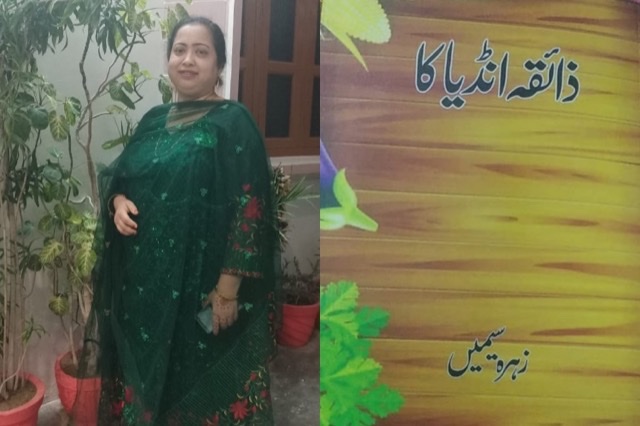
Zohra Seemee(L), her recipe book “Zaykah India Ka”
The month of Ramazan has entered its last leg and thus it is possible that the items on the Iftaar table at dusk must be getting mundane. Here, Awaz-the Voice spoke with Zohra Seeme, author of “Zaykah India ka” and founder of NGO Social Pride Welfare Society about how to pep up the Iftar platter for the family.
“I learnt cooking after I got married..”, was Zohra Seeme’s reply to how and when she learnt how to cook. Zohra said as shewas distributing ration on behalf of Mahila Panchayat (an NGO she collaborates with) to the needy when Awaz the Voice reached her for a tete-a-tete.
Here’s her top dishes that can be tried this Ramazan:
Potato-Chicken Patty: potatoes boiled and mashed properly are used as a base that are then filled with minced meat of either chicken or mutton. Minced meat or keema that is prepared by roasting it with bare minimum spices and a dash of onions till cooked properly.
Chane ki dal ke pakodas with Keema (Gram flour fitters filled with minced meat): preparing the gram flour dough by kneading it with a bit luke warm water, add salt to taste, take small portion, roll it flat, fill it with minced meat (as done with potato chicken patty) and just deep fry it or bake it (whatever suits you best).
Zohra says, “I was the youngest at my place, thus I never touched a thing, but after I got married, my partner ate less but rich food, thus my journey of preparing food started..” “I don’t particularly follow any book, I believe in intuition rather..”, she replies when asked about her mantra behind the delicious recipes.
She adds, “I make up mind as and when I enter the kitchen, I try to think of flavours in my mind and when they click, I try to lay them on the dining table..”
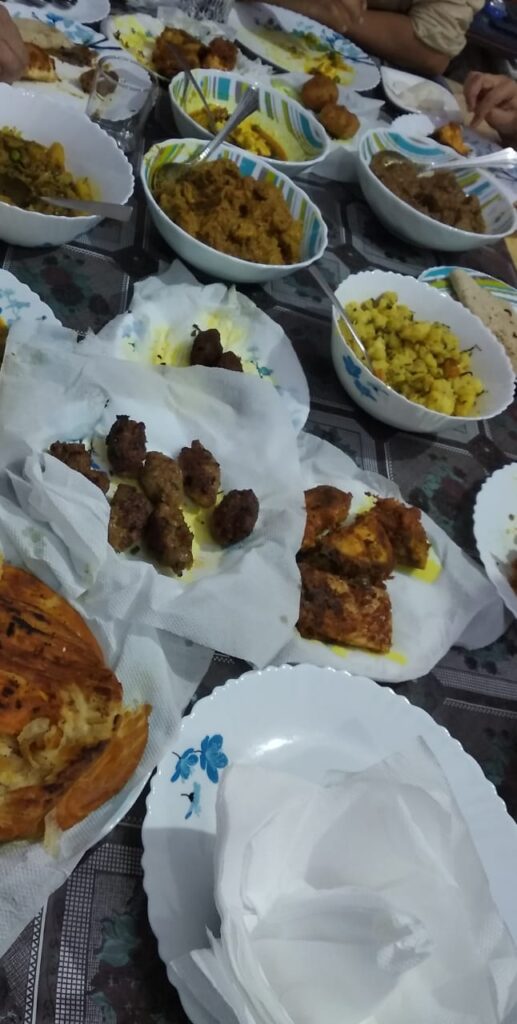
A complete iftar table as laid out by Zohra Seemee
Asked about some oil-less, health conscious recipes she says, “ well, there’s Ghugni (a local name for chana dal soaked overnight and prepared with a dash of lemon, salt, black pepper, and finely chopped onions, tomatoes..”
A healthy potpourri can be prepared by taking sprouts of your choice(soak black gram, green lentils, yellow gram overnight), and just add lemon, salt, black pepper and salad of your choice.
When asked about an all time favourite recipe of her kids she says, “I prepare chicken roast, that is one recipe that is loved by all..”
Here’s the recipe: boil the preferred choice of meat with salt, garlic, ginger and water. Separate the water from the meat when tender. Add a pinch of fine flour (maida), edible food colour and either pan fry or deep fry the same. When done it is served with preferred salad dressing.
source: http://www.awazthevoice.in / Awaz, The Voice / Home> Women / by Shaista Fatima, New Delhi / April 24th, 2022
People Welfare Front’s candidate for Palayamkottai K.M.A. Nizam of MDMK. — Photo: A. Shaikmohideen; Fatima Babu, MDMK candidate for Thoothukudi.
A social worker for Thoothukudi and a retired teacher for Nagercoil
The Marumalarchi Dravida Munnetra Kazhagam, a constituent of Desiya Murpokku Dravida Kazhagam – People’s Welfare Front, has fielded party’s Tirunelveli city district secretary K.M.A. Nizam, popularly known among the Palayamkottai residents as ‘Nizam Maama.’
Though he has not contested any election in the past, Mr. Nizam, a Grade I contractor, has held various positions in the party and is quite popular among the residents of Palayamkottai, thanks to his ‘helping tendency,’ especially to the needy.
When over 3,000 government employees and the teachers laid siege to the Collectorate recently as part of their Statewide indefinite strike, Mr. Nizam provided them lunch – both vegetarian and non-vegetarian, tea and dinner for two days.
Whenever he is approached for providing lunch for the participants of conferences, seminars in colleges here, he would oblige gleefully, saying that those who teach the younger generation should not be allowed to run from pillar to post for their professional needs.
Mr. Nizam will take on DMK’s T.P.M. Mohideen Khan and AIADMK’s A. Thamizh Magan Hussein.
The MDMK has nominated former MLA T. Sadan Thirumalaikumar, a doctor, at Sankarankovil (reserved) segment. He was elected to the Assembly from neighbouring Vasudevanallur (reserved) constituency in 2006 and had unsuccessfully contested the Lok Sabha polls at Tenkasi (1991 and 2014), Assembly polls at Rajapalayam (1996) and Assembly by-poll in Sankarankovil (2012).
Nagercoil
Marumalarchi Dravida Munnetra Kazhagam has fielded a retired teacher, Rani Selwyn, in Nagercoil constituency.
Ms. Rani is the State deputy secretary of the party’s women’s wing. She unsuccessfully contested for the post of Nagercoil Municipal Chairperson in 1986 and 1996.
The party has fielded 68-year old Sampath Chandra, chairman of the Kanyakumari District Central Cooperative Bank, in Colachel constituency.
Tuticorin
Marumalarchi Dravida Munnetra Kazhagam , a strong ally of DMDK –PWF, has fielded Fathima Babu (64), former Associate Professor of English, St. Mary’s College, in Thoothukudi. Ms. Babu is a familiar face in Thoothukudi. She is a social worker and an environmental activist. Thoothukudi Mayoral election during 2011 saw Ms. Babu as one of key contenders.
She has held various responsibilities such as Executive Committee Member of Thoothukudi Town Beautification, Senate member of Manonmaniam Sundaranar University, and State Convener of Fishermen Movements of Tamil Nadu and Puducherry. This candidate was conferred with ‘Greenpeace International Award’ in recognition of her efforts to protect the planet’s environment. Thoothukudi district administration honoured her at the Republic Day celebration in 2011 for outstanding social service.
source: http://www.thehindu.com / The Hindu / Home> News> National> Tamil Nadu / by Madurai Bureau / Tirunelveli / April 17th, 2016