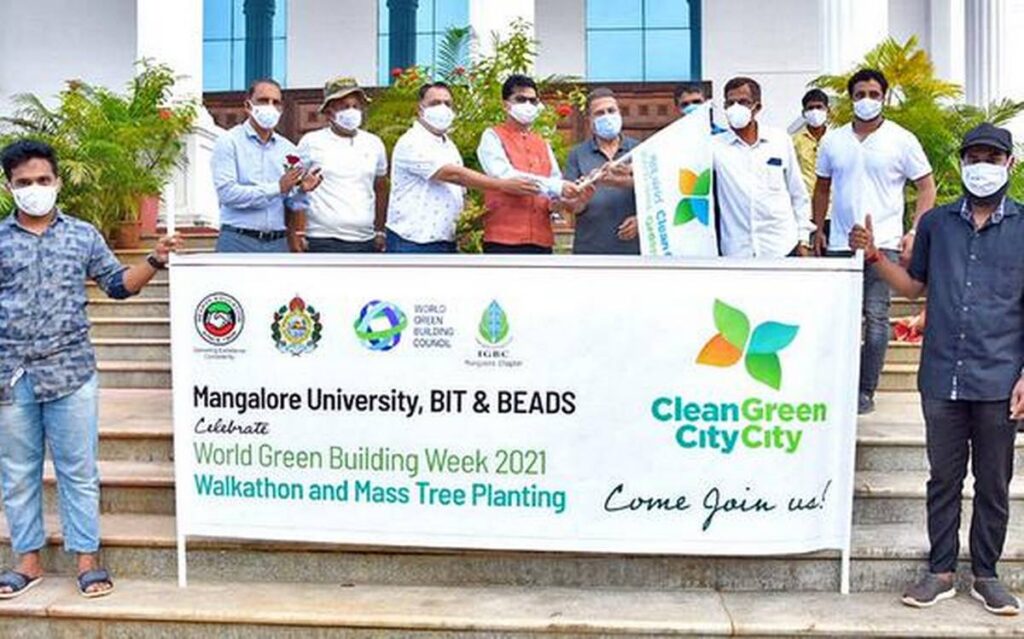
The ‘Green Walkathon – 2021’ organized by Beary’s Group was initiated in front of Mangala Auditorium of Mangalore University on Saturday September 25 morning.
The Green Walkathon, which is a part of the International Green Week – 2021 that started from in front of the university’s Mangala Auditorium moved towards Beary’s Turning Point at Deralakatte.
Mangalore University vice-chancellor, Dr P Subrahmanya Yadapadithaya, said that the environment will automatically become clean if our minds are clean. “We are following the policy of keeping our lives ahead of nature. For our lives to be saved, nature is very important. Therefore, we should join hands to conserve nature,” he stated.
Speaking after presiding over the programme, Beary’s Group president, Syed Muhammad Beary, felt that there is a need to create awareness to encourage a clean and green city. “Nature offers us several gifts. But it is important what we give in return to nature. We cut down many trees when constructing a house or building but we do not take care to plant a tree. Nature becomes green only if we keep planting the saplings. The walkathon is aimed at creating awareness about love of nature and clean environment,” he stated.
Syed Muhammad Beary said that environment in the world keeps on changing and it has cast grave influence on the hman beings. “Therefore, the humans have to strive to protect our earth. We are nothing in front of nature. We are not bigger than nature. We will survive only if we preserve nature,” he stated.
BIT principal, Dr S I Manzoor Pasha, welcomed, BEADS principal A R Ashok Mendonca, Dr Azuz Mustafa, Venkatesh Pai, Santosh D’Souza, BIT – ECE head of the department, Dr Abdulla Gubbi and others were present.
source: http://www.daijiworld.com / Daijiworld.com / Home> Top Stories / by Mohan Kuthar, Daijiworld Media Network – Mangaluru (SP) / September 25th, 2021
“Joji”, which released on Amazon Prime Video, is inspired by Shakespeare’s tragedy “Macbeth” and presents a “twisted version” of the plot.
Fahadh Faasil in ‘Joji’. (Photo | YouTube screengrab)
Mumbai :
Fahadh Faasil’s Malayalam feature film Joji has won the top honour at the Swedish International Film Festival, the actor announced on Thursday, September 23, 2021.
The 39-year-old actor shared the news on Facebook, revealing that the Dileesh Pothan-directed film won the best international feature film award at the film gala.
“Good News from Sweden ! JOJI won The Best International Feature Film Award @ the Swedish International Film Festival (SIFF) 2021,” he posted.
Joji, which released on Amazon Prime Video, is inspired by Shakespeare’s tragedy Macbeth and presents a “twisted version” of the plot filled with greed, ambition, murder and mystery, set in a plantation family in Kerala.
The crime drama revolves around Faasil’s character Joji, an engineering dropout living with his iron-fisted father and two brothers.
When his father falls ill, Joji looks forward to finally getting his share in the property but his dreams are dashed when his father starts recuperating, forcing him to take an extreme step.
At the time of the film’s release, Faasil told PTI that the movie is not expansive like the source material.
“The film’s narrative is not a direct adaptation of Macbeth. We were deeply inspired by it and we were trying to set something inspired by ‘Macbeth’ in today’s scenario.
“‘Joji’ is not as large as Macbeth…The drama happens within the family. I thought the emotions of Macbeth were more relative to the story,” Faasil had said.
Joji marked the third directorial collaboration between Pothan and Faasil.
The duo earlier worked on 2016 comedy-drama Maheshinte Prathikaaram and National Award-winning feature Thondimuthalum Driksakshiyum (2017).
Faasil will next be seen in Allu Arjun-starrer Pushpa as well as Kamal Haasan-starrer Vikram, also featuring Vijay Sethupathi.
source: http://www.newindianexpress.com / The New Indian Express / Home> Entertainment> Malayalam / by PTI / September 23rd, 2021
Around 30 children from outside Kerala are now learning Malayalam at the centre that was initiated by Samagra Shiksha Kerala (SSK) during the pandemic.
Arshi Salim
Kochi:
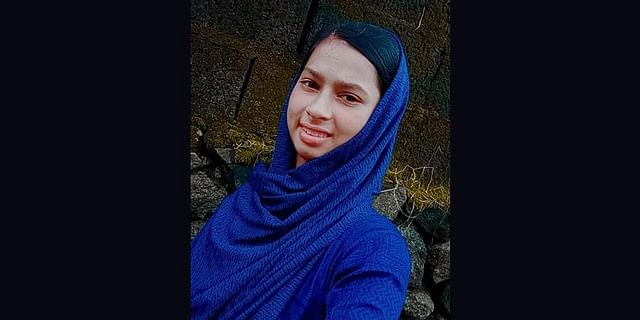
Arshi Salim, who hails from the Saharanpur district in Uttar Pradesh, is now voluntarily teaching kids of migrant workers at a special training centre functioning under the Block Resource Centre, Kothamangalam. Around 30 children from outside Kerala are now learning Malayalam at the centre that was initiated by Samagra Shiksha Kerala (SSK) during the pandemic.
As many as 41 such special training centres are functioning in the district and aim to educate schoolchildren who do not have access to online classes. Kids of migrant workers and those hailing from tribal areas are largely attending classes at the centres, said Usha Manatt, SSK district in charge.
Arshi, who reached Kerala when she was a Class IV student, learnt Malayalam at Government High School, Nellikuzhi. She bagged A+ in both her Malayalam papers in Class X.
“I wanted to learn and speak Malayalam like Malayalis. So, I approached my teachers in school and they helped me a lot. I could understand the difficulties of a non-Malayali student trying to get an education in Kerala, where the medium of instruction is largely Malayalam. So, I decided to be part of this centre,” Arshi said.
There are two centres functioning under BRC, Kothamangalam where the largest group of migrant children is getting training in the district to converse in Malayalam. Apart from students who come from UP, there are also students from Assam receiving special classes under Arshi. She is currently studying at a computer centre after finishing Class 12.
source: http://www.newindianexpress.com / The New Indian Express / Home> Good News / by Express News Service / September 17th, 2021
During the Big Ticket draw in Abu Dhabi on September 3, 2021. /Photo by Big Ticket
Indian expat in Ras Al Khaimah wins Dh12M in Big Ticket
Dubai :
An Indian expatriate who has been buying Big Ticket with his friends in the past year finally hit the jackpot after winning Dh12 million in the recent draw.
Abu Thahir Mohammed won on Friday (September 3) with ticket number 027700 that he bought on August 30.
He bought the ticket with the help of four colleagues who have been pooling their money for the monthly purchase in the last year and five months. The group will be sharing the prize money.
His friends called him up as soon as they found out their group won the jackpot in the recent draw.
What does Mohammed plan to do with his big win? “He has made no decision at this point in time, he’s still in shock,” his friend said.
List of winners in Big Ticket Series 231 draw
Dh12 million: Abu Thahir Mohammed, Indian, ticket number 027700 Dh1 million: Nina Mohamed Mohamed Raffik, Indian, ticket number 007943 Dh100,000: Sajithkumar PV, Indian, ticket number 218228 Dh80,000: Haren Joshi, Indian, ticket number 024342 Dh60,000: Zhongdong Huang, Chinese, ticket number 022396 Dh40,000: Afsal Paralath, Indian, ticket number 219099 Mercedes Benz: Ahmed Aish, Egyptian, ticket number 015598
source: http://www.expatmedia.net / Expat Media / Home / by Staff Reporter / September 05th, 2021
In an acting career which began in 1990 with hugely successful film “Dr Pasupathy”, he has acted in more than 120 films.
Popular Malayalam actor Rizabawa, who was suffering from kidney aliments, passed away at a private hospital here on Monday, said industry sources. He was 54.
In an acting career which began in 1990 with hugely successful film “Dr Pasupathy”, he has acted in more than 120 films.
Rizabawa essayed role of villains with ease but also excelled in playing the hero, as well as in comedy roles.
Condoling the actor’s death, ace director Shaji Kailas, who directed Rizabawa’s debut film, said he was a very quiet personality and was easy to work with.
“We used to regularly speak and spoke very recently also. His bowing out so young is difficult to come to terms with… I have lost a good friend and above all a very good human being,” he said.
Veteran comedian and character actor, and Malayalam actors body AMMA’s former chief, Innocent, who played a key role in Rizabawa’s debut film, said: “Even though we all will react to the news of a colleague passing away with words like unexpected, sad and what not, I am genuinely feeling deeply sad.”
“He was a genuinely very nice person and above all someone who was very quiet and did his work with lot of passion. We will all miss him,” he said.
Rizabawa’s popular films include “In Harihar Nagar”, “Malappuram Haji Mahanaya Joji”, “Pokkiriraja,” to name a few.
He was also in demand for TV serials and had acted in over two dozen serials aired by various Malayalam TV channels.
And when he was not acting, Rizabawa was a popular dubbing artiste, and this, in 2010, won him his only State film award for his dubbing in the film “Karmayogi”.
Condolences have started to pour in from various segments of the Kerala society.
source: http://www.freepressjournal.in / The Free Press Journal / Home> Regional Film News / by IANS / September 13th, 2021
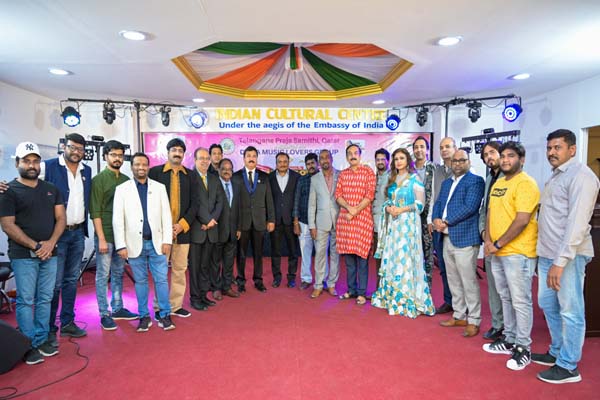
The most awaited trending and entertaining Doha Music Lovers ‘Voice of World’ Online singing competition ended on September 10, 2021 by finding its three winners of both Hindi and Telugu languages simultaneously.
The show has gained huge popularity among fans and viewers because the show brought new concepts for all the viewers. The first episode of the show appeared on June 13, 2021 on Channel 5 and after three months, the grand finale happened at ICC’s Ashoka Hall, Doha, Qatar under 75 years Azadika Amrit Mahotsav in coordination with ICC. The show was produced by Doha Music Lovers Group in association with Telangana Praja Samithi Qatar.
The three winners announced in Hindi were Tejaswi from California, USA, Jyotisha Santosh from Doha, Qatar and Shruthi Prabhala from Bilaspur, India.
For Telugu the three winners were Medha Anantuni from Texas, USA, Geeta Lakshmi from Pennsylvania, USA and Mavuru Sravani from Vishakhapatnam, India. Many contestants are left in the show to entertain the viewers.
More than 650 singers participated in this ‘Voice of World’ online singing competition out of which 30 singers were shortlisted in Hindi and 30 in Telugu, it took three months to reach the finals with 10 rounds of competition in between.
The eminent dignitaries who were present at the Grand Finale are Babu Rajan ICC President was the chief guest, Krishna Kumar, general secretary of ICC, K S Prasad ICC advisory committee board chairman, Ziyad Usman, ICBF president, Vinod Nair, ICBF vice-president, Azim Abbas, IBPC immediate president, Gadde Srinivas, president of Telangana Praja Samithi Qatar, Nandini Abbagoni president of Telangana Jagruthi Qatar, Satyanarayana president of Andhra Kala Vedika, Khaja Nizamuddin, president of Telangana Welfare Association and Syed Rafi chairman of Channel 5 and director and producer of Voice of World and last but not the least Jai Prakash Singh of North Central India Group.
Talking to media Syed Rafi said that it was very difficult to decide the winners as everyone sang very well, but as it is a competition and we have to take some hard decisions, the winners were decided based on Judges votes, committee votes, elite members votes and public votes. It is one of the longest season and ended with a bang, marking a new era in online singing contest said K S Prasad of ICC advisory committee chairman.
The winners will be given cash prize of Rs 50,000; Rs 30,000 and Rs 20,000 for first, second and third positions in each language. Voice of World online singing competition was sponsored by Dana World Contracting Co Wll, Telangana Food Suncons, H P Industries, Jai Prakash Singh and by Indian Hyderabadi Spices Restaurant.
The Grand Finale witnessed spectacular performances by Doha Music Lovers Group and this program was live on youtube wherein thousands of people watched it online from various countries.
Arif Rayees, Priti Vikramnath from Qatar and Srilatha Mula and Dr Vishwanatha Sridevi from India were the judges of this competition.
Mohinder Jalandhary, Preeti Trivedi, Venkappa Bhagavatula and Harika were the anchors for this singing competition. The show has completed 10 rounds before the grand finale.
Speaking on the occasion Gadde Srinivas president of TPS said that they are proud to provide this kind of platform to budding artist and he thanked Syed Rafi for taking this initiative and said that he and his group will be ready to support him all the time. Sophia Bukhari appreciated the efforts taken by Syed Rafi to provide a unique platform to budding artist on an international level and said that HP Industries would be proud to be associated with these kind of programs.
Jai Prakash Singh said that its not an easy task to conduct such kind of program with so much ease and professionalism, and he said kudos to Syed Rafi and his team for surpassing all the expectations. Praveen Buyyani of Telangana Food Suncons said that he was closely watching Voice of World from the first round and he observed how the program changed from the day 1 to present with lot of technicalities, background changes, lighting effects and change of stages, he said that he never expected that these many changes can be done in any program with limited resources, he concluded saying that it was an excellent program which surpassed all the expectations.
Baburajan president of ICC said that they are ready to support this kind of programs and said that they would love people to come forward which such kind of new initiatives and he congratulated Syed Rafi for conducting such a wonderful program. The show was concluded with vote of thanks by Venkat general secretary of Telangana Praja Samithi Qatar.
source: http://www.daijiworld.com / Daijiworld.com / Home> Middle East / by Media Release / September 13th, 2021
THE Muslims-stirred to the acknowledgment of their actual situation in India especially after the Mutiny of 1857. The exit of the last Mughal monarch from the throne of Delhi was not only a symbol of their downfall but also an end to their existence as a separate and dominant group in Indian political life. A new phase in India’s history opened after the 1857 rebellion and the consequent dissolution of the East India Company. The era of the colonial Raj began with Queen Victoria’s proclamation of 1 November 1858. This benign document set a new tone of authority and conciliation. The post-Great Revolt period was probably the gloomiest period in the history of the Muslim community in the Indian Subcontinent. Muslims had created and taken an unmistakable part in the events of 1857, in the British eyes, whereas Hindus kept a low profile. Therefore, the Muslims were to bear, alone, the fault. Two factors influenced the creation of this image: the first was, of course, the nature of the movements led by Shariatullah and Syed Ahmad decades before the Mutiny; and second was the lingering imagery in the West of Muslims authored by European Christian perseveres during the Crusades (1095-1291). Quick and savage responses were to be incurred by the British administration, which would bring about a cruel reality for the Muslim people group. They lost their moorings, their confidence, their hope. And, for the first time, they realized with the anguish of bitterness that they were nothing but a weak, powerless, supine minority. This was the first casting of the seeds of nationalism, the first kindling of a feeling of loneliness and prostration, the first awakening to the need of solidarity. It was a period of gigantic political, social, economic, and social change that stirred a feeling of nationalism in the people groups of India. It was a period when a modernized Muslim scholarly and political initiative came to characterize and explain fundamental Muslim community and political necessities under the Raj, simultaneously as a beginning nationalist development was being fashioned by a more extensive working-class tip-top challenging British absolutism. The pressure among Hindus and Muslims started to arise in this period. At the point when it turned out to be extraordinarily disturbed after the mid-1920s, a practically unrecoverable hole opened up between what we may call Indian nationalism and Muslim rebellion, prompting the decisive division of Pakistan from the remainder of India in 1947.
It was a period when questions began emerging among the Ashraf classes about how Muslims could approach obliging western social impacts without negating the religious statutes of Islam. It was an issue stacked with subtleties, owing more to singular inclinations than a communitarian agreement. There were tones and layers of dark in trades between Muslims of various leanings on the suitable Islamic reaction toward the western experience. Modernity itself was a challenging thought, open to many fluctuated understandings. One of the main courses through which modernity contacted the Muslim people group of India was through the press. Also, it was one of the main channels through which educated Muslims aired their perspectives on the degree to which a social system informed by Islam could serenely get the inundation of western thoughts and innovation.
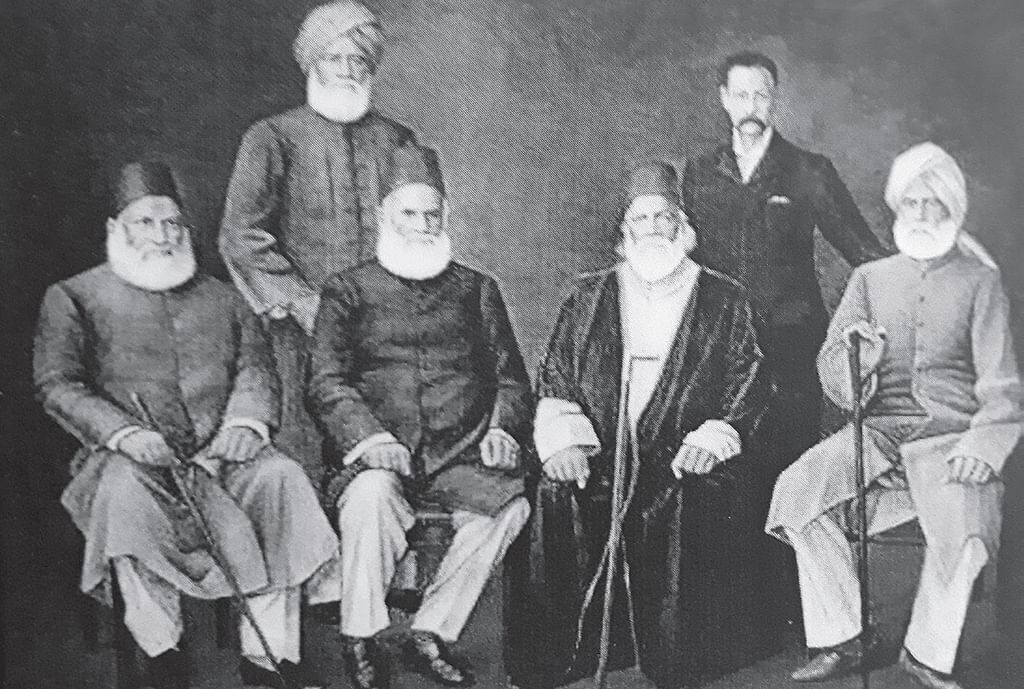
It was also a time when an extremely important character came into the frame, which went by the name of Sir Syed Ahmad Khan. The founder and intellectual pioneer of Muslim nationalism. And it was this nationalism that evolved into becoming a movement that strived to carve out a separate Muslim-majority country in the subcontinent, and then further evolve to become Pakistani nationalism. Sir Syed is the one who acted with the tide of functions and established the Aligarh’s framework in the unfriendly, undoubtedly threatening milieu of the 1880s. Sir Syed, though by no means consciously made possible the emergence of two most outstanding Muslim leaders who had enthusiastically started out as staunch Indian nationalists, ended up finally at the threshold of Muslim nationalism. Belonging to a family which had roots in the old Muslim nobility, Sir Syed’s prolific authorship on the Muslim condition in India (during British rule) and his activism in the field of education, helped formulate nationalist ideas in the Muslims of the region. These ideas went on to impact and influence a plethora of Muslim intellectuals, scholars, politicians, poets, writers and journalists who then helped evolve Syed’s concept of Muslim nationalism into becoming the ideological doctrine and soul of the very idea of Pakistan. It was Sir Syed that had initiated the educational, intellectual, ideological, cultural and political trends and engendered tendencies that laid the groundwork for a Muslim renaissance in India. It is certainly true to say that Sir Syed was too much impressed by western rationalism and wanted to show that every doctrine of Islam could measure up to all principles of science, reason, and common science. In doing this, he was trying to be both rationalist and a good Muslim. He was one of the first Muslim scholars to offer a point by point answer to British authors who were presenting and introducing the tradition of Islam as something which was damaging and retrogressive. Sir Syed reminded the British that Islam was inalienably a progressive and modern religion, and it had empowered and encouraged the study of philosophy and the sciences. He actively campaigned for the adoption of modern Western education in India, particularly for Muslims. He both started and joined a number of organizations whose purpose was to make European knowledge accessible to young Muslims and other Indians in Urdu vernacular. In 1870 the appearance of Sayyid Ahmad Khan’s Tahzib-ul-Ikhlaq exhorting Muslims to reform their religious worldview had a catalytic effect on the newspaper business. Sir Syed reprimanded ulema for compelling the Muslims to dismiss science. He composed that Muslims needed new religious philosophy of Islam, which was discerning and dismissed all doctrinal ideas that were in conflict with good judgment and reason. Threatened by Sayyid Ahmad’s bold forays into the domain of Islam, many of his co-religionists ventilated their outrage by resorting to the print medium, colonial modernity’s most attractive gift for instantaneous self-promotion. The response to Sayyid Ahmad’s arguments on the compatibility of Islamic teachings and modern ideas was similarly sharp in the North-Western Provinces and Punjab. While in the North-Western Provinces numerous new names arose on the guide of Urdu journalism as pundits of the Aligarh school, Sayyid Ahmad’s religious thoughts were given an extreme dressing down in Punjab by the Ahl-I-Hadith’s Ishaat ul Sunnat. Sayyid Ahmad’s way to deal with Islamic religious philosophy and statute acquired him the gashing maltreatment of “orthodox” Muslim ulema. His advancement of ijtihad or free-thinking and dissatisfaction with regards to taqlid or adherence to the four definitive schools of Islamic statute set him at loggerheads with the ulema who effectively found in it a scarcely masked attack on their pre-famous status as the strict watchmen of the Muslim people group. His support of western knowledge and culture as well as loyally to the raj drew astringent remarks from Muslims joined to their cultural moorings and the ideal of an all-inclusive Muslim ummah. Among Sayyid Ahmad’s fiercest critics was the Persian scholar Jamaluddin al-Afghani who lived in India somewhere in the range of 1879 and 1882 and called for Hindu-Muslim solidarity as the initial step to dislodging British imperialism.
Jamal Al-Din Al-Afghani — a bright young political activist, journalist, reformer, and Afghan ideologist who showed up in India in 1855. He one of the most prescient of modern Muslim thinkers, who had travelled and preached across British India. In contrast to the conventional ulema, Afghani didn’t perceive any great in turning inwards and drastically dismissing the modernity associated with British rule. His belief in the potency of a revived Islamic civilization in the face of European domination fundamentally impacted the development of Muslim thought in the nineteenth and early twentieth centuries. He recognized the matchless quality of Western education, however, accentuated that Muslims should grasp it to improve their parcel and afterward reverse the situation against Western imperialism by ousting it and setting up a worldwide Islamic caliphate. Al-Afghani held that Hindus and Muslims should work together to overthrow British rule in India. He worked to transform Islam into a lever against western imperialism. Afghani was the prototype of the modern fundamentalist. Like Sir Syed, he also had been influenced by western rationalism and the ideological mode of western thought. Afghani welded a traditional religious hostility towards unbelievers to a modern critique of western imperialism and an appeal for the unity of Islam, and while he inveighed against the west, he urged the adoption of those western sciences and institutions that might strengthen Islam. Afghani saw Western innovation as a solution to recover regenerate the Muslims, not as an approach to assist them in discovering a spot inside colonial settings yet to completely comprehend and afterward eradicate imperialism. Afghani was rather progressive and modernistic in his thinking. A contemporary English admirer described Afghani as the leader of Islam’s liberal religious reform movement. The pan-Islamist thought which he spearheaded esteemed the significance of changing and reforming the Muslim mentality through modern scholarly methods, and afterward utilizing the transformed as a weapon against the political incomparability of Western imperialism.
Another prominent sage of the modern Muslim intellectual movements of the time was Justice Ameer Ali. His History of the Saracens and Spirit of Islam enjoyed a wide readership both in India and Britain, but his target audience was the Western public. He wished to familiarize this public with the history and religion of Islam, and he was successful at that. He accepted that there were issues that made it problematic for his Western contemporaries to appreciate Islam as a religion suited to the needs of the modern world, but he remained unapologetic on central Islamic beliefs. Chiragh Ali (1844–95), a lawyer from Hyderabad, argued for the reform of Muslim civil law and the establishment of a humane Islamic law based on the Quran rather than on later accretions and interpretations. Altaf Husain Hali’s The Musaddas described the drama of Islam, its glories and its tragedies, in simple, sensuous, and passionate poetry; and, at the same time, he highlighted the need for the reform of Muslim society. The Musaddas became a best-seller in Urdu-speaking India, and it is still read and enjoyed by thousands even today. The scope and spirit of Urdu literature augmented during this period. Akbar Allahabadi (1846–1921), acclaimed for his gnawing parody, censured Sir Sayyid Ahmad Khan’s zing for Western culture and analyzed Muslims aping Western ways of life as ‘playing out monkeys’ for their British coaches. The Urdu weekly by Agra Akhbar, distributed by Khwajah Asif Ali denounced the Muslim Anglo-Oriental University conspire at Aligarh as ‘eccentric and illusory’. Much good Urdu prose was being written in this period; however, three specific improvements significantly advanced its reach and quality. The first one was the development of journalism. Despite the fact that the Urdu press returns to the late eighteenth century, it started genuinely to thrive and flourish from the 1870s onwards. Papers like Akhbar-e Am in Lahore (1870), Oudh Punch in Lucknow (1877–1936), and Paisa Akhbar in Delhi (1888) revolutionized journalism by receiving new patterns, for example, eye-getting features, notices, modest value, newspaper design, alongside the publication aptitudes of ironical composition, spontaneous extemporization, and powerful questioning. Hostile to British assessments were regularly communicated in such political papers as the Zamindar of Lahore, the Al-Hilal, and Al-Balagh, began by Maulana Abul Kalam Azad in 1912 and 1915, and the Hamdard edited by Muhammad Ali. The second significant advancement in Urdu writing was the introduction of the novel. Finally, we must record the rise of Urdu drama in this period.
To sum up, Sir Syed received harsh criticism. His religious naysayers remained positioned in their mosques and madrassahs. Thus, the greater part of his religious adversaries couldn’t discover a spot in the school that he set up in Aligarh. This school evolved into becoming a college and then an institution which began to produce a specific Muslim world-class and metropolitan bourgeoisie who might go on to dominate Muslim nationalist thought in India and eventually decide the course in 1906 when the consciousness of Muslim nationalism took practical form when a deputation of Indian Muslims – Shimla Deputation – held a meeting with the Governor-General Lord Minto in Shimla and secured the viceroy’s consent in respect of separate electorate for Muslims.
The views expressed in this article are the author’s own and do not necessarily reflect the editorial stance of Kashmir Observer
The author is a student at University of Hyderabad
source: http://www.kashmirobserver.com / Kashmir Observer / Home / by Inayathullah Din, Guest Author / December 18th, 2020
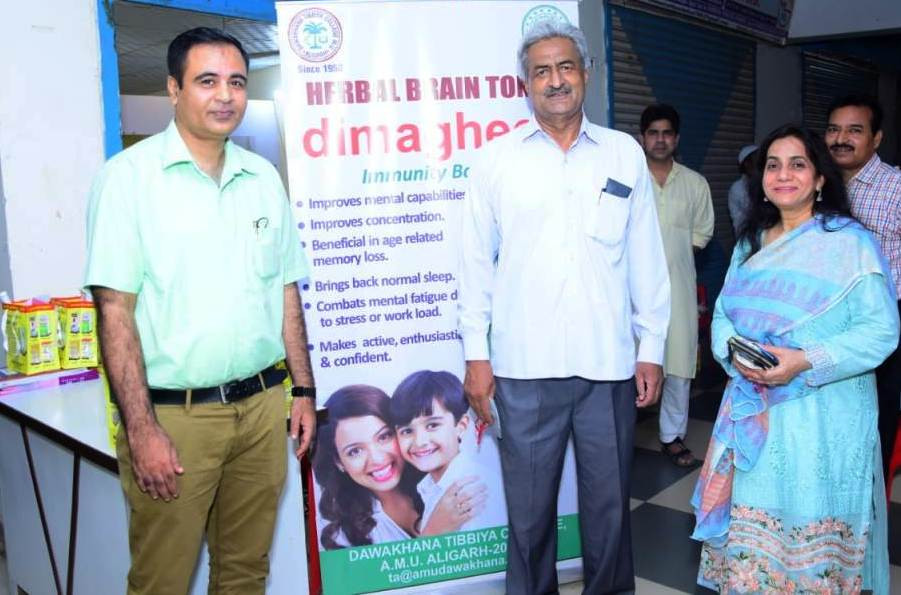
In a patient-friendly move to meet community health needs, free Unani medicines were distributed to patients from the lower economic strata by a team of Dawakhana Tibbiya College (DTC), Aligarh Muslim University (AMU). The free medicines were dispensed during the inaugural of a Unani Medicine Clinic in Jamalpur locality.
“We found that many poor patients were struggling to get medicines. Some of them have been without any income and couldn’t afford the health facilities. It prompted us to distribute free medicines to people in dire need,” said Prof Salma Ahmed (Member-in-Charge, DTC).
She distributed the medicines with the DTC Marketing Team headed by Mr Shariq Azam.
Former Dean, Faculty of Unani Medicine, Prof Abdul Mannan; Prof Shamim Ahmad (Department of Agriculture Management) and Prof Mohd Khalid Azam (Department of Business Administration) stressed that this free medicine campaign in the wake of the pandemic is a big boon for the financially backward patients.
They added that it is our duty to provide the financially weaker sections with free essential health services including medicines.
source: http://www.amu.ac.in / Aligarh Muslim University / Home> AMU News / by Public Relations Office, AMU / August 27th, 2021
So far, Jamiat Ulama-i-Hind has constructed 311 houses, mosques and schools at different places in the riot-affected district of UP
Maulana Arshad Madani handed over the keys of the houses to the victims of Muzaffarnagar riots
New Delhi :
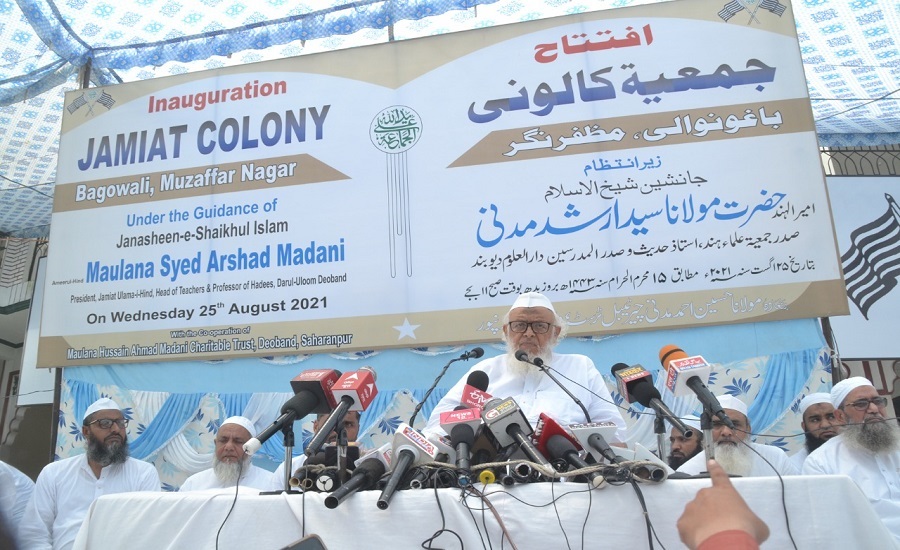
President of Jamiat Ulama-i-Hind Maulana Arshad Madani on Wednesday handed over keys of newly-built houses to 66 families who lost their homes in the deadly Muzaffarnagar riots in 2013, the group said in a statement.
Thousands of families were displaced due to riots. “These people were still living in extreme despair in different places. Jamiat Ulama-i-Hind has continued its relief and assistance from the very beginning as per its long tradition,” the Jamiat statement said, adding the group has constructed 311 houses, mosques and schools at different places in the district and the victims have been settled in them.
In March 2019, Maulana Madani had inaugurated the proposed Jamiat Colony consisting of 151 houses in Bagowali village of Muzaffarnagar. “At that time, the keys of 85 houses were handed over to the riot victims,” said the statement. “Today, Maulana Madani handed over the keys of the remaining 66 houses to the victims. A school for the religious education of the children of the victims and a mosque have also been built in the same colony.”
So far, 466 houses have been constructed for the Muzaffarnagar riot victims, and they have been resettled in them.
Addressing a grand function for handing over the keys of the houses to the beneficiaries, Maulana Madani said that “the riots in the city of Muzaffarnagar in Uttar Pradesh can also be listed as horrific because for the first time, a large number of Muslims had left their homes due to the fear of their lives. In these riots, the police showed the partiality which caused the killing and looting in the rural areas of Muzaffarnagar.”
source: http://www.clarionindia.net / Clarion / Home> Big Story> India. Indian Muslims / by Team Clarion / August 25th, 2021
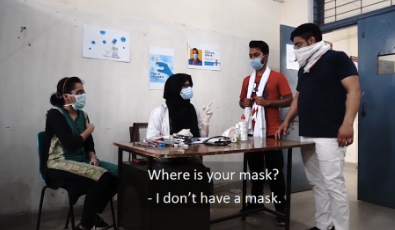
A video created by a team of students of the Department of Social Work, Aligarh Muslim University (AMU) on confronting an increasingly urgent challenge in the fight against the Covid pandemic was selected for the first prize in the ‘Regional Level Video Competition for COVID-19 Awareness in various Regional Languages/Dialects in Uttar Pradesh’. The team comprised of students namely Kapil Sharma, Nijda Zehra, Tanvi Gautam, Ilma Parveen and Anuj Sharma.
The team had participated in the competition of the National Coordinating Institution – IIT Delhi under the Unnat Bharat Abhiyan for the region-wise celebration of the 75th Independence Day (Azadi ka Amrut Mahotsav) throughout the country which had experts from IIT Delhi and Regional Coordinating Institutions (RCIs) as judges.
“This video is our effort to spread a word of awareness. It shows the importance of vaccinations, hand sanitisation, face masks, avoidance of crowded places and close contacts with people, staying at home if you are unwell and getting information from trusted sources,” said the team members.
Congratulating the student team, Prof Naseem Ahmad Khan (Chairman, Department of Social Work and Nodal Officer, Unnat Bharat Abhiyan, AMU) said, “AMU community stands proud of these students, who are creating awareness content to reach out to the masses. I wish them more success in future endeavours”.
source: http://www.amu.ac.in / Aligarh Muslim University / Home> AMU News / by Public Relations Office, AMU / August 27th, 2021