Category Archives: Community Involvement / Social Issues

With Muslim chief, TN village sends ‘inclusive’ message

Seriyalur Inam village (Alangadi Taluk – Pudukottai District) TAMIL NADU :

Though the village in Alangudi taluk in the Cauvery delta region has only 60 Muslim voters, only around 40 cast their votes, people’s choice transcended religion, caste and creed as they reposed their trust in 45-year-old Mohammed Jiyavudeen.

Seriyalur Inam is a Hindu-dominated village in Pudukkottai district of Tamil Nadu, but the nondescript hamlet has sent out a clear and loud message in the just concluded elections to rural bodies by electing a Muslim candidate as its panchayat president.

The election of a Muslim candidate in a Hindu dominated village comes at a time the country is facing massive protests against the controversial Citizenship (Amendment) Act and the proposed National Register of Citizens (NRC) which Opposition parties term as “anti-Muslim measures.”

Though the village in Alangudi taluk in the Cauvery delta region has only 60 Muslim voters, only around 40 cast their votes, people’s choice transcended religion, caste and creed as they reposed their trust in 45-year-old Mohammed Jiyavudeen.

Jiyavudeen, who has coordinated relief and rehabilitation efforts in the village and near-by areas after Cyclone Gaja left a trail of destruction in 2018, romped home despite elders of the village “auctioning” the panchayat president post in favour of another villager, Shankar, who lost by 17 votes.

The 45-year-old received maximum support from youngsters and women, who refused to toe the line of the village elders and voted in Jiyavudeen. He had returned to the village in 2018 after being in the UAE for over a decade.

“I see it as a recognition for the work that we as a group did in the aftermath of Cyclone Gaja. People reposed faith in me and two others from our group who contested as councillors. Through election people here have not just sent out a message on secularism but have also made it clear that they want people who work for their betterment,” Jiyavudeen told DH.

Jiyavudeen and fellow villagers, especially youth, had pooled in resources from various sources to rehabilitate people who were affected by Cyclone Gaja. “We built 10 new houses to people who lost their houses, distributed sewing machines to widowed women and wet grinders for elderly. We also disbursed interest-free loan for people in the village which have made them happy,” he added.

The new panchayat president said he takes pride in the fact that he neither spent money on distributing liquor or money for his voters.

Nimal Raghavan, a techie who had quit his job in UAE and is now involved in desilting lakes and ponds in near-by Thanjavur district, told DH that the country should follow the example set by people of Seriyalur Inam village.

“In our area, we live in complete peace and harmony. People will even print names of their friends belonging to other faith in wedding invitations. Election of Jiyavudeen is a classic example that humanity is above religion, caste and creed. His  election sends out a strong message as the country witnesses protests on CAA,” Raghavan said.

Kannan, a resident of Sethangudi village, said people should realise that humanity trumps everything including religion. “People like Jiyavudeen should come to power as they inspire the common man. He had worked with us to ensure that his villagers get proper relief during Cyclone Gaja. By electing him, people have spoken loud and clear against attempts to divide society on the basis of religion,” Kannan added.

source: http://www.deccanherald.com / Deccan Herald / Home> National> South / by ETB  Sivapriyan / DHNS Chennai / January 10th, 2020
Concern in Nawab landscape, too

WEST BENGAL :

Families associated with erstwhile rulers of Bengal decry citizenship regimen

Syed Reza Ali Meerza / (Picture sourced by The Telegraph)
Syed Reza Ali Meerza /
(Picture sourced by The Telegraph)

Descendants and associates of the Nawabs of Bengal who decided for centuries who their subjects would be are worried about their ability to prove Indian citizenship.

Since 1717, when Mughal Emperor Farrukhsiyar combined the nizamat (civil administration) and diwani (revenue administration) of the Bengal subah (subdivision) to elevate Murshid Quli Khan to the post of Nawab Nazim, the Murshidabad Nawabs of the Nasiri, Afshar and the Najafi dynasties ruled — de facto or de jure — for nearly two centuries the territories of undivided Bengal, Bihar, Jharkhand, Odisha, besides parts of Northeast and Chhattisgarh.

Syed Reza Ali Meerza, a 70-year-old grandson of Sayyid Sir Wasif Ali Meerza Khan Bahadur — the last Nawab Bahadur of Murshidabad recognised by the government of Independent India — said on Friday that the direct descendants of someone who had contributed to the very presence of Murshidabad in India should not be “degraded” by having to prove their citizenship.

Meerza Khan Bahadur had played a crucial role in the return of Murshidabad to India from East Pakistan after three days from August 15, 1947. He studied at Sherborne, Rugby and the Trinity College and was a resident of 85 Park Street in Calcutta towards the end of his life.

“Even if we were to forget the entire history and legacy of the Murshidabad Nawabs till 1947, at least the role played by my grandfather to ensure the return of Murshidabad to India after Partition should be remembered,” said the septuagenarian.

The former state government employee narrated the tales of how his grandfather Meerza Khan Bahadur spearheaded the initiative to ensure the return of the key district, despite being Muslim-majority, to India after the newly adopted Parcham-e Sitarah o-Hilal, the flag of Pakistan, flew atop the Hazarduari Palace for three days. The initial Radcliffe Award had placed Murshidabad in Pakistan and Khulna in India. On August 18, the two districts were exchanged.

“Now, his descendants have to stand in line on the same land to prove they are Indian,” said Meerza.

“There was a time when we — our forefathers — used to decide who were subjects and who were not. Before the British took everything from us, our family used to rule the wealthiest and industrially the most developed place in the world,” he said.

Meerza was referring to the economy of early 18th Century proto-industrialised Bengal, with its inhabitants purportedly having among the highest living standards and real wages in the world with over 10 per cent contribution to the global GDP. “Now, we have to prove that we are Indian?”

Meerza said many members of his extended family of Najafis did not have several requisite documents owing to legal reasons and were “living in fear”. “I condemn the NRC (National Register of Citizens), the CAA (Citizenship (Amendment) Act and the NPR (National Population Register) in the strongest terms,” he said.

Meerza said he had the requisite documents from the East India Company, the British Raj and the government of India, and he would not be “part of any queue” to prove he is Indian.

Other members of the extended family — who reside in the Qillah Nizamat area near Hazarduari Palace in Murshidabad — said although they had no official recognition as royals in the eyes of the state anymore, they felt demeaned even more by the prospect of being rendered stateless by the NRC.

“Our generation has not even received pension from the government, although they seized almost everything after Independence,” said Syed Mohammed Mazer Jha, who works as a nursing home employee in Murshidabad.

“Even my father did not get pension from the state. He died suddenly last year, and I am having trouble locating his papers,” he added.

Residents of the Hazarduari area said they respected members of the royal family for choosing to stay back in India. “The governments in India do not show as much respect to the descendants as groups of people in Pakistan or Bangladesh do. Still, they have stayed back,” said a resident of the area.

“The members of the royal family are by no means outsiders to this country. Rather, they have chosen not to immigrate to Pakistan or Bangladesh in spite of having lost so much property to the government of India,” said 50-year-old Mohammed Ali, a teacher at Singhi High School in Murshidabad.

source: http://www.telegraphindia.com / The Telegraph, online edition / Home> West Bengal / by Alamgir Hossain in Behrampore / January 03rd, 2020

Co-Opted As Professional Directors Of Muslim Co-Operative Bank

Mysuru, KARNATAKA :MuslimCoopBankMPOs10jan2020

Mysuru:

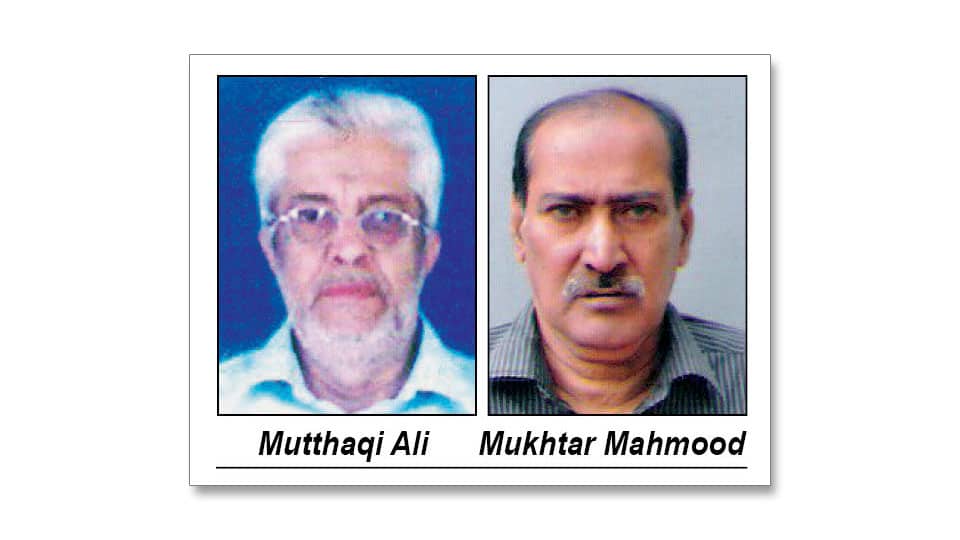
Mir Mutthaqi Ali, retired Manager of State Bank of India (SBI) and Mukhtar Mahmood, retired Senior Manager of Corporation Bank, were co-opted as Professional Directors of the Muslim Co-operative Bank Ltd., New Sayyaji Rao Road, at the recently held Board of Directors meeting in the Meeting Hall of the Co-op. Bank.

source: http://www.starofmysore.com / Star of Mysore / Home> News / March 24th, 2019

Shamsuddin Abdullah Punekar conferred Mohsin E Millat Award for his educational services

KARNATAKA :

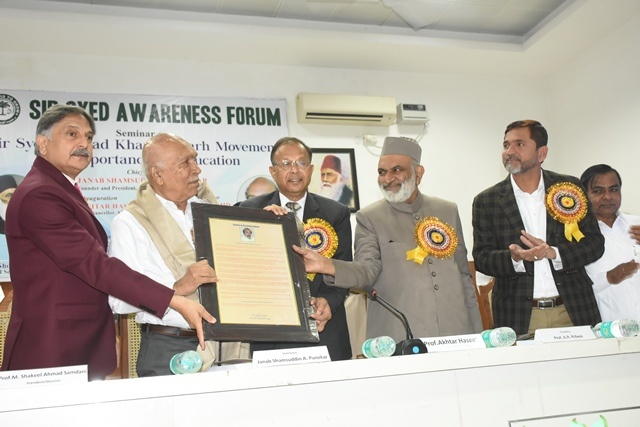
Mohsin E Millat Award being presented to Mr. Shamsuddin Punekar by Prof. Shakeel Samdani, Prof. Akhtar Hasbeeb and Prof. A.R.Kidwai

Aligarh:

“Those who are getting education from the great institution established by Sir Syed Ahmad Khan are having the blessings of Almighty on them. Had the Aligarh Muslim University (AMU) not existed, then the Indians would have remained educationally backward for a long period of time. I really admire Sir Syed Ahmad Khan that he started an educational movement and that movement gave me inspiration to do social and educational work” said edupreneur  Shamsuddin Abdullah Punekar while addressing a  seminar organized by  Sir Syed Awareness Forum (SAF) on  “Sir Syed, Aligarh Movement and Importance of Education” at Auditorium, University Polytechnic, Aligarh Muslim University, Aligarh.

Mr. Punekar was also conferred “Mohsin E Millat Award” for his services in the field of education. He is the man who established 24 educational institutions in Karnataka and running them successfully.

The award was conferred by Prof. Akhtar Haseeb, Pro Vice Chancellor, AMU and Prof. Shakeel Samdani, President of Sir Syed Awareness Forum, Aligarh..

Mr. Punekar further said that it is the duty of the old boys of this university to take inspiration from the life of Sir Syed and spare some time and money for social and educational work. He told the audience in detail about his life and struggle in establishing 24 educational institutions in Karnataka. He exhorted the audience to save our youth by guiding them on the right path. At last, he congratulated Prof. Shakeel Samdani for organizing such a wonderful seminar.

While inaugurating the seminar, Prof. Akhtar Haseeb, Pro-Vice Chancellor, AMU said that the seed of scientific education planted by Sir Syed has grown up into a tree in the form of Aligarh Muslim University and its three centres. Sir Syed always preached the ideals of tolerance, secularism and brotherhood. He, while congratulating Prof. Shakeel Samdani for successfully organizing the seminar, said that there is no substitute of hard work and those who keep on working hard will see its benefits sooner or later.  In the last he advised the audience that whatever has been transpired in the seminar should be transformed into action.

Prof. Shakeel Samdani, Director of the seminar and Dean, Faculty of Law, AMU while highlighting the objectives of the SAF, said that this forum was established 15 years ago with the mission to enlighten the ideals of Sir Syed to the students and the forum has been successful in doing so. The purpose of this forum is to make the students aware about the mission and vision of Sir Syed including constitutional ideals of secularism, tolerance, peace and harmony. Prof. Samdani furhter said that in comparison to North India, South Indian Muslims adopted Aligarh Movement and established hundreds of high qualtiy institutions. The same movement should be restarted in north India by the Muslims.

U.P. Ratan Awardee, Dr. Lokesh Sharma said that no one can repay the debt of Sir Syed Ahmad Khan. Sir Syed lost everything for the upliftment of the community. Without caring about his opposition and criticism Sir Syed continued to work for scientific education and he successfully achieved his goal.

Prof. A.R. Kidwai, Director, UGC Academic Staff Collge, AMU while delivering his presidential remarks said that, Sir Syed worked a lot for scientific education and he became a defender of scientific education. He also discussed the tour of Sir Syed to England, where he saw the lifestyle, education system, syllabus, buildings of them and tried to replicate them in AMU.

Dr. Swati Rao while addressing the gathering said that education is incomplete without proper upbringing. She further said that Urdu language is an Indian language and it can be called as the language of communal harmony. She wondered by Urdu language is not getting justice in the country.

Prof. Mohibul Haque said that Sir Syed was one who influenced the time. Sir Syed and Raja Ram Mohan Roy were the first who started socio-religious movement in India. Sir Syed launched educational movement for regeneration of Muslim community and he was the pioneer of interfaith understanding.

The notable feature of the seminar was that it was attended by 32 delegates from Karnataka, Maharashtra and Andhra Pradesh. 2 delegates came from Turkey and gave an international touch to the seminar. A large number of  academicians, faculty members and students of AMU were present in this seminar.

The seminar was moderated by Ayesha Samdani, MBBS student, at AMU. The seminar was started by the recitation of verses from the Holy Quran by Dr. Obaid Iqbal Asim, Abdullah Samdani welcomed the guests and vote of thanks was proposed by Khansa.

The seminar was made successful with the tireless efforts of Adv. Shoeb Ali, General Secretary, SAF, Dr. Haider Ali, Inchage, Mrs. Anjum Tasneem, Mohd. Nasir, Hunain Khalid, Kashif Sultan, Chitranshu, Manasvee, Samreen, Anas, Shubham, Zakia Khan, Samra Hashim, Pawan Varshney, Yusuf Iqbal, Md. Sabeeh, Sachin Varshney, Rahul Singh, Shelja, Talat Anjum, Razia Chauhan, Shreya Singh, Salman, Moiz, Adnan, Chirag and others.

source: http://www.muslimmirror.com / Muslim Mirror / Home> Education> Indian Muslim> Positive Story / by Abdullah Samdani / November 17th, 2019

Marathas, OBCs dominate, 4 Muslim MLAs get ministries

MAHARASHTRA :

After the induction of 36 ministers on Monday, the 43-member council of minsters (CoM), led by chief minister (CM) Uddhav Thackeray, has seen the Maratha community dominate the Cabinet, followed by legislators from the Other Backward Classes (OBC). Significantly, the Muslim community, represented by four ministers, has also got one of the highest representations in the Maharashtra Vikas Aghadi (MVA) Cabinet.

In terms of regions, most of the ministers are from western Maharashtra and Vidarbha.

In Thackeray’s 43-member Cabinet, there are 19 ministers from the Maratha community, with deputy chief minister Ajit Pawar, senior Congress ministers Ashok Chavan and Balasaheb Thorat, senior Nationalist Congress Party (NCP) ministers Jayant Patil, Dilip Walse-Patil and Anil Deshmukh and Shiv Sena ministers Eknath Shinde and Gulabrao Patil, being the prominent faces.

OBC community is represented by former deputy CM Chhagan Bhujbal, Dhananjay Munde, Jitendra Awhad, Vijay Wadettiwar and Sanjay Rathod.

From the Muslim community, Thackeray has inducted party legislator Abdul Sattar, as well as Hasan Mushrif and Nawab Malik from NCP, and Aslam Shaikh from the Congress.

The other caste-based representations include Nitin Raut, Varsha Gaikwad and Sanjay Bansode, who are from the Scheduled Caste (SC) community, while seven-time legislator KC Padvi is the lone tribal representative in the Cabinet.

The region-wise distribution of the ministerial berths is dictated by the number of seats each of the three parties has won in a particular region, as well as how a party has countered the Bharatiya Janata Party (BJP) in the Assembly polls.

Thirteen ministers were chosen from western Maharashtra, as the Congress and NCP gained the maximum support in the region. It was followed by Vidarbha (8), Marathwada (7), north Maharashtra (4) and Konkan (2). From the Mumbai Metropolitan Region, four ministers, including Aaditya Thackeray, are from Mumbai and two are from Thane.

“Sangli and Kolhapur have received the maximum representation from the Congress and NCP, with ministers such as Jayant Patil, Hasan Mushrif, Satej Patil, Vishwajeet Kadam along with first-time minister Rajendra Patil Yadravkar, making it to the cabinet. Satara also has been given fair representation with the induction of Balasaheb Patil. These districts had given the two parties the most number of MLAs by defeating the BJP candidates,” said a Congress leader, who did not wish to be named.

The three ruling parties have inducted Balasaheb Thorat, Prasad Tanpure and Shantaram Gadakh from Ahmednagar to limit Radhakrishna Vikhe Patil and Madhukar Pichad’s influence in the region at check. The duo had deserted the Congress and NCP to join BJP.

Congress has picked the maximum number of ministers from Vidarbha, where it had gained majorly in the Assembly polls. Congress’s Nitin Raut, Vijay Wadettiwar, Yashomati Thakur and Sunil Kedar got the Cabinet berths, while Nana Patole was elected as the speaker of the lower house after the new government came to power. From the region, NCP chose Anil Deshmukh and Rajendra Shingane, while Sena has inducted Sanjay Rathod and Bachchu Kadu. However, most of the MLA’s who won in Vidarbha are from BJP.

An NCP leader said that though the three ruling parties had decided to have better coordination in terms of representation to the region, it could not do so while finalising the names for the ministerial berths.

“For instance, Eknath Shinde (Sena) and Jitendra Awhad (NCP) both belong to Thane district, while in Sindhudurg and Ratnagiri, Sena and NCP could give only one berth despite their dominance there,” he said.

Prakash Pawar, political analyst from Kolhapur, believes that the three parties did not choose ministers on the basis of caste and region alone. “I don’t think the induction of the ministers was on the basis of caste or region. The ruling parties have tried to keep BJP, the single largest party in the Assembly, in check owing to the uncertainty over the alliance lasting for five years. This is not a natural alliance and thus it will always be under threat from BJP. By giving a fair representation to OBCs, the ruling parties have also tried to attract BJP’s traditional vote-bank of OBCs,” Pawar said.

source: http://www.hindustantimes.com / Hindustan Times / Home> Mumbai News / by Surendra P Gangan / December 31st, 2019

Musliyars from God’s own country turn lawyers

Kozhikode, KERALA :

Musliyar01MPOs27dec2019

Kozhikode:

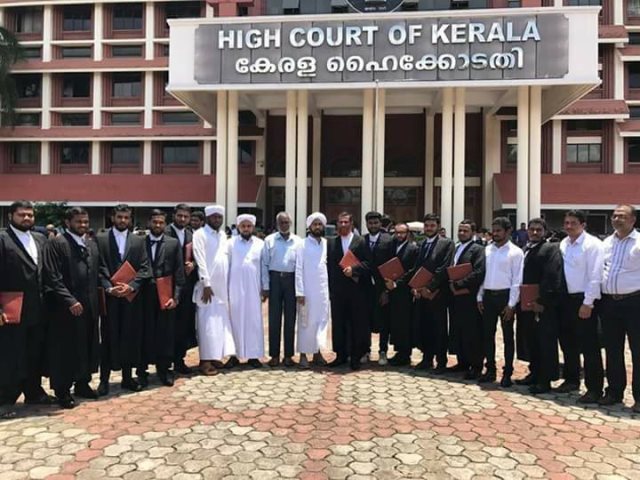
Jamia Markaz at Karanthur in Kozhikode is on a roll as the first batch of 20 Muslim religious scholars from Markaz Law College turned lawyers. Thanks to the mission of Kanthapuram A P Aboobacker Musliyar alias Sheik Abubakr Ahmad, the founder and chancellor of Jamia Markaz in ensuring students overall growth–  Intellectual, Spiritual and Social.

And rightly the Governor of Kerala Arif Mohammed Khan during an event at Jamia Markaz a week ago had eulogised the services of Aboobacker Musliyar by saying– Kerala Muslims are blessed as they have visionary religious leadership. Not just imparting education, the Markaz hones the skills of students in different spheres thereby making them face the challenges in life after their course.

Musliyar02MPOs27dec2019

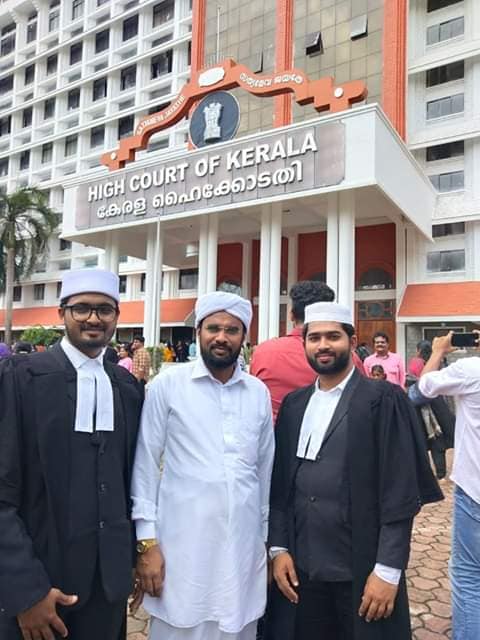
Joy knew no bounds for the Musliyars turned lawyers clad in black pants and white shirts with the advocate gowns after they got enrolled at the Kerala State Bar Council in Kochi. Interestingly, the enrolment event was like a festival with family members, college management and scores of friends and relatives accompanying them.  Markaz Law College is the first project launched under the Knowledge City of Markazu Saquafathi Sunniyya which is affiliated to the University of Calicut and is recognised by the Bar Council of India. The law college started in October 2014 at the markaz campus offers three year LLB course.

Notably, the religious scholars after completing their post-graduation in Islamic theology took up law course. Quite interestingly, fifty year-old Dr Hussain Saquafi C S,the vice chancellor of Jamia Markaz was one among the first batch of students to get enrolled as advocate at the bar council in Kochi. Enthusiam was writ large on the face of newly enrolled advocates, who are all set to begin their legal practice. Meanwhile, a few are preparing for governemnt postings as munsif cum magistrate while a major chunk of them are keen to specialise in criminology, human rights, corporate law and constitutional law.

Jamia Markaz (Islamic University) was established in 1978 in a sprawling campus at Karanthur in Kozhikode grew from strength to strength to emerge as a centre of social, cultural progress as well as educational excellence for the entire communities across the country as a whole Muslims in particular. Sheikh Abubakr Ahmad is the grand Mufti of India, who is also the General Secretary of the All India Sunni Jamiyyathul Ulama besides Chancellor of the Jamia Markaz and Chairman of the Siraj Daily and President of Islamic Educational Board of India.

source: http://www.muslimmirror.com / Muslim Mirror / Home> Education> Indian Muslim / by M Rafi Ahmed, Muslim Mirror / November 01st, 2019

Dr Sarfaraz, Irfan Ansari win 2019 Jharkhand Assembly Polls

JHARKHAND :

The JMM-Congress-RJD combine is heading for a clear mandate in the Jharkahnd Assembly polls

DrSarfarazMPOs25dec2019

Ranchi:

Dr Sarfaraz Ahmad of Jharkhand Mukti Morcha (JMM) and Irfan Ansari of the Indian National Congress (INC) are set to win the 2019 Jharkhand Assembly election from their respective constituencies by comfortable margins.

According to the update by the State Election Commission, Dr Sarfaraz Ahmad of JMM is well ahead of his nearest rival sitting MLA from Gandey assembly seat Jai Prakash Verma of BJP. The State Election Commission said Dr Sarfaraz is leading by 10,279 votes at 07:00 pm in Gandey Vidhan Sabha seat.

State Election Commission also showed Irfan Ansari of Congress leading by 9,137 votes in Jamtara assembly seat. Here BJP candidate Birendra Mandal tried to unseat Irfan Ansari from the Jamtara seat, but failed.

The JMM-Congress-RJD combine is heading for a clear mandate in the Jharkahnd Assembly polls and is set to form the new government, as per the latest Election Commission counting trends.

Of the most prestigious of the contests, Chief Minister Raghubar Das is trailing rebel BJP candidate Saryu Rai in the Jamshedpur East seat by over 1,000 votes.

As per the votes counted so far, the Jharkhand Mukti Morcha (JMM), the Congress and the Rashtriya Janata Dal (RJD) together have won or leading in 47 constituencies out of the 81 seats.

The Bharatiya Janata Party (BJP) has won 03 seats and is leading in 22. The All Jharkhand Students Union (AJSU) has won one seat and is leading in two. The Jharkhand Vikas Morcha-Prajatantrik (JVM-P) is leading in three seats.

AJSU chief Sudesh Mahto has won the Silli seat by 20,000 plus votes. JVM-P chief Babulal Marandi is leading by 15,000 votes in the Dhanwar seat.

Jharkahnd Urban Development Minister C.P. Singh has retained the Ranchi seat by 3,000 votes. Speaker Dinesh Oraon, Labour Minister Raj Paliwar, Education Minister Neera Yadav many other stalwarts and trailing.

The JMM-Cong-RJD alliance chief ministerial candidate Hemant Soren (JMM chief) is leading in both Dumka and Barhet seats.

source: http://www.ummid.com / Ummid.com / Home> India / by ummid.com with inputs from IANS / December 23rd, 2019

International Mathematics Olympiad (2017-18) Gold Medalist Aamir Sells Milk For A Living

Ranchi, JHARKHAND :

Sajid01MPOs24dec2019

We have acknowledged a lot of legendary stories of underprivileged children who knocked out every difficulties on their way to achieve a great successful life ahead. One bright example is Dr. APJ Abdul Kalam, who, out of poverty, used to sell newspapers in his early childhood to earn for his livelihood and studies. Dr. Bhim Rao Ambedkar couldn’t study in a small room due to the presence of his other fourteen siblings, so he used to sleep early and get up in the midnight  to study when all others were fast asleep. Dr. Rajendra Prasad studied under the street lights, etc.

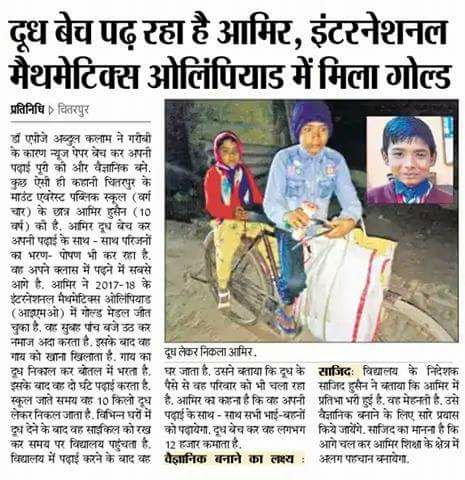
Here is a similar story of a child named Aamir Ahmad of fourth class. Aamir has won gold medal in the International Mathematics Olympiad (IMO) in 2017-2018.

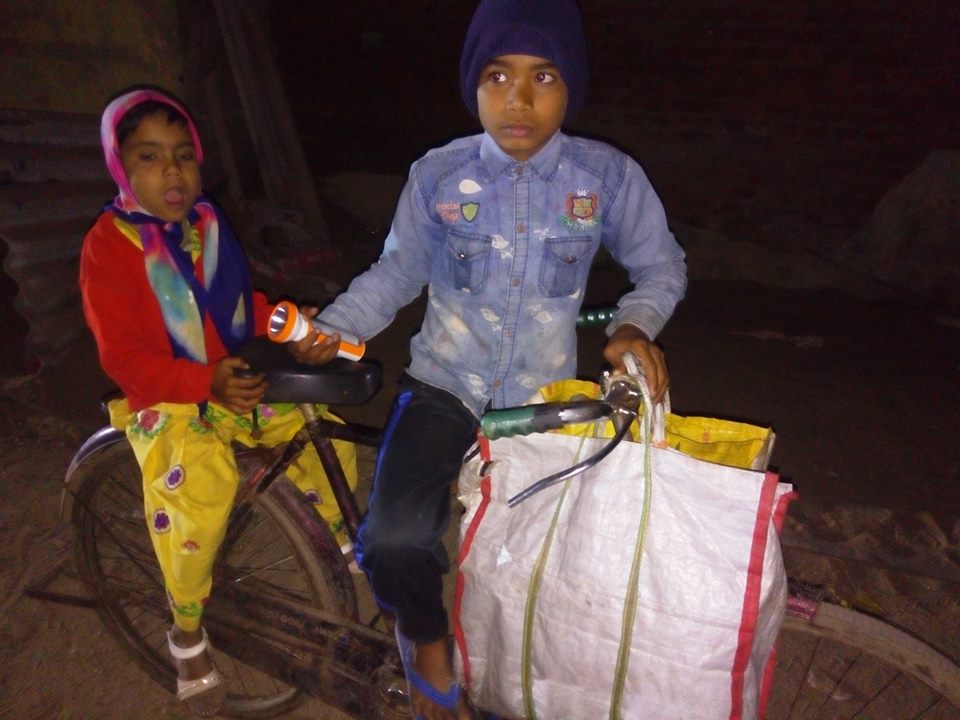
It was a cold night. It was the wedding reception party of a friend. We had our fine dinner by 9 pm. Now it was time for the talks for the gathering of friends. We set a bonfire in front of the friend’s house. And the laughter began. We indulged in the entertainment of anecdotes and jokes around married life. Then a bicycle bell rings. We were blocking the road with our gathering. A little boy on a cycle with his younger littler sister on the back carriage of the bicycle. He wanted us to move so that he could go on his way.

Aamir with his sister. Picture taken from Author’s FB page

My eyes fell on the boy. With a woolen cap on his head and a shirt with all buttons buttoned up till neck for it was cold out there, maybe he didn’t have a sweater. I recognized the boy. He was Aamir from my school. I called him out, “Aamir”. He replied, “yes, sir”. I approached him. His bicycle’s handle was laden with 10-12 one and two-litre bottles and a 3 year old sister on the back. Some 20-25 kilogram load. I asked him “where are you going in this cold night?” He replied, “I am out to sell milk, house to house.” I said “day after tomorrow you have level-2 exam of International Mathematics Olympiad”. He replied immediately, “Yes, sir. I have finished revising 7 chapters of the 14 from IMO practice book before leaving home and will finish the remaining 7 chapters after going back home before I sleep.”

I was stunned. I knew he was from an economically poor family but I didn’t know that he used to sell milk every morning and evening. I didn’t have any words to say. I stood there looking at him with a gasp. He kept looking at me if I had to tell something. I could say anything but okay bye. He wished ‘salaam’ and left to go about his work.

I was shaken from inside. I kept thinking how many such kids are struggling day in day out to make their dreams come true with all their sweat and blood, with no proper clothes to wear according to the weather, with no food to fill their stomachs two times a day but with courage to dream of reaching the stars.

Aamir is the eldest of his siblings. He tops in his class exams. Has already earned a gold medal in International Mathematics Olympiad. Tomorrow (11th Feb, 2017) he is going to Bishop Cotton School, Ranchi, to attempt level-2 of the IMO.

I only pray that this 10 year old Aamir becomes exemplary for kids of his age sucked up in Android culture and becomes a new Kalam for the country.

(Note: The original write-up(Hindi) is translated into English by Kashish Azeem and Adeel Ahmed)

source: http://www.thecompanion.in / The Companion / Home> Education / by Sajid Hussain / February 14th, 2018

Gold medallist kept out at convocation event

KERALA / PUDUCHERRY :

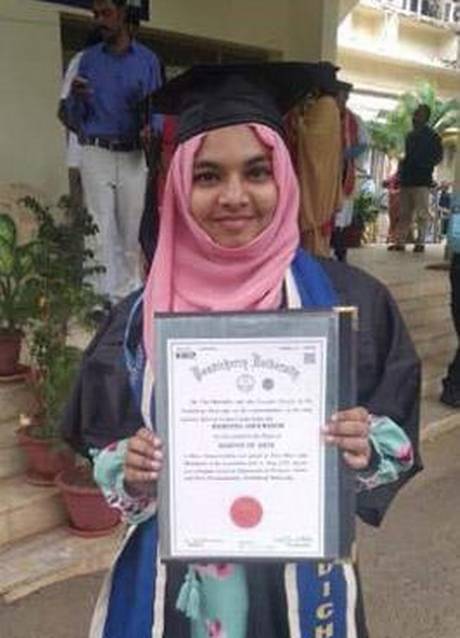
Rabeeha Abdurehim later accepted her certificate but turned down the medal. | Photo Credit: Special Arrangement

Pondy University student later accepts M.A. degree but rejects medal in solidarity with CAA protesters

A student who completed her masters in Mass Communication with a gold medal from Pondicherry University, Rabeeha Abdurehim, has alleged that she was prevented from attending the convocation ceremony attended by President Ram Nath Kovind on Monday.

Rabeeha Abdurehim, who hails from Kozhikode in Kerala, told reporters after the ceremony that she was asked to leave the hall before the President arrived.

“As I was on the radar of authorities (for participation in anti-Citizenship Amendment Act protests), I was asked to leave the hall and was allowed only after the President left. Later, I received my degree and refused to accept the gold medal,” she told reporters.

Ms. Rabeeha said her decision to reject the gold medal was also to express solidarity with students who faced police brutality while staging protests against the CAA.

‘Take a strong stand’

“Educated youth should take a strong stand against the legislation and fascist regime,” she said.

Ms. Rabeeha did her masters in the School of Media and Communication of Pondicherry University. Another gold medallist from the same school, Karthika B. Kurup had announced her decision to boycott the convocation in support of the protest against the CAA.

S.I. Humayun, officer-in-charge, Pondicherry University, said the student’s decision to not receive the medal from the President was her “personal decision” and the University had nothing to comment on it.

The official also denied knowledge of what actually led her to getting ousted as she had been duly registered and had taken a seat.

‘She was asked to leave’

“All we know is that there was commotion in the hall and she was asked to leave. She was allowed back after departure of the President.”

The official also denied the charge that she was asked to leave for wearing a hijab as was being claimed on social media.

“This is borne out by the student’s Facebook post where she herself has denied it,” said the official.

In her Facebook post, Ms. Rabeeha said that while she dreamt often about the moment she would receive a gold medal and master’s certificate, “never did I imagine it would end up being in a way in which I could send a strong peaceful message across India.”

“As a woman, as a student, as an Indian, today in my graduation I reject the gold medal awarded to me in solidarity with all the students and publicwho are fighting against CAA and NRC. This is my way of showing the world what education means to us youth, not medals and certificates but… standing up against injustice, fascism and bigotry,” she said.

“And even though (for ‘unknown’ reasons) I was send (sic) out of the auditorium where 100s of students sat awaiting their medals when the president came and was only allowed inside when he left, I feel at peace for the fact that I was able to take a stand as an educated youth”.

A post script to this added: “I have been seeing news which says I was asked to remove my scarf. That is false. No one asked me to remove anything. No one told me why I was kept outside.”

source: http://www.thehindu.com / The Hindu / Home> News> Cities> Puducherry / by Special Correspondent / Puducherry – December 23rd, 2019