Indian Medical Association will honour four doctors on Friday on the occasion of Doctors’ Day celebration in recognition of their professional excellence, service to society, and service to the IMA. Doctors’ Day is observed in memory of legendary physician and second Chief Minister of West Bengal B.C. Roy.
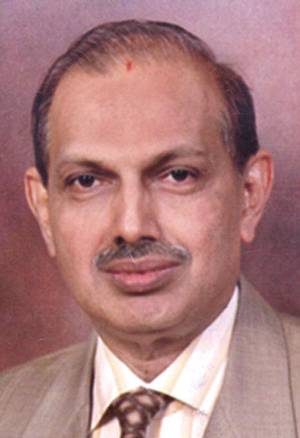
I.G. Bhat
The doctors being felicitated are: I.G. Bhat, Parvathi Bhat, Y.M. Hegde, and D.K. AbdulHameed. Mangalore University Vice-Chancellor T.C. Shivashankara Murthy will be the chief guest, according to an IMA press release.
The IMA said Dr. Abdul Hameed, who did his MBBS in 1968 and post graduation in TB and Chest Diseases in 1979 from the Government Medical College, Mysore, served the Health and Family Welfare Services of the Government of Karnataka from 1970 to 1997. For eight years, he served the Wenlock Hospital here and six years in the Primary Health Centre, Bajpe, and 14 years as a District Tuberculosis Officer. He had received the Best District T.B. Programme Award in 1990 and Meritorious Service Award in 1996 from the State government. He was conferred the Rajiv Gandhi Shiromani Award from the National Integration and Economic Council, New Delhi, for outstanding individual achievements and distinguished services to the nation for 2006-07.
The release said I.G. Bhat, serving as professor of Neurology, Kasturba Medical College here, has attended various national and international conferences. He has served as president of Dakshina Kannada chapters of IMA and the Association of Physicians of India. He did his MBBS from Mysore Medical College in 1965, MD (Medicine) from KMC Mangalore in 1970, DM from NIMHANS, Bangalore, in 1975.
Dr. Parvathi Bhat, retired professor of Pharmacology, worked in various capacities from tutor to professor and Head of the Department in KMC, Mangalore. She was the Chief Superintendent of Examinations and has edited and published the book, Drug Formulary in 1994. She did her MBBS from Mysore Medical College (MMC) in 1965, MD from KMC here in 1973. She received “Lady Dufferin Silver Medal” for being the best outgoing student of MMC from the President, the IMA release said.
It said Dr. Hegde, an ENT Surgeon, who was awarded D.L.O.R.C.S. from the Royal College of Surgeons, England, in 1976, served in different hospitals in the U.K. till 1979. On his return, he served the Father Muller Hospital as consultant for two years. He worked as Assistant Professor at KMC, Mangalore, till 1988 and served in the Ministry of Health at Muscat from 1988 to 1992. He served the Father Muller Medical College from 1999 to 2008 as Prof. and HoD, ENT. At present, he is serving the institution as Honorary Professor and is on its Trust Committee. He did his MBBS from KMC, Manipal, in 1968, M.S. (ENT) from King George Medical College, Lucknow.
source: http://www.thehindu.com / The Hindu / Home> National> Karnataka / by Special Correspondent / Mangalore – July 01st, 2011
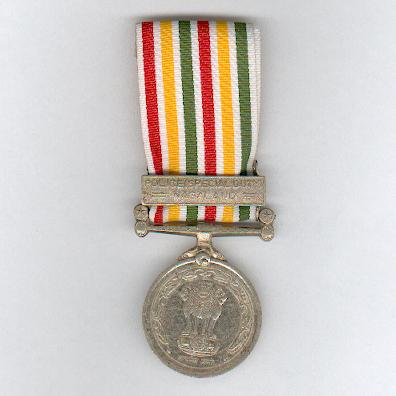
Shaik Masthan Vali, ASI in Railway Protection Force (RPF- Secunderabad) and Zahur Haidar Zaidi, DIG/PS to MOS(R), Railway Board, have been awarded with Indian Police Medal for their meritorious services.
President of India Pratibha Patil has awarded 18 Railway Protection Force (RPF)/Railway Protection Special Force (RPSF) personnel for their exemplary services on the occasion of Republic Day 2010.
Vali and Zaidi are among 14 police officers to get Indian Police Medal. The Police Medal for Gallantry, in recognition of their gallant act at Mumbai Central Railway Station during the terrorist attack on 26 November 2008, has been awarded to Sandip Dadaji Khiratkar, Inspector/RPF, Central Railway, Mumbai and Kiran Vasant Bhosale, Sub-Inspector/RPF, Central Railway, Mumbai. The President’s Police Medal for distinguished service has been given to Gopal Gupta, IG-cum-CSC/RPSF, Railway Board and Srikant Kumar Mishra, CSC/RPF, N.E. Railway, Gorakhpur.
source: http://www.twocircles.net / TwoCircles.net / Home> Indian Muslims / by TCN News / January 25th, 2010
This year 40 Muslims were among 704 personnel who have been awarded Police Medals on the occasion of the Republic Day.
The Police Medals are given in four categories; President’s Police Medals for Distinguished Service, President’s Police Medals for Gallantry, Police Medals for Gallantry and Police Medals for Meritorious Service.
On this R-Day 77 got President’s Police Medals for Distinguished Service. Of them, four were Muslims. Seven got President’s Police Medals for Gallantry wherein one is Muslim, Police Medals for Gallantry have been given to 98 including 11 Muslims while Police Medals for Meritorious Service have been awarded to 522, of them 24 are Muslims.
List of Muslim winners of police medals
S.N
Names
Awards
Posts
States/Organizations
1
Mr. Abdul Rasheed Khan
President’s Police Medal for distinguished services
Deputy Inspector General of Police, Raipur,
Chattisgarh
2
Mr. Abdul Qayoom Manhas
= =
Deputy Inspector General of Police, North Kashmir Renge, Baramulla
Jammu & Kashmir
3
Mr. Shaikh Abdul Khader
= =
Deputy Superintendent of Police, Finger Print Bureau, W.R, Mangalore
Karnatka
4
Mr. Nasir Kamal
= =
Inspector General/ Joint Director, East Block-7, RK Puram, New Delhi
National Crime Record Bureau
5
Mohammad Rafi
President’s Police Medal for Gallantry
Head Constable
Jammu & Kashmir
6
Mohammad Arshad
Police Medal for Gallantry
Superintendent of Police
Jammu & Kashmir
7
Jameel Ahmad Khatana
= =
Deputy Superintendent of Police
Jammu & Kashmir
8
Ishaq Ahmad
= =
Constable
Jammu & Kashmir
9
Ajaz Ahmad Amir
= =
Constable
Jammu & Kashmir
10
Mohammad Imran Lone
= =
Constable
Jammu & Kashmir
11
Abdul Majid Najar
= =
Constable
Jammu & Kashmir
12
Kafil Ahmad
= =
Head Constable
Jammu & Kashmir
13
Peerzada Naveed
= =
Deputy Superintendent of Police
Jammu & Kashmir
14
Shamshad Alam Shamshi
= =
Sub Inspector
Jharkhand
15
Shahab Rashid Khan
= =
Deputy Superintendent of Police
Uttar Pradesh
16
K. Sajjanuddin
= =
Commandant
Central Reserve Police Force
17
Mr. Sayed Athar Quadri
Police Medal for Meritorious Service
Additional Superintendent of Police,Intelligence Securty Wing
Andhra Pradesh
18
Mr. Ismail Khan
= =
Sub Inspector, Intelligence Department, Hyderabad
Andhra Pradesh
19
Mr. Abdul Rasheed
= =
Head Constable, Greyhounds, Hyderabad
Andhra Pradesh
20
Mr. Junaid Ahmad
= =
Sergeant Major, Patna Rail
Bihar
21
Mr. Hilal Ahmad Shah
= =
Senior Superintendent of Police, Telecom, Jammu Zone, PCR Complex, Jammu
Jammu & Kashmir
22
Mr. Mohammad Aslam
= =
Deputy Superintendent of Police, PHQ, Jammu & Kashmir
Jammu & Kashmir
23
Mr. Abdur Rashid Shah
= =
Inspector, Security HQRS, Jammu and Kashmir
Jammu & Kashmir
24
Mr. Aurengzeb Rather
= =
Sub Inspector, DSB Poonch
Jammu & Kashmir
25
Mr. Mohammad Rafiq Bhat
= =
Sub Inspector, Police Component Srinagar
Jammu & Kashmir
26
Mr. Mohammad Shafi
= =
Sub Inspector, SSG, Jammu & Kashmir
Jammu & Kashmir
27
Mr. Parvaiz Ahmad Malik
= =
Head Constable, JKAP 13th BN. Doda
Jammu & Kashmir
28
Mr. Nizam Hasan Mahagonde
= =
Head Constable, L.A.III, Worli Mumbai City
Maharashtra
29
Mr. Zaheed Mohammad
= =
Deputy Commandment, SOG, Orissa
Orissa
30
Mr. Aliyas Khan
= =
Assistant Sub Inspector, P.S. Salasar, Distt. Church
Rajisthan
31
Mr. Rehman Khan
= =
Head Constable, 11th BN RAC (I.R), Vijay Ghat,
Rajisthan
32
Mr. Mohammad Haneef
= =
Head Constable, 39 BN, PAC, Mirzapur
Uttar Pradesh
33
Mr. Ishtiyaq Ahmad
= =
Head Constable, XI BN, PAC, Sitapur
Uttar Pradesh
34
Mr. K.I. Ahmad
= =
Inspector of Police, Police, HGRS Kavaratti
Lakshdweep
35
Mr. Sayed Ruhul Amin
= =
Sub Inspector, Oil Duliajan, Distt. Dibrugarh, Assam
Central Industrial Security Force
36
Mr. Irfan Ahmad
= =
Head Constable, RGI Airport, Hyderabad
Central Industrial Security Force
37
Mr. Shafi Mohammad
= =
Sub Inspector, RTC, Dharampur, Solan , Himachal Pradesh
Central Industrial Security Force
38
Mr. Gulam Hussain Shah
= =
Head Constable, 2 BN. Sabri Nagar, Sukma, Dantewada, Chattisgarh
Central Industrial Security Force
39
Mr. Shaik Mastan Vali
= =
Assistant, Sub Inspector/Special Intelligence Branch, SCR. Secunderabad, Andhra Pradesh
Ministry of Railway
40
Mr. Zahur Haidar Zaidi
= =
DIG/PS MOS for Railways, Rail Bhawan, Raisina Road, New Delhi
Ministry of Railway
source: http://www.twocircles.net / TwoCircles.net / Home> Indian Muslims / by TCN News / January 27th, 2010
There are 52 Muslims among 755 police personnel to have been awarded with Police Medals by President of India on this Republic Day. The police medals have been given in four categories: President’s Police Medals for Gallantry; Police Medals for Gallantry; President’s Police Medals for Distinguished Service; Police Medals for Meritorious Service.
Muslim police personnel have made their presence in all categories except the first one — President’s Police Medals for Gallantry. This year President’s Police Medals for Gallantry have been given to 11 police personnel.
Police Medals for Gallantry were given to 129 personnel – 18 are Muslims. President’s Police Medals for Distinguished Service have been awarded to 82 –only 2 of them are Muslims. Police Medals for Meritorious Service have been awarded to 533 personnel – 32 are Muslims. Below is the list of honored Muslim police personnel.
Central Reserve Police Force
Riyaz Ahmed——–Constable—-CRPF
K. Sajjanuddin——–Commandant—-CRPF
Waseem Ahmed Khan——–Constable—-CRPF
Mohd. Riaz——–Constable—-CRPF
Mohammad Arif Wagay——–Constable—-CRPF
Tanveer Ahmad Mir——–Constable—-CRPF
President’s Police Medals for Distinguished Service
Taj Hassan Mohamed—Joint Commissioner of Police, Security—Delhi
S M Mohamed Iqbal—Deputy Superintendent of Police—Tamil Nadu
Police Medals for Meritorious Service
Syed Ibrahim—Head Const—Nizamabad, Andhra Pradesh
Fazal Mahmood Guard—Additional Director General of Police—Gujarat
Mohammad Salim Sati—Unarmed Police Sub Inspector—Gujarat
Tajmahmad Abubhai Sandhi—Unarmed Assistant Sub Inspector—Gujarat
Shafqat Ali Watali—Deputy Inspector General of Police—Jammu & Kashmir
Rafi Ahmad Mir—Superintendent of Police—Jammu & Kashmir
Syed Fayaz Ahmad—Inspector—Jammu & Kashmir
Mohammad Ashraf Rather—Inspector—Jammu & Kashmir
Fayaz Ahmad Banday—Inspector—Jammu & Kashmir
Bashir Ahmad Kumar—Assistant Sub-Inspector—Jammu & Kashmir
Showkat Ali—Head Constable—Jammu & Kashmir
Mohamed Budan—Police Inspector—Karnataka
Parvez Anwar Khan—Company Commander,13th Bn SAF—Madhya Pradesh
Ahmedkhan Shahjadekhan Pathan—Armed Assistant Sub-Inspector–Maharashtra
Majhar Safdar Shaikh—Police Head Constable—Maharashtra
Nasirkhan Mirsaheb Pathan—Police Head Constable—Maharashtra
Sharfuddin Khan—Head Constable—Rajasthan
S. Nizamuddin—Superintendent of Police—Tamil Nadu
F M Hussain—Superintendent of Police—Tamil Nadu
S Abdul Kani—Commandant—Tamil Nadu Special Police X Battalion
K. Kadharkhan—Head Constable, Special Task Force—Tamil Nadu
Siraj Ahamad—Constable—Azamgarh, Uttar Pradesh
Sadre Alam—Sub Inspector (Mt), 34 Bn PAC, Varanasi—Uttar Pradesh
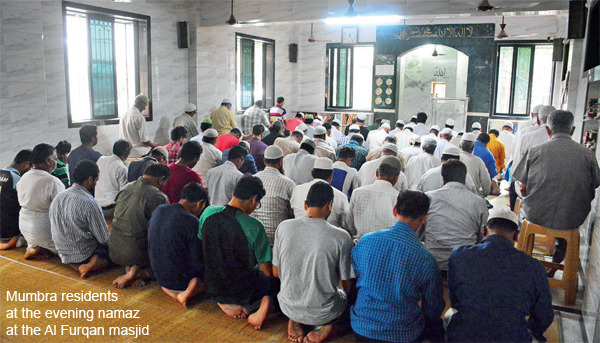
Mosque launches an outreach programme to fight misconceptions
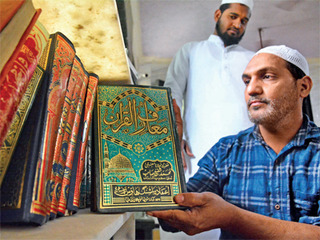
Imam of Al Furqan masjid, Maulana Saud (in white), looks on as Jamaat member Risal Baig displays the Koran. Photo by Sachin Deshmane
A ‘masjid parichay’ is enabling Hindus to visit the Al Furqan mosque and gain a better understanding of Islam.
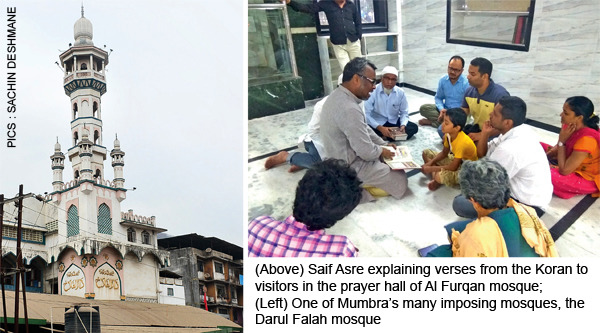
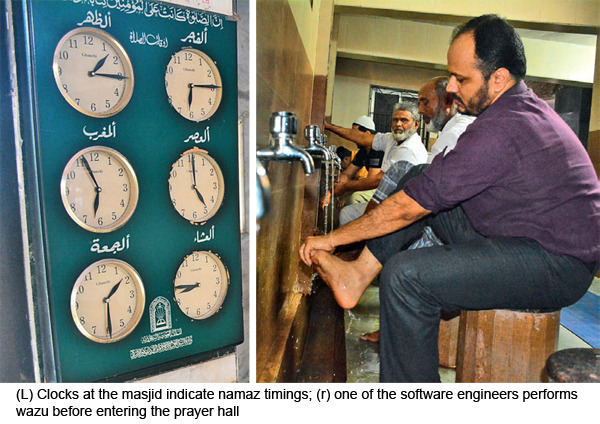
Spending four hours in a mosque is not most people’s idea of a Sunday evening outing. But for two Sundays in the last few weeks, 10 Hindus have travelled long distances to spend the entire evening at the Al Furqan Masjid, located in a bylane of Mumbra, a suburb of Mumbai. Starting off with doing wazu, or the obligatory washing of oneself before namaz, they ended their evening relishing biryani in the hall above the mosque.
None of these Hindus had ever stepped inside a masjid before.
“Going to a masjid in Mumbra? Are you out of your mind?” was the common reaction these Hindus encountered from friends — the shock stemming as much from the mention of a ‘masjid’ as from ‘Mumbra’, a place that was allegedly “internationally notorious for violent fanaticism”. A place where “no non-Muslim could go after sunset.’’
Vikhroli salesman D Gupta’s family didn’t even take him seriously when he told them about his plan. So when he returned home after his Mumbra visit, and casually mentioned where he’d been, his upset mother sent him off to “purify” himself with gau-mutra (cow urine) from the neighbourhood tabela before entering the house again.
Gupta remembers, as a 13-year-old, seeing students from a madarsa in his neighbourhood being beaten up by their teacher. An older friend said it was because the students had probably forgotten to curse Hindus enough, and warned Gupta to stay away from Muslims. The fear that had set in when he was a teenager vanished only after his recent visit to the mosque. Other friends had told him, at the time, that Muslims worshipped the Shiva lingam in masjids by pouring water over it, hence the mandatory tap at the entrance. And also that the Kaaba in Mecca, too, had a Shiva lingam inside it.
Jamaat-e-Islami member Saif Asre heard another perception about his place of worship while he was manning a bookstall distributing Islamic literature. “Commending me on trying to spread knowledge about Islam, a Hindu man said that he had heard masjids were storehouses for swords, and that one room was reserved only for the bodies of those killed with them. Driven by curiosity, the man had ventured into a mosque — but only after posting a friend to stand guard outside and inform his family if anything happened to the man,” says Asre. “This shocked me. We had no idea these were the ideas Hindus had about masjids.” This encounter was the trigger for the ‘masjid parichay’ programme that has been successfully carried out, so far, by the Jamaat in Nanded and Mumbra.
The first batch of Hindus who visited the Mumbra mosque were all members of the Indian Social Movement, a Vikhroli-based NGO that believes — according to its leaders Dr Deepak Gaekwad and Anand Howal — in being “Indians first and last”. They even use the phrase ‘Jai Bharat’ as a greeting. The group conducts awareness workshops on the Constitution, and had done so for the Jamaat, too. At least three of them had grown up with Muslim neighbours, and pointed to 1985 as the year relations between the two communities started changing. That was the year the Ayodhya movement began.
The second batch did not know anyone from the Jamaat. Their curiosity was aroused after reading a Facebook post about “masjid parichay’’.
While not all these Hindus had farfetched and bizarre ideas about masjids, some of them assumed non-Muslims weren’t allowed inside. Their knowledge of mosques was limited to the azaan, the call they heard on loudspeakers five times a day. “Allah ho Akbar” was the only phrase they could make out in the azaan. Most thought it referred to Mughal emperor Akbar (it means ‘God is great’).
The meaning of the azaan and other mysteries — the taps at the entrance to the masjid; the posture assumed for namaz, why it’s performed five times a day and the large turnout on Friday afternoons — were demystified for them by Asre. Helping him in demonstrating how namaz is performed, and how the azaan is called were four other Jamaat members, including a retired teacher and two software engineers. The latter revealed that when their work left them with no time to go to the nearest masjid for namaz, they prayed at their seat. Elevated parking lots in new office buildings made for ideal namaz spaces, where all the Muslims working on the premises could pray together, they said.
When Asre asked if there were any questions, nine-year-old Advait, who was there with his parents, Tarun Bharat journalist Bhatu Sawant and wife Kranti, put up his hand. What did the Arabic inscription on the wall mean? he asked. Later, he watched in wonder as the empty space where he had been running around a short while ago, filled up with men performing the evening namaz.
Asre revealed that thanks to the Facebook post, the Jamaat had received requests from many other Hindus, including a group of college girls. The visitors were taken to a hall in a building adjoining the mosque, where women pray on Fridays.
The Shia-Sunni divide, the burqa, the “intolerance” of Muslims who believed theirs was the only true faith — several questions were raised on these matters. But some questions remained unasked too, the participants admitted later. For instance, a question about the recurring campaigns organised by Indian Muslims in solidarity with Syria and the Rohingyas remained unarticulated.
“Those who attend such programmes will surely intervene when riots break out to explain that we are brothers,” hopes Howal, of the who felt the Quran expounds the same ideals of justice, equality and fraternity as the Indian Constitution. “If a boss reaches the masjid after his employee, he has to stand behind his employee, and during namaz, his head will be at the latter’s feet,” he pointed out, referring to the democratic nature of the Friday afternoon prayer, which must be held in congregation.
What about a reciprocal programme, where groups of Muslims can visit a temple? Asre felt Muslims were much more familiar with the Hindu religion than the other way around because even those who live in ghettos, encounter Hindus everywhere. While that is a debatable statement, the question also arises: Who would conduct such a programme? Would temple managements allow it, wondered Lokmat journalist Omkar Karambekar, as he returned from Mumbra. And, would Muslims who come to the temples, accept our ‘prasad’, was the question that bothered Gupta.
source: http://www.mumbaimirror.indiatimes.com / Mumbai Mirror / Home> Mumbai> Cover Story / by Jyoti Punwani, Mumbai Mirror / March 18th, 2018
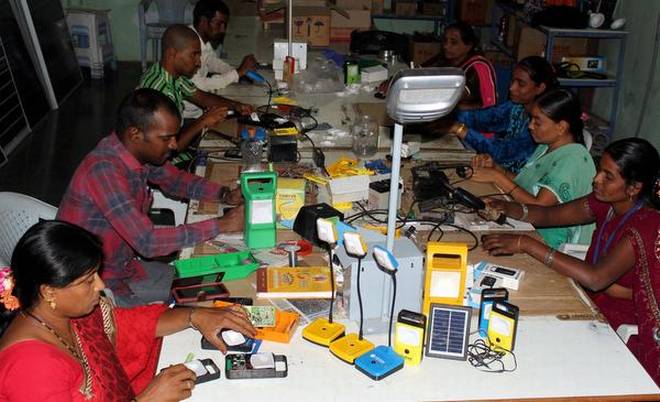
Zubeda Begum (extreme left) and her workers busy assembling solar lights in Sangareddy on Thursday.
Employs 15 divyangans led by Zubeda Begum
Sashikanth, who was affected by polio in childhood, never thought he could earn his living. But life has changed for better since the past three months, thanks to Divyangan Solar Society (DSS).
Led by Zubeda Begum, a differently-abled woman fighting for the rights of divyangans, the DSS has employed Sashikanth along with 14 others who are differently-abled to sell solar-powered lights. It has also given indirect employment to a total of 85 persons. So far, the Society has sold over 20,000 solar lights of different varieties.
Work begins at 9.30 a.m. and workers get ₹3,000 a month as salary. For many, more than the money they get by working here, it’s the respect that they earn by doing so that matters the most. “Everyone considers a differently-abled person a burden both on the family as well as the society. We don’t get jobs easily as the employers see certain limitations in what we can do and refuse to give us a chance to prove them wrong. It’s humiliating. That’s the reason why I began my fight for divyangans and their rights. I can say I have been partly successful in this regard,” Ms. Zubeda told The Hindu.
About two decades ago, she set up a public telephone booth, which took her almost a year, for self-sustenance. Given her grit to live life on her own terms, she was entrusted with the responsibility of running DSS after it was established in 2016. For the past two years, the Society has done business of ₹18 lakh. It produces 10 varieties of solar lights.
The DSS has also established its units in Mahabubnagar, Janagam, Manchiryal and Kamareddy.
source: http://www.thehindu.com / The Hindu / Home> News> Cities> Hyderabad / by R. Avadhani / Sangareddy – March 17th, 2018
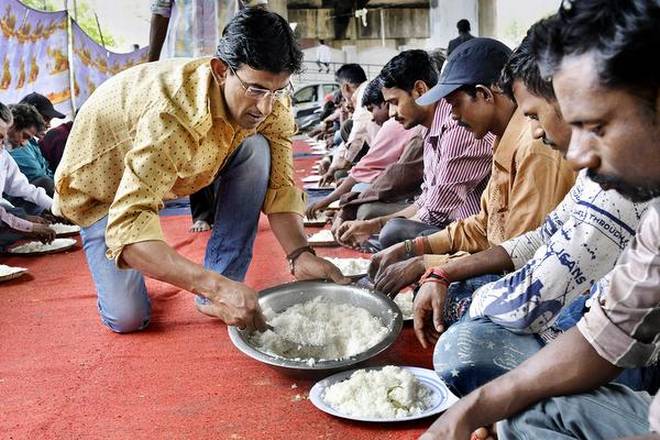
Hunger has no religion: Azhar Maqsoosi serving food to homeless under Dabeerpura flyover in Old City on Saturday.
Azhar Maqsoosi feeds the poor and homeless under Dabeerpura flyover every day
For nearly six years under Dabeerpura flyover, in the eponymous locality of Hyderabad’s Old City, a red carpet is laid out every day for the hungry and homeless. Plates are arranged and food from a makeshift kitchen is brought here. It is then that Azhar Maqsoosi, the man behind the ‘Hunger Has No Religion’ campaign begins to serve food to them as if they were his own.
On Saturday, the campaign entered 2,163rd day. Sitting in his modest one-room shop, the pensive 38 year old recounts the genesis of the campaign. “My father passed away when I was four years old. My mother raised me and my five siblings with much difficulty and there were days when we went hungry. Soon I realised what hunger was and that’s when I decided to fight it,” he says.
While the campaign had its humble beginning in the city, Mr. Maqsoosi says it has now spread to other States such as Karnataka, Uttar Pradesh and now, Assam. His Facebook page keeps his followers informed of the daily developments.
Speaking in the straightforward Dakhni idiom, Mr. Maqsoosi says the campaign was built on goodwill. The support of volunteers and collaboration from other organisations has taken it forward. “The dastarkhwaan at Dabeerpura and at Gandhi Hospital – which has entered the 896th day – is a daily affair. In Assam, it is weekly which is in its 30th week now. We have also partnered with an NGO in Bengaluru which is seeing its 505th day near Siddipura police station,” he says. Dastarkhwaan in Urdu means a table cloth or great spread – apt for Maqsoosi’s generosity. The typical meal is a simple fare of plain rice and Hyderabadi khatti daal. Sometimes, there’s zeera rice and occasionally bottle gourd gets added to the daal, just enough to satiate a person’s hunger. About 60 kilos of rice goes into feeding the hungry souls every day.
Mr. Maqsoosi’s work has attracted even the attention of Bollywood star Salman Khan. Last month, he was invited for an interaction with the actor. “The Being Human Clothing representatives informed me that I have been nominated to meet the actor. When I met Salman Khan, I told him how my wife and I began serving home-cooked food to the homeless in 2012 and today we serve food to around 300 people in Hyderabad alone. He appreciated our work,” he says.
Fund-raising has not been a problem for Mr. Maqsoosi except in the initial days. When people realised his genuine work, kindred spirits flocked to help. “My friends on social media have helped me a lot. They have always come forward for the cause. It’s only about the cause and nothing else. They understand that irrespective of faith, hunger is real. No person should sleep on an empty stomach,” he says.
source: http://www.thehindu.com / The Hindu / Home> News> Cities> Hyderabad / by Syed Mahamood / Hyderabad – March 17th, 2018
Rituals a mix of Hindu-Muslim traditions, says committee
The experts’ committee, constituted by the State government to look at the nature of rituals and worship at the controversial Bababudangiri shrine in Chikkamagaluru, has made it clear that Shah Khadri is the administrator of ‘Sree Dattatreya Bababudan Swamy Dargah’ and also the performer of the rituals.
The committee, headed by Justice Nagamohan Das, said the issue of management of the shrine was part of the “concluded findings” from the historical records.
Shah Khadri is Sajjada Nasheen (hereditary administrator) of the shrine. Syed Ghouse Mohiyuddin Shah Khadri holds the post at present.
The three-member committee submitted its report to the State government and the same has been accepted by the State Cabinet. The government has said that the report would be submitted to the Supreme Court, as the hearing of contempt petition against the government is coming up on April 6. Shah Khadri had moved the SC alleging that the government had been delaying to settle the issue, despite clear instructions from the court.
Ritual status
The committee, after verifying historical records and previous legal proceedings held since 1837, listed seven findings on the dispute. They include the name of the place (which is Sri Guru Dattatreya Bababudan Swamy Dargah) and location of the shrine on the hills. Both Hindus and Muslims are the devotees of the institution, it says. Regarding the rituals at the institute, the report states that the practice of reading Fateha, offering food items, placing flowers on the tomb and paduka, applying sandalwood paste, burning of incense, lighting of Nandadeepa, raising flags, beating of nagara (drums) and offering holy water to the devotees are performed by Shah Khadri. The institution is declared not a wakf property, but one under the jurisdiction of the Muzrai Department.
With regard to allegations against the administrator, the committee states that whenever Sajjada Nasheen committed acts of mismanagement, misappropriation etc., the Muzrai Department had taken action in accordance with the law.
Based on these findings, the committee rejected the Endowment Commissioner’s recommendations filed before the Supreme Court on March 10, 2010. The commissioner had recommended the appointment of a Hindu priest to offer prayers in accordance with Agama. Citing the Places of Worship (Special Provisions) Act, 1991, the committee opined that the Endowment Commissioner’s report was liable to be rejected. The Act prohibits a change in the religious character of any such place after August 15, 1947.
The Endowment Commissioner’s report had cited historian Suryanath Kamath’s article titled ‘KarnatakaDattatreya Aradhane’ to recommend the appointment of a Hindu priest. The experts’ committee stated that Mr. Kamath’s article was “not based on any authentic evidence.”
source: http://www.thehindu.com / The Hindu / Home> News> States> Karnataka / by Sathish G.T. / Chikkamagaluru, March 15th, 2018
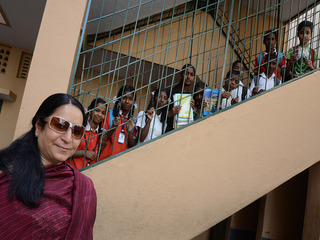
Dr Iffat Faridi, a social activist is trying to urge the government to include Kannada Language in Open School System as the poor and Kannada Medium School Children are facing difficulties in continuing their study in Open School System.
Educationist Iffat Faridi wants NIOS to alter its policy so that vulnerable students can go beyond Class 9 — the last class where they are given questions in Kannada
For students like Maya, a Std 4 dropout from a Kannada medium school, the National Institute of Open Schooling (NIOS) would seem like a Godsend.
Far removed from the rigid structure of conventional schools that require compulsory attendance, the NIOS allows for students to have access to education, with many conveniences, distance being one of them.
When Maya, who could read, write and speak fluently in Kannada, heard about the NIOS, she thought it was a dream come true. She could continue her education despite the gap and her long-cherished dream of getting a school certificate would be fulfilled. However when she decided to enroll herself in NIOS for the Std 10 exam, she realised that Kannada was not included as the medium of instruction for Std 10, although up until Std 10, it is. At the Std 10 level, students like Maya would have to choose either Hindi or English as a medium of instruction, for study material and for questions papers.
However, she was told that she could answer the question paper in Kannada since she was not fluent in Hindi or English.
The most crucial exam of a student’s life had become a battle of languages.
Fortunately, students like Maya, have in Iffat Faridi, an educationist and a resident of Bengaluru, a saviour who understands the challenges of studying in one language and being tested in quite another. And Faridi is leading the fight for giving girls like Maya the advantage of doing their Std 10 exams in a language they have fluency in.
Besides taking education to the people from underprivileged sections of society, Faridi is championing the cause to have Kannada as one of the languages of instruction in the NIOS system for Std 10.
Speaking to BM, Faridi said, “A blessing in disguise, the National Institute of Open School plays a pivotal role in the distance education system of India. It is a ray of hope for children who are not fortunate enough to join regular schools or who could not continue their schooling. Despite its obvious significant contribution to the Indian education system, NIOS has a serious issue in its system which needs to be highlighted and must be resolved,” she added.
Not just Maya…
She recounts the story of Renuka, a child of a migrant labourers from Gulbarga district, who is facing similar issues. Renuka started her schooling almost at the age of 10, after going through bridge courses based on modules developed by the Azim Premji Foundation in Kannada, Environmental studies and Math. She was admitted to a Kannada medium school, and initially enrolled in Std 1 as per rules. Later, based on performance tests conducted by the school, she was promoted to Std IV. At the moment, the 14-year-old wants to apply for Std 10 exams through NIOS and she faces the same issues as Maya. She has good command over Kannada but will have to master Hindi or English to learn the study material.
Faridi’s fight
Says Faridi, “Lack of study material in Kannada is a huge setback and injustice to the aspirations of those children who have done schooling purely in Kannada medium. Kids referred to NIOS belong to a class where parents are daily wagers. They earn very little and that too after working very hard from morning till evening. These children have taken the initiative for further education, on their own. Having travelled a fair distance on the road to being fully literate, they are facing setbacks in their path due to non-availability of study material in Kannada. They need full support from NIOS to pursue their dream of completing their education and get on a career path.”
NIOS reacts
When BM contacted Chandrashekar S, director of NIOS, Bengaluru branch, he said, “There is Kannada up to 10th. The 10th class study materials and examinations will be bi-lingual and the students can answer in Kannada. There is no problem in that. The next set of Kannada books are getting ready. Once it is released, students will be getting it.”
KDA slams the system
Reacting to the limitations for Kannada medium students in NIOS, SG Siddaramaiah, Chairman, Kannada Development Authority told BM, “What kind of unscientific methods are these? How can someone who knows only Kannada be made to read in English or Hindi and again write answers in Kannada? How is it even possible? Who is going to punish these type of people who deny access to education to Kannada medium students? This is coming to light now. What about all these years? Thousands of children have been denied education only because of this option.’’
While Faridi continues her fight with NIOS, she’s preparing her students to brace themselves for the language challenge ahead. She has already brought Hindi books from Delhi to prepare her students to learn from study materials in Hindi and English at the Std 10 level.
Why Open School?
Students who fail to qualify for regular school or are unable to pass a class despite multiple attempts have the option of completing studies through Open School. Also, mature students who wish to return to school after a break in studies or those children who have to shoulder the family’s burden pursue studies through Open School.
Are questions set only in English or Hindi?
No. Seven other options are available apart from English and Hindi. These are Urdu, Marathi, Telugu, Gujarati, Malayalam, Odia and Tamil. Note that all South Indian languages are available except for Kannada.
Can they learn and answer in Kannada?
Yes, but only till Class 9. In Class 10, the questions are set only in Hindi or English which is highly unfair for students already struggling with the system.
How many students benefit from Open School?
Last year, 1,64,192 students completed Secondary (equivalent to Class 10) through Open School. Around 500 students study in Kannada each year.
source: http://www.bangaloremirror.indiatimes.com / Bangalore Mirror / Home> Bangalore >Cover Story / by Kumaran P, Bangalore Mirror Bureau / March 16th, 2018
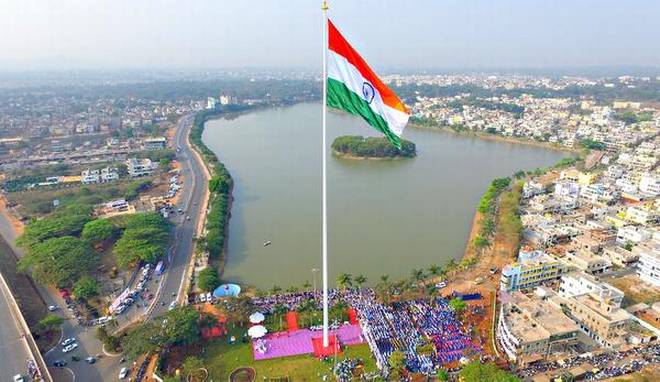
Proud moment: The 110 m tall monumental flag being inaugurated by district in-charge Ramesh Jarkiholi in Belagavi on Monday.
The 110 m tall flag post at Kote Kere is near the historic Belagavi fort
It was a joyous morning in Belagavi on Monday. Schoolchildren, NGO members, leaders and others gathered at the Kote Kere lake front to witness a unique celebration: the unfurling of what is claimed to be the country’s tallest national flag.
The 9,600 sq.ft flag on a 110 m flag pole was unfurled by Ramesh Jarkiholi, District in-charge Minister.
Religious leaders of Hindu, Muslim, Christian and Sikh institutions were present. MLA FirozSait, who has been pushing for the project, was present along with other district officials.
Mr. Jarkiholi said the flag was a testimony to the culture of harmony and togetherness of Belagavi. “BJP is not the sole custodian of nationalism. We are all proud Indians. We respect the principles of unity and harmony enshrined in the Constitution. India is a country of many faiths and all are equal here,” he said.
Mr. Sait observed that various religious and social and cultural groups had flags of different colours, but the national flag symbolised the cultural unity of all. He described this as a historic day and said the people of Belagavi had one more reason to be proud of their city.
Deputy Commissioner S. Ziyaullah, Police Commissioner D.C. Rajappa, ZP CEO R. Ramachandran, City Corporation Commissioner Shashidhar Kurer, Maratha Light Infantry regimental centre officers, and others were present.
The 110 m tall flag post at Kote Kere is near the historic Belagavi fort in the city. It is taller than the post in Pune (107 m) and the one at the Indo-Pak border at Attari (105 m).
“The monumental flag will be flown at all times, and will be well-lit at night. It should be seen by residents of Belagavi from afar and remain visible at all times,” Mr. Sait said.
The flag is made of weatherproof Denier polyester fabric. Two shorter poles with flood lights have been erected around the flag.
Permission granted
Following a judgment of the High Court of Bilaspur in 2010, the Union Home Ministry allows the flying of national flags beyond sunset. However, these flags are considered monumental flags and special permissions are issued on a case by case basis. The Union government has issued a permission for the Belagavi monumental flag.
The Belagavi City Corporation has completed the work under the Chief Minister’s special grant. The flag post is 2 m in diameter at the base and 0.6 m at the top. It has a three horsepower motor to raise the flag to the top.
New park
A park will come up in 1.5 acres around the flag. A committee comprising citizens, district administration, revenue, police and cantonment board officials will be formed to manage the park.
Earlier, the plan was to erect the flag post on an island in the centre of the lake. However, the soil there proved unstable for such a tall structure. Hence, it was shifted to the bank, an officer said.
Five flags
Officers are keeping five flags on standby. “Khadi fabric could not be used for the flag as looms cannot produce a flag of that size and the flag code does not allow stitching of small pieces,” a city corporation engineer working on the project, told The Hindu.
Officials have got Civil Aviation Ministry’s permission to fly the flag that within 25 km of the Sambra airport. A red light is affixed on top of the post to indicate its height to pilots.
source: http://www.thehindu.com / The Hindu / Home> News> States> Karnataka / by Special Correspondent / March 13th, 2018