Category Archives: Community Involvement / Social Issues

College that put poor Muslim girls in science labs turns 50

Mumbai, MAHARASHTRA :
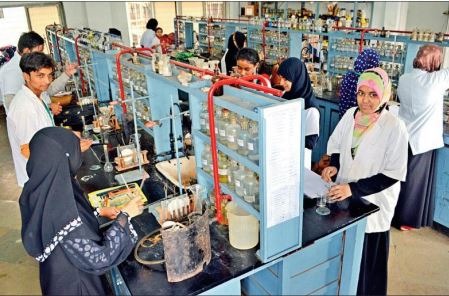
The institution located near Nagpada in central Mumbai, has shaped four generations of Muslims

The first thing that strikes you after entering the arched gate of Maharashtra College of Arts, Science and Commerce is its happy ambience. Groups of girls, many of them in hijab, and boys animatedly chat at the ground floor hall while the seven-storey building’s two lifts are constantly busy. The well-stocked library is occupied. So are its several labs. In a nutshell, vibrancy oozes out of its every pore. So how is Maharashtra College different from so many educational institutions in the city? The difference lies in its location. In the vicinity of Kamathipura, the red-light area, and near Nagpada, the heart of Muslim neighbourhoods in the city, Maharashtra College at Central Mumbai has shaped the fortunes of four generations of Muslims, especially girls, in the area.

Started in 1968, the college will soon kick off its golden jubilee celebrations and has lined up a series of programmes aimed at debating how to further empower the locality’s youths educationally.

“But for this college, thousands in the area would have dropped out after 10th Std. Conservative parents were reluctant to send their daughters to colleges in south Mumbai and this college came as a godsend,” recalls businessman and community leader Ghulam Peshimam who graduated from here in the 1970s.

It was the sheer need of a college in the Muslim-dominated area that made its founding fathers move with a missionary zeal. Educationist and philanthropist Mohammed Ali Mitha, who had founded a series of schools, led the initiative to set up a college in the locality which had none before it. Muslim-managed colleges like Burhani and Akbar Peerbhoy came later. Mitha one day landed up at then urban development minister and Islamic scholar Dr Rafiq Zakaria’s office. “Zakaria sahab was initially reluctant to come on board but couldn’t say no once Mitha assured him of finding funds and also offered him to become the life-time president of Khairul Islam Higher Education Society which runs the college,” says septuagenarian Haji N Kalaniya, who studied and retired as a teacher from here before he was inducted as the society’s general secretary.

Kalaniya recalls that once he accompanied Mitha to Haji Ali Dargah where they saw a wealthy Good Samaritan handing out Rs 100 note to each of the beggars assembled there. “Mitha stood in the queue and asked me too to stand behind him. The Rs 200 that we received went to the college funds,” laughs Kalaniya.

Started with just 100 students, Kalania adds that many students had to be coaxed and virtually “lifted” from homes to join the college as the working class in Madanpura, Nagpada and Bhendi Bazaar then gave little importance to higher education. Today the college, its principal Dr Sirajuddin H Chougle proudly informs, has over 3,700 students in various courses, including PG and PhD, IT and journalism. It caters to mostly students from deprived families, wards of daily wagers, taxi drivers, factory workers. “Once while travelling in a taxi the driver told me that his three daughters had graduated from here. I was touched to hear that,” says M Z Shahid, who teaches political science here. “If it was not this college I don’t think I would have become a boxer,” says Hijabclad Shaikh Afifa, the college’s only woman boxer. Besides, the list of sportspersons it has produced is long: Shahid Qureishi and Zafar Ansari (basketball), Khalid Khan (boxing), Nadeem Khan (football)—to name a few.

If Mumbai has been a crucible of many Urdu poets and writers, Maharashtra College must share the credit. It is here that Urdu poets like Abduallah Kamal, Irteza Nishat, Shamim Abbas and Obaid Azam Azmi honed their skills.

“I once heard celebrated poet Faiz Ahmed Faiz here reciting his famous revolutionary poem which spoke of man’s urge for emancipation. The college has kept the city’s literary lamp alive,” says Urdu Markaz’s director Zubair Azmi. As it enters its 50thyear, the city expects the college to earn more laurels in future.

source: http://www.timesofindia.indiatimes.com / The Times of India / News> City News> Mumbai News> Schools & Colleges / by Mohammed Wajihuddin, TNN / July 30th, 2017
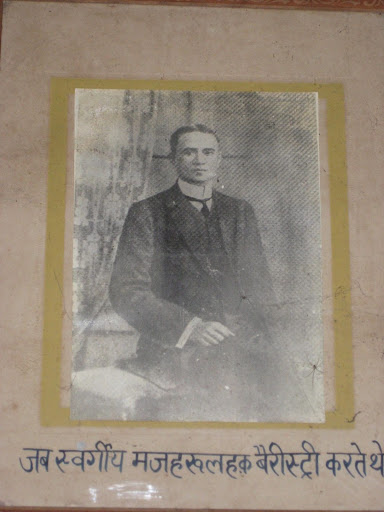
Maulana Mazharul Haque: A forgotten leader of Bihar

Bihar, PATNA :

Maulana Mazharul Haque, the man who was a firm believer in complete Independence being “the birthright of every Nation”, has his birth place in office of a government run school that doubles as food storage.

Maulana Mazharul Haque was born to a rich landlord, Sheikh Ahmedullah, in Bahpura, Thana Bihta of Patna district on December 22nd, 1866. His primary education was at home by Maulvi Sajjad Hussain, but he passed his matriculation from the Patna Collegiate in 1886. He joined Canning College in Lucknow for higher studies but same year left for England to pursue a course in Law. He started legal practice in Patna after his return from England in 1891.

MazharulHaque01MPOs29jul2017

He made a significant contribution to relief efforts launched during the famine in Saran district of Bihar in 1897. Maulana Mazharul Haque’s public life actually commenced with the creation of the Bihar Provincial Conference, a move he supported as he believed in the need for the constitution of Bihar as a separate province.

In 1906 Maulana was elected Vice Chairman of Bihar Congress Committee. Mazharul Haque helped organize the Home Rule Movement in Bihar and was its President in 1916. He actively participated in the Champaran Satyagraha for which he was sentenced to 3 months imprisonment.

Subsequently, when the Non Cooperation and Khilafat Movements were launched, Mazharul Haque gave up his lucrative legal practice and his elected post as member of the Imperial Legislative Council and turned all his efforts to the freedom struggle. By now, he was a firm believer in complete Independence being “the birthright of every Nation”.

Mazharul Haque was also a fervent believer in democratic decentralization and he organized the Panchayats in Saran district towards meeting this vision. He also made many requests for better educational facilities in Bihar, especially for free and compulsory primary education.

Maulana Mazharul Haque actively participated in anti-purdah movement launched in Bihar in response to the Non-Cooperation Movement of 1920. Mahatma Gandhi sought to bring women also into mainstream politics, to strengthen the resistance against British rule as well as empower them to play a more active role in society. The purdah system espoused by Muslim and many Hindu families, especially in Bihar, meant that women remained behind men in all spheres of life.

MazharulHaque02MPOs29jul2017

In 1919, he gave up and burnt his western attire to adopt traditional Muslim attire. He was given title of “Desh Bhushan Faqir Mazharul Haque”.

1920, he donated his 16 bigha land on Patna- Danapur road for Sadaqat Ashram and Vidya Peeth which served as college for students who left government colleges in response to Non-Cooperation Movement. Sadaqat Ashram played important role in Independence movement in Bihar.

Maulana also launched his weekly magazine “The Motherland” from Sadaqat Ashram. He also jailed for his articles in this magazine. Sadaqat Ashram continues to serve as headquarters of Bihar Congress. But it is a tragedy that even Congress do not remember the person who has given so much to the party. Till few years back, even Maulana picture was now where to be seen in the ashram.

Maulana was firm believer of Hindu-Muslim unity. His famous quote sums up his conviction, “Wheather we are Hindu or Musalmaan we are in the same boat, we must sail or sink together”.

When in London, Maulana established Anjuman Islamia. This brought Indians of various religion, region and sects under one umbrella. This was also place to discuss about India’s problem. Mahatma Gandhi first met Maulana Mazharul Haque in Anjuman Islamia, London.

Person who gave everything for the country has not got due recognition. Maulana donated the house where he was born, to start Madrasa and middle school within same compound in 1926. Idea behind establishing both in one campus was to promote communal harmony.

MazharulHaque03MPOs29jul2017

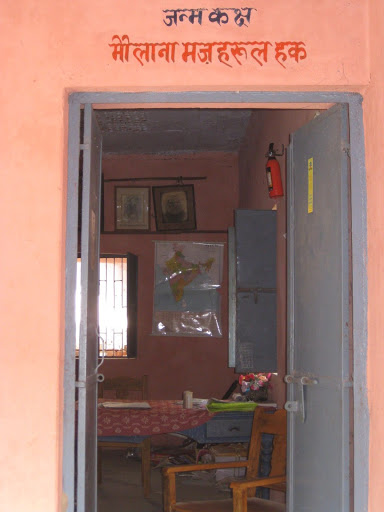
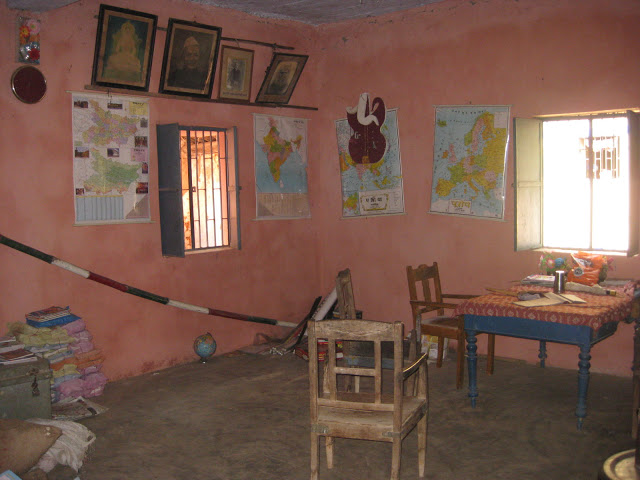
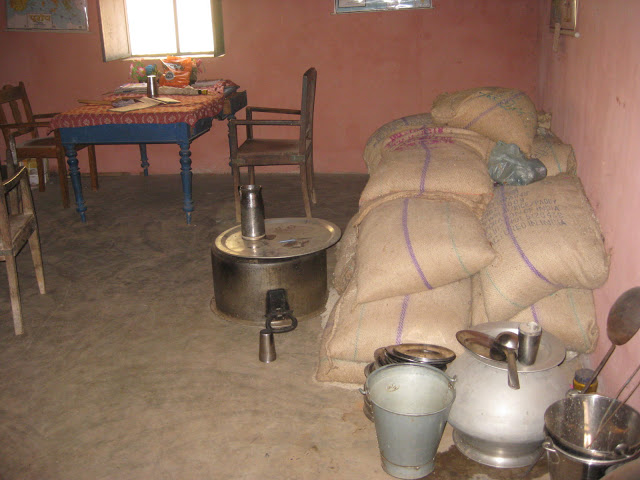
Now the very place where he was born is a principal office of government middle school. On the entrance door of principal office, a line is written in Hindi “Janam Kachh Maulana Mazharul ”(Birth place of Maulana Mazharul Haque). If you enter in the office apart from a picture of Maulana Mazharul Haque along side Dr. Rajender Prasad picture will not give any indication of place being birthplace of a person of such stature. Principal office house the ration for mid day meal scheme for the school apart from general school office stuff.

MazharulHaque04MPOs29jul2017

But this is an improvement from before. Before this school structure was build in 2004, place he was born was used as a toiler for villagers after original structure fell down. Because of the effort for few locals, this place was cleaned up and school building was build and place was marked as birth place.

MazharulHaque05MPOs29jul2017

On December 22nd politicians do come to shower words of praise on Maualana’s contributions but the pity condition of place has not moved anyone. Their promise has remained promise till date.

While talking to TwoCircles.net, Md. Yusuf Khushidi, former HOD Urdu department, Patna University said, “Locals have been demanding to build Library or Technical Institute in that place to commemorate but so far nothing has materialised.”

Yusuf Khhurshidi who belongs to Bahpura added, it is unfortunate that for a person, who sacrificed every thing for the country has been forgotten so fast. Maulana foresightedness can be judged by the fact that Maulana had emphasized on the communal harmony, democratic decentralization and education right from early stage of his life. Maulana was also in the forefront in establishing Bihar state which was carved out of Bengal.

Echoing Yusuf Khurshidi sentiments, Dananjay Yadav also demanded a memorial should be built for the one of the tallest visionary leader of Bihar.

Maulana’s family is living a struggling life in obscurity. It is disheartening to see family of a person who sacrificed everything from career to wealth for the sake of county is left high and dry.

Next birthday of Maulana Mazharul Haque is a month away. I am sure VIPs will be lining up to pay respect especially in election year. Few fascinating speeches will be delivered and few promises will be made. Politicians are known to have short term memory. So those promises will be forgotten sooner than later.

People in India too have selective memory, only very few are remembered for their part in freedom struggle and rests are still struggling to get freedom from obscurity.

source: http://www.twocircles.net / TwoCircles.net / Home> Indian Muslim / by M. Zajam, TwoCirlces.net / November 20th, 2009

Mangaluru : While on this bus , learn how to file IT returns

Mangaluru, KARNATAKA :

Ibrahim Thabreez, 23, has equipped his bus with WiFi and offers free tax consultation

Owner of a private bus in Mangaluru encourages people to file IT returns by offering information and free consultation

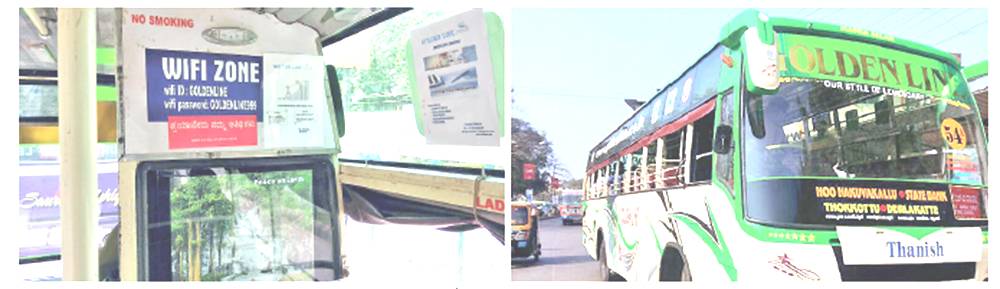
After offering free Wi-Fi services on a private city bus, a Golden Line bus that runs between Mangaluru city (State Bank of India Bus Stand) and Hoo Hakuvakallu near Konaje will offer free consultancy services on several issues such as GST, linking PAN with Aadhaar, filing IT returns and how to go about it.

Ibrahim Thabreez, a 23-year-old MBA graduate working as an export executive at Sharief Marine Product Private Limited decided to spread awareness on the subject. Thabreez‘s family is into transport business and they own about three city buses.

Speaking to Bangalore Mirror, Thabreez said, “People panic when they hear the word tax. Now, with GST, the panic has only increased. I am campaigning so that people come forward and file their returns. I explain to them the benefits of filing returns and how to go about it. For this, I have pasted posters inside the bus. I thought this is the right time to spread awareness as there are few days left to file returns for the last financial year. I addition, I am helping people with getting a PAN card, as well as linking it to their Aadhaar cards and bank accounts,” he said.

The non-salaried class often try to avoid filing returns. “I have provided my mobile number on the posters on the bus. While I guide them for free, in case they want me to take it further and get them a PAN card, I will do so only by charging a fee prescribed by the government. Regarding IT returns, I can guide them on the taxable amount and how to go about filing e-returns. In case they insist that I file it for them, I can provide the services at my office at a reasonable fee,” he said.

When JIOFi was launched earlier this year, Thabreez saw to it that a device was placed inside the bus so that people could use WiFi for free. Though the free offer has ended, they use upto 5 GB data in the bus every day.

source: http://www.bangaloremirror.indiatimes.com / Bangalore Mirror / Home> News> State / by Deepthi Sanjiv, Bangalore Mirror Bureau / July 27th, 2017

Syed Ghayorul Hasan Rizvi assumes charge of Chairman of National Commission for Minorities

UTTAR PRADESH / NEW DELHI :

Syed Ghayorul Hasan Rizvi assumed charge of the Chairman of the National Commission for Minorities in New Delhi today. After assuming the charge, Shri Rizvi said that the Commission will work for the welfare and development of minorities.

Syed Ghayorul Hasan Rizvi is a graduate in Arts and also holds Diploma in Mechanics. He served as Chairman, U.P Minority Finance Development Corporation Ltd.
Shri Rizvi has been actively participating in social service. He worked for the improvement of the basic facilities and working conditions of Beedi workers and Weaver community in Uttar Pradesh. He also worked for Communal Harmony and National Integrity.
BCK/AK
source: http://www.pib.nic.in / Press Information Bureau, Government of India, Ministry of Minority Affairs / May 26th, 2017

Shah Faaiz Alam, an AMU Mechanical Engineering Postgraduate to join Indian Air Force

Aligarh, UTTAR PRADESH :

ShahFaizMPOs26july2017

Aligarh :

Bringing string of accolades to the Aligarh Muslim University (AMU), one after the other; Shah Faaiz Alam, a Mechanical Engineering Postgraduate student of the Zakir Hussain College of Engineering and Technology, AMU has been selected by the Indian Air Force under Permanent Commission for the Aeronautical Engineering (Mechanical) Branch.

Alam, earlier brought laurels to his alma mater by getting recommended by Air Force Selection Board, Dehradun. Alam achievements did not stop there as he later made it to the All-India merit list securing 5th All-India rank under the technical stream.

He will now be joining the Air Force Academy, Hyderabad in July for the commencement of training for a period of six months. Alam will be further sent to Air Force Technical College (AFTC), Bangalore for further advanced technical training of 52 weeks under the rank of ‘Under-Training Flying Officer’.

Professor Mohd Altamash Siddiqui, Chairperson, Department of Mechanical Enginneering and Dr Nafis Ahmad II have congratulated Mr Alam for the achievement.

source: http://www.twocircles.net / TwoCircles / Home> Indian Muslim / by TCN News / July 03rd, 2017

The Wildlife And Nature Conservation Trust (WNCT), Ooty

Ooty, TAMIL NADU :

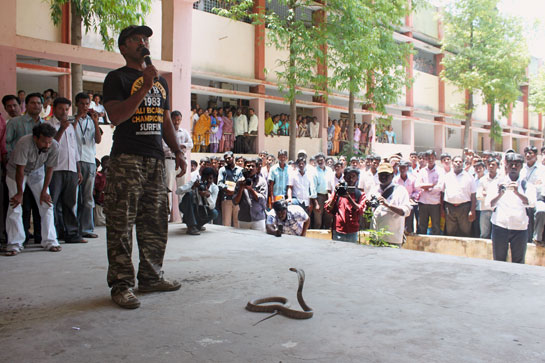
Sadiq Ali’s fascination for animals began in childhood and became his life’s mission. Ali, who was born in 1966 near Chennai, belonged to a family in the leather business. As a result, he often saw taxidermists and tanners visiting his house to meet his grandfather. He also had the opportunity to interact with Irulas (a local tribe) who lived nearby.

Photo Courtesy: WNCT.

From them, he learnt to handle snakes at a very young age. Not surprisingly, he graduated as a leather technology professional, and moved to Ooty in 1991 after which he began taking more interest in conservation-related activities. In 2012, he decided to dedicate his life to the conservation and protection of wildlife and founded the Wildlife and Nature Conservation Trust (WNCT).

WNCT’s mission statement is, “We have not inherited the earth and her wild heritage from our forefathers, but borrowed it from our future generations. Hence it is the duty of all citizens to protect the last few remaining forests of this country.”

The Ooty-based NGO works in the Western Ghats, one of the largest forest areas in south India. With several rivers and streams originating from the Nilgiris, this is a vital watershed for south India. The region is also home to around 6,000 elephants and many other critically-endangered species of flora and fauna.

As in other parts of the country, these forests face direct and indirect threats from humans. Encroachment of forest land by the land mafia is on the rise. So is pollution caused by garbage dumped into rivers and forest land. Poaching of wildlife has severely affected the populations of many species. Sand and granite mining and other construction activities continue unabated. The forest is becoming increasingly fragmented leading to man-animal conflict. WNCT is actively addressing all of these issues.

Though WNCT is a young organisation, its founder Ali has been involved in rescue and rehabilitation of wildlife in the Nilgiri biosphere for over a decade. WNCT helps bridge the divide among stakeholders like the Forest Department, local communities and the general public. It also supports the Forest Department through capacity-building initiatives such as camps and seminars. WNCT runs a round-the-clock rescue team, which helps concerned authorities mitigate conflict scenarios. They have carried out scores of successful rescue and rehabilitation missions.

“We have an effective team of members that quickly responds to calls regarding wild animals entering human habitations or in distress. They are well trained to handle such situations and there are many instances when government authorities and local communities take help from us to resolve conflict situations,” says Ali.

WNCT believes in an inclusive working style, actively engaging with stakeholders and enforcement authorities. They have a network of informers and volunteers who watch for illegal wildlife activities. They are also actively involved in seizing wild animals in illegal possession and highlighting such cases. These animals are released into their natural habitats after requisite medical treatment.

WNCT understands that investing in conservation-awareness drives for the younger generation and local communities are vital for a secure future. They impart conservation awareness to students and local communities whenever an opportunity arises. They feel that more people should be empowered in conservation activities.

“We work extensively with colleges and educational institutions to make young minds understand the importance of protecting nature. Conservation requires a lot of passion, love, experience and resources and we would like to work with like-minded NGOs to further the cause,” says Ali.

WNCT needs a SUV which will help their rescue team reach inaccessible locations faster. Contact them if you know someone planning to sell their SUV or would like to donate one. If anyone wishes to volunteer or share information about the illegal trade or captivity of wildlife, they can email WNCT on info@wnct.in.

Wildlife and Nature Conservation Trust
No. 97, 2nd Floor (Ooty Coffee House Building), Commercial Road
Ooty – 643001, Tamil Nadu, India.
Tel.: +91 96550 23288
For more information, visit: www.wnct.in

Author: Anirudh C. Nair

First appeared in: Sanctuary Asia, Vol. XXXIII No. 5, October 2013.

source: http://www.sanctuaryasia.in / Sanctuary Asia / Home> Resources/ NGO Profies / by Anirudh C Nair / Volume XXXIII No.5, October 2013

Valpoi gets new deputy chairperson

Valpoi, GOA :

Bicholim:

Sayyed Sarfaraj has been elected as the new deputy chairperson of Valpoi municipal council (VMC), the polls for which were held on Wednesday. The post had fallen vacant after former sarpanch Shehnij Shaikh resigned on June 12.

In the absence of any other nomination, Sarfaraj was elected unanimously.

Shripad Arlekar was the presiding officer for the polls, while chairperson Parvin Shaikh, and councillors Akhtar Shaha, Ramdas Shirodkar, Anil Katkar, Parveen Khan, Anjali Chari, Shehnij Shaikh were among those present.

Sarfaraj said he will work with others under the guidance of health minister Vishwajit Rane.

source:  http://www.timesofindia.indiatimes.com / The Times of India / News> City News> Goa News / TNN / July 07th, 2017

Repackaging 1,000-yr-old ideas to revive a system of medicine

Malegaon (Mumbai) , MAHARASHTRA :

The system’s beginnings can be traced to the teachings of ancient Greek physicians like Hippocrates, and its principle revolves around strengthening the ‘Quwwat-e-Mudabbira-e-Badan’ (immunity).

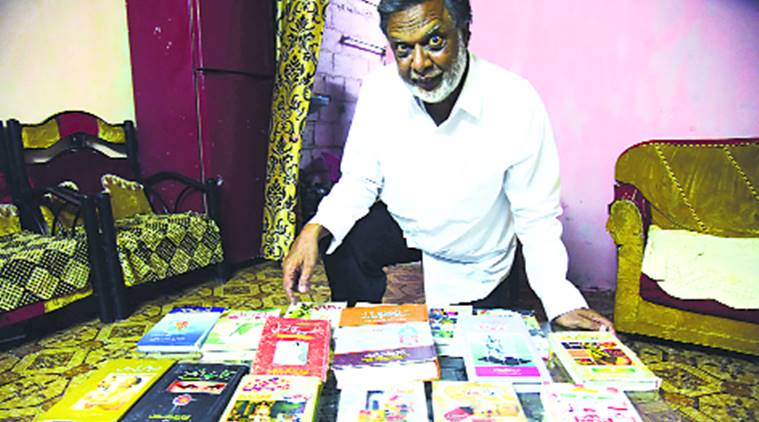
Dr Yusuf Ansari has authored over two dozen books which are used by Unani and MBBS students across India. Mayur Bargaje

The Unani system of medicine, which was introduced by the Arabs and Persians sometime in the 11th century, is said to be dying a slow death. Though India is still one of the leading countries in Unani medicine today, with the largest number of educational, research and healthcare institutions, the number of Unani practitioners here is far less than what it was in the past. In Maharashtra, a doctor has been making efforts to make Unani medicine system more relevant and accessible in contemporary India. Dr Yusuf Ansari, a 62-year-old resident of Malegaon, has authored over two dozen books in the past two decades which are used by Unani students across the country. The books are based on the Unani medical curricula laid down by the government, but some of them, like the ones on physiology, surgery and pathology, are also referred by MBBS students.

The system’s beginnings can be traced to the teachings of ancient Greek physicians like Hippocrates, and its principle revolves around strengthening the ‘Quwwat-e-Mudabbira-e-Badan’ (immunity). The foremost book on Unani — ‘The Canon of Medicine’ — was written by Avicenna in the ninth century. While Avicenna’s works were followed by other writers as well, the content and language of these books made them a bit difficult for students to follow. “All these books are scholarly pieces, but seeing that many students found these books a little difficult to follow, I attempted to write a book which would be in tune with the contemporary times and would be lucid and understandable for students as well,” said Ansari.

Ansari’s first attempt was a book called ‘Tahafuzz-e-Tibb’, or preventive and social medicine. “The idea was to link the concept of Unani medicine with contemporary medical problems. I wrote the book to make this effective medical form understandable and more relevant. The book, however, was published only in 1996 after which I was asked to write more on the subject,” said Ansari.

Interestingly, Ansari’s primary degree has not been in Unani medicine. Coming from a very humble background, Ansari gained an MA in English, and for a time used to work for Rs 20 per week. He eventually joined a Unani college as an English language teacher to make ends meet. It was only in his 30s that Ansari’s interest in Unani medicine peaked and he decided to pursue a degree in it at the same college where he taught English.

Apart from Unani medicine, Ansari also writes in various science journals on subjects such as electronics and information technology. Ansari believes that education is the only way to empower communities in the country. His son Mohammad is the first IITian to emerge out of Malegaon. His sister Dr Zubaida Ansari was the first female scientist from Malegaon and is now a part of Jamia Millia Islamia’s Centre for Interdisciplinary Research in Basic Sciences. His nephew Aleem Faizee runs a popular community website in Malegaon. “Today, this medicinal system is suffering because it is seen to be associated with a certain community. My attempts have been to ensure that people open their minds and see things for what they are really worth,” says Ansari.

source: http://www.indianexpress.com / The Indian Express / Home> India / by Zeeshan Shaikh , Malegaon / July 10th, 2017

Rayalaseema IG takes charge

Rayalseema, ANDRA PRADESH :

ShaikIqbalMPOs14jul2017

New SPs assume charge in Tirupati, Vizianagaram

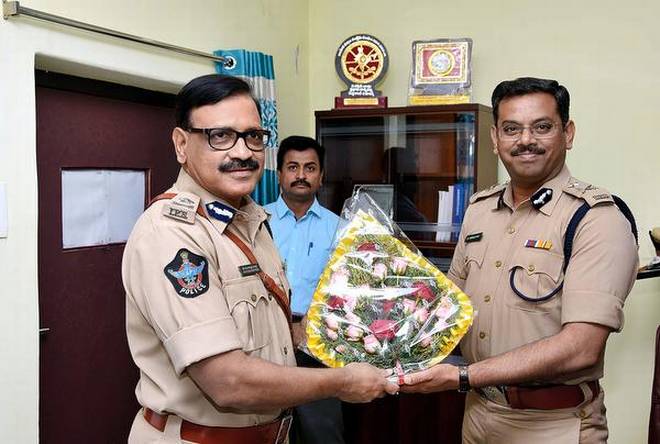
Shaik Mohammed Iqbal took charge as Inspector-General of Police, Rayalaseema, in Kurnool on Monday from N. Sridhar Rao, who has been transferred.

DIG of Anantapur Range J. Prabhakara Rao, Superintendents of Police – Gopinath Jatti (Kurnool), Rajasekhar Babu (Chittoor), Attada Babujee (Kadapa) – APSP Battalion Commandant Samuel John, Regional Vigilance and Enforcement Officer Sivakoti Babu Rao, Additional SPs P. Shaik Shavali and I. Venkatesh, Circle-Inspectors and SIs welcomed Mr. Iqbal with bouquets.

Later the officials gave a warm farewell to outgoing IG N. Sridhar Rao by felicitating him with shawls and garlands in the police guest house here.

In Tirupati, Abhishek Mohanty, a 2011 batch IPS officer, took charge as the Superintendent of Police of Tirupati Urban police district, here on Monday. Speaking to the media, he said that their focus would be on implementing the ‘rule of law’ along with basic/professional policing.

In Vizianagaram, G. Pala Raju has taken charge as Superintendent of Police from his counterpart L.K.V. Ranga Rao on Monday.

Later, talking to media persons, Mr. Raju said that he would improve community policing and other programmes that his predecessor had initiated for the welfare of people.

In Kurnool, Traffic will be streamlined in coordination with officials of the Kurnool Municipal Corporation, Roads and Buildings, National Highways, citizens and NGOs, Kurnool Superintendent of Police Gopinath Jatti has said.

source: http://www.thehindu.com / The Hindu / Home> National> Andhra Pradesh / by Special Correspondent / Kurnool – July 04th, 2017

How An Act Of Kindness By An Indian-Origin Muslim Helped A Man To Become Top Jurist In South Africa

SOUTH AFRICA :

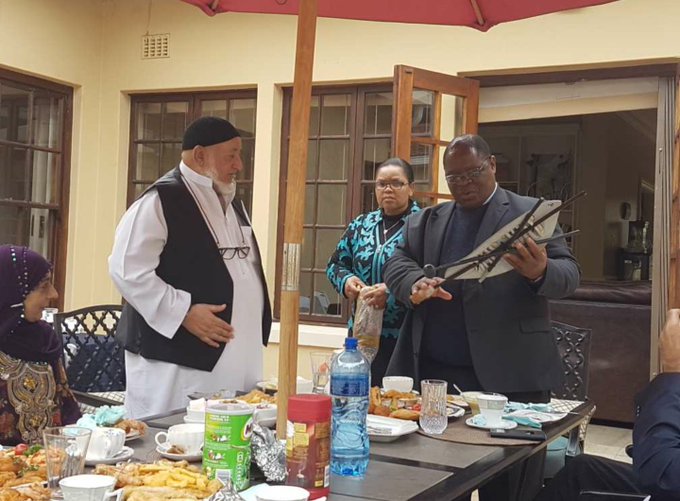
An Indian-origin shopkeeper based in South Africa became an overnight sensation after the new deputy chief justice recalled his generosity over four decades ago when he was looking for a loan to fund his studies.

TWITTER
TWITTER

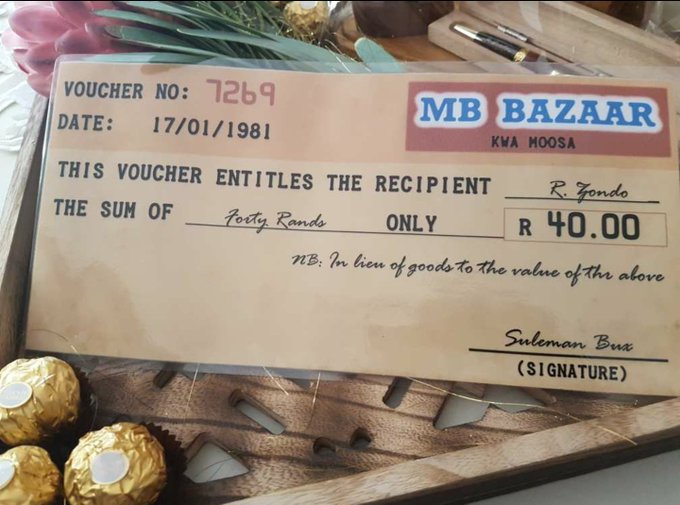
Suleman Bux, 76, who at that time ran a small general store in Ixopo town, had forgotten about the young man with whom he had struck a deal to be a good student by giving him groceries for his family so that they could save what they would have spent on this for his studies.

Judge Raymond Zondo, 57, who has been recently appointed as the Deputy Chief Justice of the Constitutional Court, recalled how he had sceptically approached Bux when he started his studies in 1981, unsure of whether he or anyone else would give a loan to a 20-year-old man.

Zondo approached Bux, without telling his family and helped him with groceries for his family.

View image on TwitterView image on Twitter

Reunion after over 30 years, Judge Raymond Zondo & Suleman Bux 😀 Absolutely love this..Faith In Humanity Restored😎@KhayaZondo73 –  ✌🙏

Zondo’s emotional video at his installation to the second highest judicial post in the country recently went viral as he recalled Bux’s influence on his life, expressing a desire to meet him again after the fasting month of Ramadan was over.

Zondo met with Bux and his extended family to thank him personally. Bux shrugged off the huge media attention.

“He gave me a very nice watch, which was very generous. I was moved by the gesture,” Bux told local media, adding that he had not expected the issue to have received as much attention as it did.

After he began earning, Zondo tried to repay Bux but the shopkeeper, who is still running a wholesale store, told Zondo to rather finance some other young students.

“I helped him because it was the right thing to do. As a Muslim, helping others is important, but you do it because you want to, not because you want recognition and for everyone to know,” Bux added.

source: http://www.indiatimes.com / Indiatimes.com / Home> News> India / IndiaTimes / July 11th, 2017