Category Archives: Community Involvement / Social Issues

Seeking Malihabad’s Jewish connect

Lucknow :

Straight aquiline noses, fair skin colour, chiselled features and a probable connection with the Ten Lost Tribes of Israel could be an addition to the identity of Afridi Pathans who have been dwelling in various parts of the erstwhile Awadh since centuries. In a quest to trace the lineage of exiled Israeli tribes, Jewish scholars from the far-off land of Israel have been guests to Malihabad over the years. Attracting world attention yet again, Malihabad will host Dr Ari Greenspan and Rabbi Dr. Ari Zivotofsky from Israel’s Bar Ilan University on Sunday, to assist their quest to understand more about Afridi Pathans’ historical connection to Judaism based on their hypothesis.

According to legend, ten of the 12 Israeli tribes had been exiled by Assyrian invaders in 721 BC, some of whom settled in India. Afridi Pathans, the supposed descendants of one such lost tribe came to India between 1202 and 1761 AD, making Uttar Pradesh their home amongst various other regions.

Barely an hour away from Lucknow, Malihabad has been home to as many as 650 families of Afridi Pathans, who take pride in their warrior genetics, but are in fact averse to the idea of bearing Jewish roots, if there be any.

The idea of Afridi Pathans tracing a Jewish ancestry grabbed attention when the Indo-Judaic studies scholar, Navras Jaat Aafreedi started working on the subject in 2002. Emphasising his thesis and claiming the lineage of Afridi Pathans to Ephraim, Navras himself an Afridi Pathan, managed to irate his kindred back then while proposing the idea of bearing Jewish roots to them.

In an email communication with Navras, the two scholars have explained how they “would like to understand the history and meet any elders who might hold or remember traditions linking the Pathans to the Jews.” It is believed some of the Jewish traditions bear resemblance to the ones followed by the Afridi Pathans.

In 2002, Professor Tudor Parfitt along with his team from the Centre of Jewish Studies, London University had collected DNA samples from the Malihabadi Afridi Pathans. In 2008, Shahnaz Ali, researching on the subject, blood samples collected from the clan, followed by gathering DNA samples in 2009. Result of the research carried out so far has not been made public, but most of the earlier studies worldwide have refuted such claims of heredity.

source: http://www.timesofindia.indiatimes.com / The Times of India / Home> City> Lucknow / TNN / December 21st, 2014

___________________________________________________________________________

Afridi Pathans resent linking lineage with Jews

Mahilabad :

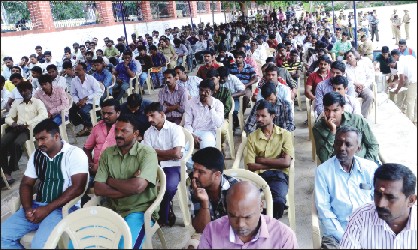
On a foggy Sunday afternoon, the otherwise quite Malihabad bounced to its Pathani vigour as a group of Afridi Pathans sat in the orchard of revolutionary poet Josh Malihabadi and conversed with Rabbi Dr Ari Zivotofsky. It was meant to be a session in which the rabbi would have asked the Afridi Pathans questions about their traditions and history, but he found himself facing questions from youth who were anguished about the constant research on their genetics by Israelis. The questions were not limited to what the Afridi Pathans said were “false claims” trying to find their roots to Judaism, but also included the situation between Palestine and Israel.

Rabbi Dr Ari Zivotofsky decided to visit Malihabad to study the historical ancestry of Afridi Pathans in the region, after his interest was aroused in previous research on the subject. Earlier hypotheses claimed resemblance between certain traditions revolving around the common Semitic customs of Afridi Pathans with those of the Jews, hinting towards a probable connection between the two.

“Five years back when Shehnaz Ali visited us in Malihabad to take DNA samples of the Pathans, she misguided us about the real motive of her research. She told us it was to reaffirm if the Afridi Pathans of present day held the same warrior qualities and other characteristics of their ancestors hundreds of years back. We later got to know that it was to find a link of Pathan ancestry with Jews,” complained Ahsan Javed Khan, a raging Afridi Pathan, host to an Israeli scholar visiting the small tehsil, who was in Malihabad researching on Pathan history.

Speaking about his experience of the meeting, Zivotofsky said, “I am not intimidated by their questions but actually surprised with how offended the Afridi Pathans are by this research and how careful one has to be with an apolitical and benign approach.” The young men pointed out anomalies in previous research carried out by other individuals and averred that DNA studies done earlier could found no conclusive result. The Pathans also claimed that the research might have a political motivation in case one of the earlier researches was funded by Israel’s foreign ministry. “The points raised here have intrigued me to follow up on the research done back then. If no conclusive results were found probably the researches couldn’t arrive at the expected results so they didn’t publicise them. I would now like to get into those flaws,” said Zivotofsky.

In the old Kothi of Khalid Yusuf, belonging to the earliest families of Afridi Pathans in Malihabad, Dr Ari spoke about an oral tradition passed on through generations. “I remember my grandmother telling me that we belong to Bani Israel (Children of Israel) and Ephraim, however this does not mean that we are Jews. Why do Israelis want to trace our ancestry to one of the lost tribes of Israel?” said Asad Yar Khan, taking Zivotofsky around his hometown.

“With the knowledge that I am taking from here, it looks like the theory of Pathans having a link with Judaism is more of an oral tradition, and collecting blood samples will not help anymore. We should look into the books now for the research to come together. It could be a better idea to rephrase the research as ‘finding a link between Afridi Pathans and ancient Israel’ instead of with Jews, to whom the people here appear to be averse,” concluded Zivotofsky.

source: http://www.timesofindia.indiatimes.com / The Times of India / Home> City> Lucknow / by Yusra Husain, TNN / December 22nd, 2014

Beary Sahitya Academy honorary awards for three

Awards to be presented at Chikkamagaluru on January 10

The Karnataka Beary Sahitya Academy will confer its annual honorary awards 2014 on B.M. Ichalangodu, B.A. Shamshuddin Madikeri and Y. Mohammed Beary Edapadavu.

While Prof. Ichlangodu is being honoured for his contributions in Beary language research, Mr. Shamshuddin is being honoured in the field of literature and Mr. Mohammed Beary in the field of education, said academy chairman B.A. Mohammed Haneef.

Mr. Haneef told presspersons here on Monday that the awards would be presented at the Beary Language Conference to be held at Chikkamagaluru on January 10. More than 5,000 Beary-speaking people were expected to attend the event, he said.

The Chikkamagaluru District Beary Federation would be co-hosting the event at the Vokkaligara Sabha Bhavana where the language conference would be held from 10 a.m. and the award presentation would be held from 3 p.m.

B.M. Ichlangod
B.M. Ichlangod

Prof. Ichlangod worked in various colleges in the undivided Dakshina Kannada and has written many works including translation of Koran, and Muslims of Tulunadu. He has also been active in the consumer rights movement.

B.A. Shamshuddin Madikeri.


Mr. Shamshuddin has worked as a journalist for many publications in Madikeri and has penned many works in Beary language.

Muhammad Byari Yedapadavu.

Mr. Mohammed Beary, after serving the Syndicate Bank for 22 years, established Ideal English Medium School at Edapadavu and has been the president of the Federation of Dakshina Kannada and Udupi district English Medium Schools. He is also the president of the committee of families of victims of Mangaluru air crash.

The awards carry Rs. 10,000 in cash and citation. The Kannada and Culture Department has proposed to the government to increase the cash purse to Rs. 75,000 each, but the academy is not sure when that would come into effect, Mr. Haneef said.

The academy has also identified nine personalities to be felicitated during the language conference for their contributions to various fields.

They are: Mariam Ismail, Ismail Azad, A.M. Sridharan and Umar Farooq (for literature); K. Mohammed (for defence); Moidin Kunhi (for medicine); Azala Ayub and B.H. Noor Mohammed (for social service) and Mohammed Iqbal (for singing), he said.

source: http://www.thehindu.com / The Hindu / Home> News> Cities> Mangaluru / by Anil Kumar Sastry / Mangaluru – December 16th, 2014

City top Cop holds Mass Counselling for reformed criminals, mob

A section of Members of Bureau of Modus Operandi at the Mass Counselling in city this morning.

Mysuru :

In his continued bid to bring listed criminals to the mainstream and aiming to rehabilitate them, now known as Members of Bureau of Modus Operandi (MOB), City Police Commissioner Dr. M.A. Saleem conducted the first-ever mass counselling for nearly 500 members of MOB at CAR grounds here this morning.

Dr. Saleem gave counselling to various categories of members of MOB including those who have been released from prison after serving terms and those accused of crimes ranging from murder, theft, robbery, burglary, dacoity, cheating, criminal breach of trust, circulation of fake currency notes and also minor crimes at all the 16 Police Stations coming under City Police Commissionerate.

There are 4,900 members of MOB in the district including 3,048 from city. Out of them, 500 who attended today’s counselling had been brought from all the Police Stations in city in government vehicles.

Dr. Saleem advised the members saying, “you may have committed crimes in a fit of rage, but you will do well to transform yourselves after serving terms to ensure that the society sees you in a better light.” He also offered to get jobs to transformed members depending upon their educational and technical skills.

Dr. Saleem, further asked the MOB members to change their mindset to gain confidence of the society to look at them as reformed persons and see their family members in a more dignified manner, thus saving their kin from being branded as relatives of criminals.

The Commissioner also collected details on conduct of these members who were divided into nine categories based on the nature of crime committed by them from authorities of all the Police Stations.

DCPs A.N. Rajanna & M.M.Mahadevaiah, ACPs A.K.Suresh, Jai Maruthi and B.T. Kavitha and Inspectors of all the Police Stations coming under the City Police Commissionerate were present during the mass counselling.

source: http://www.starofmysore.com / Star of Mysore / Home> General News /  Saturday , December 13th, 2014

Coconut plucking: women take giant strides

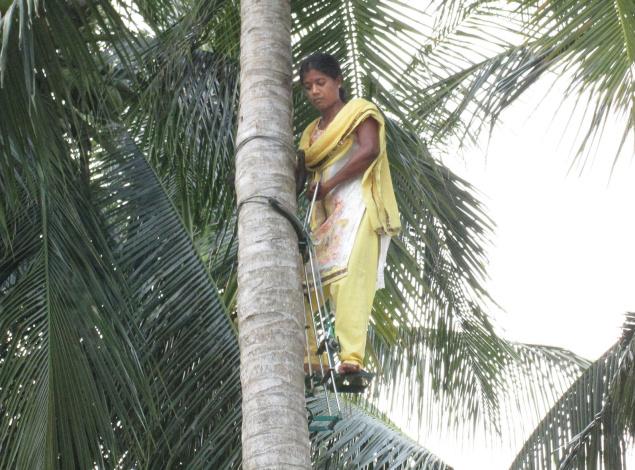
A woman undergoing training in coconut plucking at Parangipettai in Cuddalore district.

Even though Cuddalore district abounds in coconut trees, the price of coconuts is high. The reason trotted out for such market behaviour is the lack of manpower to pluck coconuts or the high wages the workers demand.

It has created a situation in which even the ripe coconuts are left either to rot on the trees or fall. It has become consternation for the coconut growers to find the workforce on time to harvest, not to speak of the plight of the households having a few coconut trees in their garden.

To overcome the problem, the M.S. Swaminatan Research Foundation (MSSRF) has launched the “Friends of Coconut Tree” programme for farmers and the unemployed youth.

R. Elangovan, Project Officer of the MSSRF, told The Hindu that the six-day training programme organised under the aegis of the MSSRF Village Resource Centre at Parangipettai was intended to help the farmers and unemployed youth learn to climb trees to pluck the coconut.

To start with, 20 persons, including four women hailing from Killai, Nochikadu, Manikkollai and Parangipettai, joined the programme conducted recently. It was conducted in coordination with the Coconut Development Board that provided the device for climbing the trees free of cost.

In-house training

It was a sort of an in-house training as the trainees would stay at the Parangipettai centre throughout the training programme. Besides mastering the tree climbing techniques, they were also taught yoga and pranayam.

Mr Elangovan said the Coconut Development Board had made it mandatory that 30 per cent of the trainees ought to be women.

It was a surprise that four women had come forward to enroll their names in the programme.

One of the trainees, Kausalya, 24, told this correspondent that initially she had hesitation in joining the programme as she lacked courage in climbing tall trees.

But, the device provided by the centre made the job simple and easy. She gained confidence gradually.

However, the centre has prescribed a dress code for women — they should either wear salwar kameez or a pair of trousers to avoid risks.

Mr Elangovan said that after completion of the training programme, Parangipettai Town Panchayat Chairman Mohammad Yunus gave away certificates and the climbing device (free of cost) to the participants.

source: http://www.thehindu.com / The Hindu / Home> News> National> Tamil Nadu / by A.V. Raghunathan / Cuddalore – December 18th, 2014

Hyderabad’s Numaish will be here soon

Children enjoying the rides at the 72nd All India Industrial Exhibition, popularly known as Numaish, in Hyderabad. Photo: K. Ramesh Babu / The Hindu

Six hours of entertainment at just Rs.20. Can you beat that? Impossible. One can’t have fun and frolic any cheaper. So tighten your belts for the annual ‘Numaish’. There are some new and amazing things to bedazzle visitors in the 75 edition of the All India Industrial Exhibition beginning here on January 1.

Locating the stalls and your dear ones is now child’s play. The smartphone in your hand will be your guide. Keeping pace with the emerging technology, the Exhibition Society has designed an ‘Exhibition App’ to help visitors navigate the sprawling grounds. It is also thinking of providing Wi-Fi in the 23-acre ‘Numaish maidan’.

The Society will also be celebrating the Platinum Jubilee of the Industrial Exhibition. President Pranab Mukherjee is expected to inaugurate year-long celebrations. Chief Minister K. Chandrasekhar Rao will inaugurate the exhibition on New Year Day, the first in the Telangana State.

The history

The Numaish-e-Masnuaat-e-Mulki had its humble beginning in 1938 when the Economic Committee of the Osmania Graduates Association came up with the idea. The 7 Nizam, Mir Osman Ali Khan, inaugurated the exhibition in 1940 at Public Gardens to mark his birthday celebrations. There were just 50 stalls then. The exhibition was shifted to its present venue in 1946 by the then Prime Minister of Hyderabad State Sir Mirza Ismail. Over the years it has grown both in content and coverage assuming an all India stature.

Given the prevailing security situation, the Exhibition Society is not taking any chances on the security front. For the first time, it has installed 8 CCTV cameras of its own. This will be in addition to the door-frame metal detectors, hand-held metal detectors, dog squad and police security.

source: http://www.thehindu.com / The  Hindu / Home> News> Cities> Hyderabad / by J.S. Ifthekhar / Hyderabad – December 16th, 2014

Statues of Akbar’s ‘navratnas’ to come up in Fatehpur Sikri fort

Agra:

The nine gems of Akbar’s court will soon adorn Fatehpur Sikri Fort, with Agra Development Authority (ADA) and Uttar Pradesh tourism planning to install their statues in the premises of the monument.

Despite his illiteracy, Mughal ruler Akbar appreciated the presence of artists and intellectuals. His passion for knowledge and interest in learning from great minds meant that men of great intellect received patronage from the emperor. Such men went on to constitute the nine courtiers, also known as ‘navratnas’, of Akbar’s kingdom. The navratnas are Abul Fazl, Abdul Rahim Khan-I-Khana, Birbal, Mulla Do-Piyaza Faizi, Raja Man Singh, Raja Todar Mal, Fakir Aziao-Din and Tansen.

According to ASI, Mughal institutions such as the ‘Ibadat-Khanah’, ‘Din-i-Ilahi’, ‘Tarikh-i-Ilahi’ , Jharokha-Darshan, the doctrine of Sulh-i-Kul and policy of liberal patronage to indigenous arts and literatures, were founded here.

Under the plan, the statues of the nine courtiers would be built at a cost of Rs 10 lakh and will be set up in the interpretation centre coming up in the Fort complex. Fatehpur Sikri was the capital of Mughal Emperor Akbar for 13 years, from 1572 to 1585. The complex of monuments was declared a UNESCO world heritage site in 1986.

Dinesh Kumar, regional tourist officer, said, “We plan to install the statues the way Akbar used to hold court meetings with them. Tourists will also be provided information about them in detail. Although the place for their installation has not been finalized yet, we are trying to get it done in the interpretation centre. A meeting with the divisional commissioner will soon be held to get his permission.”

The interpretation centre will provide a glimpse of history and culture of the Mughal era as well as facilitate tourists’ visit to the Fort. Its construction work is likely to be completed by next month, Kumar added.

Perhaps the most famous of the ‘navratnas’ is Birbal, a Brahmin advisor in the court of Akbar. He is mostly remembered in folk tales that focus on his wit.

In 1586, he led an army to crush an unrest in the north-west Indian subcontinent, which failed tragically when he was killed along with many soldiers in an ambush by the rebel tribe.

Towards the end of Akbar’s reign, local folk tales emerged involving his interactions with Akbar, portraying him as extremely clever and witty. Birbal’s defeat was one of biggest military setbacks during Akbar’s reign and his death is said to have caused the Mughal emperor much grief.

In the folk tales, Birbal is mostly shown as being younger than Akbar, religious and surrounded by envious Muslim courtiers. These tales involve him outsmarting them and sometimes even Akbar, using only his intelligence and cunning, often by giving witty and humorous responses and impressing Akbar.

Mulla Do-Piyaza is a character from a series of folk tales featuring the Mughal emperor Akbar and his witty courtier Birbal. Mulla Do-Piyaza, also portrayed as witty, is Birbal’s rival. Even though these folk tales originated at the end of Akbar’s reign (1556-1605), Mulla Do-Piyaza began to appear later, popularized by writers in the late 19th century. Most scholars consider him to be completely fictional.

The next most heard of navratna was perhaps Tansen, a prominent Hindustani classical music composer, musician and vocalist, known for a large number of compositions. He was also an instrumentalist who popularized and improved the plucked rabab (of Central Asian origin). Akbar gave him the title Mian, an honorific, meaning learned man.

Abul Fazal was the vizier of the Mughal emperor and author of the Akbarnama, the official history of Akbar’s reign in three volumes, (the third volume is known as the Ain-i-Akbari). He was the brother of Faizi, the poet laureate of Akbar.

Abdul Rahim Khan-e-Khana, another ‘navratna’ was a poet known for his Hindi couplets and his books on astrology. The village of Khankhana, which is named after him, is located in the Nawanshahr district of Punjab.

A poet and scholar of late medieval India, Shaikh Abu al-Faiz ibn Mubarak was popularly known by his pen-name, Faizi. In 1588, he became the Malik-ush-Shu’ara (poet laureate) of Akbar’s Court. He was the elder brother of Akbar’s historian Abul Fazl. Akbar recognized the genius in him and appointed him tutor for his sons and gave place to him among his decorative ‘navaratnas’.

Man Singh, the Rajput Raja of Amber, a state later known as Jaipur in Rajputana, was a trusted general of the Mughal emperor Akbar, while Todar Mal rose to become the finance minister in Akbar’s darbar. He was born in Laharpur, Uttar Pradesh in a Hindu family.

Faqir Aziao-Din was a mystic and a chief advisor in emperor Akbar’s court. Akbar regarded his advice on religious matters in high esteem.

source: http://www.timesofindia.indiatimes.com / The Times of India / Home> City> Agra / by Aditya Dev, TNN / December 14th, 2014
MIM expands horizon with cop training

Hyderabad :

In what is known as a “passing out parade” of constables held at the police academy recently, more than 70 graduates were from the stable of the Majlis-e-Ittehadul Muslimeen (MIM). But what is interesting is that of this number, more than half are Hindu, Dalit and Sikhs while only 29 are Muslim candidates.

“As a part of the MIM initiative, we had trained around 200 people over a period of three months for the physical fitness and written tests. Also, of the 10 girls selected, only two are Muslims and the rest are Hindus. It is pertinent to point out that two of the selected youth are Mahesh Yadav and Vijay Kumar from Begum Bazaar. Those selected also belong to the Reddy community and other backward classes. Another two are Sikh recruits,” said Manzoor Ali Khan, in-charge of the constable recruitment training programme.

While the MIM has been vocal about its intentions of forging a Muslim-Dalit political alliance – which has gained momentum with the slogan Jai Bheem, Jai Meem – the move indicates that the party is keen to reach out to members of the majority community as well. The party in addition has proposed initiatives for training youth for employment.

“The top leadership wants an inclusive approach in all things we do. Therefore, we intend to train youth regardless of religion, caste, creed and sex. We are now waiting for the next constable recruitment notification to be issued,” Manzoor said. The number of Hindu recruits trained by the MIM has increased substantially this year, he claimed.

Meanwhile, the Millat Fund, a philanthropic arm of the Siasat Urdu Daily, too has had its share of success in sending candidates from its training rooms. According to the managing editor Zaheeruddin Ali Khan of the daily, around 170 cadets from a batch of around 300 was selected were a part of the parade held last week.

“Since 2003, most of those who have been selected are men and we have tried our best to train women as well. Of the 20 girls who sought training from us this year belong to the majority community. We are encouraging the participation of candidates from all religions,” he said.

source: http://www.timesofindia.indiatimes.com / The Times of India / Home> City> Hyderabad / by Syed Mohammed, TNN / December 13th, 2014

Darul Musannefin an excellent seat of learning

Azamgarh:

On November 21, 2014, Darul Musannefin Shibli Academy, Azamgarh, completed 100 years of its life. Widely acknowledged by scholars of Asian neighbours, this academy of letters specializes in research on Islamic learning, medieval Indian history and oriental studies.

Moulded in the scholarly tradition of India’s ancient centre of learning, Darul Musannefin Shibli Academy in the old Azamgarh town has taken its place alongside some known modern research institutions. A well-equipped library and a well-organised publication department, putting out original works or the fruits of modern research in oriental philosophy, history and culture, make it envy of many institutions in the field.

Darul Musannefin Shibli Academy was conceived by Allama Shibli Nomani and established by his disciples headed by Maulana Hamiduddin Farahi on November 21, 1914, three days after his death with the main objectives to nurture and sustain a body of scholarly authors, provide a congenial environment for scholars to create, compile and translate literary works of high scholastic and historical value and undertake printing and publication of literary works of the Academy.

Chairman Istiyaq Ahmed Zilli said that it was aimed at effectively meeting increasing intellectual and ideological challenges faced by the Muslim community of the sub-continent after the collapse of their political authority and its replacement by British power.

The Academy continued to create scholarly works in the fields of Islamic history and literature. It had so far published more than 250 books, including significant ones like Sirat-un-Nabi and Al Faruq. The Academy had maintained an unbroken tradition of publication of its Urdu monthly journal ‘Maarif’ in uninterrupted circulation since July 1916. The Academy had nurtured a rare environment of single-minded and selfless devotion to academic pursuits.

source: http://www.timesofindia.indiatimes.com / The Times of India / Home> City> Varanasi / by Binay Singh, TNN / November 29th, 2014

Muzzafar Ali and Dimple Yadav attend Oudh Fashion Summit in Lucknow

Pehnawa – The Oudh Fashion Summit-2014, was organized by CII-Yi, Lucknow Chapter, in the city recently. 

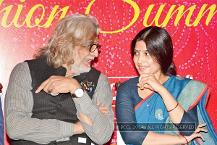
Muzzafar Ali and Dimple Yadav

Muzzafar Ali, who was the guest of honour for the event, earned many wah-wahs for his lines on Lucknow: “Nazakat aur nafasat tujhe virasat mein mili hai, naaz hai humein tujhpe pe ae Lucknow.”

The chief guest on the occasion, MP Dimple Yadav took note of the suggestions made by panelists to improve the work conditions for craftsmen working in the fashion industry, and promised to bring them to her husband and UP CM Akhilesh Yadav’s notice. “Work has already started on courses to train workers in chikankari,” she said.

source: http://www.timesofindia.indiatimes.com / The Times of India / Home> City> Lucknow / by Akash Wadhwa, TNN / December 14th, 2014