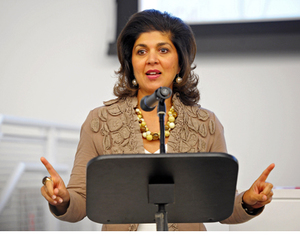
File photo of Special Representative to Muslim Communities Farah Pandith addressing the audience during the UN International Year of Youth Culmination Celebration Summit at the United Nations on Aug. 11, 2011 in New York City. (Getty Images)
Farah Pandith, appointed in June 2009 as the first-ever Special Representative to Muslim Communities by former Secretary of State Hillary Clinton, will be leaving her position to join the Institute of Politics at Harvard University.
Pandith always places people above politics, and she has performed groundbreaking work since her appointment, Secretary of State John Kerry said Jan. 23.
Her legacy “is an extraordinary record of thoughtfulness, balance, and sheer guts and determination. Anyone who’s worked with Farah will note her uncommon ability to bring people of different backgrounds together. I’ve seen that commitment firsthand in her pioneering work to reach out to countries with both Muslim majorities and minorities,” Kerry said in a statement.
Pandith will be joining the Institute of Politics as a Resident Fellow for the spring semester. As a Fellow, the Indian American will lead weekly study groups on a range of topics.
Kerry, in his statement, said of Pandith, “On so many issues, Farah Pandith has been a trailblazer and a visionary,” adding, “It’s in her DNA as a first-generation immigrant who achieved historic firsts for America, from changing the way our embassies engage with Muslim communities in Europe to getting a Quran placed in the White House Library.”
Pandith’s deputy, Adnan Kifayat, will serve as the acting special representative until a permanent replacement is named.
Pandith, originally from Srinagar, has a master’s degree from The Fletcher School of Law and Diplomacy at Tufts University, Boston, Mass., and an A.B. from Smith College.
source: http://www.indiawest.com / India West / Home> News / by A Staff Reporter / Wednesday – January 22nd, 2014
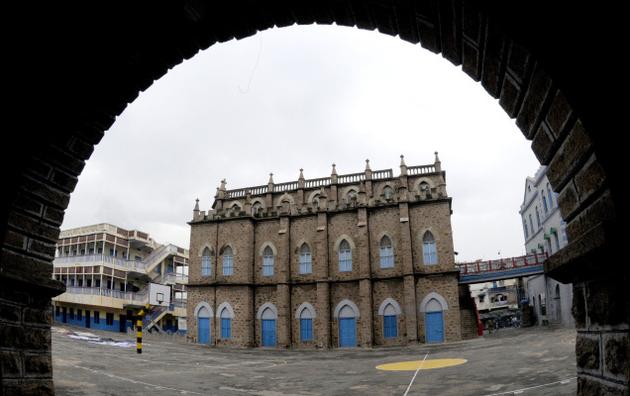
A view of the chapel on the St. Aloysius High School premises, the oldest English medium school in Visakhapatnam./ Photo: C.V. Subrahmanyam / The Hindu
Six classmates of the 1961 batch of St. Aloysius High School met after five decades at their alma mater. Reminiscing the old days, Narayanswami, who played cricket for Andhra, said it was in this courtyard that he picked up the rudiments of the game.
A group of six classmates met after five decades to relive their naughty days at St. Aloysius High School, here on Saturday.
Though, into their late 60s and early 70s none appeared to have lost his youthful vigour. Hopping from one classroom to another, going around the expansive courtyard, and calling their buddies by their nicknames, the six went on a nostalgia drive.
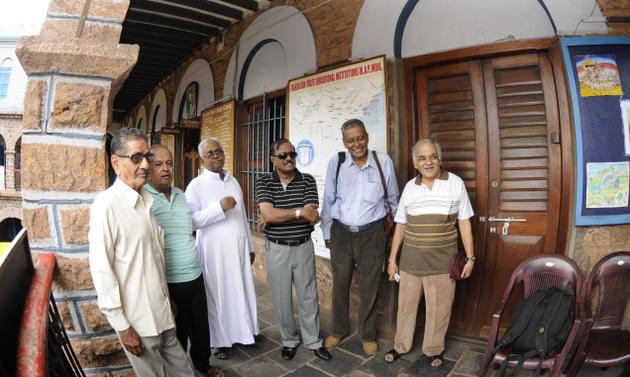
A group of seven friends who studied in St. Aloysius High School meeting after five decades on the school premises to relive the old days in Visakhapatnam on Saturday. Photo: C.V. Subrahmanyam / The Hindu
The old students of the 1961 batch who met were P.R. Narayanswami, former Director of Physical Education in Andhra University, M.A. Raihan, former Commander in the Indian Navy, V.N. Natarajan, Chief Manager of Indian Overseas Bank, Fr. George Kottam, Arun Panse, former Hindustan Shipyard employee, and Md. Ali Khan, a retired officer from the Visakhapatnam Port Trust.
Accompanying them was Rohinton Kapadia, who was a couple of years junior to them in school.
Incidentally, Fr. Kottam was not only an old student but also principal of the school during early 1980s.
Reminiscing the old days, Narayanswami, who played cricket for Andhra, said it was in this courtyard that he picked up the rudiments of the game.
“We are always ahead of the rest in athletics and games. We had the best boxing team in the district. In fact, ours was the only school that had a proper boxing ring. Even the ENC, then INS Circars, would borrow our ring for their tournament,” said Raihan.
We also had a strong NCC contingent and 80 per cent of our students were from the Anglo Indian and Muslim communities. But we never experienced any sort of discrimination based on religion, caste, or creed, said Arun Panse.
On how strict was the school, they came out in chorus, “Fr Eliemeynet, a French national, who was our principal, and our teachers were strict, but they gave us the rope to be mischievous too.”
According to Fr. Kottam, the schooling then was about holistic learning.
For Md. Alikhan, the association with the school has been for three generations. His son also studied in the school and now his grandchildren are studying there
source: http://www.thehindu.com / The Hindu / Home> News> Cities> Visakhapatnam / by Sumit Bhattacharjee / Visakhapatnam – September 21st, 2014
The Andhra University is going to host a state-level NSS awards function at BR Ambedkar Assembly Hall here Wednesday from 10.30 am. Human resource development minister Ganta Srinivasa Rao would be the chief guest at the occasion.
Revealing the details to the newsmen here Tuesday, AU vice-chancellor GSN Raju said that NSS cadets from across the state would take part in the awards function.
As many as 16 awards would be given away during the function, of which the AU NSS cadets won four awards. EPS Bhagya Lakshmi and Ch Adinarayana achieved awards in the category of Programme Officers, while Rahul Pal and Md Goush Khan won the best volunteers awards.
NSS regional head R Gokul Krishnan and state coordinator P Ramachandra Rao would be present, he added.
This apart, a blood donation camp will be organised jointly by the Indian Red Cross Society and AUCE at YVS Murthy Auditorium at 9.30 am on Sept 24 during which the NSS cadets and AU officials would donate their blood on the occasion.
source: http://www.newindianexpress.com / The New Indian Express / Home> States> Andhra Pradesh / by Express News Service / September 24th, 2014
ALIGARH: Reading The Fault in Our Stars, now that social media is abuzz with talks of the film adaptation of the book, maybe a tad difficult if you live in Aligarh. Despite the city being home to one of the country’s most prestigious educational institutions – Aligarh Muslim University – the absence of a good bookshops selling fiction, non-fiction or, for that matter, anything beyond prescribed reading material for students is quite a telling let-down.
“The city has somehow never really felt the need to have the kind of arrangement where you can go and buy fiction in a store that’s well-furnished with eclectic literary offerings,” says Shubhangini, a CAT aspirant. “Although there is not much of a choice when it comes to book shopping, it doesn’t mean people in Aligarh are not aware of the current scenario in the world of literature. Popular books can be procured through some of the stores by placing an order and paying a commission.”
There are nearly 100 bookshops functioning for decades in Aligarh, but they mostly cater to the madrassa-going students and sell Urdu literature. And almost all stores stock reading material that help in preparations for competitive examinations. This leaves the lover of fiction/non-fiction with little choice but to tap online sources or place an order at a bookshop, which may take anywhere between a week and 10 days (depending on availability) to deliver. The other option is to travel down to Delhi or the National Capital Region and go on a book shopping spree or, if one is a student, rely on AMU libraries to satiate the inner bibliophile.
Though education fairs are common in Aligarh, book fairs are few and far between. “It is a small city without much tourist inflow. So, there are not many stores that sell popular books. There are far more education fairs than book fairs here,” says Sandeep Choudhury, who recently organized an education fair in the city.
Students being on the look-out for better opportunities and job prospects have prompted even the oldest bookstore in the city – Malviya Pustakalaya – to stock books for competitive exams and recruitment tests. Malviya Pustakalaya, incidentally, has one of the most valuable collections of literature, religion, philosophy and Hindi novels.
“These were ordered, so we got them,” says Sanjeev Agarwal of Vimal Book Store, pointing to a stack of popular fiction and non-fiction reading material. It was only recently that 1 % of the shop’s stocks began comprising authors like Arundhati Roy and William Dalrymple. “Earlier, there used to be a store selling fiction but now it has shut down, probably because of dipping sales.”
However, what makes Aligarh unique to bookworms is its repository of Urdu literature. Home to a substantial number of madrassa and AMU students, the city’s stores have an enviable collection of fiction and non-fiction by Faiz, Firaq and Ghalib. “Urdu works are most popular as a lot of retired professors or students from madrassas or AMU reside here,” says Asad Faisal Farooqui, who frequents the Education BookHouse established in 1927.
“It is interesting to see modern English literature being translated into Urdu for them,” he says, adding, “Students have bought Urdu translations of books by Jaswant Singh, Irfan Habib and also religious texts, including translations of the Bhagvad Gita.”
However, the trend does not go beyond prescribed reading material or books talked about in popular media. As Ashok Kuckreja of Aligarh Law Books, says, “Students buy what their professors recommend, which may be pertinent to one’s course but may not help build a larger reading repertoire.”
The experienced bookseller rues never being asked for books by, say, legal humourist Marc Galanter or by the likes of AP Herbert. “Not even 1% of that genre is ordered here, I have tried so many times to bring to their notice the works of Edward Heward on Lord Denning, John Mortimer’s ‘The Devil’s Advocate’ and Krishna Swamy’s work on V R Krishna Iyer, but there is no interest,” Kuckreja says.
source: http://www.timesofindia.indiatimes.com / The Times of India / Home> City> Agra / by Eram Agha, TNN / September 22nd, 2014
City-based student Syed Tazib Rehman has proved his mettle at the Global Cancer Conference and Medicare Summit 2014. He is one of the 12 students across the world whose online presentations were selected for special appreciation. Rehman is a student of Sri Chaitanya Junior College Visakhapatnam. All the selected students except Rehman were graduates and post-graduates.
The 12 students would repeat their presentation before the President of India and other officials on September 15 at HICC, Hyderabad. Earlier, Rehman bagged the ‘Bala Ratna’ award for ‘Creative Scientific Innovation’ in 2013.
source: http://www.newindianexpress.com / The New Indian Express / Home> States> Andhra Pradesh / by Express News Service / September 15th, 2014
Kashmiri poet Agha Shahid Ali. / Photo: Special Arrangement / The Hindu
A tribute to Kashmiri poet Agha Shahid Ali on his 10th death anniversary.
Missing me one place search another/I stop somewhere waiting for you. Walt Whitman
The 10th death anniversary of the extremely talented Kashmiri poet Agha Shahid Ali (February 4, 1949 – December 8, 2001) again draws us to his poetry. Shahid’s name – the Persian “beloved” and the Arabic “witness” – is a signature of what adorned both, his life and craft. It is incredible to know how much Shahid was loved and how much he loved in return.
His poems exude the saffron of feelings, like the shaded yellow leaves of dusk. Friends, lovers, martyrs and a suffering mother overwhelm his poetry. Their voices add to his voice. Shahid is an embroiderer of language. It isn’t easy to catch him or let go as he invites you to unravel his deepest and most intricate feelings and concerns.
Need to be heard
Shahid evokes a mythical language of history, where he creates an urgent need to be heard against eras of loss. Like in the beginning of this beautiful poem, ‘A History of Paisley’: You who will find the dark fossils of paisleys/one afternoon on the peaks of Zabarvan –/Trader from an ancient market of the future,/. . . won’t know that these/are her footprints from the day the world began/when land rushed from the ocean, toward Kashmir.
Shahid’s Kashmir is a place looking for its future in the reclamation of its many pasts. In a poem dedicated to his friend Suvir Kaul, Shahid writes: We’ll go past our ancestors, up the staircase,/Holding their wills against our hearts. Their wish/Was we return – forever – and inherit…
Inherit what? The glass map of our country, says Shahid. But this country cannot be inherited without hands blossoming into fists/till the soldiers return the keys/and disappear. The soldiers must leave first, before the country can be painfully stitched back to recognition and the birds of childhood will find voice and the nameless graves will stir with names.
Shahid’s Kashmir, which he calls an imaginary homeland, echoing Salman Rushdie’s India, is nevertheless not a name attached to the idea of a nation. The word nation goes interestingly unmentioned in Nehru’s The Discovery of India, where he called India “a myth and an idea, a dream and a vision”. This appears significant today as the nation has not allowed India to dream generously and the idea of India has degenerated. The line of control has controlled India’s vision since Independence. We have to go back in time and hear how Kashmir and India spoke to each other. India should abandon the West’s language of nationalism. India should refuse to be among the “Rest” of the West’s imagination.
As Shahid asks in a poem: Will the middle class give up its white devotion? Just as Shahid learnt of Kashmir through the poetry of Lal Ded and the rishi Sheikh Noor-ud-Din, the idea of India needs to be revisited through Arab and Chinese travellers of the past, through Buddhist, Hindu and Muslim mystics, through Kabir, Bulleh Shah, Khusrau and Dara Shikoh. On lines drawn over a map of glass, looking for his other in the darkness of history, Shahid discovers the emblem of clarity: I must force silence to be a mirrorto see his voice, ask it again for directions.
Shahid, blind from the start, waits to ask his beloved adversary for directions. In his endearing letter of complaint to his other, the Hindus, Shahid mourns the severing event of their exodus. He is pessimistic about the possibilities of rapprochement: There is everything to forgive. You can’t forgive me. Shahid seems to suggest, if the other, driven by fondness (philia) and not reason, is willing to forgive, then there lies a long, shared history worth forgiving for.
Fate of Kashmir
As a poet of Kashmir’s struggle for dignity, Shahid paid his tributes and condolences to its martyrs and upheld their innocence. He attested fortune’s shame on the death of 18-year-old Rizwan. But even as Shahid was tormented by the fate of Kashmiri boys whose bodies were broken till they could sing no more, he asserted a lyrical, Brechtian resilience: Freedom’s terrible thirst, flooding Kashmir,/is bringing love to its tormented glass./Strangers who will inherit this last night/of the past? Of what shall I not sing, and sing?
Looking for Shahid you find yourself hearing a “witness” who dreams against the paranoia of borders. Looking for Shahid you find yourself marooned in the wailing of Paradise. Looking for Shahid you find a “beloved” hiding and seeking, veiling and unveiling, telling his lover amidst the fog: when you divide what remains of this night/it will be like a prophet once parted the sea.
Shahid, the playfully deceptive non-believer like Ghalib, once wrote in a ghazal: I (who) believe in prayer but could never in God. Elsewhere he countered Nietzsche, asking: When even god is dead, what is left but prayer?
Shahid seems to suggest, even an atheist is bound to a relationship of affect with this world. This relation can make an ethical demand on him in the heart of a despairing, Kafkan moment – to pray in god’s absence, to pray without hope, but pray nevertheless, as an unfathomable, mad duty towards the other. Shahid waits for us at the other end of that prayer.
Manash Bhattacharjee is a poet and scholar living in Delhi.
source: http://www.thehindu.com / The Hindu / Home> Features> Sunday Magazine / by Manash Bhattacharjee / December 03rd, 2011
The first ever intra departmental debating competition conducted by the Forum for Information Technology, Department of Computer Science at Loyola College proved to be a resounding success.
The competition was initiated with a small briefing about the rules and regulations to be followed during the debate, to the participants.
With topics such as ‘Has technology given more harm than use?’, ‘Are cameras a boon in public places or an invasion of privacy?’ and ‘Are social media and international communication mediums becoming a reason for international warfare?’, the competition provided a perfect platform for the students to put forth their views.
The debating rounds were adjudicated by the faculty of the English department of Loyola College. This was followed by the welcoming of the chief adjudicators for the finals. The adjudicators for the finals were Dr K S Antony Samy, coordinator, WEPRO, Loyola College, and Archana Ram, Director, Smart Training Resources Pvt Ltd. The winning team comprised Adithya of I BSc, Varun, II BCA, Lloyd, I BSc and Md Jaffer, II BCA .
source: http://www.newindianexpress.com / The New Indian Express / Home> Cities> Chennai / by Express News Service / September 10th, 2014
It was Urdu that astronaut Rakesh Sharma used when he was asked by Prime Minister Indira Gandhi to describe how India looked from space. “He said, ‘Saare jahaan se achcha Hindustan hamara’ using poet Muhammad Iqbal’s poetry,” said Fathima Muzaffar of the Indian Union Muslim League. That is enough reason to take pride in the language and promote it, she told a gathering of Urdu scholars and poets at a function here on Tuesday.
She said non-speakers tend to dismiss it as a language used for mushairas, qawwalis and ghazals. But it is a rich language with a literature of its own. “There is a mistaken belief that learning Urdu may hinder one’s economic prospects. But everywhere in the world mother tongue is respected. In European countries, children learn in their native language,” she said. She urged R. Thandavan, Vice-Chancellor of the University of Madras, who inaugurated a seminar on Sardar Jaffri – life and contributions’, to create more job opportunities for Urdu speakers.
University of Madras Vice Chancellor R Thandavan (right) presents an award to Md. Ubaidur Rehman (left), head, Department of Urdu, The New College. —PHOTO: K.V. SRINIVASAN / The Hindu
Dr. Thandavan said he had high regard for the language though he did not understand it as well as Hindi. He launched five books and distributed awards to Urdu scholars and personalities who had contributed to the language and the community.
Syed Sajjad Husain, head of the Department of Arabic, Persian and Urdu, which organised the seminar, said 25 eminent scholars, poets and personalities were honoured for their contributions.
source: http://www.thehindu.com / The Hindu / Home> National> Tamil Nadu / by Special Correspondent / Chennai – January 01st, 2014
Clubs belonging to Lions District 324A1 have installed solar power plants at 35 schools run by the State government and Chennai Corporation. / Photo: M. Srinath / The Hindu
The Government Hobart Higher Secondary School for Muslim Girls, Royapettah, recently got a 1.5 KV solar power plant. Students of classes VII, VIII and IX will benefit from the plant that can power 10 lights and seven ceiling fans.
Imtiaz Fathima Wadood, president of the parent-teachers association of the school, said the supply from the plant could also be used to power the examination hall, which has a seating capacity of 100 students, when tests are conducted.
“We have to thank the Lions Club of Periamet for providing the facility worth Rs. 2.5 lakh to the school, which has 300 children from poor families from Triplicane and Royapettah studying,” she said. The Club will maintain the facility for five years.
Clubs belonging to Lions District 324A1 have also installed solar power plants at 35 schools run by Chennai Corporation and the State government.
According to G. Ahmed Sharif, advisor, district 324A1, who is also the project chairman, said a total of 19 government and 11 Corporation schools had been covered under the project this year. “It is the suggestion of the district governor D. Balachandra Reddy that all the clubs are following. The district provides Rs. 50,000 per plant and the clubs have to bear the rest of the cost. Many classrooms are poorly lit and need such solar plants. In the long run, it will also help reduce the schools’ power bills,” he said, adding that more clubs were coming forward to install such plants.
source: http://www.thehindu.com / The Hindu / Home> News> Cities> Chennai / by Special Correspondent / Chennai – December 26th, 2013
The G. B. Pant University of Agriculture and Technology in Pantnagar, Uttarakhand, today honored its former student, United States Chief Agricultural Negotiator Ambassador Islam A. Siddiqui, with an honorary degree of Doctor of Science. The degree was conferred upon Ambassador Siddiqui in recognition of his contributions to agricultural research and development, as well as agricultural trade policy development and his work’s influence on world agriculture.
“I feel humbled and honored at the same time to be receiving this honorary degree of Doctor of Science. Thousands of agricultural scientists, engineers, and veterinarians graduating from Pantnagar and sister universities provided the foot soldiers to make the Green Revolution a reality. This massive technology transfer of modern agricultural practices – combining education, research, and extension — turned India from a net food importing country to a food exporting nation. As a student of the first batch of this great institution when it opened its doors 51 years ago, I had not imagined in my wildest dreams that one day I would receive this prestigious award.”
Ambassador Siddiqui was born in Haldwani, Uttar Pradesh and attended G.B. Pant University before taking a scholarship at the University of Illinois in the United States. Throughout his career, he has advocated for international cooperation, technology transfer, capacity building, and new technology development to achieve food security in the 21st century.
source: http://www.newdelhi.usembassy.gov / Embassy of the United States, New Delhi, India / Home> News & Events> Press Releases / New Delhi – May 20th, 2011