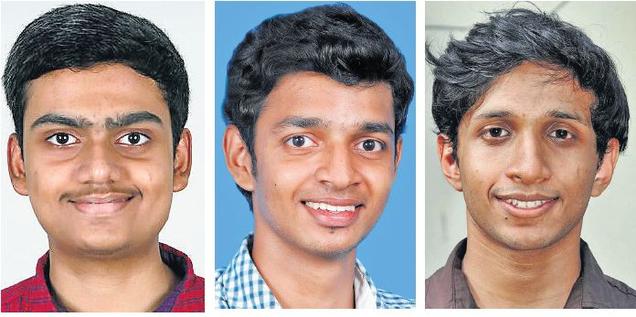
Basil Koshy Sajeev, Arun Ashokan and Abid Ali\ Khan who won the first three ranks respectively in the medical entrance examination. / by Special Arrangement / The Hindu
Engineering rank list in three weeks after standardisation
Boys cornered the top three ranks in this year’s medical entrance examination as 83,460 of the 93,897 students who wrote these examinations found a place on the rank list.
While Basil Koshy Sajeev from Odakkali, Ernakulam, bagged the first rank with a total score of 954.8936, Arun Ashokan from Muvattupuzha secured the second rank with a total score of 950.
The third spot went to Abid Ali Khan from Pathanamthitta; his score was 949.8936. The medical entrance results and the score sheet of the engineering entrance examinations were announced here on Thursday by Education Minister P.K. Abdu Rabb.
Among Scheduled Caste candidates, S. Sneha from Pathanamthitta bagged the first rank with a score of 871.3617 and N. Naveen from Purakkad, Kozhikode, the second rank with a score of 865.5319.
Among Scheduled Tribe candidates, B.I. Prasitha from Kasaragod bagged the first rank with a score of 881.1702 while the second rank went to Bhavya from Wayanad who got a score of 822.9362. Among the first 1,000 rank-holders, 491 are from the State higher secondary stream, 471 from the CBSE stream and 30 from the ISCE stream. Based on the district of permanent residence, Kozhikode returned the higher number of candidates in the top 1,000 list: 146.
Malappuram with 144 candidates comes second and Thiruvananthapuram with 124, third. Among the top 100 rank-holders, 22 are from Thiruvananthapuram, 17 from Kozhikode, and 12 from Ernakulam.
Among the top 100 rank-holders, 64 are boys. On the top-100 list, 63 candidates had written the entrance a second time.
Engineering
Of the 1,03,398 candidates who appeared for the engineering entrance examinations 74,307 candidates qualified.
The engineering rank list would be published three weeks later after combining the score in the entrance and the scores of Mathematics, Physics and Chemistry in the qualifying examinations — on a 50:50 basis — and subjecting them to a standardisation process.
source: http://www.thehindu.com / The Hindu / Home> News> National> Kerala / by Special Correspondent / Thiruvananthapuram – May 16th, 2014
Gold medallists (from left) Chalapathi Rao Kasarabada, V. Kiran Ayyar, Shaista Begum, T.R. Sunitha and A.S. Vijayabharathi are seen displaying their medals at the 14th Convocation of KSOU.
Mysore :
The 14th convocation of KSOU saw over 40 students from all ages and from all walks of life bagging gold medals/cash prizes. The gold medal/cash prize winners include: A.S. Vijayabharathi, who bagged 3 gold medals and one cash prize in M.A. Kannada; Sudeshma Nag one gold medal and a cash prize in M.A. English; Shaista Begum A. Bijapur, 2 gold medals in M.A. Urdu; Padma Seshadri, one gold medal and a cash prize in M.A. Sanskrit; 72-year-old Chalapathi Rao Kasarabada, one cash prize in M.A. Sanskrit; K.Sowmya, 2 gold medals and 2 cash prizes in M.A. Economics and V. Kiran Ayyar, 2 gold medals in M.A. Hindi.
The Ph.D awardees are: M.N. Pushpalatha in Sanskrit, N. Srimadhavi in History, V.N. Nagashetty in Sociology, Basavaraju in Management and Vasudev Shetti in Hindi.
M.Phil degrees were awarded to 3: Muthigi Srinivas in Kannada, H.L. Ravindra in Political Science and K.C. Dhanaraja in Sociology.
Love for subject: 72-year-old Chalapathi Rao Kasarabada who bagged a cash prize in MA Sanskrit said that he had studied Sanskrit as a subject while doing his B.Sc degree, which he got in 1962. He pursed his studies in Sanskrit out of sheer love for the subject. He was delighted at getting the prize and added that he holds a Ph.D. degree from an American University.
A.S. Vijayabharathi who bagged 3 gold medals and a cash prize in Kannada said that after securing her BSc., degree in 1981, she served the postal department for 25 years before taking voluntary retirement. As she was in the habit of reading books from her early age, she developed interest in doing MA Kannada. She studied the subject without wasting time, even while looking after her family comprising her husband, a son doing his Engineering degree and a daughter pursuing her M.Tech.
K. Sowmya, who bagged 2 gold and 2 cash prizes in MA Economics said although she had hoped for a medal, felt surprised when she got 2 gold. Stating that she had bagged third rank in MBA earlier, Sowmya said she was currently serving as a guest lecturer at Adichunchanagiri college in Channarayapatna and Government first grade college at H.N Pura. She has enrolled for M.Com degree at KSOU and hoped to pass out with flying colours.
V. Kiran Ayyar, who bagged 2 gold in Hindi said he is an M.Sc holder in Physics and currently working as a lecturer at Vidyavardhaka PU College in Mysore. As he had keen interest in Hindi since his young days, he pursued MA in Hindi. He was extremely delighted over winning 2 medals.
Shaista Begum, who bagged 2 gold in MA Urdu said she is currently working as a Urdu teacher at a Government high school in Haveri. She felt very happy upon receiving the medals, she remarked and added that she was interested in pursuing Ph.D degree in the same subject.
source: http://www.starofmysore.com / Star of Mysore / Home> General News / May 11th, 2014
Talat Ahmad is currently the V-C of university of Kashmir.
SUMMARY
Ahmad was awarded the National Mineral Award, 1994, by the Government of India and is a life member of the Mineralogical Society of India.
The Vice-Chancellor of University of Kashmir Professor Talat Ahmad has been appointed V-C of Jamia Millia Islamia on Tuesday.
Ahmad’s appointment comes nine months after former Jamia vice-chancellor Najeeb Jung was appointed Lieutenant-Governor of Delhi. Although the decision is yet to be announced, sources at Jamia have confirmed the appointment. Ahmad, who hails from Giridih in Jharkhand, is an alumnus of Aligarh Muslim University, University of Leicester and Cambridge University. He was serving as vice-chancellor of University of Kashmir for the last three years.
Prior to that, he had served as a geologist at the Geological Survey of India and as a professor at the Department of Geology, University of Delhi, from 2003 to 2011. He is an expert member on the board of several environmental and geological organisations, including the Science & Engineering Research Council, and has won several accolades for his research.
Ahmad was awarded the National Mineral Award, 1994, by the Government of India and is a life member of the Mineralogical Society of India. He is also a fellow of the Indian Academy of Sciences and a J C Bose fellow, 2011. Prof Ahmad could not be reached for comments. In November, the union HRD ministry advertised the position of Jamia V-C on the recommendation of the search committee.
Many names were doing the rounds for the position including those of former Hyderabad University vice-chancellor Seyed Ehtesham Hasnain and former member of the National Commission for Minorities Zoya Hassan. In September last year, more than 300 Jamia teachers wrote to President Pranab Mukherjee, also the Visitor of the country’s only central minority university, requesting his intervention in the process of appointment of the next vice-chancellor. In the letter, the teachers emphasised the need to appoint “an academician of high repute and integrity” as vice-chancellor.
The search committee comprised three members — Justice Aftab Alam and Jamia Hamdard V-C Professor G N Qazi, named by Jamia’s Executive Council along with Visitor’s nominee UGC chairperson Ved Prakash. Professor Hasnain had declined to take up the position after he heard that his name was in the fray without receiving any official word from the search committee.
source: http://www.indianexpress.com / The New Indian Express / Home> Cities> Delhi / by Naveed Iqbal / New Delhi – April 30th, 2014
With the arrival of technology, calligraphic fonts are on computer keyboards now, pushing more and more the likes of Yakub to scurry harder for work. / Photo: Sangeeta Barooah Pisharoty / The Hindu
With calligraphic writing now computerised, the katibs of Old Delhi’s Urdu Bazaar, once a vibrant community, have shrunk to a mere three
More he waits for work, more he fears it shall stop coming to him. Altogether.
When 62-year-old Mohammad Yakub, a katib or traditional calligrapher in Old Delhi’s Urdu Bazaar, breaks into a near monologue on a hot May day after some prodding, the fear of losing a job that he knows best — that too at an age when he “just can’t think of doing anything else” — is pretty blatant. “I have been without work for the last two days. Who knows, you might bring me good luck,” he says with a half-smile. Two teacups with the hot brew arrive from a nearby teashop, indication enough that he is in a mood to talk now.
Yakub’s story turns out to be one of standing against the tide and not calling it quits. Not yet. Every day, at 9 in the morning, he steps out of his house in Okhla to board Bus No. 403 to bring him to Jama Masjid. A short walk from near the Mughal era masjid to Urdu Bazaar brings him to his designated seat in a shop that sells Urdu books. A shop he has been employed with for the last 28 years, a shop with blue paint peeling off at places, its lone copying machine standing at a cobwebbed corner, unused, discoloured with age. The books kept in glass showcases make you wonder which of them is older, their yellowing pages or the showcases with stains on the glasses.
“The last time I sold a book here was a month ago,” he plaits it in to the conversation to help you understand that his state of near joblessness is linked to a drastic drop in the sale of books published in Urdu these days, which in turn, is increasingly leading shopkeepers at the Bazaar to replace their bookshops with those of readymade garments and eateries.
It is also linked to where the art of calligraphy is heading. With the arrival of technology, calligraphic fonts are on computer keyboards now, pushing more and more the likes of Yakub to scurry harder for work. No wonder then, besides Yakub, Urdu Bazaar — once a vibrant hub of katibs — is now left with just three of this ilk.
Katibs Mohammad Yaqub at work in Urdu Bazaar / Photo: Sangeeta Barooah / Pisharoty / The Hindu
Yakub can do calligraphy in Urdu, Arabic and Persian. “But what I usually end up doing now is to write in Urdu the names of various offices and departments required to make stamps since Urdu is also an official language of the Delhi Government,” states Yakub. Out of the Rs.100 that he gets per stamp, Rs. 40 goes to the shop owner. “Most times, it doesn’t pay for my day’s trip from home and back,” he points out before startling you by suddenly breaking into a Mughal-e-Azam song. Even as you recover from the shock, he asks you, “Do you think I can end up as a singer at this age?” In his ensuing laughter, the fear of the foreseeable doesn’t quite get lost. No wonder his daughter, a trained calligrapher, is joining as a teacher in a school
Taking leave of Yakub, you walk along the Bazaar. A few shops away from him sits Mohammad Ghalib, one of the last of the brigade. In his early 50s, Ghalib seems the only one among the three to be getting regular work. “I can’t say that what I am earning is sufficient but I have been able to run my kitchen with it so far. I think it is God’s grace,” he says raising his head from writing a graduation ceremony poster in Urdu for a madrasa in the Okhla area. The colourful poster will thereafter go for printing a dozen copies of it. “Look at these fonts, the unevenness of them, the colour play I do here. No computer can do this because everything in it is of certain size and shape. You can’t play with those fonts, like you can do with a handwritten calligraphic work,” he stops his work to explain the finer point to you.
Like Yakub, Ghalib too picked his skills from Darul Uloom in Deoband years ago. “They still teach it but I ask, what for? Things can change only when the Government does something concrete to keep going the skill of people like us,” he minces no words here.
You enquire about the third katib of Urdu Bazar. Ghalib says he sits just opposite the road. “He has not been coming to work for some days now. He is unwell. Also, there is a wedding in the family,” he says. What Ghalib doesn’t say is said by a bookseller who gives the katib space to operate from, “He doesn’t get much work anyway.”
Riding on a rickshaw to the Chawri Bazasr Metro Station to return home, you only hope that you have turned lucky for Yakub. Because he just can’t sing!
source: http://www.thehindu.com / The Hindu / Home> Features> MetroPlus> Society / by Sangeetha Barooah Pisharoty / New Delhi – May 11th, 2014
Bangalore, the aviation capital of India, has often had its young opting for careers in aerospace, many displaying their skills at various forums. Two teams from Bangalore only reaffirmed this fact by bagging the first two places at the recently concluded (April 12) Boeing India-IIT national-level aeromodelling competition.
The four Bangalore boys — three from ASC College of Engineering, and one from BMS — competed against 560 participants to clench the contest.
At one point, Tabrez Nadvi Anser, Pavan MJ, and Vignesh Arul of ASC College, who bagged the first place, stared at a missed opportunity. “Selection for the finals was to happen at four zones, IIT Madras (South), IIT Kharagpur (East), IIT Bombay (West), and IIT Kanpur (North). Unfortunately, we couldn’t enter the zonal-level competition at IIT Chennai, as it coincided with our semester exams. We finally got permission to participate from the East zone, and our college helped us with the funding,” Tabrez told TOI.
In the zonal round, Pavan said, the team focused on design and building of the remote control (RC) aircraft, keeping in mind the ability to glide. “We did not buy a ready-made aircraft,” Tabrez added.
Having qualified for the finals with 12 other teams from various zones, the four shifted their focus to flying and acrobatic flying, as per the problem statement given by the organizers. They built a depron-made 3D RC aircraft which performed all manoeuvres as planned. “Eventually, we won because of our strategy which was duly acknowledged by the jury,” Tabrez said.
While team ASC was busy clearing hurdles at the zonal levels, Mohammed Shadman Alam was steering a solo show. “While other teams had at least two participants, with the upper limit set at four per team, Alam did everything alone,” said one of the organizers.
At the end, the battle was between the two Bangalore teams, and Alam came second. “Going alone has its perks. I could conceive and design what I wanted, and also perform manoeuvres I liked. Also, if something were to go wrong, the blame would be all mine, and so was it with the credit,” he said.
source: http://www.timesofindia.indiatimes.com / The Times of India / Home> City> Bangalore / by Chethan Kumar, TNN / April 30th, 2014
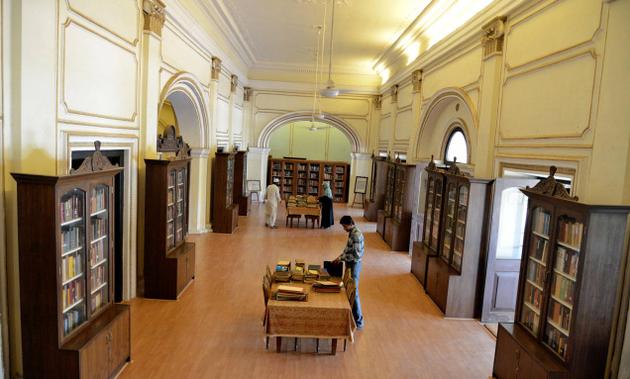
Books restored from different Asaf Jahi dynasties are in the Chowmahallah Palace library./ Photos: Nagara Gopal / The Hindu
The Mehtab Mahal library at Chowmahalla Palace throws open a treasure trove from the Nizam’s era
The Nizams, it turns out, had an eye for everything exquisite. From the jewellery they wore to the silks that adorned their wardrobe, the cars they rode in, and the cuisine they partook, everything simply spelt royalty. While these indicate their lavish lifestyle, their interest in books and literature is less known.
Throwing light on their urge to discover and relate to the world around is the Royal Library in Chowmahalla Palace; its collection of books includes The Life of Samuel Johnson, History of Don Quixote, John F Kennedy – Portrait of a President, Glimpses of India,The Princes of India and an array of Encyclopaedias and much more .
Situated in the Mehtab Mahal of the Chowmahalla, the Royal Library houses more than 10,000 books and “is a haven for researchers and book lovers.”
The library that was thrown open to book lovers last year has been digitized recently, not only to help book lovers but also ensure safety of the royal treasure.
The idea of the library is to protect and preserve the valuable collection of the Asaf Jahi kings. The collection mostly belonged to the Mir Mahboob Ali Khan (VI Nizam), Mir Osman Ali Khan (VII Nizam) and Nizam Mukarram Jah. The books have been sourced from different Asaf Jahi palaces like the Nazri Bagh, Chiran Palace and Chowmahalla to be housed in the Royal Library here.
The books thus collected were sorted and segregated into various categories.
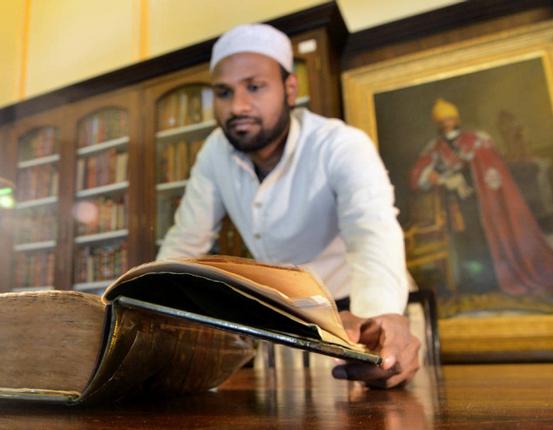
Books restored from different Asaf Jahi dynasties are in the Chowmahallah Palace library./ The Hindu
“A lot of work went into making them ready to be put in the cases for readers to read them in the library. Various professionals worked to clean, bind and make the books fit for reading. We have applied all preservation techniques, including fumigation, to protect the books,” informs G. Kishan Rao. He adds, “The collection of books range from history, literature, poetry, philosophy, geography, culture and religion. This library also houses the exclusive collection of Qurans by the Nizams which was inaugurated recently.” A few books also hint at the Nizam’s passion to learn languages. The number of English books is close to 3000, followed by Urdu, Persian and Arabic.
“There is also a good number of Persian manuscripts containing the firmans issued by the Asaf Jahis as well as several volumes of Mir Osman Ali Khan’s poetry,” informs the librarian. Qurans of different sizes are in the process of being restored and will find place in the library after that.
source: http://www.thehindu.com / The Hindu / Home> Features> MetroPlus / by Prabalika M. Borah / Hyderabad – April 25th, 2014
The award-winning Indian professor who was found dead in his residence on a university campus in Oman Friday, was a brilliant student, teacher and a scientist, his former colleague said.
M.Kabir, a visiting professor at the Centre for Development Studies here, told IANS that it was only last week that Hisham Abdul-Khader visited here for a day to attend his niece’s wedding.
“It was about 13 years back he left the state government service here and joined at the Sultan Qaboos University (SQU) in Muscat,” Kabir said.
“Two years back he got the UAE award for the best scientist. He was a brilliant student, teacher and a scientist,” he added.
Hisham Abdul-Khader, an associate professor in the chemistry department, was found dead at his residence on the SQU campus Friday night. He was not keeping well, said the former colleague of the scientist.
“We spent some time together as we were former colleagues and friends and he told me that he was having some health issues. We got the sad news Friday night and his wife (a retired professor here) has reached Oman Saturday,” Kabir said.
Abdul-Khader, who was in his late 50s, taught Chemistry at various State-run government colleges here before he went to Oman.
“We are expecting the body to arrive here tomorrow (Monday), or day after,” Kabir said.
The scientist was staying alone at the SQU campus and people saw him last Friday evening when he was out taking a stroll in Muscat. He later also spoke to his wife, reports from Oman said
Abdul-Khader’s grandfather was the legendary Vakkom Moulavi – a social reformer, teacher, Muslim scholar, journalist and a freedom fighter.
source: http://www.newindianexpress.com / The New Indian Express / Home> Nation / by IANS – Thiruvananthapuram / April 27th, 2014
Insight International School, Hyderabad has bagged three prestigious awards, International School Award by British Council, School Brilliance Award by Bangalore-based IBCI, and Eduranet Intellectual Olympiad.
A graduation and awards celebration ceremony was organized at Hotel NKM Grand in Banjara Hills, Hyderabad on April 18 to felicitate students who secured state ranks in the Eduranet competition.
In Eduranet 9th Intellectual Olympiad 2013-14, Insighters secured state ranks in categories such as Advanced Mathematics Skills, and Science and Research Skills. They bagged two Gold, three Silver and two Bronze awards in the competition.
Fourth class student Abdul Rahman and fifth class student Sidhrah Quadri Syeda won gold medals, while Afifa Hasnath of sixth standard, Syed Raaid Azzam Husaini of third standard and MD Abdul Qayyum of fifth standard won silver medals.
Speaking at the event as chief guest, Mir Ayub Ali Khan, Editor – Special Affairs, Times of India, congratulated all students and the staff members for their hard work and achievements.
Mr. Khan said: “Education is aimed at making us better human being and also a good Muslim. Education is also aimed at giving us relevant skills which are required for a gainful living.”
He remarked about two noted personalities of the Muslim community – Shah Faisal Award winning economist Nejatullah Siddiqui, and Mr. Zainul Abedeen. Mr. Siddiqui studied in madrasa and also at university level, hence a good inspiration for students, he said.
Insight International School principal Syeda Khadeja expressed joy at the achievements of her school and students. She said it reflects hard work of both the students and staff members.
“In Insight, we try to nurture curiosity among students. We are following a task-oriented curriculum for the benefit of the students. And we are evolving into a learning oriented school,” she added.
source: http://www.twocircles.net / TwoCircles.net / Home / by SM Fasiullah / April 20th, 2014
A group of engineering students from Aligarh Muslim University have succeeded in extracting bio-diesel from refined and used mustard oil, university officials said on Tuesday.
Third-year students of the Diploma in Engineering at the AMU Polytechnic designed a bio-diesel extraction plant as part of the recently developed Alternative Fuel and Combustion Engineering Lab, said M. Yunus Khan, assistant professor of mechanical engineering.
The process can help in directly replacing diesel in conventional engines, thereby reducing India’s dependence on imported oil and emissions of various pollutants, officials said.
Bio-diesel is a renewable fuel derived from vegetable oil that can be an additive to or entirely replace diesel in engines.
source: http://www.timesofindia.indiatimes.com / The Times of India / Home> Science / IANS / April 01st, 2014
Girls studying in the seminary speak fluent English and learn about interior decoration.For a casual visitor they may appear to be orthodox Muslim girls in veil receiving Islamic education at a “madrasa” (Islamic seminary).
Begum Shehnaz Sidarat watches as girls study in madrasa at Firangimahal in Lucknow
But when you talk to them the opinion will quickly change. They tell you their views about the world in fluent English and turn out to be modern in their outlook. They are computer savvy and can give you a tip on interior decoration.
These girls, as a part of their studies at the seminary, learn language and affairs of the world. Besides, they are told to be modern in their outlook. “I want the girls to remain in hijab (veil) but at the same time drive a car and also speak English,” says Begum Shehnaz Sidarat, who runs the seminary, which is located at the historic Firangimahal in the walled city in Lucknow.
The name Firangimahal had been given to the building as it used to house Britishers before Independence, who were then referred to as “firangis”.
“There is a general perception that girls who receive education in madrasas, are not modern and progressive in their outlook. They prefer to remain indoors and are considered to be orthodox. I want to change this perception,” Shehnaz told Deccan Herald.
Shehnaz calls it a kind of “fusion”. “It’s an endeavour to bring the religion closer to society, to make it progressive and make sure that there is no clash between society and the religion,” she says.
She started the madrasa in 2012. “Today, we have 33 girls and all of them are from conservative families. But that doesn’t make any difference,” Shehnaz remarks.
“The syllabus of the madrasa has been designed in such a way that it integrates religious education with modernity,” she points out and adds that it was essential today to teach the girls how to conduct themselves in a fast-changing world and at the same time maintain the traditions. Shehnaz says that all her faculty consisted of voluntary workers. She even has a Canadian national to teach girls English. Canadian Catherine Laur came in contact with Shehnaz while the former was in India in connection with her research work and got impressed with the concept of “religion-society fusion”.
Vocational training
“Besides English, girls are taught computers, interior decoration and given vocational training so that they can become independent,” she says. Girls are also taught about the rights of Muslim women. “There is a popular misconception that Islam has not given rights to Muslim women.
We want to dispel this notion. The rights are there but women do not know about them and thus become vulnerable to exploitation,” she says. “Islam has given rights to women but society has deprived them of their rightful due. It is really an unfortunate scenario,” Shehnaz says.
She said that almost all the girls at the madrasa are from middle class families and are studying 12th standard. “Initially, the response was not good but gradually it picked up,” she adds. Girls are charged a nominal fee at the time of getting admission. “We charge a nominal fee of Rs 50 only,” she says.
Shehnaz feels that there is an urgent need to re-define Islamic laws so that they are not in conflict with society. “When religious beliefs are in clash with the social beliefs, confusion begins,” she points out. “For instance there is a lot of misconception about the fatwas (religious decrees). There is no compulsion on anyone to abide by what the fatwas say.
They are simply advices to the people who seek some guidance on particular issues in the light of the islam,” she says.
Misconceptions
She also seems to be annoyed with the media for spreading such misconceptions about the “fatwas”. Shehnaz has been running adult education classes for Muslim women. She recently started adult education classes for Muslim women, who had been displaced after a large-scale communal violence in Uttar Pradesh’s Muzaffarnagar district. “We have opened four centres in Muzaffarnagar for such women,” she says.
Shehnaz says that she was thrilled by the tremendous response she received from Muslim women in Muzaffarnagar. “There were as many as 180 registrations on the first day of the opening of the centres,” she adds. Shehnaz and her group of volunteers also provide counselling to Muslim women who face exploitation of different kinds. “So far, hundreds of Muslim women have received counselling. Some were also provided legal help when it was required,” she adds.
A recipient of several awards, Shehnaz has so far successfully united hundreds of families which were on the verge of split owing to one or the other reason. Shehnaz wants to turn her madrasa into a university some day where Muslim girls could be given every kind of education. Though she herself belonged to a conservative family, Shehnaz wants Muslim girls to break the shackles of orthodoxy and adapt themselves to the changing world.
Shehnaz is also associated with All India Talim Ghar, which is engaged in providing training in teaching. “The Talim Ghar has so far prepared thousands of teachers. The students at Talim Ghar consist of all sections of society,” she says.
She underlines the need for conducting an in depth research in Islam. “Some research has been done in Islam. Ulemas (clerics) have not been able to link the religion with society,” she adds.
source: http://www.deccanherald.com / Deccan Herald / Home> Special Features / by Sanjay Pandey – Lucknow / DHNS / March 30th, 2014