Category Archives: Education

‘The Great Akbar’ of Independence struggle

Azad’s greatest gift was to postulate an equation between Islam and Indian nationalism on the one hand, and between Islam and the universal principles, on the other

Height about 5’ 5’’; exceptionally thin; noticeably fair; age about 33 years; has practically no hair on his face though he does not shave; long sharp face with prominent nose. This is the “official” description of Maulana Abul Kalam Azad, the golden boy of the Independence struggle. With his confidence, charm and sincerity, Azad impressed people of his age group with his sharp and swift mind. Later in years, he especially cultivated a look of venerable age to give a suitable background to his learning. His genius and method were too individual to found a school, but his writings and lectures exerted a profound influence owing to the breadth of view and patient learning. Rajaji described him as ‘The Great Akbar of Today’.

Unease with conformity

The study of Azad’s early life is, however, hampered by a deficiency of data. But there is ample evidence to indicate his discomfort with the traditional order of things. This was enough to rouse his scorn. So is his unease with taqlid or conformity. Is Islamic doctrine so rigid and dogmatic that it leaves no room for intellectual creativity? With this bent of mind, he broke off the shackles of fossilised theology, and critiqued all those elements in theology that inhibited the progress of empirical science and the unlimited process of their utilisation. His views on the spread of a materialistic way of life and the stagnation and retardation of religious life became well-known, but this phase in his life — when he “saw in religion only ignorance” — proved to be momentary. Once he regained his faith, he worked out a synthesis between the reformist and orthodox philosophies. He did not go too far in this journey, but went far enough to disturb thestatus quo.

The awakening at Aligarh’s M.A.O. College fostered ideas on reforms, interpretation, and innovation among the Muslim intelligentsia. Syed Ahmad Khan moulded young Azad’s thinking. He did his very best to read his writings and admired them. He also admired Shibli Nomani, founder of the Nadwat al-ulama in Lucknow. And when the Nadwa alim turned pan-Islamist after the European intervention in the Balkan States, Azad too stressed that the bonding with the Turks was unique insofar as they were a part of the Islamic community as well as its last political centre.

One has only to cast a glance at some of Azad’s early writings to realise that he entered the valley of doubts and uncertainties to demolish the suppositions that had guided theologians. He opposed the ‘scripturalists’ or the ‘literalists,’ because they advocated rigid adherence to the fundamentals of Islam, as literally interpreted from the Koran and the Sunna. His interest in the externals of religion, too, diminished. At the same time, he was consistent in his authentic inward piety. Just as he was ready to comprehend the whole Koran within the verses of the first Surah, so he conceived and pursued the politics of Islam within the Koran’s dimension of piety.

The Muslim communities were divided by geographical situation, by differences of dialect and custom and, in some cases, by the deeper chasm of sectarianism, but pan-Islamism inflamed their passions, a feeling that, although they had been ground down under the wheels of history, they thought of themselves as a mighty society spread worldwide. Azad, for one, was attached to the common inheritance of Islamic culture and explored the treasures of thought and emotion which belonged to the umma. He proceeded naturally from the conviction that education, liberalism and faith in progress were requisites for Muslim empowerment.

Setting a great example of moral leadership during World War I, Azad became the soul of the Congress party. He opposed Partition heart and soul, while a great body of his compatriots clamoured for a Muslim nation. He could not conceal the contempt that he felt for them, and at no stage in his public career did he stoop to compromise. The spectacle of Indians working out a new way of life and boldly defying the accumulated prejudices and animus of the past was one which aroused his interest and curiosity. Without looking around to find a mirror that might reflect radical faces, he identified pluralism to be the weapon of the strong and the weak against the British. He preferred the conviction of Dara Shikoh, the eldest Mughal prince and a victim of Aurangzeb’s conspiracy, that in the search for the ultimate Truth, mosques as well as temples validly mediate the one candle’s light.

Harmonious and creative Islam

Azad’s greatest gift was to postulate an equation between Islam and Indian nationalism on the one hand, and between Islam and the universal principles, on the other. He did so to enlarge our conception of what is possible, enrich our intellectual imagination, and diminish dogmatism which closes the mind to ijtehad. With his belief in an integrated, harmonious and creative Islam, he adumbrated the outlook of a religious humanist, very much in the line of the humanism embodied in the classical Persian Sufi poetical tradition. He envisaged an Islam not of sectarian belligerence but of confident partnership in a cultural and spiritual diversity where a strident divisiveness would be its betrayal.

Maulana Abul Kalam Azad, Minister of Education in free India and sponsor of an ‘official’ history of the 1857 Rebellion, referred to the two communities standing ‘shoulder to shoulder’ to liberate themselves from the British yoke. Why did Azad and others think that it was worth their while to make this point? Probably, to record the regret that “the British swept away and rooted out the late Mughals’ pluralistic and philosophically composite nationalism,” and to bemoan that they ensured that common action by Hindus and Muslims would in future not be accomplished easily.

Shakespeare’s view of life in one of his plays is that, “round the lonely great ones of this earth there is inevitably a conspiracy of envy and hatred, hatched by the base and common sort.” On December 30, 1941, the gates of Naini prison outside Allahabad opened for Azad; on August 9, 1942, the new gate of the old Ahmednagar Fort prison closed behind him.

Earlier, its mention would invariably bring to his mind several forgotten footprints of time and presented, page after page, six centuries of history. And yet, “in this world of thousand caprices and moods, so many doors are opened to be closed and so many are closed to be later thrown open.” Hence, between July 15 and August 5, 1942, he went around the country for consultation with the Congress leaders.

Azad spent a total of 10 years in jail. Thrown into a new world whose geography did not extend beyond a hundred yards and where the population was no more than 15 faces, he was overwhelmed by the morning sunlight and the evening darkness. Like Antonio Gramsci, Azad conceived of writing something that might absorb him and give a focus to his inner life. For this, he read a great deal. He drew the guidance and motivation from the reading of Scriptures. It is important to realise — and important particularly for the full knowledge and comprehension of times past — that internment kindled Azad’s Islam into warmth and fervour. Like Aurobindo Ghose who found God as a result of the wrath of the government, he felt comforted and serene. And like the future sage of Pondicherry, he found it impossible to explain the love of motherland or sacrifice to the thick-skinned Britons in India.

Independence came with Nehru’s ‘tryst with destiny’ speech, but Partition plunged Azad’s spirits into depression. “There is no more certain test of statesmanship,” wrote H.A.L. Fisher in his History of Europe, “than the capacity to resist the political intoxication of victory.” Though hurt and wounded by a colossal tragedy, the otherwise distraught Azad carried his tribulations with a stoical dignity and pursued his active role through stresses of inner disquiet. Ultimately, he suffered for the sake of truth. He had noted in one of his many elegant passages that, “the flowering trees whose offspring once represented beauty and grace were now lying in a heap in a corner, like burnt out bushes and trampled up grass.” The story which opened with the bright colours of the Al-Hilal and Al-Balagh closed in deep shadow.

Like the Urdu poet, Mir Taqi Mir, Azad could only voice affirmation of the historical process or protest against the iniquities of time and the suffering it caused to the sensitive mind and soul. He had indeed no small talk, and no time for it, or for little human foibles, but in his famous speech after independence at the Red Fort in Delhi, he lambasted those Muslims who threw themselves more and more deeply into the communal vortex. At the same time it must be said to his credit that, in the turmoil raging around the Muslim communities, Azad secured them the comfort of peace and security. Lesser men found conflict in the rich variety of life, but Azad was big enough not only to see the essential unity behind all that diversity but also to realise that only in this unity can there be hope for India as a whole and for those great and varied currents of national life.

(Mushirul Hasan is a historian of modern India. He has edited a book Azad’s Legacies: Islam Pluralism and Nationhood (forthcoming)

source: http://www.thehindu.com / The Hindu / Home> Opinion> Lead / by Mushirul Hasan / November 08th, 2013
On 125th birth anniversary, Maulana Abul Kalam Azad lies a forgotten man

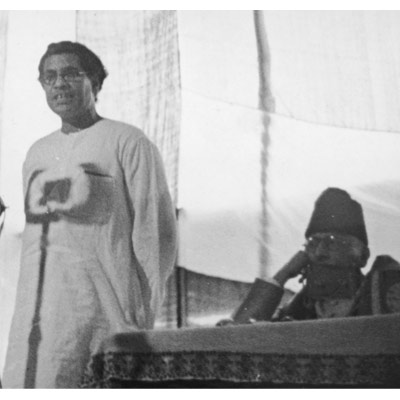
Bengali political theorist Manabendra Nath Roy (1887 - 1954) addresses the Indian National Congress, circa 1940. On the right is Muslim statesman Abul Kalam Azad (1888 - 1958), the President of the Congress
Bengali political theorist Manabendra Nath Roy (1887 – 1954) addresses the Indian National Congress, circa 1940. On the right is Muslim statesman Abul Kalam Azad (1888 – 1958), the President of the Congress

Its red sandstone boundary walls are defaced with posters and betel juice marks. Shopkeepers hang cases full of clothes and jewellery on them. Inside the walls the dry fountains gather dust and filth. This is the state of the maosoleum of Maulana Abul Kalam Azad, independent India’s first education minister, whose 125th birth anniversary will be observed Monday.

Situated in the heart of the bustling Meena Bazar, the garden-tomb of India’s prominent independence leader and close associate of Jawaharlal Nehru, the country’s first prime minister, the mausoleum is surrounded by numerous shops selling food, mobiles, CDs, clothes and other knick-knacks. Open sewers and a dump yard nearby tell a tale of unbelievable civic and governmental neglect.

Apart from the apathy of the authorities in maintaining the site, what stands out is that even most residents are not even aware about the mausoleum of a leader who is credited with establishing a national education system and modern institutes of higher education, including the Indian Institutes of Technology. His birth anniversary is also observed as National Education Day.

Walking down the winding by-lanes in search of the mausoleum, one is startled to learn that most of the locals are oblivious of his name, leave alone the location of the memorial. It’s indeed ironic how the man who persuaded thousands of Muslims during partition to stay back in India is now a forgotten man.

The boundary walls of his mausoleum have become billboards for local politicians, quacks and restaurants, while the temporary stalls adjacent to these walls have further damaged it by hammering nails and creating deep holes in places.

The gate has a lock, but it might as well not have one.

As you enter the small black iron-gate, a short staircase leads to a garden where people, mostly shopkeepers, are having lunch or a siesta. It is perhaps the only place offering peace and tranquillity in the midst of a maddening market and has thus become the resting place for many. That is another reason why the mausoleum is at least still maintained, though empty packets and wrappers of eatables and plastic bottles are scattered around the boundary walls.

In one corner is the mausoleum made of white marble with a patch of green grass on top. A canopy and a short boundary wall, both made of white marble, cover it from rain and sun – and more importantly, bird droppings. The fountains and pools, on the front and on the sides of the mausoleum, are empty and full of dust and filth, while the garden has patches of grass. Lichen covers the trunks of many trees.

The famous Urdu Park in front of the mausoleum, where Azad along with Sardar Patel, independent India’s first home minister and now much in the news, and C. Rajagopalachari, India’s first governor-general, delivered the historic 1942 Quit India address, is a playground for amateur cricketers during daytime and a haven for drug addicts and drunkards at night.

Sadly, it seems no one cares. For the locals, the mausoleum was just what it was – a mausoleum. “I know it’s a mazar (mausoleum) but I don’t know whose it is,” Abdul, a shopkeeper selling blankets near the boundary wall of the memorial, told IANS.

Similarly, tourists who come in droves to visit the nearby Jama Masjid and Meena Bazar, famous for affordable women’s apparel and accessories, give the memorial a miss as they are oblivious of its existence and importance.

Azad’s grandnephew Firoz Bakht Ahmed is not surprised at the neglect. “Since independence, he (Azad) never got the importance that he deserved. The government as well as the people have forgotten him. It’s a tragedy,” Ahmed told IANS. He said leaders like Azad, Patel and many more deserved much more recognition and respect. “There should be chapters in schools where students are taught about them and not just a handful of freedom fighters,” he said.

Talking about the poor maintenance of the memorial, Ahmed said that squatters should be removed from near the site and proper security arrangements put in place. “He was a freedom fighter and a nationalist leader known for his secular thoughts and was one of the few Muslim leaders who strongly opposed the partition of India. But sadly, he is not remembered now,” he added.

source: http://www.dnaindia.com / D NA  / Home> India> Report / Agency: IANS / Sunday – November 10th, 2013

Works from Adil Shahi era to be available in Kannada

Seven volumes of the translation are likely to be released in January

The Persian and Arabic literature dating back to the times of the Adil Shahi dynasty, that ruled Bijapur, will soon be available in Kannada, with the ambitious translation project nearing completion. The seven volumes are likely to be released in January.

Krishna Kolhar Kulkarni, director, Adil Shahi Literature Translation Project, hopes that some misconceptions about this phase of history will be dispelled once the project is completed.— photo: RAJENDRA SINGH HAJERI / The Hindu

Krishna Kolhar Kulkarni, director, Adil Shahi Literature Translation Project, says this was the first effort of its kind and a major portion of the work had been completed. He hoped that some misconceptions about this phase of history (from 15th to 17th century) would be dispelled once the project was completed.

In English

Meanwhile, the Archaeological Survey of India (ASI) has expressed willingness to fund the translation works of these books into English. “The ASI officials said this when I was in Delhi to collect some books for translation,” said Mr. Kulkarni, adding that it will be taken up after the Kannada project.

He said in the first phase, 10 rare books of the Adil Shahi era written in Persian, have been taken up for translation into Kannada, of which the translation of six books is underway. Stating that most of the books taken up for translation were written in the 17th century, he said the project will translate some of the rarest books, some not even heard of.

Mr. Kulkarni said books include ‘Tareekh-e-Farishta’ by Mohammad Farishta and ‘Ibrahim Nama’ by Abdulla Dehelvi.

“Among them, ‘Mohammad Nama’ by Kazi Nurallah is believed to have only two copies in the world, that too are reproduced versions and not original. We have succeeded in getting a copy for translation,” he said.

Mr. Kulkarni said these books have been collected from the Salar Jung Museum, Hyderabad, the archives of Andhra Pradesh and the ASI headquarter, New Delhi.

“We are making all arrangements to get some books from London Museum for translation,” he said.

While collecting some known books, he said he came across some unknown books of the era written by several foreign authors.

Informing that the committee has meticulously selected a dozen translators, Mr. Kulkarni said that some 3,500 translated pages in seven volumes will be released in January.

He added that the committee has also collected hundreds of manuscripts, Farmans (orders), Sanads (deeds) and poetries written in Persian, which will also be translated.

source: http://www.thehindu.com / The Hindu / Home> National / by Firoz Rozindar / Biijapur – September 16th, 2013

Special lecuture series on Urdu held at CIIL

UrduMPos19nov2013

Mysore :

National Testing Service-India (NTS-I) of Central Institute of Indian Languages (CIIL) has been organising series of special lectures by eminent scholars at CIIL, Mysore. One such lecture was held on Nov. 12 at CIIL.

Prof. Qazi Afzal Husain (Director, APDUMT, Aligarh Muslim University, UP) delivered a lecture on “Evaluation of Language and Literature with Special Reference to Post Modernism in Urdu” and Prof. Shamim Hanafi (Professor Emeritus, Jamia Millia Islamiah, New Delhi) delivered a lecture on “Evaluation of Culture in Urdu Language and Literature”.

Prof. Awadesh Kumar Mishra, Director, CIIL, presided.

Around 100 participants comprising distinguished scholars of Urdu, research scholars of Urdu from the University of Mysore and the staff of NTS-I, NTM and LDC-IL of CIIL attended.

Dr. M. Balakumar (Head, NTS-I) coordinated the programme. Dr. L. Ramamoorthy (Head, LDC-IL), Dr. V. Ilangovan (SRP, NTS-I), Dr. Biresh Kumar (RP, NTS-I) were present.

Workshop

Besides this, a five-day workshop on scrutiny of Conceptual Explanations of the aspects for assessing language and literature included in the General Frame of Reference (GFR) began at the National Testing Service-India (NTS-I) of Central Institute of Indian Languages (CIIL) on Nov. 11. This workshop was initiated to finalise the Urdu version. The same task will be carried out in all the other Indian languages soon.

In this workshop, the accuracy and appropriacy of the coinage of terms, language used in explanations, consistency in the usage of terminologies across levels and the overall readability of the explanations are verified. Besides, the experts will provide model question items for testing each of the terms explained. The General Frame of Reference comprises approximately about 700 terms in the areas of Language, Literature and Personality.

The explanations were prepared by the resource persons of Urdu of NTS-I. They are being checked by the subject experts for their conceptual clarity and language uniformity. The experts lauded the initiation of the work as it is very relevant and necessary, which will in turn help many stakeholders of education and also opined that the material will help in the creation of technical manpower in the area of testing and evaluation, one of the crucial area of education.

The experts participating in this programme are Prof. Qazi Jamal Hussian (AMU, Aligarh), Prof. Ali Ahmad Fatmi (University of Allahabad), Prof. Rafathunnisa Begum, Prof. Safdar Imam Qadri, Prof. Masood Siraj and Dr. Abdur Rahman (from University of Mysore).

The Urdu academics of NTS-I — Dr. G.M. Ansari, Dr. Md. Rizwan, Dr. Salim Ahmed and Dr. Zubair Shadab Khan — are assisting the experts under the supervision of Dr. M. Balakumar, Head, NTS-I. Prof. Awadesh Kumar Mishra, Director, CIIL is providing the overall guidance for the programme.

source: http://www.starofmysore.com /  Star of Mysore / Home> General News / November 13th, 2013

Prof. B. Sheikh Ali Bereaved

Mysore :

MohiyuddinMPos19nov2013Mohiyuddin Masood, Assistant Professor, Institute of Technology, Suratkal, Mangalore and son of Prof. B. Sheikh Ali, former Vice-Chancellor of Mangalore and Goa Universities, passed away yesterday at Suratkal. Namaz-e-Janaza was offered at 1.30 pm today at Chikmagalur.

Prof. Sheikh Ali left for Chikmagalur last night to attend the funeral.

Condoled: Dr. Syed Shakeeb Ur Rahman, Principal, SJCE, Abdul Khader Sait, President, MESCO Sir Khazi of Mysore Moulana Mohammed Usman Shariff, Mohdees Azam Mission, Karnataka Branch, Mysore City President Jameel Ahmed Ashrafi, Member Mirza Jamsheed Baig Ashrafi, DCC Minority Cell Ex-Chairman Allah Bakash and others have condoled the death of Mohiyuddin Masood.

source: http://www.starofmysore.com / Star of Mysore / Home> General News /  November 13th, 2013

Azim Premji tops philanthropy list with donation of Rs 8,000 crore

Mumbai :

When it comes to philanthropy, Indians don’t share the table with the likes of Bill Gates but still there are a few who do really donate and the latest list is topped by Azim Premji of Wipro.

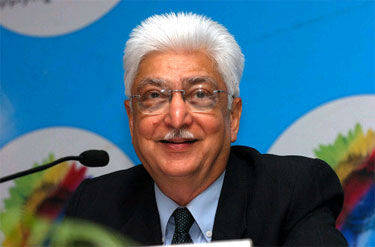
Close on the heels of releasing the second edition of Hurun India Rich List, China-based Hurun Report Inc launched the inaugural Hurun India Philanthropy List 2013, with IT tycoon Azim Hashim Premji emerging as the most generous Indian with a donation of Rs 8,000 crore in the past year.

Hurun Report included donations made by companies in which an individual had a significant share, by applying the percentage the individual has of the company on the donations. Education was the most important area for the Indian philanthropists with a total contribution of Rs 12,200 crore.

It was followed by social development (Rs 1,210 crore), healthcare (Rs 1,065 crore), rural development (Rs 565 crore), environmental cause (Rs 170 crore) and agriculture (Rs 40 crore).

“This list demonstrates the responsibility taken by entrepreneurs,” Rupert Hoogewerf, chairman and chief researcher of Hurun Report said. HCL group chairman Shiv Nadar is the second highest contributor in the list with a donation of Rs 3,000 crore. The Shiv Nadar Foundation, which completed 20 years in philanthropy this year, works towards educational initiatives and expansion programmes, directly benefiting 15,000 students across India.

Hurun India Philanthropy List is a ranking of 31 Indians who donated more than Rs 10 crore (equivalent to $1.6 million) in cash or cash equivalent during April 1, 2012 till March 31, 2013. GM Rao, through GMR Varalakshmi Foundation, donated Rs 740 crore for the education of underprivileged children, becoming the third biggest philanthropist in India’s corporate world. Nandan and Rohini Nilekani stand fourth in the list with a contribution of Rs 530 crore.

Ronnie Screwvala, whose initiatives are housed under the Ronnie Screwvala, whose initiatives are housed under the Swadesh Foundation (UTV group), contributed Rs 470 crore for achieving rural empowerment through the best practices and modern technology values.

“Biotech Queen” Kiran Mazumdar Shaw made a donation worth Rs 330 crore, while Ratan Tata  donated Rs 310 crore to various charitable organizations for the underprivileged through the JRD Tata Trust and Sir Ratan Tata Trust.

London-based mining major Vedanta Resources  chairman Anil Agarwal donated Rs 290 crore to support the cause of healthcare. PNC Menon of Sobha Developers and DLF chairman Kushal Pal Singh  contributed Rs 270 crore and Rs 200 crore, respectively for programmes like adoption of villages and skill training of the youth.

The average age of the philanthropists in the list is 62 years while the average age of the top 10 donors is 64 years. Region-wise, the report said, south Indians showed the way for making contributions with a cumulative donation of Rs 10,000 crore while north Indians pitched in with contributions of Rs 4,865 crore.

The Companies Bill, 2013 mandates companies, with a net worth of more than Rs 500 crore or revenue of more than Rs 1,000 crore or net profit of more than Rs 5 crore, to earmark at least two per cent of their average net profits of the preceding three years for CSR activities.

“This amendment to the Companies Bill should provide more transparent reporting of corporate donations,” said Anas Rahman Junaid, publisher at large of Hurun Report India.

source: http://www.timesofindia.indiatimes.com / The Times of India / Home> India / by PTI / November 13th, 2013

‘There is anger because the Muslim world feels targeted, essentially for 9/11. And its millions of people had nothing to do with that’

AgaKhanMPos07nov2013

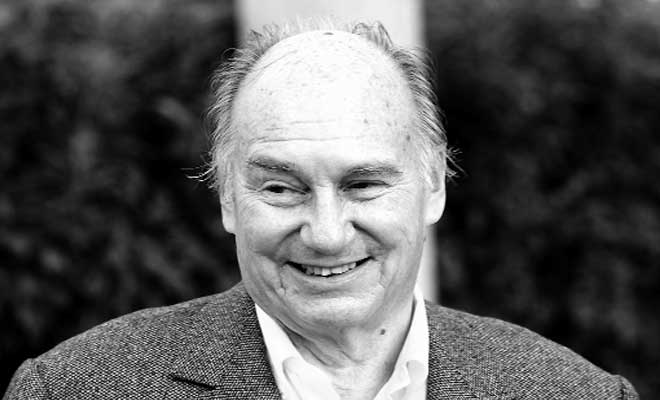
In this Walk the Talk on NDTV 24X7 at his foundation’s latest initiative, the Aga Khan Academy near Hyderabad, His Highness the Aga Khan talks to The Indian Express Editor-in-Chief Shekhar Gupta about the growing Shia-Sunni tension that worries him, and the roots of the lack of understanding between the Western and Muslim world. However, he adds, most of the conflicts one sees today have little to do with faith but have a political dimension.

It’s been said about you that no human being today bridges so many divides as gracefully and as powerfully as you do. And how many divides: the East and West, Islam and Christianity, material and the spiritual and, if I may add, ancient to the medieval, the modern and the future.

Thank you very much and I’m very happy to talk with you.

And welcome to a country which is in many ways your homeland.

Yes, yes. My grandfathers… way back.

He was born in undivided India.

He was, and the place where he was born is still there. Still in the family.

And the first school set up (as part of the Aga Khan network) was in India.

In Mundra (Gujarat).

And now there are 80-90,000 students… So what’s this thing about the Aga Khans and education?

My grandfather and I have always felt that education is an essential part of a community’s life, a country’s life, an individual’s life. It is the unavoidable building block for all people all around the world. This academy (the Aga Khan Academy on the outskirts of Hyderabad) is a part of that exercise.

Education is also a healer of the mind.

It’s a healer of the mind, but it’s also a way of making rational judgments. What we need in society is rational judgment. It helps evaluate, it helps position issues…

So before we get into the more profound discussion on making rational judgments in times when all wisdom is presumed to be given, tell us a little bit about the Hyderabad academy.

Some 10 years ago we started asking ourselves, ‘Where are we? What do we need?’. We came to the conclusion that there were a number of countries where secondary education was a critical issue. We decided that instead of trying to respond on a country-by-country basis, we would try to make a network of institutions to move intelligent children from one society to another, from one language to another, so that we would try and build global capacity and bring it in at the secondary level of education, not retard it until tertiary education or career.

And an academy like this is not limited. Access is not confined to your followers or only people of one faith?

No, no, not at all.

Purely on merit?

Purely on merit and, it goes further than that, it’s ‘means blind’. So the moment a child is qualified, it’s our responsibility to find the ability to fund that.

I haven’t heard this wonderful expression before, ‘means blind’. It’s fascinating to hear it from somebody who doesn’t like the word ‘philanthropy’.

Well I think philanthropy is very close to the notion of charity. And in Islam it’s very clear — Charity is desirable, necessary, but the best form of charity is to enable an individual to manage their own destiny, to improve his or her condition of life so that they become autonomous.

I remember something you said in an interview. You said becoming an imam doesn’t mean you distance yourself, you renounce the world. It actually means engaging with your community even more, improving their quality of life and giving them protection. It doesn’t mean sanyaas, if I may use something from the Hindu way of life.

No. And it’s not just in the Hindu way of life, there are Christian schools where engaging in life is not desirable. In Islam that doesn’t exist. It’s the contrary actually. Imams are responsible for the security of their community, for the quality of life of their community — they must engage, but they have to engage ethically.

You make a very unlikely imam. You don’t look like one — as we know the stereotype now — don’t talk like one, don’t act like one. And don’t play like one — you still suffer skiing accidents.

If you look at the life of the Prophet, he led a normal life. And in a sense he showed that Islam is part of life. It’s not separated from life.

And that’s the inspiration for you.

It’s what I believe to be correct.

And that’s what should apply to all Muslims.

All Muslims, I think, live in the real world. I don’t know of many leaders who have removed themselves totally from life. It’s not part of our religious tradition.

What about the Sufis, the dervishes?

The whole domain of mysticism, as we all know, it exists in many, many, faiths. And that is an evidence of a personal search, not of an institutional search.

And religion and spirituality should be a personal exercise.

It’s both in Islam. It’s a community approach to life, there are community responsibilities, social responsibilities, but there are also personal responsibilities. Certainly, in my interpretation of Islam, the two must go hand in hand. You can’t abandon one for the other.

There’s another fascinating thing you said — there is no clash of civilisations, there’s a clash of ignorances. But that clash of ignorances — what someone called ‘scars on our mind’, in a different context, the Cold War — is now a reality. How do you deal with it?

I’ve used all the methods I thought I had to try and help bridge civilisations rather than have them continue to look at each other in ignorance and discover each other in conflict, and all the rest.

Why call it a ‘clash of ignorances’? Let me add something to that. If the stereotypes about Islam are today cast in stone, you defy all those stereotypes.

That’s very kind. I did my degree at university on Islamic history, so I should know…

And you went to Harvard.

So in that sense, I may have had a certain amount of comfort. But if I take what was the definition of an educated child in 1957 (when he became the imam) and ask you, what was the composition of the curriculum at that time, there was nothing on Asia, nothing on Islam, very little on Africa, if anything. The industrialised world was turning around on itself. And today you still see decisions taken between the industrialised world and the Muslim world that would not have been taken if they had known each other back then.

If I can take a little chance and be sort of indiscreet, in a way the Islamic world knocked at the doors of the Western world — in the form of those planes slamming into the World Trade Center buildings.

Yes…

I’m oversimplifying.

Well it would be difficult to associate what we call the Ummah — the totality of the Muslim world — with that. I don’t think that would be right.

But that stereotype did get built.

That stereotype did get built, without doubt. But I don’t think you can attribute that to the totality of the Ummah. That’s simply not correct. So the stereotype itself is massively incorrect, which then raises another question: what is the form of communication we’re living in? How can miscommunication be as acute as it has been?

What do you tell your friends in the Western world about their new stereotypes of Islam? And what do you tell your Muslim brothers and sisters and followers about their stereotypes of the Western world?

Well I would start by asking a very simple question: in 2013 — what is the definition of an educated person? The knowledge that that person requires is more and more understanding the world, not understanding little parts of it. Understanding the world is a massively complex goal, but I think that we’ve got to admit that that’s what’s necessary. It’s unavoidable. We’re more of one world than ever before.

Because your community has also suffered, it has now come to be represented by people of a certain kind. People who hog the headlines, sort of prime-time TV, and whose silhouette usually has as an AK-47 or worse. How much damage have they done to your community?

I don’t think the community is seen as a community that is in any way engaged in this sort of concept.

Because a Muslim passport at a Western airport… I’m again using a stereotype, but it is a reality.

Well I’m not sure that is really true of all Muslims. I think there are certain areas of the Muslim world which are more, let’s say, questioned than others, but I don’t think that’s universal. And that has happened in other faiths — let’s be quite clear.

Absolutely. The Muslim world, the Ummah exists in so many countries. Your own followers are all over the world, including India.

There exists right there a fundamental point. Unless you understand the plurality of the Ummah, you are not going to think correctly with regard to that part of the world. You need to have a basic understanding of its pluralism. We are, in our part of the world, as pluralistic, if not more pluralistic, than others.

source: http://www.indianexpress.com / The Indian Express / Home / by Shekhar Gupta / Tuesday – October 08th, 2013 

Former President Kalam to grace Motilal Nehru National Institute of Technology’s convocation

Allahabad :

Motilal Nehru National Institute of Technology, Allahabad (MNNIT-Allahabad), is poised to hold its 10th Annual Convocation-2013 on Thursday at the Rajiv Gandhi MP Hall Complex. The occasion will be graced by former President APJ Abdul Kalam as the chief guest while Prof VK Saraswat, chairman, Board of Governors, would preside over the function.

Speaking to newspersons on Wednesday, director, MNNIT, Prof P Chakravorty, said that during the convocation, 693 BTech, 77 MBA, 72 MCA, 9 MSc, 6 MSW, 404 MTech and 34 PhD students will be awarded degrees. For academic session 2012-13, 23 gold medals will be awarded to postgraduate students and nine to the undergraduate students.

Further, 18 sponsored gold medals are to be awarded across various academic programmes. This is in addition to the medals to be awarded to the toppers of the first, second, third and fourth years of undergraduate programs.

The coveted and prestigious Institute Gold Medal will be awarded to Shobit Srivastava of BTech (Computer Science & Engineering) for standing first amongst students of all branches of the Institute in the Final Year Examination of 2013. He will also receive a gold medal for standing First in BTech (Computer Science & Engineering) Final Year Examination 2013.

Archan Mudwel of Mechanical Engineering will be awarded the gold medal for standing first at BTech third year examination 2013, while Tanu Agrawal and Priyanshu Srivastava, both of Computer Science & Engineering, will be awarded gold medals for standing first in the second and first year examination 2013, respectively.

He said that the institute has continued to take large strides in its mission of academic excellence. In 2012, 66 new faculty members were inducted in various departments. This has taken the total faculty strength to 199, with 50 professors, 36 associate professors and 113 assistant professors.

During academic session 2013-2014, 1,485 students were admitted for various programs of BTech, MBA, MCA, MSc, MSW, MTech and Ph.D, out of which 92 students are from other countries.

In a new initiative, the institute has organized 22 Short Term Training Programs, Faculty Development Programs and Workshops during 2012-2013. Under the TEQIP II program, the Institute has been sanctioned an amount of Rs 12.5 crores towards implementation of several schemes such as innovative research, curriculum development, educational tours, training programs, networking, procurement of equipments, purchase of books, international visits and laboratory upgradation.

The Institute has maintained its excellent record of placements up to 85% during the session with ongoing placements of post graduate students also.

In terms of providing technical assistance to industries, government organizations, the institute has offered more than 290 testing and consultancy activities during the financial year 2012-2013. Altogether 40 research projects, with total sanctioned amount exceeding Rs 10.91 crores have also been sanctioned from various funding agencies, notably DRDO, DAE, ICSSR, DST, CSIR, UGC, DBT and UPPCB.

The Institute is looking at further initiatives towards renewable energy, rainwater harvesting, reusage and recycling of waste water, disaster management and energy conservation as its focus in coming years, he added.

source: http://www.articles.timesofindia.indiatimes.com / The Times of India / Home> City> Allahabad> Mnnit / TNN / October 31st, 2013

Azim Premji wins Business Leaders Award in UK

London :

Well-known Indian IT czar and philanthropist Azim Premji  has received the Asian Business Leaders Award in the UK.

“For both his business acumen and his notable contributions to Indian social causes, Mr Premji is a very well-deserved recipient of the Asian Business Leaders Award,” UK business  secretary Vince Cable said in his welcome address at a ceremony yesterday.

(Well-known Indian IT czar…)

“With 40 per cent of the world’s High Growth Markets located in Asia, it is more important than ever to recognise the role of Asian businesspeople in contributing so much to the strength and breadth of the UK economy ,” he added.

The chairman of Wipro Limited  joins the likes of former Tata Group  chairman Ratan Tata  and Lord Green, UK minister of state for trade and investment, as a recipient of the honour presented by Asia House, a non-profit pan-Asian organisation based in the UK.

The annual award recognises individuals who embody the principle of ‘Servant Leader’ – economic success and professional excellence accompanied by moral leadership and service to society.

“We are delighted to honour a business leader admired greatly by the Asia House community. Azim Premji has achieved outstanding success as a global business leader. He has demonstrated a lifetime commitment to social and education issues through both organisations and people making him a most deserving recipient of the Asian Business Leaders Award,” said Sir John Boyd , chairman of Asia House.

The award itself was presented to Premji by Britain’s Foreign Office minister, Hugo Swire.

source: http://www.articles.economictimes.indiatimes.com / The Economic Times / Home> News> News By Company / Corporate Trends / by PTI / October 15th, 2013