Category Archives: Freedom Fighters (under research project)

The amazing Hakim Sahib

NEW DELHI :

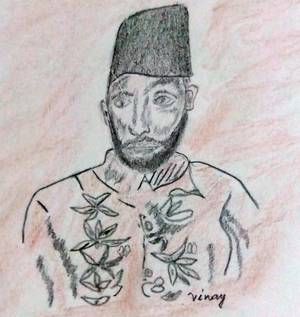
Illustration by Vinay Kumar | Photo Credit: 01dmc rvsmith

Providing a healing touch to the sick and the destitute, there are several stories associated with Hakim Ajmal Khan

An Oriental wearing a Western suit and carrying a small box walked down a street in Paris when he saw a man rolling on the ground. Quickly he took out something from the box and, after a few minutes, the man got up, clutched his stomach for a while and then, with a nod of thanks, walked away. The Oriental was Hakim Ajmal Khan who had put away his sherwani and pyjamas to don a suit during his visit to France in 1925. It was widely believed by generations of Delhiites that Ajmal Khan had a magic chest from which he took out medicines to effect near-miraculous cures, like that of a woman in England with an abnormal issue of monthly blood and an epileptic at an Iraqi shrine. He spent nine years as the guest of the Nawab of Rampur, where he revived a dying begum.

Over the years, since his death in 1927, people seem to have forgotten the great hakim whose lasting legacy is the Unani Tibbia College in Karol Bagh. But last week Jamia Millia Islamia held a symposium on the works of Hakim Sahib, who was one of its founders and also the first Chancellor in 1920. It was decided to set up a Hakim Ajmal Khan Institute for Literary and Historical Research in Unani Medicine at Jamia Millia. The proposed institute would translate the classical works on Unani medicine which are hitherto available only in Urdu and Arabic.

Hakim Ajmal Khan was descended from Hakim Sharif Khan. His father Hakim Mahmud Khan was one of the three sons of Sharif Khan and, interestingly enough, also had three sons of whom Ajmal Khan was the youngest. His elder brother, Hakim Abdul Majid died in 1901 and the second brother three years later. Ajmal Khan founded the Tibbia Conference in 1906 to bring hakims together for joint initiatives. His popularity increased with each passing year and he began to be regarded as a man whose views on medicine, politics and religion were widely respected, not only by Hindus and Muslims but also by Europeans like C. F. Andrews and Sir Malcolm Hailey, Chief Commissioner of Delhi. Mahatma Gandhi, six years younger than Ajmal Khan, was the one who opened Tibbia College in 1920 though he regarded Unani and other medicines as “black magic” and believed in natural cures.

It is interesting to note that Ajmal Khan started off by wearing the Mughal angarkhas, then switched over to the Aligarh sherwani and pyjamas and then suits for foreign visits he made in 1911 and 1925, besides the one in between to Shia religious places in the Middle East. When Ahmed Ali wrote his “Twilight in Delhi”, he couldn’t help mentioning the great hakim in it as the one who had attended to the novel’s hero, Mir Nihal after a paralytic attack. The hakim gave him rare medicines and also prescribed the soup of wild pigeons, caught by the Mir’s Man Friday, Ghafoor, whose own wife had died of abdominal ulcers since she was wedded at a young age to a much older. Even the hakim could not cure her as Ghafoor did not exercise restraint. But Mir Nihal surely benefited from his medication, as also the goat being masqueraded as a sick purdah woman and prescribed green grass.

Barbara D. Metcalf, who wrote a learned paper on Ajmal Khan and his family, recalled the words of the poet Hali on the death in 1900 of Hakim Mahmud Khan: “…Mahmud Khan’s strength was an honour to our race/ But he too, left the World. Alas, the fortune of our race/Ajmal Khan filled up the gap with élan. Not only that, he was also a born poet with the pseudonym of Shahid Dihlawi (possessed lover from Delhi) and left behind a dewan of his poetry, which he sometimes recited at mushairas and during debates on who was greater: Daagh or Zauq. Surprisingly enough Ghalib was left hanging in between.”

Being a man of common sense, despite dabbling in romanticism, he refused to entertain fakirs who claimed to have secrets of alchemy. Ahmed Ali writes about Mir Sangi who had wasted his wealth in trying to make gold and of Molvi Dulhan, dressed as “the bride of God in red sari and with bangles and long hair like a woman”.

According to the Moulvi, there is a prescription written on the Southern Gate of the Jama Masjid which no one has been able to unravel. It says (for alchemy is needed) “half a piece of That”! However the vital word describing ‘That’ is missing though a fakir once claimed that it was ‘actually a small, golden flower with red circles and dots on the petals”. When the problem was referred to Ajmal Khan he wrinkled his forehead and remarked “There are other things worth seeking instead of the art of making gold which remains a fantasy”. The writing on the masjid gate is just a brain teaser.”

The hakim sahib is then said to have walked away with a shrug of his shoulders, still what followed him was the belief that the Sharifi family had a special verbal formula (amal-i-taskhir) which never failed to effect a cure. It is not known whether Ajmal Khan divulged it to his successors but those who came for treatment to the Hindustani Dawakhana in Ballimaran probably thought he had, for after all wasn’t he the “Masiha-e-Hind!”.

source: http://www.thehindu.com / The Hindu / Home> Society / by R.V. Smith / May 31st, 2015
Sify columnist releases book on Indian Muslim freedom fighters

NEW DELHI :

FreedomFightersMPOs22dec2017

Patna:

In a glittering ceremony, two books on the Muslim community’s contribution to the Indian freedom movement were launched in Patna last week. The function was presided over by Harsh Mander, former IAS officer and human rights activist.

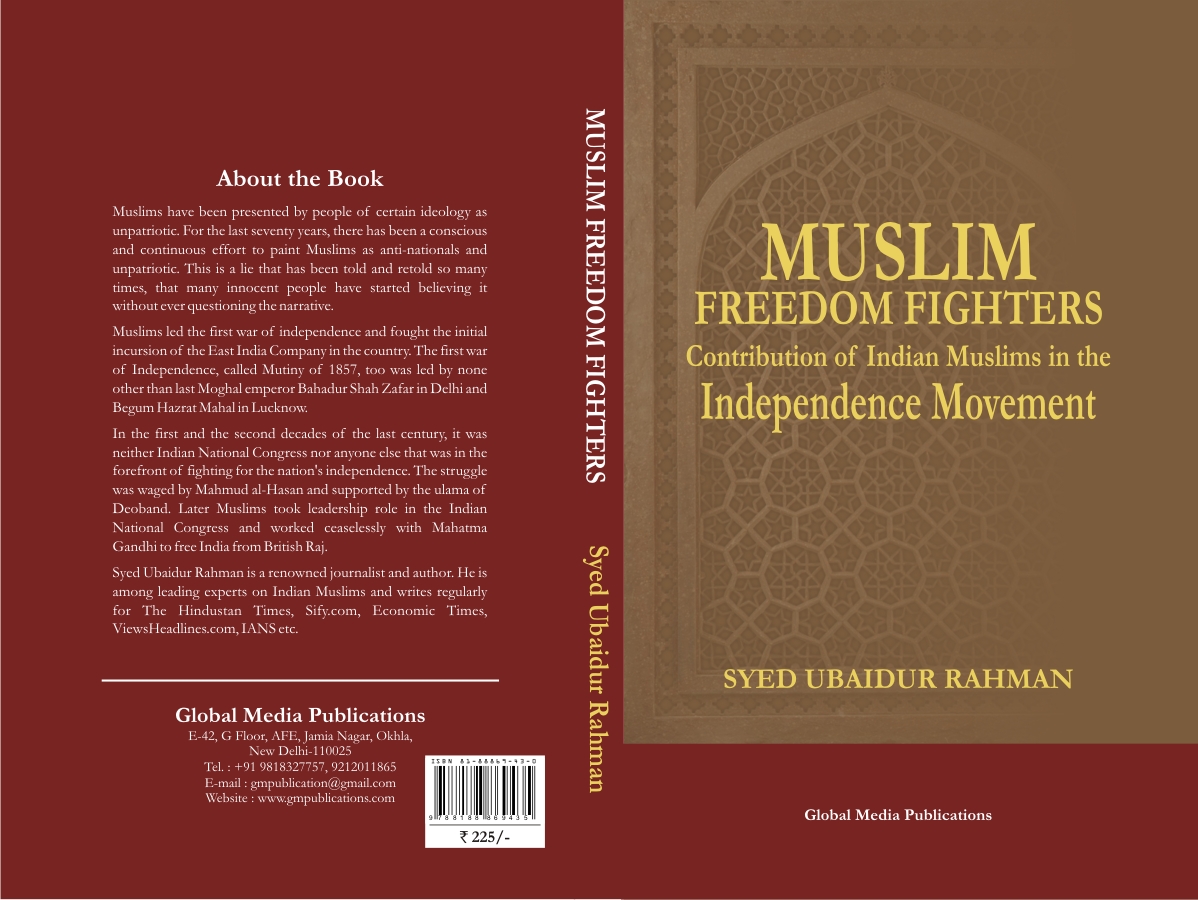
The books ‘Muslim Freedom Fighters: Contribution of Indian Muslims in the Independence Movement’ and its Urdu version ‘Muslim Mujahideen-e-Azadi aur Tehrik-e-Azadi Mein Unki Khidmat’ have been authored by well-known Delhi based author and journalist Syed Ubaidur Rahman.

The two books try to fight the oft-repeated allegations that Muslims are anti-national and have not contributed for the freedom of the nation. The books nail the lie and prove that Muslims not just participated in the freedom movement, they went on to lead the freedom struggle for a long time. The first war of Independence or Mutiny of 1857 was led by Mughal emperor Bahadur Shah Zafar in Delhi and Begum Hazrat Mahal in Lucknow.

The Independence Movement in the first two decades of the twentieth century was led by Mahmud Hasan and ulama of Deoband and they had respect and support of everyone including Hindus and Muslims.

If anyone has any doubt about the Muslim contribution in the freedom movement, the fact that the Indian National Congress had as many as nine Muslims as its president till the year 1947 will remove such doubts.

While speaking on the occasion, Harsh Mander said that the divisive forces in the country are trying to divide the nation on the basis of religion and faith. He said that the danger from such forces for the national fabric and its unity has become grave.

Mander added that the threat to the communal amity in the country was never so high as is today as divisive forces are doing every thing to pit one community against the other and create a fear psychosis among the majority community prompting it to turn it against minorities.

Khursheed Mallick, a Chicago based urologist, philanthropist and director of IMEFNA said that the book is a timely reminder to the nation that Muslims and Hindus both sacrificed for the nation and this fact must be clearly told to our young generation. He said Muslims sacrificed heavily for the cause of the freedom of the nation and efforts must be made to tell the history.

Syed Ubaidur Rahman, the author of the two books, while speaking on the occasion said Muslims have been rather loath to write about the sacrifices they have made for the cause of the Independence and freedom. He said Muslims suffered badly throughout the freedom movement. They were the worst suffers in the wake of the mutiny of 1857 and its aftermath when Muslims were hounded across North India and beyond. Tens of thousands of Muslims lost their lives for the freedom.

Syed added that ulama of Deoband played a stellar role in the freedom movement. Unlike the common perception, they were secular to the core and when they established a government in exile in Kabul in 1915, they appointed Raja Mahendra Pratap as its President and Maulana Barkatullah Bhopali as its Prime Minister.

The book documents the lives of forty renowned Muslim freedom fighters including, Shaikhul Hind Maulana Mahmud al-Hasan, Maulana Barkatullah Bhopali, Hakim Ajmal Khan, Maulana Ubaidullah Sindhi, Maulana Abul Kalam Azad, Maulana Mohammad Ali Jauhar, Dr Maghfoor Ahmad Ajazi, Dr Mukhtar Ahmad Ansari, Ashfaqulla Khan, Maulana Hasrat Mohani, Maulana Muhammad Mian Mansoor Ansari, Asaf Ali, Husain Ahmad Madani, Aruna Asaf Ali (Kulsum Zamani), Peer Ali Khan, Saifuddin Kitchlew, Mohammed Abdur Rahiman, Captain Abbas Ali, Abdul Qaiyum Ansari, Prof. Abdul Bari, Moulvi Abdul Rasul, Nawab Syed Mohammed Bahadur, Rahimtulla Mahomed Sayani, Syed Hasan Imam, Sir Syed Ali Imam, M.C. Chagla, Yusuf Meherally, Justice Fazal Ali, General Shah Nawaz Khan, Allama Fazle Haq Khairabadi, Maulana Shaukat Ali, Syed Mahmud, Maulana Mazharul Haque, Badruddin Tyabji, Col Mehboob Ahmed, Begum Hazrat Mahal, Maulana Shafi Daudi, Rafi Ahmed Kidwai, Syed Mohammad Sharfuddin Quadri, Batak Mian .

The book launch function was organized at Anjuman Taraqqi Urdu and was presided over by Abdul Qaiyum Ansari, chairman of Anjuman Taraqqi Urdu Bihar.

Syed Ubaidur Rahman is a New Delhi based writer and commentator. He has written several books on Muslims and Islam in India including Understanding Muslim Leadership in India.

source: http://www.sify.com / Sify.com / Home> SifyNews> National / by SIFY.com / Friday – December 22nd, 2017

Book on Hindu-Muslim unity released

ANDHRA PRADESH :

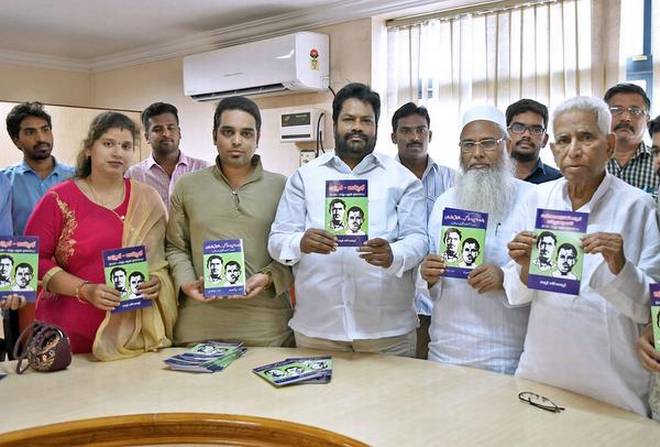
RASS general secretary G. Muniratnam releasing a book on freedom fighters on Tuesday. | Photo Credit: K_V_POORNACHANDRA_KUMAR

Ram Prasad Bismil and Ashfaqullah Khan were hanged to death by the British

At a function organised by Aam Insaf Muslim Samaj (AIMS), the book ‘Pandit Ram Prasad Bismil and Ashfaqullah Khan’ was released here on Tuesday by social activist and Rashtriya Seva Samithi (RASS) general secretary G. Muniratnam, a ‘Padma Shri’ awardee.

The trilingual book focussing on the life history of the fiery revolutionaries, who were hanged to death by the British government, is available in Telugu, English and Urdu for the benefit of readers.

The Telugu version was written by noted journalist Syed Naseer Ahamed, while B.V.K. Purnanandam translated it into English.

The duo shot to fame with the Kakori train incident, executed by Hindustan Republic Association in August 1925, after which the British regime arrested the two and awarded death sentence to them.

Even before they were to be hanged, the bosom friends gave an immortal call to Indians to stay united and move ahead, transcending the barriers of religion, caste and region.

AIMS president Shamsher Syed and secretary Rahamathulla Sharif appealed to the public to transcend the narrow communal barriers. The book is priced at ₹25.

source:  http://www.thehindu.com / The Hindu / Home> News> States> Andhra Pradesh / by Staff Reporter / Tirupati – December 20th, 2017

The lady with a legacy

MorrisMinorMPOs10nov2015

As a young boy, Javeed Mehkri would watch his father spend hours with his favourite car — a 1950 model of Morris Oxford, better known in India as the Hindustan 14. Javeed not only learnt about the car and its mechanics but thoroughly enjoyed the drive in it to and from school.

The passion for the Morris Oxford is living on through four generations with Javeed now transferring the ownership of the car to his 22-year-old son Junaid Mehkri. Junaid shares as much passion for the classic beauty as his father.

The car has an interesting history to it and Javeed gets nostalgic when he settles down to talk about it. Javeed says, “My grandfather, AK Mehkri, purchased it. He was working as the superintendent of engineering in the Shimsha hydro-electric station in the erstwhile princely state of Mysore. The car was initially registered and used in Mysore for three years, after which my great grandfather moved to Bengaluru. The car has been with us since,” explains Javeed.

Almost every member of the Mehkri family has driven the car. Those who revelled at its wheel include MG Mehkri, private secretary to the Yuvaraja of Mysore; Dr MS Mehkri, founder of the Bangalore Medical College; and ME Mehkri, a freedom fighter and a well-known philanthropist. “In fact, the landmark, Mehkri Circle, is named after ME Mehkri,” adds Javeed.

Decades after, the car has been restored with some of its parts being replaced and brought to perfect working condition. “The car was taken care of by Rasheed Mehkri, my late uncle. Rasheed passed away in 2013 and wasn’t there to see the car in running condition,” says Javeed.

However, he admits that the biggest challenge, is to maintain the car. “Spare parts for the American-made vintage and classic cars are available online but you will never find perfect spares for British classic vehicles in India. I got some of the parts replicated here but again you have to personally supervise it to make sure you are not taken for a ride. It is an expensive and time-consuming process to maintain these cars,” he says.

Javeed says among those who were drawn to his car was former prime minister of Nepal, Tulsi Giri. “There’s a church just opposite our house and he used to visit the church whenever he was in the City. Once, he saw the car parked outside my house and he asked me why I didn’t do anything to get it back on the roads. When he returned six months later, he again asked me the same question. I got the same advice from my cousin Sajjad. All this hastened the restoration process,” adds Javeed.

Among Javeed’s prized possession is also a 1960 model Lambretta Scooter — his father’s first purchase. “My father rode it and I used to go to college on it. Now, my youngest son Uzair gets dropped by the scooter once in a while,” he says. Like other youngsters of their age — Junaid and Uzair — love swanky cars but they value their two prized possessions more.

The Morris Oxford has been a regular at Karnataka Vintage and Classic Car Club rally for the last two years. And Javeed loves basking in all the adulation the car draws. “It was during one of the rallies that a lady in a car stopped beside us. She asked me: ‘How old is she?’ I said 65. She smiled and said: ‘She’s my age’. Total strangers admire and compliment me on the car,” he narrates.

(Javeed can be reached on Javeedmehkri@hotmail.com)

source: http://www.deccanherald.com / Deccan Herald / Home> Supplements> MetroLife / by Nina C. George / DHNS – Bengaluru , November 10th, 2015