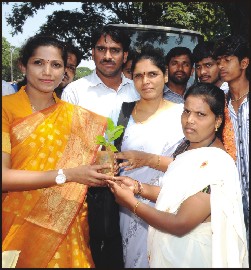
ZP President Dr. Pushpa Amarnath is seen distributing sapling during the programme organised to marked the 84th birth anniversary celebration of former President late Dr. A.P.J. Abdul Kalam, under the aegis of Arivu Samsthe in city this morning.
Mysuru :
Distribution of saplings amongst the public and awareness campaign on the importance of using eco-friendly bags, marked the 84th birth anniversary celebration of former President late Dr. A.P.J. Abdul Kalam, organised under the aegis of Arivu Samsthe in city this morning.
Mayor R. Lingappa, who spoke after launching the programme by offering floral tributes to the portrait of Dr. Kalam in city bust stand premises, stressed on the need for using eco-friendly bags (paper bags, cloth bags, etc.).
He also complimented the Samsthe for organising the programme with the theme ‘Shun plastics, use eco-friendly bags.’
The Mayor distributed tree saplings to the public on the occasion.
ZP President Dr. Pushpa Amarnath, Social Worker K. Raghuram, Corporator B.V. Manjunath, ex-Corporator M.K. Ashok, BJP leader Jogi Manju, Arivu Samsthe President Kashyap, Vikram and others were present.
source: http://www.starofmysore.com / Star of Mysore / Home> General News / October 15th, 2015
Incumbent president of the Kozhikode district panchayat Kannathil Jameela may not be contesting the polls this time, but she is confident that the development initiatives during her five-year tenure will see the CPI (M)-led Left Democratic Front (LDF) romp home in the local body elections.
“The district panchayat focused its attention on all sectors. Top priority was given to education, health, agriculture and industry. Almost all the schemes that we launched were running successfully,” Ms. Jameela said.
Model schools
Model schools were set up at Atholi, Balussery, Chorode and Punoor, which now have necessary facilities such as science and computer labs and a gym. Utmost care was taken to improve the infrastructure in all government schools, she said.
“The Vijayotsavam programme, aimed at improving SSLC results by offering special coaching to students, had achieved its desired effect. For the past three years, Kozhikode district had registered the highest number of A Plus students in the State. Today, students from the lower and middle income groups and those from the fishing and farming communities vie with their counterparts in the city,” she said.
Ms. Jameela consecutively contested the polls on the CPI (M) ticket since 1995 when she was elected president of the Thalakulathur grama panchayat.
She was standing committee chairperson of the panchayat in 2000; president of the Chelannur block panchayat; and later elevated as district panchayat president in 2010 when the post was reserved for women.
Likewise, she said the district panchayat had been able to focus on government-run hospitals by providing them with essential equipment. It had also tied-up with the Kozhikode Medical College Hospital for early detection of cancer and treatment.
“Besides, it had successfully implemented the Snehasparsham project for kidney patients at the Kuttiyadi Government Hospital and the Kozhikode Medical College Hospital,” she said.
On the agriculture front, she said farming initiatives in Koothali, Perambra, Puthuppadi and Thikkodi had yielded positive results. The district was almost self-reliant in milk production. The modern poultry farm at Chathamangalam can now hatch 5,000 chicks at a time. “Organic vegetable farming executed through Kudumbasree units had registered an all-time record,” Ms. Jameela added.
The development of the industrial estates at Cheruvannur- Nallalam with 45 exclusive plots for was a model for the State, she said.
source: http://www.thehindu.com / The Hindu / Home> News> Cities> Kozhikode / by Biju Govind / Kozhikode – October 13th, 2015
Hundreds of people on Sunday gathered in Mhasla, a census town in Raigad district of Maharashtra’s Konkan region, for the funeral of Syed Shaukat Ali Nazir, Imam of Mumbai Jama Masjid.
Syed Shaukat Ali Nazir, the Imam of Mumbai’s Grand Mosque located at Crawford Market passed away at his ancestor’s town Mendri in Taluka Mhasla on Saturday late in the afternoon. He is survived by his wife and son.
The news of his death sent shock waves across India. When the worshippers at the Mumbai Jama Masjid were told about his death soon after the Asr prayers Saturday, many were left in tears.
Besides people from the neighboring towns and cities in Konkan, a large number of people from Mumbai, Gujarat and other parts of Maharashtra travelled to Mhasla for the funeral prayers of Syed Shaukat Ali.
The 84-year-old cleric, among one of the most respected living clerics in India, was Imam of Mumbai’s Jama Masjid for 51 long years since 1964.
He was ailing since last few years and had shifted to Mendri. The last time he visited the Mumbai Jama Masjid was during the month of Ramadan when he came to Mumbai for two days.
Very pious and soft spoken, Syed Shaukat was famous for his Friday sermons. His sermon delivered immediately after the tragic demolition of Babri Masjid in 1992 is still in people’s minds. Advising calm and restraint, Syed Shaukat Ali had called upon the worshippers for introspection and prayers.
Syed Shaukat Ali Nazir was a graduate from Darul Uloom Deoband and was among the talented students of the senior teachers of that time like Qari Mohammad Tayyab, Aizaz Ali Amrohavi and Ibrahim Balyavi.
President of Jamia Hussainia in Shreewardhan, Syed Shaukat Ali had also presided over the inaugural session of the All India Muslim Personal Law Board (AIMPLB). He also worked as the Arabic language teacher at Mohammadia High School.
source: http://www.ummid.com / Ummid.com / Home> India / by ummid.com Staff Reporter / Sunday – October 11th, 2015
India Harmony Foundation, headed by Zafar Saifullah, former Union Cabinet Secretary, held a two-day cultural event at the Indian Islamic Cultural Centre on 18-19 July. The star attraction was the presentation of the Chishti Harmony Award for 2011 to two personalities which have spent a life time for communal harmony and community service. The first is Pandit Yugal Kishor Shastri of Ayodhya who has stood as a rock against communalists in Ayodhya and beyond and the second is Begum Bilkees Latif, wife of former Air Chief Marshal, Idris Latif, who has dedicated her life to serve the downtrodden in Mumbai. The awards were presented by Vice President Hamid Ansari in a function attended by Union minister of law and justice Veerappa Moily, Chief Election Commissioner Dr. S. Y. Quraishi and others. Hamid Ansari said in his brief speech that the Sufi Chishtia Order is the best example of the how human beings can do two things simultaneously: establish relationship with the Creator and serve humanity. The receipients of this award by their example have demonstrated the essence of Chishti teachings. It is the same old message which should be reiterated time and again so that human beings can live harmoniously with one another.
Here are brief life-sketches of the award receipients: Pandit Yugal Kishor Saran Shastri of Ayodhya is a person of quiet but extraordinary achievements. Born into a poor Yadav family of Madhubani district of Bihar, Pandit Yugal Kishor, struggling against heavy odds, completed his MA in Sanskrit from the Varanasi University. Whereafter he took over the care of the Sarayu Kunj Ram Mandir, located opposite the Babri Masjid at Ayodhya. Following the demolition of the Masjid in December, 1992, this remarkable man devoted his entire life to defending the lives, the properties and the livelihood of the Muslim community in the region at great risk to his own life. Without money, privilege or power, he upheld the values of secularism and respect for all religions. He ensured that Ayodhya has not been afflicted by the communal virus. Targeted, both physically and psychologically, by forces inimical to his work to abandon it, he has defied all odds to continue what he has taken as his life’s mission, namely, to preserve the centuries-old tradition of total communal harmony within the families of Ayodhya – a name which itself means “a land without conflict”. He has now enlarged his vision and the ambit of his work, to extend the same message of harmony on a wider scale throughout the country. A commendable initiative which he has embarked on in conjunction with several like-minded social workers and organizations are two padyatras. The first one from Ayodhya to Sewagram (Wardha) in Gujarat and the other from Ayodhya to Ajmer in Rajasthan to motivate people along the route to work for national harmony.
Begum Bilkees Latif was born into a privileged Muslim family and is married to former Air Chief Marshal, Idris Latif. She chose to make her most distinctive contribution in social service, in Dharavi, India’s largest slum cluster in Mumbai. It was notorious as home to some of Mumbai’s most dreaded mafia dons, where children were employed in illicit distillation; and the area recorded Mumbai’s highest crime rate. Following her very first visit to Dharavi in 1982, she decided to work for the transformation of the lives of the families living here. She established SHED (Society for Human and Environment Development) along with a few prominent and public spirited citizens of Mumbai. So dramatic has been the impact of her work that Dharavi today has the lowest crime rate in Mumbai. SHED has set up 45 youth groups in Dharavi. Through them, Vocational Training Projects, eradication of Leprosy and Tuberculosis, family planning, immunization of children and national integration programmes have been systematically taken up with active help in most cases of many of the Mafia dons and their families, who have even assured them total security. So much so that when communal unrest raged in other parts of the city, not a single instance of any communal disturbance was recorded in Dharavi. In fact, the whole area joins in celebrating festivals of each others’ communities with their own funds. SHED has taken up this work in other slums in Mumbai and the neighbouring district of Thane. Their work has covered the most extensive range of social services leading to requests from the World Bank and several other multi-lateral international aid agencies to take up their programmes.
As Chairperson of the National Bal Bhavans for two terms and of the Rajiv Gandhi Childrens’ Museum, she launched in November, 2005, a movement for children “to build the India of their dreams and secular values in nation-building”. Bilkees Latif is truly a role model for young Indian Muslim girls to follow.
source: http://www.milligazette.com / The Milli Gazette / Home> Special Reports / Online August 13th, 2011 – Print Issue 16-31 August 2011
Besides top police officials, Chief Minister Mufti Sayeed and former CM Omar Abdullah also paid their tributes
Image Courtesy: NDTV
Jammu and Kashmir lost one of its best counter-insurgency police officers on Thursday, after he was gunned down in an encounter with suspected Lashkar-e-Taiba (LeT) militants in the state’s Bandipore district.
Ahmed was shot in on Wednesday when he was on a covert mission to track down Lashkar-e-Taiba commander Abu Qasim. He was airlifted to Army’s 92 Base Hospital at Badamibagh cantonment where he was declared ‘brought dead.’
“I am unable talk on camera. I might break down,” director general of police K Rajindra Kumar told NDTV .
Altaf was the recipient of the President’s police medal for gallantry and several other state bravery awards.
A resident of Kulgam in south Kashmir, Altaf is survived by his wife and two children aged four and two.
Besides top officers of the police, Chief Minister Mufti Sayeed, former CM Omar Abdullah and senior intelligence officials paid their tributes to the officer.
Here are four things you need to know about the officer :
1. He was the main man behind neutralizing Hizb-ul-Mujahideen network
The Hizb-ul-Mujahideen is a Kashmiri separatist group, designated as a terrorist organisation by India, which has been active in Jammu and Kashmir since 1989.
According to an Economic Times report, Altaf almost neutralized the Hizbul Mujahideen network in the valley between 2006-07. He also exposed another high profile militant network of a police-constable-turned-militant Abdul Rashid Shigan, who was arrested along with two other militants in 2012.
Ahmed also played a key role in operations in which HM’s top commanders Qazi Misbah-ud-Din, Muzaffar Dar, Hanief Khan were killed.
2. He played an important role in Masarat Alam’s arrest
Ahmed was also responsible for tracking and arresting separatist leader Masarat Alam during the 2010 uprising.
Alam, who is the chairman of the Jammu Kashmir Muslim League (JKML) and the general secretary of All Parties Hurriyat Conference, is believed to have mobilized people for protests during the 2008 uprising and 2010 riots in which at least 112 people had died and over 500 were injured.
“Altaf was one of our best officers. He has done tremendous work on the anti-terrorism front. It is big loss for us,” Kashmir police chief SJM Giliani told India Today.
3. Altaf’s technical surveillance skills
Ahmed, who was in his thirties, joined the department as a constable and rose through the ranks as he mastered the art of tracking militants through mobile phones.
“He took a loan to buy a laptop and started recording phone calls of militants. Soon, everyone recognized his efforts and he was heading a separate counter-insurgency unit,” an officer told The Indian Express.
He was promoted out-of-turn thrice since 2006 and was due for another one this year.
4. His work against the LeT
Altaf was credited with raiding many LeT hideouts and arresting hundreds of militants over the last ten years.
According to reports, he was the brain behind 33 per cent of the operations against militants.
In fact, it was the same terrorist organization that led to his demise as Altaf, with two colleagues, was tracking down Lashkar-e-Taiba commander Abu Qasim, for his alleged role in the terror attack on a BSF convoy in Udhampur in August, when he was shot and killed.
source: http:/www.thenewsminute.com / The news Minute / Home / by TNM Staff / Thursday – October 08th, 2015
Deputy Commissioner Meer Anees Ahmmed directed the officials to gear up for the upcoming Tula Sankramana event at Talacauvery scheduled to be held on October 17.
Chairing a preparatory meeting on Tuesday, he asked officials to ensure drinking water supply and construct temporary toilets and maintain cleanliness at Talacauvery where thousands of devotees are expected to take part.
The DC also asked officials to make lighting arrangements at the site as the event will be held at midnight and to clear the weed grown on either side of Madikeri-Bhagamandala-Talacauvery, Napoklu-Bhagamandala road and to ensure cleanliness placing waste bins at various locations in Talacauvery.
He directed the revenue officials to conduct revenue and pension adalats and respond to the grievances of the public. “There are complaints about delay in the issuance of income and caste certificates. The issue needs to be rectified at the earliest. The applications received under the old age pension, Sandhya Suraksha yojana, widow pension, Manaswini, Maitri and other schemes should be cleared at the earliest,” he added. Additional DC M Sathish Kumar said there is a need to dispose of the applications filed seeking voter IDs within a short time frame.
source: http://www.deccanherald.com / Deccan Herald / Home> District / DHNS – Madikeri, October 07th, 2015
The 216th death anniversary of Tipu Sultan was commemorated on Monday.— Photo: M.A. Sriram / The Hindu
The expansion of sericulture in Mysuru region has been credited to Tipu Sultan
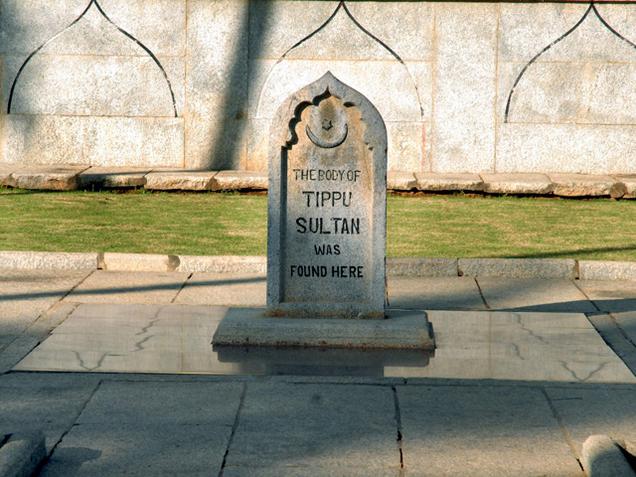
The death of Tipu Sultan on May 4, 1799, brought to close a fascinating chapter in Indian history; but his legacy continues to endure notwithstanding the controversy surrounding him in the present times.
Though it has been 216 years since the death of Tipu Sultan, historians are unanimous in pointing out that his initiatives in the socio-economic fields have continued to endure, though these were fast fading from public memory.
The expansion of sericulture in the Mysuru region has been credited to Tipu Sultan. The Mysore Gazetteer notes that Tipu secured the know-how from Bengal and introduced mulberry cultivation in 21 centres. In what could be described as a step to encourage local industry, he banned the export of cotton to ensure that local weavers were not denied the raw material.
The introduction of sugarcane on a large scale has also been attributed to Tipu Sultan for which he secured the assistance of Chinese experts, according to the Gazetteer, which notes that quality sugar and candy were produced with their assistance.
During the pause between the various wars he fought, Tipu Sultan took some reformatory measures including a ban on alcohol. Cattle being closely linked to agriculture, Tipu Sultan encouraged livestock breeding. Hallikar and Amrit Mahal breeds are believed to be products of this initiative.
Rocket technology
Modern day historians also credit Hyder Ali and Tipu Sultan with an elementary knowledge of missile or rocket technology, which is considered to be the prototype of present-day missiles and rockets. They were put to full use during the wars with the British. Some of these have been preserved at the Royal Artillery Museum in England. The paintings at Dariya Daulat, the summer palace of Tipu Sultan at Srirangapatana, are a clear indicator of the use of these missiles in wars.
A courtyard within the ruins of the Srirangapatana Fort was identified by archaeologists as the possible spot from where the missiles were launched. Scientists from DRDO have also visited the spot on many occasions in a bid to ensure better maintenance. Plans for a ‘missile museum’ are yet to materialise.
The expansion of sericulture in Mysuru region has been credited to Tipu Sultan
source: http://www.thehindu.com / The Hindu / Home> National> Karnataka / by R. Krishna Kumar / Mysuru, May 05th, 2015
Tipu Sultan cannot be reduced to a singular narrative or tradition of intolerance or bigotry as he represented multiple traditions. Photo: M.A. Sriram / The Hindu
The recent offer made by a film producer to Tamil superstar Rajinikanth to act in a movie on the ‘Tiger of Mysore’, Tipu Sultan, has yet again opened up a Pandora’s Box. The Bharatiya Janata Party (BJP) and some Hindutva groups have demanded that Rajinikanth refuse the offer. This argument is made on the grounds that Tipu, the 18th century ruler of Mysore state, was a “tyrant” who killed thousands of Hindus as they refused to convert to Islam.
This is not the first time that Tipu’s name has been dragged into a controversy. It began some years back when Sanjay Khan made a tele-serial based on Bhagwan S. Gidwani’s book, The Sword of Tipu Sultan. His name was once again dragged into a controversy when the Congress government intended to celebrate his birth anniversary in 2014. There was opposition when a proposal was made to establish a university named after him.
Tipu’s very name has become contentious for two reasons: first, his controversial steps in dealing with different communities and people who rose against him. Second, different perspectives through which history was constructed and his image built.
Colonial historians have projected Tipu as a “religious bigot”, who was instrumental in killing and converting to Islam thousands of Nayars of Kerala, Catholics of Dakshina Kannada and Coorgis of Kodagu. Even Kannada chauvinists have projected him as anti-Kannadiga as he was instrumental in changing the local names of places and introducing Persian vocabulary into administration. Marxist historians, on the other hand, have viewed him as “one of the foremost commanders of independence struggle” and a “harbinger of new productive forces”.
History is unkind to Tipu Sultan. The fact is that Tipu cannot be reduced to a singular narrative or tradition of intolerance or bigotry as he represented multiple traditions. He combined tolerant inter-religious traditions, liberal and secular traditions, anti-colonialism and internationalism. He could do this as he had strong roots in Sufism, which is not explored much by historians. He belonged to the Chisti/Bande Nawaz tradition of Sufism.
In fact, Tipu was radical in more than one sense. He was the first to ban consumption of alcohol in the entire State, not on religious grounds, but on moral and health grounds. He went to the extent of saying: “A total prohibition is very near to my heart.” He is credited with introducing missile or rocket technology in war. He was the first to introduce sericulture to the then Mysore state. He was the first to confiscate the property of upper castes, including Mutts, and distribute it among the Shudras. He is also credited with sowing the seeds of capitalist development at a time when the country was completely feudal. He thought about constructing a dam across the Cauvery in the present-day location of Krishnaraja Sagar. He completed the task of establishing a biodiversity garden named Lal Bagh.
His tolerance is reflected in his annual grants to no less than 156 temples, which included land deeds and jewellery. His army was largely composed of Shudras. When the famed Sringeri Mutt, established by Shankaracharya, was invaded by the Maratha army, he issued a firman to provide financial assistance for reinstallation of the holy idol and restoring the tradition of worship at the Mutt. His donation to the famous Srikanteshwara temple at Nanjangud; the donation of 10,000 gold coins to complete temple work at Kanchi; settling the disputes between two sects of priests at the Melkote temple; and gifts to Lakshmikanta temple at Kalale are all well-known. Interestingly, Srirangapatna, a temple town, remained his permanent capital till the end of his rule. He was also instrumental in constructing the first-ever church in Mysuru. Incidentally, well-known historian B.A. Saletore calls him “defender of Hindu Dharma”.
The allegation of forcible conversions has to be seen in the background of political exigencies — either they were with the colonialists such as in the case of Christians of Dakshina Kannada, or were waging a protracted guerrilla war as in the case of Coorg. Here, historians have distorted the facts by reducing political exigencies to the “communal ideology” of Tipu.
A ruler, who once identified himself with the American and French Revolution and Jacobinism, has remained an enigma to many. That a man who ruled for just 16 years continues to haunt Hindutva groups obviously means that Tipu continues to exist in the political discourses, political narratives as well as in the imagination of nation-building. This is where the irony of history lies — one cannot just bury Tipu in the annals of history.
Muzaffar Assadi
(The writer is chairman, department of political science at the University of Mysore. muzaffar.assadi@gmail.com.)
source: http://www.thehindu.com / The Hindu / Home> National> Karnataka / by Muzaffar Assadi / September 27th, 2015
Cashew Export Promotion Council of India celebrating diamond jubilee
The cashew processing industry in the country worked its way up from humble beginnings in Kollam to eventually become the global citadel of cashew processing. All cashew kernels available in the domestic and foreign markets were for a long time only those processed from Kollam.
Cashew also moved forward to become a major foreign exchange earner. But now when the Cashew Export Promotion Council of India (CEPCI) is celebrating its diamond jubilee in Kochi, cashew export from the country is facing serious challenges in the international markets.
Processing of cashew on a commercial basis was introduced in Kollam during the mid-1920s by a Sri Lankan national, Roche Victoria. Later, W.T. Anderson of the U.S. settled in Kollam and started processing on a large scale by opening a factory. All kernels were exported to the U.S.
Cottage industry
CEPCI chairman T.K. Shahal Hassan Musaliar said soon cashew processing became a flourishing cottage industry in Kollam. The export of kernels had increased from 45 tonnes in 1923 to 1,350 tonnes by 1939. During the initial years of commercial processing, raw nuts were sourced from the country itself.
Import of raw nuts from Africa began in the 1930s.
Mr. Musaliar said during 1940-41, about 28,000 tonnes of raw nuts were imported from Africa and the export of kernels touched 40,000 tonnes by 1941. World War-11 saw a fall in exports. Processors like Thangal Kunju Musaliar, Vendor Krishna Pillai, Poyilakada Parameshwaran Pillai, Kidangil Kunnju Raman and the company Pierce Leslie took cashew processing in Kollam to new heights after the war.
Mr. Musaliar recalls that when the industry faced a crisis in 1955 due to which exports suffered, the then Union Minister of Finance, T.T. Krishnamachari, intervened and called a meeting of cashew exporters in Kotttayam during his Kerala visit. Mr. Krishnamachari felt that the industry seriously needed some guidance in promoting exports and this led to the formation of the CEPCI that year, Mr. Musaliar said.
Major market
He said the U.S. was the major buyer of kernels till 1955. In 1956, the erstwhile Soviet Union began purchasing kernels from Kollam and became the top buyer of kernels from 1969.
New international markets also began developing. Today, the U.S. is back as the biggest importer of cashew from India. During the 2013-14 fiscal, the country imported 33,898 tonnes of cashew kernels from India. More than 25 countries import kernels from India now, he said.
source: http://www.thehindu.com / The Hindu / Home> National> Kerala / by Ignatius Pereira / Kollam – September 30th, 2015
The South Indian Classical Dance Festival began in the city on Saturday under the aegis of Southern Cultural Centre (Tanjavore), cultural councils of Central and state governments, and Young Men’s Hindu Association (YMHA).
Andhra Pradesh Assembly speaker K Siva Prasada Rao lit the lamp and inaugurated the festival. He emphasised upon the need to encourage the classical art forms in the state and pointed out that Tamil Nadu encourages art forms in a big way. He assured to set up Government Music and Dance College in the city with the help of public representatives.
Southern Region Cultural Centre director EN Sajith, city mayor Sheikh Noorjahan, YMHA Trust Board general secretary KV Satyanarayana and working committee president Ch Gopi also participated. Later the speaker felicitated the dance artists.
On the occasion, the Aiswarya Warrior team of Baroda performed Mohiniyttam (‘Shakti’ dance play let), while Kuchipudi artiste Amaranth Ghosh from Chennai performed ‘Jayadeva Ashtapadi’ and ‘Shivasthakam’. The Ghosh team also performed ‘Ganapathi Kowtham’, ‘Govardhan Giridhari’ and ‘Marakata Manimaya’, which enthralled the audience.
source: http://www.newindianexpress.com / The New Indian Express / Home> States> Andhra Pradesh / by Express News Service / September 27th, 2015