Ahmed Javed on Tuesday was appointed the new Mumbai Police Commissioner .
Ahmed Javed will take over from Rakesh Maria.
Rakesh Maria has been promoted to DG Home Guards.
Rakesh Maria was much in the news these days due to Mumbai Police’s ongoing investigations in the Sheena Bora murder case.
The home department held the changes were made taking into account the law and order factor ahead of the Ganapati festival, dismissing suggestions that that it has some links with the ongoing investigation in the high-profile murder case.
“Maria has been promoted to the director general rank and posted as the DG of Home Guards in Mumbai in place of Ahmed Javed. Javed (who was DG-Home Guards) becomes the new CP of Mumbai,” additional chief secretary (home) K P Bakshi said.
He said that post of Mumbai police commissioner has been upgraded to ‘director general’ rank post.
He said Maria, a 1981-batch IPS officer, had been transferred with “immediate effect” and that Javed, also a 1981-batch IPS officer, will take over as the new CP on Tuesday itself.
“There was no hurry in transferring Maria. It would have been inappropriate to transfer him on September 30, in the middle of the festive season as Ganapati festival, a very important event in Maharashtra would be on at that time. Therefore, we decided to advance the promotion of Maria,” he said.
When asked about the fate of the ongoing Sheena Bora murder case investigation, Bakshi said that all investigations are important and not only this particular case and that the work of the CP is only to supervise the investigation.
“Investigations are conducted by lower-level police officials and supervised by the CP. The new CP is competent. Also, Javed should get enough time to handle the situation in Mumbai,” Bakshi said.
Chief minister Devendra Fadnavis is away in Japan on a visit.
(With inputs from agencies)
source: http://www.timesofindia.indiatimes.com / The Times of India / News Home> City> Mumbai / TNN / September 08th, 2015
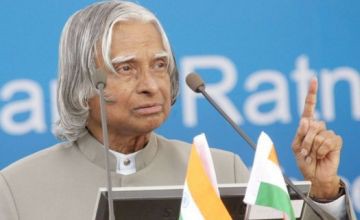
Filmmaker Nila Madhab Panda, who is planning to make a biopic on APJ Abdul Kalam, says he needs good amount of time to direct the movie on the former Indian President.
The I Am Kalam director said he had even discussed the idea of making the film with Kalam.
“When you think of making a film on such a personality, you have to take a hiatus for at least three years. It is not a film which can be made in six-seven months.
“I would love to make a film on him because I have spent ample amount of time with him. But I don’t know when I will start making it. I had few discussions with Kalam sir too about his biopic when he was alive,” Nila said.
When the entire country was mourning the death of the former Indian president, who died in Shillong in July, the filmmaker was happy to see how every channel was showing “I am Kalam” to keep his spirit alive.
“Every channel was showing I Am Kalam after his death.
Though it was not a film on his life, it is a film which will keep his spirit and teachings alive.”
I Am Kalam, a 2011 film, revolved around a poor Rajasthani boy whose life changes forever after he takes a cue from a speech delivered by the former President.
Nila’s latest satirical drama Kaun Kitne Paani Mein hit theatres recently. The film talked about the water scarcity in a village in Odisha.
source: http://www.thestatesman.com / The Statesman / Home> Interview / Press Trust of India, New Delhi / September 07th, 2015
Weavers of Erode paid homage to former president Dr A P J Abdul Kalam by weaving a window curtain with the ‘missile man’s’ face. They plan to hand over their specially made curtain to Kalam’s family soon.
Talking to TOI, designer of Chentex (The Chennimalai Weavers Cooperative Production and Sale society Limited), K Appusamy, said that this is the first time he has designed a curtain for such an occasion. “I have made several curtains stamped with eminent personalities. I am happy to have this opportunity to design a curtain as a tribute to Dr. Kalam.
It’s a jacquard weave he has used to make the curtain. The face is first designed on the computer. After work on the computer was completed, he handed over the jacquard pattern to weavers Baby and her husband Subramanian.
“It took me a day to complete the design work. It took another whole day for the weavers to complete their work. The entire curtain has been made by hand,” he said.
This is the second time Appusamy designed Kalam’s face. On the first occasion, he had made a wall hanging when Dr Kalam became the President of the country. He has also made a wall hanging for Sachin Tendulkar, when he hit a double century in a one-day match for the first time.
He also did some design work for the Semmozhi function held during the DMK regime. When the Thanjavur temple turned 1,000 years old, he created a design of the temple. He got global recognition for his bed spread sprinkled with Tamil vowels.
The members of Chentex plan to present this special window curtain to Kalam’s family in Rameswaram, after all the formalities are completed.
They plan to sell specially made wall hangings through Co-optex outlets across the state.
source: http://www.timesofindia.indiatimes.com / The Times of India / News Home> City> Coimbatore / by V. Senthil Kumaran, TNN / July 30th, 2015
When late President APJ Abdul Kalam prayed at Jamiah Mosque in Madikeri, Kodagu
by Prof. M.I.K. Durrani
Jainulabadeen always felt that his son was destined to be exceptional and in his heart of hearts he hoped that his promising young son would one day make the family proud by becoming a Collector (Deputy Commissioner), not having the slightest inkling of what the future had in store for this darling of the family. His wife Ashiamma joined her husband in wishing Godspeed to their son as he left Rameswaram.
And thus commenced a long scientific odyssey leading to one achievement after another, followed by one glory succeeding another and finally one accolade upon another accolade in the form of Padma Bhushan, Padma Vibhushan and Bharat Ratna and then the acme as the first citizen of this country — President of India.
[Continued from yesterday]
But in spite of all the innate greatness of the genius that the country can boast of, this very personification of humility has got this to say:
“Each individual creature on this beautiful planet is created by God to fulfil a particular role. Whatever I have achieved in life is through His help and an expression of His will. He showered His grace on me through some outstanding teachers and colleagues and when I pay tribute to these people, I am merely praising His glory. All these rockets and missiles are His work through a small person called Kalam, in order to tell the several million mass of India to never feel small or helpless. We are all born with a divine fire in us. Our efforts should be to give wings to this fire and fill the world with the glory of its goodness.”
And I wondered how the young dreamer, who once watched cranes and sea-gulls soar into flight, longed to fly and did realise his dreams. And that unique person was going to visit the Jamiah Mosque at Madikeri and I too would be one of the fortunate few to behold the nonpareil in flesh and blood.
By the time I reached Balayatrie Estate on Thursday, the 6th April, 2006, it was nearly 10 pm. I was welcomed with all the usual warmth and affection that my brothers-in-law could muster up. There was the eldest of them, F.M. Khan, former MP and his third brother, Noor Mohammed and the youngest of the five brothers, Afroz Mohammed Khan. F.M. Khan was virtually a recluse after his cardiac surgery and whenever any relatives came to stay with him, he would be immensely pleased to enjoy their company. Noor Mohammed had arrived from Mysuru along with his family comprising his wife, son, daughter in-law and his two grand-children. Since Dr. Kalam was by nature very fond of children, Afroz suggested that the President should be welcomed to the mosque with a special bouquet of flowers from carnivorous plants as a mark of respect and the honour of presenting it should be given to Noor Mohammed’s exceptionally cute four-year-old grandson, Mohammed Khan. Everybody endorsed Afroz’s suggestion. F.M. Khan was feeling drowsy so he retired to bed and Noor also followed suit.
Afroz and I were by ourselves, not feeling sleepy at all, I, because of my curiosity pertaining to the President’s impending visit to the Mosque and Afroz due to his bubbling excitement. He got up and said he would fetch some tea for me and went straight to the kitchen. Of all the five Khan brothers, Afroz is the youngest but the tallest. He happens to be chip off the old block since his philanthropic nature, charitable generosity and compassion for all his paternal and maternal relations have been inherited by him to a large extent from his father late Yusuf Ali Khan.
F.M. Khan, his eldest brother, as the dejure muthavalli (manager) of the Mosque wasn’t able to discharge his duties owing to his ill health. Afroz, the youngest volunteered to shoulder the responsibility and thus he was the defacto muthavalli at that time and simultaneously he had been elected as the President of the Managing Committee of the Jamiah Mosque. As a dedicated and zealous servant of God Almighty, he had just then completed the renovation of the Mosque and had changed it into a well-known mosque of Madikeri.
As we started sipping our respective beverages, I asked Afroz how he had manoeuvred to get the President participate in the Friday prayers. Synopsised, it amounted to this:
It was during the first week of April 2006 that the news was flashed in the newspapers that the President of India was to visit Madikeri to participate in the centenary celebrations of General K.S. Thimayya and the day selected happened to be a Friday which all devout Muslims consider as a day of festival for the followers of the faith and every Muslim is expected to attend the congregational prayer on that day. So assuming that since Dr. Abdul Kalam had descended from a very pious family, he might in all probability would not miss the obligatory Jummah prayers.
So Afroz wanted to find out whether there was any scheduled programme of the President to attend the prayers. The first thing he did on 5.4.2006 was to ring up the office of the Deputy Commissioner, the Superintendent of Police and the Wakf Board, Mercara, to ascertain whether a visit to the Mosque was envisaged but from all the three places, the curt answer was an emphatic “No.” And thirty minutes later at 11.30 am, he called the Offices of the Deputy Commissioner and the Superintendent of Police again to find out the latest position but once again he was told that there was no such programme.
Afroz, as the President of the Mosque, was in a dilemma. Then suddenly he had an inspiration. He got an e-mail sent to the Rashtrapathi’s Office stating that the Friday prayers at the Jamiah Masjid in Mercara will commence at 1 pm. The very next day, on Thursday, the 6th April 2006 at 11.30 am, there was a call to the Jamiah Masjid from P.M. Nair, Secretary to the President, desiring Afroz Mohammed Khan to contact P.M. Nair and Afroz did so at noon. Nair said that his e-mail was received and the President thanked him for the information. He added that the President would be joining the Jummah prayers. Nair further said that it would be a purely private visit, therefore there was no need to inform either the Deputy Commissioner or the Police about it.
Afroz informed his brother F.M. Khan about the talk he had with the President’s Secretary and the ex-MP wanted to get it confirmed so he contacted the Deputy Commissioner, the Superintendent of Police and the Office of the Wakf Board but none among them had any information about it. F.M. Khan was rather sceptic about the visit to the Mosque and expressed his fears.
However, Afroz went to the Deputy Commissioner’s office at 5 pm to discuss about the President’s visit. He sent his card in but the officer was otherwise busy, as usually people in such position are, and then there was no urgent need to attend to a visitor who was only a President of a Mosque.
Afroz waited patiently for about half-an-hour but since there seemed to be no end to his travail, he left the place and went back to the Mosque.
[To be continued]
source: http://www.starofmysore.com / Star of Mysore / Home> Feature Articles / Saturday -September 05th, 2015
———————————————————————————————————————–
Recollections …: Prayer with People’s President – 3
By Prof. M.I.K. Durrani
The Mosque was as usual spic-and-span and there wasn’t any room for further improvement. At about 8.30 pm that evening, Additional Superintendent of Police Bhagwan Das arrived at the Mosque just to inspect the place with regard to cleanliness and security. He was completely satisfied with the upkeep of the place and desired to know how the President would be received and by whom. Afroz informed him that he himself, as the President of the Mosque, would receive President Dr. Abdul Kalam. The officer wanted to know how many garlands would be used since they had to be subjected to a thorough scrutiny. He was told that garlanding a person in the Mosque as a gesture of welcoming him isn’t customary and, therefore, there would be no garlanding. However, as a token of high regard, it was decided to offer the President a special bouquet of flowers from carnivorous plants and the same would be presented by a four-year-old boy at the entrance of the Mosque. The Additional Superintendent of Police was completely satisfied with the arrangements and bid goodbye to the staff of the Mosque.
[Continued from yesterday]
The next day was Friday, the day named after Frigga (or Freya), wife of Odin (the God), who is immortalised in the name Wednesday (Odin’s Day) but in Arabic it is called Jummah, meaning Congregation — an assembly of a large number of people for prayer. Jummah is considered by Muslims all over the world as a Holy Day, a sacred and blessed one.
A great deal of sanctity is associated with it since it is believed that Adam, the first man, was created on that day and that was the day he was admitted into the Garden of Eden from where he was much later expelled and that day also happened to be another Jummah and when he passed away, it was a Jummah too. The Day of Judgement is also expected to be on the same day. Furthermore, it is also believed that Allah forgives all sinners on this day when they are truly contrite, so it may as well be described as a day of deliverance from sin.
And on the D-day, we, all the menfolk, got ready well- in-time. After our bath, every one put on his Friday’s best comprising a white jhubba and white pyjamas, both soaked in light perfume. We reached the Mosque at about 12 noon. Already there were quite a few Policemen in the vicinity and the devotees had started trickling in. Afroz told the Mouzzan (Mosque official) to keep sufficient stock of water in case it was required by the President for performing Wazoo (the mandatory ritualistic washing of the face and limbs) before joining the congregation.
Exactly at 1 pm, the Imam started his bayan (speech) in Urdu which usually precedes the mandatory Arabic Khutbah (sermon or talk) in two parts. The first part of the Khutbah was over but there wasn’t any sign of the VVIP. The second part was also started, still the suspense continued. Exactly at 1.55 pm, there was a phone call from S.M. Khan, the Press Secretary, informing Afroz that the President would be arriving in another five minutes.
The Mosque clock chimed two O’ clock, the Khutbah came to an end and at that very moment, the President’s car arrived at the entrance of the Mosque and out emerged the smiling President wearing a closed collared coat and trousers with a white skull cap in his hand, which he put on to his head as he entered the odoriferous prayer hall. His feet were covered with white socks as he had left his shoes inside the car. He was received by Afroz in his capacity as the President of Mosque and Dr. Kalam shook his hand warmly and regretted his late arrival.
Then Noor Mohammed’s grandson, Mohammed Khan, the cute little laddie presented the bouquet to the President. After receiving the bouquet, the President, good humouredly snatched the cap from the boy’s head as though he was taking it away, but the very next moment he put it back on the child’s head and blessed him by placing the palm on his head and the boy bent his head and simpered. In the meanwhile, Afroz approached S.M. Khan and enquired sotto voce whether the President would perform the Wazoo. Khan replied that the President never went out with Wazoo. Even then he was Bawazoo (with the Wazoo).
Dr. Kalam, followed by his Secretary, joined the congregation. He found a vacant place on the carpeted floor in the third row and there he sat down. Though he had been offered a place in the first row, he had declined it as he must have felt that he was just a devotee like any other person and he didn’t like any kind of discrimination on the basis of a person’s status. Just then all the people stood up and formed lines. The Imam said ‘Allah-o-Akbar’ and the entire flock joined the rituals.
One thing which had at that time moved me almost to tears was when I saw the first citizen of this great land of ours, like any other commoner, joining the congregation wherever he found a vacant place, not expecting any kind of special consideration. What a contrast it is with the attitude of upstarts among the self-styled VIPs, who always consider it their birth right to enjoy preferential treatment wherever they go. Dr. Kalam, a man of remarkable humility, must have remembered one stanza from Dr. Mohammed Iqbal’s Urdu poem, Shikwa (complaint) in which there is this touching narration:
1. Aagaya aine lada ee may jab waqt-e-namaz,
Qibla roo ho ke khadi ho gayi qaum-e-hijaz,
2. Ek hi saf may khade ho gaye Mahmood-o-Ayaz,
Na koyee banda raha na koyee banda nawaz,
3. Banda-o-saheb-o-mohtaj-o-ghani ek huye,
Teri sirkar may pahunche toh so bhi ek huye.
And the above lines have been excellently rendered into English by no less a person than late Khushwant Singh, thus:
1. In the midst of raging battle, if the time came to pray,
Hijazis (Arabs) turned to Mecca, kissed the earth and ceased to fray;
2. Sultan and slave (Mehmood and Ayaz) in single file stood side by side,
Then no servant was nor master, nothing did them divide;
3. Between serf and Lord, needy and rich, difference there was none,
When they appeared in your court, they came as equals and one.
And that one act of self-effacement speaks volumes about the greatness of the humble, God-fearing scientist.
[To be continued]
source: http://www.starofmysore.com / Star of Mysore / Home> Feature Articles / Sunday -September 06th, 2015
Recollections …: Prayer with People’s President – 4
By Prof. M.I.K. Durrani
[Continued from yesterday]
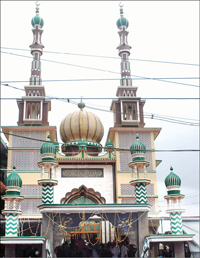
Jamiah Mosque in Madikeri, Kodagu.
After the prayers were over, the courteous President told Afroz to seek, on his behalf, permission from the Imam to address the gathering.
While all the members of the congregation were seated, he stood up and spoke to them in English. He expressed his happiness at witnessing such a large gathering. He said that his father and grandfather were all orthodox Muslims and never missed a single prayer.
His father used to take him to Mosque every evening and whenever he achieved anything, his father used to make him offer thanksgiving prayers in the Mosque. He hoped that the audience would continue to keep up the practice of their ancestors and lead virtuous lives. At the same time, he advised them to live in greater harmony with the people of other religions and to be proud of being Indians.
Sensing that what he was saying might be misunderstood by a majority of the audience due to their ignorance of the English language, he concluded his speech by asking the people to join him by repeating the Arabic Ayats (lines) from Surah Al Fatihah which all Muslims recite during prayers and which implore Allah to guide them to the path of those who were favoured by Him and not the path of those who earned His wrath by going astray.
The audience felt maximum spiritual intensity by repeating each ayat with fervour as the President recited them like a teacher.
Afroz proposed a vote of thanks and the President started moving through the throng of the much impressed audience, shaking hands with several persons who were standing on either side of his path.
Noticing a group of children, he went straight to them and spoke to them in English and was much pleased to find them responding in that language. Then he got into his car, waved towards one and all, who were standing on both sides of the route and departed leaving behind the admiring people of Madikeri, who would always cherish the memory of a People’s President’s visit to their beautiful hill station.
And today, when I look back and recollect what a great day it was in my life when I had the honour of shaking hands with that gem of a man, I just wonder whether it was really so or it was just a dream. Today he is no more with us but he has left such an indelible impression on our mind that the Bard whispers from nowhere:
“His life was gentle and the elements
So mixed in him, that nature might stand up,
And say to all the world, This was a man.”
[Concluded]
source: http://www.starofmysore.com / Star of Mysore / Home> Feature Articles / Monday -September 07th, 2015
Swiss-engineering major ABB on Wednesday appointed its India managing director Bazmi Husain as its global Chief Technology Officer (CTO) with effect from January 1, 2016.
India-born Husain, an expert in power and automation who has been with ABB for more than 30 years, will report to CEO Ulrich Spiesshofer, says the statement issued by the company. In his new role, he will be based in Bengaluru with an office in Switzerland.
As CTO, Husain will be responsible for overseeing all aspects of ABB’s global R&D, which serves the entire company, its scientists and engineers, and for the R&D activities within ABB’s divisions.
Reporting to him will be the heads of R&D at group and division level as well as ABB’s venture capital arm, ABB Technology Ventures. With locations in seven countries, ABB’s corporate research centres bring together an international team of highly-skilled scientists across a variety of disciplines. ABB spends $1.5 billion annually on R&D and employs some 8,500 technologists.
“Bazmi Husain’s unrivalled know-how will drive technological innovation across multiple disciplines to support our profitable growth ambitions and the paradigm shifts in power and automation,” said CEO Spiesshofer.
source: http://www.deccanherald.com / Deccan Herald / Home> Business / DHNS / Bengaluru – September 03rd, 2015
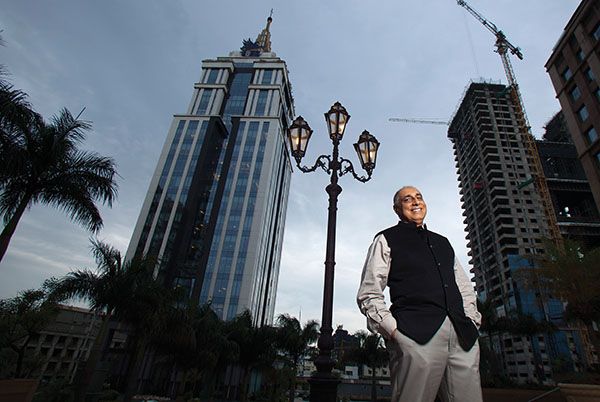
Having made Prestige a household name in Bengaluru, can billionaire-developer Irfan Razack do the same in India’s most expensive and competitive real estate market ?
Image: Namas Bhojani for Forbes India Irfan Razack, 62, chairman and managing director of Prestige Group
In 1990, when Irfan Razack sold his second real estate project in his home market of Bengaluru for Rs 1 crore, he began planning his retirement. Elated with the money he had made, Razack thought he could spend his days indulging in his favourite hobby—horse riding. But twenty-five years later, the now 62-year-old chairman and managing director of Prestige Group is still hooked on to real estate. “My friend had warned me that making buildings is like a drug. He said, ‘You will become addicted to it’,” says Razack, who heads Prestige Estates Projects Ltd, the group’s flagship company.
A self-professed “clear thinker” who prides himself on being meticulous, he believes that life is about conquering the next big milestone. “Money loses its charm after a while. It is the creativity that keeps you going,” says the billionaire, who, with a net worth of $1.23 billion, ranks at No 77 on the 2014 Forbes India Rich List.
Prestige Estates Projects, India’s second-largest listed real estate company, is on the brink of greater things. Now more than ever, it needs its leader. Retirement is not an option for Razack.
For the first time, in financial year 2015, Prestige has overtaken India’s largest listed real estate developer DLF Ltd in pre-sales (new sales). Last year, the difference between the pre-sales of the two competing companies was Rs 1,424 crore with DLF in the lead. But Prestige ended the recently concluded fiscal 2015 with Rs 5,014 crore in pre-sales compared to DLF’s Rs 3,850 crore of pre-sales much to the surprise of analysts who were initially sceptical of Prestige meeting its new sales target of Rs 5,000 crore.
Now, Razack expects to touch Rs 20,000 crore in pre-sales in the next three years. And this time around, everyone, competitors included, is paying attention.
To put things in perspective, prior to its initial public offering (IPO) in FY09, Prestige had recorded revenues of Rs 889 crore. Since 2010, its market capitalisation has grown from Rs 2,000 crore to about Rs 10,000 crore currently. Its subsequent rise in these last six years has coincided with DLF’s decline in growth. DLF’s market capitalisation has been on a downward spiral from a high of Rs 2 lakh crore in 2008 (a year after its IPO) to approximately Rs 22,000 crore.
These comparisons don’t sit too well with Razack. “We are the number two developer by default, rankings don’t matter,” he says.
But how did he ride the crests and troughs of the real estate market? For nearly three decades, the Bengaluru-based developer built an enviable portfolio by focusing mostly on his home turf (85 percent of its ongoing projects are in the city) compared to its larger rival DLF, which has projects across India. Luck had a hand in his success, too. Bengaluru, along with Mumbai and Delhi, is one of the top three residential property markets in India, and has held steady unlike the National Capital Region (NCR) where DLF has most of its projects.
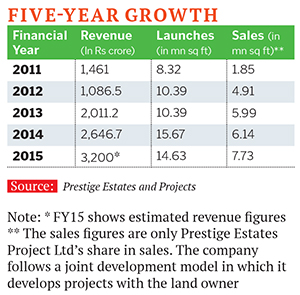
In terms of revenue, Prestige pales in comparison to DLF. The New Delhi-based real estate company ended FY15 with Rs 8,168 crore in revenue compared with Prestige’s modest estimated revenue of Rs 3,200 crore for FY15. Prestige was scheduled to declare its audited financial results for FY15 on May 30, 2015 (after Forbes India went to print).
What has largely gone unnoticed, however, is that a substantial portion of the Bengaluru developer’s sales have not yet come in for revenue recognition. Real estate firms recognise revenues once their projects reach the threshold limit of 25 percent completion. Because many of Prestige’s projects haven’t reached that limit, the company is sitting on unrecognised revenue (sales made but yet to come in for recognition) amounting to Rs 8,377 crore as of December 31, 2014. Much of these sales will kick in by FY16.
Not that Razack is sitting around waiting for the numbers to kick in. He has far bigger plans.
source: http://www.forbesindia.com / Forbes India / Home> Features – Big Bet / by Shabana Hussain & Debojyoti Ghosh / June 09th, 2015
“The Hardayal library is an important signpost of our city’s history. We need to ensure that it is restored to its erstwhile glory,” said Jung.
In a meeting on Friday, Lieutenant Governor Najeeb Jung approved a Rs 3-crore grant for the restoration of the ailing Hardayal municipal public library in Chandni Chowk.
The meeting was attended by Commissioner (North corporation) representatives from the South and East corporations, the secretary and librarian and senior government officers.
“The Delhi Urban Heritage Foundation (DUHF) will look into the restoring the library’s outer and inner structure. A joint inspection shall be undertaken immediately to chart out the course to be taken and for removal of encroachments. Work shall also be undertaken to help digitise rare and old books in the library’s collection,” stated the Lt-Governor.
“The Hardayal library is an important signpost of our city’s history. We need to ensure that it is restored to its erstwhile glory,” said Jung.
Established in 1862, the library is more than 150 years old and is presumably the oldest one in Delhi. It has a collection of extremely rare and precious books, including books dating back to the 16th century.
It has a collection of more than 1,70,000 books in different languages, with 8,000 of these in the rare category section. It has 28 branches which are spread all across the three municipalities of Delhi.
source: http://www.indianexpress.com / The Indian Express / Home> Cities> Delhi / by Express News Service / New Delhi – August 29th, 2015
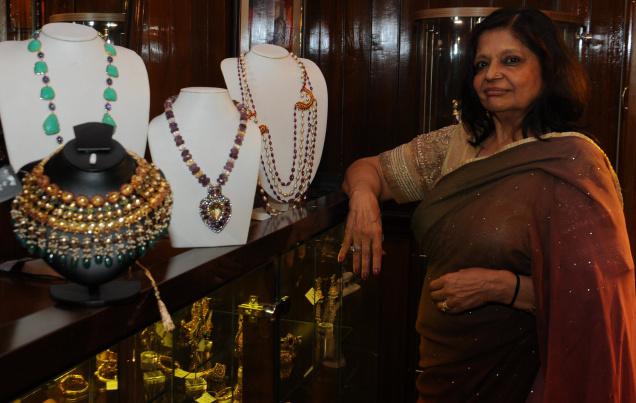
Former minister Nafees Fazal has launched her own jewellery studio
Nafees Fazal, a former minister for Medical Education and Science and Technology, in Karnataka “loves politics and jewellery. I have a passion for beautiful things,” explains the lady herself. Dressed in an elegant sari, she is not wearing any jewellery herself. “I don’t like to look like a Christmas tree all the time. A lovely sari, draped well, is enough to get me through the day,” she beams.
Nafees is now in the news as she launched her own jewellery studio called The Private Collection by Nafees Fazal. She has converted a room in her bungalow into the studio. “Having a studio at home helps me cut the overheads,” she explains.
As of now she has a limited range of jewellery called the “Naf Collection”. “Naf is short for my name,” she says, and dons the role of a model as she stylishly demonstrates how a particular piece of jewellery must be worn or carried in style.
“I am itching to get back into politics. But what do I do in the meantime? I can’t play housewife all the time. I decided to travel, and curate this collection for women. Who doesn’t love jewellery?” asks Nafees. The collection, currently on display, starts at Rs. 4,000. It is collected from Tanjavur, Rajasthan, and Delhi over the “last four months”. It offers designs in precious and semi-precious stones, antique pieces from Trivandrum, “which are bought at the princely sales”. Then there are jhumkis, large earrings, kangans, neck pieces and so on.
From bridal wear, to party wear or just making a style statment, the collection has something for every occasion. “They are created in silver, plated with gold, and come with kundan in polki and other hand works. Hence, it brings the cost down drastically. The aim is to offer the traditional with a touch of modernity. Part of the proceeds will go towards my Kare Foundation, which was started to help poor patients in 2009,” states the former minister.
She adds that she is “passionate to help the poor”. “I do not have crores but am all game to help those in need.”
Will she get into designing as well? Pat comes the reply, “No! I am not into manufacturing but only curating. I need to get back into politics. This is just a hobby. The studio will continue. I assure you that there is something stylish for everybody here.”
source: http://www.thehindu.com / The Hindu / Home> Features> MetroPlus> Fashion / by Shilpa Sebastian R / Bengaluru – August 31st, 2015
President Pratibha Patil has issued an order on Sep 23, appointing state Lokayukta’s additional registrar Moosa Kunhi Nayarmoole as a judicial member of the Karnataka Administrative Tribunal (KAT). He has served as additional registrar since 2009.
Born of Haji Moidin Kutty and Fatima Hajuma in Nayarmoole, Manila in Bantwal taluk in 1952, he pursued primary education in Pakalakunja HP School and high school education in government high school in Paivalike.
After completing B Sc in Vivekananda College, Puttur, he later studied Law in Udupi and secured sixth rank in the final examination. He began practice as junior to advocates, the late T Yusuf Hyder and M Seetaram Shetty in Mangalore.
He made his entry into the judicial service by being appointed as munsiff and first class magistrate in 1983. In 1992, he was upgraded as civil and chief magistrate and in 2000 as district civil judge.
He has served as city civil and sessions judge, chairman of Karnataka Waqf Tribunal, additional director of Karnataka Judicial Academy, secretary to the chief justice of state high court, additional secretary to state law, justice and human rights department and immediately before the present appointment as additional registrar at the Lokayukta.
source: http://www.mangalorean.com / Mangalorean.com / Home / by Team Mangalorean / October 04th, 2011