Category Archives: Leaders

City girl breaks into Indian tennis team

idhi Chilumula with two-time Grand Slam winner Sania Mirza. Photo: V.V. Subrahmanyam

With two silver medals at the recent National Games, Nidhi is delighted at the way her game has shaped up over the past year.

For 20-year-old Nidhi Chilumula, the moment of reckoning has finally arrived. In a team led by her childhood favourite Sania Mirza, she will represent the country in the Fed Cup championship to be held here from April 14.

With two silver medals under her belt at the Kerala National Games held recently, Nidhi is today delighted at the way her game has shaped up after joining the Sania Mirza Tennis Academy (SMTA) in December 2013. “This is a huge honour. More so because I will be playing under someone whom I cheered as a 10-year-old kid from the stands, when Sania won her first WTA singles title in 2005 at LB Stadium,” she remarked.

“Joining the SMTA and training with Sania is a huge learning curve in my career. She has given me so many invaluable tips,” recalls Nidhi.

“I am really grateful to Sania’s parents – Imran and Nasima for their support,” she said. “Interactions with WTA Tour consultant Christian Filhol and also (fitness trainer and former Aussie Olympian) Robert Ballard helped me achieve my highest WTA ranking of 581 in singles and 428 in doubles.”

Right now, this young champion’s plans include playing 24 to 30 ITF tournaments in different countries in the next one year.

“I want to break into the top five in the country and then chase the bigger dream of playing a Grand Slam, which is possible if I could be in the below-200 WTA rankings,” Nidhi explained.

Looking for support

A B.Com graduate from Keshav Memorial College, Nidhi is looking for corporate support. “It will be of great help if someone supports my training programmes,” she said.

A native of Telangana, Nidhi is also looking at support from the State government.

Being part of the Hyderabad Aces team in the inaugural Champions Tennis League along with the likes of Martina Hingis, Mark Philippoussis and Mikhail Youzhny was an unforgettable experience, she says. “I sincerely believe it will help me a long way in the days to come,” she added.

source: http://www.thehindu.com / The Hindu / Home> News> Cities> Hyderabad / by V.V. Subrahmanyam / Hyderabad – March 17th, 2015

Udupi CMC bags best practice award

The Udupi City Municipal Council (CMC) has bagged the Best CMC Practice Award for its initiative “Improved financial and Energy efficiency in Water Supply” at a function organised by the Department of Urban Development, Directorate of Municipal Administration and City Managers’ Association, Karnataka, at the Vikasa Soudha in Bengaluru recently.

A release here said the award carries a cash prize of Rs. 1 lakh. Vinay Kumar Sorake, Minister for Urban Development and Qamarul Islam, Minister for Municipal Administration, Public Enterprises, Minorities Welfare, Haj and Wakf, gave away the award. P. Yuvaraj, president of Udupi CMC, received the award on behalf of the council.

source : http://ww.thehindu.com / The Hindu / Home> News> National> Karnataka / by Special Correspondent / Udupi – March 17th, 2015

Wipro hires ex-TCS executive as COO

Global software major Wipro Ltd on Monday appointed former TCS honcho Abid Ali Neemuchwala as its group president and chief operating officer from April 1.

WiproMPOs17mar2015

“Abid will head service lines of global infrastructure, business application, business process and advanced technology solutions,” the company said in a statement here.

Abid headed the business process services (back office operations) of Tata Consultancy Services (TCS) and held leadership positions during his 23-year career in the IT bellwether.

“Abid brings invaluable experience with his track record of building and scaling businesses. I am confident his understanding of technology and expertise in IT & BPS will help power our businesses to greater heights,” Wipro chief executive T.K. Kurien said.

A chess buff, Abid is an electronics & communication engineer from NIT, Raipur in Chhattisgarh and has masters in industrial management from IIT, Mumbai.

“I am honoured to join Wipro, a company with a rich heritage of technology innovation and unflinching commitment to values. I look forward to contributing towards the company’s next phase of growth,” he said from Dallas in US’ Texas state, where he lives with family.

Abid will also head business operations, geographies comprising continental Europe, Africa, Latin America, strategic engagements, advisor relationships and marketing function.

source: http://www.deccanherald.com / Deccan Herald / Home> Business / IANS / Bengaluru – March 16th, 2015

All-Women Police Station Opened in Howrah

An all-women police station was today opened in Howrah (rural) district.

The police station was inaugurated by state correctional home minister Hyder Azid Safi at the Uluberia police station.

Parliamentry secretaries and MLAs Nirmal Majhi and Pulok Roy alongwith DIS Subroto Mitra was present on the occasion.

source: http://www.outlookindia.com / Outlook / Home> Howrah / March 16th, 2015

Aamir Edresy conferred with “Huzur Mujahid-E-Millat Award”

Aamir heads Association of Muslim Professionals, a Mumbai-based NGO with members from all over India, its Facebook group has more than 44 thousand members.

AamirMPOs17mar2015 

The award was given in an Annual Conference named after renowned Sufi Buzurg and Freedom Fighter Hazrat Maulana Shah Habibur Rahman (Commonly known as Mujahid -e- Millat for his contributions for community) at Handiwali Masjid, Saifee Jubilee Street, Bhendi Bazar, Mumbai.

This recognises Aamir Edresy’s continous efforts for Educational and Economical Empowerment of Muslim Community all over India through different projects of AMP. The award was given by the hands of Hazrat Maulana Syed Khalid Ashraf Saheb.

Maulana Ejaz Kashmiri, Maulana Anees Ashrafi, Amin Patel (MLA), Amin Parikh, Haji Ameen, Irshad Lakdawala, more than 100 clerics from all over Mumbai and huge crowd was present in the conference.

AMP Facebook Group: http://www.facebook.com/groups/ampindia.786/  Website: www.ampindia.org

source: http://www.milligazette.com / The Milli Gazette / Home> Online News> Community News / March 17th, 2015


ASI-protected 14th century tomb gets a whitewash

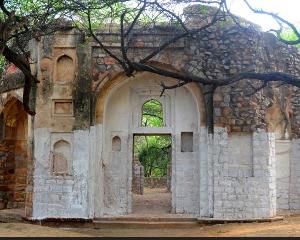
Defaced- Tomb of Khan Shahid, located inside the Mehrauli Archaeological Park. (TOI photo by Rajesh Mehta)

New Delhi  :

A 14th century monument, Tomb of Khan Shahid, located inside the Mehrauli Archaeological Park was defaced and whitewashed some days ago. The monument, protected by the Archaeological Survey of India, used to be brown in colour. Now it has been painted white. Other smaller monuments in the park have also been encroached upon.

“This monument was notified as ‘protected’ in 2008-09,” said an official with INTACH.

Khan Shahid was the son of Ghiyas-ud-din Balban, the ninth Sultan of the Mamluk dynasty during the Delhi Sultanat period. There are around 60 monuments in the Mehrauli Park, spread over 200 acres. The park’s land is owned by Delhi Development Authority but officials say their responsibility is only to maintain the park. “These monuments are ASI’s responsibility, not ours,” a DDA spokesperson said.

ASI officials were not aware of the monument’s status. “We don’t know whether ASI, Delhi Wakf Board or DDA is responsible for it,” said Deepak Bhardwaj, a surveyor with ASI Delhi.

The tomb could well become a cause of contention between different institutions. As per ASI, DDA is the land-owning agency and even outside the park DDA boards have been put up. However, on the freshly white-painted walls, one could see Delhi Wakf Board written in black.

“We didn’t send any painter to this site. But if it is Delhi Wakf Board property then we have the right over it and repair work can be carried out,” said Rana Siddique, chairperson, Delhi Wakf Board.

The tomb is supported on 12 Delhi quartzite columns and is covered with a vaulted roof of brick and plaster. The enclosure measures 4.85m by 3.85m. Hidden by thick vegetation, it isn’t easily accessible. It is easy to miss the turn leading to the tomb as the small plants market on Anuvrat Marg has encroached upon the pavements and the road leading to it.

The structure had undergone conservation work in 1998 as a part of the INTACH Delhi Chapter under the project on 20 monuments within the area. The columns have engraved capitals and the ceiling has inscriptions, geometric and floral motifs in plaster. All this is now hidden under the white coat of paint. Even the tomb is in shambles and needs immediate repair.

“Last week it came to our notice that the tomb and other small monuments in the enclosure are all painted white. It isn’t even maintained well,” the INTACH official said.

There is a mosque and a graveyard in the same compound. One could see people drying clothes on the roof of another small monument next to the mosque. Some people also live inside the mosque. “We are living here for some years now,” said one of them. The encroachers confirmed that last week two painters came and daubed it in white.

source: http://www.timesofindia.indiatimes.com / The Times of India / Home> City> Delhi / by Maria Akram, TNN / March 17th, 2015

DOWN MEMORY LANE – Talk about a tomb

SafdarJungMPOs16mar2015

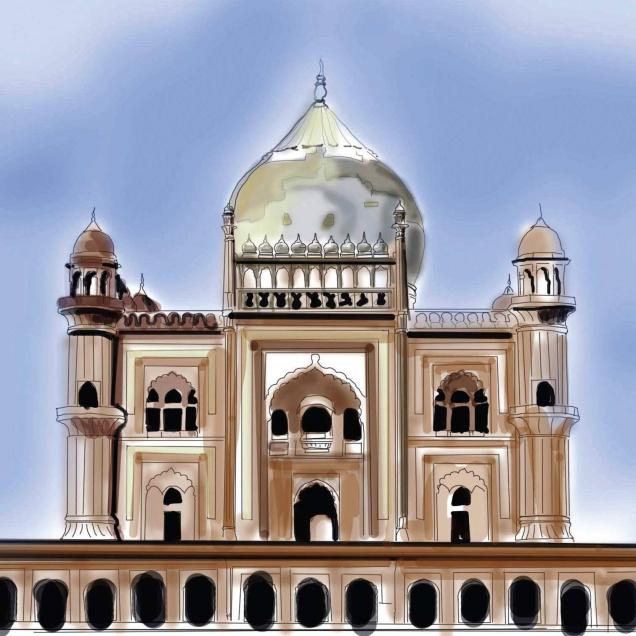
Nawab Safdarjang’s tomb used to be a place of halt for the Tazia procession from the Walled City before it ended at the Karbala in present-day Jorbagh

Many have admired Safdarjang Tomb as the last flickering lamp of Mughal architecture but it was left to Dulcie Hamilton, a passing-by travel writer from Melbourne, to remark that it was like “an inverted lotus, just the opposite of the latter-day Baha’i Lotus Temple” (in an age when the Lotus symbol is politically abloom). Both the structures incidentally have an Iranian link as the founders of the Baha’i faith, the “Bab” and Bahaullah belonged to Iran while Nawab Safdarjang also had Iranian antecedents. For this reason, his last resting place occupied pride of place in Jorbagh, the Shia cemetery that extended up to it at one time and was second in importance only to the (Hazrat Ali) Qadam Sharif shrine set up by Qudsia Begum, the wife of Mohammad Shah in the 18th Century. Safdarjang was the Vazir at her husband’s court and later that of her son. It should be no surprise, therefore, that the tomb took pride of place during the Moharrum mourning for Imam Hussain.

The tazia processions that came from the Walled City made their first halt at the palace of Mahabat Khan, behind his contemporary Abdun Nabi’s masjid in the present ITO area and the next one at Safdarjang’s Tomb before finally ending at the Karbala. Mahabat Khan’s mahal does not exist now but his grave is there in Jorbagh.

Another interesting fact that few know about is that Safdarjang’s first Urs or death anniversary saw many Shia divines arriving in Delhi from Oudh and surprisingly enough, a qawwali was also held at the behest of his son and successor, Nawab Shujauddaulah who was reputed to have the longest moustaches in the Mughal empire. He aided Ahmed Shah Abdali in the third Battle of Panipat in which the Maratha confederacy led by the imperious Sadashiv Rao “Bhau” lost. After that Shujauddaulah’s clout in the Mughal durbar increased with the arrival in Delhi from Allahabad of Shah Alam (designated emperor by Abdali).

Safdarjang’s mausoleum, designed on the pattern of Humayun’s Tomb, is a poor imitation. The three-storey tomb in fawn-coloured stone also bears a faint resemblance to Akbar’s mausoleum at Sikandra, but lacks the magnificence of the latter. Even so it is an interesting monument, situated amidst a garden of 300 square yards, and enclosed by a wall at the corners of which stand octagonal towers and a central dome, rising above a 16-sided drum.

Arcaded pavilions, named Moti Mahal, Badshah Prasad and Jangli Mahal, have been, constructed on the northern, southern and eastern sides, like the pavilions in the outer quadrangle of the Taj. It is believed that these were meant for the accommodation of nobles who visited the mausoleum. The tomb has a carved cenotaph in the central chamber within which is another chamber containing two unmarked graves, both with earthen mounds above them. In it lie buried Mirza Muquin, Abul Mansoor Khan Safdarjang, and his wife Banu Begum. The monument was built by Shujauddaulah at a cost of Rs.3 lakhs with a lot of marble and other material being pinched from the mausoleum of the Khan-e-Khanan and other Mughal buildings.

Safdarjang was the head of the Shia Irani Party at the court of Ahmed Shah (1748-1754). His opponents were the leaders of the Sunni Turani party headed by Imtiaz-uddaulah and Imadad-ul-Mulk. Safdarjang, who had succeeded Burhan-ul-Mulk as Nawab of Oudh, died at Faizabad in 1754 and his body was brought to Delhi, for though he had to leave the Mughal court in disgrace after trying to play kingmaker, he nevertheless pined for his days of grandeur in the Capital and desired to be laid to rest there. His mausoleum has a mix of Mughal, Rajput, Iranian and Egyptian architectural patterns jostling for space.

Even so, it attracts a lot of tourists but these days, the water channels – a notable feature – are dry which is a turn-off. The renovation work has been done only on some portions with others are still badly in need of repairs. When one visited the tomb recently under overcast skies, one wondered if yesteryear music ‘mehfils’ could be revived and tazia processions made to converge on it either at Moharrum or Chhelum for the halim dish break that used to replenish the fatigued ‘Akharas’ or sword and lathi-wielding squads in the past. One thing that Safdarjang couldn’t have dreamt about is that 261 years after death his memory would be enshrined not only in the Maqbara but also in the airport, road, hospital and enclave named after him by a generous posterity which only has a nodding acquaintanceship with him.

The author is a veteran chronicler of Delhi.

source: http://www.thehindu.com / The Hindu / Home> Features> MetroPlus / by R.V. Smith / March 15th, 2015

From Bean to Cup

The Coffee Board of India serves as the friend, philosopher and guide to the coffee sector in the country covering the entire value chain

CoffeeBeansKF12mar2015

The saga of Indian coffee began on a humble note, with planting of ‘Seven seeds’ of ‘Mocha’ during 1600 AD by the legendary holy saint Baba Budan, in the courtyard of his hermitage on ‘Baba Budan Giris’ in Karnataka. For quite a considerable period, the plants remained as a garden curiosity and spread slowly as back yard plantings. It was during 18th century that the commercial plantations of coffee were started, thanks to the success of British entrepreneurs in conquering the hostile forest terrain in south India. Since then, Indian coffee industry has made rapid strides and earned a distinct identity in the coffee map of the world.

The Coffee Board

During 1940s, the coffee industry in India was in a desperate state due to the World War II resulting in very low prices and ravages of pests and diseases. At this time, the Government of India established the Coffee Board through a constitutional act – Coffee Act VII of 1942 – under the administrative control of the ministry of commerce and industry. The Board comprises 33 members including the chairman, who is the chief executive and appointed by the Government of India. The remaining 32 members represent the various interests such as coffee growing industry, coffee trade interests, curing establishments, interests of labour and consumers, representatives of governments of the principal coffee growing states and members of Parliament.

After pooling was discontinued in 1996, Coffee Board serves as the friend, philosopher and guide to the coffee sector covering the entire value chain. The core activities are primarily directed towards research & development, transfer of technology, quality improvement, extending development support to growing sector, promotion of coffee in export and domestic markets. The activities of the Board are broadly aimed at (i) enhancement of production, productivity and quality; (ii) export promotion for achieving higher value returns for Indian coffee and (iii) supporting development of the domestic market.

Research and Export Promotion

Organised research in coffee was initiated during 1925 by the erstwhile Mysore Government by setting up the Mysore Coffee Experiment Station near Balehonnur in Chikmagalur district. After formation of the Coffee Board, the research station was brought under its administrative control. Presently the Research Department of the Board with its headquarters at the Central Coffee Research Institute and five regional stations has a sanctioned strength of 113 scientific personnel and is involved in development of improved varieties with tolerance to major pests and diseases and standardisation of technology for improving production, productivity and quality.

CoffeeAreasKF12mar2015

After liberalisation in 1996, the marketing functions were deregulated. The Coffee Board plays the role of facilitator and promoter of Indian coffee exports. However, registration of exporters is the responsibility of the Coffee Board. Under the Export Promotion scheme, exports of value added coffees in retail packs and export of coffee to high value far-off destinations are incentivised to offset the transaction costs to some extent and enable the Indian exporters to be competitive in the export market. These incentives provide opportunities to expand the footprint of Indian Coffee in higher value destinations like USA, Japan, Canada, Australia, New Zealand, etc on one hand and reinforcing presence in traditional markets i.e., European Union/ Russia and CIS etc.

Besides, the Board regularly participates in leading coffee trade shows/ exhibitions held in major consuming countries to promote awareness about quality of Indian coffee to the overseas roasters, traders and consumers. The Board also conducts Flavour of India – The Fine Cup competitions to select fine coffees and expose them to the export market. It also promotes coffee consumption in the country through 12 India Coffee Houses located in major cities across the country.

In India, coffee is traditionally grown in the Western Ghats spread over Karnataka, Kerala and Tamil Nadu. Coffee cultivation is also being expanding rapidly in the nontraditional areas of Andhra Pradesh and Odisha as well as in the North East states. Coffee is predominantly an export oriented commodity and 65 per cent to 70per cent of coffee produced in the country is exported while the rest is consumed within the country. Indian coffee industry earns a foreign exchange to the tune of about Rs 4000 crore. In the international market, Indian coffees earn a high premium, particularly Indian Robusta which is highly preferred for its good blending quality. Arabica Coffee from India is also well received in the international market.

Arabica is a mild coffee, but the beans being more aromatic, it has higher market value compared to Robusta beans. On the other hand Robusta has more strength and is, therefore, used in making various blends. India is the only country that grows all of its coffee under shade. Typically mild and not too acidic, these coffees possess an exotic full-bodied taste and a fine aroma.

India cultivates all of its coffee under a well-defined two-tier mixed shade canopy, comprising evergreen leguminous trees. Nearly 50 different types of shade trees are found in coffee plantations. Shade trees prevent soil erosion on a sloping terrain; they enrich the soil by recycling nutrients from deeper layers, protect the coffee plant from seasonal fluctuations in temperature, and play host to diverse flora and fauna.

Coffee plantations in India are essential spice worlds too: a wide variety of spices and fruit crops like pepper, cardamom, vanilla, orange and banana grow alongside coffee plants.

Training courses in coffee culture and management

The Central Coffee Research Institute, popularly known as CCRI, has grown as an internationally recognised, state-of-the-art research centre for carrying out research on all aspects of coffee cultivation. CCRI is committed to introducing emerging technologies and sustainable package of practices to benefit the coffee farmers. It plays an important role in the development and growth of the coffee agricultural sector. CCRI has 133 dedicated scientists working for the development of newer technologies in close association with a number of international institutes, reputed national institutes and pure science and agricultural universities.

The CCRI, apart from the development of new technologies, is involved in imparting training on scientific coffee cultivation to the benefit of all the stakeholders since 1953. The institute is recognised as an international centre of excellence for training in coffee culture by the FAO, Rome. Candidates from several coffee growing countries are being sponsored for these training programmers by the world organisations like UNDP, FAO or by their respective countries.

CHART

Coffee regions of India

Anamalais (Tamil Nadu): Wildlife sanctuaries in this region are the abode of spotted leopards,while the plantations are home to fine, high-grown Arabicas, including the exotic Kents.

Araku valley (Andhra Pradesh):
 Home to colourful parrots, it is not unusual to see a flock of chattering red and green birds, darting through trees in this scenic valley.

Bababudangiris (Karnataka): Bababudan brought seven ‘magical’ beans from Yemen and planted them in the lofty hills of this region. Deer is often spotted, grazing alongside plantations abundant with full-bodied Arabicas.

Biligiris (Karnataka/Tamil Nadu):
 Besides full-bodied Arabicas, this region is noted for the sambar – the largest Indian deer with huge antlers.

Brahmaputra: The mighty Brahmaputra which flows through the North Eastern states is the lifeline of this region which is home to the one-horned rhinoceros. This sturdy animal is found in large numbers at the Kaziranga National Park in eastern Assam.

Chikmagalur (Karnataka): Chikmagalur’s forests and wildlife sanctuaries are abundant with beautiful peacocks, India’s national bird. The peacock loves to show off its colourful feathers, especially during its elaborate courtship dance.

Coorg (Karnataka):
 Lush coffee plantations are bustling with honeybees which yield the delicious Coorg Honey, collected by nimble-footed tribals

Manjarabad (Karnataka): Gentle sloping terrain with small streams and coffee plants provide a natural habitat for the jungle fowl. This yellow-headed bird with a red comb and multi-coloured plumage is generally seen in pairs, close to the coffee plantations.

Nilgiris (Tamil Nadu): The plantations are home to fine, high-grown Arabicas, including the exotic Kents.

Pulneys (Tamil Nadu): A well-known feature of this region is the bright, bluebell-like Kurinji flower that makes a dramatic appearance, once in 12 years. The high-grown Arabicas however, are a predominant sight, year after year.

Sheveroys (Tamil Nadu): 
The magnificent Gaur or Indian bison is an embodiment of vigour and strength, much like the boldsized Arabicas grown here. This massive animal with its huge head and sturdy limbs grazes on the lower hill tracts of this picturesque region.

Travancore (Kerala): The national flower of India, the lotus symbolises purity and beauty. These bright, fragrant flowers with floating leaves and long stems, grow in shallow waters in this region noted for its Arabicas and Robustas.

Wayanad (Kerala):
 Wayanad is home to the Indian tiger, India’s national animal – a symbol of valour and courage.

source: http://www.financialexpress.com / Financial Express / Food & Hospitality World / Home> Cover Story / March 05th, 2015

‘RSN Memorial Award’ for Freedom Fighter

Ramashesh and Sanjhi Artist Huseni

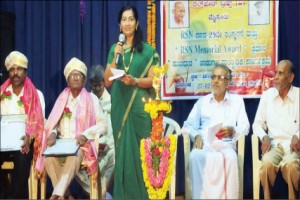
Zoo Authority of Karnataka (ZAK) Chairperson Rehana Banu is seen delivering inaugural address during the award function organised by R.S. Naidu Art and Cultural Welfare Trust in memory of Freedom Fighter R.S. Naidu at Nadabrahma Sangeetha Sabha in city recently as Sanjhi Artist S.F. Huseni, Freedom Fighter M.R. Ramashesh, Brahmana Association Chairman Raghuram and R.S. Naidu Trust President P.Y. Venkatadri look on.

Mysuru :

Freedom fighter M.R. Ramashesh and Sanjhi Artist S.F. Huseni were conferred with ‘RSN Memorial Award’ at a programme organised by R.S. Naidu Art and Cultural Welfare Trust in memory of freedom fighter R.S. Naidu at Nadabrahma Sangeetha Sabha in city recently.

Speaking after inaugurating the programme, Zoo Authority of Karnataka (ZAK) Chairperson Rehana Banu said, “Many artists across the country have contributed in their respective fields despite lack of encouragement and recognition. They should be lauded for their commitment and passion. We should encourage the artists through felicitation programmes.”

After the award function, Indu Shekhar and Troupe presented a musical programme.

Renowned artists of Mysuru and Bengaluru sang the old film songs sung by P.B. Sreenivas, S.P. Balasubramanyam, P. Susheela, S. Janaki and others. They even sang the songs from the movies of Dr. Rajkumar, Dr. Vishnuvardhan and Puttanna Kanagal.

The following songs were sung on the occasion: ‘Hindusthanu endu mareyada…’ from the movie Amrutha Ghalige, ‘Snehada kadalalli…’, ‘Aseya bhava olavina jeeva’, ‘Karunada thayi’, ‘Haadu haleyadaadarenu’, ‘Jeeva veene needu midithada sangeetha’, which made the audience to travel down the memory lane.

Mike Chandru compered the musical programme.

Singers including Indrani Anantharam, CFTRI Krishnamurthy, KEB Gangadhar, Srinivas Hemanth, Vijayanand, Joyce Peters, Anantharam, Kiran Kumar, Geethalakshmi Keni, Vijay Manasa and others took part in the function.

R.S. Naidu Art and Cultural Welfare Trust President P.Y. Venkatadri and Trustee M.K. Ramesh; K. Raghuram, Chairman, Brahmana Association; Mysuru Anand and Parthasarathy were present on the occasion.

source: http://www.starofmysore.com / Star of Mysore / Home> General News / Wednesday – March 04th, 2015

Elected unopposed to All India Milli Council , Mysuru

MilliMPOs08mar2015

Mysuru :

Hazrath Moulana Mohammed Zaka Ulla and Corporator K.C. Shoukath Pasha were unanimously elected as President and General Secretary respectively of All India Milli Council, Mysuru District Unit, at a meeting held recently at Madrasa-e-Ashraf Ul Uloom in Kesare here.

The meeting was held under the supervision of Hazrath Moulana Qadeer Ahmed, President, All India Milli Council (AIMC), Karnataka State Unit; Hazrath Moulana Mufthi Baqar Arshad, Vice-President, AIMC, Karnataka State Unit and Syed Shahid Ahmed, General Secretary, AIMC, Karnataka State Unit.

Hazrath Moulana Mohammed Zaka Ulla is also the President of Majlis Ul Ulema and Khateeb & Imam, Masjid-e-Firdose, Bannimantap while Corporator Shoukath Pasha is also the member of District Planning Committee. This is the second term of Pasha as General Secretary of AIMC, Mysuru.

Both the newly elected office- bearers were felicitated on the occasion.

Hazrath Moulana Mohammed Usman Shariff, Sir Khazi of Mysore, Taj Mohammed Khan, Member, AIMC, Karnataka State Unit, Hazrath Moulana Mohammed Naseem, outgoing President, AIMC, Mysuru, Hazrath Moulana Ahmed Khan Rishadi, Moulana Mohammed Ibrahim, former Mayor and Corporator Ayub Khan, Corporator Suhail Baig, JD (S) leader Azeez Ulla, Syed Zaheer Ahmed, General Secretary, Central Muslim Welfare Council, Mohammed Zaheer Ul Haq, Mohammed Mumtaz Ahmed, Secretary, Mysuru District Relief Committee, Syed Akram Pasha, Syed Jalal, Secretary, Muslim Boys Orphanage and others were present on the occasion.

source: http://www.starofmysore.com / Star of Mysore / Home> General News / Monday – March 02nd, 2015