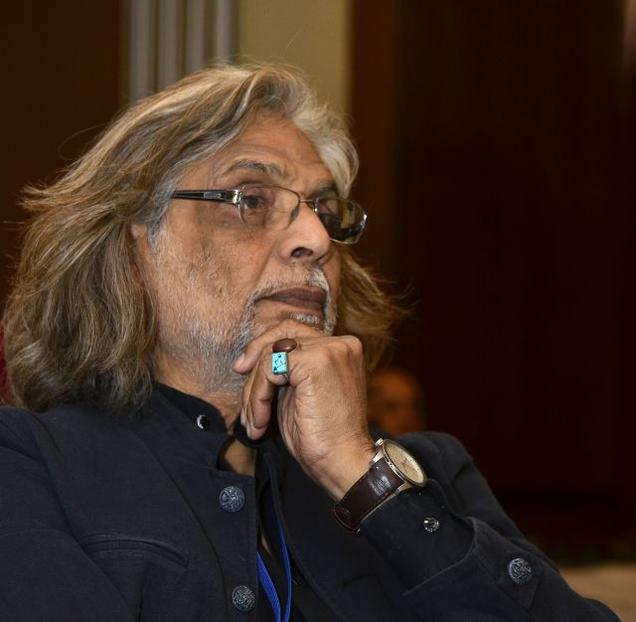
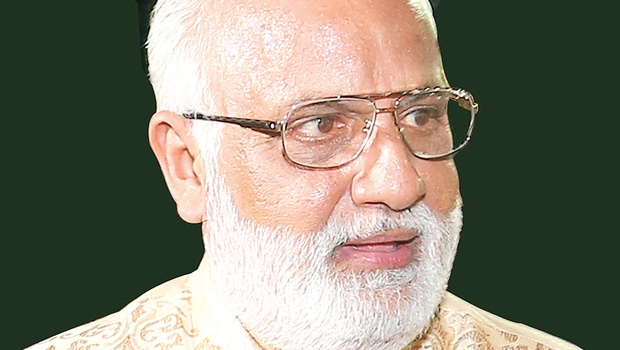
Renowned filmmaker Muzaffar Ali. / File photo: Shiv Kumar Pushpakar / The Hindu
Noted filmmaker Muzaffar Ali, who had directed the Bollywood classic “Umrao Jaan”, has been selected for Rajiv Gandhi National Sadbhavana Award for his outstanding contribution towards the promotion of communal harmony, peace and goodwill.
It carries a citation and cash award of Rs 5 lakh.
The decision to honour the 69-year-old film maker, social worker and sufi poet was taken at a meeting of the Advisory Committee of the Rajiv Gandhi National Sadbhavana Award yesterday.
Born in Lucknow, Ali also directed over one-and-a-half dozen movies including “Gaman” and “Khizan”. He was awarded Padma Shri in 2005.
This will be the 22nd edition of the Sadbhavana award, which will be presented at a special ceremony at Jawahar Bhavan on August 20, the birthday of late Prime Minister Rajiv Gandhi.
Congress president Sonia Gandhi has been presenting the award ever since it was constituted.
It was instituted to commemorate the contribution made by him to promote peace, communal harmony and fight against violence.
Recipients of the award include Mother Teresa, K.R. Narayanan, Ustad Bismillah Khan, Lata Mangeshkar, Sunil Dutt, Dilip Kumar, Ustad Amjad Ali Khan and Maulana Wahiduddin Khan.
Others who got it were Jagan Nath Kaul, Mohd Yunus, Hiteswar Saikia and Subhadra Joshi (jointly), Kapila Vatsyayan, Teesta Setalvad and Harsh Mander (jointly), S N Subbarao, Swami Agnivesh and Madari Moideen (jointly), Nirmala Deshpande, Hem Dutta, N Radhakrishnan, Gautam Bhai, SPIC MACAY and D R Mehta.
source: http://www.thehindu.com / The Hindu / Home> Features> CinemaPlus / PTI / New Delhi – August 01st, 2014
Prestige Group head Irfan Razack buys a 4000-sq ft plot once owned by the late Ambaram Fakirbhai. The property is just a block away from a shop from where the rags-to-riches story of the construction group began
Irfan Razack says he bought the property since it is close to their first store, Prestige Men’sStore, on Commercial Street
Virgin land in the heart of the city is priceless. Those with ramshackle old buildings on them command a hefty price. But the benchmark was raised on Monday when a plot on upscale Commercial Street was sold for Rs 62,500 per square foot — the highest in the city so far.
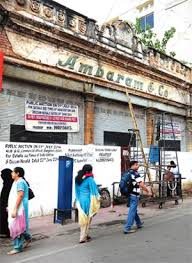
Irfan Razack, head of the Prestige Group, the top realty firm, purchased the 4,000-sq ft plot from the heirs of late Ambaram Fakirbhai, the textile businessman who once owned large swathes of land in the area now known as Indiranagar. Razack was the lone bidder in the auction.
The plot, which bears municipal registration numbers 15 and 16 and includes a dilapidated building, was bought for a staggering Rs 25 crore at a public auction. This is the second largest realty deal in Bangalore in the last fortnight; the previous one was an eight-acre plot in Koramangala which sold for Rs 345 crore.
“The going rate around Commercial Street is in the Rs 40,000 – 45,000 per sq ft range,” a realtor who monitors transactions in the central business district said. “But the Ambaram deal is a real stunner.”
The Prestige Group are not saying what they plan to do with the plot just as yet, but a source said, “The area is close to the hearts of the Prestige Group founders as they started with a cloth shop on Commercial Street close to the Ambaram plot. By buying land a stone’s throw away from their old store, they have shown that they want to stay attached to their Commercial Street roots.”
Confirming the transaction, Razack told Bangalore Mirror, “The property is very close to my property – Prestige Men’s Store. I bought this because there is only one property between this and our property. The Prestige Men’s Store is a family business run by me and my brothers (two of them). It was a matter of pride to buy a property on this street.”
On the exorbitant price, Razack indicated that he had little choice. “The court had fixed a minimum price of Rs 25 crore for the property,” Razack said. “We were the only ones to participate in the bidding as two others who had registered their names, didn’t participate. Though the price is on the higher side, I don’t think I will regret my decision five years later. It is a family deal and my company has no role in this. This was a personal decision.”
The auction brought the curtains down on a 43-year-old feud by heirs of Ambaram over the land. “Since the heirs could not reach a consensus on sharing the prime property, the court decided to auction it,” sources said.
According to the copies accessed by Bangalore Mirror, the original propositus was Ambaram Fakir Bhai. He married Jeeva Bai and after her death, he married Girija Bai. They had six sons — Thakurdas, A Venilal, A Ramanlal, A Sukhlal, A Krishna, A Narayan — and five daughters — Umiya Ben, Vichkore Ben, Parvathi Ben, Narmada Ben and Tara Ben.
After the death of Ambaram, his eldest daughter, Vichkore Ben, filed a suit for partition of her 1/12 share in the estate left behind by her father. Though the suit was still pending, she sold her right, title and interest in favour of four of her brothers — Krishna, Venilal, Sukhlal and Narayan. Similarly the other four daughters received a certain sum of money from these four brothers in lieu of their share in full and final settlement. Thakurdas and Ramanlal were each allotted 1/7th share.
The above suit culminated in final decree proceedings initiated by Thakurdas in 1981. A commissioner was appointed to work out the modalities of actual partition. He reported to the High Court that the properties were not divisible and that it should be disposed in a public auction. Dispute arose in regard to the mode of partition of shop premises No 15/15, Commercial Street and premises No 27 F, E and D of Hospital Road. It resulted in a civil revision petition before the High Court (CRP No 2920/1973).
All the brothers, however, had reached an agreement that Thakurdas and Ramanlal were to be given first option to purchase 5/7 share of the parties to the suit by depositing Rs 10.71 lakh in the trial court on or before November 14, 1974. When they failed to deposit the amount, the other brothers – Venilal, Sukhlal, Narayan and Krishna — purchased the share of Thakurdas and Ramanlal by depositing a sum of Rs 1.75 lakh each.
Since the four brothers did not have funds, they had obtained a loan from Vijaya Bank to buy their bothers’ shares. It was also agreed that immediately after the purchase of share of Thakurdas and Ramanlal’s shares, premises bearing No 15 and No 16 of Commercial Street and premises No 27 F, E and D of Hospital Road will be substituted as security for the repayment of the loan in place of the individual properties of Venilal and Sukhlal.
Property was locked for 15 years
The three brothers entered into possession in April 1976, while another brother, Narayana, took actual possession of the entire premises in 1978. But he kept the premises under lock and key for 15 years, rendering it unfit for human habitation. Moreover the loan obtained from Vijaya Bank had not been repaid despite repeated reminders. A fresh suit was filed in 1991 for partition of the property. The suit was contested and during the pendency of the suit, two brothers, Venilal and Sukhlal, died.
During the pendency of appeal, parties decided to settle the matter amicably and they filed a compromise petition before the High Court on September 5, 2005. The court decided to auction the property.
Earlier bids unsuccessful
The court’s reserve price for the Commercial Street property was set at Rs 12 crore, while that of the Hospital Road properties was Rs 6 crore. All bids were to commence for a price higher than the reserve price indicated above.
Advocate K N Krishna Rao, representing the family members of Ambaram, told Bangalore Mirror, “During 2005, the Hospital Road property was sold for Rs 18 crore at an auction, but there was no buyer for the Commercial Street property. The Commercial Street property was again put up for auction in 2008 and again there were no bidders. Finally on Monday, the auction was conducted with the initial bid amount of Rs 25 crore and if was successful.”
source: http://www.bangaloremirror.com / Bangalore Mirror / Home> Bangalore> Cove Story / by Atul Chaturvedi, Bangalore Mirror Bureau / July 23rd, 2014
Twenty decadent facts from the life and times of India’s last ‘nawab’
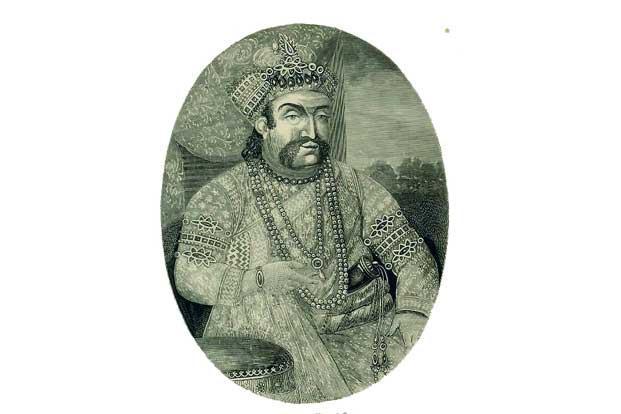
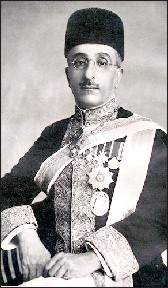
A portrait of Wajid Ali Shah. Photo: Wikimedia Commons.
The poet-ruler Wajid Ali Shah (1822-87) was the last nawab of the north Indian state of Oudh. Deposed by the British, he spent the last 30 years of his life in a riverside mansion near Calcutta (now Kolkata), where he languished in a mock-kingdom with 6,000 subjects. It was a make-believe world. Many of the exiled king’s high-ranking officials held on to their old titles. To the extent that it was possible, Wajid Ali Shah, whose actual reign lasted only nine years, continued the customs of the court.
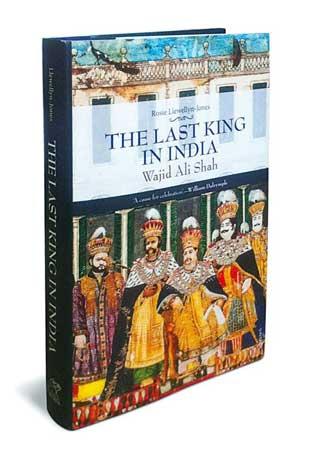
In The Last King In India: Wajid Ali Shah, British historian Rosie Llewellyn-Jones resurrects the nawab with all his tasteful eccentricities. “Holed up in his new palaces, dreaming of love, music and drama,” Llewellyn-Jones writes, “his lack of enterprise only increased the distance between the bubble-like atmosphere of the Court and the reality of peasant life outside the city.”
Days after finishing the book, I mostly remember the following aspects of its hero:
1. Wajid Ali Shah’s famous portrait (at the Hussainabad Picture Gallery in Lucknow) shows him as a well-fed man wearing a lavishly embroidered tunic. His sash has four rows of large pearls. His left breast and nipple are artistically exposed between the gold borders of his dress.
2. He married (approximately) 375 women.
3. At 15, he was married, for the first time, to Khas Mahal, the granddaughter of an Anglo-Indian woman called Sally Begam. Like her husband, Khas Mahal was a poet.
4. He had three kinds of wives—the mahals, who gave birth to his children and were veiled; the begams, who did not give birth and went unveiled; and the khilawatis, who performed menial household jobs.
The Last King in India—Wajid Ali Shah: Random House, 314 pages, Rs 599
5. His autobiography was dreamily titled Pari Khana (House Of Fairies).
6. His poetic pen name was Akhtar, meaning “star” in Persian.
7. At 22, he wrote the play Radha Kanhaiya Ka Qissa—a rare instance of a would-be Muslim king creatively engaging with Hinduism.
8. He had a soft corner for dark-skinned women. One of his brides, Yasmin Mahal, “is clearly of African origin with her short curly hair and un-Indian features”.
9. His personal bodyguards consisted of female African soldiers dressed in red jackets and tight-fitting, rose-coloured silk trousers.
10. His mother Janab-i Aliyyah, who died during a visit to Europe, lies buried in Père Lachaise, the largest cemetery in Paris, which is also the resting ground of musician Jim Morrison and author Oscar Wilde.
11. He ascended the throne in 1847; by then he was fairly notorious. Two years earlier, John Shakespear, an East India Company bureaucrat (he was recently described as the great-great-great- great grandfather of British Prime Minister David Cameron), complained to the governor general that “The Heir Apparent’s character holds out no promise of good. By all accounts his temper is capricious and fickle, his days and nights are passed in the female apartments and he appears to have resigned himself to debauchery, dissipation and low pursuits”.
12. By the time he became king, he had written two lengthy romantic narrative poems—Darya-i-Ta’ashshuq (The River Of Love) and Bahr-e ‘Ishq (The Ocean Of Affection)
13. Wajid Ali Shah marked the beginning of his reign by building Qaisarbagh Palace—it happened to be Lucknow’s last palace. One of the structures was given the poetic name of Jalpari Darwaza, or The Mermaid Gate, which no longer exists. The palace also had a spiral staircase that led nowhere. In 1955, British architecture critic John Terry saw in the palace “the full horror of the impact of stucco and European baroque”.
14. After being compelled to move from Lucknow to Bengal in 1856, the deposed nawab was settled by the British in Garden Reach, an area south-west of Calcutta that had opulent villas along the Hooghly river.
15. The Garden Reach estate comprised three buildings. One of them was Azud Manzil. It was the royal menagerie and had 20,000 birds, beasts, snakes and “every conceivable variety of freshwater fish that can live in a hot climate”. The pigeons, of every variety and colour, numbered 18,000 . There was also a collection of cobras. One morning in 1879, a tigress escaped, severely wounding a German man and an Indian lance corporal (it also killed two cows before being shot dead by the Howrah magistrate).
16. The nawab’s evenings during his years in exile were chiefly spent in the company of musicians and dancing girls.
17. In his later life, he was carried all over on a sedan chair. He is said to have been afflicted with an anal fistula that forced him to spend many agonizing hours in the toilet.
18. On his death, the nawab’s survivors—his wives, children and their servers—numbered about a thousand.
19. At his funeral procession, a military band played Dead March from Saul, the oratorio by German composer George Frederic Handel that was also performed in the funerals of US president Abraham Lincoln and British prime minister Winston Churchill.
20. Throughout his life, Wajid Ali Shah remained a teetotaller.
source: http://www.livemint.com / Live Mint & The Wall Street Journal / Home> Lounge> Business of Life> Indulge – Leisure / Book Review / by Mayank Austen Soofi / Saturday – July 19th, 2014
I remembered Sir Mirza Ismail, the renowned Dewan of Mysore, about whom I had written in my column [Down The Memory Lane’ in Nov. 2010] while reading KBG’s Abracadabra in SOM dated July 2 and thought it is worth reproducing a para as to how much Mirza liked his Mysore, describing it in a Radio Broadcast in 1938:
“… Wash themselves with Mysore soap, Dry themselves with Mysore towels (product of KR Mills), Clothe themselves in Mysore Silks, Ride Mysore horses, Eat the abundant Mysore food, Drink Mysore coffee with Mysore sugar, Build their houses with Mysore cement, Mysore timber, Mysore steal, Furnish their houses with Mysore lamps and Write letters on Mysore paper.”
To add to this, a senior personnel from State Bank of Mysore, who met me to collect some material with photos for their Bank’s Centenary Souvenir, remarked, “Sir, we would like to end this with ‘bank’ with Mysore Bank and publish Mirza’s speech in our souvenir.” This made me add one more to the Mysore list: Study in Mysore University.
If Star of Mysore and Mysooru Mithra were being published during his time, Sir Mirza would have added them to his list of Mysore products.
Yes, “Mysore was breathed by Sir Mirza Ismail,” the title I had given to my column.
—K. Vijayakumar, Former Jt. Director of Information & Publicity
V V Mohalla
3.7.2014
source: Voice of the Reader Section / source: http://www.starofmysore.com / Star of Mysore / Home> Voice of the Reader / July 04th, 2014
This is in response to the story. See Post of July 07th, 2014 in www.mpositive.com
While pondering over the absence of ‘Mirza Ismail Road’ in Mysore (Abracadabra, SOM dated July 2), what spontaneously springs to one’s mind is the much-prized ‘Ali Askar Road’ (off Cunningham Road) in downtown Bangalore.
This road is named after Sir Mirza’s grand-father Ali Askar, who was a prominent trader in Arabian horses and Persian carpets, and an influential public figure, with close links to Mummadi Krishnaraja Wadiyar as well as Sir Mark Cubbon. Ali Askar was originally from Persia and found asylum in the court of Mummadi Krishnaraja Wadiyar as a trainer of cavalry and supplier of horses, after fleeing from persecution under Sultan Ahmad Shah of Iran in 1824.
Apart from Sir Mirza, many of Ali Askar’s descendants became well-known figures in business and administration and it is possible that ‘Agha Abbas Ali Road’ and ‘Agha Abdullah Street’ in Bangalore are named after some of these descendants.
While feeling proud on seeing a premier road in Jaipur named after Sir Mirza (it is popularly recognised as M.I. Road, just like M.G. Road in Bangalore), Mysoreans feel proud also of the munificence of the rulers of Mysore in giving the name of a visiting king — Sayyaji Rao Gaekwad III — to a trunk road in their own legendary city.
— S. G. Seetharam
Gita Road, Mysore
8.7.2014
source: Voice of the Reader Section / source: http://www.starofmysore.com / Star of Mysore / Home> Voice of the Reader / July 13th, 2014
This is in response to the story. See Post of July 07th, 2014 in www.mpositive.com
Mysore city is blessed in more ways than many other cities of South India. Its location is ideal. An imposing hill with a temple of Goddess Chamundeshwari. River Cauvery flows just 12 kms away. River Kabini is just 35 kms away. A green cover all around with a salubrious climate. Even summer is forgotten as fast as one started complaining of the heat with the monsoon setting in by May end.
If these are nature’s bounty bestowed on our city, providence too has been kind with the Wadiyar dynasty ruling the Kingdom of Mysore with this city as its capital. And blessed are the people because the Kings who ruled after 1800 AD have all been good kings with most of them being patrons of art, literature and music. And during the long reign of Krishnaraja Wadiyar IV the Kingdom became a Rama Rajya as Gandhiji called it and the King himself was a Rajarishi. Philosopher-king. It was this king who ruled the kingdom with the help of renowned Dewans [Prime Ministers]. One among them was Sir Mirza Ismail.
For some years I was a member of ‘Freemasons,’ sort of secret club known as The Grand Lodge of India, Lodge Mysore. Recently I was going through its publication known as ‘The Square and Compasses’ and was intrigued to find the name of Sir Mirza Ismail being mentioned in it in glowing terms just as his work in Mysore was much appreciated.
His name was mentioned in connection with the problems the ruler and administrators faced in the Kingdom of Jaipur, Rajasthan, from vested groups. The situation was similar to what happened during the building of the Great Temple in Jerusalem after Jews were freed from their Babylonian captivity after 70 years of exile.
It appears during the year of exile of Jews, there was no government of any kind in the country and many outlaws, murderers, debtors and others with dubious characters from neighbouring countries came and settled in the Jewish country, specially in the city of Jerusalem. These people resented the arrival of Jews, from their Babylonian exile, trying to restore law and order. There was daily strife between the two warring sides which compelled the labourers at the temple area literally to work with the ‘trowel in hand and sword by the side.’ This, of course, has become part of the traditional ritual in the Freemason ceremony.
Recalling this historic ancient incident, the report in the magazine connects it to an incident in modern times. It says, “In our own times, we have heard of Sir Mirza Ismail — Special Officer entrusted with the task of beautification of the city of Jaipur in Rajasthan. With undaunted courage and determination, he went on with pulling down dozens of houses as per his masterplan without fear or favour, even those of big and influential citizens who naturally tried to oppose his doings.”
No wonder the grateful citizens of Jaipur named a major road after Sir Mirza Ismail. Now compare this with ourselves. Is there a road named after this great Dewan of Mysore Sir Mirza Ismail? I don’t know. Is there a road named after Sir M. Visveswaraya? I do not know. Yes, someone told me there indeed is a Mirza Road but it does not run even a km length in Nazarbad. In Jaipur, I have seen Sir Mirza Ismail Road, a double road, running to a few km length in keeping with his stature. Yes, there is also one inconspicuous Circle named after Sir MV ! Could they not have a statue of Sir MV there just like the other two statues of Maharajas?
Incidentally, the message from the Grand Master Most Worshipful Brother Vasudev J. Masurekar, OSM, has the opening paragraph that takes you to 2nd century BC and then brings you to 2014 AD. It speaks of Delphic Oracle in Greece where I had been about five years back, hence my interest. The Grand Master says:
The temple of Apollo at Delphi, built in the 2nd century BC, has three phrases carved into the stone. First is, “Know thyself,” second “Nothing in excess” and the third is “Make a pledge and mischief is nigh.”
These three statements have made the Oracle of Delphi famous universally.
All the three statements are profound and impacts on every individual’s life. Because we do not try to know ourselves, we delude ourselves as someone that we are not. Buddha has taught us to follow the golden path, the middle path. Nothing in excess. Neither more nor less. The third statement is rather complex. No wonder over the centuries there have been many interpretations of these words and debates by philosophers and scholars.
However, let me venture to interpret the third statement in the light, nay in the dim light, of my own wisdom. It says, “Make a Pledge and Mischief is Nigh.” These are the days where politicians in our democratic country keep making pledges, from swearing on our Constitution, to protect and preserve it, to provide a good administration and infrastructure. But, our experience has been that they seldom keep their pledge. That is why I interpret this statement to mean, ‘when you make a pledge, you are near a mischief.’ You are upto some mischief! Read politician in the place of you. Howzzat?
e-mail: kbg@starofmysore.com
source: http://www.starofmysore.com / Star of Mysore / Home> Abracadabra….Abracadabra / by K.B. Ganapathy / July 02nd, 2014
Former President APJ Abdul Kalam on Sunday asked parents to have a small library at home to encourage their children to read books.
“Every home should have a small library with a minimum of 10 books to inculcate the reading habit in children,” Kalam said at a function to mark the sesquicentennial (150 years) of Bishop Cotton Boys’ School here.
Citing the importance of education, he said parents should take sincere steps to increase the collection of books every now and then. “And they should make their wards refer to the books at least an hour a day,” he added.
Paying a tribute to his science teacher Siva Subramaniam Iyer, Kalam said he was inspired by him to become a rocket scientist. “When we were in Class 5, he took us to Rameswaram beach to show students the birds’ flying pattern. He also had a model aircraft to show us the similarity. This eventually inspired me to become a rocket scientist,” he added
Hailing the significance of the Bishop Cotton Schools, the former president said: “One hundred and fifty years is a long time for a school. In astronomy, it’s equal to the number of time taken by the Earth to orbit around the Sun. But most importantly in its every orbit, a star is born.”
Earlier in the day, Bishop Cottons Girls’ School, founded in 1865, celebrated a Holy Communion service on St Peter’s Day at its Bishop George Edward Lynch Cotton auditorium. Archbishop of Dublin Dr Michael Geoffrey Jackson, Bishop Cotton Boys’ School principal John K Zachariah and Bishop Cotton Girls’ School principal Princess Franklyn presided over the service. The day was named after the school’s patron saint and inspiring role model.
source: http://www.timesofindia.indiatimes.com / The Times of India / Home> /City> Bangalore> Namma Metro / TNN / June 30th, 2014
Last Sunday my wife and I went on a journey that we had wanted to undertake for the last thirteen years ever since she lost her brother who was serving in the army as an officer. Major S. M. K. Ghori, a former student of the Maharaja’s College here, laid down his life in the cause of the motherland while fighting insurgency in the forests of Baramulla District in the State of Jammu and Kashmir on 1st July 2001. Two of his most trusted men too went down fighting alongside him on that fateful evening. Four days later while we were waiting with all our grieving family members at the Bangalore Airport for his body to arrive, I told my wife that we should try and visit his unit not only to see where exactly he was serving when his end came but also as an act of homage to his sacrifice.
A trip to Kashmir somehow never materialised over the next thirteen years and finally when a chance came up last week in the form of a group tour with about a dozen doctors’ families, my wife and I felt that it was the right time for us to go there. Having finished our sight-seeing in and around Srinagar with the others members of our group we extended our stay by a further two days to accomplish what we had been looking forward to. Upon contacting the army top brass through my brother-in-law’s wife we were told that his unit was still stationed near Baramulla and arrangements would be made to allow us a visit.
Very soon a Colonel who was the chief of the unit called us up and said that he would be happy to show us around the place and also insisted that we stay back for lunch. We very politely declined this part of the invitation as we did not want to intrude on the time of officers and men who were expected to be in a state of operational readiness round-the-clock. However, we agreed to have a cup of tea with them without wasting much of their time. A friend in Srinagar who used to meet us every evening arranged for a trusted cab driver to drive us to our destination and back since he did not consider it safe for us to go there with an unknown person. As he was from the nearby town of Sopore where he had his ancestral house, he said that we should be his guests for lunch which would expose us to the traditional Kashmiri hospitality. This was a suggestion to which we readily agreed and left early in the morning. The drive from Srinagar towards the western border of the country was full of security bottlenecks with all vehicles being stopped and photographed by heavily armed men in combat readiness. The road lined on either side by tall poplar trees passed through some very fertile countryside, full of verdant apple orchards nourished by a maze of mountain streams with snow-clad hills in the not too distant background. The apparent tranquillity of the hills belied the turmoil that they have been witness to from time to time.
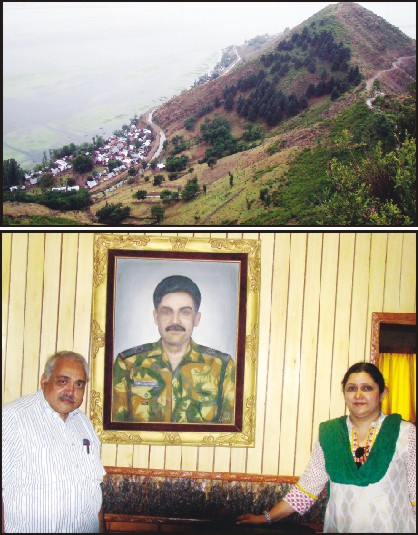
After a drive of about thirty kilometers from the town of Baramulla through some of the most remote and lonely stretches, we reached the army unit where we were welcomed with a warmth that we had never expected from men in uniform. The Colonel himself was standing with his deputy to receive us with fighting men’s iron handshakes and they escorted us to the drawing room of their barracks. It had a large life-sized portrait of my late brother-in-law on one of its walls since he was the only officer of the unit who had died in action since its inception while it had lost twenty-nine Jawans whose sacrifice was in no way less significant. Their photos too adorned another wall in a close cluster which perhaps was a reflection of the close ties they shared while they were alive.
The Colonel briefly told us about their life as soldiers and the uncertainty that comes with it. Later he himself drove us in his personal vehicle to the place from where we could see the hill across a lush valley at the base of which my brother-in-law and his men went down fighting. We stood in silence trying to visualise the final moments of their brave stand. Returning to the base we were a little surprised and even embarrassed to discover that the tea was almost a meal prepared and served by men in uniform in a manner that would have put the most talented hostess to shame.
We were then invited to stand alongside the painting of my brother-in-law and have a picture clicked as a keepsake of our visit which we did [see pic]. It was a very sentimental moment against which I had warned my wife well in advance and thankfully she put up a brave face.
After I signed the visitors’ book it was time once again for iron handshakes but this time to say goodbye. It was a very short drive to Sopore, a Spartan town with horse-drawn carriages and tin-roofed houses that seemed to have been frozen in a time warp like the rest of the Kashmiri countryside. The atmosphere seemed a little eerie as we found that every entry point was guarded by heavily armed soldiers alongside their armoured personnel carriers. We located our friend’s home which was tucked in a maze of narrow alleyways and were soon lost in another session of tea accompanied by some traditional Kashmiri snacks and dry fruits. The tea itself was a very distant cousin of what we drink here as it is salted instead of sugared. My host then suggested that he would take us for a traditional lunch to a resort overlooking the Wular Lake, the largest freshwater lake in Asia which was just a stone’s throw from his village. The breathtaking view from the place was something to be treasured forever in the mind’s e
ye. It is because of sights like this that Kashmir has come to be called a ‘Paradise on Earth’. After a hearty meal we parted company as it was time for us to get back to Srinagar. On the way back too we noticed unusually hectic military activity along the main road and on the outskirts of the town we even saw an ambulance and a large convoy of army vehicles parked around a house. We did not make much of it and reached Srinagar safely for a good night’s rest.
Early the next morning one of my friends who had been in our group and who had returned with the others a day earlier called me up from Mysore to tell me that Sopore had been the scene of a fierce gun-battle between security forces and insurgents the previous night. Since a civilian youth too was killed in the crossfire it appears there were widespread protests and an indefinite curfew had been imposed on the whole town with all roads completely blocked. Occurrences like these are a very common feature of life in Kashmir and the ensuing inconvenience is accepted as a normal part of living there. The whole of Monday and Tuesday, till we left Srinagar, life remained completely paralysed in the entire valley. My wife and I thanked God that we had been able to get away in the nick of time from what could have become a tricky situation blocking our exit. Our ‘Mission Kashmir’ had been accomplished at last !
e-mail: kjnmysore@rediffmail.com
source: http://www.starofmysore.com / Star of Mysore / Home> Feature Articles / Friday – June 27th, 2014
This refers to the letter of Brig. R.S. Rajan, vsm, (SOM dated June 30) on the need to remember the martyrdom of Maj. Ghori with mixed feelings of sadness that we forgot the sacrifice of young Indian Army Officer for his nation and a desire to undo the indifference.
I knew his Commanding Officer. He was always full of praise of Maj. Ghori, who he said was an epitome of an Officer and a gentleman. Being in army and that too a serving officer, I am not supposed to interact with media or give my opinion. We in armed forces respect the rule and follow it. However, I could not control myself on reading Brig. Rajan’s letter and hence this letter.
Ncc Group Mysore will take concrete steps to ensure that the memory of Maj. Ghori remains alive in Mysore and India. May I very humbly appeal the citizens of Mysore to respect our martyrs as they have sacrificed their today for your tomorrow, their own families lie forgotten and unattended, perhaps as our neighbours.
We as soldiers always follow the credo that ‘The country comes first always and every time … Our own honour, safety and welfare comes last, always and every time’. Maj. Ghori followed the Chetwode credo to his last breath. The need of the hour is that all Indians make a beginning towards it.
May I end my first letter to media with an epic poem on the saga of HORATIUS by Thomas Macaulay:
To every man on this earth
death comes soon or late,
How can a man die better
Than facing fearful odds
For the ashes of his Fathers
And temples of his Gods,
Maj. Ghori was a HORATIUS
for all the Indians who
breathe today and tomorrow.
—Col. Rajeshwar Singh, Shaurya Chakra, Sena Medal, Group Commander, NCC
Mysore, 1.7.2014
source: Voice of the Reader Section / source: http://www.starofmysore.com / Star of Mysore / Home> Voice of the Reader / July 07th, 2014
Kerala Government has appointed senior IAS officer A P M Mohammed Hanish as Nodal Officer for the matches likely to beld in Kochi during the 2017 FIFA under-17 world cup football.
The appointment is as per FIFA’s direction, a Kerala Football Association press release said.
The official has also been entrusted with overseeing the infrastructure and development of soccer in the run up to hosting the event.
Hanish is the Kerala Roads and Bridges Managing Director.
source: http://www.business-standard.com / Business Standard / Home> PTI Stories> National> News / Press Trust of India / Kochi – July 01st, 2014
Scholarships distributed the Carnatic Family Association (CFA) founded by the Nawabs of the Carnatic, distributed the annual educational scholarships to deserving students of the Carnatic Family, at its general body meeting held at Amir Mahal.
The Association distributed scholarships to 92 school students and college students, ranging up to `10,000, for different courses.
The Prince Of Arcot, Nawab Mohammed Abdul Ali, is the head of the Carnatic Family and patron-in-chief of CFA. A large number of members from the Carnatic Family attended the function.
The Association also organises socio-cultural activities to promote communal harmony and national integration and also celebrates major religious festivals. It also conducts games and sports for its members periodically.
source: http://www.newindianexpress.com / The New Indian Express / Home> Cities> Chennai / by Express News Service / June 16th, 2014
Anuradha Sriram will host a radio show on the Mozart of Madras
Singer Anuradha Sriram has taken on a new role – she’ll be hosting a radio show titled Rahman Ungaludan. As the name suggests, it will talk about everything about the Mozart of Madras – tales and trivia about the man of few words.
For the singer, who perhaps kick-started the idea of reality music shows in television when she hosted shows way back in 1996, it is a challenge and something to cherish at the same time. “Radio is a different ballgame but the fact that I’ll be speaking about a person who has been a mentor to me makes it exciting,” she says. Anuradha first sang for Rahman for Mani Ratnam’s Bombay; it was not a full-fledged song but a few notes that she hummed. “He told me then that my voice was divine,” she says, “With Rahman, there’s always space to improvise and experiment. He lets you be who you are. Perhaps that’s why the output is always good – from then to now.”
It will be a learning experience for her, she hopes. “As a singer and a person interested in music, it’s fascinating to see how great minds work. I hope to track Rahman’s journey in music…and learn from it.”
‘Anbendra Mazhaiyile’, one of her songs for Rahman, remains fresh in the memory of the classically-inclined. “He wanted me to sing that particular song because he felt I evoked divinity in listeners,” recalls the singer, who later also branched into singing fast-paced kuthu songs like ‘Malai Malai’ (Chocolate) and ‘O Podu’ (Gemini).
Few people know that ARR has a sense of humour too – the singer recalls how he used to call her ‘Gnanapazham’. “He was very interested in classical music and used to discuss ragas extensively. I will talk about those sessions in the show and try to provide a perspective of the composer that only a few people know,” says Anuradha, who also ventured into music composing when she, along with husband Sriram Parasuram, worked on Five Star.
Starting tonight, Rahman Ungaludan will play every Monday to Friday at 9 p.m. on 92.7 BIG FM.
source: http://www.thehindu.com / The Hindu / Home> Features> MetroPlus / by Srinivasa Ramanujam / Chennai – June 15th, 2014