The 216th death anniversary of Tipu Sultan organised by Hazrath Tipu Wakf Estate Development Committee was held at Gumbaz in Srirangapatna this morning.
Hazrath Tipu Wakf Estate Development Committee Chairman and MLA Tanveer Sait offered floral tributes to the tomb of Tipu Sultan located inside the Gumbaz.
Hazrath Moulana Hafiz -o-Qari-Inayath Ur Rahman, Khateeb-o-Imam, Masjid-e-Aqsa, Gumbad-e-Shahi recited versus of Holy Quran and prayed for Hazrath Tipu.
Hazrath Moulana Mahmood Ul Hassan, Moulana Ayub Ansari, Moulana Akbar Shariff, Iqbal Pasha, Allah Bakash Bakshi, Jameel Ahmed Ashrafi, Mohammed Abdul Salam, Khaleel Ur Rahman, Abdul Khader, Ibrahim Shariff, Haseena Shariff, Syed Akram Pasha, Mohammed Rafiq, Pansari Mujeeb Ahmed, Estate Officer Mohamed Ayub and others were present.
In another programme organised by Mysore City (District) Congress Committee at its office on Sayyaji Rao Road, MLA Vasu regretted that Tipu Sultan’s history had been distorted and said that even today the idol given by him to the Nanjangud Temple was being offered puja which showed his affection towards all religions.
Vasu urged the Tipu’s critics to study about Tipu in detail before passing any comments.
MLA M.K. Somashekar, former MLA Mukhtarunnisa Begum, Mysore City Congress Committee President C. Dasegowda, former Mayors Arif Hussain and Ayub Khan and others were present. Members present offered floral tributes to the portrait of Tipu Sultan.
It was on this day Tipu Sultan died fighting against the British Army in the year 1799. His body was found among the dead near the Ranganatha Swamy Temple.
source: http://www.starofmysore.com / Star of Mysore / Home> General News / May 04th, 2014
While the neighbouring region is resplendent with the remnants of the glorious Vijayanagar empire in Hampi, adjacent to it are the vestiges of the Bahmani Sultanate.
The Jama Masjid, the great mosque inside the Gulbarga Fort is a testimony to this.
One of its kind
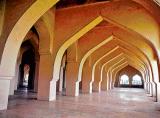
From an architectural viewpoint, the Mosque is considered unique in South Asia for its form and structure. The material used is lime and brick.
The arches of Jama Masjid are similar to the interiors of Spanish Mosque of Hyderabad.
These are the only two mosques in India which have the similarity in interiors of the Great Cathedral–Mosque of Cordoba in Spain.
The Jama Masjid was built by Muhammad Shah I (1358-75) to commemorate Gulbarga as the capital of the Bahmani Sultanate.
The Bahmani dynasty was founded by Ala al-Din Hasan Bahman Shah, a Bahmin’s servant at the court of Muhammad bin Tughluq. The Bahmanis established themselves in Gulbarga once the Delhi Sultanate began losing its hold.
The Jama Masjid does not have minarets. But the mosque built inside the Fort is unique because of a huge dome and many smaller ones which adds to its grandeur.
It was built in 1367 AD, by a Spanish architect, with arched doorways on the same lines as that of the Great Cathedral–Mosque of Cordoba in Spain. It has a large dome on the west side and middle-size domes at the four corners of the mosque, making it a beautiful sight to behold. Instead of having a courtyard, it has 63 small domes in line in the central area.
The main entrance is at the north side and has a higher arch-shaped gate than the other sides.
The mosque has a natural lighting system. Instead of solid outer walls, there are open arcades to allow light that would generally be filtered in from a courtyard.
In the west prayer room, pillars are painted in white with no decoration.
In addition, wide spans of these pillars’ supporting large arches create a majestic atmosphere.
The floor measures 216 feet by 177 feet (66 by 54 m) with widely arched enclosures defining the perimeter. The west bay is spacious and covered in the centre with a high dome, which is surrounded by twelve smaller domes. This high central dome is given even greater prominence by being slightly larger and because it is placed on an arcade, forming a square cloister that rises above the smaller domes. It has a capacity to accommodate 2,000 persons.
The interior of the mosque has a span of arches, which turned out rather appealing and were used in many other Deccan buildings. The arches here are supported on short imposts. These unconventional ‘stretched’ arches later became a characteristic of Deccan architecture.
He played cricket and football for St Stephen’s Delhi with distinction. He did his masters in English as well as Arabic and he topped Punjab University in Persian. And if you are to name a saviour of the cave art of Ajanta and Ellora it is him: Ghulam Yazdani, a Padma Bhushan awardee as well as a recipient of OBE (Order of British Empire).
As the Archaeology Department of Andhra Pradesh marks its 100 years the coming Friday, it is time to remember the man who created the department out of nothing.
If Hyderabad has a vestige of its heritage left, it is thanks to him. Deputed to Hyderabad as a Superintendent in 1914, he brought with him his expertise, energy and accountability. Not for him the claptrap of archaeology department doing the job of cataloguing and executing conservation work, Yazdani was a hands on man who got a road laid between Hyderabad and Bidar to protect the Bahamani heritage of Bidar and also between Toli Masjid and Golconda.
A man of sharp wit, he dismisses the decorative motifs of Toli Masjid as: “The impression made by such buildings overloaded with decorations is like the impression left by the ostentatious and lavish display of personal adornment, generally favoured by lowly persons suddenly become rich.”
For the restoration of the Ellora cave art, he tried to get Luigi Cavenaghi, the man linked to restoration of Leonardo’s Last Supper, to work on the paintings. Unfortunately, he could get only Lorenzo Cecconi, who applied shellac on the paintings, ruining them further. Ghulam Yazdani published a series of photographs and reproductions of the cave art with his explanations.
And by the way, Ghulam Yazdani’s salary was ` 560 per month. And just recently, the Archeology Department found it fit to name its museum after YS Rajasekhara Reddy!
source: http://www.timesofindia.indiatimes.com / The Times of India / Home> Life & Style> People / by Serish Nanisetti, TNN / April 21st, 2014
She broke the glass ceiling many a times, from being the first woman to enter any Class-I civil service to becoming the first IRS officer to be appointed a UPSC member and to being the only woman to have worked in the Central Narcotics Department.
After donning multiple hats during her long career, it was another proud moment for Parveen Talha, when she was conferred the Padma Shri award on Saturday for her contribution to the Civil Services.
But the road to success wasn’t that easy for Talha and the biggest hurdle was to overcome the anti-women mindset of her bosses at the initial stages of her career.
“It is indeed a proud moment for me but I am grateful to my bosses too. Though I had to initially deal with their anti-women mindset when I joined services 45 years ago, after a few years I was able to prove that I could handle the tricky jobs as efficiently as my male colleagues,” Talha told PTI.
70-year-old Talha joined Indian Revenue Service (Customs and Central Excise) in 1969 where she worked for 35 years and was then picked up as a member of the Union Public Service Commission (UPSC) in 2004.
“Once my bosses began to trust in my capabilities, I started getting challenging assignments including posting as Deputy Narcotics Commissioner in Uttar Pradesh,” she said.
“There was a large-scale leakage of opium going on in UP then. While I tried my best to play a stringent officer dealing with certain illegal channels, poppy cultivators were surprised too because they had never seen a woman at that level,” she added.
By halting for days in the cultivation areas and delving deep into all processes of poppy cultivation from sowing to lancing and harvesting, she gathered foolproof intelligence which was put to good use by her hand-picked preventive parties.
During her posting in UP and Bihar in 1990s, she attached illegally acquired property worth millions of rupees belonging to smugglers and drug traffickers at the risk of her life.
While she was posted as Director General Training in 2002, Talha provided strategic vision to the Department of Customs and Central Excise in evolving comprehensive packages of programmers for technical capacity building of all cadres and service providers.
Talha, who was honoured with the President Award for “Specially distinguished record of service” in 2000, also has a penchant for writing.
She has written ‘Fida-e-Lucknow’, a collection of 22 short stories, besides writing the dialogues for the serial ‘Husn-e-Jana’ directed by Muzaffar Ali.
“I find there are stories in every nook and corner that are waiting to be told. So I will pursue my passion for writing now that I am a retired person,” she said.
source: http://www.newindianexpress.com / The New Indian Express / Home> Nation / by PTI – New Delhi / April 27th, 2014
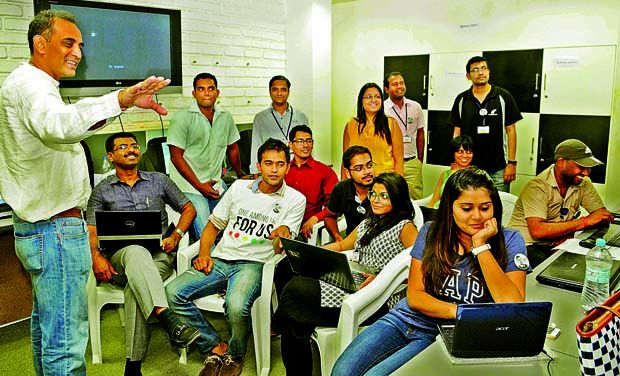
Volunteers working at Rizwan Arshad’s war room. (Left) Congress candidate from Bangalore Central, Rizwan Arshad along with MLA Dinesh Gundu Rao campaigns in Gandhinagar on Wednesday —R.Samuel
Bengaluru:
The Karnataka Pradesh Congress Committee (KPCC) office stands proud on Queens Road, with larger-than-life posters of Rahul Gandhi gazing down on the busy street. However, all the election time action is happening elsewhere, in a narrow bylane nearby where the party’s back office is located, invisible to those who are not in the know.
About 30 people sit inside the quiet office, slaving away at their computers. Youtube videos, social networking and Website content are generated here, and the group is responsible for the Congress party’s strong online presence.
These are volunteers who have put their regular jobs on hold for Congress’ Bangalore Central candidate Rizwan Arshad, vowing to ensure that he wins the election.
Inside the ‘op centre’, people from different teams don’t interact with each other directly.
“The campaign is never fully revealed,” said a source. “That’s the best way to keep it a secret.” Even so, the pieces come together to form a well-knit campaign, titled “One Among Us, For Us.”
“I heard of this through a mutual friend and I think Rizwan is a great guy. Besides, being part of the campaign gives me a high. I have been doing this since the last three elections,” said Bhagath Reddy, a marketing professional in his thirties. “I make it a point to volunteer for someone or the other.”
The group of volunteers, he said, comprises people between the ages 18 and 32, some of whom work on the campaign full time and others who come in on weekends. “It’s interesting to see these volunteers here, because in today’s world, people barely know who the candidates are even in their own constituencies.”
At this point, Muzaffar enters the room. The 34-year-old businessman says he and Rizwan are childhood friends and have been together since school.
“I’ve been campaigning for him since college,” he said. “We’ve been together through thick and thin.” Although he has been closely involved with local politics and his loyalty to Rizwan Arshad has never faltered, he has no political ambitions himself.
That seems to be the case, though, with all the young volunteers. The involvement of youth in politics seems issue-based. Anushree N., who does content, and Shruti Das, who handles graphic design, echo this sentiment.
“I want to understand how the system works,” said Shruthi, in response to why she volunteered for this. “I’ve never done political writing and I wanted to give it a try. It’s been a great experience so far,” said Anushree.
Whatever their reasons, for the youth, this is more than a battle between political candidates. This is a chance to shape the India they want to see. //
source: http://www.deccanchronicle.com / Deccan Chronicle / Home> Nation> Politics / by Darshana Ramdev / April 10th, 2014
Sazia Ilmi is a prominent member of Team Anna and one of the beautiful faces in the Indian Media. A Former Anchor in Star TV and a noted Journalist, she is now the urbane, Muslim, media-savvy face of Team Anna.
Born in 1970 to a middle class Muslim Family in Kanpur, she did her schooling from St. Mary’s in Kanpur and Nainital and college from St. Bede’s, Shimla.
Her Father was the founder-editor of the oldest and largest-selling Urdu daily from Kanpur, Siyasat Jadid.
The youngest in a family of four brothers and two sisters, she was expected to marry comfortably and settle down or at best (since she was academically bright) become an IAS officer. But as she puts it, “When you have so many problems with the system, how can you become a part of it? Freedom is not economic alone, it is the freedom to make a choice and do what you want to from your heart.”
She is married to an investment banker Sajid Mallik, half-Gujarati Muslim and half-Tamil Iyer, Shazia is emotionally dependent upon her extremely supportive husband. For her famous women like Kalpana Chawla and Kiran Bedi are source of Inspiration and possibly this is the reason she joined Team Anna.
She is the Media Face for Team Anna. Whether it is Press Briefing or Television Debates it is Sazia who plays a prominent role. Being on TV is Ilmi’s core competence. She has done it for 15 years, as political correspondent and news anchor. Sometime in 2010, she contracted a condition prevalent among working journalists of a certain vintage—a crisis of purpose. “I was done with mouthing inanities night after night,” Ilmi says.
She also plays her familiarity with Delhi’s media and political class to Team Anna’s advantage. Many decision makers in TV newsrooms are friends, former colleagues, or were fellow beat reporters. “I understand how the system works. And I know the media well. I have seen all the power broking and the wheeling-dealing,” she says.
Recently she was nominated to be part of a media contingent travelling with Prime Minister Manmohan Singh to Mexico and Brazil but the proposal was withdrawn amid opposition from her brother.
source: http://www.news.biharprabha.com / Bihar Prabha / Home> Nation / by BP Staff / August 02nd, 2012
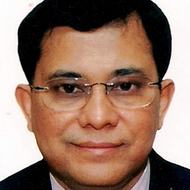
Harun Rashid Khan on Monday took charge as the deputy governor of the Reserve Bank of India for a period of three years. He replaces former deputy Shyamala Gopinath, who retired last month, the central bank said in a statement.
As one of the deputy governors at RBI, Mr Khan will look after external investments & operations, government & bank accounts, payment & settlement systems, foreign exchange, internal debt management department, inspection & central security cell.
Prior to this, he has been an executive director at the central bank in charge of DEIO and IDM since 2007. He joined the banking regulator in 1978 after masters in political science from Utkal University. He is a Certified Associate of the Indian Institute of Banking and Finance and also holds a diploma in business management.
An MPhil from JNU, Khan, who spent 32 years with RBI, is said to be mild but sharp. He has worked under former deputy governor Usha Thorat and handled internal debt management cell for several years. He has handled diverse responsibilities in areas of rural credit, currency management, banking supervision and regulation, debt management, reserve management, exchange control, personnel administration and internal accounts of RBI. He has also been associated with a number of internal and external committees, including technology exports, ways and means advances to states and working group on model fiscal responsibility and budget management bill for states, among others.
He also chaired a panel which was involved with rural credit and microfinance and popularly known as the Khan Committee. Khan was also the nominee director of RBI on the boards of Dena Bank , Bank of Maharashtra , Punjab and Sind Bank, Bank of Rajasthan and Orissa State Finance Corporation.
The other three deputy governors at the central bank are KC Chakrabarty who looks after banking supervision, Subir Gokran in charge of monetary policy department and Anand Sinha in charge of banking operations and development & non-banking supervision.
source: http://www.articles.economictimes.indiatimes.com / The Economic Times / Home> News> News By Company> Corporate Announcements > Central Bank / ET Bureau – July 05th, 2011
The government has appointed Harun Rashid Khan a deputy governor of the Reserve Bank of India ( RBI) .
Khan, who gets a three-year term, will monitor the foreign exchange department, payment and settlement systems and external investments and operations, among others.
H R Khan’s deputy governor’s position at the central bank became vacant after Shyamala Gopinath retired on June 20. RBI has four deputy governors. They serve for five years or till the age of 62, whichever is earlier.
Khan was an executive director (ED) at RBI since October 2007. He is credited with evolving the information communication technology-based business correspondent model for financial inclusion. He chaired the RBI internal committee on rural credit and microfinance. Based on the recommendations, RBI had issued guidelines to expand banking outreach through business correspondents.
As an ED, Khan was in charge of the department of external investments and operations, the foreign exchange department and internal debt management, among others.
He joined RBI in 1978, after a Masters in political science from Utkal. University, Bhubaneswar, and an M.Phil from the School of International Studies, Jawaharlal Nehru University, Delhi.
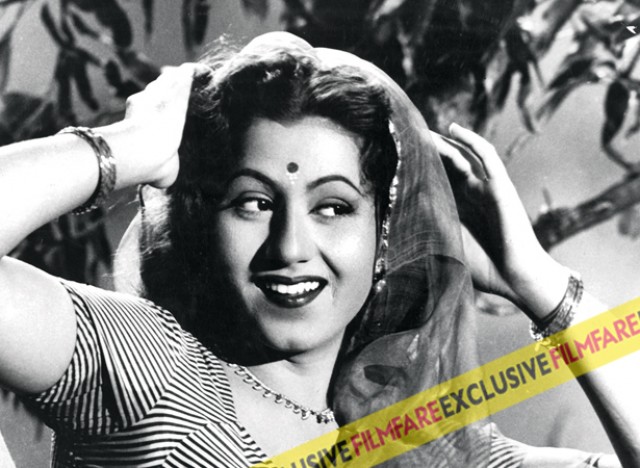
The indelible Madhubala led a tumultuous life albeit with great elegance.
She was the flawless beauty. A woman of resolve and uncanny character. Her mystique and charisma attracted the West to our showbiz shores. More than Raj Kapoor, Dilip Kumar and Dev Anand, the cogs in Hollywood wanted to know who she was, so when Hollywood director Frank Capra visited Bombay, all that he wanted to do was meet her. She was the veritable Indian beauty, our answer to Marylin Monroe. But unlike her Hollywood equivalent, she evoked awe and respect in the Hindi film industry. Her sex-appeal was preceded by her tehzeeb. Unlike Marylin who was chided for being the blonde, she was considered a professional par excellence. As the story goes, she was so dedicated that she obsessed about punctuality. In the late ’40s, she reported on the sets of her film a good hour-and-a-half before time. This after she had braved torrential rain, floods and a trip in the local trains. Her then director Kidar Sharma was pleasantly shocked. She continued to display the same commitment even when she was a top-billed star.
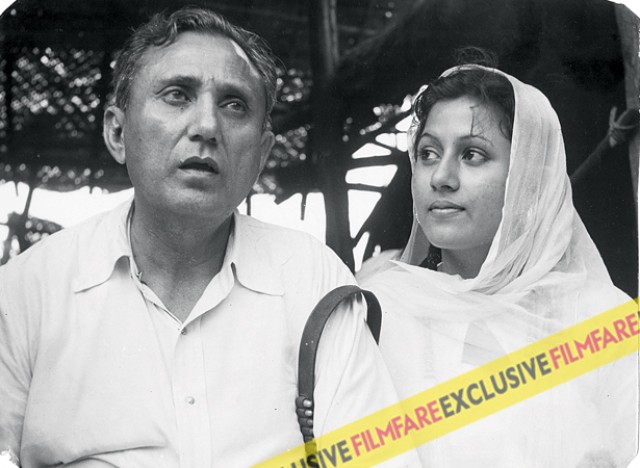
A young Madhubala is pictured with her father Ataullah Khan. Her father was a key figure in Madhubala‘s career. He would maintain strict control over who she could meet and where she could go. Reportedly, he even imposed a 7 pm deadline for the actress.
Beauty with a heart
She was the most exquisite woman celluloid ever witnessed. Her beauty had the power to mend broken hearts. Dilip Kumar was nursing heartbreak in 1950 but when he met she on the set of Tarana, it was her fluttering smile that stole his heart. The list of her suitors just went on and on.
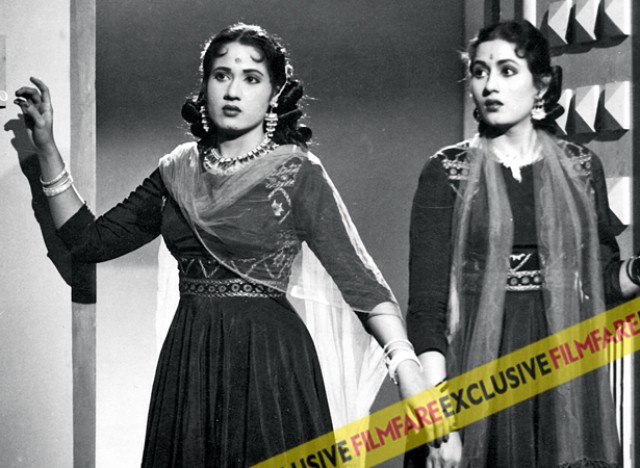
Madhubala (R) with co-star Chanchal (L) in Mehlon Ke Khwab. This the mad cap comedy with Kishore Kumar was one of Madhubala’s early foray into comedy.
Prem Nath who was good friends with Dilip Kumar, also vied for her affections. So much so that, his friendship with Dilip apparently went kaput. Despite the flooding interest of men, she never found what she was looking for – true love. But that didn’t change her intrinsic warmth. She was known to be compulsive about lending a helping hand. She was known to give away a purse full of 100 rupee notes to the less fortunate on her sets. She would even greet trespassing paparazzi with her famous melancholic smile.
Light-hearted romances worked for Madhubala too. Movies like Tarana with Dilip Kumar added good steam to her career.
Sweet poison She was the most sought after actress in B-town. She could do comedy, tragedy and romance with consummate ease. But for all the talent in the world, her initial foray as leading lady wasn’t well-received. Barring Mahal (1949) and Tarana (1951) all her initial movies failed at the box-office.
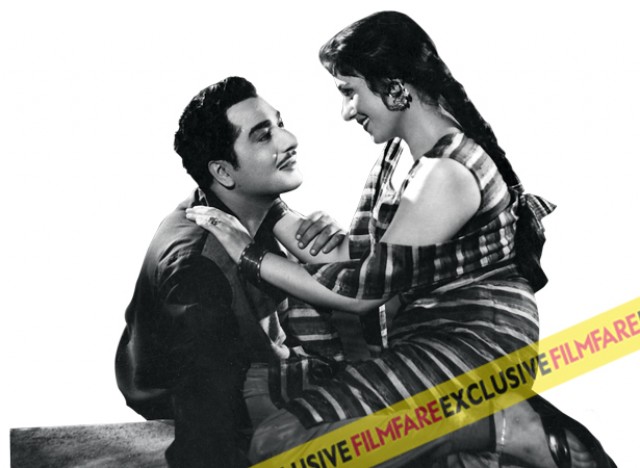
Pradeep Kumar and Madhubala worked together for the first time in Passport. This film was one of the highest grossers of 1961, simply because the audience wanted to see more of the Mughl-E-Azam star.
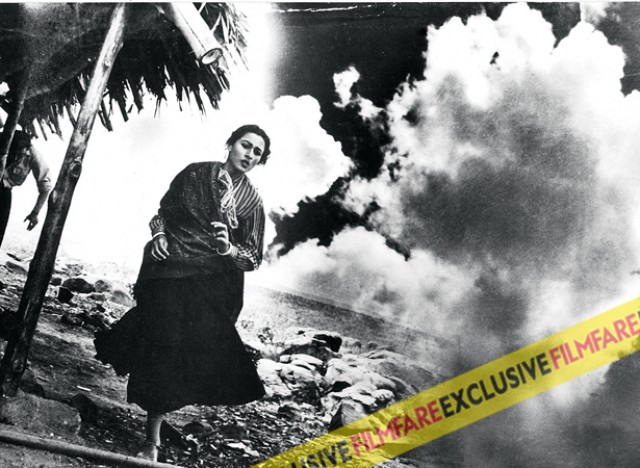
She was called ‘box-office poison’ and was relegated to films like Lal Dupatta, Singaar and Desh Sewa. But as resolute as she was she bounced back with films like Badal, Sangdil, Mr & Mrs 55 and Howrah Bridge. By the time Mughal-E-Azam hit screens in 1960, she was at the top of her game. Her last film to release was Jwala in 1971 with Sunil Dutt.
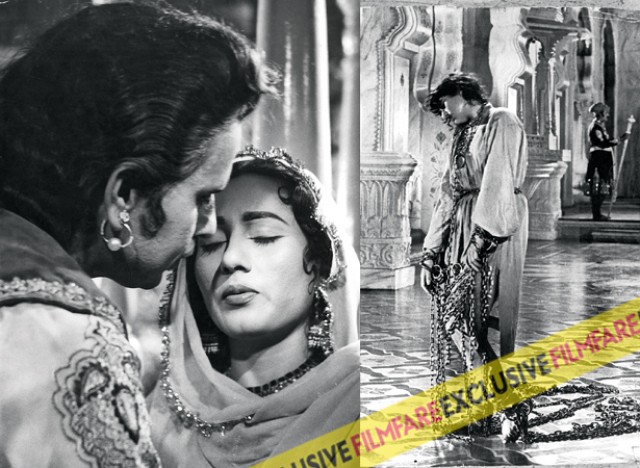
(L)Mughl-E-Azam was the epic film in Madhubala’s career. Not only were audiences curious to see her and Dilip Kumar together in the same frame, they wanted to see why the magnum opus took so many years to complete. (R)It was during the shooting of Mughl-E-Azam that the first bulletins of her heart ailment became public. Director K Asif had reportedly got her shackled in real iron chains which hadn’t helped the ailing actress.
Business savvy
With the world at her feet, she could’ve had anything she fancied. But her ambitions were modest. The sole reason she worked in films was because she was the breadwinner of her huge family. In the late ’40s, when she first featured as a lead actress, Suraiya was the top heroine.
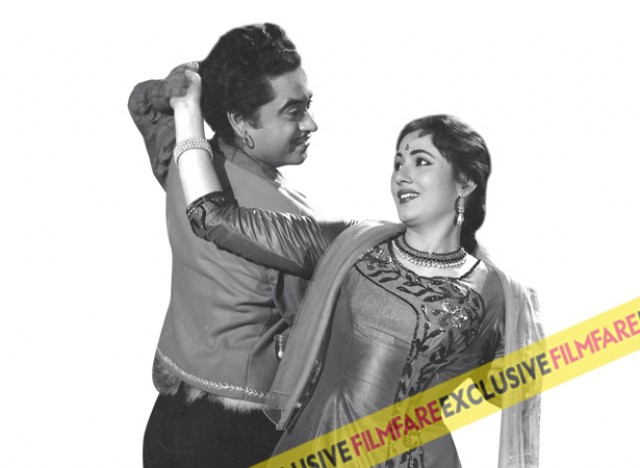
In the early ’60s musical comedies had become a staple for star her. Her pairing with Kishore Kumar was being appreciated a lot and one such caper was the fun-filled film Jhumroo.
Call her a beauty with brains because she made sure a dozen producers hired her thanks to her more lucrative deals. She used to sign films at one fifth the price that her contemporaries were charging. The modest remunerations changed into fat pay cheques when she became a star.
After a long period of absence Madhubala tried to comeback to the movies in the late ‘60s. Jwala (1971) with Sunil Dutt released two years after her death.
Tragedy hit
Right through her life, she lived in the shadow of her father Ataullah Khan. He’s known to have controlled what movies she worked in, whom she met and what places she could visit. It was his alleged domination that lead to the unfortunate end of her much-talked about love affair with Dilip Kumar. She had her moments of belligerence, when she attended the premiere of Insaniyat (1955) on Dilip’s arm. But eventually the friction led to a public split, what with Dilip having a showdown in court. The trauma of it all broke her already fragile heart.
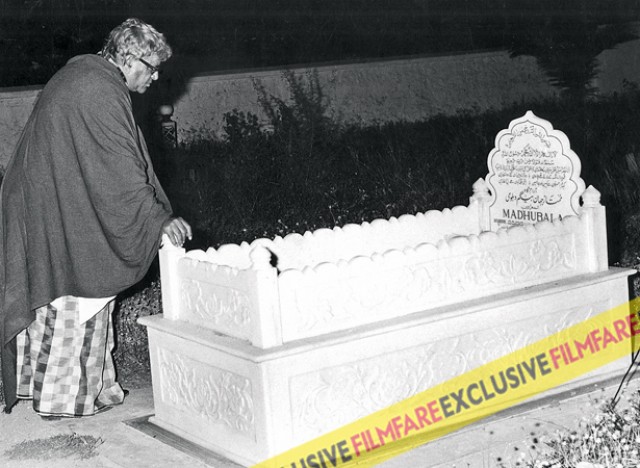
Madhubala’s death was a grave loss. Here you can see Prithviraj Kapoor visiting her burial site in Mumbai.
Yes, the most beautiful Indian woman in the world born on Valentine’s Day, February 14, suffered from a ventricular spetal defect, a hole in the heart. Nonetheless, she was able to ward off depression and anguish and tie the knot with Kishore Kumar. But she was slated for a tragic end. Her health deteriorated. Even though Kishore did his best, he couldn’t save the inevitable. She faded to an ailing heart.
source: http://www.filmfare.com / FilmFare.com / Home> Features / by Rachit Gupta, Features Editor / Monday – November 11th, 2013
The former member of the U.P. Minorities Commission, Nasheed Ahmed Khan, will be the Samajwadi Party candidate from Rampur in the forthcoming Lok Sabha election.
Rampur, situated in the Muslim-dominated Rohilkhand region of Uttar Pradesh, is Urban Development Minister Mohammad Azam Khan’s political backyard and the Samajwadi Party candidate is said to be of his choice.
Party president Mulayam Singh had authorised Mr. Azam Khan to take a final call on the candidate.
Mr. Nasheed Ahmed Khan’s candidature was declared by the party on Saturday. Rampur is among the 11 constituencies where polling would be held in the second phase on April 17.
With Mr. Khan’s nomination, the Samajwadi Party has declared the names of candidates for 78 of the 80 Lok Sabha seats in the State. Only Rae Bareli and Amethi remain.
In the 2009 Lok Sabha election, the Rampur seat was won by Jaya Prada, who was fielded by Mr. Mulayam Singh despite opposition from Mr. Azam Khan.
Ms. Prada’s nomination from Rampur (she had won the seat for the SP in the 2004 Lok Sabha poll ) and former SP leader Amar Singh’s reported influence over the Samajwadi Party president was one of the factors for the rift between Mr. Mulayam Singh and Mr. Azam Khan. He was subsequently expelled from the party.
Things turned full circle when Mr. Amar Singh was expelled and Mr. Azam Khan made a return to the party.
Jaya Prada is likely to join the Congress and may be fielded from the neighbouring Moradabad.
source: http://www.thehindu.com / The Hindu / Home> News> National> Other States / by Atiq Khan / Lucknow – March 09th, 2014