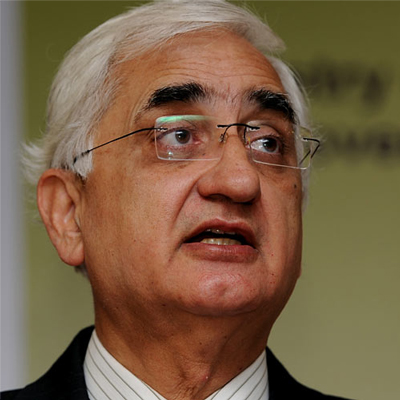
Observing that disparities between the rich and the poor are growing, External Affairs Minister Salman Khurshid today pitched for a new global awakening and a means to meet the needs of the poorest “effectively and adequately”.
“We are living in a complex world where disparities between the rich and the poor, as just being told, are wide and continue to grow. The world population continues to grow and increase globally,” he said during the inaugaral address of the Delhi Sustainable Development Summit.
“Consequently, the needs also grow exponentially. We, therefore, need a new global awakening to be able to deal with disparities and means by which the needs of the poorest can be met effectively and adequately,” Khurshid said.
He said this was not just a political imperative, as has been reminded due to important and dramatic changes taking place in several countries of the world, but also a moral obligation. He asked the global community to take urgent steps to anticipate future challenges and start dealing with them right away in the wake of growing problems of energy, water and food.
“Problems of energy, water and food are likely to become more acute over time unless we take urgent steps globally to anticipate future challenges in this regard and start dealing with them right away,” Khurshid said. He said while large number of people in this world do not have access to electricity, there are others who are living under the shadow of water shortages, hunger and malnutrition.
“Continuation of these conditions will lead to global tensions and threats to lasting peace. The global community and international organisations in particular have to be at the forefront of efforts — to change directions if need be — and take such initiatives as are required to solve these problems,” Khurshid said. He said India has placed great emphasis on food, water and energy and no global efforts to live in peace together will be possible unless we ensure sustainable development.
source: http://www.dnaindia.com / DNA / Home> India / Thursday – February 06th, 2014
To assuage the sentiments of Muslims in the wake of Muzaffarnagar riots, the Uttar Pradesh government on Friday elevated three ministers of state from the community to the Cabinet rank and also inducted a new Muslim face in the ministry.
Those elevated to the Cabinet rank today are Mehboob Ali, Iqbal Mehmood and Shahid Manzoor. Yasir Ali was sworn in as a minister of state by Governor BL Joshi. Ali is the son of Waqar Ahmed Shah, who was ailing for the past several months and was relieved of his labour portfolio.
The expansion of the 21-month-old Akhilesh Yadav ministry came ahead of the upcoming Lok Sabha elections.
Shivakant Ojha, who could not be present during the last reshuffle on January 18 as he was abroad, was today elevated as a cabinet minister.
The swearing in function was held in Raj Bhawan here.
With this, the strength of the ministry has risen to 60 — 27 cabinet, including the chief minister, and 33 ministers of state.
This is the sixth Cabinet expansion since Samajwadi Party came to power in March 2012.
The exercises is understood to have been taken in the wake of ruling SP facing flak in the aftermath of riots in Muzaffarnagar and Shamli districts last year, in which over 60 persons were killed. Many victims, who had fled their homes are still languishing in relief camps.
PTI
source: http://www.zeenews.india.com / Z News / Home> State News> Uttar Pradesh / by PTI / Friday – January 24th, 2014
Most of the world’s disabled live in the global south. This is why India and other Brics nations must ensure their policies are both inclusive and accessible
Abidi says companies should not equate disability with corporate social responsibility.
Born with congenital spina bifida, a developmental disorder, Javed Abidi has traversed the world on a wheelchair, advocating the rights of the disabled.
Considered a pioneer of the cross-disability movement in India, he was instrumental in the drafting and passage of The Persons with Disabilities (Equal Opportunities, Protection of Rights and Full Participation) Act, 1995, and in the setting up of the National Centre for Promotion of Employment for Disabled People in 1996. He has been its director since 1997. In October 2011, he was appointed world chair of Disabled People’s International (DPI), a global organization working for the rights of people living with disabilities.
In July, Abidi also took over as the vice-chair of the International Disability Alliance, a global alliance working for disability causes. In his new role, he stresses that disability movements must focus on the global south (which includes India), for this is where nearly 800 million of the world’s one billion people with disabilities live. Edited excerpts from an email interview:
As the world chair of Disabled People’s International, what are your priorities?
The dynamics of the disability rights movement are going through tremendous churning at this point. In 2011, the World Health Organization (WHO) said one billion, or 15% of the world’s population, live with a disability. Of this, as many as 80%, or 800 million, live in countries of the global south. People with disabilities also comprise 20% of the world’s poorest. Yet the leadership and the mechanisms that shape policies that affect the lives of this 80% are controlled by people from the developed world, who have absolutely no idea what it means to be a person with disability—to not even have a wheelchair, to not even have a hearing aid, to live in abject poverty, etc. My biggest priority as of now is to remind the world, again and again, of this fact.
What is the DPI’s agenda for the UN general assembly’s high-level meeting on disability and development in September in New York?
In the past decade or so, it has by and large been established that disability is a cross-cutting human rights issue. But what the DPI and other global bodies are now trying to underline is that disability is also a developmental issue. Our first endeavour is to ensure that the respective governments send the highest level of delegations to this meeting. The DPI has also raised the demand for a global forum on disability and development—a platform for all stakeholders on the sidelines of the high-level meeting, along with a strong outcome document.
Most importantly, the DPI will try for a sizeable representation from the global south—from Asia, Africa, Latin America, Caribbean—to ensure that their disability and development agenda is not hijacked by people who have very different realities from ours.
How can workplaces in India be made disabled-friendly? What are the challenges, and how can they be met?
Companies that are serious and committed to being disabled-friendly will have to look at it as a policy issue at the highest level. Inclusivity is not just employing people with disabilities. It encompasses making all your facilities and systems accessible. Most companies approach this wrong and equate disability with corporate social responsibility. They first employ people with disabilities and then make their workplaces disabled-friendly. Very soon, India will have a strong anti-discrimination law on disability. Everyone will have no choice but to fall in line. It is up to the employers to decide if they want to be a role model or be forced to comply.
Post-2015, when the world prepares for a new development framework after the UN’s Millennium Development Goals (MDGs), where do you see the disability movement going?
I think that in the past couple of years, development practitioners have become more aware of disability. The challenge is to translate this awareness into action and tangibles. Apprehensions are that disability will again be overlooked. Policymakers and decision makers do not seem to grasp the obvious connection between disability and human rights and development issues. For instance, if you talk about conflict and wars, disability has a direct and significant correlation to it. The same holds true for disability and natural disasters; disability and situations of humanitarian risks; disability and the effects of climate change, and so on.
The task at hand, especially for grass-roots organizations such as the DPI, is to ensure that we keep reminding the people who matter about us.
In what ways can India shape the global disability agenda?
If we go by the 15% theory of WHO, India would be home to more than 150 million people with disabilities, and some of these are the poorest and most vulnerable people on this planet. India’s policy on disability, hence, will have a significant impact on not only the region but also the world. With the new economic dynamics and the power balance shifting towards developing economies such as India and the other Brics nations—Brazil, Russia, China and South Africa, it is imperative that their development policies are inclusive and accessible to disabled people. India should lead here by looking at reforms to advance disability rights, raising the issue at the UN and other bilateral and multilateral platforms. The nations of the global south, especially the Brics countries, are somewhat disillusioned by the MDGs and will therefore be critical to the post-2015 process.
What are the key hurdles in India’s disability movement and how can they be met?
The biggest challenge is to get the attention of policymakers and decision makers to put disability on the agenda and to convert the attention into political will. India made a grave mistake during the formative years, because of which our schools, colleges, universities and public infrastructure continue to be inaccessible to people with disabilities. Rather than rectifying those errors, we are continuing to build more barriers. In a budget analysis done by us, we found that in the Union budgets since 2008, India spends only 0.009% of its GDP on disability! A strong anti-discrimination law with punitive measures is also needed to ensure equal participation of people with disabilities.
What difference are you going to make for the movement in South Asia, especially since you are an Indian?
The MDG Report of 2012 says that by 2015, four out every five people living on less than $1.25 (aroundRs.70) a day will be in South Asia. It is anybody’s guess as to how many of them will be people with disabilities, given the vicious cycle of poverty and disability. My immediate aim is to build a strong cross-disability network in South Asia to highlight these issues. We have already started this process and some progress has been made.
As a major development aid donor, India also needs to rethink its “no-strings attached” south-south cooperation policy. A democracy cannot possibly fund projects that violate the human rights of people with disabilities by creating barriers for them.
source: http://www.livemint.com / Live Mint & The Wall Street Journal / Home> Lounge> Business of Life> Indulge / by Pallavi Singh / Sunday – April 28th, 2013
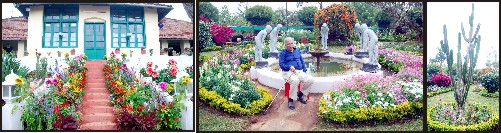
An eye-catching flower show has been organised from Jan. 26 to Jan. 28 from 10 am to 5 pm at the Yousuf Ali Khan memorial flower garden at the premises of Balyatri Coffee Estate near Boikeri on Madikeri-Suntikoppa Road in Kodagu.
The estate belongs to former Rajya Sabha member F.M. Khan. Briefing the press on the annual flower show, Khan said that “over 90 varieties of flowers and fruits have been grown in the garden which is the only private flower garden in the country. The garden took shape about 50 years ago and for the last 15 years the flower show is being organised annually for the public. The garden houses Philia, Lorsper, Khel, kelen chus, cactus, dahlia, daisy, roses, pinks, kupia and other exotic varieties including bonsais.
He said that horticulture was bifurcated from agriculture when Indira Gandhi was the Prime Minister to boost the growth of horticulture which has not happened to the desired level yet. Continuing, he opined that Congress needed young leaders like Rahul Gandhi and Priyanka.
However he felt that Rahul should address more public rallies instead of closed-door meetings to reach the masses.
source:http://www.starofmysore.com / Star of Mysore / Home> General News / January 25th, 2014
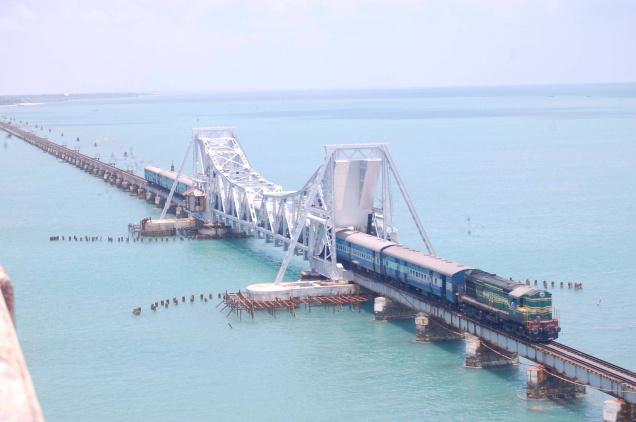
ENGINEERING MARVEL: The special train carrying former President A.P.J. Abdul Kalam at Pamban railway bridge./ Photo: L. Balachander / The Hindu
India’s first cantilever bridge connects Rameswaram with mainland
A long-time resident of Rameswaram and former President A.P.J. Abdul Kalam inaugurated the centenary celebrations of the Pamban railway bridge — India’s first cantilever bridge, connecting the pilgrim-island of Rameswaram with the mainland. He turned nostalgic as a two-coach special train took him from Mandapam across the bridge. “Pamban bridge is part of my life,” Mr. Kalam said. As a young boy, he had travelled hundreds of times on the bridge to take newspapers to the island for distribution.
Mr. Kalam unveiled a plaque and released a book Marvels of South Indian Railway, marking the inauguration of the nearly month-long celebrations.
Southern Railway General Manager Rakesh Misra said the bridge was an engineering marvel that had withstood corrosion and a violent sea for over a century. The 65.23-metre-long rolling central lift span (the bridge is 2.06 km long), named after Scherzer, German engineer who designed and built the span, has been given a fresh coat of paint and decorated with lights. It opens up like a pair of scissors to allow vessels to pass through under the bridge.
Mr. Kalam had played a vital role in preserving the bridge. After the Railways announced its uni-gauge policy in 2006, and almost gave up gauge conversion at the bridge, he brought in IIT-Madras expertise to thrash out an engineering solution.
The bridge was put to test for the first time in December 1964, when a severe cyclonic storm hit this part of the area. All girders, both RCC and steel, were washed away. Two of the 141 piers were also damaged. But, Scherzer’s span withstood nature’s fury.
source: http://www.thehindu.com / The Hindu / Home> National / by Walter Scott / Pamban – January 29th, 2014
Former President APJ Abdul Kalam delivering the convocation address at the 33rd convocation of OUAT in Bhubaneswar on Saturday. | EPS
Former President APJ Abdul Kalam said if trained teachers educate and motivate students in schools, absence of school infrastructure is immaterial.
Speaking at a special meeting of teachers organised by the School and Mass education (S & ME) Department here on Saturday, Kalam cited examples about the education system in Singapore and Finland.
He stated that the Governments there have prioritised primary education and are spending a lot of money on the primary school teachers. He administered an oath to the teachers at the end of his speech.
He asked them to encourage the students to develop a spirit of curiosity, to celebrate the success of the students and treat every student equally.
When asked by a teacher if internet based knowledge can replace teachers, he replied that nothing can. Only a teacher can radiate knowledge, which a machine can never, he said.
S&ME Department Secretary, Usha Padhee said that they will create digital video copies of Kalam’s speech and mail it to the teachers who could not attend the meet.
More than 200 teachers attended the meeting the Capital High School.
source: http://www.newindianexpress.com / The New Indian Express / Home> States> Odisha / by Express News Service – Bhubaneshwar / January 26th, 2014
The Nizams’ rule found place in the record books of both the Legislative Assembly and Council on Friday.
Congress MLC Mohd Ali Shabbir actually submitted a detailed note to Council chairman A. Chakrapani, stating that the Nizams, especially Nizam VII, had developed Hyderabad city and not Telugu Desam president N. Chandrababu Naidu.
Shabbir listed over 100 buildings, monuments, infrastructure projects, government departments, hospitals and others, including the present Assembly building, Jubilee Hall, Hussainsagar Lake, Railway network, Road Transport Corporation, Begumpet Airport, Osmania University, Osmania General Hospital etc. that had been constructed by the Nizams or during their reign.
“Pre-1956 Hyderabad was the largest and most prosperous of all princely states in India. It had its own army, airline, telecommunication system, railway network, postal system, currency and radio broadcasting,” he explained in the note which was part of the debate on the AP Reorganisation Bill.
“Hyderabad, the first planned city of India, was already a developed city centuries before it became part of Andhra Pradesh. The world’s first drinking water reservoir, Hussainsagar, was built in 1562,” he said.
Several MLAs and MLCs like Akbaruddin Owaisi, Mohd Shabbir Ali, Etela Rajender and others gave credit to the Nizams for the development of Hyderabad, while some Seemandhra MLAs like D. Narendra and others criticised their rule, which they said, had led to the Telangana armed rebellion and the notorious Razakaar movement.
“I wanted to put the record straight. The Nizams developed Hyderabad city and others contributed later. The claim of Leader of Opposition in Assembly, Nara Chandrababu Naidu, is ridiculous that he got Hyderabad on the global map. The fact is, Naidu went on the global map and got recognition by reciting the name of Hyderabad repeatedly,” Shabbir Ali said in the note to the Legislative Council Chairman.
He challenged Seemandhra leaders for an open debate on Hyderabad. “In fact, Naidu tried to damage the culture and identity of Hyderabad. The historic Hussain Sagar Lake was shrunk during Naidu’s period and he tried to change the name of the city from Hyderabad to Cyberabad. Even NTR’s samadhi is built on encroached land which was originally Hussain Sagar,” he alleged.
source: http://www.deccanchronicle.com / Deccan Chronicle / Home> News> Politics / DC / January 25th, 2014
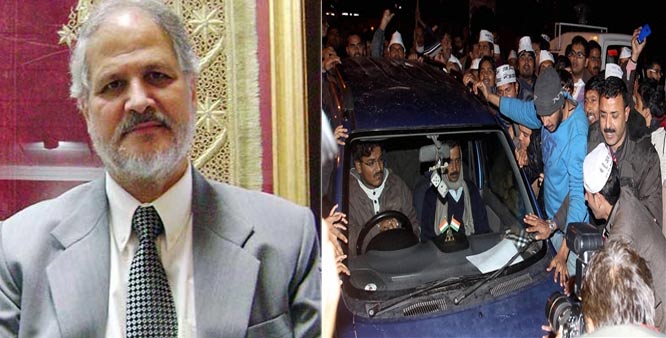
“The Lt Governor played a key role in defusing the situation,” said a government source. Jung made discreet inquiries at his end and reportedly found some damaging information against the police officials whom the Delhi government wanted penalized, the source added.
As to the withdrawing of the dharna, the source said that Jung had sought a commitment from Kejriwal that he would agree with the formula devised by him “to end the stalemate”.
Kejriwal’s two-day dharna outside Rail Bhavan in Delhi was on Tuesday withdrawn after the Lt Governor “partially agreed” to the government’s demand of action against five Delhi Police officers for alleged dereliction of duty.
As the proposal reached the government, Chief Minister Arvind Kejriwal and the members of AAP’s Political Affairs Committee (PAC) held an hour-long closed door meeting at Press Club following which the CM announced his decision to call off the dharna.
Kejriwal, his cabinet and party colleagues and AAP supporters had gone on a dharna over their demand for the suspension of three SHOs and two ACPs in connection with three separate cases.
One of those involved the gang-rape of the Danish woman in the national capital while the second case deals with the alleged burning of a woman by her in-laws over dowry.
The third matter is related to an alleged prostitution and drug ring in Malviya Nagar and Khirki Extension and the refusal of police there to undertake a raid against those reportedly involved in the racket when Delhi Law Minister Somnath Bharti had sought their intervention for the same.
Under the compromise agreed by AAP, the SHO of Malviya Nagar and the PCR van in-charge at Paharganj, where the Danish woman was gangraped last week, have been sent on leave. Earlier in the day, with Kejriwal leading the dharna outside Rail Bhavan, senior AAP leader Yogendra Yadav met Jung over lunch to discuss the scope for ending the stalemate.
The Delhi Lt Governor is learnt to have made an appeal for the chief minister to agree with his proposal for a compromise between Delhi government and the Centre.
(Agencies)
source: http://www.post.jagran.com / Home> India News> General News / by Agencies / January 22nd, 2014
Karnataka hopes to maintain its winning streak at the Republic Day parade
The Congress government in Karnataka will roll out the tableau of ‘Tipu Sultan—the first ruler of India to see the evil designs of the East India Company’ at the Republic Day parade.
Karnataka has been winning accolades every year during Republic Day parade. Sources in the Information Department told Bangalore Mirror that this year, it was unanimously decided to have Tipu’s battle against East India Company as the theme of the tableau. While one part reflects his valour with a life-size bust and an unsheathed sword, another part story depicts his humiliating defeat at the hands of Lord Cornwallis who took away Tipu’s two sons as captives in the Second Mysore War (1780-84).
“Tipu was one of the first rulers who saw the evil designs of the East India Company. He repeatedly said that he would rather live two days as a tiger than live 200-years like sheep. Tipu’s personality also has qualities of a good diplomat, visionary and a planner. He had a vision for missile technology and the first-ever rocket centre was set up in Srirangapatna. He had embassies with France, Amirs of Afghanistan and Sultan of Turkey and established trade contacts,” explained a source from the Information Department.
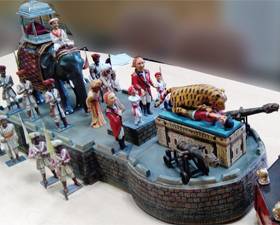
The scene that the government has recreated in the form of tableau was adopted from the painting of Brown who has pictured a lame Vakeel escorting two sons of Tipu. The children, dressed in muslin cloth with blue slashes and white turban, look towards Lord Cornwallis, reflecting a poignant moment in the history of India. The tableau also depicts Tipu’s famous sword measuring 91 cms with an impressive and ornate hilt carrying an Arabic inscription which reads ‘Sword of the Ruler’.
The state won President’s awards for its tableaux in the past four years.
source: http://www.bangaloremirror.com / Bangalore Mirror / Home> Bangalore> Others / by Niranjan Kaggere, Bangalore Mirror Bureau / January 22nd, 2014
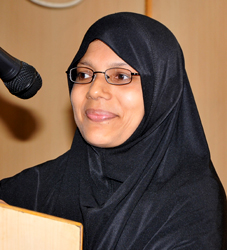
Mangalore-based woman activist Shahida Aslam has been unanimously elected the new president of National Women’s Front. She was the Karnataka state unit president of the organisation.
The announcement was made at the third national general council of the organization that was held on Sunday at Malabar House, Puttanathani in Kerala.
Aslam, who holds a master degree in mass communication and journalism, is a freelance journalist from Mangalore. She was part of the editorial board of Prastutha, a Mangalore-based Kannada fortnightly. She also had worked for a women’s monthly magazine.She was also an office-bearer of Karnataka women’s writers forum. She presented a paper titled ‘Muslim women in public space’ at an international conference organised at Calicut by institute of objective studies, Delhi. She had also worked as a member of several fact finding teams for human rights organisation and women’s rights organisation.
Alima Fathima from Tamil Nadu and Fareeda Hasan from Kerala have been chosen as the vice president and general secretary of the NWF respectively.
The council started with the introduction by the national president Shahida Tasnim. She said, “The last two years of the organization were the years of growth. We were successful in reaching new places and setting state committees in Goa and Andhra Pradesh. The organization also received good response from women activists from Delhi which has encouraged us to take our movement to the northern part of India in the coming term.”
The leadership oath to the president was given by the returning officer. The newly elected president administered the oath to the newly elected office bearers and national committee member. The programme concluded with the valedictory speech of the newly elected president Aslam, who motivated the members to put in more efforts for the protection of rights and social justice.
The general elected a 13-member national committee and also the new office bearers. The new leadership is as below:
1. Shahida Aslam Karnataka – President
2. Alima Fathima Tamil Nadu – Vice-president
3. Fareeda Hasan Kerala – General secretary
4. Shifa Coimbatore, Tamil Nadu – Secretary
5. Shahida Tasnim, Karnataka – Treasurer
6. Zainaba Ali, Kerala – National committee member
7. Asiya Maryam, Tamil Nadu – National committee member
8. Nousheera Karnataka – National committee member
9. Atiya Firdos, Delhi – National committee member
10. Shareena Najib, Kerala – National committee member
11. Habeeba Usman, Kerala – National committee member
12. Rehana, Goa – National committee member
13. Safiya Erode, Tamil Nadu – National committee member
The following resolutions were passed by the national general council:
1. Provide security, justice and rehabilitation to Muzaffarnagar riot victims: The NGC of NWF demanded the immediate rehabilitation and adequate protection of the riot victims of Muzaffarnagar. The government failed to attend the basic needs of the people displaced from their homes and native villages. The NGC strongly believes that rehabilitating the families thrown out of their native villages along with providing security to their lives and properties is the primary task the government has to fulfil. The NGC demands the UP government to take immediate steps to solve the humanitarian crisis and fulfill is promises.
2. Pass the Communal Violence Bill in the upcoming parliament session : The country has been infected by the deadly virus of communalism since independence. This in turn resulted in various communal riots which has caused an extreme loss to the country and especially to the Muslim community. After every riots the culprits go scot free and no legal action is taken on them. Such negligence by the law authorities has only increases the confidence of the communal fascist forces. The demand for the communal violence bill is a long pending demand which has only seen promises but no actions. The NGC of NWF demands that the government immediately brings into effect a powerful communal violence bill in the upcoming Lok Sabha session and take quick steps for its implementation.
3. Take immediate steps for protection of women: Since the past few years the issue of rapes has come to the national attention. It is a tragedy that even after so much discussion happening about this issue the government and police has failed miserably to protect the women from such heinous crimes. Every day we see a new incident happening in almost all the cities of country. The cases happening to women from rural and tribal areas not even reported. The NGC of NWF strongly demands the central and state governments to take the issue very seriously and give top priority to the protection of women.
source: http://www.daijiworld.com / DaijiWorld / Home> Top Stories / Press Release / Mangalore – January 20th, 2014