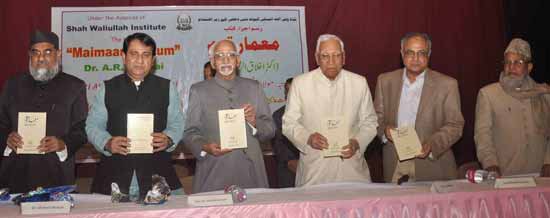
Vice President Hamid Ansari released here on 21 November a book on the life and services of Akhlaqur Rahman Kidwai, the veteran Congress leader who honorably served the country in various capacities like Rajya Sabha MP, chairman of Union Public Service Commission and governor of the states of Bihar, Orissa, Haryana and Punjab.
The book “Me’mar-e Qaum” [Builder of a nation], is authored by Mufti Ataur Rahman Qasmi and published by Shah Waliullah Institute.
The book release was held at the India Islamic Cultural Centre. Vice President Hamid Ansari said that services of Kidwai cannot be forgotten by the people of the country. He said Kidwai enjoys serving people, an spirit rarely found in people these days. He helped many. One of his historic initiatives was to start Mewat Development Board.
While speaking during the function, AR Kidwai said his character has been shaped by Jamia Millia Islamia which he joined in 1924 as a student of class 2. He was fortunate to get the attention of an educationist like Dr Zakir Husain.
The function was chaired by the former Union minister and the present general secretary of Congress Party, Shakil Ahmad who said that the services of AR Kidwai are such that one yearns to emulate him. He said that a characteristic of Kidwai is that he never exhibits his work.
Ataur Rahman Qasmi, the author of the book, said that Kidwai added to the stature of any post he held. He never compromised on his principles. These days it is rare to find such servants of the people.
The function was attended by a sizeable number of Delhi elite which bore witness to the popularity of Kidwai who is now leading a private life after offering an example of how Muslims can selflessly serve the country with honesty and dignity.
source: http://www.milligazettec.com / The Milli Gazette / Home> News> Special Report / by The Milli Gazette / November 26th, 2013
Despite Kejriwal not addressing any public meetings in Muslim pockets or visiting Muslim-dominated areas like Jama Masjid and Okhla during his election campaign, the Aam Aadmi Party (AAP) performed well in Muslim-majority constituencies. AAP secured victory in 8 out of 11 Muslim-concentrated seats. Notably, four Muslim candidates from AAP—Amanatullah Khan, Aaly Mohammad Iqbal, Imran Hussain, and Chaudhri Zubair—won comfortably. Meanwhile, Asaduddin Owaisi’s AIMIM, which contested with high hopes, failed to open its account and faced disappointment.
Muslims constitute around 13% of Delhi’s voter base. Their votes influence the results of nearly 11 assembly seats. There are 11 seats where the Muslim voter population is significantly high. Let’s examine the situation in these Muslim-majority areas:
A Look at the Results of Delhi’s Muslim-Majority Seats
Let’s take a closer look at the statistics of 11 Muslim-majority constituencies. Notably, Muslims constitute 13% of Delhi’s electorate, and 11 seats are considered Muslim-majority constituencies. These include Okhla, Mustafabad, Ballimaran, Seelampur, Matia Mahal, Chandni Chowk, Seemapuri, Babarpur, Karawal Nagar, Jangpura, and Sadar Bazar. This time, there was a high voter turnout in these constituencies. The results of these seats are as follows:
AAP’s Victories in Muslim-Majority Constituencies
Amanatullah Khan Wins from Okhla
In Okhla, AIMIM’s Shafa Ur Rahman, AAP’s Amanatullah Khan, Congress’ Ariba Khan, and BJP’s Manish Chaudhary contested the elections. According to the Election Commission’s data, AAP’s Amanatullah Khan secured victory with a margin of 23,639 votes, receiving a total of 88,943 votes. BJP’s Manish Chaudhary came second with 65,304 votes, while AIMIM’s Shafa Ur Rahman ranked third with 39,558 votes.
Aal Mohammad Iqbal Secures Matia Mahal
From Matia Mahal, AAP’s Aal Mohammad Iqbal won by a significant margin of 42,724 votes, securing a total of 58,120 votes. BJP’s Deepthi Andora finished second with 15,396 votes, while former Congress MLA Asim Mohammad Khan came third with 10,295 votes.
Zubair Ahmad Clinches Victory in Seelampur
As per the Election Commission’s data, AAP’s Zubair Ahmad won Seelampur by a huge margin of 42,477 votes, receiving a total of 79,009 votes. BJP’s Anil Kumar Sharma came second with 36,532 votes, while Congress’ Abdul Rahman secured third place with 16,551 votes.
Imran Hussain Emerges Victorious in Ballimaran
Ballimaran witnessed a tough contest, but AAP’s Imran Hussain secured victory with a margin of 29,823 votes, receiving a total of 57,004 votes. BJP’s Kamal Bangdi came second with 27,181 votes, while Congress’ Haroon Yusuf stood third with 13,059 votes.
Prernadeep Singh Sahni Wins from Chandni Chowk
AAP’s Prernadeep Singh Sahni won Chandni Chowk with a margin of 16,572 votes, securing a total of 38,993 votes. BJP’s Satish Jain finished second with 22,421 votes, while Congress’ Modit Aggarwal came third with 9,065 votes.
Gopal Rai Triumphs in Babarpur
From Babarpur, AAP’s senior leader Gopal Rai secured a decisive victory with a margin of 18,994 votes, receiving a total of 76,192 votes. BJP’s Anil Kumar followed in second place with 57,198 votes, while Congress’ Mohammad Ishraq Khan came third with 8,797 votes.
Sadar Bazar Goes to AAP’s Som Dutt
From Sadar Bazar, AAP’s Som Dutt won with a margin of 6,307 votes, securing a total of 56,177 votes. BJP’s Manoj Kumar Jindal stood second with 49,870 votes, while Congress’ Anil Bhardwaj secured third place with 10,057 votes.
Vir Singh Dhangan Secures Seemapuri for AAP
In Seemapuri, AAP’s Vir Singh Dhangan won by a margin of 10,368 votes. BJP’s Kumari Rinku, who was leading at certain points in the counting, finished second with 55,985 votes. Congress’ Rajesh came third with 11,823 votes.
Three Muslim-Majority Seats Won by BJP
There are three Muslim-majority constituencies in Delhi where BJP candidates secured victory. These seats are Mustafabad, Jangpura, and Karawal Nagar. Details of these seats are as follows:
BJP’s Big Win in Mustafabad
In Mustafabad, BJP’s Mohan Singh Bisht won by a large margin of 17,578 votes, receiving a total of 85,215 votes. AIMIM’s Tahir Hussain, AAP’s Adil Khan, and Congress’ Ali Mehdi also contested from this seat. AAP’s Adil Khan finished second with 67,637 votes, while AIMIM’s Tahir Hussain stood third with 33,474 votes.
Close Contest in Jangpura, BJP Secures Victory
Jangpura was a high-profile seat where BJP’s Trivendra Singh won by a narrow margin of just 675 votes. AAP’s senior leader and former Deputy Chief Minister Manish Sisodia secured 38,184 votes but lost by 675 votes. Congress’ Farhad Suri finished third with 7,350 votes.
Kapil Mishra Wins Karawal Nagar for BJP
From Karawal Nagar, BJP’s firebrand leader Kapil Mishra won by a decisive margin of 23,355 votes, receiving a total of 107,367 votes. AAP’s Manoj Kumar finished second with 84,012 votes, while Congress’ P.K. Mishra came third with 3,921 votes.
source: http://www.muslimmirror.com / Muslim Mirror / Home> Indian Muslim> Politics / by Muslim Mirror Desk / February 09th, 2025
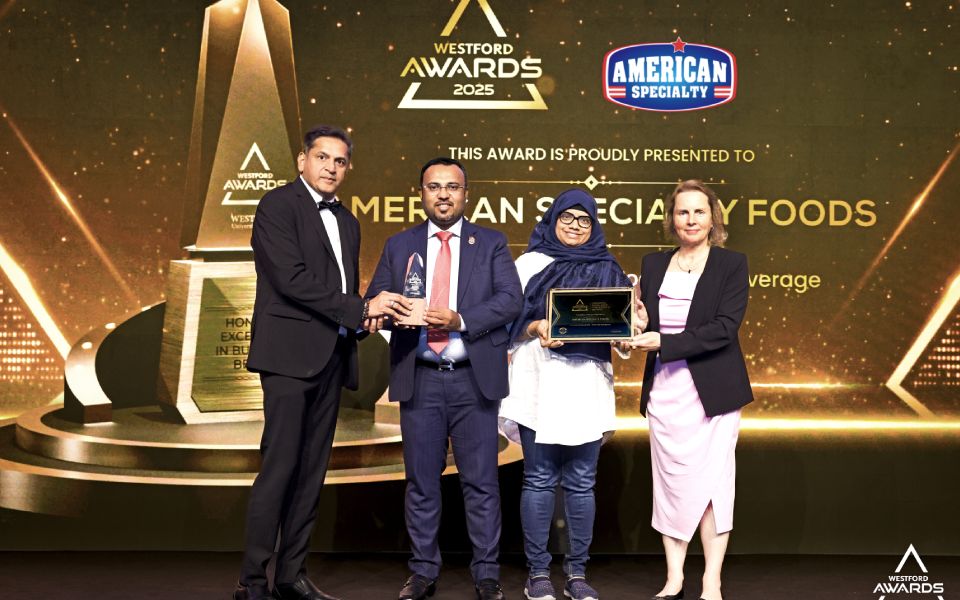
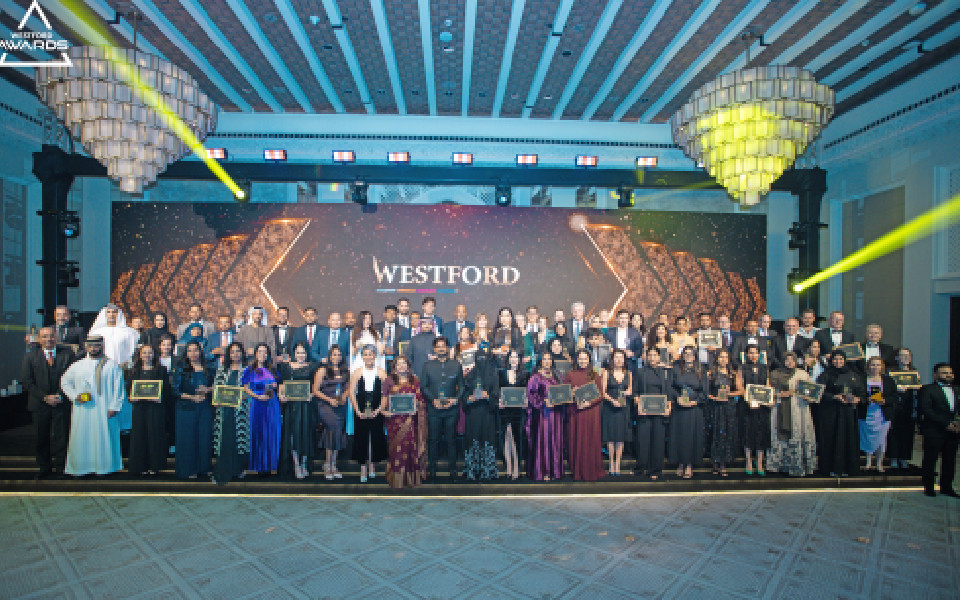
American Specialty Foods Co has been honored with the prestigious Westford Award for Business Excellence in the Food & Beverage category. The award was presented at a grand ceremony held at Madinat Jumeirah, Mina Al Salam, Dubai, on January 24, 2025.
The award was received by the company’s Founder and CEO, Hany M. Haneef, along with Co-founder and Director, Shahanaz Haneef. Expressing his gratitude, Haneef stated, “I am truly honored to receive this award. It belongs to our incredible team, partners, and supporters. Success is built on dedication, teamwork, and excellence. This is just the beginning; there is so much more ahead.”
Established in 2013, American Specialty Foods Co has grown into a leading provider of premium global food solutions. Headquartered in Maryland, USA, the company also has offices in New York, Mexico, the UK, and the UAE. With a distribution network spanning over 50 countries, the company offers more than 20 specialty food categories and actively participates in major international food trade events worldwide.
The Westford Awards recognize outstanding business achievements across various industries, providing winners with greater visibility and networking opportunities. “This recognition further cements American Specialty Foods Co’s position as a leader in the specialty food and beverage sector,” a statement from the company added.
source: http://www.english.varthabharati.in / Vartha Bharati / Home> Gulf / by Vartha Bharati / January 31st, 2025
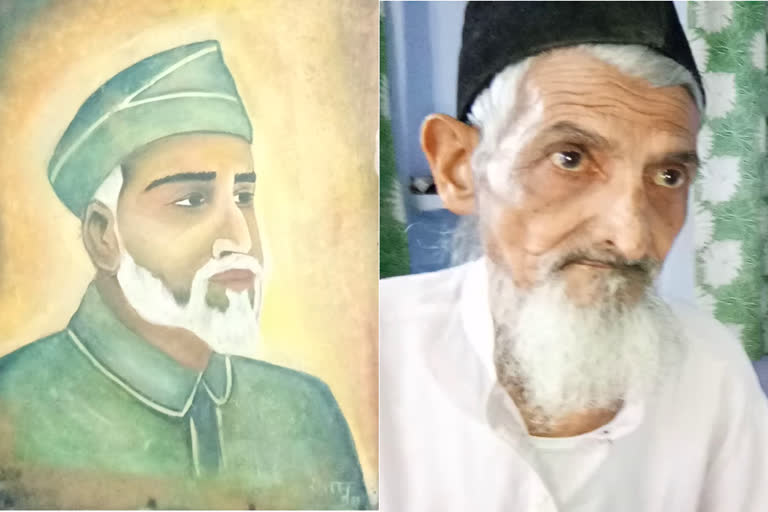
Nawab Shafan Khan, the heir of Nawab Khan Bahadur Khan, who kept the Rohilkhand region free from British rule for eleven months during the 1857 freedom movement, has passed away.
Nawab Shafan Khan breathed his last at the age of 80. The sacrifices of his ancestors are recorded in golden words in the pages of history.
Death of Nawab Shaffan Khan, heir of Nawab Khan Bahadur Khan
Nawab Shafan Khan, a resident of Shahabad area of Bareilly city, has passed away. He was laid to rest in Bhor graveyard near his home after Zuhr prayers. He was the heir to a great family whose ancestors ruled not only Bareilly but also in about 9 surrounding districts. His great-grandfather Nawab Khan Bahadur Khan had set a great example of bravery and sacrifice in the style of his namesake.
He was a hero of the 1857 revolution. He was born in 1791 into a Nawab family. He was the grandson of Rohilla Sardar Hafiz Rehmat Khan.
The slogan of revolution was raised in Meerut on 10 May 1857 and when the news of it reached Bareilly on 14 May, preparations were intensified here too. On 31 May, Khan Bahadur Khan and his generals and soldiers, led by Subedar Bakht Khan, declared a rebellion against the British government.
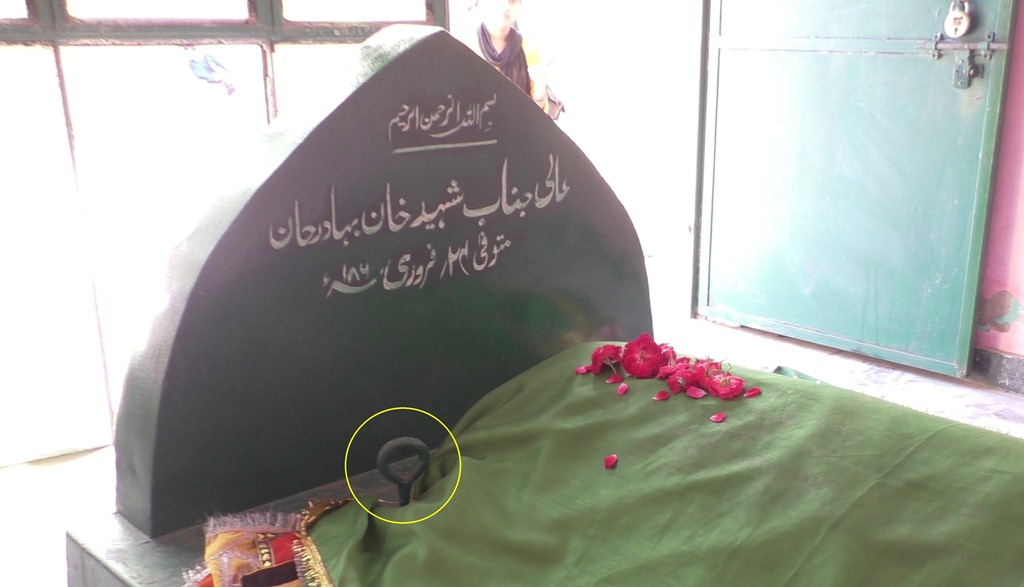
Tomb of Nawab Khan Bahadur Khan
The then magistrate, civil sergeant, jail superintendent and principal of Bareilly College, “C.Buk”, were killed by the revolutionaries. By five in the evening, the revolutionaries had taken control of the Bareilly division.
On June 1, these revolutionaries took out a triumphant procession. When the procession reached Kotwali, a large number of Bareilly citizens crowned Nawab Khan Bahadur Khan and elected him the Nawab of the Bareilly division.
Heir of Nawab Khan Bahadur Khan
An example of the bravery of Nawab Khan Bahadur Khan is that despite the numerous atrocities and abuses of the British government and being a powerful ruler, he kept the Bareilly division free from the rule of the British government for eleven months.
However, later, the British government arrested Nawab Khan Bahadur Khan while fighting a war at one place. He was brought to the same Kotwali where he was awarded the title of Nawab. He was imprisoned and kept in an unknown place.
Then on February 24, 1860, the hero of the urban people was brought on foot to the Kotwali and hanged on the same day at 7:10 am. A strange silence fell in the city and darkness prevailed.
Heir of Nawab Khan Bahadur Khan
To prevent any unrest in the city after the hanging of Nawab Khan Bahadur Khan, his body was taken to the district jail in an armored police vehicle and buried in the premises of the district jail.
Heir of Nawab Khan Bahadur Khan
The special thing is that he was buried with irons. Even today, the irons are clearly visible on the head of his grave. The British government had also buried Khan Bahadur Khan in the prison premises so that people could not gather at his grave and there would be no further excitement in the revolution.
Now let us mention Nawab Shafan Khan, the heir of Khan Bahadur Khan. He struggled for life and livelihood till his last breath. Despite belonging to the Nawab family, his family had to face difficulties for years or even their entire lives. Despite this, the struggle did not end in his life till his last breath.
According to his younger brother Nawab Liaquat Khan, Nawab Shaffan Khan’s health had deteriorated for the past five days. He was unable to go to the mosque to offer prayers during those days. Due to the weak financial condition of the family, he was undergoing treatment at home. But in the morning, his health deteriorated further and he died after a few moments.
source: http://www.etvbharat.com / ETV Bharat – Urdu / Home> Urdu> State / by Urdu translation into English / July 02nd, 2021
From technology to hospitality, Muslim businessmen are raising India’s stature on the global stage
New Delhi :
In the ever-evolving world of business, several prominent figures are not just shaping the Indian economy but also placing the country on the global map. Among them, six Muslim businessmen stand out, with their remarkable ventures spanning across various sectors, such as technology, healthcare, retail, and hospitality. These influential entrepreneurs are enhancing India’s image worldwide, further solidifying its position in the global business arena.
Azim Premji – The Tech Magnate Azim Premji, often regarded as the richest Muslim businessman in India, has played a pivotal role in the growth of India’s technology sector. As the chairman of Wipro, one of the country’s largest IT companies, Premji’s leadership has helped the company expand its reach across various international markets. His contributions extend beyond the business world as well. “India’s rise in the global tech landscape is closely tied to Wipro’s innovation and excellence,” said Premji. Through Wipro, Premji has established himself as a philanthropist, with substantial donations to charitable causes.
Meraj Manal – The Herbal Business Visionary Meraj Manal, the driving force behind the success of ‘Himalaya,’ India’s prominent herbal company, is known for his dedication to promoting natural wellness. His business expertise has helped Himalaya expand into a globally recognised brand, selling products in over 90 countries. Manal attributes his success to innovation and a commitment to quality. “We’re not just selling products; we’re selling a way of life,” he shared. His continued success has played an essential role in reinforcing the global appeal of Indian herbal and natural products.
Rafiq Malik – Footwear Industry Leader Rafiq Malik, founder and owner of ‘Metro,’ one of India’s leading footwear brands, has seen significant international growth. His entrepreneurial vision has positioned Metro as a key player in the retail space, both in India and abroad. Under his leadership, Metro has expanded its footprint, contributing to the growing demand for Indian brands in global markets. “Metro is about more than just shoes; it’s about delivering quality and style to every customer,” said Malik.
Yusuf Ali – Hospitality and Retail Mogul Yusuf Ali, owner of ‘Lulu,’ one of the largest retail chains and shopping malls in many world countries and in India, has firmly placed his mark in the retail and hospitality sectors. With Lulu Mall’s presence in multiple countries, his business is recognised globally. From large-scale shopping centres to luxury hotels, Yusuf Ali’s diverse portfolio is a testament to his entrepreneurial prowess. “Our mission is to provide an unparalleled shopping experience for our customers, no matter where they are,” Yusuf Ali explained.
Other Notable Names While Premji, Manal, Malik, and Yusuf Ali are among the most prominent, several other Muslim businessmen are also contributing significantly to India’s economic growth. Their ventures span multiple industries, from healthcare to infrastructure, highlighting the diversity and dynamism of Muslim entrepreneurs in India.
These businessmen not only continue to lead successful ventures but also serve as role models for the younger generation, proving that entrepreneurship knows no bounds. Through their business acumen, these individuals are ensuring that India continues to grow as an economic powerhouse on the global stage.
source: http://www.clarionindia.net / Clarion India / Home> Editors Pick> India / by Team Clarion / December 07th, 2025
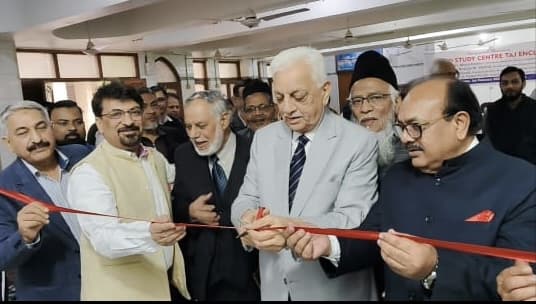
A Mosque Study Center was inaugurated in Taj Enclave, Northeast Delhi, with the support of the Shaheen Group. The center aims to provide both religious education and academic coaching for medical, engineering, and competitive exams.
During the event, Faisal Falahi, Director of Shaheen Academy Delhi, introduced the Shaheen Group, highlighting that approximately 35,000 students are currently enrolled in its institutions, where they receive not only general education but also specialized coaching for NEET and engineering entrance exams. He emphasized that the new study center aligns with this vision.
Advocate Feroz Ahmed, President of All India Muslim Majlis-e-Mushawarat, underscored the importance of education, citing former President Dr. APJ Abdul Kalam as an inspiration for students from underprivileged backgrounds. He stressed the need for initiatives like those led by Dr. Abdul Qadeer in the current educational landscape.
Mufti Adil Jamal Nadvi emphasized the necessity of combining religious and worldly education, while former Secretary of the Maulana Azad Foundation, Rizwan-ur-Rahman, highlighted the importance of counseling to help school dropouts return to education.
Dr. Khwaja Shahid, President of the All India Educational Movement (AIEM), shared his long-standing association with Shaheen Group and its founder, Dr. Qadeer. He referred to such study centers as “academic ICUs” for students struggling with education. The center was jointly inaugurated by Dr. Shahid and Advocate Feroz Ahmed.
Before the inauguration, AIEM General Secretary and former President of the Taj Society, Abdul Rashid, expressed gratitude to Shaheen Group and Dr. Qadeer for their support in establishing the center. The event was presided over by Faisal Faridi, President of Taj Society, and conducted by Nasir Aziz. The vote of thanks was delivered by the society’s secretary, Javed Hasan Khan.
The ceremony witnessed the presence of several distinguished guests, including Supreme Court Advocate-on-Record Aslam Ahmed, former DSP Mohammad Akhtar, Ilyas Saifi, Dr. Idris Qureshi (President, Mushawarat Delhi), and a large number of attendees.
source: http://www.radiancenews.com / Radiance News / Home> Focus> Latest News / by Radiance News Bureau / February 03rd, 2025
The air is thick with political tension in the bustling lanes of Delhi’s Okhla constituency as the assembly elections in the city draw near. A determined and vocal leader, Nooreen Fatima rallies the crowd with the chant, “Bolega Okhla, Jeetega Insaf (Okhla will speak, justice will win).”Fatima is campaigning for her husband, Shifa Ur Rehman, an outspoken anti-Citizenship Amendment Act (CAA) activist, who has been behind bars since April 2020. Accused of being involved in a conspiracy to incite riots in Northeast Delhi, he faces serious charges, but his supporters believe the allegations are baseless.
Steadfast in her mission, Fatima tells the voters, “We could not get justice in the courts, but we trust you to deliver it at the ballot box.” Her voice reverberates through the streets and seemingly resonates with the people of Okhla who still seek justice for what they perceive as wrongful incarcerations.Talking to TwoCircles.net, Fatima explained why her husband decided to contest the elections despite his lack of political experience and imprisonment for five years. “We are a part of this society. Politics is part of our life,” she said. “Although Shifa-ur-Rahman has no political background, he has always had an interest in politics. We are not gullible people. It is not that Shifa does not understand the political landscape. In the past, he was very much involved.”
Nooren Fatima campaigning
She continued, “Owaisi Sahab took a risk by giving us a ticket, something no big party would do. They want big faces, not freshers. But Owaisi took that risk, and now people are learning about Shifa. This is a platform for us, and for that, we are grateful.”
Often seen leading the charge, Fatima passionately addresses the core issues that have plagued the community. “The education system in Okhla has failed us. The healthcare system is a mess. The government promises a lot but delivers little. People need better schools, better hospitals and better opportunities. We will fight for these rights.”
She argues that the local government’s “neglect” has only exacerbated the community’s problems, with basic infrastructure such as roads and drainage systems still in disrepair.
She has a conviction in fighting for her husband. “We cannot just sit back and watch as our future is decided by others,” she said. “It is time for people to rise and take charge. Our fight is not just for Shifa; it is for all of us who have been wronged.”
Rehman’s candidacy, endorsed by All India Majlis-e-Ittehadul Muslimeen (AIMIM) chief Asaduddin Owaisi, has apparently stirred the community.
Once a stronghold for the Congress, the Okhla constituency has shifted to the Aam Aadmi Party (AAP) in recent years, thanks to the party’s emphasis on local issues like education and healthcare. Many now believe AAP is the best hope for keeping the Bhartiya Janata Party (BJP) from gaining ground in the area.
Reflecting on the bigger picture of the elections, Fatima emphasises the need for unity and focus. “This is not just about our family, it is about the future of the community. We need leaders who will fight for justice, for education, for healthcare, for our rights,” she says. “I appeal to the people of Okhla to consider who is genuinely fighting for them and who is merely playing political games. We have had enough of broken promises. Now is the time for real change.”
Always direct, Fatima also critiques the state of politics in the region. “I want to appeal to the people to vote wisely. Take into consideration how the candidate addresses your issues. Making emotional speeches and issuing hollow statements will not resolve the various issues. They will be resolved if your issues are genuinely taken into account. Think about Shifa’s sacrifices, his nature, and the difficulties he has faced.”
Meanwhile, in Mustafabad, another Muslim-majority constituency in North East Delhi, the mood is similarly charged. The area still feels the scars of the 2020 riots, where 53 lives were lost, 38 of them Muslims, and the subsequent arrests of students and activists.
Tahir Hussain, a former AAP councillor, remains behind bars. He is accused of murder and riot-incitement. His wife, Shama Anjum, has stepped up to carry his political torch, campaigning fiercely for his innocence. “The allegations against him are baseless,” she asserts, drawing from her personal pain and conviction. “He is not a rioter. He is a victim.”
Out on a six-day custody parole granted by the Supreme Court, Hussain is campaigning in his constituency, where he is contesting as an AIMIM candidate. “I had announced six months ago that I will contest from Mustafabad. All the parties knew this… they all announced their candidates just a few days ago. None of them reached out to me. The AAP and the Congress could have, but they were scared that the BJP will make this a poll issue,” he tells TwoCircles.net.
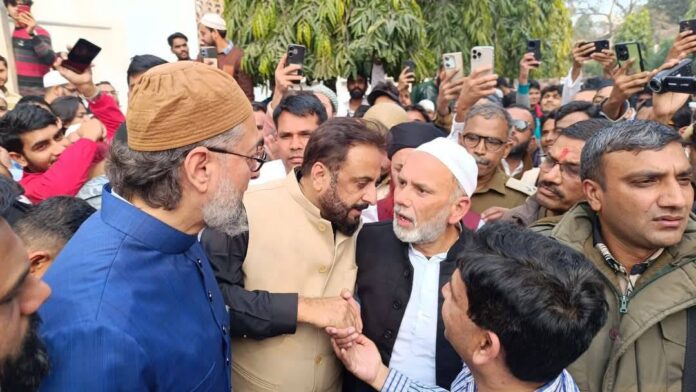
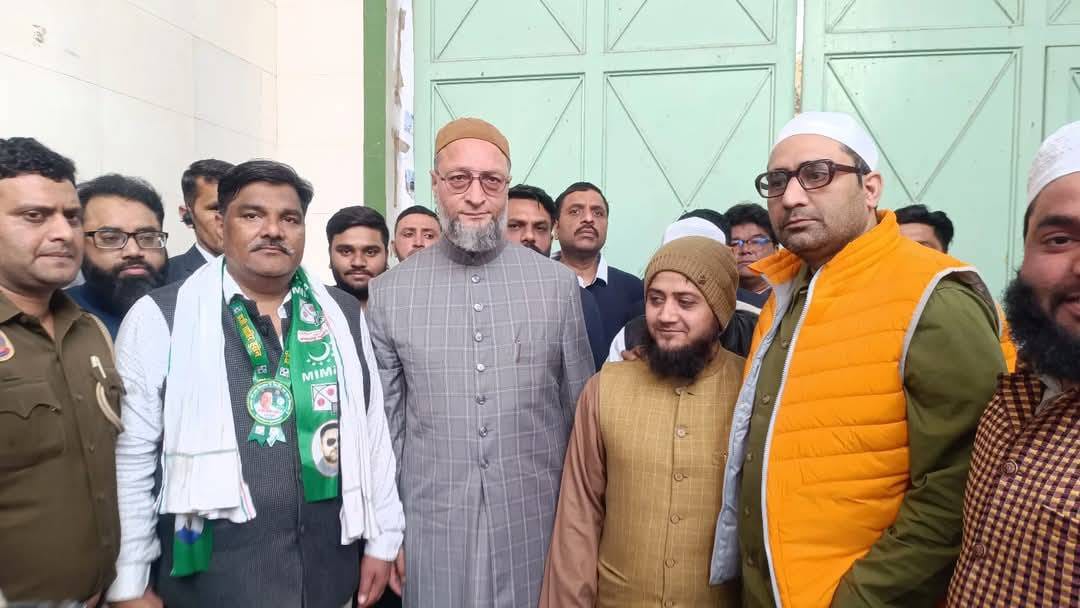
Tahir Hussain with Owaisi and others from AIMIM
Hussain expresses gratitude towards the AIMIM, saying, “I am grateful to Owaisi that he gave me a chance. He is a seasoned politician… Parties that I spent time with, I shared meals with and campaigned for, abandoned me. But an unknown person showed faith in me. He hugged me and fielded me on party symbol.”
While Hussain faces political isolation from his former allies, his personal connections with Mustafabad are deep-rooted. “I have grown up here, got married and had children in Mustafabad. I love my people and rule their hearts,” he says. Despite the challenges, he remains confident in his campaign and asserts that he is “banking on 30 years of hard work”.
Further criticising the AAP, he says, “For the last 10 years, Kejriwal has not even shown his face to us. The people will not fall for their trap this time. There is so much work to be done here.”
As posters demanding justice for Hussain adorn the walls of Mustafabad, the political landscape becomes more complex. The AAP has fielded Adil Ahmad Khan, promising a more developed and educated constituency, but criticism lingers over the party’s alleged failure to adequately address post-riot rehabilitation. Attempting a comeback with Ali Mehdi, another local leader, the Congress is challenging the AAP’s grip on the area, while the BJP’s candidate, Mohan Singh Bisht, aims to consolidate Hindu votes by focusing on “justice” for riot survivors within the Hindu community.
The AIMIM’s decision to field Rehman and Hussain, both tied to the 2020 riots, has ignited intense emotional support among Muslim voters, but it also raises concerns about vote fragmentation.
The stakes have never been higher for Okhla, Mustafabad, and the broader political landscape in Delhi. The February 5 elections will not only be a contest of power but a struggle for justice, dignity and the future direction of the city’s diverse communities.
source: http://www.twocircles.net / TwoCircles.net / Home> India News> Indian Muslims / by TwoCircles.net Staff Reporter / February 01st, 2025
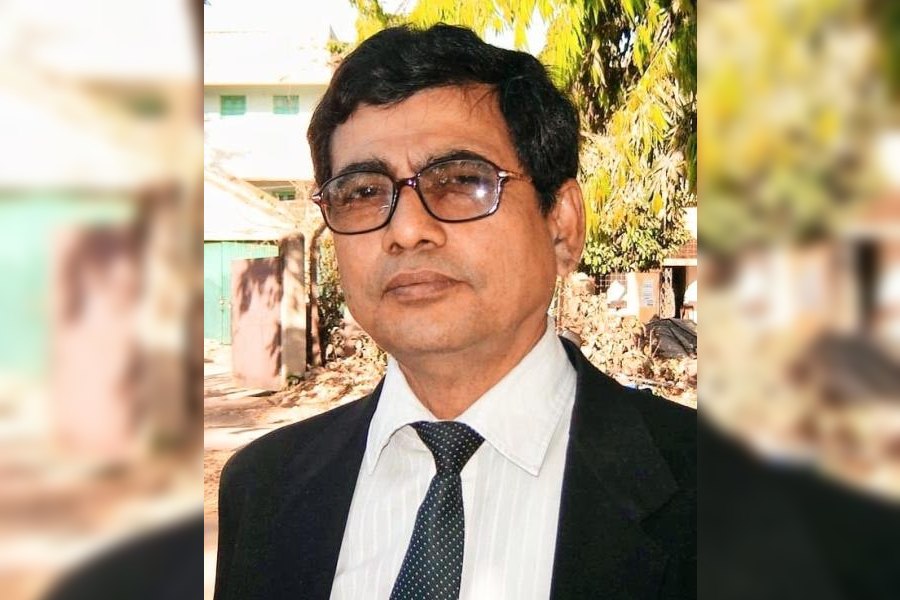
Laal suffered cardiac arrest on Saturday night and was rushed to Mira Primary Health Center in Plassey, where doctors declared him dead.
Trinamool MLA from Kaliganj in Nadia, Nasiruddin Ahmed aka Laal, passed away at 71.
He suffered a cardiac arrest on Saturday night and was rushed to Mira Primary Health Center in Plassey, where doctors declared him dead.
Nasiruddin, fondly known as ‘Laal’ in political circles, was the chairman of the Trinamool Congress’ Krishnanagar organisational district.
By profession, he was a lawyer. He is survived by a son and two daughters.
Expressing her deep condolences, chief minister Mamata Banerjee in a post on X stated: “Saddened by the sudden demise of my colleague Nasiruddin Ahmed (Laal), MLA from Kaliganj, Nadia. A veteran public worker and political representative, he was our trustworthy asset. He was a lawyer and a very good social worker, and I truly valued him. My condolences to his family, friends and followers”.
Leader of Opposition in Bengal Assembly, Suvendu Adhikari, in a similar post on X, expressed his condolences.
Adhikari wrote: “It’s disheartening to learn about the sad and untimely demise of Kaliganj MLA; Janab Nasiruddin Ahmed (Lal). I express my condolences to his family members, friends & political associates. May his soul rest in peace”.
Nasiruddin’s political journey began in 2011 when he was elected as a Trinamool Congress MLA from Kaliganj. In 2016, he lost the seat to Congress-CPM alliance candidate Sheikh Hasanuzzaman.
However, Hasanuzzaman later joined Trinamool. Nasiruddin also reclaimed the Kaliganj seat in the 2021 Assembly polls.
Nasiruddin’s unexpected death has left the Trinamool leadership in Kaliganj without a key figure.
Nakashipara Trinamool MLA Kallol Khan expressed his sorrow, saying: “It is very shocking for me. I spoke to Laal on Saturday afternoon and he seemed to be fine. I will no longer have him by my side in our political journey.”
With Nasiruddin’s demise, the Kaliganj Assembly seat has fallen vacant.
A by-election will be announced. However, given that the state Assembly elections are scheduled for next year, a new MLA will likely be elected for a brief tenure of around six months.
source: http://www.telegraphindia.com / Telegraph India / Home> West Bengal / by Subhasish Chaudhuri / February 02nd, 2025
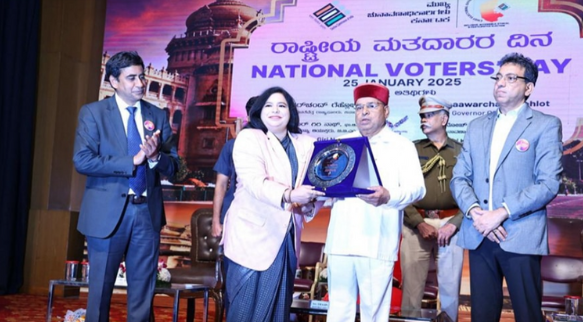
Anjum Tabassum, Tahsildar of Humnabad in Bidar district of Karnataka was presented with an award for her excellent performance as Assistant Electoral Registration Officer during Parliamentary elections 2024.
State governor Thawarchand Gehlot gave away the award to her on National Voters’ Day in Bengaluru on January 25.
This prestigious recognition is a testament to her outstanding efforts and dedication during the Lok Sabha Elections 2024. Her hard work has paid off, and this award is a well-deserved acknowledgment of her commitment to ensuring free and fair election.
Anjum Tabassum Lashkari from Gulbarga cracked the Karnataka Administrative Services (KAS) in 2014. She did her masters from Gulbarga University and had schooling earlier in Shahbad town.
source: http://www.radiancenews.com / Radiance News / Home> Pride of the Nation> Awards> Latest News / by Mohammed Atherulla Shariff / January 27th, 2025
Zillur Rahman, a professor, poet and hakim, has established a museum-cum-library in Aligarh to preserve books and artefacts that tell the story of Delhi of yore.
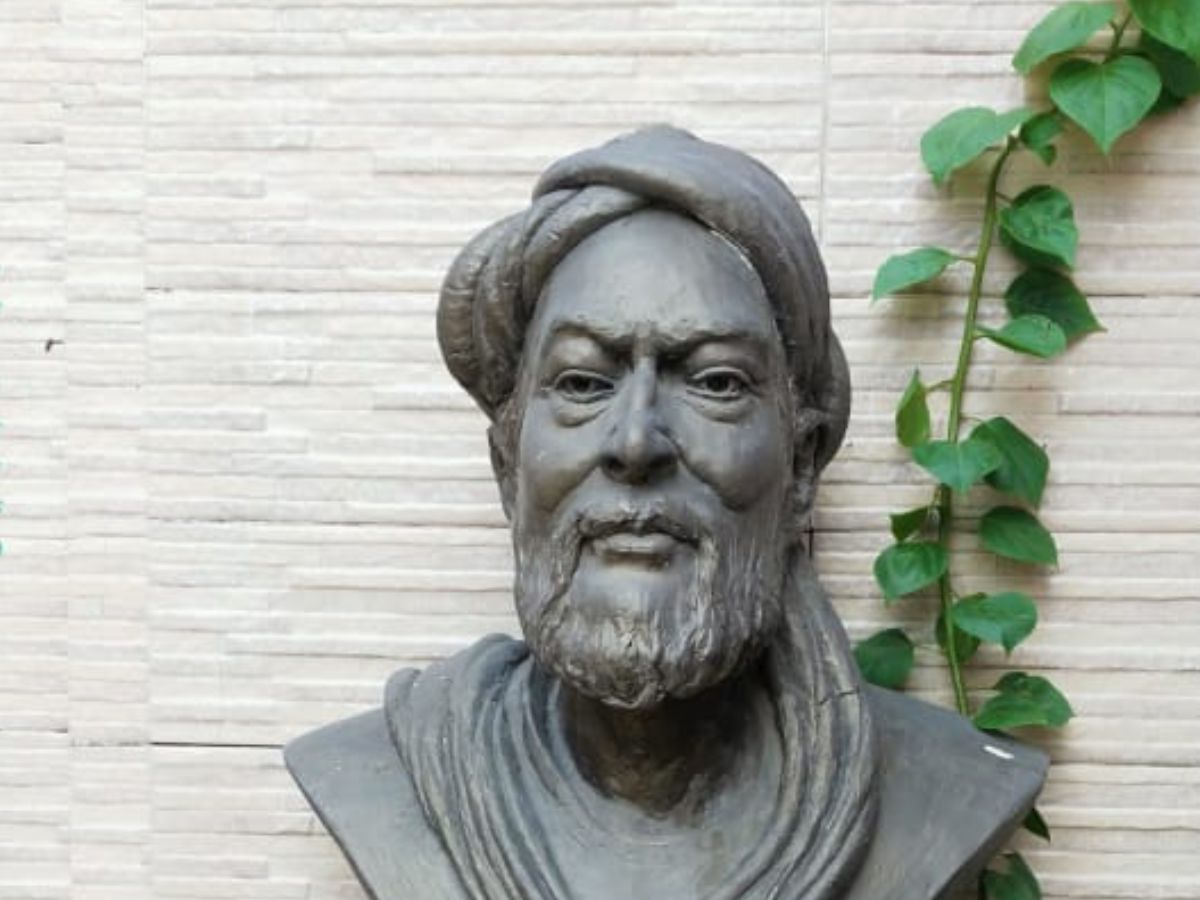
PIONEER: A bust of Ibn Sina, a physician and philosopher, who lived over a thousand years ago, at the Ibn Sina Academy in Aligarh
Nestled in the heart of the city of Aligarh, Uttar Pradesh, is Ibn Sina Academy of Medieval Medicine and Sciences, named after famous scholar of philosophy and medicine Abu Ali Ibn Sina (980 -1037), who lived over a thousand years ago.
Located at Tijara House, the non-profit, non-government and non-political academy was established in the year 2000 by Professor Syed Hakim Zillur Rahman, an academic and a litterateur from Aligarh.
A one of its kind museum and library, it was aimed at encouraging and promoting researches and studies in medieval sciences, especially Ibn-Sina’s, as well as arts, culture, poetry among other subjects.
Notably, Ministry of Ayush, Government of India gave accreditation to the academy in 2004 and promoted it as a Centre of Excellence in 2008. The professor had a mammoth personal library that he had established in 1960s. After Ibn Sina Academy was born, the library became a part of it.
The specialty of this museum lies in its varied collection that includes sofas, crockery, jewels, armours, stamps, mirrors, outfits of princesses, queens and kings as well as turbans worn during battles by historical legends.
The Zillur Rahman Library houses 32,000 rare books and magazines, 1,100 manuscripts apart from paintings, sketches, citations, artefacts and much more.
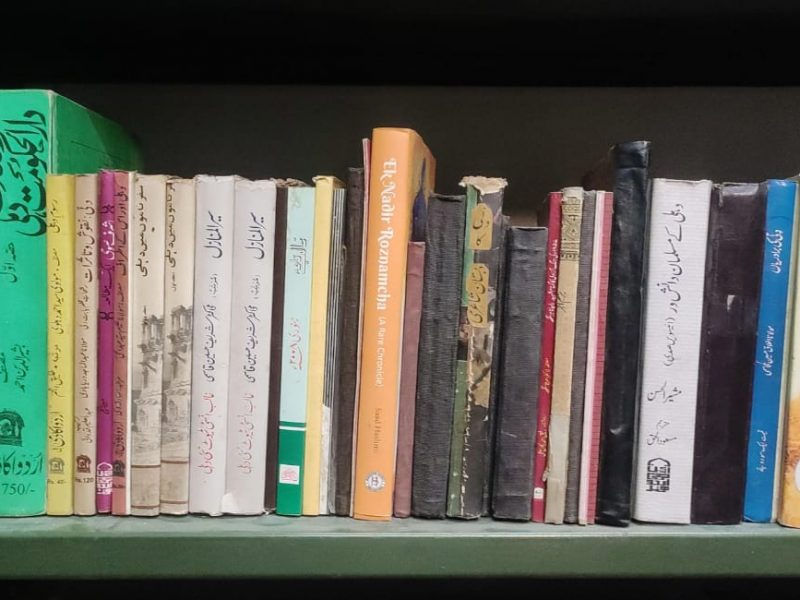
RARE: A collection of books on Delhi
The Delhi connection
There are 7,500 books on Delhi of yore in the library, including on poet Iqbal, dictionaries as old as 150 years, authentic diwaan on Ameer Khusrau, books dating back to 1893, on and by the last Mughal emperor Bahadur Shah Zafar, British Raj–Victorian Era with pictures in lithographs and more.
But considering Delhi is dry without the ‘zikr’ (mention) of the poetic legacy of Asadullah Khan ‘Ghalib’, the library has dedicated a special space for the poet: “Ghalib Study Centre”.
A galaxy in itself, this part has 1,350 rare books in Urdu, Persian, English and Hindi on Ghalib apart from several special issues in different magazines (called risala in Urdu) which are now available only in this museum.
For instance, an important old publication called Sooraj (meaning sun) had special Ghalib edition.
One of the books has illustrations of most of the ghazals he had penned, while in his own Deewan (collection of his authentic shayri) there, Ghalib’s original ghazals had no pictures or illustrations.
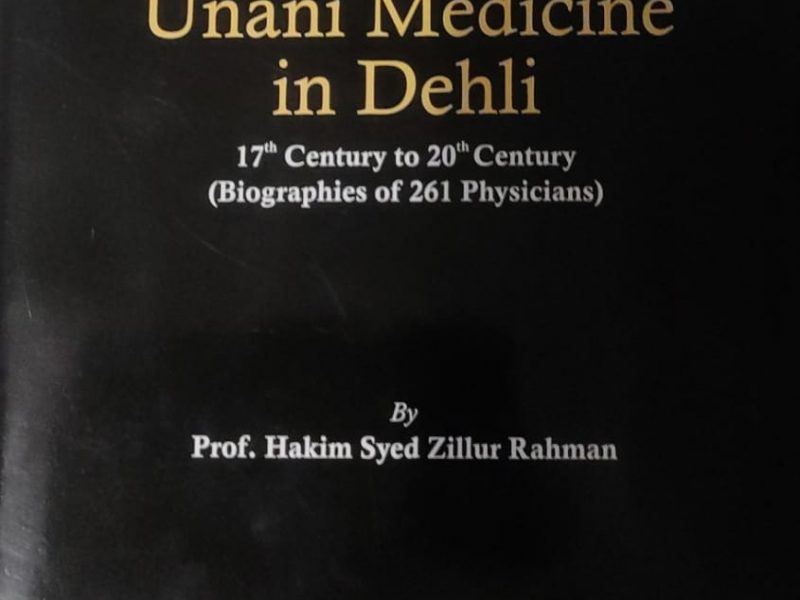
MASTERPIECE: The translation of the book written by Hakim Zillur Rahman
One of the most important collections here is a book by renowned author Shakeel ur Rahman called Mirza Ghalib aur Mughaliyaat, which has illustrations from Muraqqa-i-Chughtai, an illustrated selection of Ghalib’s work by AR Chughtai, a renowned artist of early last century. The illustrations are based on an important topic or issue that the poet raised in his couplet (sher).
Rare books with names like Jihad-e-Ghalib, Ghalib Satrung, Soz-e-Ghalib, his letters in Persian and many more ornate the archive.
Additionally, a book called Naqsh-e-Rung from Pakistan which was brought to India by scholar Urdu litterateur and poet professor (late) Shamsur Rehman Farooqui enriches the book shelves.
Tehqeeq-nama Ghalib, Ghalib’s ghazal in Persian called Ghazaliayat-e-Farsi, Ghalib, few rare and special issues of magazines like Shama, Nuqoosh, Hunoon, Taar-e-Nau, film magazines, Al-Ilm, Shayar, Kaarvaan with special edition on Ghalib are the other charms.
A rare pocket-sized edition on Ghalib is a popular one.
Travels to Delhi
Another section on Delhi consists of travels and trips done in Delhi by the authors, travellers and poets of old times. Rare books like Safarnama Dehli and Sair-ul-Manazir provide an inside view of Delhi in the 18th century.
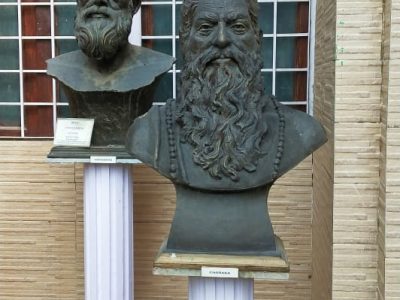
LEGEND: Bust of a renowned Indian physician Charaka at the academy in a section dedicated to physicians and medicinal plants
Also, over 200 rare books on Delhi’s poets (shayars) in Urdu and important personalities form another gallery here. For instance, there is Aslam Parvez’s award-winning book on Bahadur Shah Zafar, and his another one called Meri Dilli. There is also a book on Hamare Zamane Ki Dehli, Charagh-e-Dilli, Dilli Wale by famous author Salauddin, Aalam mein intekhab-e-Delhi among others.
Rare and significant books on personalities include those on Hakim Ajmal Khan, Sir Ross Masood, former India President Zakir Hussain, Sir Syed Ahmad Khan, Raja Mahendra Pratap and many more.
An entire unit is also devoted to all the journals that came out of Delhi during the War for Independence “and those from late 17th century to beginning of 19th century. The Delhi College was established in 1824, with it, all these journals rose to a great height. These form an enticing collection in the museum,” apprises Aftab Najmi, the coordinator and convener at Ibn Sina Academy.
On enquiring why such a large collection in Urdu finds space here, Professor Rahman adds, “Our own language and culture is much better described only in Urdu and Persian. So, it was very important to have a different section on Urdu to give a peep into what Delhi was in olden times.”
However, countless notable oldest books in English and Hindi on Delhi also enrich the collection on the Capital.
A legacy himself
Professor Zillur Rahman has 56 books to his credit. The subjects are related to Tib (Unani medicine) and Urdu literature. His books on medical sciences with oldest references (100 to 200 years old) are immensely popular. He is also a poet and an ardent admirer of Urdu poets of yore. He has also edited Diwan-e-Ghalib and many books on Urdu shayri. So far, 11 books have been written on him by students from different parts of India and globe in Arabic, Urdu and English. There are two academies, in Meerut and Bhopal, named in his honour. A part of the library has books on Zillur Rahman’s own family and their contribution to academics, medicine, poetry and culture.
For the next generation
On why he decided to make such a rare museum and library under one roof, Rahman says, “I was just a teacher at AMU. I had no money like businessmen to construct roads and hospitals so I decided to build this museum and library to help those who want to study but have neither books nor a place for the same. I want the current generation to know that books on all our glorious histories and personalities were penned in Urdu before 1947.
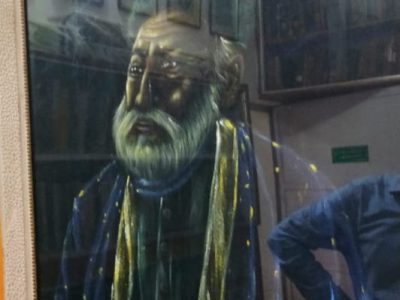
ICONIC: A portrait of Mirza Ghalib at the library, which boasts of rare works on the Delhi-based poet
“So, our generation has to know Urdu to understand their buzurgs (elders) and what charismatic works they had done. Our current generation, which doesn’t know Urdu, is like a blackboard. Anyone can write anything on it and it doesn’t impact them because they are so ignorant of legacies of their own language.”
Professor Rahman has travelled abroad 44 times. He visited Greece, including its capital Athens, Samarkand and Bukhara in Uzbekistan, Spain, Turkey, Germany and other countries.
“I went to Iran 11 times to gather books and study how it has preserved its arts and culture, literature, medicine and environment,” he says adding that children of every country know their mother tongue and can read and write in it.
“India’s children, especially the new Muslim community, is ignorant of its own legacy in Urdu.”
The Ibn Sina Academy has a tremendous collection of Islamic sciences and Islamic medicines. The professor has procured them from across the globe.
“Some are bought, some gifted and some requested and begged for. Hamaare 3,200 hazaar kitaabon mein, Ghalib ka collection jo hamaare paas hai vo duniya mein kisi ke paas nahi hai (No one in the world has the rare collection on Ghalib that we have among our 32,000 books). Even Delhi’s own Ghalib Institute and Ghalib Academy visit us and take photocopies of the rare material they require. We have made our academy work on Delhi’s poets, littérateurs, historical buildings and monuments,” he adds.
Most books, he adds, are from Iran, Samarkand and Bukhara.
“The richest in education, philosophy, medicine and culture is Uzbekistan but it could not present it to the world, the way Iran did.”
Why Delhi in Aligarh?
Why Delhi forms a special section at his library, has its reasons.
“Delhi was always the capital of India, be it during the Mughal, British eras or post-Independence period. So, it has always been not only a melting pot of cultures but also an abode for the best of poets, authors and travellers. The number of academics, authors, sufis, litterateurs, shayars (poets), lovers of arts and music and academic institutions that Delhi had, no other capital in the world has it till date,” he reasons with pride.
To know Delhi better, he suggests books penned by the renowned Dehlvi family.
For instance, there is Dilli jo aik shahar thaa by Shahid Ahmad Dehlvi, who was born in Delhi in 1902.
He wrote extensively on vanishing culture of Delhi which was a symbol of Indo-Muslim culture ruined by violence and blood of the War of Independence. Post Independence, he went to Pakistan and died in 1967.
Waqyaat-e-Darool Hukoomat in three volumes by Bashiruddin Ahmad Dehlvi published from Urdu Academy, Delhi in 1990, and books on 1857 revolution are also there in the academy.
Delhi just got richer by another book by Zillur Rahman — Dilli aur Tibbi Unani which has just come out in Urdu. It is translated in English by Toronto-based Zakaria Virk, titled ‘History of Unani Medicine in Delhi – 17th Century to 20th Century – Biographies of 261 physicians’.
source: http://www.thepatriot.in / The Patriot / Home> Delhi NCR / by Rana Siddiqui Zaman, Delhi NCR / November 15th, 2023