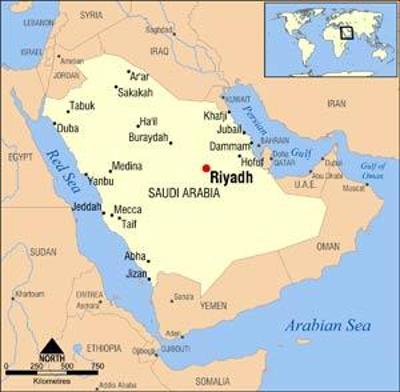
The Union government is leaving no stone unturned to ensure the safe return of Indian expatriates in Saudi Arabia, said Mohammed Irfan Ahmed, member of Central Haj Committee of India..
Irfan said as many 8,000 labourers are stranded in Saudi Arabia. Majority of them are from Kerala and Karnataka. “We are working on their return as well demanding that they are paid their dues,” he said.
source: http://www.timesofindia.indiatimes.com / The Times of India / News Home> City> Mangalore / TNN / August 09th, 2016
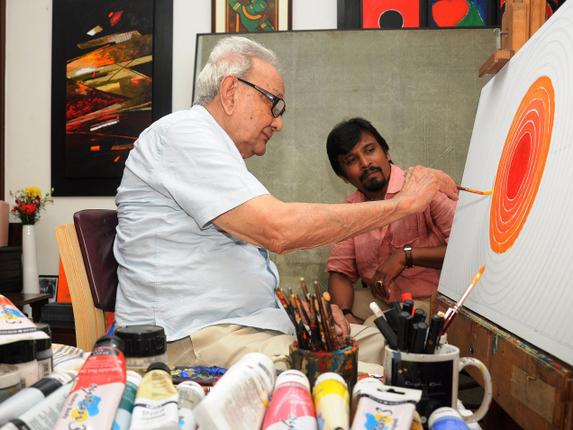
In this September 12, 2013 photo, S.H. Raza works on a “bindu” as his disciple Manish Pushkale looks on at the former’s studio in New Delhi. / The Hindu
“Bindu is a source of energy, source of life. Life begins here, attains infinity here”.
A few years ago, aged 89, S.H. Raza was game to talk to children almost like one, maybe just a couple of years older. Then, at the Jaipur Literature Festival he allowed the youngsters, who had surrounded him, a little peek into his life. Back in India after spending 60 years in France, his life seemed to have come a full circle. Not ready to confer retrospective dignity to his early years, Raza candidly admitted: “I was not fond of school. I was a bad student scoring low marks. Arithmetic did not interest me. My interest lay in drawing and painting. Fortunately, I found the right gurus. It is imperative parents as well as teachers understand a child’s qualities.” Raza himself was lucky. A restless soul that he was, his primary schoolteacher once asked him to continuously look at a dot on the wall inside the classroom to calm his mind. It was a little exercise that was to change the meaning of life for Raza, who turned the simplebindu into a work of art before raising it to the status of life itself.
Incidentally, Raza often judged as a France-based artist, grew up in a Madhya Pradesh village and went on to study at the Sir JJ School of Art. Around the time that the nation was hoisting the tricolour for the first time as an independent country in 1947, he founded the Bombay Progressive Artists’ Group. The group challenged the existing art establishment and Raza’s image as a rebel was probably etched with it.
His long journey in the world of arts started thus. Raza started as a landscape painter, a colourist. Soon the bindu occupied his mind and he turned to metaphysical ideas. This relentless search for the infinite got him plenty of laurels and lots of money. Though he refused to quantify art in terms of money, none could deny the steep price tags that accompanied many of his works. For instance, Saurashtra went for Rs. 15.9 crore. His La Terre attracted a whopping Rs. 18.8 crores.
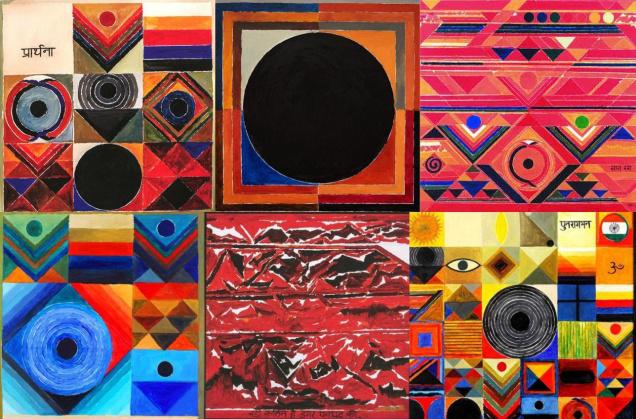
(A combination of S.H. Raza’s works. “Bindu is a source of energy, source of life. Life begins here, attains infinity here,” he had said)
After linking all the dots in the universe of art, Raza, aged 94, passed away quietly in an intensive care unit of a hospital in New Delhi.
There was not a note that was not dignified, not a colour in the palette that was left unexplored. Often short of breath, hard of hearing with fading vision, Raza with his frail frame looked very much his age to a layman. To a lover of art, he remained a genius, transcending the inevitable frailties of age with determination. Where his eyes failed him, his fingers did not. He continued to whip up magic till the end. Even when the man who was a master at giving a new meaning to colours needed the help of an assistant to mix his colours, his magic did not elude him. Fittingly, one of his last exhibitions was titledNirantar (Relentless). With that single term he lived up to the words of noted Hindi author Ashok Vajpeyi who often said that Raza did not paint to live, he lived to paint. The exhibition itself contained some of the works he had done after coming back to India, between 2011 and 2016.
If in that interaction with youngsters in Jaipur, Raza stated that “Bindu is a source of energy, source of life. Life begins here, attains infinity here”, a few years later in New Delhi he showed other shades to his personality as he talked gently, if, one may say so, almost relentlessly, of Modernism. Yet he did not fail to talk of specifics, happy once again to talk of the bindu, how it provides focus in life, indeed, life itself. Happy he was to talk of early red, the later blues and yellows. And equally at ease talking of the marriage of art and artist, how initially man creates art, how then art forms him. Little wonder, the distinction between Raza and his art gradually disappeared over the years. His art could never conceal the artist, in the final years, it spoke on behalf of the artist. Little wonder, fellow artist Krishen Khanna once said that his friend lived his art! And Raza found profound meaning into something as innocuous as juxtaposing two colours. According to him, the two colours could be in conciliation and harmony or conflict and unending struggle, almost like a man-woman relationship. Raza brought to his canvas the quintessential Indian spirituality and tradition by concentrating his energies on colours, purush-prakriti and nari in his trademark geometric abstract works. And to think, he introduced the French to our artworld and set up studios there!
A contemporary of M.F. Husain, F.N. Souza, Khanna and Tyeb Mehta, Raza carved out his own niche on his own terms. He played with colours like none else and was wise enough to understand that art lovers abroad loved Indian art not jut for its spirituality but its constant soaking in of colours. Of course, like the longest of journeys begins with a single step, for Raza any art too began with a dot. An art work was never the sum of its parts, rather each part, each stage was art itself. Slowly, this centreing of the universe around the dot consumed the mind, and life, itself of Raza. What it gave him in return was priceless art that seeks to confer immortality on the artist.
As he celebrated the bindu in conversations, he occasionally recalled the primary school teacher too. As the Padma Vibhushan awardee fought one last battle one cannot help recall Ashok Vajpeyi’s words that Raza lived to paint. And when he could no longer paint, life lost its meaning… Life indeed had come a full circle. Yes, the bindu is the most important thing of all.
source: http://www.thehindu.com / The Hindu / Home> Features> Friday Review> Art / by Ziya Us Salam / July 23rd, 2016
Geetakshi Arora, a PG student of the South Asia Institute at the School of Oriental and African Studies, University of London, won the £1,000 prize.
An Indian student is the winner of the first Noor Inayat Khan Prize for 2016, the London-based Noor Inayat Khan Memorial Trust announced on Saturday.
Geetakshi Arora, a post-graduate student of the South Asia Institute at the School of Oriental and African Studies (SOAS), University of London, won the prize — which consists of £1,000 and a certificate — for her dissertation on “Goddess Myths in Graphic Novels: Reimagining Indian Feminity”.
The Trust awards the annual prize to a post-graduate student from SOAS, University of London, working in the area of gender studies and South Asian history.
Ms. Arora said that she was “humbled” by the award. “Noor has always inspired me to stand up for the values of peace, education and respect for all individuals irrespective of race, gender and religion. I will always try to live up to her legacy,” she told The Hindu.
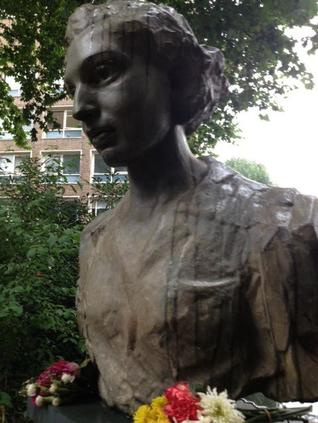
Noor’s bust in Gordon Square, London. / The Hindu
Of Indian descent, Noor Inayat was a secret agent in the Second World War, who was sent to Nazi-occupied Paris in 1943 from where she worked as a wireless operative sending intelligence reports to the Allies. Though betrayed to the Gestapo, tortured and ultimately killed at the Dachau concentration camp, she defied her captors to the very end.
“We hope the annual award keeps the memory of Noor Inayat Khan alive in the student community. We felt that SOAS was the natural choice to locate this prize given its long tradition of promoting South Asian culture and history” said Shrabani Basu, founder and chair of the Noor Inayat Khan Memorial Trust, and author of the biography of Noor Inayat, The Spy Princess.
A campaign by the Noor Trust resulted in the unveiling by Princess Anne in 2012 of a bust of Noor Inayat in Gordon Square, a tranquil lung space close to a cluster of institutions including SOAS.
source: http://www.thehindu.com / The Hindu / Home> International / by Parvathi Menon / London – March 19th, 2016
Syed Ali Rizvi waves to voters entering the Bowman Elementary School voting location. Wicked Local Staff Photo/Jordan Frias
By Jordan Frias
jfrias@wickedlocal.com
Rizvi, originally from Lucknow, India, missed the February deadline for nomination papers, but learned about the write-in candidate process.
LEXINGTON
Syed Ali Rizvi stood outside of Bowman Elementary School March 2 to gain support for his write-in campaign to become a Town Meeting member for Precinct 2.
Rizvi, originally from Lucknow, India, missed the February deadline for nomination papers, but learned about the write-in candidate process.
“Someone mentioned to me that you can be a write-in candidate. I didn’t know that,” he said. “The best investment I can make to the town is serving it.”
Rizvi was elected with 33 votes, according to unofficial results from the town clerk’s office, as was Jason Bressner, who received 14 write-in votes. Five other candidates in Precinct 2, who were on the ballot, each received two votes.
Precinct 2 was one of two that didn’t have enough people running for Town Meeting. Three write-in candidates were elected to Town Meeting this year.
Rizvi has been involved in school functions since he moved to Lexington 10 years ago.
“We have benefited tremendously from the town and all of what it offers,” he said. “Bowman parents have known me for many years.”
Rizvi had a lawn sign created for parents driving by or to Bowman Elementary School to see, which he held up on Election Day for people like Peter Kovner who might not have known about him.
Kovner only voted for the five Town Meeting candidates on the ballot because he knew of no write-in candidates. Rizvi had held up his sign in the morning and Kovner voted that evening.
“If somebody had let me know that they were running I would have put them down. If they had a sign, they would have my vote, not that they would need it,” Kovner said.
Kovner said low voter turnout was concerning, but he wasn’t at all bothered with the fact that these races weren’t contested. The March 3 election had a 16 percent turnout, according to the town clerk’s office.
“If there were more contentious issues in town people would run. I don’t think people are being smug, I think they’re pretty happy with what’s been happening,” he said.
Long-term membership
One of the longest-serving members, Dan Fenn II, has been in Town Meeting for 52 years. Having experience working in Washington, D.C., Fenn calls Town Meeting “a microcosm of the democratic process.”
“You see the same kind of personalities, the same kind of human behaviors in Congress in Washington,” he said. “It’s important to participate in public affairs of the community in which you live.”
source: http://www.lexington.wickedlocal.com / Home> News Now> Article / by Jordan Frias / Lexington, March 06th, 2015
East African Asian society was complex and contradictory as any truly multicultural society needs to be, and perhaps as only Indians can make it
Toronto, CANADA :
It is amusing to contemplate that if an Indian man, one afternoon in March 1498, had been able to swim, he would have escaped capture by Vasco da Gama off the Mozambique coast, and the world might have been different. The Indian, whose companions had managed to swim away, was called “Davane” by his captors; he was from the Gujarati city of Khambat (Cambay). Davane gave advice to da Gama on local matters and even assisted him in outwitting the local sultan, so that the Portuguese ships eventually anchored safely in Malindi, up north in present-day Kenya. Here he took a pilot, who was possibly a Gujarati, and reached the Malabar coast.
Portuguese sailors plying the Indian Ocean thereafter often wrote about the presence of Indians and Indian ships in Kilwa, Mombasa, and Malindi. Around 1500, Captain Duarte Barbosa observed, “These ships of Cambay are so many and so large, and with so much merchandise, that it is terrible to think of so great an expenditure of cotton stuffs as they bring.” The trading connection between India and East Africa is actually even older, as the carving of a giraffe on a wall of the Konark sun temple indicates.
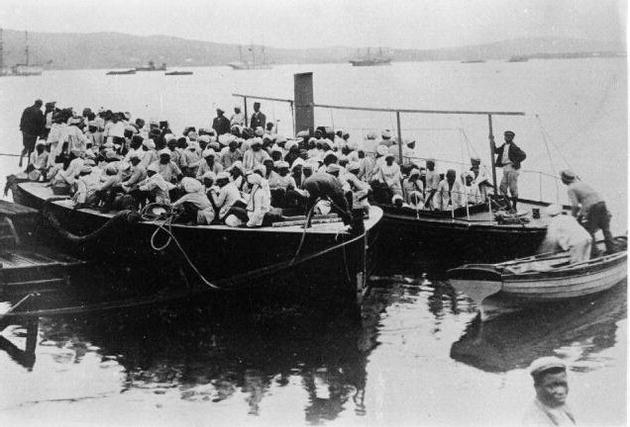
The arrival of Indians in South Africa by boat. / The Hindu Archives
It was in the nineteenth century, however, that Indians began arriving in numbers to trade and settle in Zanzibar, which was by then a major metropolis in the Indian Ocean with international connections, and home to the ruling Omani sultans. The more enterprising men ventured off to the small towns dotting the mainland coast. Most Indians arrived penniless from their drought-prone villages in Kathiawad and Kutch, and remained modest traders, but a few of them went on to become veritable merchant princes with spectacular wealth. Among them were Jairam Sewji, Ladha Damji, and Tharia Topan, to whose firms the sultans farmed out their customs collection and to whom they were often in debt.
Generation of tycoons
With the advent of British and German colonialism in the early twentieth century, Zanzibar’s commercial power and political influence waned, while the interior of East Africa opened up with new infrastructure and increasing trade. As a result, the Indians spread out all over the mainland, which now consisted of the three colonies of Kenya, Uganda, and Tanganyika. (In 1964 Tanganyika and Zanzibar joined to form Tanzania. The Indians went on to be called “Asians”.) The new generation of tycoons included Sewa HajiParoo, whose caravans went from Bagamoyo (near Dar es Salaam) all the way north to the Kilimanjaro region. His apprentice, Allidina Visram, topped him to become “the uncrowned king of Mombasa,” supplying the dukas (shops) that had sprung up from Mombasa to Uganda, and further in eastern Congo and southern Sudan. In 1890 A.M. Jeevanjee, a Bohra from Karachi, arrived in Mombasa and made his fortune supplying goods (and workers) to the Uganda Railway. Much of early wood-and-iron Nairobi was constructed by his firm; the city’s Jeevanjee Gardens was his donation.
By the mid-twentieth century every small town in East Africa had the characteristic Indian strip of shops, and in even the smallest village you would find an Indian family branch running the solitary Indian shop. The Asian population totalled 366,000, with the highest number, 176,000, in Kenya with its total population of around 9 million. Unlike elsewhere, Indians had settled in East Africa as communities; there were Bhatias and Khojas, Jains, Shahs, Patels, Lohanas, Sikhs, Bohras, Memons, Kumbhads, and others. In the cities, the larger communities like the Khojas had their own primary and secondary schools for girls and boys, hospitals, dispensaries, and community halls. Dar es Salaam, with roughly 100,000 people at the end of the 1950s, had at least five Asian cricket teams. Abject poverty was rare, and even the most straitened household could afford three simple meals a day. For us growing up in East Africa, it was India that was poor and backward, as revealed to us in the newsreels and Indian films of the period.
Complex and multicultural
East African Asian society was complex and contradictory as any truly multicultural society needs to be (and perhaps as only Indians can make it). Asians tended to live close to their own communities; caste discrimination persisted, as did Muslims sectarian differences. Yet by the standards we see today in the world, East Africans were largely tolerant. It was understood that you did your thing. The azaan would go off in the mosques, the Khoja ginans would blare out over loudspeakers from their jamat khanas, a temple procession would block a road, the Diwali fatakdas would explode in the Hindu sections (and elsewhere). There was hardly any inter-communal violence, and nothing to compare remotely with the communal and caste slaughter that seems so routine in India.
Undoubtedly the Asians were racist — looking up to the “Europeans” and down on the Africans, by whom, as middlemen, they were often resented. Intermarriage between communities and races was a taboo that was just beginning to yield as I emerged from my teen years. Because the poorest people were among the Africans, it has been broadly claimed and often in Shylockian language that Asians were their exploiters. Asian liberals like to wallow in self-guilt. I have often retorted that my widowed mother worked from eight in the morning to ten at night, running her small shop, barely making ends meet while raising five children; whom did she exploit? Today many Tanzanian African women run small businesses similar to my mother’s. We often forget the wealthy and sophisticated African peoples who owned land and cattle; and while many Africans had homes in their villages, most Asians in Africa did not. If Asians did not marry Africans, the Africans, with ancient traditions of their own, had their own taboos; to imply that they panted to lay hands on Asian women is itself racist.
At the end of the 1960s
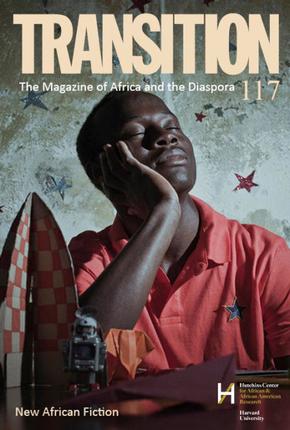
Be that as it may, around East Africa’s independence, in the early 1960s, there was a thriving community of Asians who saw themselves as Africans. In Tanzania most would speak two Indian languages plus Swahili and English. Among the elite there was excited talk of the “new African Asian” identity. There were Asian politicians and budding writers — Wole Soyinka’s Poems of Black Africa (1975) includes, significantly, three young Asian poets from Kenya; Africa’s most influential and exciting literary magazine of the 1960s, Transition, was founded and edited by Rajat Neogy of Kampala; and Amir Jamal, Tanzania’s beloved minister of finance for many years, was elected in African constituencies. At the end of the 1960s, there was no doubt in my generation that Africa was our home and we were in the vanguard.
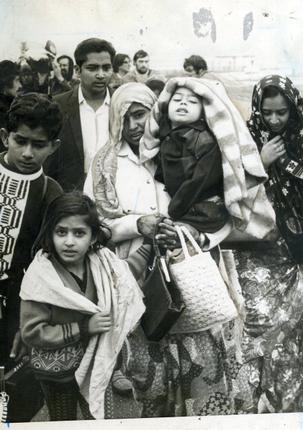
The first set of Ugandan refugees to arrive at Stansted Airport near London after then Ugandan President Idi Amin ordered them on September 18, 1972 to leave the country. / The Hindu Archives
And yet in the 1970s it all fell apart. Kenya’s Asians who had not renounced their British citizenships in time had to leave en masse. In Uganda, Idi Amin had a dream and expelled all the Asians in another “Asian exodus”. In Tanzania, in spite of Nyerere’s enlightened policies, his socialism, combined with the Idi Amin scare, drove out many Asians. What remains of the Asians today is a somewhat insecure and aggrieved population, though most appear dedicated to where they live. Racism of the old sort is gone; intermarriages do happen. At crowded kabab and bhajia restaurants in Dar es Salaam, it is truly pleasing to see Indians and Africans squeezed together at the tables. Indian cuisine has made a big headway especially in Tanzania; country bus stops often have a stand making chapatis; “pilau,” “biriyani” and “sambusa” are Swahili words. What thwarts complete integration is the Asians’ distinct features and cultures, often reinforced by their religious traditions.
A new crop of young Indians has started to arrive. When I see them, they seem foreign and lost. At times I get xenophobic — what are they doing here? do they even speak the language? — when I myself am now Canadian, but also an African Asian.
(M.G. Vassanji is the author of A Place Within: Rediscovering India, and most recently, of And Home Was Kariakoo: A Memoir of East Africa. He lives in Toronto. www.mgvassanji.com)
source: http://www.thehindu.com / The Hindu / Home> Opinion / by M. G. Vassanji / December 27th, 2015
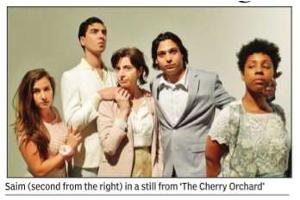
He wanted to join the media industry but landed up in Hollywood. Meet 29-year old Saim Hyder who is doing theatre and also acting in short films in the United States of America. He has recently completed playing the leading role in the classic Anton Chekov play `The Cherry Orchard’ for Falcon Productions, a wellknown theater group in New York City .
Hyder’s talent landed him meaty roles in the plays ‘Bonafide Women’ directed by Stephanie Ogeleza. He played the lead in short film `Larry Bought Lemon’, screened at the prestigious Indian Film Festival of Tampa, Florida in 2013) and another film, `Patrons’, directed by Polish director Rita Haider was screened at the International Palm Springs Film Festival last year.
Hyder’s performance received favorable criticism in US media. Broadway World, authority on all Broadway shows called his performance in the part-comedy-part-drama `The Rajah’s son & Princess Labam’ “dramatic and riveting”, while NRI Tribune, one of the largest Indian-American newspaper described his role in the same play as “one of the most loved performances”.
In Lucknow, Hyder went to La Martiniere College where his acting talent was nurtured under his teachers. In school, I acted in school plays and inter school competitions where I stood out and was praised,” said Saim. It was only when he moved to US in 2008 to pursue Mass Communication from the University of Arkansas, he realised performing on stage could mean more than journalism. ” was so passionate about the film industry that at UOA, took up research on the influence of Indian cinema he roes on the youth,” said Hyder, who later trained at the renowned New York Film Academy and Maggie Flanigan Acting Studio in New York City.
While at NY Film Academy, he was trained in the basics of film genre. It was a MF studio where he received intensive training under the best in the industry in the exclusive `Meisner Technique of acting which legendary actors such as Marlon Bran do, Robert Duvall and Tom Cruise learnt as students Meisner technique is an approach to acting which develops from an interna source such as emotional re call, memory, etc. Back home, Hyder is famous for entertaining family and friends, acting out famous dialogues of Indian and Hollywood actors. “In all our family get-togethers, he is made to enact scenes from his plays or films, his favourite, which he repeats most of the time, being from The Cherry Orchard, saying the lines, `I have done it, I have done it all. The Cherry Orchard is mine…’, to an applause from all of us,” said Aaqil, Hyder’s cousin, who is more a friend.
Hyder hasn’t restricted himself to theatre, he has also dabbled with radio. “I have anchored more than 100 minutes of live shows, called Bindaas Bol on Jus Radio, an online channel popular with the Indian American diaspora,” he said.
His upcoming work includes a Hindi sitcom for a South Asian TV channel which is even being produced by him. “With his focus and talent, we are hopeful that Saim will make a mark in the highly competitive entertainment industry in Hollywood. The talent of this Lucknow boy will shine around the world,” said his father Nafees Haider Naqvi.
source: http://www.timesofindia.indiatimes.com / The Times of India / News Home> City> Lucknow / by Isha Jain, TNN / December 07th, 2015
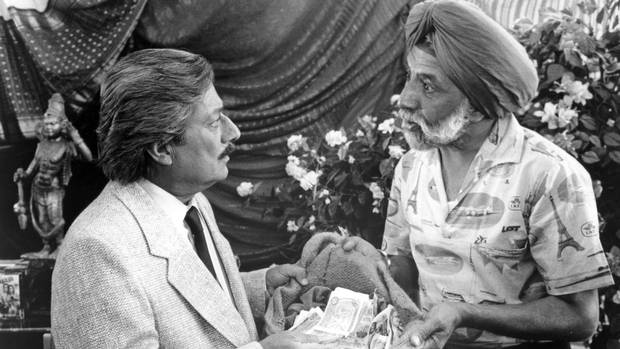
In a career spanning more than half a century, Saeed Jaffrey had made almost 200 screen appearances, working with directors including John Huston, James Ivory, David Lean, Richard Attenborough and Stephen Frears. But, his performance as Mir Roshan Ali in Satyajit Ray’s ‘Shatranj Ke Khiladi’ remains the high point of his career. When news of the demise of the 86-year-old actor reached the Ray family, it brought back many memories of him working at Kolkata’s Indrapuri studio.
In the film, set in 1856, Jaffrey had played the role of one of the two Indian noblemen in Lucknow who was obsessed with the game of chess. “Back then, I was assisting my father. I remember having spent some wonderful time with him on the sets. Always full of life, he came across as a sparkling personality. He was a colourful man and always jovial,” recalled filmmaker Sandip Ray, who remembered shooting with Jaffery both in Kolkata as well as in a village near Lucknow for the climax of the film.
Jaffrey was the first actor to have come on board for the film. “Baba had cast him even before he had cast Amjad (Khan), Sanjeev (Kumar) and Richard Attenborough. Prior to that, we had all heard of Saeed’s name. Sometimes, Baba and he would meet up casually. They would bump into each other at airports. Whenever they met, Saeed would say: ‘Manik-da, I am waiting for your call’,” Ray said.
When that call finally came from Ray, while he was planning ‘Shatranj…’, Jaffrey was “literally on the seventh heaven”. “I don’t remember whether Baba had made a telephone call or sent him a letter. All I can recall is that he was elated. Later, when he came down, we all sat and read the short story by Munshi Premchand on which the film was based,” he said.
While many have said that the character of Mir Roshan Ali was naive and absurd, others have described it as complex and elusive. “I don’t think it was a simple character. Saeed gave his best. He was practically a one-take artist,” Ray said.
Not just his own acting, Jaffrey apparently helped Sanjeev Kumar, too, on the sets. “It was a story of two friends and Saaed used to help out Sanjeev in some of the scenes. When he was on the sets, he would make sure that the environment was lively,” Ray recalled.
Mimicry, according to Ray, was his passion. “But, when it came to acting, he was totally focused. He brought certain nuances to the character, especially the nawabi style, that added so much to the film. Casting him ensured that a director was safe,” Ray said.
Once the shooting was over and the film was to release in the US, Jaffrey had accompanied Ray on the trip as well.
On Sunday, Jaffrey’s niece broke the news of his death on Facebook. When this news reached Sandip Ray, he said, “We lost an actor who was an insurance for any director.”
source: http://www.timesofindia.indiatimes.com / The Times of India / News Home> City> Kolkata / by Priyanka Dasgupta, TNN / November 17th, 2015
Saeed Jaffrey, one of the best-known faces of British-Indian cinema and television, has died at the age of 86.
The Indian-born British actor appeared in the Oscar-winning Gandhi and films such as My Beautiful Laundrette, as well as many Bollywood films and British television productions, including Coronation Street.
Among his screen credits in a career spanning more than 50 years were roles in director John Huston’s The Man Who Would Be King and Indian director Satyajit Ray’s The Chess Players, as well as the BBC television series and film versions of A Passage to India.
A statement issued by his family on Monday said he passed away peacefully on Nov. 14 at a London hospital; he collapsed at his home in London from a brain hemorrhage and did not regain consciousness, they said.
In a career that spanned more than 50 years, Mr. Jaffrey worked with actors and directors including Sean Connery, Michael Caine, Roshan Seth, Daniel Day-Lewis, James Ivory and Richard Attenborough.
Mr. Jaffrey’s other international works included the popular 1980s television series TheJewel in the Crown (in which he played the Nawab of Mirat) and films such as Chicken Tikka Masala.
In a tweet on Monday, Indian Prime Minister Narendra Modi described Mr. Jaffrey as “a multifaceted actor whose flair and versatility will always be remembered.”
Saeed Jaffrey was born on Jan. 8, 1929, into a Muslim family in Malerkotla, Punjab, and started his acting career by setting up his own theatre company in New Delhi. He worked at the state-run All India Radio before moving to the United States as a Fulbright scholar and studying drama at the Catholic University of America, according to the Press Trust of India news agency.
He was the first Indian to take Shakespearean plays on a tour to the United States. He later quit the tour to marry his first wife, Madhur Jaffrey, an Indian-born actor, food and travel writer and television personality. The couple, whose marriage ended in divorce in 1965, had three daughters, Sakina, Zia and Meera.
Sakina Jaffrey is also a film and television actor (Raising Helen, House of Cards, Sleepy Hollow), and appeared with her father in the 1992 Canadian-made film Masala, which was set in Toronto’s Indian community. Globe and Mail reviewer Rick Groen praised it for being a “movie that refuses to compromise … and that perfectly embodies the meaning of its exotic title: ‘a spicy combination of elements.’”
In addition to his children, Mr. Jaffrey leaves his second wife, Jennifer, whom he married in 1980.
In the 1975 film The Man Who Would Be King, he played opposite Mr. Cain and Mr. Connery. In 1982, he portrayed Patel in Gandhi, which starred Ben Kingsley. In 1985’s My Beautiful Laundrette, which starred Mr. Day-Lewis, he play the laundrette owner, Nasi.
Mr. Jaffrey developed his Bollywood career in the 1970s and 80s with roles in popular movies such as Masoom (Innocent), Mr. Ray’s Chess Players and later Henna. He worked with several top Bollywood actors, including Amitabh Bachchan, Aamir Khan and Madhuri ixit.
In 1995, Mr. Jaffrey became the first Indian to named to the Order of the British Empire, for his contributions to drama.
With files from AP and staff
source: http://www.theglobeandmail.com / The Globe and Mail / Home> Arts> Film / by Michael Roddy / Reuters / Monday – November 16th, 2015
This foundation day, on November 25, Lucknow University alumnae society will confer `Lifetime Achievement Award’ to Lord (Dr) Khalid Hameed. Hameed is the chairman and CEO of London International Hospital and chairman of Alpha Hospital Group. Lord Hameed completed his MBBS from Lucknow University in 1967.
LU alumni society will felicitate eight other illustrious former students who have brought laurels to their alma mater by doing exceptionally well in their respective professions.
Among those who will be felicitated this year are Justice SS Chauhan of the Allahabad high court; IAS officer Lov Verma; director general, Archaeological Survey of India Rakesh Tewari; CEO Biotechnology Park Prof Pramod Tandon; senior journalist Rahul Dev; eminent theatre personality SM Kulshreshtha; chairman-cum-managing director, Mineral Exploration Corporation Ltd Gopal Dhawan and noted Awadh historian Yogesh Praveen.
source: http://www.timesofindia.indiatimes.com / The Times of India / News Home> City> Lucknow / by Isha Jain, TNN / November 16th, 2015
Lord Noon was brought up in Mumbai before setting up the hugely successful Noon Products
Sir Gulam Noon, who was known as the curry king, has died aged 79 PA
Labour peer Gulam Noon, who was known as the curry king, has died aged 79, it has been announced.
The prominent entrepreneur made his fortune selling Indian food and was a significant party donor.
He became caught up in the cash for honours scandal after making a significant contribution to Labour coffers.
Tony Blair led tributes to “great character” who he said would be “deeply mourned” while senior Labour MP Keith Vaz said the Asian community had “lost one of its greatest stars”.
Mr Blair said: “Gulam was a great character, brilliant businessman and above all someone dedicated to our country and its future. He was devoted to getting those of different religious faiths working together and was a wonderful role model in the Muslim community. He will be deeply mourned.”
Lord Noon was born in a single-room house on Mumbai’s crowded Mohammed Ali Road and lived in it along with eight others. He later made his way to the UK where he set up his sweet stall Bombay Halwa in Southall, west London, in 1972 and Noon Products 17 years later.
In 2006 amid claims that financial support was being rewarded with honours, the tycoon joined other donors in asking for his nomination for a seat in the House of Lords to be withdrawn saying he had been left in an “invidious position”. He was made a life peer in 2011.
The decision to award him a knighthood in 2002 sparked criticism by current Labour leader Jeremy Corbyn, who said at the time he was “very disturbed” about the move.
But the businessman said he believed that he had received the honour on merit.
Mr Vaz said: “Today we have lost a giant, not only of the British Asian community, but also of British entrepreneurship. A decent, honourable and generous man, who was dedicated to his family, but also to his country, the United Kingdom.
“Rightly known as Britain’s first curry king, he brought curry to the high street. There are thousands of people in Britain, in India and throughout the world who have benefited from his enterprise, jobs he created, and his big heart. The world of cricket will also miss one of its most devoted followers.
“He was the epitome of everything a first generation immigrant can achieve, someone who literally came with nothing, but was also grateful to Britain for giving him the life chances to prove what an extraordinary man he was, whilst never forgetting his roots in India.
“Our community has lost one of its greatest stars.”
source: http://www.independent.co.uk / Independent / Home> News> UK> UK Politics / by Sam Lister / October 28th, 2015